Buyer Fit Snapshot
| Best fit | Coordinate Cross Dock Cartons projects where brand print, material claims, artwork control, MOQ, and repeat-order consistency need to be specified before quoting. |
|---|---|
| Quote inputs | Share finished size, material target, print colors, finish, packing count, annual reorder estimate, ship-to region, and any compliance wording. |
| Proofing check | Approve dieline scale, logo placement, barcode or warning zones, color tolerance, closure strength, and carton packing before bulk production. |
| Main risk | Vague material claims, crowded artwork, missing packing details, or unclear freight terms can make a low unit price expensive after revisions. |
Fast answer: Coordinate Cross Dock Cartons: Structure, Print Proof, Packing, and Reorder Risk should be specified like a repeatable production item. The safest quote records material, print method, finish, artwork proof, packing count, and reorder notes in one written spec.
Production checks before approval
Compare the actual filled-product size with the drawing, then confirm tolerance on folds, seals, hang holes, label areas, and retail display edges. Reserve space for logos, QR codes, warning copy, and material claims before decorative graphics fill the panel.
Quote comparison points
Review material grade, print process, finish, sampling route, tooling charges, carton quantity, and freight assumptions side by side. A quote is only useful when the supplier can repeat the same color, closure quality, and packing count on the next order.
How to coordinate cross dock cartons sounds simple until the first trailer shows up early and the outbound lane is already full. Then the nice clean plan turns into a pile of timing problems, half-read labels, and somebody asking where a carton is supposed to go. I have watched a “small” labeling issue add twenty minutes to a dock wave. That is not small. That is the kind of delay that makes people invent new ways to sigh.
Cross-dock cartons are not warehouse stock sitting in reserve. They are moving freight, and they need to stay readable, stackable, and route-ready the moment they arrive. So how to coordinate cross dock cartons really means getting the carton spec, label format, barcode placement, inbound timing, and outbound plan lined up before the shipment hits the floor. If one of those pieces is off, the dock team pays for it immediately in extra touches, rework, or a missed departure.
How to Coordinate Cross Dock Cartons: What It Means on the Dock
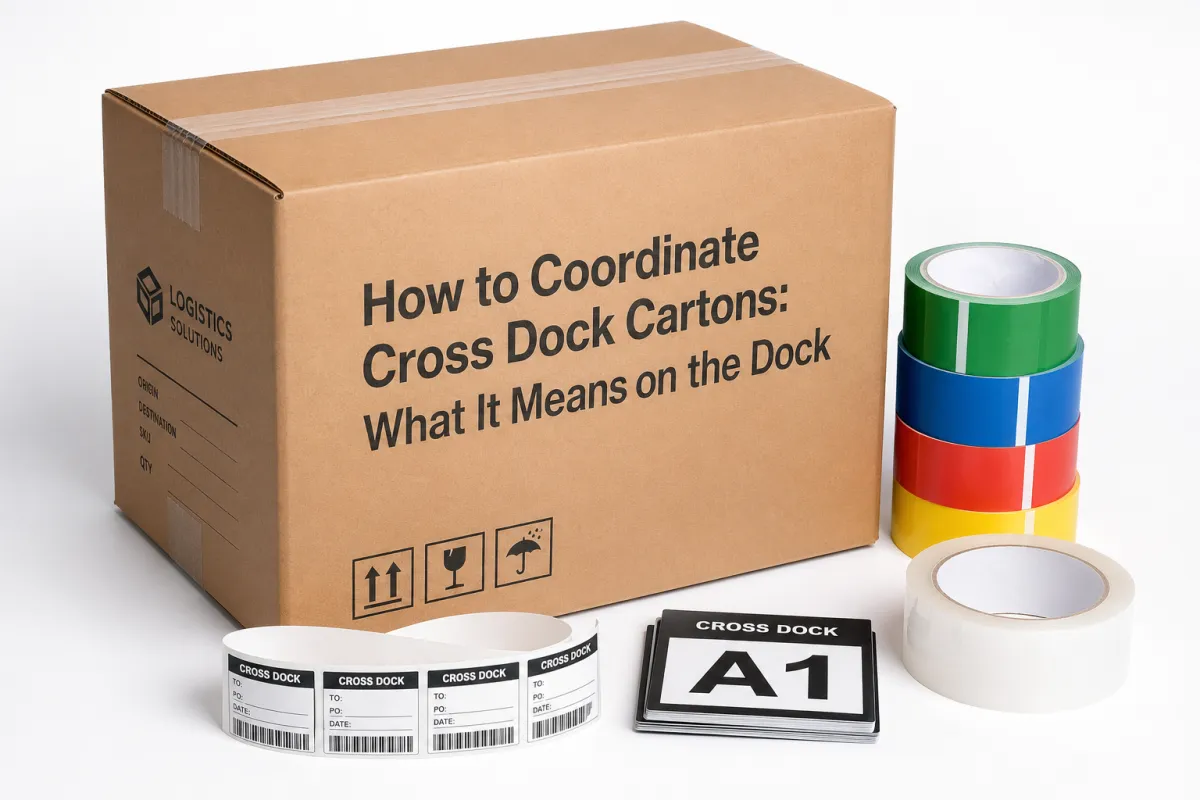
Cross-dock cartons are built for speed, not storage. That changes the rules pretty fast. A carton that would sit just fine on a warehouse shelf for a week can become a problem on the dock if the label rubs off, the board bows, or the destination code is hard to read from a forklift seat. People asking how to coordinate cross dock cartons are usually trying to remove friction between inbound and outbound movement.
The goal is straightforward: receive the freight, verify it quickly, and move it with as little handling as possible. Good coordination means the dock does not need to guess which pallet goes where, which route a carton belongs to, or whether a case has to be opened just to prove what is inside. The carton should carry the information the dock needs in a format that can be scanned, read, and trusted the first time.
That is a different job than general warehouse organization. A warehouse can absorb a little uncertainty because items can sit in location, get picked later, or be corrected in the next cycle. Cross-dock work does not have that cushion. The schedule is the control point. Carrier appointments, trailer availability, sortation capacity, and carton identification all have to line up. That is why how to coordinate cross dock cartons is as much a timing discipline as it is a packaging decision.
From a packaging buyer’s point of view, the carton is not just a container. It is part of the routing system. Wrong dimensions, weak print, or sloppy barcode placement slow down every downstream step. The box may still hold product, but it will not support the pace the dock needs.
If the label cannot be read in three seconds, the dock is already paying for it.
That sounds blunt because it is. Cross-dock labor is measured in seconds, not in the soft little minutes people pretend exist when a process is under pressure. The faster the team can confirm destination, sequence, and carton count, the less likely the load is to fall behind. Clean information beats heroics every time. Heroics also tend to be expensive, which is a cute little detail everyone notices after the fact.
How Cross Dock Cartons Move Through the Flow
The basic flow is easy to describe and annoying to keep clean every shift. A supplier shipment arrives, the receiving team checks the carton count and condition, the cartons are staged or sorted, and then they move to the outbound load. If that flow stays tight, how to coordinate cross dock cartons becomes a repeatable process instead of a daily scramble.
Receipt comes first. The dock team checks for obvious damage, verifies counts against the advance ship notice, and confirms that carton labels match the expected route or destination. A carton that is crushed, unlabeled, or carrying a barcode that will not scan should be pulled aside immediately. Letting exceptions drift into the main flow is how a small problem turns into a lane-wide delay.
Verification and quick sortation follow. Standard cartons should move straight toward their outbound lane. When the label format is consistent and the carton dimensions are predictable, the team can route them without opening the case. That is the real value of planning how to coordinate cross dock cartons well: fewer touches, fewer questions, and less chance of mixed freight getting pulled into the wrong trailer.
Staging is where timing and carton design meet. Consistent carton size helps the load build faster and hold together better. Mixed heights and odd footprints force the crew to rebuild stacks around awkward pieces, which slows the lane and makes the load less stable in transfer. A carton that stacks cleanly is not just convenient. It helps the whole dock move faster.
Outbound loading and handoff close the loop. Final counts, seal checks, trailer readiness, and departure timing all have to match the schedule. Successful coordination means the outbound crew gets cartons in the order they need, not in the order they happened to arrive. Sequence matters, especially for delivery routes with stop-off order or customer-specific handling rules.
In one facility I worked with, the receiving team had a habit of saying, “We’ll fix it at the trailer.” That only works right up until the trailer is gone or the dock is buried in mixed freight. After that, the fix becomes a lot less charming. The better habit is to stop the problem at the point of receipt, where it is still easy to isolate and correct.
Where relabeling or rework fits
Relabeling belongs at the exception point, not in the middle of the main lane. If a carton needs a new route label, a pallet ID, or a scan-friendly panel, move it to a controlled area, verify the destination, and correct it there. That one habit keeps how to coordinate cross dock cartons from turning into a guessing game. It also keeps the rest of the load from getting interrupted.
Packaging teams usually get the best results from the simplest carton design. Clear top-panel print, high-contrast destination text, and barcodes placed where they stay visible after stretch wrap or banding make a real difference. If the dock has to hunt for data, the carton is working against the operation. Nobody wants to play scavenger hunt with freight.
Key Factors That Keep Cross Dock Cartons Aligned
Labeling gets the first round of attention, but it is not the whole story. How to coordinate cross dock cartons depends on a cluster of details working together: label placement, carton durability, size consistency, route communication, and visibility into priority. If one of those pieces slips, the operation slows down.
Label standards matter more than many buyers expect. Route codes, destination names, carton IDs, and barcode placement should follow one readable format. The label should not wrap over a seam, disappear under tape, or sit where a forklift operator has to twist the carton to read it. A label can look fine on a desk and still fail on the dock. Testing it in real handling conditions is the only version that counts.
Durability is the next practical issue. If cartons are moving quickly between trailers, dock plates, conveyors, and staging lanes, the board needs enough strength to survive the trip without collapsing. That usually means looking at corrugated board selection, edge crush resistance, and how the carton is glued or stitched. Weak cartons do more than damage product. They make people hesitate, and hesitation kills flow.
Pack consistency matters just as much. Mixed dimensions make it harder to build stable loads, especially when cartons have to be staged in sequence. A carton that is two inches taller or wider than the others can interrupt a clean stack and force the team to rebuild around it. Stable shipment profiles make how to coordinate cross dock cartons much easier to standardize.
Communication bridges planning and execution. Receiving needs to know what is arriving, shipping needs to know what is leaving, and the planner needs to know whether there is enough door space and labor to support the scheduled wave. If those teams work from different versions of the plan, cartons get misrouted or parked while someone untangles the instructions.
Inventory visibility still matters, even in a cross-dock setting. The cartons may not sit in storage, but someone still needs to know what is in the trailer, what is priority freight, and whether any service-level commitments are tied to a specific lane. Better visibility means better decisions, and better decisions keep the dock moving.
For teams that want a useful outside reference on performance testing, the International Safe Transit Association provides guidance on packaging test methods and distribution challenges at ista.org. That matters because how to coordinate cross dock cartons is not only about the dock layout; it is also about how the carton behaves under vibration, compression, and handling stress.
If fiber sourcing is part of your carton spec, chain-of-custody language may also matter. Certifications such as FSC can help support responsible material sourcing documentation, especially when cartons are printed for retail or customer-facing programs. More information is available at fsc.org.
How to Coordinate Cross Dock Cartons: Step-by-Step Process and Timeline
The best cross-dock operations work from a sequence, not a reaction. How to coordinate cross dock cartons starts before the truck arrives, because the carton spec, label format, and carrier window should already match the route plan. Waiting until the freight is on the dock leaves almost no room for fixes. That is how minor issues become someone else’s emergency.
1. Set carton rules before release. Confirm carton size, board grade, print content, barcode location, and any customer-specific handling notes before the shipment is released. If a lane needs cartons that stack on 40 x 48 pallets or has a maximum cube restriction, that should be set in advance. This is where how to coordinate cross dock cartons saves the most labor, because it prevents avoidable exceptions from showing up on the floor.
2. Check the appointment and route plan. Before the inbound truck lands, the receiving team should know the expected carton count, destination mapping, and outbound carrier window. A live appointment schedule is not a nice-to-have in cross-dock work. It is the operating map. If the outbound lane is not ready, cartons may need to be held in a controlled staging area rather than pushed into a crowded aisle.
3. Receive and verify quickly. As soon as the cartons hit the floor, scan or inspect them, compare counts to the ASN, and separate damaged or mislabeled units. This is the moment where how to coordinate cross dock cartons becomes visible. A clean receiving pass means the team can move standard cartons straight through without stopping to investigate every piece.
4. Stage by route, trailer, or stop order. Group cartons so the outbound crew can load them in the correct sequence. If there are multiple customers or delivery points on one trailer, stop order matters. A carton for the last stop should not be buried behind the first stop if the route requires selective unloading later. That sounds obvious, and yet docks still manage to do the opposite on a regular basis.
5. Finish with count and departure checks. Confirm the final carton count, verify the trailer seal if one is used, and document the handoff time. That closes the loop and helps everyone see whether the plan held. In many operations, the missed details are not dramatic. They are small count mismatches, a label that peeled up, or a trailer that left five minutes before the lane was ready. Good coordination catches those misses before they spread.
One timing habit helps a lot: build a short pre-arrival window, a fast verification window, and a fixed handoff window. That three-part rhythm keeps the dock from trying to do everything at once. It also makes training easier, because new team members can remember the sequence without memorizing a dozen exceptions.
For carton specification work, I usually recommend documenting the following in one place:
- Carton size and board grade for each lane or customer group
- Label format including route code, barcode type, and print location
- Acceptance rules for damage, overhang, and rework
- Carrier appointment time and staging deadline
- Exception path for relabeling, repacking, or hold decisions
That level of clarity sounds basic because it is basic. Basic rules are exactly what keep how to coordinate cross dock cartons stable under pressure.
Cost and Pricing Considerations for Cross Dock Cartons
Cost gets discussed as if the carton price is the whole story, but in cross-dock work the cheaper carton can become the expensive choice once labor and delays get counted. How to coordinate cross dock cartons changes the real cost structure because every exception adds touches, and every touch adds time.
The main cost drivers are usually board strength, print complexity, label application, order variation, and exception handling. A plain carton with one-color print may be economical for a stable lane, while a carton with multiple destination panels, high-contrast labeling, or custom inserts will cost more upfront. That extra spend can still make sense if it prevents repacking or cuts down misroutes.
Here is the simple version: if a stronger carton saves two minutes of labor, avoids one damaged unit, and helps the dock make the trailer window, it may be cheaper overall even if the unit price is higher. How to coordinate cross dock cartons is really about comparing packaging cost against operational cost, not just comparing vendor quotes line by line.
| Carton Option | Typical Unit Cost | Best Use | Main Tradeoff |
|---|---|---|---|
| Standard corrugated carton with simple print | $0.18-$0.28 per unit at 5,000 pieces | Stable lanes with low label complexity | Less support for rough handling or mixed routing |
| Reinforced carton with higher board strength | $0.26-$0.42 per unit at 5,000 pieces | Heavier product, longer transfer paths, higher crush risk | Higher material cost, slightly more storage cube |
| Preprinted carton with route-specific labeling zones | $0.30-$0.55 per unit at 5,000 pieces | Multi-lane cross-dock programs with frequent scanning | More setup and tighter forecast requirements |
| Carton plus applied label pack | $0.22-$0.38 per unit plus labor | Programs where route data changes often | Added labeling labor and higher exception risk |
These are planning ranges, not universal quotes. Print coverage, flute selection, case count, and lead time all change the number. Still, they are useful for budgeting because they show how the packaging choice affects the dock outcome. How to coordinate cross dock cartons is not just a receiving problem. It is a packaging and procurement decision that reaches into labor, damage, and service-level performance.
There is also a hidden cost in missed trailer windows. If cartons are not staged correctly, the dock may need to hold them for the next departure, pay for extra handling, or absorb chargebacks tied to late delivery. That is where a lower unit price can turn into false economy. A carton that looks inexpensive on the PO may cost more once the freight gets delayed.
If you are deciding between carton options, ask a few practical questions:
- Will the carton survive the actual handling path, not just the inbound ride?
- Can the label be read at speed, under dock lighting, and after stretch wrap?
- Does the carton stack well with the rest of the outbound load?
- How much labor does each exception add when how to coordinate cross dock cartons breaks down?
- Is the supplier quoting carton price only, or carton price plus the cost of repacking and relabeling?
Those questions usually reveal where the money is going. In many cases, the better coordination plan is not more expensive overall. It is just more honest about the cost of poor flow.
Common Mistakes When Coordinating Cross Dock Cartons
Inconsistent labeling is one of the biggest mistakes. A carton may arrive with the right product but the wrong destination format, a faded barcode, or a label placed on the wrong panel. That small inconsistency can stall the dock because nobody wants to guess. How to coordinate cross dock cartons depends on information the team can trust without interpretation.
Vague routing instructions cause trouble too. If the advance ship notice is incomplete or the lane change happened late in the day without updating the receiving team, cartons get parked in the wrong area. By the time the mistake is found, the outbound window is already shrinking. The fix is not more chaos control after the fact. It is cleaner pre-arrival communication.
Overpacking and underpacking both create trouble. Overpacked cartons may bulge, split, or fail stacking tests. Underpacked cartons can crush easily and leave voids that make the load unstable. In a cross-dock setting, where time is tight, neither problem is easy to solve on the fly. If how to coordinate cross dock cartons is going to work, carton fill and board strength need to match the product weight and the handling path.
Timing errors show up all the time. Inbound freight may arrive early and crowd the floor, or the outbound trailer may move up and leave less time for staging. Either way, the carton plan and the dock schedule drift apart. A good process keeps a live eye on both sides of the move, not just the arrival side.
Ignoring exceptions causes another layer of pain. A few unlabeled cartons, a damaged corner, or one pallet built too high can seem minor until it blocks the lane. The safest move is to isolate the exception immediately, confirm the facts, and keep the main flow moving. That discipline is one of the simplest ways to improve how to coordinate cross dock cartons without adding complexity.
Here are the failures I see most often in practical terms:
- Labels placed where scanners cannot see them quickly
- Carton sizes that vary too much for clean stacking
- Late routing updates that never reach the dock floor
- Mixed freight staged together without clear separation
- Damaged cartons left in the active lane instead of being pulled aside
Each one is fixable. None of them requires a total overhaul. Most of the time, how to coordinate cross dock cartons improves when teams tighten a few ordinary details and stick to them consistently.
Expert Tips and Next Steps for Better Coordination
If a team wants better results fast, I would start with a carton audit. Look at the carton spec, the label position, the route instructions, and the handling path for the next shipping cycle. That one review usually exposes the gap between what the packaging says and what the dock actually needs. How to coordinate cross dock cartons improves quickly when the carton design matches the physical flow.
A second useful step is building a short dock checklist. Keep it practical: count, damage, label, lane, trailer readiness. That is enough for most operations to catch the most expensive mistakes before they spread. A checklist will not fix a weak carton by itself, but it will make the weak spots visible sooner.
Documenting exceptions is another habit that pays off. If the same lane keeps generating relabeling, if a certain carton size keeps tipping, or if one customer’s instructions keep changing at the last minute, write it down and treat it as a recurring issue. That is how how to coordinate cross dock cartons moves from reactive cleanup to steady improvement.
Test one change at a time. Standardize one carton size. Change one label format. Update one lane’s staging rule. If too many variables change at once, nobody knows which fix worked. Small, controlled changes are easier to verify and easier to train.
From a material standpoint, a carton spec should support the handling reality. That can mean stronger board, cleaner print, or a label panel that remains readable after tape and banding. It can also mean using a more disciplined print file so the same layout appears on every run. In a cross-dock environment, consistency is an operational asset.
Keep the coordination loop tight between procurement, packaging, planning, and shipping. If one team changes the carton or the route code and the others find out too late, the dock ends up carrying the burden. That is exactly the kind of breakdown how to coordinate cross dock cartons is meant to prevent.
For custom logo cartons, the takeaway is simple. Better cartons are not just nicer-looking cartons. They are clearer, stronger, easier to scan, and easier to trust. When the carton supports the route, the dock moves faster and the team spends less time fixing avoidable problems.
How to coordinate cross dock cartons comes down to a few disciplined habits: set the spec before shipment release, confirm the route before arrival, stage by the outbound plan, and isolate exceptions before they spread. Get those pieces right and the carton stops being a source of confusion. It becomes part of the reason the dock runs on time.
Frequently Asked Questions
How do you coordinate cross dock cartons when inbound and outbound schedules change?
Use a live appointment and carton-status update process so the dock team knows which cartons are still on plan and which need rerouting. Keep exception cartons separate from standard flow so one delay does not slow the entire transfer lane. That is the most reliable way to keep how to coordinate cross dock cartons under control when schedules shift.
What carton features matter most for cross dock operations?
Clear labels, consistent sizing, durable board strength, and easy-to-scan placement matter most because they speed handling and reduce errors. Cartons should also stack predictably so outbound loads stay stable during short dwell and transfer. Those features are the backbone of how to coordinate cross dock cartons without extra rework.
How can cross dock carton coordination reduce costs?
Good coordination reduces rework, repacking, damage, and missed departures, which are often the biggest hidden costs on the dock. Standard cartons and cleaner routing instructions also lower labor time per shipment. In many programs, that makes how to coordinate cross dock cartons a cost-control strategy as much as an operational one.
What is the best process timeline for cross dock cartons?
Plan carton specs and labels before shipment release, confirm arrivals before the inbound truck lands, and stage cartons by outbound route as soon as they are received. Finish with a final count and departure check so the handoff stays aligned with the carrier window. That sequence gives how to coordinate cross dock cartons a repeatable structure.
How do you fix mislabeled or mixed cross dock cartons quickly?
Pull exceptions into a separate area, relabel only after verifying the correct destination, and notify both receiving and shipping teams immediately. Do not release ambiguous cartons back into the main flow until they are confirmed. That is the safest correction method when how to coordinate cross dock cartons breaks down on the floor.
Related packaging resources
Use these related guides to compare specs, costs, quality checks, and buyer decisions before making the final call.