Buyer Fit Snapshot
| Best fit | Edge Crush Test Packaging projects where brand print, material claims, artwork control, MOQ, and repeat-order consistency need to be specified before quoting. |
|---|---|
| Quote inputs | Share finished size, material target, print colors, finish, packing count, annual reorder estimate, ship-to region, and any compliance wording. |
| Proofing check | Approve dieline scale, logo placement, barcode or warning zones, color tolerance, closure strength, and carton packing before bulk production. |
| Main risk | Vague material claims, crowded artwork, missing packing details, or unclear freight terms can make a low unit price expensive after revisions. |
Fast answer: Edge Crush Test Packaging: Quote Scope, Sample Proof, MOQ, and Lead Time should be specified like a repeatable production item. The safest quote records material, print method, finish, artwork proof, packing count, and reorder notes in one written spec.
Production checks before approval
Compare the actual filled-product size with the drawing, then confirm tolerance on folds, seals, hang holes, label areas, and retail display edges. Reserve space for logos, QR codes, warning copy, and material claims before decorative graphics fill the panel.
Quote comparison points
Review material grade, print process, finish, sampling route, tooling charges, carton quantity, and freight assumptions side by side. A quote is only useful when the supplier can repeat the same color, closure quality, and packing count on the next order.
If you have ever bought boxes by weight alone, you already know how that story ends. Heavy does not automatically mean strong. That is exactly why what is edge crush test packaging matters. It gives you a real way to judge whether a corrugated box can handle stacking, transit, and warehouse pressure without guessing. And guessing is a great way to pay for broken product twice.
For Custom Logo Things, this choice touches both product packaging and shipping costs. The right spec protects your goods, supports your package branding, and keeps your Custom Printed Boxes from turning into expensive overkill. The wrong spec? You pay extra for fiber and still get crushed corners. Nice trade. If you are asking what is edge crush test packaging, you are really asking how to buy the right strength without wasting money.
"The box looked sturdy until the pallets started stacking."
People say things like that after the damage shows up. Not before. I have heard it more than once from buyers who trusted a sample carton that survived a quick hand squeeze and then failed in a warehouse under real load. In practice, what is edge crush test packaging is less about a lab number and more about whether a carton can keep its shape when a warehouse worker stacks six more cases on top of it, or when freight sits in a humid trailer for three days. If you sell retail packaging, ship Direct to Consumer, or palletize by the case, this spec deserves a seat at the table before production starts.
What Is Edge Crush Test Packaging?
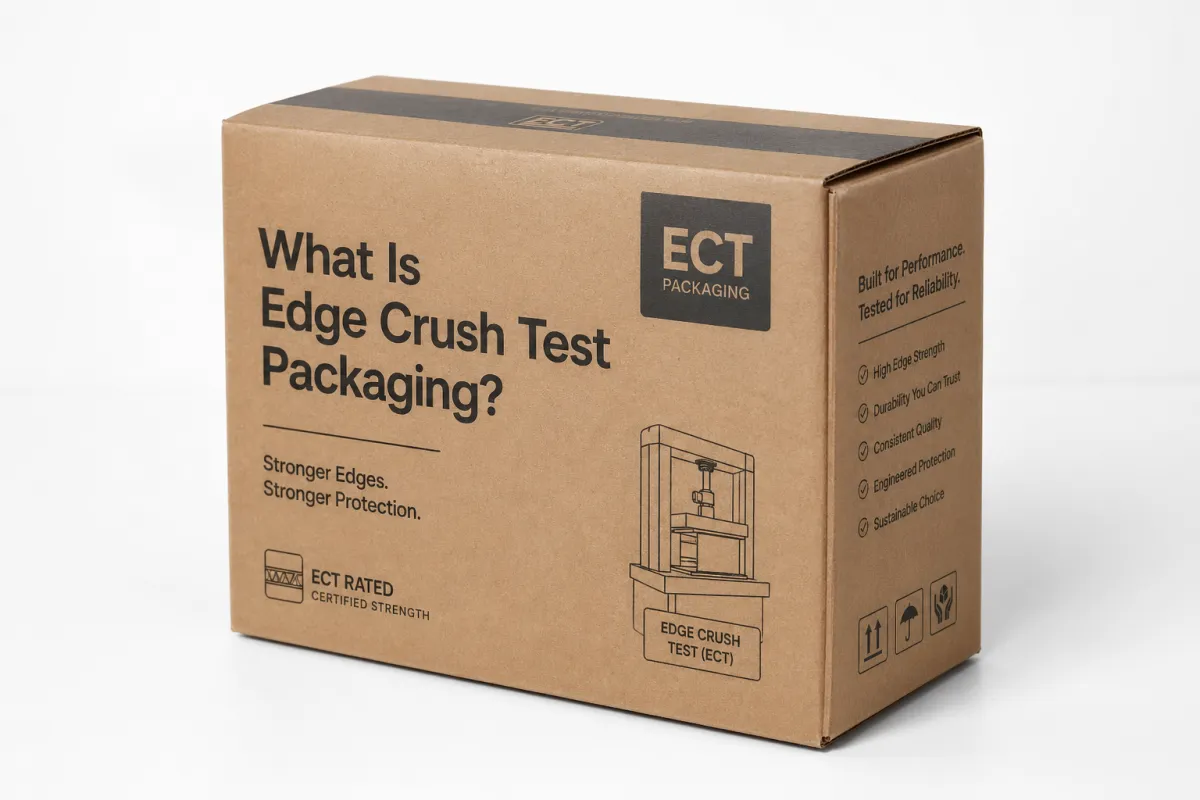
What is edge crush test packaging? Plain answer: it measures how much force the edge of corrugated board can take before it buckles. The test looks at the board itself, not the finished carton, and the result helps predict how well a box may resist vertical compression. That matters because most packaging failures are not dramatic explosions. They are slow crush failures under stacks, pallets, and bad storage habits.
The method is simple. A corrugated strip is placed on edge and compressed until it fails. The result is the ECT value, usually listed in pounds per inch or another equivalent metric depending on the market. A higher value generally means better stacking resistance. It does not make the box bulletproof. It means the board can take more edgewise load before it starts to fold, which is exactly what you want when cartons are stacked in a warehouse or loaded into a trailer.
For buyers, what is edge crush test packaging is useful because it gives a spec you can compare across suppliers. Instead of saying, "This box feels strong," you can say, "I need a 32 ECT or 44 ECT for this load case." That difference matters. One is a hunch. The other is a buying decision. It also gives you a clearer way to compare corrugated board, stacking strength, and compression resistance before you place an order.
For common shipping boxes, you will often see specs like 32 ECT, 44 ECT, or higher. Those numbers are not decoration. They help match box strength to the job:
- Single-carton parcel shipping often needs less stacking strength than palletized freight.
- Warehouse storage increases compression risk because cartons sit under load for longer periods.
- Retail-ready packaging may need a balance of print quality, display appeal, and structure.
- Heavy or dense products need careful sizing because load distribution matters as much as board grade.
That is why what is edge crush test packaging is not just a technical phrase. It is a filter. If the boxes are too weak, they fail early. If they are too strong, you burn money on material, freight, and converting. The sweet spot usually sits somewhere in the middle, and that middle depends on product weight, carton dimensions, and how the goods actually ship.
For packaging buyers, this spec matters a lot for Custom Printed Boxes and branded cartons. Print coverage and nice graphics are fine, but they should not push the carton into a weaker build than the shipping route can handle. Strong design means the box looks good and survives the trip. Wild idea, I know.
One thing I tell teams early: an ECT label is not a shortcut around real testing. It is a starting point. If the load is odd, the route is rough, or the box gets re-used in the supply chain, you still need to verify the carton in context. A tidy spec sheet is helpful. A crushed shipment is not.
How Edge Crush Test Packaging Works
What is edge crush test packaging in the lab? A narrow strip of corrugated board is compressed edgewise until it buckles. The test measures the force required to crush the edge, and that number becomes the ECT rating. It is a simple test, but simple does not mean useless. In packaging, simple metrics are often the ones buyers can actually use.
The board is not tested as a finished carton. That matters. A completed box adds glue joints, folds, scores, and cutouts, all of which affect strength in different ways. So an ECT rating tells you the board's compression resistance, while the finished box strength depends on the board plus the structure around it. That is why what is edge crush test packaging helps, but does not tell the whole story.
There is also a difference between edge crush strength and burst strength. Burst strength measures resistance to rupture or puncture from pressure in a different direction. ECT is usually more useful for stacking and compression. Burst can still matter for rough handling, but for warehouse stacking and pallet loads, ECT is usually the more practical metric.
Here is how the numbers get used in real buying decisions:
- Board is selected based on the load the carton needs to support.
- Box dimensions are matched to the product so void space does not waste strength.
- Closure style is chosen to keep seams from splitting under pressure.
- Shipping method is considered, because parcel, LTL, and palletized freight treat boxes differently.
If your shipments move through parcel carriers, do not rely on a single lab number and call it done. Testing protocols such as those published by ISTA help show how packaged goods behave under drop, vibration, and compression conditions. That is a better reality check than staring at a carton spec sheet from a safe distance.
What is edge crush test packaging also explains why a board spec and a finished box spec are not the same thing. The board may test well, but a weak score line, oversized blank, sloppy glue line, or badly designed die-cut can drag performance down after converting. In plain English: the board can be strong and the carton can still act like a mess.
For buyers, the point is simple. What is edge crush test packaging turns board performance into a business decision. It helps you choose a carton that can hold load without defaulting to the thickest board on earth. That usually saves money, especially at scale. It also keeps your package branding honest, which is a polite way of saying the box still has to work after the design team finishes with it.
Key Factors That Change ECT Performance
What is edge crush test packaging worth if the carton fails in the real world? Not much. ECT performance changes because corrugated is a material system, not a single magic layer. Board composition, flute type, liner quality, box size, and environmental exposure all affect how much strength survives from paper mill to shipping dock.
Board construction matters first
The biggest driver is the board itself. Stronger liner, a better flute profile, and good bonding between layers all improve the final result. Single-wall board behaves differently from double-wall board, and the difference is not just thickness. A 32 ECT single-wall carton can work well for many lighter shipments, while a heavier load may need 44 ECT or a double-wall build. That is the core logic behind what is edge crush test packaging: match the board structure to the load, not to instinct.
Flute type matters too. Larger flutes can offer better cushioning, while smaller flutes may print more cleanly and stack differently. That creates tradeoffs between retail appearance and compression behavior. If you are trying to combine retail packaging with shipping strength, the board spec has to support both jobs, or else the package branding looks great right up until the pallet starts leaning.
I have seen teams choose a beautiful print spec and then act surprised when the carton performs like a display piece instead of a shipper. That is not a printing problem. It is a packaging brief problem.
Size and load change the math
Box size is not a side note. Bigger cartons have more surface area, so they can flex more under load. Smaller cartons can often support stacking better, but they may concentrate force if the product is dense or oddly shaped. Product weight matters just as much. A light box with bad stacking geometry can fail sooner than a heavier box with a better load path. That is why what is edge crush test packaging should always sit next to dimensions and packed weight, not live on its own.
In real shipping, the carton has to survive whatever sits on top of it. Warehouse pallets are usually stacked in layers, and the lower layers take the most abuse. If the load goes through line haul freight, transfer points, or long dwell time in a distribution center, compression risk climbs fast. A box that looks fine in the office can collapse after 48 hours under load. Paperboard loves that kind of irony.
Humidity and handling are the silent killers
Humidity softens corrugated board. So does rough handling, especially when corners get dented or seams get stressed during packing. Hot trailers, damp warehouses, and long transit times can all reduce actual performance. In those conditions, a spec that was barely enough on paper can become a failure in practice. The Environmental Protection Agency has plenty of material on waste reduction and source reduction at EPA, and packaging buyers should care because overbuilt and failed cartons both waste fiber, time, and money.
What is edge crush test packaging really measuring, then? Part of the answer. The rest comes from how your product is packed, how long it sits, and whether your operation treats corrugated like a structural material instead of a disposable afterthought. That sounds obvious. Somehow it still gets ignored a lot.
One more thing: print coverage and structural cuts can affect performance too. Large windows, heavy die-cuts, oversized hand holes, and aggressive branding layouts can reduce usable fiber in the panel. That does not mean you should avoid strong package branding. It means the structure and the artwork need to respect each other. Good packaging design is visual and structural at the same time.
Edge Crush Test Packaging Cost and Pricing
Here is the part most buyers care about after the first quote lands: what is edge crush test packaging going to cost me? The honest answer is that the spec alone does not set the price. Board grade, flute structure, print coverage, size, order quantity, and converting complexity all change the final number. Still, ECT is one of the best places to look for savings because the right spec can reduce material use without increasing damage.
A lot of people assume stronger board always costs more. Sometimes it does. Sometimes a smarter structure saves money because you can reduce unnecessary thickness or avoid double-wall overkill. The real comparison should include the box price, freight, damage claims, returns, repacking labor, and the time your team loses dealing with broken cartons. That is where what is edge crush test packaging starts earning its keep.
Below is a practical pricing comparison for common corrugated options. These are typical packaging-only ranges for mid-size production runs, often around 5,000 units, and they move with size, print coverage, and market conditions.
| Option | Typical Use | Estimated Unit Price | Tradeoff |
|---|---|---|---|
| 32 ECT single-wall | Light to moderate shipping, retail cartons, lower stack loads | $0.25-$0.60 | Lowest material cost, but limited margin for heavy stacking |
| 44 ECT single-wall | Heavier product packaging, warehouse storage, palletized cases | $0.32-$0.78 | Better stacking resistance, usually a safer default for freight |
| 48-51 ECT single-wall | More demanding transit, heavier contents, longer dwell time | $0.40-$0.95 | Higher material cost, but less risk of crush-related claims |
| Double-wall corrugated | High stack loads, rough handling, bulky or dense products | $0.90-$1.85 | Stronger, but often unnecessary if the load case is modest |
What is edge crush test packaging doing in a pricing table? It helps you compare apples to apples. If one supplier quotes a 32 ECT carton and another quotes a 44 ECT carton at a different size, that is not a real comparison. Same dimensions, same closure style, same print coverage, same shipped quantity. Anything else is just decoration.
For branded packaging and custom printed boxes, artwork complexity can push cost up fast. Full bleed print, specialty coatings, heavier ink coverage, or multiple design passes all add time and money. Die-cuts, inserts, and custom features do the same. If you want the carton to look premium and still survive shipping, the smarter path is often a balanced spec with a simple build instead of a flashy overbuild.
That is why buyers should request quotes with the same assumptions every time. I would ask for:
- Exact internal dimensions with tolerances called out.
- Target ECT rating or an alternate board grade if the supplier recommends one.
- Print coverage, including number of colors and whether the design is full bleed.
- Quantity breakpoints so you can see whether price drops at 2,500, 5,000, or 10,000 units.
- Shipping method, because palletized freight and parcel shipping can justify different specs.
If you are reviewing options for a product line, it helps to look at Custom Packaging Products early in the process. That makes it easier to connect structure, print, and budget before you lock in a spec that looks good on paper and awful on the invoice.
One more thing. What is edge crush test packaging worth if the supplier cannot explain the tradeoff between weight, strength, and cost? Not much. Good packaging quotes should explain why a lighter carton still works, or why a stronger one is justified. If the quote is vague, the build usually is too.
Step-by-Step Process and Timeline
What is edge crush test packaging if you are actually buying cartons? It is a specification process. You define the product, the shipping path, the load, and the branding requirements, then the supplier recommends a board structure and box style that can hold up. Good suppliers do not start by asking what color you want. They start by asking what the box has to survive.
Here is the usual workflow when a buyer wants a custom corrugated spec:
- Collect product data - weight, dimensions, fragility, and whether the product ships unit by unit or by the case.
- Define the shipping route - parcel, LTL, palletized freight, retail distribution, or mixed use.
- Set the strength target - ECT rating, burst strength reference, or a structural recommendation from the supplier.
- Review the box style - regular slotted carton, die-cut, mailer, retail-ready tray, or another format.
- Approve a sample - check fit, print alignment, and actual compression behavior before full production.
That workflow sounds obvious, yet people still skip steps. They send a product photo and ask for "something stronger." Stronger than what? The answer matters. What is edge crush test packaging supposed to solve if the supplier does not know the product weight, pallet pattern, or transit conditions? It cannot solve a mystery with no clues.
Here is a realistic timeline for most custom jobs:
- Spec review: 1-2 business days if the buyer sends complete dimensions and usage details.
- Sample build or prototype: 3-7 business days for standard structures; longer for complex die-cuts.
- Internal testing and revisions: 2-5 business days depending on how many adjustments are needed.
- Final production: often 10-15 business days after approval for standard runs, with longer timelines for heavy print coverage or larger volumes.
If your box must survive parcel handling, ask for a real package test instead of a pretty mockup. The value of what is edge crush test packaging goes up when you pair it with compression, drop, and vibration checks. If your supplier can tie the build to common ASTM or ISTA test logic, even better. A box that only works in a perfect demo is not a shipping solution. It is a slideshow.
One practical way to move faster is to send complete information up front. Include:
- Product weight and dimensions
- Carton internal dimensions
- Number of units per box
- Stacking height or pallet count
- Carrier type and shipping distance
- Any retail display or branding requirements
The more complete the brief, the less back-and-forth. That matters because every revision costs time. And yes, it is irritating when a two-line request turns into twelve emails because the buyer forgot to mention the product weighs 18 pounds and the cartons stack seven high. What is edge crush test packaging supposed to do with missing data? Guessing is not engineering.
Common Mistakes With ECT Packaging
What is edge crush test packaging good for if people keep using it badly? Preventing that is half the fight. The biggest mistakes are rarely technical. They are usually buying mistakes. Someone picks a box by feel, compares specs without matching the use case, or ignores the environment the carton actually lives in. Then they act surprised when the math behaves like math.
The first mistake is choosing a carton because it "feels sturdy." That is not a spec. It is a sensation. A box can feel solid in your hands and still be wrong for stacking, especially if the product is heavy or the box goes on a pallet for several days. The second mistake is comparing ECT numbers without matching dimensions. A smaller box with the same ECT rating can outperform a larger one simply because geometry changes load behavior. What is edge crush test packaging supposed to tell you? The answer depends on the full package, not just the board label.
The third mistake is ignoring humidity and transit abuse. Corrugated loses strength as moisture rises. Corners get crushed. Seams take stress. Pallet loads shift. A carton that was barely acceptable in dry conditions can become a failure after one damp warehouse cycle. If your boxes move through seasonal storage, coastal shipping, or uncontrolled distribution centers, leave margin in the spec.
The fourth mistake is over-specing because bigger numbers sound safer. Sometimes they are. Often they are just expensive. Paying for double-wall board when a single-wall 44 ECT box would do the job is not good packaging. It is cardboard theater. The box gets the trophy for toughness, and your budget gets the bill.
Here are a few signs that your spec needs another look:
- The box survives one sample test but bows under real stacking load.
- The corners crush before the panel fails.
- The product is light, yet the carton uses heavy board because nobody reviewed the actual load path.
- The print looks great, but the die-cut reduced the usable board area too far.
- The supplier quoted one ECT rating, but the dimensions changed later without a fresh check.
That last point is sneaky. A small change in carton size can alter performance more than people expect. If you are buying product packaging for a full line, make sure changes to fit, insert size, or pallet pattern get reviewed before production. What is edge crush test packaging if not a tool for preventing avoidable loss? It works best before the first bad shipment, not after the complaints start.
Another mistake is forgetting that branding and structure need each other. Some teams chase a cleaner look by reducing board weight or opening up large display areas, then discover the carton no longer supports the shipping load. Good package branding does not require weak structure. The best results usually come from a clear brief: protect the product, meet the shipping conditions, and then make the box look like your brand.
I am not gonna pretend every product can live happily in the same board grade. A skincare set, a dense countertop appliance, and a case of canned goods do not behave the same way. Treat them like they do and you will end up reordering boxes. That part is on the spec, not the carrier.
What Is Edge Crush Test Packaging? Next Steps
If you want the shortest possible answer to what is edge crush test packaging, here it is: it is a practical way to choose Corrugated Boxes That can handle stacking and shipping pressure without overbuying board. The real value comes from matching the ECT spec to the product weight, box size, and shipping path. That is the difference between a smart purchase and a costly carton habit.
Before you request quotes, write down the basics:
- Product weight and whether the load is evenly distributed.
- Carton dimensions and whether the box is a shipper, mailer, or retail display piece.
- Stacking load or pallet height in warehouse storage.
- Shipping method and expected transit time.
- Branding requirements such as print coverage, color count, and finish.
Then ask for the box spec in writing. A good quote should include ECT rating, board construction, box style, size, and any testing assumptions. If a supplier gives you only a price and a smiley face, keep moving. Good packaging decisions need numbers. You are not shopping for a horoscope.
I also recommend testing a sample carton under real conditions. Fill it with the actual product. Stack it. Drop it. Leave it under load. Watch what fails first. That is where what is edge crush test packaging becomes useful in practice, because the sample tells you whether the spec is strong enough for your own operation, not some idealized lab version of it.
For buyers comparing Custom Packaging Products, the best outcome is usually the lowest safe spec, not the biggest number. If a 32 ECT box handles the load, buy the 32 ECT box. If a 44 ECT box is the minimum that keeps corners alive in transit, pay for the 44 ECT box. The goal is not bragging rights. The goal is fewer damaged goods, fewer returns, and less waste in your custom printed boxes.
That is the practical answer to what is edge crush test packaging: choose the lightest carton that still survives the full load path, then verify it with sample testing before you commit to volume. Keep the spec tied to reality, because reality is where the boxes actually live.
If you are building a new SKU or fixing an existing one, start with the carton that survives the worst part of the trip, not the prettiest part. That one decision usually saves more money than chasing a lower unit price ever will.
What is edge crush test packaging used for in shipping?
It helps estimate how well a corrugated box will hold up under stacking and compression during storage or transit. It is most useful for palletized loads, warehouse storage, and shipping cartons that need predictable strength without oversized board.
Is edge crush test packaging better than burst strength packaging?
Usually, yes, if your main concern is stacking and vertical compression. Burst strength focuses more on puncture and rupture resistance, while ECT is more useful for pallet loads and warehouse performance. The better choice depends on how the box is used, not which metric sounds tougher.
What ECT rating do I need for my box?
Start with product weight, carton dimensions, and how many boxes will stack on top of each other. Then ask a packaging supplier for a recommendation based on the actual shipping path. A sample packout test is still the best check, because the right rating depends on the full package, not just the board spec.
How much does edge crush test packaging cost compared with heavier board?
A higher ECT box is not always more expensive if it uses a smarter board structure or less unnecessary material. The true cost comparison includes freight, damage claims, returns, and repack labor. Ask for quotes with the same dimensions and usage case so you can compare true cost per shipped unit.
How do I test whether my edge crush test packaging is strong enough?
Run compression, drop, and stacking tests with fully packed cartons, not empty samples. Check whether corners crush, seams split, or the board bows under load before you approve the spec. If the box only survives perfect conditions, it is not ready for real shipping. If you can say exactly what the load path is, what the carton weighs, and how it will stack, then what is edge crush test packaging becomes a practical buying tool instead of a random number.