Buyer Fit Snapshot
| Best fit | create brand identity packaging sticks for packaging buyers comparing material specs, print proof, MOQ, unit cost, freight, and repeat-order risk where brand print, material, artwork control, and repeat-order consistency matter. |
|---|---|
| Quote inputs | Share finished size, material target, print colors, finish, packing count, annual reorder estimate, and delivery region. |
| Proofing check | Approve dieline scale, logo placement, barcode or warning zones, color tolerance, and any recyclable or compostable wording before bulk production. |
| Main risk | Vague material claims, crowded artwork, or missing packing details can create delays even when the unit price looks attractive. |
Fast answer: Create Brand Identity Packaging Sticks: Dieline, Finish, Proof, and Buyer Review should be specified like a repeatable production item. The safest quote includes material, print method, finish, artwork proof, carton packing, and reorder notes in one written spec.
What to confirm before approving the packaging proof
Check the product dimensions against the actual filled item, not only the sales mockup. Ask for tolerance on folds, seals, hang holes, label areas, and retail display edges. If the package carries a logo, QR code, warning copy, or legal claim, reserve that space before decorative graphics fill the panel.
How to compare quotes without losing quality
Compare board or film grade, print process, finish, sampling route, tooling charges, carton quantity, and freight assumptions side by side. A lower quote is only useful if the supplier can repeat the same color, closure quality, and packing count on the next order.
How to Create Brand Identity Packaging That Sticks sounds clean and simple until you put it under real-world stress: shipping, returns, store shelves, and impatient buyers. If you are trying to figure out how to create brand identity packaging, you are not designing a pretty jacket for a product; you are building the first piece of proof that the brand is reliable. A package has maybe three seconds to communicate trust, and then hours, days, and weeks to earn repeat purchase.
That is why I always separate this from decoration. Early in my consulting work, I reviewed a startup skincare launch where the founder spent a fortune on foil and complex textures for a mailer that got crushed on day one. The label was gorgeous, but the return rate told the whole story. The lesson was basic: a premium feeling starts with fundamentals, not effects.
If you want to get practical, browse Custom Packaging Products and compare what you might actually need versus what looks good in a mood board. Then cross-check a few campaigns on Case Studies where packaging had to survive warehouse handling, not just Photoshop.
Pretty packaging that fails in transit is not premium; it is a refund with better graphics.
The sections below stay close to how to create brand identity packaging in practice: design logic, cost, timeline, and the common traps that quietly erase strong ideas. The goal is not applause from the art department; it is packaging that is recognizable, practical, and stable enough to support the brand after unboxing.
What Brand Identity Packaging Actually Is and How to Create Brand Identity Packaging the Right Way
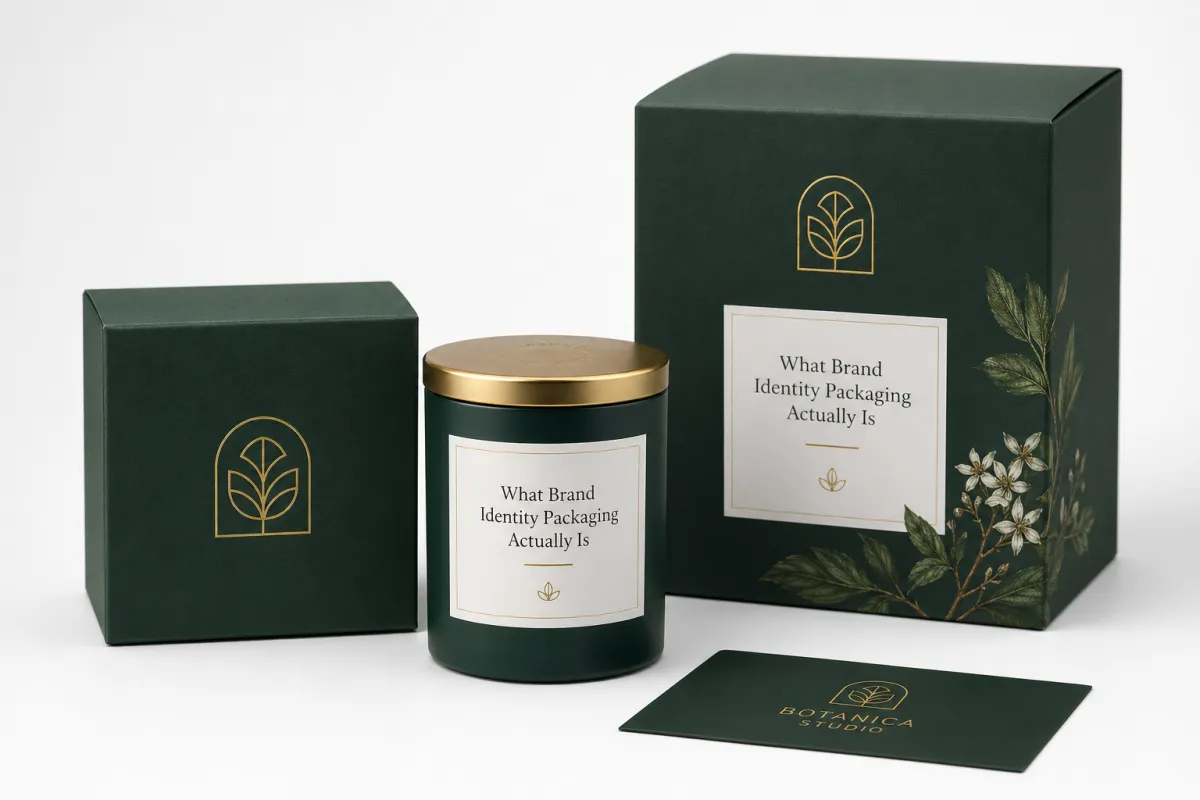
How to create brand identity packaging starts with a hard split: protective packaging does one job, brand identity packaging does two, maybe three. It protects the product, tells the brand story, and creates immediate recognition. A plain carton can protect. A branded package makes the protection part feel intentional.
Think of brand identity packaging as the physical expression of everything the brand says it is. Logo, color, typography, copy, material choice, and tactile feel move from the shelf or mailbox straight into the customer’s hand. It can show up as a mailer box, folding carton, rigid set-up box, sleeve, label, insert, or shipper. The design itself is secondary if the package does not behave consistently across touchpoints.
The biggest misconception is that design begins with beautiful artwork. It does not. The package job has to be mapped first: shelf visibility, subscription shipping, gifting, or retail replenishment. I still see teams fall in love with a mockup before the package function is defined, and that usually creates expensive revisions. Deciding the function first keeps the identity coherent when the budget gets squeezed.
Perception is the real engine here. A matte kraft mailer with one dominant color can outperform a metallic rigid format if the brand position is down-to-earth and utility-first. A glossy rigid format with foil and precise embossing may be perfect for a premium segment, but can feel off-brand for a high-volume daily-use category. Neither is universally right. Context decides.
Brand identity packaging should do one thing very well: reduce cognitive effort. If customers can identify your box shape, color block, and opening logic after one encounter, they are more likely to remember and choose you. That is the technical, psychological side of packaging strategy. It is also where many launches go wrong.
Quick definition, then done: how to create brand identity packaging means designing a consistent physical identity system that links structure, visuals, and handling behavior so the package looks and feels like the brand before the product is even used. It sounds neat because it is neat; execution is where it gets interesting.
How Brand Identity Packaging Works Across the Customer Journey
How to create brand identity packaging is easier when you trace the customer journey in order. A package enters at purchase intent, then enters shipping, then enters the door, then the unboxing, then storage, reposting, and memory. It keeps influencing perception long after the first day.
The first contact is usually outside: shipping mailer, outer box, or retail carton. A damaged, crumpled, or weakly printed exterior sends a negative signal before the consumer reaches the product. I learned this the hard way during a fulfillment audit where one supplier swapped paperboard quality and the brand voice dropped like a stone instantly. If it looks careless, trust follows.
Readability and hierarchy matter most in those first seconds. Strong packaging usually sticks to one primary color system and repeatable logo placement with type that can be read under fluorescent lights and from a short distance. This is not glamorous stuff, but it is what drives split-second decisions. Customers classify brands faster than they analyze them.
Tactile decisions are part of this first impression too. Soft-touch lamination creates a muted premium sensation. Embossing adds visual depth. Foil can create contrast, but if it is overused it looks like an effects list instead of a brand promise. A rigid insert with controlled tolerances can create a clean reveal and avoid the “thrown together” feeling. The difference shows up in repeat-order behavior and customer reviews.
At retention stage, the memory layer activates. People remember color, shape, and opening sequence. If those cues are stable, they can identify your package in a photo, in a cart, or in a subscription box while buying quickly. That repeatability is the foundation for brand recall, and it comes from strict consistency rules rather than one-off hero art.
There is also a social behavior layer. Good packages get photographed because people instinctively want to show what feels intentional. No one is promising “post this” behavior in ads; they post when the package feels good to hold and coherent to show. Packaging becomes an unpaid signal, but only if it holds together in real use.
For brands that ship heavily, how to create brand identity packaging includes testability. A design that passes desktop rendering and fails transit testing will not carry trust. ISTA methods are commonly used for impact, vibration, and drop performance in parcel logistics, so ask your manufacturer which protocol they will validate against. For sustainability-minded buyers, FSC-certified board is a stronger and more transparent argument than a vague “eco” badge.
The Key Factors That Shape Brand Identity Packaging
How to create brand identity packaging is never a single call. It is a matrix. Brand narrative, audience expectation, product fragility, channel, margin target, and legal obligations all move the result. Same logo, very different package behavior.
I have seen teams get this wrong by optimizing one variable and ignoring the rest. A premium look gets chosen for a low-ticket consumable, then distribution burns margin because the structure cannot hold the shipping volume. Another team chose minimalist finishes and saved money but lost category clarity because the material did not match the price point. The brand story and economics have to agree.
Material selection is the backbone. Corrugated (especially E-flute or B-flute in certain markets) is usually strong for shipping and abrasion tolerance. Folding cartons in 16–24 pt paperboard work well for lightweight retail use, with lower unit cost and easier assembly. Rigid boxes can feel premium and durable, but they usually increase shipping weight and handling costs. Kraft stock gives a natural, unpolished aesthetic; not Every Brand Should use it.
Print matters. Digital is often better for shorter runs, fast proofs, and quick edits. Offset often makes sense for larger quantities because color consistency and repeatability improve at scale. Flexographic print is common in corrugated and is often chosen for high-volume packaging where graphics are simple but repeated. For small runs, the setup cost can overshadow the actual print cost.
Finishing choices alter both perception and margin. Aqueous coatings, soft-touch lamination, spot UV, foil, embossing, and debossing each create a different optical and tactile effect. They also change die-cut complexity, drying profile, and waste. This is where teams can overfit the look and lose production stability. A single hero finish usually performs better than stacking four effects that fight each other.
Structure is equally critical. Tuck-lock and tuck-end boxes are easy to scale. Mailers are practical for direct-to-consumer. Inserts prevent movement and avoid damage claims. Sleeves add branding depth without replacing the primary structure. Custom geometry is memorable and often expensive, and it can slow manufacturing if your supplier has not run it before.
The tension is constant: aesthetics versus performance. If the structure is fragile, assembly is awkward, or stackability is poor, the packaging will cost more in returns and support tickets than it saves in visual novelty. That is why how to create brand identity packaging must be judged by both impact and operating cost.
How Do You Create Brand Identity Packaging Step by Step?
How to create brand identity packaging becomes manageable when you treat it as a system. In my own workflow, I begin with three things: existing brand standards, product constraints, and use-case assumptions. If those are fuzzy, the first production sample is usually a correction project, not a launch artifact.
Step one is brand audit. Pull the approved logo files, color definitions (Pantone or CMYK values), font permissions, tone-of-voice references, legal text requirements, and exact product dimensions. When these are incomplete, the team invents details and inconsistencies appear at print, usually too late. A strong system starts with clean inputs.
Step two is definition. Clarify package objectives: Is it for shelf presence, protective shipping, subscription renewal retention, premium gifting, or social unboxing? One format can cover multiple use-cases, but not all at the same level of excellence. That is why teams should prioritize one or two goals and design for them first.
Step three is structure, then graphics. Build the shell before the full art pass. If the dieline is wrong, no amount of art can fix fit, fold, or closure strength. You can do prototypes and user handling tests with a cleaner look later; you cannot reverse-engineer weak geometry into a premium feel.
- Audit the brand - finalize approved assets, specs, packaging claims, and legal text.
- Define the package job - shipping, retail display, fulfillment style, and retention objective.
- Choose the structure - mailer, folding carton, rigid box, sleeve, insert, or hybrid stack.
- Map the graphics - front, side panels, inside, labels, and copy hierarchy.
- Pick finishes - coat, foil, embossing, UV, matte, or none.
- Prototype early - test with actual product, not just screen renders.
After this, request dielines and structural drawings from your print partner. That document defines fold lines, glue areas, scoring, tolerance windows, and bleed. A 1 to 2 mm discrepancy can become a functional failure when assembled at volume. You will spend less rework if you respect the dieline before art polish.
Prototype hard and early. Put the real product in the sample pack. If this is a shipping pack, run a short internal drop test. Open it with cold hands, one hand, and in low light. Ask people who are not emotionally invested to interact with it. This often catches the “looks fine, but not usable” problems that designers miss.
For quick direction, compare format options side by side before deciding. Use Custom Packaging Products to evaluate whether your package should be a mailer, carton, sleeve, or combination, instead of trying to force-fit a format to your concept. Then, as a calibration exercise, study Case Studies where similar brands had to produce at scale.
One hard truth: how to create brand identity packaging is less an art sprint than cross-team coordination. Designers, prepress, sourcing, operations, and fulfillment teams need one single source of truth. If each team uses a different file version, the final pack can drift in fit or timing by days. On a 8,000-unit launch, that margin matters.
Small note from the field: if you are shipping regulated goods (food, medicine, supplements, or anything with safety warnings), I strongly recommend involving compliance and legal early. You can spend all your budget on aesthetics and still fail on labeling, barcode placement, recycling marks, or tamper evidence. I have seen campaigns stop at the last mile because one missing warning line cost a full reprint.
Brand Identity Packaging Cost: What You Actually Pay For When You Create Brand Identity Packaging
How to create brand identity packaging on budget starts with cost drivers, not emotional preferences. The top variables are material grade, structure, print coverage, finishes, order volume, and turnaround speed. If a quote does not show these clearly, ask for a breakdown and ask who is carrying the setup risk.
Quantity changes everything. A 500-unit job often looks expensive because setup costs are spread across fewer pieces. At 5,000 units, the same artwork can drop dramatically per unit. This is why unit cost and landed cost are separate and both need tracking. I tell teams to budget both before saying yes.
A practical way to spend money is with intention: invest in elements customers perceive (logo clarity, opening experience, protective insert logic) and trim from low-impact zones. Over the long run, this is often the difference between strong brand delivery and sticker-shock margin loss. A memorable package does not need maximum effects.
| Packaging Option | Typical Material | Approx. Unit Cost at 1,000 pcs | Best For | Tradeoff |
|---|---|---|---|---|
| Mailer Box | E-flute corrugated | $0.90-$2.20 | Direct-to-consumer shipping and unboxing experience | Strong, but premium finishes raise cost quickly |
| Folding Carton | 16 pt-24 pt paperboard | $0.25-$0.80 | Retail packaging, lightweight product packaging | Lower material cost, less protective on its own |
| Rigid Box | 1200 gsm chipboard wrapped in printed paper | $2.50-$6.50 | Luxury sets, gift packaging, high perceived value | Looks premium, but shipping and storage cost more |
| Mailer + Insert | E-flute corrugated with molded pulp or paperboard insert | $1.40-$3.60 | Fragile goods, kit packaging, repeatable presentation | Better protection, more tooling and design work |
Those numbers are directional, not universal. Prices move by board grade, print technology, die count, supplier location, freight lane, and seasonality. Still, this table is useful for conversations because it highlights the structural trade-off in plain terms. You can have a low-cost structure with premium visuals, but not always without constraints.
Hidden costs become decisive in phase two. Sampling cycles, freight, assembly labor, packaging storage, returns, and QA rework can erase a cheap quote very quickly. If your package is hand-assembled and your production is volume-heavy, labor can become the largest variable after raw materials. A landed-cost quote is the realistic benchmark, not only the unit quote.
Special finishes are best used where they improve clarity. A foil treatment on a logo can add precision and brand distinction. Foil on every edge, however, quickly looks performative. Spot UV on selected calls-to-action can add contrast and premium perception if used sparingly. If an effect does not improve recognition or durability, treat it as decorative debt.
If money is tight, choose one meaningful cue and keep the package disciplined. One strong color system, one typographic approach, and one structural cue can outperform four mixed-effects variants. That is often how teams actually execute how to create brand identity packaging without burning margin or confidence.
Brand Identity Packaging Process and Timeline: From Brief to Delivery
How to create brand identity packaging without timeline chaos depends on process hygiene. The sequence is straightforward at first: brief, structure, artwork, proofs, sampling, production, freight. In practice, revisions and material substitutions can loop back unexpectedly, so schedules should include checkpoints, not just end dates.
For straightforward projects with approved dielines, 12–15 business days from proof sign-off is a common window. Custom structures, multiple SKUs, foil or embossing, or split approvals can stretch to 20–30 business days plus shipping. Layer in freight and assembly and you quickly learn why “fast turn” is never truly one number.
Most delays are predictable: late copy edits, multiple internal approvals, material substitutions, and sample mismatches are all normal. Build buffers around those realities and the launch is less likely to become firefighting.
A practical milestone format:
- Week 1 - lock brand assets, dimensions, legal text, and target use cases.
- Week 2 - validate structure and dieline, then approve visual direction.
- Week 3 - review proofs, typography hierarchy, and finish selection.
- Week 4 - receive physical samples, test fit and shipping behavior.
- Week 5+ - final approval, production release, and freight booking.
That timeline is a flexible frame, not a strict playbook. If everything is standard, the process gets shorter. If you add inserts, coatings, and multi-color print, it gets longer. Planning backward from launch avoids false urgency and avoids weekend rewrites.
Testing points should stay mechanical, not emotional. Check panel strength, closure tolerance, barcode placement, contrast, color, and shipping load behavior. For fragile goods, choose an ISTA-relevant test path and use that result in your decision. Retail-only packages should also pass shelf wear checks and handling simulation. The point is to eliminate predictable field failures, not to win a trophy.
Define stop criteria before approval begins. A color drift inside tolerance is often acceptable; weak closure performance is not. A slight logo shift may be fixable; poor scans at point of sale are not. A shared checklist lowers arguments and keeps everyone focused on objective criteria when launch pressure rises.
Freight deserves equal weight. A perfect design delivered after campaign launch is technically a failure. That means freight lead time and cut-off dates must be in your timeline from day one. Logistics can be the last gate, and the most expensive one.
Common Mistakes, Expert Tips, and Next Steps
How to create brand identity packaging gets more reliable when you stop repeating common mistakes. The first is imitation. Too many brands copy successful category cues and end up sounding like every other brand in their lane. Distinction is what drives recall; mimicry gets you short-term familiarity and long-term invisibility.
Another pattern is overdesigning the surface and underdesigning the structure. Too many colors, effects, and copy options turn the package into noise. In several launches I reviewed, teams had to remove 30–40% of visual elements before they matched the brand promise. Restraint is often the premium move.
The third error is treating shipping as a separate problem. A package is not “designed” and then “shipped”; it is designed for a distribution reality. If insert walls are too thin, if flaps are weak, if print rubs off in humidity, customers notice quickly. It is a production issue before it is a design issue.
Here is a condensed habits list that keeps projects solid:
- Choose one primary visual driver - color, structure, or finish, and make everything support it.
- Keep exterior info legible - logo, product identity, and core message should be readable fast.
- Align inside and out - opening, messaging, and inserts should feel like one system.
- Use finishes to clarify - skip effects that do not improve perceived value or handling.
- Validate true cost early - samples, freight, and assembly define the actual margin.
- Test in real conditions - if you can’t pass real handling, you won’t pass customer reality.
Do not design for perfect studio conditions. Most people see packages from uneven angles, under mixed light, and while distracted. In that environment, clarity wins over cleverness. That is a small detail with big returns.
If you want a practical verification pass, run this quickly before final sign-off:
- Does the structure protect the product with normal handling and basic shipping stress?
- Does the graphic system match the promised brand tone on every panel?
- Are materials appropriate for shipping, retail, and repeat use?
- Do finishes increase clarity or create clutter?
- Does the landed cost align with margin assumptions at target volume?
- Can one person identify the package’s brand cues within five seconds?
That checklist can sound blunt, and that is fine. Blunt is useful when quality is on the line. Strong brand identity packaging is not created in one beautiful moment. It comes from repeated choices: clarity, testability, and consistency.
Next move for you is to audit your current packaging and pick your top three recognition cues: one color rule, one structure cue, and one information cue. Then define exact product dimensions, run supplier samples, and compare actual landed quotes instead of only per-unit prices. If those three points are not clean, the packaging is still a concept, not a system.
How to create brand identity packaging becomes dependable when you treat that system as a repeatable process. Final rule: choose the package that can be produced, shipped, and repeated consistently. If it does that, the brand memory layer starts stacking in your favor.
FAQ
How do I create brand identity packaging on a small budget?
Start with one strong cue, like a clear color anchor or a focused typography system, and avoid stacking many effects in the first run. Use standard structures and avoid custom die changes until performance is proven. Also, order volume at the right break-even point; that is how you avoid per-unit shock. If your team is gonna win on consistency, the first run should be simple and testable.
What should brand identity packaging include?
It should include a defined visual system, a structure that supports the product, a short message hierarchy, and all required legal or regulatory product information. The exterior and interior need one coherent language so customers see the same promise at every stage. For shipped goods, protection is as important as beauty; if the package fails before opening, the brand voice collapses.
How long does it take to create brand identity packaging?
Simple runs can move quickly if dielines and artwork are already approved, while custom structures and effects increase lead time. Multiple sign-offs, substitutions, and testing add weeks quickly. Build buffers for sampling, revision, and freight because delays in packaging are more common than delays in design software.
How much does brand identity packaging cost?
Costs vary by material grade, size, print method, finish complexity, quantity, and delivery urgency. Low runs usually increase unit cost because setup and tooling spread across fewer units. Request a landed-cost quote that includes freight, sampling, and assembly, and compare that with your margin model before committing.
What are the biggest mistakes in brand identity packaging?
Designing for screenshots, not shipping reality, is the number one miss. Overloading finishes, missing sizing tolerances, weak inserts, and unreadable labeling are other common mistakes. These issues rarely look like major design failures on day one, but they show up fast in return rates and customer comments.