Buyer Fit Snapshot
| Best fit | Branded Packaging Pricing for projects where brand print, material claims, artwork control, MOQ, and repeat-order consistency need to be specified before quoting. |
|---|---|
| Quote inputs | Share finished size, material target, print colors, finish, packing count, annual reorder estimate, ship-to region, and any compliance wording. |
| Proofing check | Approve dieline scale, logo placement, barcode or warning zones, color tolerance, closure strength, and carton packing before bulk production. |
| Main risk | Vague material claims, crowded artwork, missing packing details, or unclear freight terms can make a low unit price expensive after revisions. |
Fast answer: Branded Packaging Pricing for: Material, Print, Proofing, and Reorder Risk should be specified like a repeatable production item. The safest quote records material, print method, finish, artwork proof, packing count, and reorder notes in one written spec.
Production checks before approval
Compare the actual filled-product size with the drawing, then confirm tolerance on folds, seals, hang holes, label areas, and retail display edges. Reserve space for logos, QR codes, warning copy, and material claims before decorative graphics fill the panel.
Quote comparison points
Review material grade, print process, finish, sampling route, tooling charges, carton quantity, and freight assumptions side by side. A quote is only useful when the supplier can repeat the same color, closure quality, and packing count on the next order.
A smaller, cleaner box can cost more than a larger one, and teams usually find that out only after the quote lands. I have sat through enough packaging reviews to know the reaction is almost always the same: the design looks simple, the number does not. That mismatch is not a mystery. Tooling, print setup, finishing, and handling can easily outweigh the raw board cost, so packages that look similar on a screen often sit in very different price bands.
From a buyer’s point of view, a quote is never just paperboard or corrugated stock. Material, construction, decoration, labor, setup, freight, and waste all leave fingerprints on the total. A strong branded packaging pricing guide keeps those layers visible before a launch budget gets locked. Practically speaking, this is less about finding a cheap box and more about understanding where each dollar goes in the full packaging cost breakdown.
Packaging has never been just a container. It acts as product packaging, retail packaging, and package branding at the same time, which creates real pressure at the end of the chain. A sound budget protects shelf impact, shields the product, and preserves margin. A weak one usually forces tradeoffs right where the unboxing moment was supposed to carry sales. That part is kinda ruthless, honestly.
That is why this branded packaging pricing guide matters for teams comparing supplier proposals, building launch budgets, or trying to decode why two Custom Printed Boxes with nearly identical footprints come back with wildly different numbers. Once the cost drivers are mapped, the quote becomes easier to negotiate, defend, and plan against.
Why the Branded Packaging Pricing Guide Matters
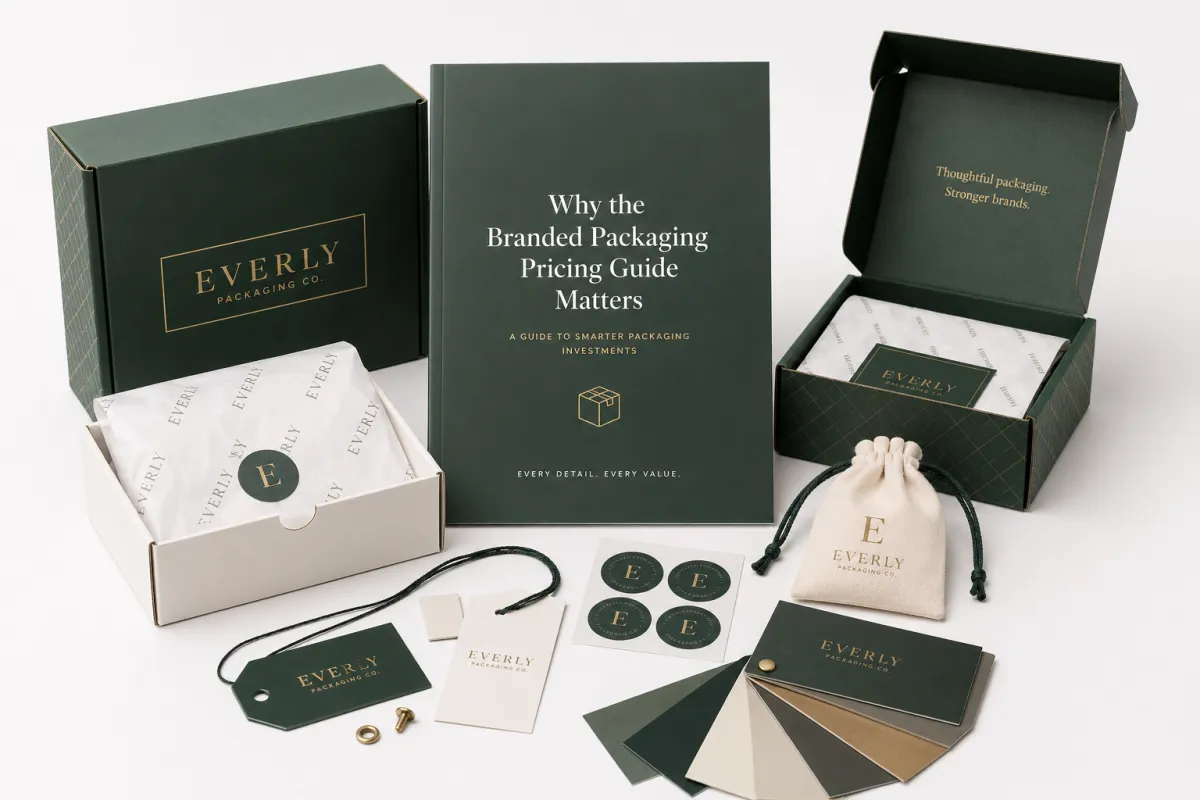
Most buyers notice this first: the lowest quote is rarely the simplest package. A smaller carton with tight tolerances, specialty finishing, or a complex insert can outcost a larger blank box because the supplier still absorbs setup time, tooling, and extra handling. A branded packaging pricing guide turns those hidden mechanics into something operationally legible.
There is also a common gap between expectations and production reality. Many teams assume cost comes mostly from board and ink. Real numbers, however, often include die tooling, plate charges, proofing, trimming, folding, gluing, packing, and spoilage allowances. A branded packaging pricing guide that puts those elements in plain view reduces the shock when a full estimate arrives.
Packaging performance is not only about decoration. A rigid setup box with foil and soft-touch lamination can feel premium because the finishing is doing most of the visual lifting. A kraft mailer can also feel premium if the structure, print coverage, and insert strategy are aligned. A branded packaging pricing guide helps teams connect those design outcomes to a budget that can support repeat orders instead of just the first run.
There is also a strategic split that buyers sometimes flatten into one comparison: some launches need display-ready retail packaging with polished shelf presence, while others need durable e-commerce protection with a clean delivery experience. Those are not the same job, and they should not be priced the same way. A branded packaging pricing guide keeps the team anchored to the intended use, not a convenient but misleading comparison.
For supplier evaluation, this guide works as a planning framework, not a shopping list. It helps teams ask sharper questions, remove hidden assumptions, and verify that each proposal really covers the package they think they are buying. Startups, established brands, and first-time custom packers all face the same issue: they need consistency in what is being compared.
The quote that looks low on day one often becomes the expensive one later when inserts, freight, or finishing were under-specified from the start.
Margin pressure is another reason not to skip this branded packaging pricing guide mindset. Packaging is a direct input to unit economics, not a side expense. If landed cost rises by $0.40 per unit instead of $0.18, the difference feels small in isolation and then rewrites the P&L after 8,000 or 10,000 units. High-performing teams treat packaging like a production variable, not a design afterthought.
Teams wanting visual examples of package structures across categories can use the Custom Packaging Products page as context. It helps when estimating what different formats might require, from mailers and folding cartons to rigid boxes and related build methods.
How the Branded Packaging Pricing Guide Works
Quoting usually follows a more methodical path than buyers expect. Suppliers collect dimensions, product weight, quantity, artwork status, substrate choice, finish preferences, and destination details before modeling the estimate. A branded packaging pricing guide becomes useful when it maps the final number into setup, production, and shipping segments instead of leaving it as one opaque figure.
One-time costs are usually the first place to look. Dies, plates, tooling, and sample production are front-loaded and often tied to the first run or to a revision event. Recurring costs behave differently: board, ink, adhesives, and labor return with every reorder. A branded packaging pricing guide helps teams separate what can be spread across volume from what stays fixed every time the line runs.
Quantity breaks can turn a “too expensive” package into a reasonable one. If setup effort barely shifts between 500 and 5,000 units, the per-unit math changes fast. That is why a branded packaging pricing guide should always capture incremental pricing by quantity so teams can see where the curve begins to flatten and where efficiency actually appears.
Proofing and sampling are not optional checkboxes. Digital mockups are useful for communication, but they do not confirm hand-feel, insert fit, or structural stability under real load. Physical samples, prototypes, and preproduction approvals add time and often budget, yet they reduce the risk of full-reject batches. A branded packaging pricing guide that ignores this stage leaves a major blind spot.
Execution speed inside the press and converting plant is itself a cost input. A one-color print on standard board can move quickly through the line. A multi-pass foil, emboss, and inside-print combination adds setup events, handling points, and inspection time. In a branded packaging pricing guide, production speed is not a technical footnote; it is a pricing driver.
For a practical benchmark, this table helps teams compare structure and effort:
| Packaging Option | Typical Use | Approx. Price Range at 1,000 Units | Approx. Price Range at 5,000 Units | Main Cost Drivers |
|---|---|---|---|---|
| Printed folding carton | Cosmetics, supplements, small consumer goods | $0.45-$1.10 per unit | $0.18-$0.45 per unit | Board grade, print coverage, coating, die complexity |
| Custom mailer box | E-commerce shipping and subscription programs | $0.85-$2.25 per unit | $0.42-$1.10 per unit | Corrugated flute type, print method, insert count, box size |
| Rigid setup box | Premium gifting, electronics, high-end launches | $1.75-$4.50 per unit | $0.95-$2.80 per unit | Board wrap, lamination, specialty finishing, manual assembly |
These ranges are directional and should be treated as guardrails, not fixed prices. Material markets move. Freight changes. Labor does too. Their value in a branded packaging pricing guide is benchmarking: a buyer can test whether a quote lines up with the specified structure and spot when two proposals are actually based on different package definitions.
Teams evaluating sustainability and durability together can use the Case Studies page to watch how category, quantity, and package architecture shift total spend. It helps separate recurring patterns from one-off exceptions.
When buyers compare sustainability variants, fiber source can affect both cost and commercial credibility. FSC-certified board may carry a premium. It can also help with procurement criteria, retailer scrutiny, and consumer trust. For transport reliability, ISTA testing standards offer an objective reference point for drop and vibration performance. A strong branded packaging pricing guide looks at the system from design room through warehouse gate.
Key Factors That Shape Branded Packaging Pricing
Material selection usually sets the pricing floor. Paperboard, corrugated, and rigid grayboard each move differently through converting, printing, and final use. A basic SBS folding carton can be cheaper than a fully wrapped rigid box, but board weight, coating, and print spec determine how wide that gap becomes. A branded packaging pricing guide should call out board weight and structure because these variables often outrank artwork in impact.
Size can move price in ways that feel counterintuitive. Bigger dimensions do not automatically mean a higher unit cost, and smaller dimensions do not automatically save money. A compact package can become expensive if it forces awkward sheet layouts or poor material utilization. Comparing size with sheet utilization and waste percentage reveals the real cost logic better than dimensional intuition.
Construction adds another layer of variance. A simple tuck-end carton is typically easier to run than a custom die-cut with multiple locking points. A mailer with an integrated insert costs more than a plain shipper in many runs. A rigid format with magnetic closure, paper wrap, and ribbon pull enters a different labor class than a standard lid-and-base design. A branded packaging pricing guide should tie those labor implications to the design choice.
Decoration is where many budgets bend quickly. One-color print follows a simpler path than full-color process printing. Outside-only printing often remains more efficient than all-over and two-sided work. Foil stamping, embossing, debossing, spot UV, and soft-touch lamination each add tooling, monitoring, and handling layers. If the brand relies on one standout effect, the guide should quantify that decision before approval.
Operational costs frequently hide behind a clean mockup. Packing efficiency impacts freight. Pallet geometry changes storage and handling cost. Overage requirements for tolerances and spoilage are expected in production planning, not negligence. When a branded packaging pricing guide omits these, it describes only half the program and invites cost surprises after PO release.
A quick finish comparison helps make these tradeoffs concrete:
| Finish Choice | Visual Effect | Typical Cost Impact | Best Use |
|---|---|---|---|
| Uncoated print | Natural, tactile, understated | Lowest | Kraft styles, eco-forward branding, simple retail packaging |
| Matte or gloss aqueous coating | Cleaner surface, better protection | Low to moderate | Most custom printed boxes and mailers |
| Soft-touch lamination | Premium feel, velvety hand feel | Moderate to high | Premium launches, gift packaging, high-end product packaging |
| Foil stamping and embossing | High contrast, strong shelf appeal | Moderate to high | Brand marks, limited editions, premium presentation |
The table reinforces a core principle in any branded Packaging Pricing Guide: each added finishing operation can increase both cost and quality-control touchpoints. As finishing complexity rises, so does the chance that setup and line adjustments will shift final total cost more than expected.
Design tolerances are another quiet cost engine. Tight fits demand extra sample cycles, closer dimensional review, and stricter prepress checks. Artwork near folds or glue zones invites additional cleanup. These are design decisions that can be excellent for brand fit while quietly shifting production hours. A practical branded packaging pricing guide links design creativity with manufacturing consequences.
For teams with forest stewardship requirements, FSC certification can strengthen sourcing narratives and retail conversations. The route is not always the lowest-cost option, but procurement, ESG goals, and retailer scrutiny may make it the right business choice. In a balanced branded packaging pricing guide, price remains central without being the only metric.
Step-by-Step Process and Timeline for Pricing
Pricing begins at discovery, where teams submit dimensions, target volume, branding requirements, and functional features like inserts, windows, or closures. The completeness of this brief often determines speed later. A branded packaging pricing guide is most valuable here, because it separates essential input from information that can wait until after first feedback.
Once brief data is in, suppliers review structure and production fit. This usually includes dieline selection, material recommendation, print option selection, and compatibility checks for efficient converting. If the carton can be resized to standard sheet geometry or waste can be reduced, that is usually when the first meaningful cost adjustment appears. A branded packaging pricing guide that protects this stage can prevent expensive revisions downstream.
Sampling follows. Digital proofing may arrive quickly, often in 24 to 48 hours, but structural samples or preproduction prototypes usually need additional lead time. Revisions during this phase extend schedules, and every extension is rarely free. Separating proof turnaround from production timeline is a useful discipline in any branded packaging pricing guide.
Production lead time varies by mix of material, decoration method, and quantity. A straightforward folding carton can move from approval to run in roughly 10-15 business days in many facilities. Rigid boxes with specialty finishing commonly need longer windows. Manual assembly and custom inserts add additional sequencing complexity. Rushed approvals cost more often than they save, especially when revisions spill into press-ready cycles.
Finishing, packing, and shipment complete the flow. Print completion does not finish the job, because cartons still require assembly, counting, packing, and transit prep. Freight may be presented as a separate line or embedded in a broader quote. Either way, landed cost is the number that determines spend reality, not the in-plant production line figure.
A realistic custom packaging sequence is usually:
- Request a quote with exact dimensions, quantity, substrate, and finish preferences.
- Review proposed structure and confirm dieline integrity or sample format.
- Approve digital mockup, then request a physical prototype if fit and handling are critical.
- Finalize artwork and copy during one controlled proofing round.
- Run production, finishing, packing, and freight booking together.
- Inspect the first shipped cartons before scaling to the next replenishment.
The pauses in this sequence usually appear at handoff points. Missing dielines, late copy changes, unresolved barcode placement, and uncertain shipping addresses create bottlenecks faster than any creative debate ever does. A branded packaging pricing guide works when it pushes teams to lock foundational details early.
Seasonality can swing timelines in ways that are difficult to predict from a table. Plant schedules around launch windows, holidays, and trade-show fulfillment often absorb capacity first. For retail rollouts or e-commerce campaigns, asking where a job sits in queue beats assuming all lead times are equal. Honest branded packaging pricing guides also flag schedule pressure as a quality-risk variable, not just a logistics note.
Common Mistakes That Inflate Packaging Costs
Focusing only on the printed shell is a common budgeting trap. Inserts, labels, tapes, protective wraps, shipper cartons, and pallet components all add cost even though they are less visible in early pricing conversations. A package crossing from warehouse to retailer or DTC channel needs a whole system, not a single SKU file. A branded packaging pricing guide that ignores this can mislead even a careful buyer.
Late artwork churn is expensive in a very mechanical way. Every update after proof triggers file review, potentially a new sample, line interruption, and schedule movement. The result is administrative friction combined with scrap risk and extra press wear. A strong branded packaging pricing guide teaches teams that stable artwork is cheaper artwork.
Unstructured quote comparison is another costly habit. A lower quote can come from thinner board, omitted insert, simpler finish, or relaxed tolerance. Two proposals can appear close but represent different products in disguise. A branded packaging pricing guide should force one-to-one comparisons before any budget is approved.
Skipping samples saves little and can cost a great deal later. Poor fit damages product packaging, awkward closure hurts shipping outcomes, and weak print quality damages retail confidence. A prototype may add an upfront line item, yet a failed production run usually writes a much larger check. A mature branded packaging pricing guide treats sampling as risk control rather than optional taste.
If two quotes do not share the same board, print method, and finish scope, they are not valid price comparisons.
Aesthetic ambition without production logic causes silent overruns. A crowded decorative spread, dense ink coverage, extra inside print, or unusual insert material can increase spend without improving the customer experience in any meaningful way. The most useful branded packaging pricing guide does not ask how many effects you can add. It asks which effects still move the buyer.
Freight and warehousing frequently hide in the cost tail. Larger order sizes can lower unit price while increasing pallet count, storage demand, and inbound freight. This is why landed cost matters across the full order lifecycle. A branded packaging pricing guide that stays at ex-works pricing misses a substantial part of the equation.
To see how small structural decisions change spend by category, the Case Studies page remains a practical comparison library. Real examples make pattern recognition easier, especially around structure, quantity, and finishing combinations.
Expert Tips to Lower Costs Without Losing Impact
Streamlining the finish stack often yields the fastest savings while preserving brand tone. A strong logo plus a restrained color system can outperform a crowded surface full of effects. When visual hierarchy is clean, one- or two-color print can be both clearer and more cost efficient. A branded packaging pricing guide should allow room for this kind of disciplined restraint.
Standardizing dimensions across SKUs is a quiet multiplier. If several products can share one base footprint, suppliers can improve yield and simplify setup while planning systems become easier to forecast. Savings appear in material, production planning, storage, and replenishment. A branded packaging pricing guide that includes SKU consolidation can build scale early instead of forcing repeated resets.
Designing around common sheet sizes adds unexpected margin support. A layout that nests efficiently into standard die-board geometry reduces waste and can shave setup overhead. Printing teams often spot these gains immediately, while buyers might only notice once costs normalize at reorder time. A branded packaging pricing guide that tracks yield tends to be more trustworthy than one that only tracks aesthetics.
Insert decisions deserve equal scrutiny to finishes. The right insert secures product and supports opening flow; the overbuilt insert creates avoidable spend. A molded form may look premium, yet a simple paperboard or corrugated cradle can deliver equivalent functional performance in many programs. A branded packaging pricing guide should compare protection, presentation, and production impact as one decision.
Batch strategy influences cost more than many buyers admit. Separate small runs with separate setups often carry repeated setup penalties. Combining runs or grouping seasonal demand can improve per-unit economics without forcing excess inventory, as long as storage and sell-through patterns are accounted for. The critical point is identifying when unit cost improves enough to justify consolidation.
Three quote structures help teams test tradeoffs with less emotional noise:
- Premium version: premium board, specialty finishing, and maximum shelf or unboxing impact.
- Balanced version: refined branding touches, controlled complexity, and cleaner production flow.
- Budget-conscious version: simplified structure, reduced finishing steps, and printing/assembly tuned for efficiency.
This method gives teams an actual negotiation path instead of a binary accept-or-reject cycle. A branded packaging pricing guide should evaluate alternatives side by side because the middle tier frequently protects both brand presentation and gross margin better than the extremes.
Line-item transparency is a practical leverage point. Showing setup, material, decoration, assembly, and freight separately helps teams modify one component without destabilizing the whole quote. This is especially valuable for custom printed boxes and retail packaging programs where premium look and cost discipline are both non-negotiable.
Next Steps for a Smarter Packaging Budget
Before requesting another quote, store essentials in one clean brief: exact dimensions, target volume, branding objectives, preferred materials, finish priorities, destination, and launch date. Add whether distribution is mostly shelf-bound or parcel-oriented. A branded packaging pricing guide only performs as well as the data that powers it.
Ask for itemized costs whenever possible. Setup, tooling, materials, decoration, assembly, and freight should be shown separately or clearly explained if bundled. Item clarity reduces confusion and helps identify whether a quote is genuinely stronger or merely structured differently.
Create a standing internal reference file for each packaging program. Track approved dimensions, board grade, print method, finish list, sample notes, and final landed cost. That record becomes a decision engine on the next order, not just a filing artifact. This is one of the easiest paths from ad hoc shopping to a repeatable buying workflow powered by your branded packaging pricing guide.
Post-launch review is where continuous improvement begins. Check insert fit, assembly speed, freight accuracy, and customer feedback against the assumptions made in the original estimate. This review closes the cost loop and keeps packaging design aligned with actual business performance. A branded packaging pricing guide gains value only when teams reuse it after first production, not only before purchase.
Supplier conversations with many variables work best when anchored to total value instead of unit vanity numbers. The cheapest per-unit bid may not deliver the best outcome, and the highest bid may not be the right answer either. The meaningful decision is whether the package supports the product, the brand, and the delivery chain without paying for avoidable complexity.
What affects branded packaging pricing the most?
The biggest driver is usually quantity, because setup is spread across more units. But that is only the first layer. A full packaging cost breakdown also has to account for board grade, print method, finish stack, inserts, freight, and sample rounds. Two quotes can look close on paper and still represent very different custom box pricing models if one includes tooling, proofing, or a more expensive landed cost. That is why a branded packaging pricing guide should compare the same structure, not just the same dimensions.
Frequently Asked Questions
What affects branded packaging pricing the most?
Quantity usually drives the largest movement because setup costs are spread across volume, and that logic appears in nearly every branded packaging pricing guide. Board choice, print coverage, and specialty finishes can also shift cost quickly once a package moves from standard carton to premium setup. Freight, inserts, and structural complexity are frequently just as influential as the printed surface, so the whole package system deserves review.
How can I compare branded packaging pricing quotes fairly?
Use identical inputs for every proposal: dimensions, board type, print method, finish list, and delivery terms. A quote based on thinner board or a different closure style is no longer the same product and should not be treated as a direct match. Freight treatment, sample costs, and tooling treatment also need explicit visibility because these numbers swing totals rapidly. A reliable branded packaging pricing guide calls for line-item comparison before final selection.
Can branded packaging pricing go down if I simplify the design?
Yes, and simplification is often the most effective lever. Reducing finishes, colors, and structural complexity can lower labor and setup costs while improving print efficiency. Standardized dimensions improve sheet yield and reduce waste, while cleaner artwork generally prints more predictably than high-density designs. Efficient production design usually creates more margin than trimming tiny visual effects.
How long does the packaging pricing and production process take?
Simple projects can move quickly; custom structures and premium finishes usually add review time. Proof approvals, sampling, and revisions create the biggest schedule variation, especially with non press-ready artwork or unresolved dielines. Freight planning and destination approvals should be built into launch timelines from the beginning. A branded packaging pricing guide should treat timing as part of cost planning, because speed pressure often creates avoidable edits and extra spend.
What should I ask for in a branded packaging quote?
Ask for quantity tiers, tooling costs, sample expectations, material details, finish options, freight terms, and separate proof and production timelines. Confirm whether overages, assembly, and parcel-safe packaging are included in the total. If the brand requires stronger shelf aesthetics or premium unboxing cues, specify that up front so the scope matches execution. That practice turns the branded packaging pricing guide into negotiation-ready intelligence instead of a generic estimate.
What is the single best takeaway for budgeting?
Lock the spec before you compare the price. Exact dimensions, materials, finish scope, and freight terms need to be fixed first; otherwise you are not comparing quotes, you are comparing guesses. If the internal brief is tight and the supplier response is itemized, the branded packaging pricing guide becomes a real buying tool rather than a rough reference. That is the point where budget control stops feeling reactive and starts feeling usable.


