Buyer Fit Snapshot
| Best fit | design vegan friendly packaging well for packaging buyers comparing material specs, print proof, MOQ, unit cost, freight, and repeat-order risk where brand print, material, artwork control, and repeat-order consistency matter. |
|---|---|
| Quote inputs | Share finished size, material target, print colors, finish, packing count, annual reorder estimate, and delivery region. |
| Proofing check | Approve dieline scale, logo placement, barcode or warning zones, color tolerance, and any recyclable or compostable wording before bulk production. |
| Main risk | Vague material claims, crowded artwork, or missing packing details can create delays even when the unit price looks attractive. |
Fast answer: Design Vegan Friendly Packaging Well: Dieline, Finish, Proof, and Buyer Review should be specified like a repeatable production item. The safest quote includes material, print method, finish, artwork proof, carton packing, and reorder notes in one written spec.
What to confirm before approving the packaging proof
Check the product dimensions against the actual filled item, not only the sales mockup. Ask for tolerance on folds, seals, hang holes, label areas, and retail display edges. If the package carries a logo, QR code, warning copy, or legal claim, reserve that space before decorative graphics fill the panel.
How to compare quotes without losing quality
Compare board or film grade, print process, finish, sampling route, tooling charges, carton quantity, and freight assumptions side by side. A lower quote is only useful if the supplier can repeat the same color, closure quality, and packing count on the next order.
How to Design Vegan Friendly Packaging That Sells Well
How to design vegan friendly packaging sounds straightforward until you are standing beside a Heidelberg Speedmaster in a plant outside Eindhoven, holding a carton that reads beautifully at arm's length and then realizing the adhesive on the insert uses a dairy-derived binder. I have seen a launch in Leeds slip by nine business days because a label supplier in Guangdong forgot to attach a written material declaration, and I have also watched a premium beauty carton get held at the dock in New Jersey because the coating spec only said "soft-touch" instead of naming the actual chemistry. That is why how to design vegan friendly packaging is never just a design task; it is a materials, sourcing, and production brief that has to survive a press check, a compliance review, and a shipping schedule all at once.
For the brands I work with, the real job is making vegan friendly packaging feel credible on shelf, stay practical on a packing line in Dongguan or Monterrey, and remain inside a budget that a finance team can actually sign off on. A pack that looks polished but cannot be documented will create trouble during retail onboarding. A pack that is technically clean but visually clumsy will still lose the sale. The useful middle ground in how to design vegan friendly packaging is where package branding, product packaging, and factory reality all agree on the same spec, from the 350gsm C1S artboard to the final pallet label.
Shoppers read packaging quickly, often in less than five seconds in a store aisle in Chicago or Manchester, and they notice contradictions faster than teams in a conference room do. A vague icon, a glossy green carton, or a claim with no support can make a brand feel slippery instead of trustworthy. A restrained carton with clear materials, accurate copy, and sensible finishing usually builds more confidence than a dozen leaf graphics ever will. That practical discipline sits at the center of how to design vegan friendly packaging, especially for categories like skincare, snacks, and supplements where buyers are comparing three or four options from the same shelf strip.
How to Design Vegan Friendly Packaging: What It Really Means
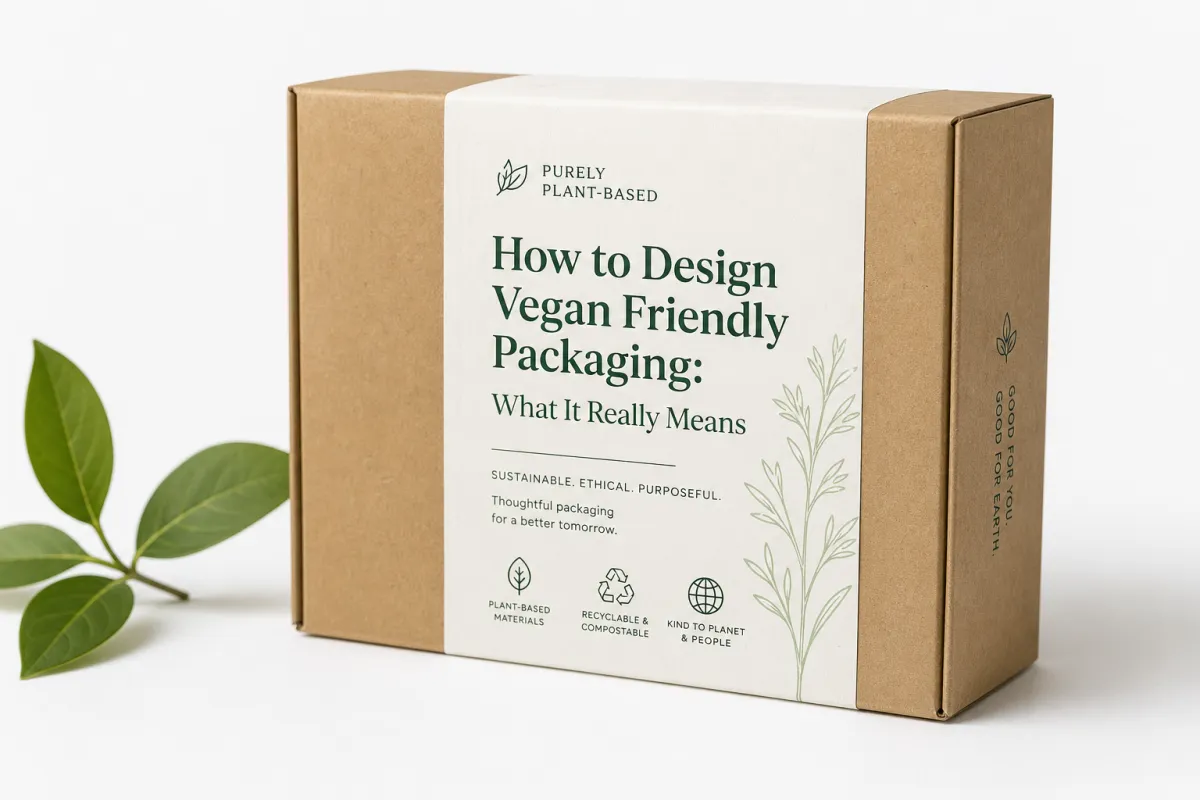
When I talk about how to design vegan friendly packaging, I start with the claim itself. Vegan means the packaging system, including hidden components, is free from animal-derived inputs such as casein, gelatin, shellac, beeswax, and tallow-based additives. That definition reaches into inks, coatings, adhesives, release liners, inserts, and specialty surface treatments, so a pack can be paper-based and still fail review if one hidden component comes from an animal source. I have watched a packaging team in Milan go quiet for a full minute after discovering that a "paper-only" insert used a glue blend with a non-vegan binder, which is exactly the kind of detail that turns a simple launch into a paperwork chase.
That is where people often confuse vegan with other common claims. Plant-based usually points to a feedstock like corn, sugarcane, or wood pulp, not the full supply chain. Compostable means the material breaks down under defined conditions, often under ASTM D6400 or ASTM D6868, but compostable does not automatically mean vegan. Recyclable describes the end-of-life path, not the ingredient origin. Cruelty-free usually applies to testing practices, which is a separate question. If you are learning how to design vegan friendly packaging, those distinctions matter because retailers in the UK, Germany, and California may treat each word differently and ask for different proof.
I still remember a meeting with a skincare client in Austin who wanted a soft, premium carton with a satin hand-feel, a blind emboss, and a brushed matte finish. The marketing team had a strong mood board, but the packaging spec had almost no detail beyond "premium white box." Once we pulled the supplier sheets, the first coating option used a binder that could not support a vegan claim. That is the moment many brands learn how to design vegan friendly packaging properly: you cannot ask for a vibe and expect a compliant structure to appear out of nowhere. A mood board is useful; a stack of materials, an approved dieline, and written declarations are what actually carry the project.
"We want the pack to feel calm and premium, but if the claim cannot stand up in front of a retailer in London or Berlin, the finish does not matter."
That line came from a buyer at a natural beauty chain with 120 stores across the UK, and it still captures the issue cleanly. Consumers want reassurance, but they punish overstatement. If you print vegan friendly packaging on the front panel and the rest of the pack feels vague, the claim starts to read like marketing noise. The better route in how to design vegan friendly packaging is to let the board, the ink, the adhesive, and the copy do the quiet work. Quiet work still takes discipline, because the supplier file has to be precise down to the adhesive batch number and the coating line used on the run.
There is also a branding reason to handle this carefully. Ethical buyers often look for consistency across the full product line, so your package branding, shipper cartons, and inserts should sound like they belong to the same family. If the front of the carton says vegan but the secondary packaging says nothing, or the website says one thing and the box says another, the story feels incomplete. That is why how to design vegan friendly packaging has to include the whole journey from shelf appeal to carton pack-out, because the customer does not separate those moments the way a procurement team does. A box that looks right in a render but misses the shipping spec in Toronto or Dublin is still a problem.
How do you design vegan friendly packaging?
You design vegan friendly packaging by checking every visible and hidden component for animal-derived ingredients, then building the artwork, supplier documentation, and factory approvals around that verified material stack. In practice, that means reviewing substrate, inks, coatings, adhesives, release liners, inserts, and finishing methods before you lock the dieline. The fastest way to stay on track is to treat the claim like a production requirement, not a marketing flourish.
A clean vegan claim usually rests on three pieces of evidence:
- Material declarations from the substrate, ink, coating, and adhesive suppliers.
- Artwork and spec control so the approved structure matches the production run.
- A claim file that shows what was checked, who approved it, and when the review happened.
For paper-based projects, I like to ask whether the board is FSC-certified and whether the converter can document the chain of custody from the mill to the finishing plant. The FSC system does not certify vegan status, of course, but it does help show that the paper source is controlled and traceable, which matters on projects moving through Poland, Vietnam, and the eastern United States. I have seen too many teams assume "paper" is enough, then spend the next week collecting declarations from three suppliers and one converter like they were tracking down missing passport pages.
How Vegan Friendly Packaging Works in the Factory
How to design vegan friendly packaging becomes much easier once you walk the factory floor and look at the stack piece by piece. The substrate is only the beginning. A folding carton may start with paperboard, then pick up prepress chemicals, CMYK inks, aqueous coating, die-cutting dust control, folding adhesive, and sometimes inserts, windows, or tamper-evident labels. Each layer is a possible entry point for an animal-derived input if nobody asks the right questions, and a factory in Dongguan or Ohio is the least forgiving place to discover that one part of the stack was never reviewed.
On a Bobst folder-gluer line in New Jersey, I once saw a clean kraft carton pass visual inspection and then get flagged by the compliance team because the varnish supplier could not document one additive in the coating package. The printer had assumed the issue was only about the board, but the board was never the problem. That is a classic lesson in how to design vegan friendly packaging: the final pack is a system, not a single raw material. I have learned to respect the quiet troublemakers in a spec, because the shiny layer is almost never the one causing the headache.
The first parts I check are the inks, adhesives, coatings, release liners, and inserts.
- Inks: Most modern water-based or soy-based systems are fine, but specialty pigments, varnish blends, and metallic effects need written review.
- Adhesives: Casein, gelatin, or other animal-derived ingredients can still appear in niche glue systems used for labels and cartons.
- Coatings and varnishes: Soft-touch, satin, and matte effects can hide ingredients that are not obvious in the sales sheet or quote.
- Release liners and tapes: Labels, seals, and tamper evidence can carry their own surprises and usually come from a separate supplier.
- Inserts and cushioning: Molded fiber, pulp trays, foam alternatives, and paper wraps each need a separate review, especially for export into the EU.
Flexible packaging changes the questions without changing the stakes. A mono-material pouch may look simple, yet the sealant layer, tie layers, ink system, and barrier coating still need supplier declarations. In rigid packaging, glass and aluminum are often easier on the vegan side, but closures, liners, and decorative components still deserve scrutiny. In labels and shrink sleeves, the smallest pieces can cause the longest delays because they are often sourced separately from the primary pack in Shenzhen or Ho Chi Minh City. That is one of those frustrating packaging truths nobody puts on a slide deck: the tiny components have a habit of creating the largest mess.
That is why I push clients to ask for documentation before artwork is finalized. A good converter can usually provide technical data sheets, declarations, and sample approvals early enough to prevent surprises. For brands building custom printed boxes or broader branded packaging programs, that early check is cheaper than fixing a non-compliant component after the dieline is approved and the plates are already booked. I have seen a straightforward carton launch lose a full production window because one small adhesive never made it into the approval file, and everyone acted shocked, as if the glue had somehow hidden under the packing table.
Factory teams also work in stages that matter for how to design vegan friendly packaging. Prepress catches artwork problems and ink choices. Proofing shows how the colors and finish behave on the selected stock. Pilot samples reveal whether the glue lines, fold memory, and board stiffness are actually production-safe. If a brand skips any of those steps, it usually pays later in waste, rush freight, or rework. The factory does not care that the marketing calendar is aggressive; a line in California or Suzhou still wants what the line wants.
I like to think of vegan compliance as a chain, not a checkbox. The board may be clean, but if the insert is not, the claim is shaky. The adhesive may be clean, but if the label stock is not, the claim is shaky again. When you are learning how to design vegan friendly packaging, that chain mindset keeps the project grounded in real material data and stops everyone from pretending one approved line item solves the whole job. A single missing declaration can undo a full set of beautiful mockups in under ten minutes.
For shipping and transit testing, I also like to see a reference to an ISTA protocol, especially for product packaging that will move through distributors, warehouses, and ecommerce channels. ISTA does not validate vegan claims, but it does help make sure the pack survives the journey intact, which protects both the product and the brand story. There is nothing elegant about a box that arrives crushed in Philadelphia or Madrid, and there is definitely nothing elegant about replacing it at cost because route testing got skipped to save $120 on the first round.
Key Design Factors for Vegan Friendly Packaging
How to design vegan friendly packaging starts to feel manageable once you break it into material, structure, and visual language. The first decision is the substrate. Paperboard works well for many food, beauty, and wellness brands because it is easy to print, easy to explain, and often easy to source with FSC documentation. Molded fiber can be a strong choice for inserts, trays, and protective forms, especially when a brand wants less plastic in the visible package. Glass and aluminum are also common in vegan product packaging because they are familiar, premium, and straightforward to explain to consumers from Seattle to Stockholm.
For flexible formats, mono-material films are usually easier to position than mixed-laminate structures. That does not make them perfect, and it does not mean every film pouch is vegan by default. It does mean a brand can simplify its conversation if the structure is kept clean and the supplier data is solid. In how to design vegan friendly packaging, simplicity is often your friend because fewer layers usually mean fewer hidden questions. I have never regretted making a structure easier to explain, especially when the project team is spread across London, Austin, and a contract packer in Ohio.
Structure matters just as much as substrate. A rigid setup box with a paperboard insert may create a premium unboxing moment, but it also adds cost and material volume. A straight tuck folding carton may be lighter and easier to recycle, but it might not support the same shelf presence. A shoulder-neck rigid box may feel luxurious, yet that extra reveal can slow the packing line and increase waste in a plant that runs 15,000 units per shift. You are not just designing a box; you are designing how the pack behaves in production, on shelf, and in the customer's hand, which is a lot for one piece of board to handle.
Visually, I have found that vegan packaging design works best when it is confident and restrained. Earthy colors can help, but overusing leaves, farm imagery, and rough textures can make the pack feel cliche or performative. Clean typography, a clear ingredient story, and one strong focal point usually do more to build trust. If the product is a snack, the flavor and nutrition panel should be easy to read at 3 feet. If it is a cleanser or cream, the function and benefit should be obvious before the consumer ever reads the vegan claim. That is how to design vegan friendly packaging that feels grown-up instead of trying too hard to look wholesome.
That is where package branding becomes strategic. The vegan message should sit inside the brand hierarchy, not bulldoze it. I usually advise clients to keep the claim visible but calm, then support it with the right secondary details: recyclable icons only if they are true, FSC marks only if certified, and clear copy on what was reviewed. How to design vegan friendly packaging is not about shouting louder; it is about saying less and proving more. The best packs often feel understated because the facts do the heavy lifting, and a measured front panel usually ages better than an overdecorated one printed for a trade show in Las Vegas.
Tactile finish is another area where brands can accidentally complicate things. Soft-touch lamination, embossing, debossing, foil stamping, and spot UV all change cost and can affect how the package feels in hand. A soft-touch film can make a carton feel expensive, but it may also add a more complex material layer. An embossed logo can feel elegant, but it requires a tighter die and may reduce run speed. If the surface finish is part of the story, keep it intentional. If it is just decoration, consider dropping it. I say that with affection, but also with a little fatigue, because decorative extras have a way of appearing right when the budget is already at $0.28 per unit and the line is booked solid.
For brands that need Custom Packaging Products, I usually recommend selecting the simplest structure that still carries the claim properly. A well-made folding carton built from 350gsm C1S artboard with a water-based coating often beats a complicated special-finish pack that is harder to document across a factory in Illinois or Jiangsu. That is a practical part of how to design vegan friendly packaging: let the structure serve the message instead of forcing the message to rescue the structure. The pack should do its job quietly and then get out of the way.
Another useful rule is to make the vegan claim easy to find but not impossible to ignore. Front panel placement usually works, though some categories do better with a side panel or back-panel callout depending on shelf competition in pharmacies, grocers, or online subscription boxes. If the claim is too tiny, consumers miss it. If it is too large, it can feel like the product is trying too hard. Good packaging design finds the center of that tension, which is harder than it sounds because people in meetings often mistake "more prominent" for "more believable." A claim that is 8 to 10 points in a clean sans serif often reads better than a giant badge screaming for attention.
How to Design Vegan Friendly Packaging Without Overspending
How to design vegan friendly packaging without blowing the budget is where the conversation gets real. The biggest cost drivers are usually substrate choice, print coverage, special finishes, die complexity, insert count, MOQ, and how many SKUs are being launched at once. A simple carton with one or two spot colors is obviously cheaper than a full-coverage premium sleeve with foil, embossing, and a custom molded insert. That sounds obvious, but I have seen brands approve beautiful mockups without realizing how much each added feature moves the unit price. The render looks lovely; the invoice tends to have a different opinion.
Here is a practical pricing snapshot for a run of 5,000 pieces, based on quotes I have seen from converters in the US Midwest, Guangdong, and northern Italy. These are ballpark figures, not promises, because paper markets, labor rates, freight, and press setup conditions change constantly.
| Option | Typical Unit Cost | Best For | Watchouts |
|---|---|---|---|
| 350gsm C1S folding carton with aqueous coating | $0.15 to $0.28 | Beauty, supplements, and entry-level retail packaging | Keep coatings and glue systems documented, especially for casein-free claims |
| Kraft rigid setup box with paper insert | $0.78 to $1.35 | Gift sets and premium branded packaging | Higher material use and higher hand-assembly cost |
| Molded fiber tray with printed sleeve | $0.12 to $0.25 for tray, sleeve extra $0.07 to $0.14 | Shipping-friendly product packaging | Tooling lead time and moisture behavior need review |
| Mono-material flexible pouch | $0.09 to $0.21 | Lightweight food or refill formats | Check sealants, inks, and barrier performance before launch |
The cheapest-looking pack is not always the cheapest overall. If a carton jams the line, requires hand packing, or generates a higher reject rate, the hidden labor cost can erase the savings. I once watched a client chase a lower quote on a very glossy box in Shenzhen, only to discover that the finish slowed the folding line so much that the true cost landed higher than the more modest original spec. That is a classic example of how to design vegan friendly packaging with your eyes open, instead of falling for the seductive little lie that a lower per-unit price automatically means a lower project cost.
There are several places where you can save money without weakening the vegan message:
- Use a standard board grade instead of a custom specialty stock unless there is a clear reason not to.
- Limit the number of special finishes to one hero effect, not three or four competing ones.
- Reduce insert complexity by using paperboard engineering instead of mixed-material supports.
- Keep the dieline efficient so the converter can run it with less waste and fewer setup changes.
- Consolidate SKUs where possible so one approved structure can support multiple flavors or variants.
At a supplier meeting in Shenzhen, I once spent forty minutes talking through a white glue spec with a vendor who kept saying, "It should be fine." That word should is dangerous in packaging. I asked for the declaration, the technical sheet, and the production note, and only then did we learn the adhesive family needed one more approval step. The project still landed well, but not because of optimism. It landed because the team treated how to design vegan friendly packaging like a production brief, not a mood board. I wish I had a dollar for every time "should be fine" turned into "we need to remake three pallets."
If you are collecting estimates, ask converters to quote the actual operating conditions: board grade, print coverage, finish type, number of folds, insert count, pack-out method, and expected MOQ. Ask for separate pricing on each option so you can see where the value sits. A good quote for custom printed boxes should show what changes when the structure changes. That makes it easier to compare a premium finish against a simpler structure that may sell just as well, and it gives you a cleaner way to defend the decision if someone later asks why the shiny version did not win. I usually ask for a second quote on 10,000 units too, because the step-down can reveal whether setup cost or material cost is doing most of the damage.
When the pack needs a more premium feel, spend the budget where customers notice it most. A cleaner print surface, a tighter fold, and a more confident opening experience often beat an expensive effect that only the packaging team can appreciate. The goal is not to make the box expensive; it is to make the product feel worthy. That distinction is central to how to design vegan friendly Packaging That Sells well, because the customer notices confidence long before they notice cost. A carton that opens cleanly at a retail demo in Boston or Barcelona will usually outperform a showpiece that costs 18 percent more and delivers no extra clarity.
Step-by-Step Process and Timeline for Vegan Packaging
How to design vegan friendly packaging works best when the workflow is staged clearly from the start. I usually break it into seven steps: define the claim, choose the materials, build the artwork, request supplier declarations, produce samples, review proofs, and then schedule production. If that sequence feels slow, it is still faster than discovering a claim issue after tooling is complete. The real delay is almost never design; it is documentation, and paperwork has a wonderfully irritating habit of showing up only after the deadline is already on the calendar.
A realistic timeline for a standard carton project often looks like this:
- Claim definition and scope review: 2 to 4 business days.
- Material sourcing and declarations: 5 to 10 business days.
- Artwork and dieline setup: 3 to 7 business days.
- Sample production and feedback: 5 to 8 business days.
- Proof approval and legal sign-off: 2 to 5 business days.
- Full production: typically 12 to 15 business days from proof approval for many carton jobs.
Those are not hard rules. They shift with capacity, shipping mode, and the complexity of the spec. But they are a useful baseline for how to design vegan friendly packaging without building an impossible launch calendar. The faster the brand wants to move, the more important it becomes to lock the claim early and keep the material stack simple. Speed is useful; scrambled compliance is not, especially if the goods need to move from a plant in Suzhou to a fulfillment center in Nevada by a fixed ship date.
Some steps can overlap, and some absolutely cannot. Artwork can happen while samples are being prepared. Supplier declarations can be requested as soon as the shortlist is fixed. Legal review can begin once the claim language is stable. If the structural spec is still changing, though, the proof should not be considered final. I have seen teams approve copy before the insert material was even finalized, and that is how launch stress starts to stack up. Nothing makes a calendar uglier than having to reopen a decision everybody thought was done three days earlier.
That is also why I recommend early factory consultation. A converter can usually tell you whether a soft-touch finish, a special insert, or a complicated window patch will create avoidable delays. Sometimes the smarter answer is to choose a simpler route that still looks premium and still supports the vegan claim. That is not a compromise; it is good packaging engineering. I trust the simple solution far more than the fancy one that needs four extra apologies and a second proof cycle.
For brands building a new packaging line, I advise a milestone checklist that includes both creative and operational gates:
- Claim language approved by brand and legal.
- Supplier declarations collected for substrate, coating, adhesive, and ink.
- Prototype checked for fit, fold, and shelf appearance.
- Final artwork signed off against the approved spec.
- Transport and handling reviewed against an ISTA-style distribution plan.
One of the most useful habits in how to design vegan friendly packaging is to treat each milestone as a stop point. If one item is missing, pause and fix it. That sounds conservative, but in a factory it is actually the fastest way to keep a project moving because it prevents rework. I would rather lose a day on a proof than lose a week to a corrective print run, and I have yet to meet a plant manager in Ohio or Barcelona who disagrees after the third emergency email.
Common Mistakes in Vegan Friendly Packaging Design
How to design vegan friendly packaging gets messy when brands chase the claim but ignore the small parts of the pack. The biggest mistake is greenwashing language. Words like "eco," "natural," or "clean" may sound nice, but they do not prove a vegan supply chain or a documented material review. A retailer in Seattle or Paris will usually ask for substantiation, and a consumer on a product page may ask a harder question than the marketing team expected. I have watched otherwise smart teams get tangled because they picked a feel-good phrase instead of a verifiable one.
Another common problem is assuming the visible part of the packaging is the only part that matters. I have seen secondary labels, tamper seals, coatings, and even internal sachets create issues after the main carton was already approved. If you are serious about how to design vegan friendly packaging, every component needs the same level of scrutiny, even the pieces customers barely notice. The hidden layers are where the awkward surprises like to live, and they usually arrive at the worst possible time.
Overcomplicated structures cause trouble too. A brand may start with a beautiful concept that uses mixed materials, multiple inserts, and several decoration methods. The result can be more costly, slower to produce, and harder to keep consistent across batches. That kind of complexity also increases the chance that one vendor will miss a detail while another vendor assumes someone else handled it. The cleaner the structure, the easier the vegan story is to defend, and the less time everybody wastes digging through email threads to figure out who approved what in the first place.
There is also a temptation to design for social media first and shipping second. That usually shows up as delicate corners, oversized windows, fragile closures, or decorative elements that look great in a render but fail in distribution. Good retail packaging has to display well, open well, and survive the route to store. If the pack tears, crushes, or shifts in transit, the brand trust problem becomes much bigger than the vegan claim itself. A pretty box that arrives mangled in transit to Dallas or Warsaw is still a problem, even if it photographed beautifully for 12 minutes.
Here are the failures I see most often:
- Claim language that is not backed by supplier documentation.
- Coatings or adhesives that were never reviewed beyond the headline spec.
- Artwork approved before the full material stack was locked.
- Design choices that look premium in mockup but slow the line in production.
- Missing retailer or market-specific rules for claim substantiation.
I also tell clients to check the claim against the market they are selling into. Not every channel treats vegan claims the same way, and private-label buyers may want more evidence than a direct-to-consumer brand. If the pack will sit beside a competitor in a crowded category, the claim needs to be both accurate and calm enough to feel trustworthy. That is a subtle but important part of how to design vegan friendly packaging, because trust often comes from restraint rather than spectacle. A simple line of copy on the back panel can sometimes outperform a large badge on the front.
Finally, do not let aesthetics outrun compliance. I have been in meetings where the creative team wanted a stronger headline, a bigger stamp, or a more dramatic icon, while operations was still waiting on a coating declaration from a supplier in Milan. That gap between what looks ready and what is actually ready can derail a launch faster than any color mismatch. The best teams close that gap early, before everybody starts pretending the problem is "just a small detail" worth ignoring.
Expert Tips and Next Steps for Vegan Friendly Packaging
How to design vegan friendly packaging becomes much easier when you build a simple discipline around it. My first tip is to create a one-page materials spec that lists the board, coating, adhesive, ink system, insert material, and any finishing process. Keep it readable. The goal is not to impress anyone with jargon; the goal is to make approvals fast and traceable. If someone needs a decoder ring to review the spec, the spec is already too clever for its own good, and it will probably slow a plant in Chicago or Antwerp by a full shift.
My second tip is to ask every supplier for written declarations, not verbal comfort. The phrase "it should be fine" has burned enough packaging teams to fill a warehouse. I want technical data sheets, material declarations, and, where appropriate, a certificate trail that shows the paper source and conversion path. If the brand is pursuing paper-based packaging with chain-of-custody support, the trade resources from major packaging associations can help with background reading, but the actual proof still has to come from your supplier file, whether the converter is in Lancashire or Jiangsu.
My third tip is to run a small pilot order before you commit to the full launch. That pilot tells you whether the board cracks on fold, whether the color holds on press, whether the finish feels right in hand, and whether the team can pack the product without frustration. In my experience, a small pilot is one of the cheapest forms of risk control in how to design vegan friendly packaging because it exposes real production behavior, not just theory. It also saves everyone from the special kind of embarrassment that comes with discovering a problem after 40,000 units have already landed at the warehouse.
My fourth tip is to hold a final review with branding, operations, procurement, and compliance in the room at the same time. That meeting is where the pack either becomes a coordinated system or slips into four separate opinions. If the brand says one thing, the spec says another, and the carton art says a third, you have not designed a package yet. You have created a future correction cycle, and future correction cycles are expensive in every possible way, especially when freight and reprint fees hit the same month.
For teams that are getting ready to buy, here is a practical final checklist:
- Confirm the vegan claim language and the markets where it will appear.
- Collect declarations for board, coatings, inks, adhesives, labels, and inserts.
- Compare two or three costed structures before locking the final pack.
- Sample the selected option in production-like conditions.
- Set a sign-off deadline for artwork, copy, and supplier approvals.
If you are building a broader branded packaging rollout, tie the vegan claim back to the rest of the product story instead of treating it as a standalone badge. That is where product packaging solutions and the larger family of custom printed boxes can support a unified look across the shelf, the shipper, and the unboxing moment. Good package branding feels consistent even before the consumer opens the box, and the strongest brands make that consistency look easy even though it never is. A rollout that covers 6 SKUs in one dieline family can often save 8 to 12 percent in setup cost versus six unrelated structures.
One client in the personal-care space told me that the best result we ever delivered was not the most glamorous carton, but the one that passed review, packed cleanly, and sold through without a single claim question from retail. That is honestly how to design vegan friendly Packaging That Works in the real world: keep it honest, keep it documentable, and keep it manufacturable. If you do those three things, how to design vegan friendly packaging stops being a guessing game and becomes a reliable part of your launch process. And if you have ever sat through a launch meeting with a stack of unresolved specs, you know how valuable that actually is.
The next move is simple: lock the claim, gather the declarations, and brief the factory before you polish the artwork. Do that in the right order, and the pack is far more likely to hold up on shelf, in transit, and in front of a buyer who asks the one question nobody wants to answer with a shrug.
Frequently Asked Questions
When the full system is checked properly, how to design vegan friendly packaging becomes less about chasing a trend and more about making smart decisions that survive the factory floor, the compliance review, and the customer's first touch in a store or on a doorstep.
What materials work best for vegan friendly packaging?
Paperboard, molded fiber, glass, aluminum, and carefully specified mono-material plastics are common choices when the full system is reviewed for vegan compliance. For cartons, a 350gsm C1S artboard with an aqueous coating is a practical starting point; for inserts, molded pulp from a supplier in Vietnam or Mexico is often easier to document than mixed-material foam. The best option depends on product protection, shelf life, print requirements, and whether the converter can document every coating, adhesive, and ink component.
How do I prove my vegan packaging claim to retailers?
Ask suppliers for written material declarations, technical data sheets, and any third-party certifications that support the claim. Keep a claim file with ingredient, coating, and adhesive information so retail partners can review the evidence quickly, and include the approval date, the factory location, and the final art file name. A clean file that can be sent in one PDF is far easier for a buyer in London or Toronto to approve than a scattered email thread with six attachments.
Is vegan friendly packaging always more expensive?
Not always, because many vegan-friendly structures use standard substrates and common print methods that do not increase cost much. A simple folding carton can land around $0.15 to $0.28 per unit at 5,000 pieces, while costs rise when you add specialty finishes, custom inserts, complex structures, or extra documentation and sampling rounds. The most expensive part is usually complexity, not the vegan requirement itself.
Can compostable packaging also be vegan friendly?
Yes, but compostable does not automatically mean vegan, so the full material stack still has to be checked. Always confirm adhesives, inks, coatings, and additives before assuming a compostable pack also satisfies a vegan claim, and ask for written proof from each supplier rather than a verbal reassurance. A compostable pouch from a converter in Thailand can still fail if the sealant or print varnish includes a non-vegan component.
What is the biggest mistake when designing vegan packaging?
The most common mistake is focusing on the headline claim while overlooking small components such as coatings, glues, seals, and labels. A second major error is making sustainability promises without documentation that supports them across the whole supply chain. If the carton art is approved on Tuesday and the adhesive declaration arrives on Friday, the project is already telling you that the workflow needs tighter control.