Buyer Fit Snapshot
| Best fit | Negotiate Custom Packaging Setup Fees projects where brand print, material claims, artwork control, MOQ, and repeat-order consistency need to be specified before quoting. |
|---|---|
| Quote inputs | Share finished size, material target, print colors, finish, packing count, annual reorder estimate, ship-to region, and any compliance wording. |
| Proofing check | Approve dieline scale, logo placement, barcode or warning zones, color tolerance, closure strength, and carton packing before bulk production. |
| Main risk | Vague material claims, crowded artwork, missing packing details, or unclear freight terms can make a low unit price expensive after revisions. |
Fast answer: Negotiate Custom Packaging Setup Fees: Quote Scope, Sample Proof, MOQ, and Lead Time should be specified like a repeatable production item. The safest quote records material, print method, finish, artwork proof, packing count, and reorder notes in one written spec.
Production checks before approval
Compare the actual filled-product size with the drawing, then confirm tolerance on folds, seals, hang holes, label areas, and retail display edges. Reserve space for logos, QR codes, warning copy, and material claims before decorative graphics fill the panel.
Quote comparison points
Review material grade, print process, finish, sampling route, tooling charges, carton quantity, and freight assumptions side by side. A quote is only useful when the supplier can repeat the same color, closure quality, and packing count on the next order.
How to negotiate custom packaging setup fees: the hidden markup trap
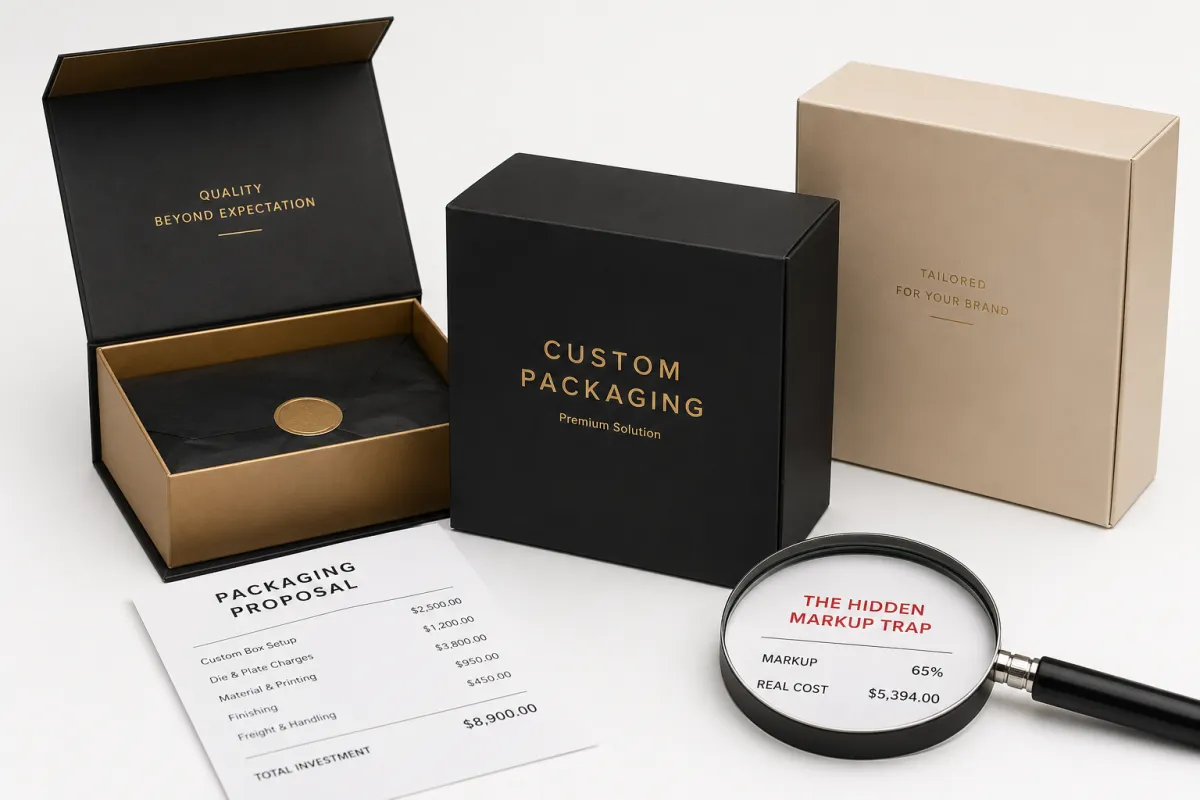
I still remember a quote that looked tidy enough to lull a buyer into a bad decision: a Chicago nutrition brand wanted 5,000 rigid cartons, 12 x 8 x 5 cm, 350gsm C1S board, unit price $0.62, setup fee $760. Then the second page showed up. Plate change, $210. Proof correction, $145. Production coordination, $190. By the time the call ended, the total had climbed again. That was not pricing. That was a magician's sleeve with better typography.
Setup fees are not decorative fees meant to pad a margin and confuse procurement. They pay for real work before the first sellable unit exists: die build, prepress checks, mold seating, ink calibration, press make-readies, and sample approval. A carton run on 350gsm C1S often needs tooling plus at least one or two proof cycles before the line is stable. Flexible packaging behaves differently, but the pattern is the same. The supplier has to get the machine into a repeatable state before they can sell you a clean unit cost.
The economics are plain once you strip away the theater. A $600 prepress block spread across 3,000 units adds $0.20 per unit; spread across 60,000 units, it adds $0.01. That is why how to negotiate custom packaging setup fees starts with cost recovery math, not instinct. Fixed work is fixed work. Optional work is optional. If you separate die build from extra proofs, and extra proofs from late-stage file changes, the quote stops looking mysterious.
Most buyers ask for a lower setup fee before they know what is inside it. That is backward. I sat in a Dongguan line review once where the operator looked at a food-and-beverage carton quote and pointed to the revision log: three art changes, one replate, one extra trial. He laughed, not unkindly, and said, "That setup only looks cheap because your files were not final." He was right, and the truth was kinda inconvenient.
"If the setup line is vague, the factory is making room for later charges. Ask for the math first, then ask for the discount. On one Shenzhen project, that split took a $950 setup down to $640 without hurting quality."
That is the core rule for how to negotiate custom packaging setup fees: scope first, money second. A barcode move from the back flap to the side panel, a matte laminate switched to soft-touch, or a metallic spot added late in review can trigger another calibration pass. I watched one New Jersey packaging launch turn a "small" design adjustment into three revisions and a setup stack that doubled in under two hours. The supplier was not being dramatic. The scope had changed.
How it works: setup-fee mechanics before unit pricing
Setup follows production sequence, not anyone's mood. A clean quote usually moves through file review, preflight checks, first-off sample production, press check, and then repeat-run pricing. For a 24 x 16 cm carton, the first acceptable sample can take 36 to 60 labor hours before a single production unit ships. That means the first piece often costs more than the next 500. There is nothing suspicious about that as long as the invoice explains the labor.
Recurring and one-time costs sit side by side, but they do not behave the same way. Unit pricing changes with volume, paper grade, film thickness, ink coverage, and finish. Setup charges land once per colorway, structure, or material family. If you change a kraft mailer to a white SBS carton, move from gloss varnish to a longer UV cure, or jump from four-color process to six-color print, the setup changes too. I have seen a brand assume one die could support three SKUs until a fold line moved by 4 mm and forced a recut. That is geometry, not negotiation.
Add-ons cause the worst surprises when nobody puts a lid on them. Rush revisions, barcode changes, stock swaps, and extra approved samples can all be absorbed into a quote at first, then reappear as standalone charges later. A supplier can show a $0.03 per-unit improvement and quietly add $250 in adjustment setup. The numbers still "work" on paper, but the buyer has paid for the relief with a hidden line item elsewhere.
One Chicago packaging team wanted a low-cost launch and made four last-minute changes: nutrition panel, flavor panel, foil effect, and start date. We tracked the escalators one by one. An ingredient panel update. Another art review. A foil-block change. A weekend press start. Setup moved from $480 to $1,110 before the first carton printed. A week later, after they froze the scope, the next quote made more sense. That is usually how it goes once the panic passes.
Benchmark ranges help, but only if you use them with context. A simple label might land around $180 to $260 for setup at 10,000 units in a standard format. A custom full-color rigid carton at the same volume can sit between $650 and $1,400 when embossing, special coating, or unusual folds are involved. Flexible packaging carries a different kind of friction: web tension, seal station alignment, and film handling can add $120 to $300 per setup cycle, regardless of material cost. These are ranges, not promises. Region, machine condition, and file readiness all move the number.
Cost and pricing factors: what drives custom packaging setup fees
Complexity creates the slope. A 2-color food label with high ink coverage usually has a lighter prepress profile than a 6-color beauty carton with two metallic effects and a transparent window. On one quarter's worth of RFQs I reviewed, a single-color label came in at $230 setup, while a laminated six-color sleeve rose to $690. The spread was not arbitrary. More plates. More approvals. More make-ready time. More chances for a file to drift out of tolerance.
MOQs matter most when cash is tight. A 2,500-unit minimum forces setup recovery into a smaller block of product, which is why low-volume jobs often feel expensive. I have seen 12-micron flexible film quotes with a 2.5k MOQ land at $900 setup, while a 10k-unit option dropped to $620 because the nonrecurring work got spread more efficiently. You can push back by reducing colors, aligning substrate families across SKUs, or simplifying the die line so it does not require extra folds or additional tooling checks.
Timeline pressure also gets priced in. If a buyer asks for a holiday launch 120 days out but enters the project at day 102, factories in Ningbo and Shenzhen often apply rush bands of 10% to 25%. In one Shenzhen quote, a Friday 2 p.m. change request pushed the schedule into a weekend changeover, and the supplier added $180 for production rebooking. Nobody was being spiteful. Overtime and line sequencing cost money, plain and simple.
When I benchmark quotes, I ask suppliers for a split sheet with categories that actually mean something: prepress, die prep, proofing, materials, sample handling, and quality control. If the supplier only sends one lump sum, there is plenty of room for padding. If they break it into six lines, the negotiation changes shape. Suddenly you can see which pieces are real technical work and which pieces are just admin dressed up as necessity.
| Packaging type | Typical setup drivers | What to ask for | Negotiation angle |
|---|---|---|---|
| Custom printed boxes | Die build, plate prep, folder-gluer setup, print registration | Itemized tooling hours and proof count, usually 1 full proof plus 1 correction | Bundle multiple SKUs with the same dieline family and the same 350gsm artboard spec |
| Flexible packaging | Web alignment, seal testing, color calibration, material changeovers | Press time split by hour and tooling split by die change | Cut color count from 5 to 4 or freeze the film structure before approval |
| Labels | Plate prep, artwork revision, roll orientation, adhesive checks | Fee per artwork version and fee per rerun after approval | Lock version control dates and keep barcode layout constant |
| Stand-up pouches | Pouch forming, zipper alignment, seal verification, sample approval | Clear sample and approval limits, such as 2 samples maximum | Offer a tighter 72-hour approval window in exchange for lower setup load |
The strongest model for how to negotiate custom packaging setup fees is simple subtraction: show what is included, then remove what is not required. If the fee covers three die changes, two proof rounds, and one sample rerun, maybe you only need two of those pieces. Maybe you do not need the rerun at all. That framing keeps the discussion anchored in production reality instead of vibes, and it is much harder for a quote to hide in that light.
How to negotiate custom packaging setup fees: a 6-step plan
Negotiation is a process, not a personality trait. I have sat with converters in Hong Kong and packaging studios in Chicago where one quote showed $220 setup and another effectively charged $920 under a bucket labeled "art coordination." Same brand. Similar SKU count. Same volume. The difference was preparation: clean scope, revision guardrails, and version ownership. That is the part most teams miss when they ask how to negotiate custom packaging setup fees and expect the first answer to be fair by default.
- Build a real-cost baseline. Start with fixed project data: design freeze date, maximum revisions, minimum run size, and format type. If you name box size, board grade, total ink coverage, and finish upfront, vague setup fees are harder to defend.
- Ask for an itemized fee sheet. Request separate lines for die prep, plate prep, prepress, proof uploads, sample approval, and calibration. If a supplier combines color calibration with handling, ask how many hours sit in each bucket. In one Guangdong quote, a split turned a single $700 line into $320 prepress, $180 calibration, and $200 sample handling. Still valid. Just no longer foggy.
- Bundle by substrate and color family. If two SKUs share the same substrate and color stack, ask for one setup umbrella across the family. For a beverage launch with three 250ml pouch variants, we negotiated a single setup at $540 instead of three separate $300 lines because the shared die and artwork zones reduced labor. The factory still got paid. The buyer stopped paying three times for one motion.
- Trade timing for price. Factories regularly lower setup fees when buyers accept fixed proof windows. One Guangzhou buyer gave a Tuesday noon file freeze and a no-change-after-first-approval rule, and carton setup moved from $710 to $540. The tradeoff was a two-business-day proof extension. That is a clean exchange, and both sides know it.
- Link concessions to stability. If there are no revisions after the first approved proof, ask for fee relief tied to that condition. A $480 setup with a revision-free proof guarantee or a $40 credit on the next 10,000-unit run gives the supplier a reason to value your discipline. Stability has a price. So does chaos.
- Get it in writing immediately. Put revision limits, expiration dates, and fee caps into the RFQ or purchase order. A useful line reads like this: one-time fee cap of $650, no additional setup unless design, substrate, or carton dimensions change, and changes processed only with PO amendment number and approval timestamp. If the supplier does not like that, they are telling you something useful.
What to ask before the quote turns into a trap
Ask three questions with numbers attached: what is included in base setup, what triggers each fee threshold, and what counts as rework. If barcode relocation is billed as a fresh setup above 2 mm of movement, you need that detail before proof approval, not after. At a plant in Guangzhou, I watched a buyer lose 18 hours because a "minor" ingredient panel edit was treated as a full setup event late in sign-off. The line did exactly what the paperwork allowed it to do.
How to trade speed for price
If you want a lower setup fee, give the supplier a measurable reason to grant it. On one tea-brand run, we reduced setup from $640 to $410 by locking dieline dimensions at 140 x 100 mm, accepting a standard 2-day proof cadence, and appointing one person to own approvals. The cost was two extra business days. The payoff was avoiding an overtime surcharge for a same-day change. $230 saved. That is the kind of math a plant manager understands immediately.
Regional comparison still matters. Huhtamaki, Smurfit Kappa, Berry Global, and DS Smith do not always structure quotes the same way across regions. A North American plant may fold sample handling into setup, while a European operation may bill sample handling separately at around EUR90 to EUR150 per sample. Comparing fee categories, not only totals, helps explain why a Shanghai quote can appear lower while carrying more change approvals, or why a Rotterdam quote looks higher but leaves fewer surprises later. The total is only half the story.
If your schedule is tight and your spec is stable, use our Custom Packaging Products request sheet before final review of unit pricing. One team in Phoenix used that approach to replace an ambiguous "setup TBD" field with actual values: die build $280, proofing $140, sample release $95. Once the numbers were visible, the rest of the quote stopped wobbling.
How do you negotiate custom packaging setup fees?
Start by asking for an itemized breakdown, then compare each line against your real scope. If the supplier cannot separate die prep, prepress, proofing, sample handling, and changeover time, ask them to do that. A clean counteroffer usually has three parts: a frozen file set, a revision cap, and a setup ceiling. That is the short version of how to negotiate custom packaging setup fees without turning the conversation into a pricing tug-of-war.
The best results come from trading certainty for savings. A supplier will often lower the setup fee if you lock artwork early, keep the substrate unchanged, and accept a fixed proof window. If the quote still floats, ask which part is optional, which part is mandatory, and which part only exists because the files are not final yet. That question can expose hidden recovery costs before they harden into the invoice. I have seen it happen more than once, and it saves a lot of back-and-forth.
Process and timeline: from inquiry to first production sign-off
Timing shapes setup behavior as much as design complexity does. A clean path often looks like this: inquiry day, two-day technical review, two-day negotiation, three-day prepress approval, two-day sample run, one day for sign-off, then tooling start. In the projects I run, first production sign-off usually lands 12 to 15 business days after proof approval for standard rigid packaging, and 16 to 21 business days for high-finish flexible film. That timeline is why every missed checkpoint carries a cost. It is not just a schedule issue. It is part of how to negotiate custom packaging setup fees without paying for preventable delay.
Buyer silence costs real money. In one Suzhou project, a missing logo file caused a 90-minute line stop, and at an effective line occupancy cost of $220 an hour, that gap became a $330 setup charge. The buyer thought it was a tiny file issue. The operator saw a stopped machine and a reset cycle. Manufacturing is very literal in that way. Incomplete info turns into cost fast.
I prefer update checkpoints every two business days for artwork, dieline, and sample readiness. That cadence catches noncompliance early. If the barcode drifts 3 mm into a fold radius, it gets corrected while the plate is still soft. If carton dimensions drift 2 mm beyond tolerance, it is fixed before trial setup. Miss those windows, and the change becomes a late-engineering event that can push setup back by $120 to $250 per issue, depending on line load and whether the plant is already booked.
Here is the timeline I use to keep how to negotiate custom packaging setup fees under control:
- 7 calendar days for technical quote feedback and file review.
- 3 business days for fee breakdown and line-item clarification.
- 2 business days for sample review and a no-guess revision call.
- One final frozen file set submitted before tooling or plate generation begins.
Negotiating early gives the factory options: swap to a similar board, adjust sample count, or change the proof protocol. Negotiate after tooling starts, and the supplier is charging for completed work, not for flexibility. In one New Jersey case, a team waited until week 4 to negotiate and spent another $160 in corrections that would have been unnecessary if the 5-day review window had been used properly.
Common mistakes that make custom packaging setup fees explode
First mistake: chasing the lowest setup before risk control. A retailer saved $120 by accepting a "low" $380 setup on 3,000 units, then paid $380 in revisions after missing color proof tolerance and alignment controls. The final landed cost doubled. Cheap setup that creates rework is not cheap. It just delays the pain.
Second mistake: incomplete files. A mockup PDF without bleeds, crop marks, and a safe zone is not a production file. When we received a 1.2MB low-resolution dieline for a 280 x 180 mm label in Toronto, prepress had to recreate paths and confirm the type area. That became a billable redraw. A final PDF with embedded Pantone references would have avoided it. Not glamorous. Very real.
Third mistake: accepting "setup included" without defining sample count, color checks, or change limits. If the contract says setup is $600 but does not state "three proofs and two samples included," the clause is open-ended by design. In one Chicago-to-Europe cosmetics launch, a 6-color box run began with that ambiguity and moved to a $220 extra sample fee after an unannounced retest. The buyer did not lose because the factory was sneaky. The buyer lost because the scope was blurry.
Fourth mistake: blending shipping prep into packaging setup. Courier labels, country-of-origin notes, and marking corrections can slip into the same bucket if the line items are not separated. For export cartons to Germany in a Hamburg warehouse, this happened with customs marking language and pallet labeling. Splitting those into logistics-administration lines prevented a $140 invoice surprise on the final week.
Fifth mistake: waiting until after PO release. Once the purchase order is accepted, schedule elasticity disappears. I watched a team in Austin try to renegotiate a setup adjustment five hours before prepress lock and get told there was no room left in the schedule. The room had already been closed by their own late approvals. The fee stayed at the upper band.
Sixth mistake: assuming reusable tooling is automatic. Ask whether the die, plate, or mold stays on file for the next run. In a 2025 skincare program, one supplier reused a die for 24 months only if storage and maintenance were paid annually. The next print run looked cheap until the old "included" tool was removed from the quote and the buyer had to pay a fresh $310 reactivation fee. That one catches a lot of people.
Expert tips from working with real factories and converters
Factories respond to commercial language tied to production reality. When you ask about die life, plate count, or waste percentage, the conversation shifts from discount theater to operational planning. In a Guangdong conversion job, using terms like "24-hour press occupancy risk" and "0.3% overrun allowance" changed the supplier response from generic to specific. That specificity is how to negotiate custom packaging setup fees without creating friction. The plant sees that you understand their process, and they usually stop trying to bluff.
Use a proposal rhythm that mirrors converter workflow: base fee first, then measurable concessions. Ask for a lower setup if you can guarantee stable files, a pre-approved material stack, and one owner for all revisions. In a stand-up pouch rollout in Rotterdam, that combination reduced setup from EUR760 to EUR550 because the supplier could drop uncertainty around version churn. They were not giving away margin. They were trading risk for predictability.
Ask one diagnostic question: what is tooling labor and what is press-time labor? If the supplier cannot answer with separate values, the quote probably hides broad recovery. One supplier once split the fee 70/30 and later admitted that the sample handling charge was tied to internal labor, not material handling. That is not automatically wrong, but it needs to be visible. Hidden labor is where buyers get tripped up.
Payment terms are part of the negotiation architecture too. A common structure is 40% deposit, 40% after approved sample, 20% before start. Add a line that caps late-approval penalties so design, legal, and marketing misses do not turn into surprise setup fees. I have used that model in Shenzhen and Chicago. It tends to stabilize behavior on both sides. Factories can plan cash flow. Buyers can protect themselves from moving goalposts.
On a beauty program with 15,000 units, we negotiated a fixed base setup of $880, a revision cap of 2, and a no-extra-fee clause for design, substrate, or size only when changes stayed within tolerance. When marketing requested a late copy edit in week 2, the team paid for one true modification only, not a cascade of rework charges. That single clause cut a potential second setup event of $600. It was not magic. It was language.
The best negotiators in this area are not loud. They are exact about thresholds: "No more than two revisions by Thursday at 3 p.m.; if changed, charge only this line and only this line." That kind of precision works on high-volume runs too. If you know what you are buying, you can preserve the relationship and still keep setup costs from drifting away from you.
What a clear supplier answer sounds like
A clear answer sounds like this: "Setup includes die build, first proof, color calibration, and one sampling cycle; each additional proof is $110, and each size change after approval adds $95." It is specific, almost boring, and perfect for negotiation because each future conversation now has a boundary.
A weak answer sounds like this: "We can probably work with you." That phrase usually shows up when scope is still undecided, and uncertainty is where setup escalation starts. In one warehouse packaging job in Shenzhen, that wording turned a $560 setup into an unplanned $940 after two change events that should have been captured in the first line item. Nobody likes that outcome, least of all the buyer who has to explain it upstream.
How to negotiate custom packaging setup fees: your final action plan
Start this week by splitting one live quote into three buckets: mandatory, optional, and removable. For a 5,000-unit run, the mandatory side might include one die build, two proofs, and one sample batch. Optional might include rush handling and extra revisions. Removable might include unnecessary barcode variants or duplicate approval loops. If the supplier's math still feels hazy, ask for a line-by-line breakdown before you accept the total. This is where how to negotiate custom packaging setup fees becomes a repeatable habit instead of a rescue mission.
Within 48 hours, send the same specs to two backup converters: one in Guangzhou and one in the Midwest. Ask each to define fee movement for first proof, second proof, die change, artwork change, and final sample approval. In one test, two suppliers came back with almost the same unit price but very different setup architecture: one at $610 fixed, the other at $590 with a strict change fee schedule that made hidden costs easier to predict. The totals looked close. The risk profiles were not.
Before approval, set hard limits: max setup fee, max revision count, max turnaround extension. A practical set is a $650 cap, two revision rounds, and no more than three business days of schedule slip before penalties apply. If the quote cannot hold those boundaries, move to a backup plan before tooling begins. The number of fallback options directly affects negotiation power. That part never gets old.
Prepare a decision memo with three tracks: fastest, lowest-cost, and most stable. Example: Fastest - $1,200 setup, 10-day launch; Lowest-cost - $780 setup, 18-day launch; Most stable - $920 setup, 14-day launch with three locked checkpoints. That memo stops the room from arguing over one number and forces the team to choose trade-offs with known cost outcomes. It is a far better meeting than the usual "let's revisit after lunch" loop.
My final move is a written, testable request: We want to negotiate custom packaging setup fees down to X using the attached scope, proof schedule, and revision cap. Add a date, supplier ID, and expiry timestamp. Then ask for one response window, such as 24 or 48 hours. If the supplier accepts, great. If they hesitate, that hesitation tells you where the hidden costs live. That is the bit people skip, and it is usually where the savings are hiding.
How to negotiate custom packaging setup fees when the first quote feels too high?
Start with a full split. On a first pass, identify and remove at least one optional line item, such as rush handling ($80 to $140), extra proofing rounds (often $90 each), or oversized sample fees (sometimes $150 per variant). Then counter with a concrete envelope: for example, 8,000 units, two revisions only, one proof cycle, and barcode freeze after proof. The ask should include what gets removed and what you offer in return, such as fixed approval dates. A vague counteroffer usually gets a vague response back.
What is a fair range for custom packaging setup fees on a flexible packaging run?
For flexible packaging, real ranges depend on structure: a simple transparent film pouch with two colors can fall around $350 to $550 at 10,000 units; a foil or hot-stamp variant with six-color registration can move toward $900 to $1,700. If the quote claims $250 for a complex pouch with seal testing and special coating, flag it and ask for process-level justification before signing. That low of a number often means the supplier plans to recover cost elsewhere.
Can I negotiate custom packaging setup fees if my order volume is below supplier MOQ?
Yes, but precision matters more than volume. For 2,000-unit orders, a common strategy is a lower setup cap, for example $500 instead of $900, with a modest per-unit surcharge spread, such as +$0.08 per pack. Ask for reduced scope, one colorway, and a reusable design template in the same die family to avoid paying multiple make-ready events. Small orders can still negotiate well if the scope is tight.
How should I negotiate setup fees if design is not fully finalized yet?
Request a conditional quote with a clear base fee plus explicit change fees. Example: base setup of $620 for finalized artwork and $95 for each unresolved section not frozen by day 8. Add a strict change cut-off, like no design edits after 5 p.m. on Wednesday for first sample. In trials with one beverage team and one health-brand team in Shenzhen, that protocol cut late-edit charges by 30% to 40%. The goal is not to rush the creative team; it is to keep production from paying for indecision.
Is it possible to split custom packaging setup fees across multiple SKUs?
Yes, when SKUs share substrate, dieline, and print stack. Ask for a family cap, for example one $850 setup across four variants, then apply only incremental charges for real differences such as barcode position or label size. It works well for branded packaging programs where flavor variants share the same carton geometry and print process across multiple fulfillment regions. If the supplier says no, ask which part of the tooling truly changes. Sometimes there is a real reason. Sometimes there is just habit.
If you only do one thing, freeze the file set before you ask for a lower number. That is where most of the savings live, and it is also where most of the surprises begin.
Related packaging resources
Use these related guides to compare specs, costs, quality checks, and buyer decisions before making the final call.