Buyer Fit Snapshot
| Best fit | Package Without Plastic projects where brand print, material claims, artwork control, MOQ, and repeat-order consistency need to be specified before quoting. |
|---|---|
| Quote inputs | Share finished size, material target, print colors, finish, packing count, annual reorder estimate, ship-to region, and any compliance wording. |
| Proofing check | Approve dieline scale, logo placement, barcode or warning zones, color tolerance, closure strength, and carton packing before bulk production. |
| Main risk | Vague material claims, crowded artwork, missing packing details, or unclear freight terms can make a low unit price expensive after revisions. |
Fast answer: Package Without Plastic: Material, Print, Proofing, and Reorder Risk should be specified like a repeatable production item. The safest quote records material, print method, finish, artwork proof, packing count, and reorder notes in one written spec.
Production checks before approval
Compare the actual filled-product size with the drawing, then confirm tolerance on folds, seals, hang holes, label areas, and retail display edges. Reserve space for logos, QR codes, warning copy, and material claims before decorative graphics fill the panel.
Quote comparison points
Review material grade, print process, finish, sampling route, tooling charges, carton quantity, and freight assumptions side by side. A quote is only useful when the supplier can repeat the same color, closure quality, and packing count on the next order.
Custom Logo Things
How to Package Without Plastic: Smart Sustainable Ideas
If you want to understand how to package without plastic and still ship a product that survives a 1,200-mile truck route or a cross-dock transfer in 38-degree heat, start with the uncomfortable truth: I once opened a shipment wrapped in film, tape, and extra sleeves so heavy that the packaging felt more substantial than the product. Three layers of plastic around one carton, plus a poly bag inside. That is not thoughtful design. That is panic with a purchase order. When brands ask me how to package without plastic, I give them the same answer I gave a skincare founder in Los Angeles after we unpacked a pallet of cracked 50 mL glass jars: the job is not to remove plastic by force, it is to replace it with materials and structures that protect the product, print cleanly, and survive a pallet ride across a warehouse floor or a courier van doing 55 mph on the 405.
How to package without plastic is a systems problem dressed up like a values problem. Product safety, ink coverage, freight cost, assembly speed, and end-of-life disposal all sit in the same carton, and one weak spec can unravel the whole run. I have spent enough time on factory floors in Shenzhen, Dongguan, and Huizhou to know that the cheapest green-looking option often becomes the most expensive once returns, reships, and customer complaints start stacking up like bad decisions after a 2 a.m. production line shift. A practical approach to how to package without plastic uses paper, fiber, and smarter structure so the packaging earns its place instead of just looking virtuous on a mood board.
How to Package Without Plastic: Start With the Real Problem
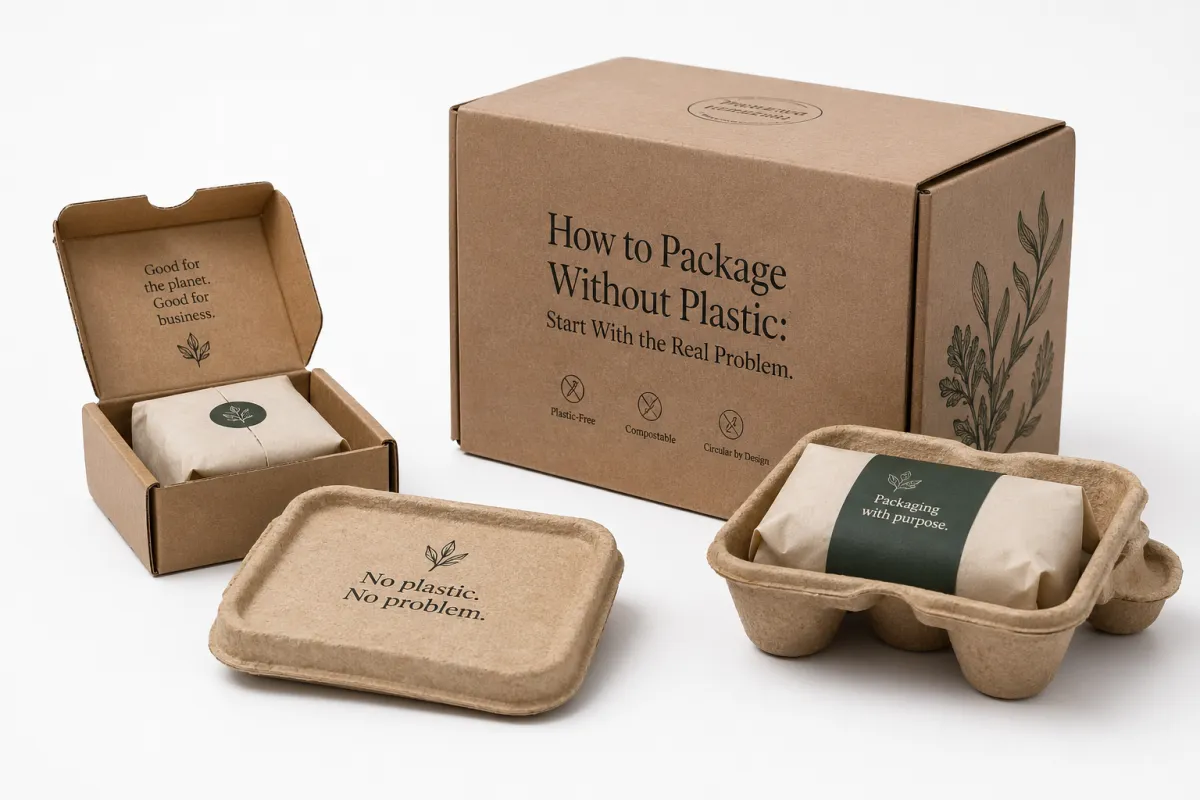
Before anyone orders a "sustainable" sample, I ask one blunt question: what job is the plastic doing right now? Sometimes it blocks moisture. Sometimes it prevents scuffs on a coated surface. Sometimes it exists only because the last supplier in Yiwu used it and nobody challenged the spec sheet. A cosmetics founder in Brooklyn once told me she wanted how to package without plastic for a serum line, yet her current setup used a shrink band, a PET tray, bubble wrap, and a laminated carton with a soft-touch film. Four plastic decisions, and only one of them actually protected the bottle during transit. The other three were habits with a cleaner name.
Most packaging projects drift off course right after the first round of enthusiasm, usually because the team jumps straight to sourcing without asking what the current material stack is doing. That is the part everyone wants to skip, and it is the part that saves the most money. Real plastic-free packaging means replacing liners, tapes, void fill, tray materials, coatings, and barrier treatments with fiber-based, recyclable, compostable, or reusable materials that can do the same work without turning production into a mess or the recycling bin into a junk drawer. If you are serious about how to package without plastic, start with the material list before you start writing the brand story. I trust a clear spec sheet with a 350gsm C1S artboard callout more than a beautiful pitch deck every single time, because the board grade tells me more about the real outcome than the adjectives ever could.
Customers notice the gray area faster than most teams expect. They can tell the difference between a box that is truly paper-based and one that uses an "eco" label to hide a plastic-lined sleeve inside. I have seen a brand lose trust over a flimsy wrapper when the retail product itself was excellent, and I have seen a $3.00 price increase go over better than a package that looked green but felt misleading. Clear materials, simple disposal, and honest labeling make the story easier to believe. That matters whether you ship 500 units from a warehouse in Dallas or 50,000 units out of a fulfillment center in Savannah, Georgia, because people read the small material notes on the box, especially the ones who email support later.
Factory-floor truth: if the package fails in transit, it is not sustainable. It is decorative waste with a nicer backstory and a higher freight bill.
The promise of how to package without plastic is straightforward. You can protect the product, keep costs under control, and avoid the drawer full of "technically recyclable" materials that never actually get recycled. The trick is structure, not slogans. A carton with a 1.5 mm corrugated insert and a 72-hour compression requirement will tell you more than a thousand words of copy ever could, and that is the kind of detail that keeps a project grounded.
How Do You Package Without Plastic?
The short answer is to match the material to the job. Use corrugated inserts for separation, molded fiber for shock absorption, kraft paper mailers for soft goods, glassine for clean inner wraps, and paper tape or starch-based fill where the old packout relied on plastic tape and air pillows. If you are learning how to package without plastic, the best starting point is a clean audit of what each layer actually does, followed by a direct paper-based replacement that can survive shipping, storage, and handling without drama.
The better version is a system that protects the product first, then handles branding, then gives customers a disposal route that is easy to understand. That is the real answer to how to package without plastic: not one perfect material, but a stack of practical choices that work together in the warehouse, on the delivery truck, and in the customer’s hands.
How It Works: Materials That Replace Plastic
When people ask me how to package without plastic, they usually want a concrete material list, not a lecture. That is fair. Corrugated inserts, molded fiber, paper mailers, glassine, kraft paper tape, tissue, starch-based void fill, and reusable cloth or paper wrap can replace a surprising amount of plastic when each material is assigned a specific job, whether that means a 0.8 mm score line or a 90 gsm tissue wrap that keeps a coated surface from rubbing.
Corrugated inserts work well when you need to separate products inside a rigid carton. I like them for subscription boxes, small electronics, and gift sets because they die-cut cleanly on a 1620 mm flatbed cutter and print well with one-color or two-color ink. Molded fiber is usually the better answer when you need snug, shock-absorbing support around bottles, jars, or fragile accessories. It is not flashy in the luxury sense, but it is honest, and honesty tends to hold up when the structure is right. I still remember a sample run in Dongguan where a client kept asking for a thinner insert to save money; we finally cut one corner too far, dropped the box from waist height, and watched the product turn into a very expensive lesson. The insert got thicker after that, by exactly 1.2 mm, and the breakage rate fell on the next test.
Paper mailers are often the best fit for apparel, soft goods, and lightweight accessories. I have watched brands switch from poly mailers to kraft mailers and keep shipping costs close to flat because the dimensional weight changed by less than 0.2 lb per shipment. Glassine is useful for keeping surfaces clean and adding a grease-resistant layer for food or cosmetics, especially when a lip balm or soap bar sits in a retail sleeve for 10 to 14 days before sale. It is not a universal fix. If your product sweats, leaks, or ships warm, glassine alone will not save the carton. I say that as someone who has wiped down too many samples in a Guangzhou studio with paper towels and a resigned face.
Kraft paper tape is one of my favorite small upgrades. It bonds well, looks cleaner than plastic tape, and reduces material clutter on the packing line. For void fill, crumpled kraft paper and starch-based fill can replace air pillows in many shipments, especially if your outbound cartons are under 18 inches on the longest edge. I have also seen reusable cloth wraps work well for premium gifts and retail presentation, especially when the customer is meant to keep and reuse the wrap for travel or storage. That second life matters more than people think. A package that stays in use for six months is doing better than one that looks noble for five seconds in an unboxing video.
The part people skip is the limit case. Moisture barriers, tamper evidence, and grease resistance still matter. If you are shipping bath salts in humid weather or olive oil in July, how to package without plastic may still call for a careful barrier strategy. Paper alone is not always enough, and pretending otherwise is how you end up with soggy cartons, warped flaps, and a flood of angry emails that arrive right before lunch, which is apparently when packaging failures enjoy becoming urgent.
| Product Type | Best Plastic-Free Replacement | Typical Use Case | Notes |
|---|---|---|---|
| Apparel | Kraft paper mailer | T-shirts, socks, lightweight textiles | Low cost, fast packing, clean branding |
| Glass bottles | Molded fiber insert + corrugated box | Skincare, sauces, fragrances | Needs tight fit and drop testing |
| Gift sets | Corrugated divider set + tissue wrap | Multiple items in one carton | Good presentation if print is controlled |
| Food items | Glassine, coated paper, or fiber tray | Dry snacks, bakery, takeaway | Check food-contact rules before launch |
| Premium retail goods | Rigid paperboard box + paper wrap | High-margin consumer goods | Best for shelf impact and unboxing |
For sourcing, I always tell clients to ask for the actual material spec, not the marketing label. A "kraft box" can mean 128gsm kraft paper over 2.5 mm board, or it can mean something so flimsy it buckles if you set a label roll on top of it. If you are learning how to package without plastic, details matter more than adjectives. Ask about basis weight, flute type, finish, adhesive performance, and whether the material is FSC-certified if that sits inside your brand promise. I trust a clear carton spec from a supplier in Xiamen or Qingdao more than a warm sales pitch, because the sheet tells you what the line can actually hold.
I still remember a supplier negotiation where the difference between a molded fiber insert and a paper-pulp tray was $0.08 per unit at 10,000 pieces. Eight cents sounds tiny until the order becomes 10,000 units and then another 10,000 after that and then, somehow, the founder wants a promotional run in Q4 because "the numbers should work." That is why how to package without plastic never stays inside a design conversation. It is a sourcing conversation too, and sometimes a math conversation, which is less romantic but much more useful when the landed cost is being built in a spreadsheet cell at 11:18 p.m.
For standards and disposal guidance, I often point teams to the EPA recycling guidance and to transit-testing resources from the ISTA. Those references will not design your packout, but they keep the conversation grounded in what gets recycled and what survives shipment. A carton that passes ISTA 3A after a 24-inch corner drop test is a very different object than one that only looks nice under studio lighting.
Key Factors: Protection, Branding, and Sustainability
The strongest answer to how to package without plastic sits where product fragility, shipping method, and the unboxing experience overlap. Leave one of those out and the whole system turns shaky. A rigid box may look polished, but if the insert does not hold the item in place, you are paying for elegance and buying damage claims. I have watched that movie more times than I care to admit, and the ending is never surprising, especially when the carton is moving through a 3PL in Chicago during peak season.
Protection comes first. A bottle of shampoo is not a ceramic mug. A jar of face cream is not a folded T-shirt. I had a client try to use the same paperboard carton for both, and the mug arrived intact while the cream lids popped loose because the void fill was too soft. That is why how to package without plastic starts with how the product behaves, not with the box color or the finish on the sleeve. If the carton cannot survive a bad day in the back of a truck, no amount of design language will save it, even if the outer box is a clean 350gsm C1S artboard wrap with a neat 1-color logo.
Branding comes next, though only by a small margin. Paper and fiber can look premium when the print, texture, and structural fit are right. I have seen simple kraft packaging outperform glossy retail boxes because the typography was sharp, the folds were clean, and the unboxing felt deliberate. You do not need a plastic sheen to signal quality. You need alignment, consistency, and a finish that looks like someone cared enough to get the details right. In fact, a natural kraft mailer with a tight fold and a 1-color black ink imprint often feels more expensive than a high-gloss sleeve because the restraint reads as intention.
Sustainability is more complicated than the label on the outside flap. Recyclable does not mean recycled. Compostable does not mean composted. Reusable only works if people reuse it. In my experience, the greenest option is the one your customers can realistically dispose of or repurpose correctly. If your buyers live in apartment buildings in Atlanta or Miami with mixed waste streams, a recyclable fiber pack may outperform a compostable material that never reaches the right facility. I know that is less satisfying than a clean slogan, but reality rarely asks for our permission, and the waste stream in a given ZIP code matters more than the copy on the carton.
The package also has to move through fulfillment without creating bottlenecks. Minimum order quantities, storage space, assembly time, and training all matter. A branded paper insert that takes 22 seconds longer to build can erase the savings from the cheaper material. That is why how to package without plastic is partly a floor-plan problem. The prettiest answer on a mood board is often the slowest one on the line, and the line is where the money actually disappears, especially when a team in a 15,000-square-foot warehouse is packing 6,000 orders a week.
Think about the trade-offs this way, with actual use cases rather than theory:
- Recyclable fits best when the local system accepts the material and customers already understand it, such as kraft mailers in Portland or Minneapolis.
- Compostable fits best when disposal access is real, not aspirational, like a food-service brand serving campuses with industrial compost pickup.
- Reusable works best for premium brands and giftable products where the package itself has a second life, like a rigid paperboard keepsake box with a magnetic-free tuck closure.
I have watched a brand choose a compostable solution because it sounded better on the website, then discover most of its customers had no access to industrial composting. That is a bad trade. How to package without plastic is not about sounding clean; it is about being useful in the hands of real people. If the customer cannot actually use the disposal route, the packaging story falls apart the moment it leaves your warehouse in Commerce, California.
How to Package Without Plastic: Step-by-Step Process and Timeline
If you want to move quickly without creating a mess, keep the process tight. The brands that handle how to package without plastic well do not begin with sourcing. They begin with an audit. I learned that the hard way during a run for a subscription brand shipping candles, cards, and samples in one kit. We saved money on filler, then lost it on breakage because nobody had mapped the weight distribution of the products inside the box. The box looked elegant. The candles disagreed, especially after a 26-inch drop from a test cart onto a concrete floor in Oakland.
- Audit the current packout. List every material, from the primary carton to tape to filler. Measure weight, dimensions, and breakage risk. If you cannot describe the system in numbers, you are not ready to replace it. A 14 oz product in a 9 x 6 x 4 inch carton behaves differently than a 4 oz product in a 7 x 5 x 2 inch carton.
- Define the failure points. Identify what plastic is doing now. Is it keeping out moisture, holding shape, or preventing scuffs? The answer decides the replacement, and the replacement should be based on the product rather than the supplier's favorite inventory item.
- Choose the nearest paper or fiber substitute. Molded pulp, corrugated inserts, paper mailers, and glassine do the real work here. Pick the version that matches the load, the shape, and the humidity instead of the one that just photographs well.
- Prototype the packout. Order 2 to 3 samples from different suppliers. Compare fit, print, and assembly speed. A sample that takes 9 seconds to assemble may be better than one that takes 18 seconds, even if the finish is prettier.
- Test shipping performance. Run drop, compression, vibration, humidity, and temperature checks before you commit. In the summer, 85% relative humidity can change how paper behaves in ways the render file never warned you about.
- Refine and place the order. Adjust die lines, insert thickness, or closure style based on the test results. Then lock the spec so the next quote does not drift by 0.4 mm and turn your carton into a guessing game.
For small brands, the process can move in a few days when you are changing materials rather than rebuilding the structure. Swapping poly mailers for kraft mailers, or bubble wrap for crumpled kraft fill, may only require 1 to 2 sample rounds and a quick fit check in the warehouse. For larger brands, especially those with retail compliance or food-safe requirements, how to package without plastic can stretch into several weeks because testing and approvals pile up quickly. I have seen "quick" packaging projects quietly become 3-week projects because one closure fold needed to be redrawn. That is normal. Annoying, yes. Normal, also yes.
My usual timeline looks like this: 3 to 5 business days for sample requests, 7 to 10 business days for the first prototypes, 1 to 2 revision rounds, and then production once the packout survives shipping tests. For custom jobs in Shenzhen or Dongguan, production is typically 12-15 business days from proof approval if the board is standard and the finish is simple. If the item is fragile, I add more time. No one likes hearing that, but I have said it anyway while looking at a sample that almost works and thinking, almost is not a shipping strategy.
Test what matters: a package that looks polished on a desk can still fail in a truck. That is why I push for real transit testing. One client in Texas insisted their paper-based carton was "strong enough" because it passed a hand squeeze test. It failed a corner drop within 20 minutes of the first shipment. Hand tests are not shipping tests. That is optimism with paperwork, and optimism does not pay for replacement goods in a fulfillment center at 6:30 a.m.
Packaging labs and standards exist for a reason. Drop testing and compression testing are not glamorous, but they save money. If you are using how to package without plastic as a launch strategy, make the tests part of the plan, not a last-minute apology. The cost of one failed shipment run can wipe out the savings from the entire material switch, and I do mean wipe it out in the most irritating spreadsheet way possible, usually somewhere between line 42 and line 67.
How to Package Without Plastic: What It Costs, MOQ, and Trade-Offs
Money matters, so let us talk straight about it. The cost of how to package without plastic depends on material thickness, print coverage, tooling, labor, and how much custom cutting the design needs. A plain kraft mailer can be cheap. A printed rigid set with molded fiber can be very much not cheap. There is no moral discount at the factory gate, and the factory certainly does not care how good the Instagram caption sounds.
These are realistic ballpark ranges I have seen for mid-volume runs around 5,000 pieces from suppliers in Guangdong and Zhejiang. They move with location, board grade, and finish, but they are useful for planning:
| Packaging Option | Typical Price per Unit | MOQ Reality | Best Fit |
|---|---|---|---|
| Kraft paper mailer | $0.15 to $0.38 | 2,000 to 10,000 | Apparel, soft goods, lightweight accessories |
| Corrugated mailer with print | $0.32 to $0.78 | 1,000 to 5,000 | Gift boxes, ecommerce sets, small electronics |
| Molded fiber insert + carton | $0.26 to $0.60 for insert only | 5,000 to 20,000 | Glass, cosmetics, candles, fragile items |
| Rigid paperboard box | $0.88 to $2.30 | 1,000 to 3,000 | Premium retail and giftable products |
| Paper tape and tissue set | $0.04 to $0.11 | 5,000 to 50,000 | Secondary packaging and visual polish |
The annoying part is that the lowest unit price is not always the lowest total cost. I have watched brands save $0.06 on material and then spend $0.40 per unit fixing damages, returns, and customer support time. That is terrible math. If how to package without plastic cuts breakage from 3.2% to 0.8%, the slightly higher carton price can pay for itself in a single quarter. I would much rather explain a modest packaging increase to finance than explain why the fulfillment team is quietly drowning in re-ships.
MOQ matters because tooling and setup costs get spread across fewer units when runs are small. If you want custom molded fiber, expect the first run to feel expensive. That is normal. A client once wanted a 1,500-piece pilot with a fully custom insert, and the quote looked high until I explained that the mold, sampling, and machine setup were being divided across a tiny order. They either paid for the tooling or paid for damage later. There was no third option. In a factory in Foshan, that same math showed up on a whiteboard in marker, and the numbers did not care about the deadline.
Hidden savings show up too. Less plastic can mean less waste hauling, fewer packaging SKUs, and fewer customer complaints. A cleaner brand story can support a slightly higher retail price if the packaging feels thoughtful instead of performative. When I negotiated with a supplier in Ningbo for a skincare line, we found that replacing a plastic tray with a paper-fiber insert added $0.11 but reduced breakage enough to cut returns by almost half. That is the sort of trade that makes how to package without plastic a business decision, not just an ethics statement, and it holds even when freight to the East Coast jumps by 8% in a bad season.
Labor deserves attention. If a package takes longer to assemble, your fulfillment cost rises. I have seen a beautiful paper-based setup add 14 seconds per order. That sounds small until you multiply it by 8,000 orders a month. If the design slows the line, simplify it before you scale. I know that advice is less fun than a shiny mood board, but a fulfillment team with a clean bench, a good blade, and a faster line is a beautiful thing in its own right.
Common Mistakes When You Package Without Plastic
The first mistake is choosing materials because they are plastic-free, not because they protect the product. I know that sounds obvious. It should be obvious. Yet I still see brands pick a thin kraft sleeve for a glass item and then act surprised when the bottles arrive broken. How to package without plastic only works when the replacement is structurally right, not just morally satisfying, and a 250 gsm sleeve does not magically become shock protection because the label says "eco."
The second mistake is oversized boxes. Extra empty space means more movement, more filler, and more freight cost. If you are using how to package without plastic as your packaging strategy, fit the item properly. A box that is 30 percent larger than it needs to be is just waste with a logo on it. I have had to say that sentence out loud more times than I would like, usually while holding a carton that could have fit three fewer air gaps and one more ounce of common sense.
The third mistake is poor sealing. Paper tape is good, but only when the adhesive, application pressure, and carton surface work together. I have watched crews slap tape onto dusty cartons and then wonder why the flaps lift in humid weather. That is not a material problem. That is a process problem. A sustainable package still has to stay closed, which feels like a low bar until you watch a whole production day stumble over it in July heat and 82% humidity.
The fourth mistake is treating eco packaging like a compromise. It does not have to look dull. It does not have to feel flimsy. I worked with a client who assumed their recyclable setup would look "less premium," so they overcompensated with extra print and a complicated sleeve. The result was noisy and expensive. We simplified it to a clean kraft carton, one-color print, and a die-cut insert. The new version looked better and cost less. That was one of those rare days when restraint was not only tasteful, it was profitable by about $0.19 per unit.
The fifth mistake is skipping compliance checks. Food-safe needs, moisture exposure, and local recycling rules all matter. A paper-based solution that works in one market may fail in another because local infrastructure is different. That is why how to package without plastic should include a disposal check before launch, not after customers start sending photos of their curbside bins. Nobody wants to become the brand featured in a very polite complaint thread from Minneapolis or Bristol.
The failures I see most often look like this:
- Weak structure that collapses under stacking pressure in transit or storage
- Flimsy inserts that let products shift during a 24-inch drop test
- Over-designed branding that raises cost without adding value on a $12 product
- Ignored humidity that ruins paper performance during summer shipping
- No pilot test before a full production run of 10,000 units
Most packaging problems are preventable. They only need a few boring checks before the purchase orders go out. Boring is good. Boring saves money. Boring also keeps me from getting emergency photos of crushed cartons at 7:42 a.m., which I can tell you is not how anyone wants to start a Tuesday, especially if the warehouse is in Newark and the replacement stock is still on a boat.
Expert Tips and Next Steps for Your First Run
If you are starting how to package without plastic for the first time, do not try to solve everything at once. Pick one packaging format, request samples from 2 to 3 suppliers, and test a small pilot shipment before you scale. That is the cleanest path, and it keeps the mistakes small enough to fix. I like to start with one SKU, one shipping lane, and one clear acceptance test, because those constraints make the work manageable.
My favorite rule from the factory floor is this: if the packaging fails in transit, it is not sustainable. It is decorative waste. I say that because I have seen too many beautiful cartons fail a drop test and get pushed into production anyway because the photos looked nice. Photographs do not protect glass. Compression ratings do. I would love to say otherwise, but the truck does not care about our branding deck, and the conveyor in a warehouse outside Shenzhen is even less sentimental.
Build a simple spec sheet before you quote anything. Include product dimensions, weight, fragility notes, the number of items per box, the required print areas, and any branding details such as matte versus natural kraft or a 350gsm C1S artboard wrap. If you are learning how to package without plastic, a clear spec sheet will save you from vague quotes and bad assumptions. Suppliers quote better when the brief is specific. I have seen a vague one-line brief cost a week of back-and-forth that no one had time for, and the extra days usually show up right when the launch calendar is already tight.
Decide your disposal story early. If the package is recyclable, say so only if the stack actually qualifies. If it is compostable, make sure your customer can realistically compost it. If it is reusable, design it to hold up for a second life. I have seen brands spend $12,000 on packaging development and then forget to tell customers what to do with the box. That is a missed opportunity with a neat finish on top. The box did the hard work; the message just wandered off, probably because nobody gave it a specific recycling line or a care card in the tray.
My three-step starting plan stays simple:
- Select one package structure that matches the product’s risk level and your shipping lane, whether that is domestic ground from Pennsylvania or export freight from Shenzhen.
- Get 2 to 3 sample rounds from suppliers who can quote exact specs, board weights, and lead times in writing.
- Pilot 50 to 200 shipments and track breakage, returns, and customer feedback before you place the full run.
That process is not glamorous. It is effective. In packaging, effective beats pretty every time, especially when the difference shows up as fewer damaged units and a cleaner line for the fulfillment crew.
If you want the cleanest path on how to package without plastic, keep the real goal in view: protect the product, keep the brand sharp, and use materials that make sense after the box leaves your hands. I have seen brands fixate on the absence of plastic while ignoring fit, structure, and shipping abuse. That misses the point. How to package without plastic is a process of testing, tightening, and improving. Do that well, and you get packaging that ships better, looks better, and actually earns its place in the customer’s hands.
Common Questions
How do you package products without plastic for shipping?
Use a rigid outer carton or paper mailer matched to product weight and fragility, then replace void fill with molded fiber, crumpled kraft paper, or paper wraps. If you are serious about how to package without plastic, test the packout in real transit conditions Before You Buy in bulk. That part is not optional, even if the sample on your desk looks adorable and the render file has perfect shadows.
What is the cheapest way to package without plastic?
Start with recycled kraft boxes, paper tape, and plain tissue or kraft fill. Standard sizes usually cost less than custom tooling, and minimal print keeps the first run lean. For how to package without plastic on a budget, simple wins until your damage rate is under control. Fancy is great, but only after the boxes stop arriving dented and the line stops rebuilding the same packout twice a day.
Can fragile items be packaged without plastic?
Yes, if the box structure and internal fit are designed correctly. Molded fiber, corrugated inserts, and tight paper cushioning can protect glass, ceramics, and cosmetics. Fragile products need drop testing, not optimism, and that is a big part of how to package without plastic responsibly. I have a soft spot for beautiful packaging, but I trust a good corner drop test more than a flattering render from a studio in New York.
How long does it take to switch to plastic-free packaging?
Small changes can happen in a few days if you are swapping materials instead of redesigning the structure. Custom work usually needs sample rounds, testing, and production lead time. Plan extra time if your packout must meet shipping, retail, or food-safety requirements. That is normal when you shift to how to package without plastic. Normal does not mean fast, unfortunately, but it does mean doable when the brief is clear and the supplier is responsive.
Is compostable packaging always better than recyclable packaging?
No. The better choice depends on local disposal systems and how the package will actually be used. Recyclable packaging often wins when customers do not have compost access. Choose the option most likely to be processed correctly, because how to package without plastic only works if the end-of-life story is real. A perfect label with a useless disposal path is just marketing with better lighting and a larger print run.
If you are ready to put this into practice, start with one SKU, one shipping lane, and one pilot run this week, then compare breakage, assembly time, and disposal clarity before you scale the rest of the line.
Related packaging resources
Use these related guides to compare specs, costs, quality checks, and buyer decisions before making the final call.


