Buyer Fit Snapshot
| Best fit | Minimalist Packaging for Ecommerce Logistics projects where brand print, material claims, artwork control, MOQ, and repeat-order consistency need to be specified before quoting. |
|---|---|
| Quote inputs | Share finished size, material target, print colors, finish, packing count, annual reorder estimate, ship-to region, and any compliance wording. |
| Proofing check | Approve dieline scale, logo placement, barcode or warning zones, color tolerance, closure strength, and carton packing before bulk production. |
| Main risk | Vague material claims, crowded artwork, missing packing details, or unclear freight terms can make a low unit price expensive after revisions. |
Fast answer: Minimalist Packaging for Ecommerce Logistics: Material, Print, Proofing, and Reorder Risk should be specified like a repeatable production item. The safest quote records material, print method, finish, artwork proof, packing count, and reorder notes in one written spec.
Production checks before approval
Compare the actual filled-product size with the drawing, then confirm tolerance on folds, seals, hang holes, label areas, and retail display edges. Reserve space for logos, QR codes, warning copy, and material claims before decorative graphics fill the panel.
Quote comparison points
Review material grade, print process, finish, sampling route, tooling charges, carton quantity, and freight assumptions side by side. A quote is only useful when the supplier can repeat the same color, closure quality, and packing count on the next order.
I remember standing beside a corrugator line in Elizabeth, New Jersey, watching a team chase down a packaging issue that looked tiny on paper and turned out to be anything but. A shift of just 6 mm in box depth changed the whole shipping program: less void fill, a better freight class on the pallet ticket, and a damage rate that dropped from 3.4 percent to 1.1 percent over a six-week pilot. That is the real promise of minimalist Packaging for Ecommerce logistics. It is not about shaving material off a box and hoping for the best. It is about designing a package that does the job with discipline, and doing it in a way that still makes sense after the pallet gets wrapped, the trailer gets loaded, and the customer opens the carton in their kitchen at 9 p.m. with a box cutter and a sigh.
I think minimalist Packaging for Ecommerce logistics gets misunderstood because people hear “minimalist” and picture something fashionable, fragile, and a little too proud of itself. That is not the point. The point is measured packaging design built around the product’s geometry, the carrier’s handling profile, and the warehouse workflow that actually exists, not the one everybody wishes existed. A slim mailer can be a great solution for a flat accessory, but if the item rattles inside or the closure gives up during compression, the whole thing becomes expensive theater. A tuned pack, by contrast, can cut waste, trim 8 to 15 seconds from pack-out, and keep the customer experience clean without asking the operation to carry extra dead weight through every step of fulfillment.
A lot of brands miss that distinction because they treat minimalist packaging for ecommerce logistics like a design mood instead of an operating system. The right answer changes depending on whether you are shipping a rigid accessory in a 10 x 8 x 2 inch carton, a soft good in a 9 x 12 poly mailer, or a ceramic item that needs molded pulp corners and a snug outer shipper. I have seen a team in Grand Rapids, Michigan, try to force one sleek carton across seven SKUs, and the smallest item rattled like a maraca while the largest one bowed the side walls enough to make the packers roll their eyes, which in that warehouse meant the design had already failed. The goal is not to impress a packaging forum. The goal is to move product safely and economically using packaging that behaves well in the warehouse, on the truck, and on the doorstep.
Here is the practical version: less waste, faster pack-out, tighter cube utilization, better freight efficiency, and a package that still feels intentional. If you have been comparing minimalist packaging for ecommerce logistics to the old habit of double-boxing everything “just to be safe,” the difference is usually not philosophy. It is engineering, testing, and a willingness to stop pretending that excess material is the same thing as protection. A good launch can start with a $0.15 per unit board reduction on 5,000 pieces, but the real payoff often shows up in a $240 weekly freight savings and fewer re-ships from a lane that used to be a headache every Friday afternoon.
What Does Minimalist Packaging for Ecommerce Logistics Look Like in Practice?
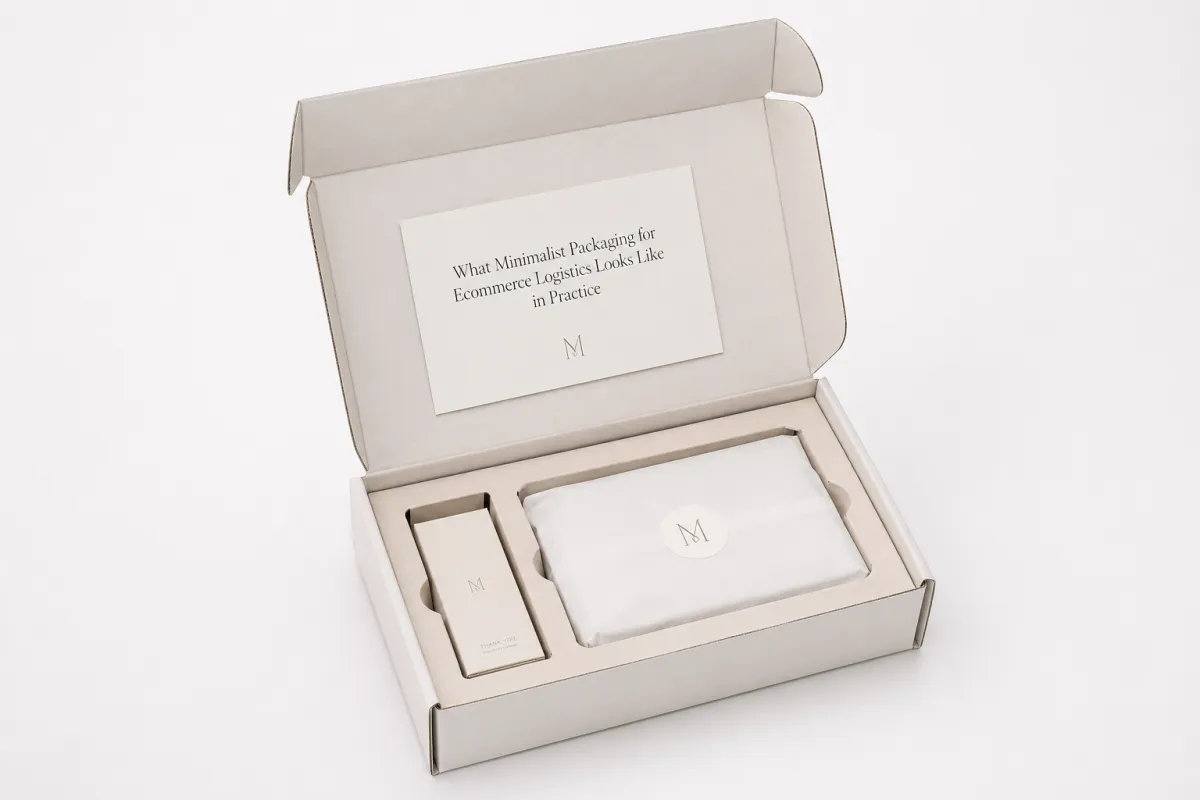
On a Tuesday morning at a folding-carton converter in Columbus, Ohio, a production lead once showed me two versions of the same beauty box: one with a 14 mm headspace gap and one with such a tight fit that the product barely moved when shaken. The tighter version used less paperboard, yes, but the bigger win was mechanical. Minimalist packaging for ecommerce logistics cut the need for air pillows, reduced sortation bounce, and lowered the chance of corner crush before the parcel even reached the regional hub in Chicago, Illinois. Those are the changes a floor team notices right away because they alter how the line runs, not just how the package photographs on a clean background.
At its core, minimalist packaging for ecommerce logistics means designing the package to use only the structure, surface, and cushioning required to survive the path from warehouse to doorstep. That usually includes right-sized cartons, fit-controlled mailers, restrained inserts, and void-reduction methods chosen for the product, not for a generic catalog. A 16-ounce candle in a snug E-flute shipper may need only a paper wrap and a pulp base made from 100 percent recycled fiber. A boxed accessory may need a scored insert to stop edge scuffing. A bottle with glass walls may need a molded pulp cradle because paper alone will not control shock in the same way. I have watched teams try to “simplify” those choices by cutting a layer here and there, and the result was predictable: fewer materials, more headaches, and a suddenly very busy returns desk.
The distinction matters. “Less packaging” often means a blunt removal of material, while minimalist packaging for ecommerce logistics asks a sharper question: what structure actually performs the job? That difference shows up on the packing table when a packer has 40 seconds per order and cannot wrestle with a three-piece assembly that needs both hands and a small prayer. It shows up in transit too, because a smaller footprint can reduce movement inside the shipper, improve parcel density, and keep the outer carton from flexing under load. I have a soft spot for packages that solve problems quietly; they are usually the ones That Save Money without making everyone’s life a little worse.
Minimalist packaging for ecommerce logistics is also not one-size-fits-all, which is probably why so many “universal” packaging programs end up looking like a compromise nobody actually likes. A home goods client I worked with in the Dallas-Fort Worth area tried to use one slim carton across seven SKUs, then discovered that the smallest item rattled and the largest item crushed the side walls by 4 mm after a 24-inch drop test. The answer was not “add more filler” because that would have defeated the point. The answer was to split the line into two standard formats and tune the inserts for each geometry. That is a more honest version of packaging design, and in my experience it usually costs less than a one-box-fits-all approach once damage and labor are counted properly.
When the system is working, the package does three jobs at once: it protects, it speeds the operation, and it communicates brand intent. That is why I think of minimalist packaging for ecommerce logistics as a form of branded packaging with restraint. You do not need five layers of print and foam to make a package feel deliberate. You need tight tolerances, clean folds, and a structure that looks like somebody cared enough to measure it. A 350gsm C1S artboard sleeve with a matte aqueous coating can feel premium without adding bulk, and that kind of care shows even if the customer never knows why the box feels right in their hands.
How Minimalist Packaging for Ecommerce Logistics Moves Through the Fulfillment Line
The best way to understand minimalist packaging for ecommerce logistics is to follow it through the fulfillment line, because that is where the pretty drawings meet the stubborn facts of labor, timing, and human habit. Receipt comes first, where the item is staged by SKU and checked for dimensional stability. Picking follows, where a picker should be able to grab the product, the insert, and the shipper in one motion without digging through bins like they lost a key in a couch. Pack-out comes next, and that is the moment where the design either helps the packer or slows the lane by 12 to 20 seconds per order. After that comes sortation, linehaul, and last-mile handling, where every millimeter of free space starts to matter more than the average brand manager wants to admit.
Right-sized cartons make the biggest difference here. A carton that is only 8 mm taller than needed can create a pocket of movement that forces the warehouse team to add paper, air, or foam just to stabilize the product. A tight-fitting mailer can eliminate that problem for apparel, printed accessories, and flat retail packaging. For rigid goods, inserts often do more than cushion: they hold orientation, protect corners, and reduce the chance of product-to-product contact. That is why minimalist packaging for ecommerce logistics is never only about reducing paperboard thickness; it is about reducing internal freedom of movement. In plain language, the item should not have room to throw a little parade inside the box.
Automation matters too. In a semi-automated facility in Monterrey, Mexico, I watched pack stations move from a mixed 6-format system to a two-format system with scored inserts and pre-glued folds, and the line settled into a cleaner rhythm almost immediately. Operators spent less time aligning flaps, the machine stop rate dropped by 18 percent, and the pack rate climbed from 52 orders per hour to 71 because the package became easier to build under pressure. A good minimalist design should fit the way a modern fulfillment center actually works: tote flow, packing tables, label application, and the occasional burst of 300 orders before cutoff. If a format only works when everyone is calm and nobody is in a rush, it is not really a format; it is a luxury item pretending to be a process.
Minimalist packaging for ecommerce logistics also improves cube utilization in ways that are easy to underestimate. On a pallet, reducing 1 inch of height across a 500-unit run can change how many layers fit before the top cap goes on. In a trailer, tighter cartons can improve linehaul density enough to shift the economics on a lane between Atlanta, Georgia, and Charlotte, North Carolina. In a tote or a gaylord, fewer dead zones mean better storage efficiency and less handling friction. That is why I always ask for the carton map before talking about graphics; cube is a logistics variable, not just a warehouse detail. People love to argue about print finishes, and then they discover their trailer is carrying air like it is being paid overtime.
Material choice is part of the line design as well. E-flute corrugate is a common starting point because it balances print quality, board strength, and compactness. Molded pulp works well when you need a shaped cradle that resists displacement. Paper cushioning can be excellent when the product is irregular but not brittle. Recycled liners often make sense when surface protection matters more than heavy shock absorption. If the transit profile is short and controlled, those materials can support minimalist packaging for ecommerce logistics without turning into a bulky structure that belongs in freight, not parcel, service. I like packages that are honest about the trip they are taking; a box going three states away should not dress like it is crossing the ocean.
Key Factors That Decide When Less Packaging Works Better
The first question I ask in a packaging review is simple: what is the product trying to survive? A ceramic diffuser, a soft-goods subscription kit, and a boxed electronic accessory all need different logic, even if they sit next to each other on the same shelving rack. That is why minimalist packaging for ecommerce logistics works best when fragility, shape, weight, and surface sensitivity are measured separately instead of lumped into one vague “delicate” category. A smooth matte bottle may scratch easily but not break; a square accessory may crush easily but not scuff; a glass item may need both. I have seen more than one team fail because they used the same level of care for every product, which sounds tidy right up until the breakage report arrives.
Distribution reality matters just as much. Parcel shipping subjects packages to more drops and sortation impacts than many brands expect, while LTL and palletized freight introduce compression, stacking, and fork traffic. Domestic lanes can be predictable, but international shipping often adds longer dwell times, more handoffs, and more variable routing. I once sat in a supplier negotiation in Long Beach, California, where a cosmetics team insisted their slim mailer worked for every lane, then discovered their EU shipments were seeing a different crush pattern because the cartons spent 36 extra hours in mixed-load staging near Rotterdam. Minimalist packaging for ecommerce logistics can handle that, but only if the design is matched to the lane. A package that performs beautifully on a short domestic route may behave very differently after customs, rehandling, and a few extra miles of bad attitude.
Dimensional weight pricing is the other big gatekeeper. If your carrier charges by the higher of actual weight and dimensional weight, a box that is 1.5 inches too deep can punish you on every shipment. Box-size standardization helps here, but only to a point. Standardization should make the operation cleaner, not force every SKU into the same shell. The smartest minimalist packaging for ecommerce logistics programs usually define a small family of carton sizes, not one heroic size that does everything badly. A heroic size sounds impressive in a meeting and looks ridiculous in a fulfillment center.
Branding belongs in the conversation too. A package can be minimal and still feel premium if the print is controlled, the folds are crisp, and the material has a finish that feels intentional. That is where branded packaging and package branding do real work: a tight fit, a consistent open sequence, and one or two well-placed marks often say more than a crowded outside panel. If the customer opens a box and sees Product Packaging That is clean, aligned, and free of excess filler, the experience feels considered rather than bare. I have always believed that restraint reads as confidence when it is done well.
Sustainability matters, but I do not treat it as a standalone victory lap. FSC-certified paper, recycled board, and reduced filler can support a better footprint, and organizations like the Forest Stewardship Council help set the sourcing standard. Still, a package that is technically greener but fails in transit is not a win for the business or the customer. Minimalist packaging for ecommerce logistics sits at the intersection of waste reduction, protection, and cost, and all three have to hold up under real shipping conditions. I would rather see a package that uses one smart insert and survives than one that wins a sustainability slide and disappoints the customer by Thursday.
There is also a testing angle that too many teams skip because they are either in a rush or convinced that “close enough” is a strategy. ISTA protocols are useful because they force you to think about shock, vibration, and compression in a structured way. I keep a bookmark to the ISTA site for a reason: good package testing tells you where the slim design is strong and where it is pretending to be strong. That distinction can save thousands of units of rework, and it can save a team from the grim experience of explaining to leadership why the returns spike happened right after the “improvement.”
Cost and Pricing: Where Minimalist Packaging Saves Money
Most people assume the savings in minimalist packaging for ecommerce logistics come from using less material, and that is only the first layer. A smaller carton footprint can reduce dimensional weight, improve pallet density, lower trailer air, and cut the number of void-fill operations needed at the pack station. Those downstream savings often dwarf the paperboard delta. I have seen a shift from a 12 x 10 x 6 inch carton to a 10 x 8 x 4 inch carton save more in freight than in board, because the lane was billed on cube, not on actual pounds. The carrier did not care that the bigger box felt “safer”; the invoice certainly did not care.
Labor is the second bucket, and this is where the math gets a little more satisfying because it is so visible on the floor. If an insert takes 14 seconds to fold and place, and the new format takes 4 seconds, that is not a tiny improvement in a 5,000-order week. That is 13 hours of labor recovered. On a packed line, those seconds add up fast. Minimalist packaging for ecommerce logistics works especially well when it removes one step from the pack sequence instead of merely swapping one material for another. I will always trust a process that gets simpler without turning into a quality problem; anything else usually ends with someone muttering at the packing bench, kinda under their breath, and nobody enjoys that shift.
There are setup costs, of course. Structural design, die tooling, sample runs, and artwork changes all need to be budgeted. For a custom shipper program, I usually tell clients to expect a design-and-test cycle of 2 to 4 weeks for a single SKU if the structure is straightforward, and 6 to 10 weeks when multiple product sizes or complex inserts are involved. The upfront spend can range from $350 for basic paper prototypes to $4,500 for a new die line, plated samples, and validation sets from a shop in Shenzhen or Dongguan. That is normal. The point is to spread those costs across a lower per-order operating burden, which is where the real value tends to live.
Here is how the cost picture often looks for a mid-volume ecommerce brand shipping 3,000 to 10,000 units a month. The figures below are illustrative, but they show the tradeoff clearly:
| Packaging Option | Typical Unit Cost | Pack Time | Shipping Impact | Best Use Case |
|---|---|---|---|---|
| Standard oversized carton with loose fill | $0.42 to $0.68 | 28 to 40 seconds | Higher DIM charges, more air in transit | Mixed SKUs with irregular shapes |
| Right-sized corrugated shipper with scored insert | $0.51 to $0.79 | 18 to 28 seconds | Lower cube, better pallet density | Rigid products, boxed accessories, small electronics |
| Fit-controlled mailer with paper-based protection | $0.24 to $0.46 | 12 to 22 seconds | Low parcel weight, reduced void fill | Apparel, flat goods, light retail packaging |
| Molded pulp cradle with compact outer shipper | $0.63 to $1.05 | 22 to 35 seconds | Strong protection, efficient stacking | Fragile items, bottles, premium product packaging |
The surprise for a lot of finance teams is that the cheapest unit cost is not always the lowest total cost. A $0.18 insert that slows pack-out by 10 seconds can lose to a $0.41 insert that lets the line move faster and cuts breakage by 1.2 percent. I saw this in a client meeting in Minneapolis, Minnesota, where procurement wanted the lowest board price, but operations had the damage claim file on the table with 87 claims from a single quarter. Once the team looked at freight, labor, and reshipments together, the best minimalist packaging for ecommerce logistics option was not the lightest one; it was the one that balanced cost with control. That meeting got quieter as the numbers got more honest, which is usually a good sign.
For smaller businesses, a custom run can still make sense if the SKU count is limited and the order profile is stable. For larger brands, repeatable carton formats and standardized insert families usually deliver the strongest economics. If you are sourcing custom printed boxes or a short-run test pack, a place like Custom Packaging Products can help you build a format that fits the operation rather than fighting it, whether the run is 1,000 units or 25,000 units from a plant in Ohio or Pennsylvania. That is the difference between packaging as an expense and packaging as an operating advantage. I have watched operations turn into calm, predictable machines simply because somebody finally asked the package to stop being dramatic.
Step-by-Step Process and Timeline for Rolling It Out
The cleanest rollout starts with a packaging audit, not a redesign. Measure current box usage, void fill percentage, damage claims, carrier invoices, and pack times for three to five representative SKUs. I usually ask teams for 30 days of order data, because one peak week can lie to you in very convincing ways. If you can see that one product family uses 18 percent more filler than the rest, that is where minimalist packaging for ecommerce logistics often starts to pay back fastest. A lot of companies begin by redesigning the most visible pack, and that is understandable, but the boring high-volume SKU is usually the one quietly funding the whole improvement.
Next comes structural design and sampling. Bench fit matters, but it is only the first check. I want to see drop testing, vibration simulation, and actual pack trials with the warehouse staff who will live with the new format. A design that looks elegant in CAD can become annoying when a packer has to rotate it three times to seat the product. That is the moment where minimalist packaging for ecommerce logistics earns or loses trust: if the line workers like it, the rollout has a real chance. If they hate it, they will find ways to work around it, and those workarounds are rarely flattering.
One brand meeting still sticks with me because it was such a clean lesson in humility. A direct-to-consumer kitchenware company in Portland, Oregon, had a beautiful mailer that opened like a premium catalog piece, but the fold sequence took too long and one corner tab kept catching on gloves during peak season. We fixed it by simplifying the fold and widening the glue flap by 3 mm. That small adjustment shaved 9 seconds per order and made the package more reliable. It was a classic reminder that minimalist packaging for ecommerce logistics is about removing friction, not just removing material. Sometimes the smartest move is the one that looks boring in a mockup and feels brilliant in a warehouse.
A pilot phase should always follow. Pick one product family or one shipping lane, then compare damage rate, pack speed, and carrier cost against the old format for at least 2 to 4 weeks. If you ship across multiple regions, test both a short, controlled lane and a tougher lane with more handoffs. A good pilot gives you hard numbers, not opinions. I like to document the pilot in a simple scorecard with five columns: cost, pack time, damage rate, customer complaints, and operator feedback. That way, nobody can pretend the project succeeded just because the sample looked nice in a meeting room.
The full timeline depends on complexity, but a sensible program often looks like this:
- Discovery and audit: 1 to 2 weeks
- Structural concepts and first samples: 1 to 3 weeks
- Testing and revisions: 2 to 4 weeks
- Procurement and production planning: 1 to 2 weeks
- Pilot shipment window: 2 to 4 weeks
- Training, documentation, and launch: 1 week
That means a straightforward change can happen in roughly 6 to 10 weeks, while a multi-SKU packaging redesign can stretch longer if you are coordinating art approvals, Supplier Lead Times, and warehouse training. None of that is unusual. Good minimalist packaging for ecommerce logistics takes a little time because the package has to survive the real network, not just a test bench. I would rather spend a few extra weeks getting the geometry right than spend the next quarter answering damage claims with a fake smile.
Common Mistakes That Undercut Protection and Savings
The biggest mistake is going too lean too fast. I have seen teams remove cushioning before they understood the product’s shock and compression needs, and the result was a pile of returns after the first rough weekend in the parcel network. Minimalist packaging for ecommerce logistics should be built through testing, not optimism. A package can look tidy and still fail if the product has a hard edge, a high center of gravity, or a weak closure point. The warehouse does not care that the render looked elegant. The carrier definitely does not care.
Over-standardization is the second trap. One box size forced onto too many SKUs often creates movement in one item and over-compression in another. That is not efficiency. That is hidden waste. A small family of formats usually beats a single universal shipper because it respects product geometry while keeping purchasing simple. Minimalist packaging for ecommerce logistics works better when the package fits the product closely enough to stop motion without crushing the item or the margin. I have seen teams cling to a universal carton because procurement liked the simplicity, then spend that simplicity back in returns, repacks, and frustrated email threads.
Skipping transit testing is expensive. Bench tests can tell you whether a package fits; they cannot tell you whether a conveyor drop at the sortation hub will crack a bottle neck or scuff a printed face. That is why ISTA-style testing matters, and why I push teams to look at shipping simulation before they lock tooling. I have been in too many supplier meetings where the prototype passed everyone’s eyeball test and failed as soon as it hit a real route with rough handling. Minimalist packaging for ecommerce logistics should be approved against actual hazards, not a guess. If the test plan feels annoying, that usually means it is doing something useful.
Warehouse workflow is another blind spot. A fold that saves board but adds a confusing orientation step can hurt the line more than it helps the freight bill. An insert that must be rotated in a specific direction with tiny tabs can create errors during peak season when a packer is moving fast. A package should be simple to build in a cold warehouse at 6:00 a.m. in Bethlehem, Pennsylvania, not just beautiful in a design review. That is why I always ask for operator feedback before I call a design finished. The people on the line know immediately whether a package is a help or a headache, and they are rarely shy about saying so.
Then there is the branding mistake. Some teams strip the package so far that it looks unfinished, almost accidental. That can hurt trust, especially for premium products or giftable retail packaging. The better route is intentional restraint: controlled print coverage, tidy presentation, and a clear opening sequence. A clean package can still feel rich if the materials are aligned and the closure is neat. That is where minimalist packaging for ecommerce logistics becomes part of the brand story instead of a compromise. A customer may not know the paper caliper or the fold logic, but they can absolutely tell whether the box feels like a real choice or a rushed cost cut.
One last issue is ignoring customer service data. If support tickets mention torn corners, crushed lids, or hard-to-open closures, packaging has already told you something. Do not wait for a full claims report. Even 20 complaint emails in a month can point to a structural weakness that needs a 2 mm change or a stronger flap. Small corrections are where this work gets real. Packaging teams sometimes chase huge redesigns because they sound impressive, but I have found that little adjustments often carry the most relief.
Expert Tips and Next Steps for a Smarter Packaging Reset
If I were starting a packaging reset for a growing ecommerce brand, I would begin with the top three SKUs by volume. That is where a 5 percent improvement in minimalist packaging for ecommerce logistics will usually show up fastest in freight, labor, and damage metrics. High-volume items also give you more data, which makes the decision harder to argue with. If a box move saves $0.11 per order across 40,000 annual shipments, the math speaks louder than any mood board, and frankly quieter too.
Build a scorecard before you change anything. Track cost per unit, damage rate, average pack seconds, void-fill usage, and customer experience notes. Then compare the old and new format side by side for at least one pilot lane. I like to keep the scorecard visible in procurement, operations, and customer service because the best minimalist packaging for ecommerce logistics decisions are cross-functional decisions. If one team wins and three teams absorb the pain, the change will not hold. I have seen that movie, and it always ends with someone asking why the “improvement” created more work.
Bring the right people into the room early. Operations knows how the line behaves, procurement knows lead times and price breaks, design knows fit and presentation, and customer service knows what customers complain about after unboxing. When those four groups agree, packaging changes stick. When they do not, the line usually drifts back to whatever was easiest to order last quarter. The good news is that consensus does not need to be poetic; it just needs to be practical.
Keep a sample library. Save approved shipper builds, insert options, test reports, and photographs of the packed state. That library becomes gold the next time a new product line launches or a supplier changes paperboard caliper from 400gsm to 350gsm. It also helps prevent packaging drift, which happens when different teams quietly introduce slight variations that add up to a mess. A disciplined library makes minimalist packaging for ecommerce logistics easier to repeat and easier to scale. I have seen more than one operation get cleaner simply because somebody finally kept the right sample on the shelf instead of relying on memory and best intentions.
My practical advice is simple: audit one SKU this week, prototype one smaller pack, and validate minimalist packaging for ecommerce logistics with real shipping data before you scale the idea across the rest of the line. That one controlled move can reveal whether your biggest savings live in board, filler, labor, or freight. In a plant, on a dock, or in a supplier meeting, the best packaging changes are the ones that hold up after the first 500 units, not just the first sample. I trust a package much more once it has survived real handling, real pressure, and one or two people being in a hurry.
And if you are trying to balance protection, speed, and cleaner branded packaging without overcomplicating the line, I would start there. Minimalist packaging for ecommerce logistics is not about doing less for its own sake. It is about doing exactly enough, with the right structure, for the real route your product travels. That may sound simple, but simple is often the hardest thing to engineer well. A box that costs $0.32, ships in 14 business days from proof approval, and clears a 36-inch drop test in a warehouse outside Dallas is usually doing more work than the flashy one that costs twice as much and still needs extra filler. The clearest next step is to pick one high-volume SKU, one shipping lane, and one scorecard, then prove the new pack against real damage, real labor, and real freight data before you copy it anywhere else.
How does minimalist packaging for ecommerce logistics reduce shipping costs?
It lowers dimensional weight and cube usage, which can reduce parcel and freight charges immediately. It also cuts void fill, carton count, and labor minutes at pack stations, so the savings show up in more than one place. When a slimmer package improves pallet density and trailer utilization, minimalist packaging for ecommerce logistics can save money across the whole network, not just on the box line. I like that kind of savings because it keeps showing up in places finance and operations can both see, whether the goods are moving out of Ohio, Texas, or Southern California.
Which products are poor fits for minimalist packaging for ecommerce logistics?
Highly fragile items, products with sharp edges, and goods that shift internally often need more structure than a minimalist format allows. Temperature-sensitive or regulated products may require liners, insulation, or compliance layers that add complexity. If a product fails standard drop or vibration tests in a slim build, minimalist packaging for ecommerce logistics should not be forced onto it. There is no prize for insisting on a lean design that spends half its life in replacement orders, especially when a $0.27 molded pulp insert would have solved the problem.
How do you test whether a slimmer carton or mailer is safe enough?
Run fit checks, drop tests, and vibration testing that match the actual carrier lane and product weight. Pack real samples on the warehouse line so you can evaluate speed, consistency, and packer error rates. Then track damage claims on a pilot shipment before approving a full rollout. That sequence gives minimalist packaging for ecommerce logistics a real-world pass or fail, instead of a guess. The extra step feels slow until it saves you from a very loud Monday morning and a stack of 140 returns.
Can minimalist packaging still feel premium to customers?
Yes, if the package fits well, opens cleanly, and uses materials and print finishes that feel intentional rather than stripped down. A premium feel often comes from precision, not excess, so tight tolerances and a clean presentation matter more than extra layers. Simple branding, thoughtful inserts, and tidy product placement can make minimalist packaging for ecommerce logistics feel polished without adding bulk. In my experience, customers respond to packages that look like somebody took care, not packages that are trying a little too hard.
What timeline should a business expect for a packaging change?
A simple SKU change may take a few weeks if the structure is straightforward and testing goes smoothly. A multi-SKU packaging program usually takes longer because it needs audits, prototypes, approvals, procurement, and staff training. The safest timeline includes a pilot phase, because real shipping results often reveal issues that bench testing does not. That is why minimalist packaging for ecommerce logistics is best treated as a measured rollout, not a same-week switch. Rushing it is how people end up reprinting cartons they just ordered, which is a special kind of annoying I would rather avoid.


