Buyer Fit Snapshot
| Best fit | Reduce Packaging Damage Rates projects where brand print, material claims, artwork control, MOQ, and repeat-order consistency need to be specified before quoting. |
|---|---|
| Quote inputs | Share finished size, material target, print colors, finish, packing count, annual reorder estimate, ship-to region, and any compliance wording. |
| Proofing check | Approve dieline scale, logo placement, barcode or warning zones, color tolerance, closure strength, and carton packing before bulk production. |
| Main risk | Vague material claims, crowded artwork, missing packing details, or unclear freight terms can make a low unit price expensive after revisions. |
Fast answer: Reduce Packaging Damage Rates: Quote Scope should be specified like a repeatable production item. The safest quote records material, print method, finish, artwork proof, packing count, and reorder notes in one written spec.
Production checks before approval
Compare the actual filled-product size with the drawing, then confirm tolerance on folds, seals, hang holes, label areas, and retail display edges. Reserve space for logos, QR codes, warning copy, and material claims before decorative graphics fill the panel.
Quote comparison points
Review material grade, print process, finish, sampling route, tooling charges, carton quantity, and freight assumptions side by side. A quote is only useful when the supplier can repeat the same color, closure quality, and packing count on the next order.
How to reduce packaging damage rates: A practical playbook from the shipping floor
Every few months, I still get asked the same question: "How do we actually make packaging damage rates go down without turning the team's workload into chaos?" It sounds simple, but I have watched people throw money at prettier boxes and better labels while breakage keeps chewing through margins. The straightforward answer is less glamorous: treat packaging like a measurable process, not a design preference, and trace damage back to exact touchpoints instead of guessing.
Back when I helped a regional food distributor that handled 18,000 cartons a week, we hit a 3.8% damage rate at one point, enough to make every operations call sound like a fire drill. Instead of asking for a new carton supplier first, we started with photos of every failed shipment, forklift incident logs, and dimensional data from the warehouse scanner. We discovered two hard truths in the first two weeks: half the failures were from vertical collapse inside bins, and another chunk came from repeated vibration during the last 30 miles of road leg. That was the moment the team stopped talking in vibes and started fixing causes.
How to reduce packaging damage rates: start with a baseline that means something
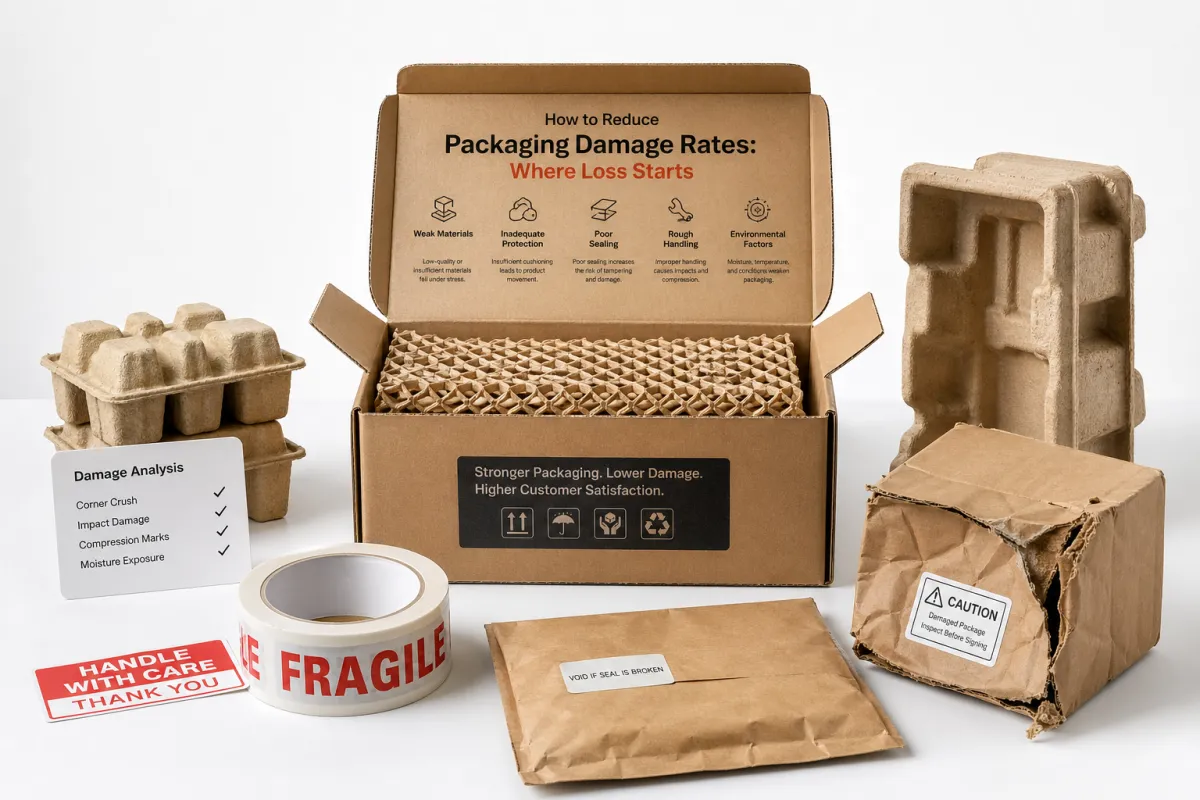
If you do not have a baseline, you are guessing. Build one by defining damage by SKU family, route, and carrier lane. A lot of teams skip this and combine "all damages" into one pile; that hides the real pattern. The right baseline usually starts with a simple question: what failed, where did it fail, and what did the package look like before it moved?
Use a few basic buckets and keep them consistent. Many teams do well with damage categories such as crushed corners, split seams, punctures, product shift, moisture exposure, label loss, pallet collapse, and transit abrasion. If you count each claim differently from week to week, your improvement curve will be noisy and hard to trust. A cleaner view often comes from damage rate per 1,000 shipments, plus a separate cost-per-claim view so you can see whether small damage events are becoming expensive.
- Track damage count by package type such as small parcel, palletized, and mixed loads.
- Separate "packaging failure" from "handling failure" and "carrier incident" where possible.
- Record condition at dispatch, transfer points, and destination to pinpoint where stress begins.
- Track the product family, not just the carton, because fragile items often fail for different reasons than dense items.
- Capture the time of year and storage condition, since humidity and temperature can change packaging performance.
As a benchmark, most e-commerce and distribution operations I have seen land in the low single-digit range on damage rates when systems are stable; the same network can drift into high single digits after peak-season surges, bad weather, or staffing gaps. If your baseline is unknown, your improvement target becomes wishful thinking. Even a rough baseline is better than none, but the goal is to make it repeatable enough that the team can tell whether changes are helping or just shifting damage from one lane to another.
If you are setting up the baseline from scratch, a simple weekly scorecard is usually enough. Include shipment count, claims count, damage rate, top three failure modes, and the highest-risk routes. For more complex operations, split the scorecard by production line, shift, or fulfillment zone so you can see whether the problem lives in packing, palletizing, dock handling, or carrier transfer. When teams do this well, they often find that 20% of the process steps create 80% of the damage.
What actually drives damage most often
Here is where people get tripped: they assume fragile goods are the only issue. Not quite. The big killers are usually five basics, all boring and all fixable. When the same issue shows up again and again, it is often because the package is being asked to survive a stress it was never designed for, or because the pack-out is inconsistent from one shift to the next.
- Load instability. Boxes that cannot hold shape in transit will crush corners and pop seams.
- Underfilled void spaces. Too much movement inside means repeated impacts on corners, walls, and product surfaces.
- Wrong spec for the mode. A carton spec that works for warehouse shelving may not survive parcel drops or line-haul vibration.
- Human handling variability. One rough lift, one late turn, or one poor pallet rebuild can trigger damage that looks like a material problem.
- Humidity, temperature, and seasonal stacking. Paper products, adhesives, films, and corrugated board all react differently when conditions shift.
In one warehouse we found stretch film tension was being set by habit, not by load requirement. That tiny variable, combined with an occasional top-heavy build, gave us a 20% damage concentration in just one zone over two months. In another scenario, the issue was not the carton itself but the way mixed-SKU pallets were built: heavier units were stacked on one side, lighter cartons on the other, so the whole load slowly leaned during transport. The damage did not look dramatic on the dock, but by the time it reached receiving, the deformation was obvious.
Another common cause is packaging that is technically strong enough in the lab but weak in practice because the production environment introduces variation. Adhesive set time may change, tape may not fully bond in cold storage, or inserts may be installed upside down during a rushed shift change. These are not glamorous failures, but they are common. If you want to reduce packaging damage rates, you have to treat process variation as a first-class problem, not a footnote.
It also helps to remember that damage is not always a packaging failure in the strict sense. Sometimes the package is doing its job but the route is harsher than expected, the dwell time is too long, or the receiving team is handling mixed loads with different priorities. That is why the best damage reduction plans usually combine packaging changes with handling rules and transport controls.
How to reduce packaging damage rates with technical discipline
My go-to stack for fast impact is a three-layer check: design, pack, and move. It is not a flashy framework; it is just where the failures happen. If one of those three layers is weak, the whole system tends to fail in a predictable way, even if the packaging looks fine at a glance.
- Design: Use ISTA-style orientation logic, even in a scaled-down version. Know your crush strength limits and align product internals with those limits. For corrugated cartons, many teams look at board grades in the common range of 32 to 44 ECT for lighter to moderate loads, while heavier or more demanding loads often need stronger board or a different structure. The exact spec depends on product weight, stacking height, and transit type.
- Pack: Set a standard for protective density, not "looks full," but "prevents lateral shift under vibration." If the product can move more than about 10 to 15 mm inside the shipper, that often deserves a redesign or at least a better insert. The goal is not just to fill space but to control motion in all directions.
- Move: Audit conveyor transfers, dock heights, and manual handling touchpoints. If the package shape changes during transfer, you have a design-and-process issue. If the same carton survives packing but fails after staging or loading, the answer is probably not a better inner tray; it is usually a handling or stacking adjustment.
Use simple shock indicators and corner compression test sheets on at least one pilot lane. They are not glamorous, but they quickly separate hype from data. If you are checking 100 random loads weekly, you will catch repeat offenders before your customer does. That kind of loop matters because damage reduction is usually less about one big breakthrough and more about catching a handful of failure modes before they become normal.
When the product itself is delicate, add packaging layers based on the specific hazard. Compression issues usually call for stronger outer packaging, reinforced corners, or better pallet builds. Vibration issues often respond to tighter fit, better partitioning, and reduced headspace. Impact issues may need cushioning that distributes force rather than just softens it. A common mistake is to use one generic solution, like more bubble wrap, for every problem. That can reduce one failure mode and worsen another by making the pack unstable.
If you are comparing structures, it helps to browse Custom Packaging Products and match the packaging format to the actual failure mode rather than the product category alone. A strong shipper for one line may be too expensive for another, and a lightweight mailer may be fine for low-risk items but inadequate for anything with corners, glass, powder, or stacked components. The best choice usually depends on product mass, fragility, route length, and how many times the package will be touched.
Field testing beats spreadsheet theory
People in my line of business know that one "perfectly written SOP" does nothing on Monday morning unless the team can actually do it in ten seconds while the dock gate is backing up. Pilot changes on a narrow route first. Pick one product mix, one carrier, and one loading pattern for two weeks, then compare damage rates by week and by handling terminal. That tells you whether the change is helping in the real world or only on paper.
I once watched a team replace expensive corner protectors with a heavier single-grade paneling strategy and get no measurable benefit. Then they switched from random taping patterns to a uniform tension profile and a top-restraint method for that lane, and damage dropped quickly. Same supplier, same plastic, same labor minutes, just better consistency. It was a good reminder that process discipline can beat premium materials every time.
The other underrated piece is feedback speed. If the receiving team waits until end of day to report damage, your root-cause map arrives too late. Near-real-time incident logging, even a shared sheet with photo evidence, is enough to change behavior in less than a week. A lot of teams also benefit from a simple "before and after" photo library so new operators can see what acceptable packaging looks like and what failure starts to look like before it becomes a claim.
Testing does not have to be complicated, but it should be structured. In many operations, a practical pilot includes a control group, a small change set, and a fixed review window. For example, you might compare two cushioning configurations, two tape patterns, or two pallet wrap methods across the same lane. If the change lowers damage but increases pack time or material cost too much, you may still need to refine it. The goal is not just fewer damages; it is fewer damages at a cost and labor profile the operation can sustain.
When possible, test for the failure mode you care about. If cartons are crushing, focus on compression and stacking. If the issue is product breakage, focus on drop and shock. If the issue is label loss or scuffing, look at abrasion, adhesive performance, and surface protection. The more the test resembles the real shipping environment, the more likely the result will hold after rollout.
Material and format choices that usually matter most
The packaging material is only one part of the system, but it can either absorb mistakes or magnify them. Most teams do not need exotic materials; they need the right structure in the right place, with enough consistency to survive normal variation. That usually means choosing the simplest format that still protects the product across the full route.
For corrugated packaging, think in terms of board strength, flute profile, box dimensions, and closure method. Smaller parcel items often do fine with standard single-wall corrugated if the product is not too fragile, while heavier, sharper, or more compressible goods may need stronger board, double-wall construction, or a better internal fit. Common practice is to keep cartons close to the product footprint so the item does not slide, but not so tight that assembly becomes difficult or the product edges take load during closure.
For cushioning, the amount and type should match the hazard. Foam, paper, molded pulp, and air-based systems all have different strengths. A common range for corner or edge protection is roughly 25 to 50 mm, but the right amount depends on weight, drop height, and how much motion the package sees. Paper-based fill can work well for light and moderate products if it is properly crumpled or formed, while molded inserts often give better repeatability for products that need a fixed orientation.
For palletized shipments, load containment matters as much as the box itself. Many damage problems come from mixed stacks, pallet overhang, weak corner support, or wrap that is too loose to hold the load through acceleration and braking. In general, good pallet builds keep the load centered, reduce overhang, and use enough wrap layers to prevent shifting without distorting the product. Teams often see better results when they standardize the top and bottom wraps, then check the wrap pattern shift by shift rather than leaving it to operator preference.
Adhesives and closures deserve more attention than they usually get. Tape that performs well in a warm packing room may not bond the same way in a cool dock area. Labels can peel when surfaces are dusty or when condensation forms during temperature changes. If packages are failing at seams or closures, the answer may be better glue, a different tape grade, a stronger fold, or a closure step that gives the adhesive enough time to set. That is especially true for products stored in variable conditions or moved between different environments.
If your operation uses custom fit options, it can be worth comparing Custom Packaging Products against the current pack-out by product family. A tailored insert or carton size often saves more in avoided damage than it costs in material, especially when the product is high value or hard to rework. The key is not to over-engineer every item; it is to match the structure to the actual risk level.
Handling, storage, and transport controls
Packaging does not fail in a vacuum. The handling environment often determines whether a decent pack survives or gets defeated by the last mile. Even strong packaging can be damaged by poor staging, mixed stack height, or rough transfer points, so the operations side needs the same discipline as the design side.
Start with storage. If packaging materials sit in humid or fluctuating conditions, corrugated performance can drift, sometimes noticeably. Paper-based materials often lose stiffness as moisture rises, while some adhesives and films behave differently in cold or dry conditions. Many operations improve results simply by storing packaging materials in a stable area and rotating stock so old material is not used after long exposure to poor conditions.
Then look at staging. A box that survives production can still fail if it is staged under a heavy pallet, loaded at an angle, or stacked in a way that crushes the top panel before it ever reaches the truck. Common fixes include clear stack-height limits, separate holding areas for fragile or odd-sized goods, and a rule that damaged outer packaging is removed before load-out rather than sent anyway. This sounds obvious, but many damage claims begin with "it looked fine when it left."
Transport also matters. Parcel, LTL, and full truckload networks create different stress patterns. Parcel often brings more drops, more sorting touches, and more conveyor impacts. Palletized freight often sees compression, vibration, and corner knocks during transfer. Mixed-mode routes can combine both. That is why a single packaging spec across every lane usually produces uneven results. If the route changes, the packaging spec may need to change with it.
Operational controls are usually cheap compared with claims. Examples include clearer pallet build standards, better fork truck alignment, a "no overhang" rule unless there is a tested exception, and a load verification step before dock release. Some teams also get value from training on three or four handling cues that are easy to remember under pressure. The point is not to make people memorize a book; the point is to reduce avoidable variation.
Temperature-sensitive goods need extra care. If products or packaging move from cold storage to a warm dock, condensation can weaken labels, cartons, and adhesives. For those items, the usual answer is not just stronger packaging but a controlled staging window, better protective overwrap, or a packaging method that tolerates moisture better. The right fix depends on product sensitivity and dwell time, but the principle is the same: reduce exposure to conditions that the packaging was never designed to handle.
A realistic rollout plan for the next 30 days
Here is the non-salesy truth: you cannot fix packaging in one big move, but you can chip away at the leak points until the numbers bend. Start with a baseline, cut one high-frequency failure mode at a time, and do not ignore environment and loading habits while obsessing over box quality. A practical rollout works better than a dramatic overhaul because it gives the team time to learn without burying them in change.
Use a simple 30-day sequence:
- Define your current damage rate by SKU, route, and damage class.
- Pick the two highest-volume routes and run a 2-week pilot with fixed cushioning and tie-down standards.
- Train handling teams on three handling cues and do post-shift spot checks.
- Track material usage, pack time, and claim rate together so you do not solve one problem by creating another.
- Recalculate at the end of week two and stop the changes that do not show measurable improvement.
That sequence works because it does not rely on perfect data or a full packaging redesign. It focuses on the most common failure points first, which is usually where the fastest gains live. If you see damage drop on one lane but not another, do not assume the fix failed. Often it means the lanes are not really comparable, and the second lane has a different dominant failure mode.
If you need a practical checkpoint, ask three questions at the end of the pilot: Did the damage rate move? Did pack time stay within an acceptable range? Did the new method create any new failure modes, such as label loss, product scuffing, or higher labor strain? If the answer to all three is positive, you likely have something worth scaling. If not, refine the design and test again rather than forcing a weak solution across the whole operation.
If you are still choosing packaging formats while you roll out the pilot, compare options through Custom Packaging Products so the trial uses the closest match to the actual shipment condition. That helps you avoid the common trap of testing a format that is too weak, too expensive, or simply mismatched to the product's real hazards.
Frequently asked questions
What is the fastest way to reduce packaging damage rates?
The fastest wins usually come from standardizing the pack-out, improving carton fit, and tightening handling rules on the highest-risk lane. If you fix one repeated failure mode, such as product shift or pallet collapse, you can often see improvement within a few weeks. The key is to focus on the highest-volume problem first instead of trying to redesign every package at once.
Should I start with stronger boxes or better cushioning?
It depends on the failure mode. If boxes are crushing, seam splitting, or losing shape, stronger outer packaging or a better pallet build is usually the first move. If the box stays intact but the product inside breaks or scuffs, better cushioning or a tighter internal fit is often the better answer. Many operations need both, but one is usually the priority.
How do I know if the issue is the packaging or the carrier?
Use damage timing and failure pattern clues. If damage appears before carrier handoff, the process is likely internal. If damage is concentrated after one carrier lane, terminal, or transfer point, the transport chain is probably part of the problem. Photos, timestamps, and route comparisons usually make the pattern clearer than opinions do.
What packaging tests are worth doing first?
Start with the test that matches the failure mode. Drop tests help when impact is the issue. Compression checks help when cartons are crushing or stacking poorly. Vibration or route simulations help when product shift or abrasion is the main complaint. You do not need a perfect lab program at first; you need a test that resembles the stress your package actually sees.
How often should I review damage data?
Weekly is a good starting point for most operations, with faster review on high-value or high-risk lanes. Daily review can help if damage is severe or the operation is changing quickly. The best cadence is one that is frequent enough to catch problems early but simple enough that the team can keep up with it.
Do custom packaging solutions always lower damage rates?
Not always. Custom solutions help when they match the product, route, and handling environment better than a generic format. But if the real problem is poor handling, bad stacking, or inconsistent packing, a custom box alone will not fix it. The most effective approach is usually custom packaging plus process control.
In the end, reducing packaging damage rates is less about a single magic material and more about building a repeatable system. Measure honestly, design for the actual stress, and keep the packing and handling steps consistent. If you do that, the numbers usually start moving in the right direction, and they usually stay there longer than a one-time packaging upgrade would on its own.

