Buyer Fit Snapshot
| Best fit | Source Seaweed Mailer Materials Without Guesswork projects where brand print, material claims, artwork control, MOQ, and repeat-order consistency need to be specified before quoting. |
|---|---|
| Quote inputs | Share finished size, material target, print colors, finish, packing count, annual reorder estimate, ship-to region, and any compliance wording. |
| Proofing check | Approve dieline scale, logo placement, barcode or warning zones, color tolerance, closure strength, and carton packing before bulk production. |
| Main risk | Vague material claims, crowded artwork, missing packing details, or unclear freight terms can make a low unit price expensive after revisions. |
Fast answer: Source Seaweed Mailer Materials Without Guesswork: Film, Print, MOQ, and Carton Packing should be specified like a repeatable production item. The safest quote records material, print method, finish, artwork proof, packing count, and reorder notes in one written spec.
Production checks before approval
Compare the actual filled-product size with the drawing, then confirm tolerance on folds, seals, hang holes, label areas, and retail display edges. Reserve space for logos, QR codes, warning copy, and material claims before decorative graphics fill the panel.
Quote comparison points
Review material grade, print process, finish, sampling route, tooling charges, carton quantity, and freight assumptions side by side. A quote is only useful when the supplier can repeat the same color, closure quality, and packing count on the next order.
If you are trying to figure out how to source seaweed mailer materials, the hard part is not the idea. It is finding a supplier whose film, coating, or blended structure behaves the same way on every roll, every pallet, and every pass through a packing line in Shenzhen, Dongguan, or Ho Chi Minh City. I have spent enough time around converting floors to know that a polished sustainability pitch can unravel fast if seals open at 38℃, print smears after a 28-day humidity cycle, or lead times jump from 14 business days to 7 weeks without a clean explanation. That last one still feels painfully familiar.
That is why how to source seaweed mailer materials has become a procurement question, not a branding exercise. Buyers usually want three things at once: less dependence on conventional plastic, a cleaner story for customers, and packaging that still survives pressure from corrugated cases, belt conveyors, and the occasional 90 cm drop onto a concrete dock. Those goals line up only when the sourcing work is specific, disciplined, and skeptical of vague claims. I think that skepticism is healthy; packaging teams that never question a supplier usually end up paying for it in rejects, rework, and delayed launches.
The category also draws attention for a practical reason. Seaweed-based packaging may fit into compostable or renewable packaging strategies, but the structure varies a great deal from supplier to supplier. Some materials are closer to a biopolymer film, some are blended with other renewable inputs, and some are coated or layered to behave more like specialty mailers. If you are already comparing options like kraft paper mailers, recycled materials, or even Custom Poly Mailers, the right choice depends on the product inside the bag, the route it takes through your warehouse, and how much handling abuse you expect before delivery. A 250 g skincare kit is a different problem from a 1.2 kg apparel bundle, and the material spec should reflect that difference in black and white.
Here is the honest version from the floor: sourcing this category well is less about finding a miracle material and more about asking the right questions in the right order. I have seen brands rush in because a sample looked impressive on a sales table in Guangzhou, only to discover later that the material needed a narrow seal window or a slower packing speed than their fulfillment team could tolerate. I have also seen the opposite, where a buyer took a measured approach, tested three constructions, and ended up with a supplier that delivered 30,000 units a month with almost no variation. That is the kind of result how to source seaweed mailer materials should aim for.
How do you source seaweed mailer materials for production?
Start with the product weight, the shipping route, the seal window, and the compliance target. Then request the technical data sheet, run a sample lot on your actual line, and compare landed cost rather than factory price. The teams that get how to source seaweed mailer materials right usually treat the first order as a pilot, not a verdict, because the first run tells you more about line behavior than any polished sales sample ever will.
I would add one thing here: define the failure modes before you place anything. If a mailer is going to live in a humid packing room, say so. If it will be stored flat for eight weeks, say that too. A supplier can only tune the structure if the brief is real, not aspirational. Otherwise you are guessing, and guessing is how projects get expensive in a hurry.
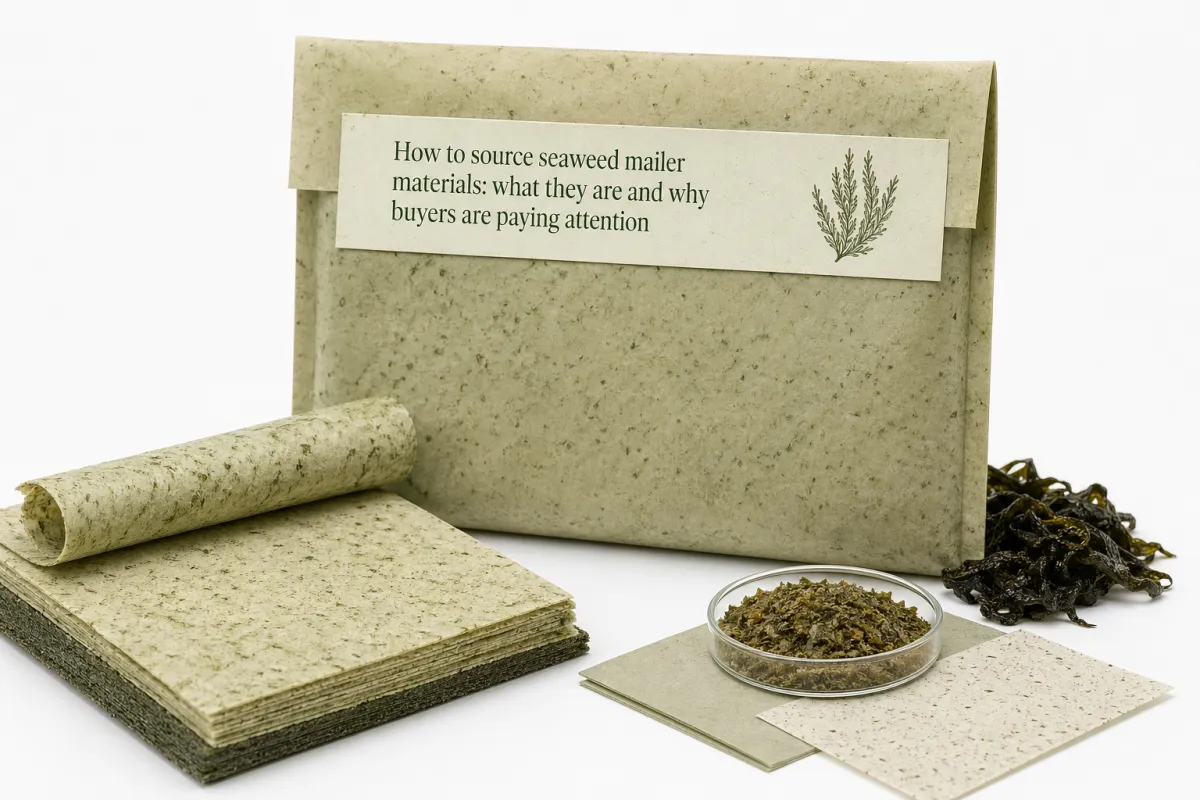
How to source seaweed mailer materials: what they are and why buyers are paying attention
At the simplest level, seaweed mailer materials are packaging substrates made with seaweed-derived content, seaweed-based polymers, or blends that use seaweed as one part of a wider bio-based structure. Depending on the supplier, the material may be cast as a film, laminated into a mailer, or combined with other renewable components to improve handling and seal performance. The language can sound similar from one brochure to the next, which is exactly why how to source seaweed mailer materials starts with definitions, not sales claims.
Some versions look and behave more like flexible film, while others are closer to coated paper or hybrid mailer structures. That difference matters. A mailer intended for lightweight apparel might perform fine with a 60 to 80 micron film and a stable heat seal, but a cosmetic kit with glass jars may need a tougher wall structure, higher puncture resistance, and a different finish for label adhesion. Buyers who already understand how to source seaweed mailer materials usually move faster because they can separate the base chemistry from the final form of the mailer.
I remember visiting a converting line in Shenzhen where a sample roll looked excellent in hand, but the operator showed me a 6 mm variation in seal width after a speed increase from 120 bags per minute to 160. That sort of detail never shows up in a glossy product sheet, yet it can decide whether the material survives a real fulfillment shift. If you are serious about how to source seaweed mailer materials, you need that kind of operational thinking from day one.
The business reasons are easy to understand. Some buyers want lower plastic dependency, some want a stronger story around renewable inputs, and some are trying to align packaging with compostable or biodegradable packaging goals. I still keep one foot on the ground: the sustainability story matters, but it does not replace performance testing, and it does not excuse a supplier from proving what the material actually contains. That is why how to source seaweed mailer materials has to include documentation, not just design intent.
For brands that ship through e-commerce, the upside is real if the material is right. A clean-looking mailer can pair well with printed tissue, a branded insert, and outer shipper formats like kraft paper mailers or boxes made from recycled corrugated cardboard. Still, I would never choose a seaweed-based option purely because it sounds better. In practice, how to source seaweed mailer materials works only when the business case, the technical spec, and the warehouse reality all line up. A small beauty brand shipping 4,000 orders a month can tolerate a different structure than a warehouse sending 80,000 units weekly.
There is one more point buyers sometimes miss. These materials are still early in their commercial life compared with standard poly, so batch consistency can vary more than people expect. That does not make them unsuitable; it just means you should source with tighter controls, clearer acceptance criteria, and more patience on the first order. If you approach how to source seaweed mailer materials that way, you are already ahead of most first-time buyers.
How to source seaweed mailer materials and understand how the material works
To do this well, you need a basic picture of how the material is made. Seaweed is harvested or farmed, processed into usable feedstock, and then converted into a biopolymer, additive, or blended input depending on the final application. Some suppliers extrude a film from a seaweed-derived formula, while others use seaweed content as part of a multilayer structure with coatings or binder systems. If you know that pathway, how to source seaweed mailer materials becomes a technical conversation instead of a guessing game.
The wording gets slippery fast. A supplier may say the material is “seaweed-based,” but that can mean very different things: a high percentage of seaweed-derived content, a small additive fraction, or a hybrid structure built around another resin. I have seen buyers assume all these claims were equivalent, only to discover the actual construction was closer to a blended compostable film than a pure seaweed-derived substrate. Anyone learning how to source seaweed mailer materials should ask for the exact composition and not settle for a marketing summary. A material declaration that says 18% seaweed-derived content, 62% starch-based polymer, and 20% plant-fiber binder is useful; a slogan is not.
Performance is where the truth appears quickly. The material needs to hold a seal, resist tearing at stress points, and survive a reasonable amount of moisture exposure if it will pass through a humid warehouse or a summer truck route in Jakarta, Bangkok, or Houston. You should also look at shelf life, storage conditions, and print compatibility. One apparel client I worked with had a beautiful seaweed mailer sample that looked flawless until the adhesive label tested against it for 72 hours; the label edge lifted on the third day because the surface energy was not what their print vendor expected. That is why how to source seaweed mailer materials should include print and label trials, not just hand feel.
The manufacturing step matters just as much as the feedstock. Two suppliers can start from similar renewable inputs and still end up with very different film behavior because one uses a tighter extrusion profile, one uses a different coating weight, or one controls moisture more carefully in conversion. I have seen this firsthand in supplier meetings where a 0.03 mm thickness variation turned into a warehouse issue because the packing team used the same seal jaw temperature across both lots. Once you understand that, how to source seaweed mailer materials starts to look like process control, not just material selection.
For buyers who want a reference point, the packaging field already has useful frameworks for testing and claims. Organizations like the ISTA provide common methods for transport testing, and packaging standards from groups such as FSC matter when paper components, sleeves, or secondary packs are part of the system. If the supplier also references compostability or recovery claims, you will want proof, not a slogan. That is a core part of how to source seaweed mailer materials without getting tangled in vague environmental language.
One caution I give every team: seaweed-derived content is not the same thing as automatic home compostability. In some cases the material may need industrial composting conditions, and in others it may still be a hybrid that belongs in a different recovery stream. The label has to match the evidence. That sounds dull, but it saves people from making claims that fall apart in review.
Key factors that shape seaweed mailer material sourcing
When I sit down with procurement teams, I usually break how to source seaweed mailer materials into five practical filters: material spec, compliance, supplier reliability, sustainability proof, and end-use fit. If any one of those is weak, the order can wobble later. I have seen buyers get seduced by the story, only to discover the supplier could not hold batch consistency over 10,000 units, which is a painful lesson when your launch date is already locked. Nobody likes explaining that kind of delay to a sales team that already promised the moon.
Material spec should be the first filter. Ask for thickness in microns, tensile strength, elongation, seal initiation temperature, seal strength, puncture resistance, and whether the material can tolerate your actual packing speed. If your line runs 45 cartons per minute and the mailer has to be filled, sealed, and labeled in one pass, the spec needs to match that workflow. A buyer who understands how to source seaweed mailer materials always asks for machine compatibility, not just a pretty sample. For a converted mailer, I want a written spec such as 75 micron total thickness, 14 N/15 mm seal strength, and a 105℃ to 125℃ seal window, not a vague promise that it “runs well.”
Compliance comes next. If the material will be marketed as compostable, biodegradable, or renewable, ask for the underlying test basis and the geography it applies to, because claims can vary by market. If the packaging might touch food-contact applications or regulated cosmetics, that adds another layer of review. For broader sustainability programs, buyers often compare the seaweed option against post-consumer waste packaging, recycled materials, or FSC certified paperboard components. I would rather see a supplier be precise than poetic, because precision is what keeps how to source seaweed mailer materials from becoming a legal headache. A claim approved for the EU can still need different wording for California, Japan, or Australia.
Supplier reliability is where factory reality takes over. Lead time consistency, MOQ, batch-to-batch quality, and communication speed all matter. A small supplier may offer a sharp quote but struggle with a 20,000-unit repeat order if their production window is already full. One of the bluntest negotiation moments I have had was in a supplier office outside Dongguan, where the sales manager admitted that a “7 to 10 day” promise really meant “if nothing changes, and if resin supply stays stable, and if the line does not get pulled to another job.” That honesty actually helped us decide whether how to source seaweed mailer materials with them made sense.
Sustainability proof is not optional anymore. Ask for chain-of-custody information, third-party test reports, and traceability on the feedstock if the supplier can provide it. If a material claims to be biodegradable packaging, ask what conditions are required, because industrial composting and backyard breakdown are not the same thing. I also look at whether the supplier can explain their raw inputs in plain language without getting defensive. The stronger the proof, the easier how to source seaweed mailer materials becomes for your internal team. A supplier that can hand over batch IDs, test dates, and a production lot from Xiamen or Quanzhou is much easier to work with than one that only has a headline claim.
End-use fit matters more than most people think. A seaweed mailer for lightweight socks is a different job than one for skincare kits with pumps, droppers, or small glass containers. If you are shipping products that need extra abrasion protection, you may still use a seaweed mailer, but you may pair it with inserts, tissue, or a secondary outer pack. I often compare that thinking against options like eco mailer packaging or kraft paper-based systems, because the answer is rarely one material for everything. That is one reason how to source seaweed mailer materials should always start with the product, not the trend.
I had a brand manager tell me, after a pilot run failed a simple drop test at 75 cm, “We bought a sustainability story and forgot to buy a packaging spec.” That line stuck with me because it is exactly how projects go off the rails.
For additional context, the broader packaging industry has been moving toward more transparent material disclosure, and organizations like packaging.org publish useful background on packaging formats, materials, and recovery systems. I do not treat any one source as gospel, but I do treat it as a useful baseline when how to source seaweed mailer materials needs to fit into a larger packaging strategy. That baseline matters even more when your supplier is quoting a structure with a 350gsm C1S artboard insert, a soft-touch outer film, and a water-based adhesive label.
How to source seaweed mailer materials: cost, pricing, and what really drives the quote
Let me be direct: how to source seaweed mailer materials gets expensive fastest when buyers compare only unit price and ignore everything wrapped around it. The raw material is only one piece of the quote. Feedstock availability, processing complexity, coating weight, print coverage, carton pack-out, and freight all move the number, sometimes more than the resin itself. I have watched people shave pennies off the unit cost and then spend far more cleaning up the mess afterward. Not a fun trade.
In one supplier review I handled, the base material looked competitive at $0.19 per unit for 10,000 pieces, but the moment we added two-color print, a custom zipper feature, and export paperwork, the real landed cost moved to $0.31 per unit before domestic distribution. That kind of shift is common. If you are serious about how to source seaweed mailer materials, you should request a full breakdown, not just the headline quote. Ask for resin or feedstock assumptions, converting costs, packaging, and freight as separate lines, and ask which items are fixed versus variable.
Prototype pricing is a different animal from production pricing. A 500-piece sample run may cost four to six times more per unit than a 20,000-piece order because the supplier has to set up, test, and often hand-handle more of the job. That does not mean the sample is overpriced; it means you are paying for iteration. A buyer who understands how to source seaweed mailer materials will budget for two or three sample rounds and treat them like insurance against a failed launch. I would rather pay for the test now than explain a broken launch calendar later, and yes, I have had that conversation more than once.
| Material option | Typical use | Sample price range | Production price range at 5,000 units | Main watchout |
|---|---|---|---|---|
| Seaweed-based mailer material | Light apparel, small accessories, branded DTC shipments | $1.10 to $2.40/unit | $0.22 to $0.48/unit | Batch consistency and seal window |
| PLA blend mailer | Bio-based programs with defined compostability goals | $0.90 to $2.00/unit | $0.18 to $0.40/unit | Heat tolerance and certification scope |
| Kraft paper mailer | Retail, apparel, and low-moisture shipments | $0.70 to $1.60/unit | $0.16 to $0.34/unit | Moisture exposure and tear performance |
| Recycled poly mailer | General e-commerce shipping with lower cost pressure | $0.35 to $1.10/unit | $0.08 to $0.22/unit | Brand preference and recycled content proof |
That table is not meant to crown a winner. It is meant to show that how to source seaweed mailer materials has to be measured against the actual use case. A luxury skincare brand may accept a higher price if the presentation and sustainability message are strong, while a high-volume apparel seller may need a tighter cost ceiling and a simpler conversion. I have seen buyers save money by moving to kraft paper in one line and seaweed on another, which is smarter than forcing one material everywhere. For some programs, a 12 x 16 inch seaweed mailer with a matte finish and one-color print is enough; for others, a reinforced 18 x 24 inch format is the real requirement.
Freight is another sneaky cost. A shipment from a specialty supplier in Asia can look fine on paper until you add ocean transit, customs handling, palletization, and the cost of a delayed launch. A good sourcing team calculates total landed cost, not just factory price, because that is where the truth lives. For how to source seaweed mailer materials, I always ask for a quote that separates EXW, FOB, and delivered pricing so the comparison is not distorted. A factory in Kaohsiung, for example, might quote one number at the dock and a very different one after pallet wrap, moisture barrier bags, and inland trucking to the port.
Ask for tiered pricing at 3,000, 10,000, and 50,000 units if possible. That spread tells you how much of the cost is fixed setup versus variable production. I also like to see whether the supplier can explain what happens when feedstock pricing changes, because that tells you how volatile the business is. In one negotiation, a supplier in Kaohsiung gave me a simple but valuable answer: if the biopolymer input moved by 8%, the unit price moved by 4.5% after a one-month lag. That kind of detail makes how to source seaweed mailer materials much easier to forecast.
Here is the plain truth. If a quote is suspiciously low, there is usually a reason. Maybe the print is excluded, maybe the MOQ is hidden, maybe the lead time is unrealistic, or maybe the supplier is buying the raw input opportunistically and cannot guarantee another run. Buyers who understand how to source seaweed mailer materials ask for the cost sheet, not just the price, and they usually save themselves from a very expensive surprise. I have also seen quotes from Zhejiang factories that looked attractive until the supplier admitted they could not hold the same film gauge on the second order.
Step-by-step process and timeline for sourcing seaweed mailer materials
The best way I know to manage how to source seaweed mailer materials is to treat it like a controlled project with gates. Start with an internal brief that defines dimensions, product weight, shipping environment, print needs, and compliance requirements. If you cannot describe the use case in one page, the supplier will probably guess, and guessing is where sourcing gets messy. I have seen too many teams start with a mood board and then act shocked when the packaging does not match the warehouse. That never gets old, oddly enough, and by “never gets old” I mean it remains frustrating forever.
Next, build a shortlist of suppliers or converters and ask for material data sheets, sample availability, and basic commercial terms. A realistic early-stage timeline is 5 to 10 business days for outreach and qualification, then 7 to 15 business days for sampling, depending on whether the supplier has existing stock or must make a custom trial. That is a normal rhythm for how to source seaweed mailer materials, especially if the format is not already in their standard catalog. If the bag needs a custom gusset, extra tear notch, or a printed QR code, add another 3 to 5 business days for artwork and prepress.
Then comes testing. I recommend a real-world pilot, not just a bench test. That means a few hundred units run through the actual packing team, with the same tape guns, label printers, and sealing equipment you use every day. In one apparel warehouse visit, I watched a team discover that a sample seaweed mailer was fine at low speed but buckled when the operator increased the fill rate to keep up with an afternoon backlog. That problem never would have appeared in a neat showroom sample, which is why how to source seaweed mailer materials should include a live trial. A pilot of 300 to 500 units in a warehouse in Guangzhou will tell you more than a polished presentation ever will.
After testing, review the results with operations, procurement, and sustainability teams together. This is the moment where many projects stall because each group wants something different, and nobody has documented the trade-offs. You may need to revise thickness, seal profile, or print coverage. Expect 2 to 4 weeks for that iteration if the supplier is responsive, and longer if the material requires a custom formulation. The calmest programs I have seen treat how to source seaweed mailer materials as a phased approval process rather than a single yes-or-no decision.
Only after the pilot passes should you move to commercial approval and production scheduling. A simple standard order can move from brief to first shipment in roughly 4 to 8 weeks, while a custom or documentation-heavy project can take much longer. The delays usually come from three places: revised specs, certification requests, and shipping bottlenecks. If you plan the calendar around those three risks, how to source seaweed mailer materials becomes much less stressful. A buyer who wants launch stock in October should not start supplier outreach in late September; that sort of timeline usually ends with emergency air freight and a bad mood.
One practical planning tip: build a buffer for at least one extra round of samples. It costs less to catch a seal failure in a 300-piece pilot than to discover it after 12,000 units have already been packed. I have never regretted an extra test roll, but I have regretted rushed approvals more than once. That is the discipline that makes how to source seaweed mailer materials work in the real world.
If you want the shortest possible version of the timeline, here it is: brief, sample, pilot, revise, approve, then order. Anything that skips one of those steps is basically a gamble dressed up as speed. That can work once or twice. It is not a sourcing strategy.
Common mistakes when sourcing seaweed mailer materials
The first mistake is trusting the language too much. I have seen suppliers use broad sustainability claims that sounded impressive but did not say whether the material was compostable, biodegradable, renewable, or simply bio-based in part. That matters because how to source seaweed mailer materials must be built on test data and documentation, not a polished slide deck. A sales deck can smile. A test report cannot.
The second mistake is skipping compatibility testing with the actual packing line. A sample can look fantastic on a desk and still fail at the sealer, the labeler, or the cartoner. A client once told me they had no issue in the office, then watched their warehouse team fight with static and curl in a humid summer bay where the temperature hit 31℃ by 2 p.m. That sort of thing is exactly why how to source seaweed mailer materials should be tested in the environment where it will live. I have also seen film that worked in dry January conditions in Auckland but behaved differently in a July monsoon season in Penang.
The third mistake is buying on unit price alone. A low price can disappear quickly once you add freight, reject rates, customs delays, or emergency reorders. I have seen a “cheap” package become the most expensive option on the spreadsheet after the supplier missed two consecutive ship dates. Buyers who understand how to source seaweed mailer materials know that quality failure is a cost, not a side issue. If your reject rate climbs from 1.5% to 6.0%, the math changes faster than most teams expect.
The fourth mistake is ignoring regional compliance differences. A claim that works in one market may need support, wording changes, or testing updates in another. That becomes especially important if the same mailer is used across multiple countries or channels. If you are comparing the system against recycled materials, FSC certified paper, or biodegradable packaging claims, make sure the regulatory language is approved before print plates are made. That is a core detail in how to source seaweed mailer materials without creating downstream risk. A label approved for Singapore may still need a different evidence file for Germany or the United States.
The fifth mistake is failing to define the end-use case clearly. A mailer for jewelry with a soft insert needs different handling than a mailer for athletic apparel or a rigid cosmetic kit. If you do not specify product weight, drop risk, moisture exposure, and shelf presentation, the supplier has to guess on thickness and finish. That is why how to source seaweed mailer materials starts with the product, the warehouse, and the route to customer, not with the material story. A 180 g mailer can be perfect for socks and useless for a box of serum vials.
The sixth mistake, and this one is sneaky, is assuming every supplier uses the same definition of “renewable” or “bio-based.” They do not. A broad statement can hide a small share of seaweed-derived input in a much larger mixed matrix. That does not automatically make the product bad, but it does mean the buyer needs to know exactly what is being purchased. If the answer is fuzzy, the rest of the discussion is probably fuzzy too.
The strongest sourcing programs I have seen are boring in the best way: clear specs, sample logs, test results, and one person owning the next step after every review.
Expert tips for sourcing seaweed mailer materials that hold up in production
If I were advising a brand on how to source seaweed mailer materials tomorrow morning, I would start with a technical data sheet, a sample lot, and third-party test results before I ever talked about branding language. Ask for thickness, seal temperature range, tensile data, puncture data, and any environmental certifications that are actually relevant to the product. The cleaner the technical file, the less likely you are to get surprised later. It sounds dull. It also saves money, time, and a few gray hairs. A supplier that can provide a report dated within the last 6 months from a lab in Guangzhou or Taipei is easier to trust than one that only has a presentation deck.
I also recommend a supplier scorecard. Keep it simple and compare five items: performance, documentation, responsiveness, Pricing, and Lead time. Give each a score from 1 to 5 and review it with procurement and operations together. That keeps the discussion grounded. In one cosmetics project, the supplier with the best price lost because their samples took 11 business days to answer basic questions, while the second supplier replied within 24 hours and delivered a more stable roll. That is exactly how how to source seaweed mailer materials should be evaluated when business continuity matters. A 4% price gap is rarely worth a 3-week delay.
Another smart move is to pilot the material in the real fulfillment environment, not in a showroom or a lab alone. Run it through your actual printers, your actual sealers, and your actual pick-and-pack team for at least a few hundred units. Watch for static, curl, seal misfires, label lift, and operator fatigue. A lot of issues appear only after the 200th pack when the line workers stop being careful with a sample and start treating it like daily production. That is why how to source seaweed mailer materials must be tested under ordinary pressure. I like to see a pilot that includes a morning shift, an afternoon shift, and one batch packed after a machine warm-up from 19℃ to 27℃.
Do not get trapped in abstract sustainability language. Ask the supplier to explain the measurable outcome they can support: reduced virgin plastic, renewable content, verified recovery pathway, or a specific certification basis. If the seaweed material is part of a larger package system, include the paper insert, tape, and outer shipper in the conversation. I often remind teams that a mailer can be excellent, but the full pack may still rely on kraft paper inserts or recycled corrugated cardboard, so the total system is what matters. That practical view is central to how to source seaweed mailer materials in a way that holds up.
It is also worth comparing the seaweed option to other packaging paths before you lock the decision. Sometimes kraft paper mailers offer a better balance of cost and feel, while other times a recycled poly format provides a lower-cost bridge until the seaweed supply stabilizes. The right answer depends on your margin, your brand promise, and how much risk you can carry on the first production run. That is the part of how to source seaweed mailer materials that seasoned buyers respect: the answer is rarely emotional, and it is rarely universal. For a brand shipping 50,000 units a month, even a $0.02 difference matters; for a premium launch with 1,200 orders, presentation may matter more.
Finally, keep your internal checklist visible. Procurement should own the commercial terms, operations should own line compatibility, and sustainability should own claim verification. When those three groups review the same sample set and the same test report, decisions get faster and cleaner. That is the closest thing I know to a reliable method for how to source seaweed mailer materials without wasting cycles. I have seen this work best when the checklist sits in a shared folder and the approval owner is named before samples arrive. It is not fancy. It just works.
If you need one practical rule to anchor the process, use this: no quote should be approved until the same material has survived your own test run, your own warehouse conditions, and your own documentation review. If any one of those three fails, keep looking. That is the boring little filter that saves a lot of money later.
FAQ
What should I ask a supplier before I source seaweed mailer materials?
Ask for the exact material composition, the technical data sheet, available certifications, and recent batch test results. I would also confirm minimum order quantities, lead times, print options, and whether the supplier can support repeat production at scale, because how to source seaweed mailer materials gets much easier when the commercial and technical answers line up early. I also like to ask one slightly annoying question: “What tends to go wrong?” The best suppliers answer it without flinching, and the answer usually includes a specific issue such as seal lift, moisture pickup, or print adhesion.
How do I compare seaweed mailer materials with paper or PLA options?
Compare them on moisture resistance, seal performance, durability, compostability claims, and total landed cost. Choose based on the product being shipped, not just the sustainability story, because each material behaves differently in transit. That comparison is a core part of how to source seaweed mailer materials responsibly. If one option needs a 125℃ seal temperature and another works at 95℃, that difference matters on a high-speed line.
How long does it usually take to source seaweed mailer materials?
Expect time for supplier vetting, sampling, compliance review, and pilot testing before a commercial order is approved. Simple sourcing projects may move quickly, but custom formats or documentation-heavy programs often take several weeks longer, which is normal for how to source seaweed mailer materials when quality matters. A realistic timeline is 5 to 10 business days for supplier qualification, 7 to 15 business days for first samples, and 2 to 4 weeks for revisions if the structure needs changes.
What are the biggest hidden costs when sourcing seaweed mailer materials?
Freight, printing, converting, sampling, testing, and compliance work often add more to the project than buyers expect. Low-volume orders can also carry a steep per-unit premium, so pricing should be evaluated across the full production plan. That is why how to source seaweed mailer materials should always be priced as a total program, not a single unit. A quote from a factory in Xiamen can look attractive until ocean freight, duty, and inland trucking add another 18%.
How do I know if seaweed mailer materials are right for my brand?
Start with the product you ship, your warehouse process, and the performance requirements your packaging must meet. If the material can satisfy durability, compliance, and cost targets while supporting your sustainability goals, it is worth piloting. That is the practical test behind how to source seaweed mailer materials without getting carried away by the novelty. A premium skincare brand and a budget apparel seller can reach different answers from the same test sheet, and that is normal.
If you take one thing from this, let it be this: how to source seaweed mailer materials works best when you treat the material like a production asset, not a slogan. Ask for the spec, test it in your own warehouse, compare the landed cost, and insist on documentation that stands up next to real packaging standards. That is the same disciplined approach I use whether I am evaluating a biopolymer film, a kraft paper format, or a recycled materials program, and it is still the most reliable way I know to source seaweed mailer Materials Without Guesswork. I have learned, usually the hard way, that packaging rewards the people who stay curious and annoyingly specific.
So the actionable takeaway is simple: build a one-page brief, request three comparable samples, run a real pilot on your line, and only then decide whether the material deserves a place in your packaging program. If you do that, you will know pretty quickly whether the seaweed option is a real fit or just a good story.

