Buyer Fit Snapshot
| Best fit | Source Eco Packaging Materials Without Guesswork projects where brand print, material claims, artwork control, MOQ, and repeat-order consistency need to be specified before quoting. |
|---|---|
| Quote inputs | Share finished size, material target, print colors, finish, packing count, annual reorder estimate, ship-to region, and any compliance wording. |
| Proofing check | Approve dieline scale, logo placement, barcode or warning zones, color tolerance, closure strength, and carton packing before bulk production. |
| Main risk | Vague material claims, crowded artwork, missing packing details, or unclear freight terms can make a low unit price expensive after revisions. |
Fast answer: Source Eco Packaging Materials Without Guesswork: Material, Print, Proofing, and Reorder Risk should be specified like a repeatable production item. The safest quote records material, print method, finish, artwork proof, packing count, and reorder notes in one written spec.
Production checks before approval
Compare the actual filled-product size with the drawing, then confirm tolerance on folds, seals, hang holes, label areas, and retail display edges. Reserve space for logos, QR codes, warning copy, and material claims before decorative graphics fill the panel.
Quote comparison points
Review material grade, print process, finish, sampling route, tooling charges, carton quantity, and freight assumptions side by side. A quote is only useful when the supplier can repeat the same color, closure quality, and packing count on the next order.
I still remember a recycled mailer quote that landed at $0.18 a unit for 5,000 pieces while the virgin-stock version came in at $0.21, both quoted from a converter in Dongguan with a 12-business-day turnaround after proof approval. The lower number won, yet the real reason had nothing to do with marketing gloss or a supplier dressing up the spec with green language. The details were ordinary and useful: the mailer width fit the product with 14 mm less headspace, the print area stayed at one color on a 220 mm by 300 mm panel, and the carton count per pallet improved from 96 to 120. That is the part many teams miss when they try to figure out how to source eco packaging materials: the substrate matters, but dimensions, print coverage, and transit abuse matter just as much.
On a factory floor outside Shenzhen, I watched a corrugator push two rolls of kraft paper through the same line, one at 120 gsm and one at 140 gsm, with the order booked for a 30,000-unit export run to California. The 120 gsm sheet looked fine until a corner drop test from 45 cm split the seam on the second impact, while the 140 gsm stock held together after four drops and a 60% humidity hold overnight. The difference was not dramatic on paper, yet it changed the outcome completely. If you are learning how to source eco packaging materials, those dry numbers are what separate a clean shipment from a refund pile and a support inbox full of complaints. And yes, the support inbox will somehow always arrive on a Friday afternoon, usually after 4:30 p.m.
Brands usually begin with good intentions and a bad brief. They ask for “eco” and then wonder why the first quote swings from $0.42 to $0.74 a unit, or why the supplier asks for five weeks just to get samples in hand from a plant in Xiamen or Ningbo. The brief has to do more than gesture at sustainability; it needs the board grade, the caliper, the coating, and the target ship lane in black and white. I want to show you how to source eco packaging materials without falling for vague claims, inflated pricing, or the kind of sales deck that says sustainable twelve times and proves nothing.
What Does It Mean to Source Eco Packaging Materials?
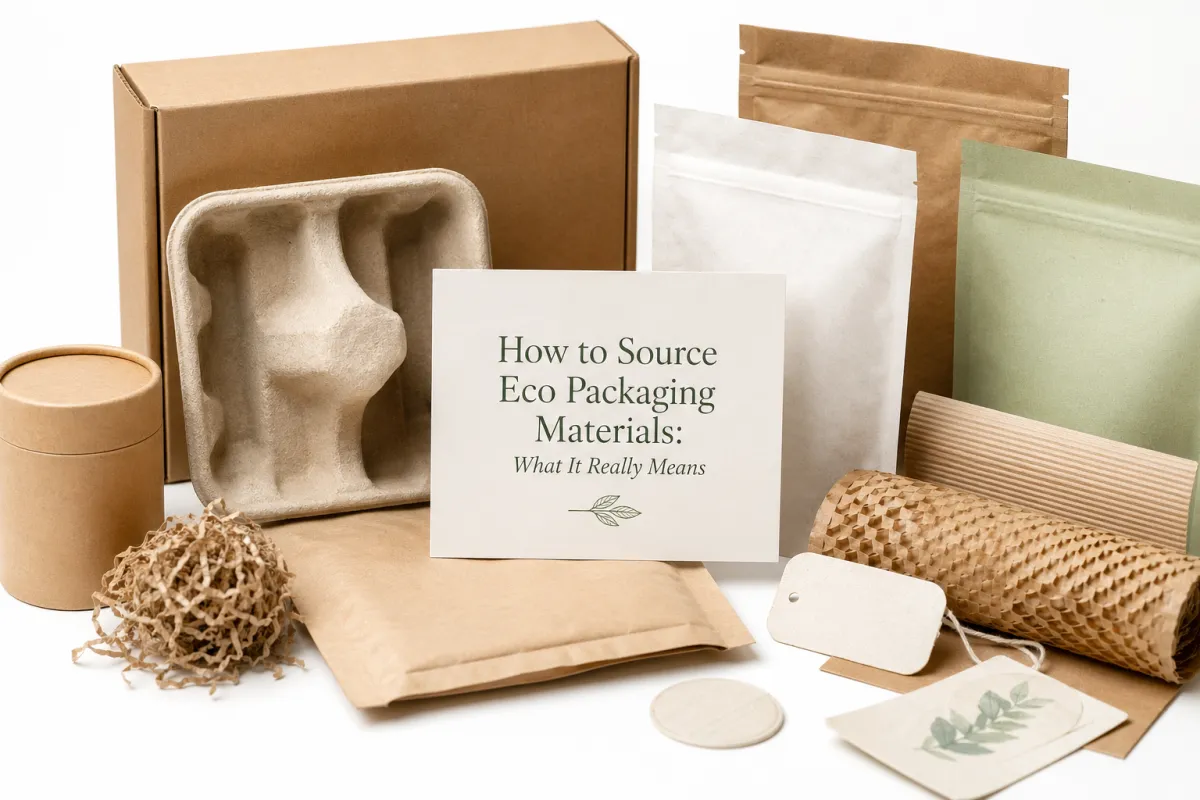
At the simplest level, how to source eco packaging materials means buying packaging that reduces waste, uses responsibly sourced fiber or lower-impact resin, and still protects the product on the route it actually travels. That might be recycled paperboard, molded fiber, kraft paper, recycled mailers, or compostable formats with the right certification behind them, and each one can carry a different minimum order quantity, from 3,000 units for a stock mailer to 20,000 units for a custom tray. None of those labels is a magic stamp. Each one carries a trade-off, and every trade-off has a number attached to it.
I define eco packaging in plain English: recycled content, responsibly sourced fiber, lighter-weight structures, lower-ink printing, and end-of-life options that exist where the customer lives. A box built from 100% post-consumer content is not automatically better if it crushes under a 12 lb parcel stack or bows 3 mm when stored for two weeks in a 34-degree warehouse. A compostable pouch is not automatically honest if the city sends organics to landfill. That is why how to source eco packaging materials starts with the disposal path, then moves to performance, then cost, then finish. Honestly, that order saves people from a lot of expensive optimism.
“A compostable claim is useless if the customer has no compost pickup and the seal fails at 28 degrees Celsius after a 48-hour transit delay.”
That line came from a cosmetics client in Chicago who had already paid for 20,000 units of retail packaging that looked elegant but failed the fridge-to-bag transition test after 72 hours of chilled storage and one round of condensation. The fix was plain and mechanical: a 350 gsm FSC board from a converter in Suzhou, a water-based coating, and a lighter insert that removed 11% of the material without weakening the structure. The unit price moved from $0.63 to $0.58, and the damage rate dropped below 1.5% over a 1,200-unit pilot. That is what sourcing eco packaging materials looks like once the guesswork is stripped away.
I also think most teams ask the wrong first question. They ask, “What is the greenest material?” I ask, “What is the product, what route is it traveling, and what will the buyer do with it after opening?” If the item is a 90 g candle in a mailer or a 2 kg skincare set in a rigid carton, the answer changes fast. The right eco choice for Custom Printed Boxes in parcel shipping is not always the right choice for retail packaging sitting under warm lights for a month, especially if the shelf is in Phoenix in August or Manchester in January.
For fiber jobs, I want chain-of-custody proof before I want design files. The FSC chain-of-custody standard at fsc.org is one of the first documents I review when a supplier says their board is responsibly sourced, and I usually ask for the certificate number, the issuer, and the expiry date in the same email. If a vendor cannot explain the claim in one sentence, I treat it like a slogan rather than a fact. That filter matters a lot when you are trying to understand how to source eco packaging materials without buying a story instead of a substrate.
The end-user reality is messier than most purchasing teams expect. A recyclable tray that works in the United States may be handled differently in parts of Germany, the Netherlands, or Ontario, and compostable claims can be dead on arrival if the local waste stream has no access to industrial composting within 50 km. How to source eco packaging materials is not about selecting the trendiest label. It is about matching material, market, and outcome with enough discipline to survive a real launch and a real returns policy.
How Eco Packaging Materials Move Through the Supply Chain
To understand how to source eco packaging materials, follow the material upstream. Fiber starts as pulp, then becomes board, paper, or molded pulp in mills from Guangdong to Wisconsin. Resin becomes film, mailers, or wraps. After that, the converter prints, laminates, die-cuts, folds, seals, and ships the finished package. Each step can add cost, delay, or waste if the spec is sloppy by even 2 mm, and a 2 mm mistake on a 230 mm dieline can change the entire pallet pattern.
Material choice changes almost everything downstream. A recycled paperboard box with a simple one-color print can often hit a 10 to 12 business day schedule after proof approval, while a molded-fiber tray with custom tooling may need 4 to 6 weeks before the first usable sample and another 7 to 10 days for revisions. If you are learning how to source eco packaging materials, keep one eye on the board grade and the other on the conversion method. A good raw material can still fail if the converter has weak die lines or poor humidity control in the finishing room.
Proof points matter more than claims. FSC, PEFC, SFI, GRS, recycled content statements, compostability standards like ASTM D6400, and third-party test reports all tell you different things, and a supplier in Shanghai or Ho Chi Minh City should be able to send them within 24 hours. None of them gives you a free pass. For ship testing, I keep the ISTA procedures open because a package that passes on a desk can still split after one ugly drop on a parcel sorter or a 90-minute vibration run. That is why how to source eco packaging materials has to include actual test data and not just a pretty environmental badge.
Failures usually show up in the same places. Seams open on mailers after a humid ocean leg from Shenzhen to Long Beach. Ink scuffs on kraft paper because the coating was rushed and the cure time was only 18 hours instead of 48. Molded fiber trays stick to each other in hot storage because the stack height was too aggressive and the warehouse sat at 33 degrees Celsius. I once watched a supplier in Guangdong promise “eco” on a 30,000-unit skincare insert and then admit they had no migration test and no adhesive specification at all. That was not sustainability. That was theater, and how to source eco packaging materials gets ugly fast when theater meets a production line.
Suppliers position themselves differently, too. Mondi tends to speak in paper and performance language, especially around recycled board and bag-in-box applications. UPM and Stora Enso often lean into fiber sourcing and board engineering from Finland and Sweden. EcoEnclose is strong on ecommerce-friendly recycled solutions. I am not saying one is perfect for every brief; I am saying you learn more by comparing conversion model, lead time, and documentation depth than by reading the homepage. That is a real shortcut for anyone serious about sourcing eco packaging materials.
Key Factors That Decide the Right Material
The product comes first. Weight, fragility, moisture sensitivity, grease resistance, shelf life, and shipping distance all shape the answer. If a jar weighs 420 g and ships in a carton that gets tossed through a 7-stop parcel route, corrugated cardboard with a smart insert may beat a thinner paperboard sleeve by a mile. How to source eco packaging materials always starts with the product’s abuse profile, not the brand’s mood board.
Brand requirements come next. Luxury unboxing, retail display, ecommerce durability, and print finish are not the same problem. A matte one-color kraft mailer gives one kind of honesty; a foil-free custom printed box with water-based ink gives another. If you need package branding that looks premium without fake gloss, you might choose 400 gsm board with a soft-touch aqueous coating and a stripped-back color palette. That can still feel expensive, especially at 5,000 units. It just does not shout about it.
Regional reality is the part nobody wants to budget for. Recyclability is local. Compostability is local. Even the availability of collection bins changes by city, let alone by country. I have had buyers in Toronto and Dallas ask for the same format, then discover that one market had curbside acceptance and the other did not. That is why how to source eco packaging materials needs a market-by-market check, especially for retail packaging and branded packaging that will be sold across borders.
Regulatory filters matter too. Food contact, cosmetics compatibility, odor transfer, migration limits, and adhesive rules can turn a nice design into an unusable one. A kraft paper sleeve for dry goods is easy. A sleeve for a scented oil bottle or a lip balm set is not. If the package touches food or a cosmetic surface, ask for the right papers before you approve the finish. That step alone can save two sampling cycles and about $180 in courier fees from places like Suzhou or Nashville, which sounds small until it happens three times.
| Material option | Typical unit price at 5,000 units | Best fit | Main risk |
|---|---|---|---|
| Recycled kraft mailer | $0.42 | Light ecommerce orders, apparel, inserts | Low moisture resistance if the seam spec is weak |
| FSC corrugated cardboard box | $0.55 | Custom printed boxes, fragile product packaging | Higher freight cube if the dieline is oversized |
| Molded fiber tray | $0.68 | Cosmetics, electronics, premium kits | Tooling lead time and stack-height limits |
| Compostable film mailer | $0.74 | Short-haul shipments with verified compost access | Certification mismatch if the market cannot compost it |
Climate is not an afterthought. Humidity softens some paper structures, heat can warp inserts, and cold can make certain sealants brittle. I learned that in a warehouse near Hong Kong where a 38-degree room turned a clean-looking insert into a warped mess after six days on a pallet and one cold-morning transfer through an air-conditioned loading bay. That was an expensive way to learn that how to source eco packaging materials should include storage conditions, not only shipping conditions.
How to Source Eco Packaging Materials Without Overpaying
The first rule of how to source eco packaging materials without overpaying is simple: do not compare unit price in a vacuum. Compare landed cost. That means raw material premium, printing, tooling, freight, duties, waste, and the cost of failed tests. I have seen a $0.39 quote turn into $0.57 landed because the supplier added a $120 tooling charge, a higher pallet count, and a surprise export packing fee from a plant in Ningbo.
Order volume changes the math. A 5,000-unit run can look expensive against a 50,000-unit quote, but the setup fee, freight break, and material utilization often tell a different story. In one negotiation for custom printed boxes, a client wanted to save $1,200 by choosing the cheapest carton. We changed the dieline by 8 mm, dropped one ink color, and reduced the board grade from 450 gsm to 400 gsm. The final savings ended up closer to $2,800 because the pallet count fell by 14% and the freight bill dropped by two cubic meters. That is the kind of detail that makes how to source eco packaging materials less mysterious and more mathematical.
Use one spec sheet. One artwork file. One insert count. One target performance standard. If you send three suppliers slightly different PDFs, you are not comparing quotes. You are comparing confusion. I tell teams to ask for the same configuration every time: exact dimensions, caliper, print coverage, coating, drop test requirement, and the expected ship lane. That is how you get apples-to-apples pricing on how to source eco packaging materials instead of three different sales stories.
Keep a backup quote in your pocket. I like one primary supplier and one regional fallback, especially for jobs tied to launch dates or paid media campaigns. On a molded fiber tray project, I pushed a Guangdong supplier to match a local converter’s $0.68 unit price by simplifying the rib geometry and reducing stack height. They agreed after two rounds of negotiation, but only because I had a second quote at $0.71 and the freight math was already visible. That is not being difficult. That is buying with your eyes open.
If you want a fast starting point, browse our Custom Packaging Products and use the product details as a baseline spec before you ask for pricing. I have seen teams save a week by starting from an existing box style instead of inventing a format from scratch, especially when the design needs a 350 gsm C1S artboard or a 32 ECT corrugated insert. You can also compare a second set of options on our custom packaging products page if you need a backup structure for retail packaging or ecommerce shipments.
One practical trick: ask every supplier for a quote with the same freight assumption, preferably a delivered price to your fulfillment center or co-packer. A $0.42 recycled mailer can beat a $0.38 quote if the cheaper one adds $260 in cross-border freight, customs handling, and carton breakage. That is the moment how to source eco packaging materials gets real fast. The cheapest line item is not the cheapest result, especially on a 12,000-unit order shipped from Shanghai to Dallas.
Step-by-Step Process to Source Eco Packaging Materials
If you want how to source eco packaging materials to feel less like a guess and more like a workflow, follow the same sequence every time. I use the same seven-page spec packet on almost every project because it cuts down rework and removes half the excuses. It also saves money. When a supplier has to infer the size, they usually infer wrong, and a wrong inference on a 95 mm by 140 mm carton can cost a whole sample round.
- Build the spec sheet. Include product dimensions, product weight, pack-out method, shipping lane, brand finish, and any claims you want to make publicly. A 210 mm by 148 mm mailer is not the same as a 220 mm by 155 mm one. Those 10 mm change board usage, freight cube, and print layout.
- Shortlist by proof, not by polish. Ask for FSC, PEFC, SFI, GRS, recycled content statements, or compostability documentation before you care about the fancy homepage. If the supplier cannot explain the certificate number, they are not ready for how to source eco packaging materials at scale.
- Request samples and documents together. I ask for dielines, test reports, and sample photos in the same email. That way I do not wait 10 days for a pretty box that fails an adhesion test on day 11.
- Run a pilot order. A realistic timeline is often 1 to 2 weeks for supplier sourcing, 2 to 4 weeks for sampling, and 4 to 8 weeks for pilot production depending on complexity. If the job is mold-dependent or involves special coating, add another week for safety and a few days for freight from South China.
- Test the shipment. Use a real pack-out, not a desk test. Weight, vibration, corner drops, and humidity exposure all matter. ISTA-style thinking keeps you honest, and that is why how to source eco packaging materials should always include shipping abuse, not just visual approval.
- Review the communication. If the supplier ghosts you during sampling, they will not become organized later. I learned that after a factory in Ningbo took nine days to answer a single caliper question. We switched suppliers before production and saved the client from a six-week delay.
That process sounds rigid, but it is flexible enough for custom printed boxes, molded fiber, kraft paper sleeves, and mailers. The material changes. The sequence does not. After a few projects, how to source eco packaging materials becomes a repeatable habit instead of a one-off panic. That habit is worth far more than one lucky quote, especially when a launch window is only 21 days away.
If the first pilot passes, scale carefully. I would rather place a 10% buffer order than chase a last-minute emergency run at a 22% premium. The shipping line, the color approval, and the lead time all get calmer when the second order has already been sampled. That is a small move with a very large upside, particularly on a 15,000-unit run where one missed carton can stop a whole fulfillment week.
Common Mistakes When You Source Eco Packaging Materials
The biggest mistake in how to source eco packaging materials is chasing green language without proof. A nice deck does not tell me whether the board is actually FSC-certified or whether the “compostable” claim is tied to ASTM D6400. I once had a supplier send me a five-page sustainability brochure and no chain-of-custody document. That was a red flag the size of a pallet, and it came from a factory in Shenzhen with a 6-week lead time on paper, if you believe the paperwork.
Another mistake is buying the cheapest material before testing real shipping conditions. A recycled mailer at $0.42 looks excellent until the seal opens after a wet last-mile run through Portland or a warehouse transfer in New Jersey. A molded fiber tray at $0.68 seems expensive until the product survives a two-meter drop and you avoid 300 replacement units. This is why how to source eco packaging materials has to include abuse testing, not just procurement math.
People also forget the end-of-life path. A compostable pouch is not a moral achievement if the customer has no compost collection. A recyclable carton is not a win if the local system rejects the coating. I have had clients in two countries using the same artwork and needing different disposal claims on the side panel, one for Munich and one for Toronto. That tiny detail can save a complaint, a return, or a bad review. It is not glamorous, but neither is customer service at 7 p.m.
Machine compatibility gets ignored more often than I like. A converter can sell you an eco upgrade that jams on the filling line or seals inconsistently on humid mornings. I visited a pack-out line in southern China where a paper-based insert slowed output by 18% because the die-cut tolerance was too tight for the nesting equipment. The supplier blamed the machine. The machine blamed the insert. Both were partly right, which is exactly why how to source eco packaging materials should include line testing before full production.
Lead time and MOQ get underestimated constantly. A custom order is not a stock carton you can pull off a shelf. If the supplier says 6 to 8 weeks, that is usually after artwork approval, deposit receipt, and final proof sign-off. I still see buyers act surprised when a 3,000-piece custom run cannot be rushed like a 30-piece sample. That surprise is expensive. It adds air freight, overtime, and a little regret along the way, especially when the package has a 300-line print file and a 2-color insert.
“The cheapest quote is often the one with the biggest asterisk, usually hidden in freight, inserts, or a missing test report.”
I said that to a client after a factory in Dongguan increased the carton price by $0.06 because they had quietly excluded the inner partition from the original quote. The client laughed, then paid the difference, because the alternative was a delayed launch and a second print run. If you remember one thing from how to source eco packaging materials, remember this: the hidden line item is usually the real line item.
How to Source Eco Packaging Materials and Move Fast
If speed matters, score suppliers on four things: proof, price, response time, and production capability. I use a simple 1-to-5 rating because it keeps sales charm from contaminating the decision. A supplier with a slick website but a 6-day response time loses to a slightly rougher shop that answers in 3 hours and has actual conversion equipment on site. That scoring model is one of the few shortcuts I trust in how to source eco packaging materials.
Send the same package of documents to everyone: one spec sheet, one sample request, and one landed-cost template. If you need speed, do not make suppliers hunt through six email threads for the board grade or the target print finish. I have watched a procurement team cut sampling time from 19 days to 11 days by standardizing the request, and the only extra cost was an hour to build the form in Google Sheets. That is not magic. That is basic organization with a deadline attached.
Keep one local converter and one regional supplier in reserve. If the first choice misses a proof date or changes pricing, your backup can keep the launch alive. On a branded packaging project for a subscription box, I moved a job from one supplier in Taiwan to a local converter in 48 hours after the original quote jumped by 14% because freight space tightened. The product still launched on time, and the client saved roughly $900 in rush shipping. How to source eco packaging materials is easier when the backup is already warm.
Start with one SKU. Not the whole catalog. If you validate one box, one insert, or one mailer first, you learn more about real production than you will from 12 sample PDFs. After that, you can scale into the rest of the line with fewer surprises. If you need a starting point, our Custom Packaging Products are a useful benchmark for formats, materials, and finishes before you build a larger sourcing plan, especially if you are deciding between a 250 gsm sleeve and a 32 ECT corrugated mailer.
My last piece of advice is blunt. Do not wait for perfect. Pick one product, collect three samples, check the certifications, compare landed costs, and book the supplier call this week. If you do that, how to source eco packaging materials turns from an abstract research task into a concrete buying decision. That is where the real savings live, and I have seen the gap reach $4,000 on a single container when the spec was right and the freight lane was stable.
What is the cheapest way to source eco packaging materials?
Usually recycled paperboard or kraft mailers are the lowest-cost entry point, especially for 3,000 to 10,000 unit runs with simple one-color print and no lamination. The real savings come from standard sizes, fewer finishes, and suppliers close to your production or fulfillment center in places like Dongguan, Memphis, or Monterrey. Ask for landed cost, not just unit price, because freight and waste can erase a $0.05 difference very quickly.
How do I know if eco packaging materials are actually sustainable?
Ask for third-party proof such as FSC, PEFC, SFI, recycled content statements, or compostability test reports tied to the exact material, board grade, or resin type. Then check whether the claim matches your market's waste system, because recyclable on paper does not mean recyclable in practice in every city or county. If a supplier cannot explain the claim in one sentence, I assume the claim is mostly marketing.
What certifications should I ask for when sourcing eco packaging materials?
For fiber packaging, ask for FSC, PEFC, or SFI chain-of-custody documentation. For recycled or textile-based materials, ask for recycled content verification and relevant third-party test data. For compostable claims, ask for the exact standard, such as ASTM D6400 or ASTM D6868, and confirm it matches the region where your customers dispose of the package, whether that is California, British Columbia, or the UK.
How long does it take to source eco packaging materials?
Simple stock-style runs can move in a few weeks if the supplier already has the right material in inventory. Custom projects usually need 2 to 4 weeks for samples and 4 to 8 weeks for pilot production, sometimes longer for specialty formats, tooling, or a 350 gsm C1S artboard finish. Build extra time for testing, revisions, and freight delays if the packaging has to survive strict shipping conditions.
Can I use eco packaging materials for food or cosmetics?
Yes, but you need the right barrier performance and the right compliance documents for the product category. Food and cosmetics often need grease resistance, odor control, migration testing, or specific ink and adhesive limits, and some launches require a 72-hour shelf test at 30 degrees Celsius before approval. Do not assume a material is safe because it is recycled or compostable; ask for product-specific approval before you place a production order.
If you want to know how to source eco packaging materials without burning money on vague promises, start with one SKU, one spec sheet, and one real test. I have watched that simple method beat expensive guesswork in Shenzhen, Dongguan, Chicago, and Toronto more times than I can count. Collect the samples, check the certifications, compare the landed costs, and speak to a supplier this week. Then lock the winning spec, because that one disciplined decision does more for sustainability and cost control than a stack of glossy claims ever will.

