Buyer Fit Snapshot
| Best fit | Kraft Corrugated Mailers Price projects where brand print, material claims, artwork control, MOQ, and repeat-order consistency need to be specified before quoting. |
|---|---|
| Quote inputs | Share finished size, material target, print colors, finish, packing count, annual reorder estimate, ship-to region, and any compliance wording. |
| Proofing check | Approve dieline scale, logo placement, barcode or warning zones, color tolerance, closure strength, and carton packing before bulk production. |
| Main risk | Vague material claims, crowded artwork, missing packing details, or unclear freight terms can make a low unit price expensive after revisions. |
Fast answer: Kraft Corrugated Mailers Price: What Really Affects It should be specified like a repeatable production item. The safest quote records material, print method, finish, artwork proof, packing count, and reorder notes in one written spec.
Production checks before approval
Compare the actual filled-product size with the drawing, then confirm tolerance on folds, seals, hang holes, label areas, and retail display edges. Reserve space for logos, QR codes, warning copy, and material claims before decorative graphics fill the panel.
Quote comparison points
Review material grade, print process, finish, sampling route, tooling charges, carton quantity, and freight assumptions side by side. A quote is only useful when the supplier can repeat the same color, closure quality, and packing count on the next order.
If you are trying to pin down kraft corrugated mailers price, the number on the quote sheet is only the starting point. A low unit price can look great for five minutes, then quietly lose its shine once damage claims, re-ships, packing delays, or dimensional weight charges start piling onto the shipping ledger. From a packaging buyer's side of the desk, the real comparison is not just paperboard against paperboard. It is protection, pack-out speed, freight efficiency, and how much waste the mailer creates after it leaves the dock.
That is the job here: make kraft corrugated mailers price easier to compare without forcing anyone through packaging jargon that adds more heat than light. In the orders I have reviewed, a well-chosen spec often reduces void fill, trims labor, and keeps the finished product looking sharp when it reaches the customer. A poor spec can look inexpensive for a moment, then turn into a recurring expense in transit, fulfillment, and returns. That part is kinda annoying, but it is also very real.
Why Kraft Corrugated Mailers Price Changes So Much
Kraft corrugated mailers price shifts for a few basic reasons, and none of them are mysterious. Size uses more board. Board grade changes crush resistance. Print adds setup work. Higher volume spreads fixed costs across more units. That is the core of it, even if some quotes are dressed up to sound more complicated than they really are.
The most common mistake is comparing a light-duty mailer with a heavier one and treating them as equal because both are made from kraft. They are not equal. One might be an economical E-flute build for flat apparel. Another may use heavier board, tighter tolerances, and a more secure locking closure for books, media kits, or subscription packs. Those differences show up directly in kraft corrugated mailers price, and they should.
Freight changes the picture too. A mailer that fits the product closely can reduce dimensional weight, cut carton volume, and move through parcel networks more efficiently. A package that is oversized wastes shipping space, needs more filler, and invites movement during transit. That is how a slightly higher unit price can still win on total landed cost. If the comparison stops at the unit line, the real expense stays hidden.
These are the patterns that show up most often:
- Small runs with simple unprinted kraft mailers often sit in the lower price band, yet the unit cost remains higher because setup is shared across fewer pieces.
- Mid-volume branded orders usually land in a more balanced kraft corrugated mailers price range, especially with one-color print and standard sizing.
- Heavier board or full-coverage print pushes the number upward quickly, but the mailer usually performs better in rough parcel networks and crowded fulfillment environments.
The shift in price is normal. What is not normal is assuming every change is random. Once the important variables are clear, kraft corrugated mailers price becomes far easier to control. That helps whether you are buying for an ecommerce brand, a wholesale program, or a mixed catalog that ships a little of everything.
For teams building a broader packaging line, it also helps to compare mailers against Custom Packaging Products as a category instead of forcing every job into one structure. Some orders need a mailer. Some do not. The right container is the one that protects the product, keeps the process moving, and avoids paying for features the shipment will never use.
Product Details: What You Are Actually Buying
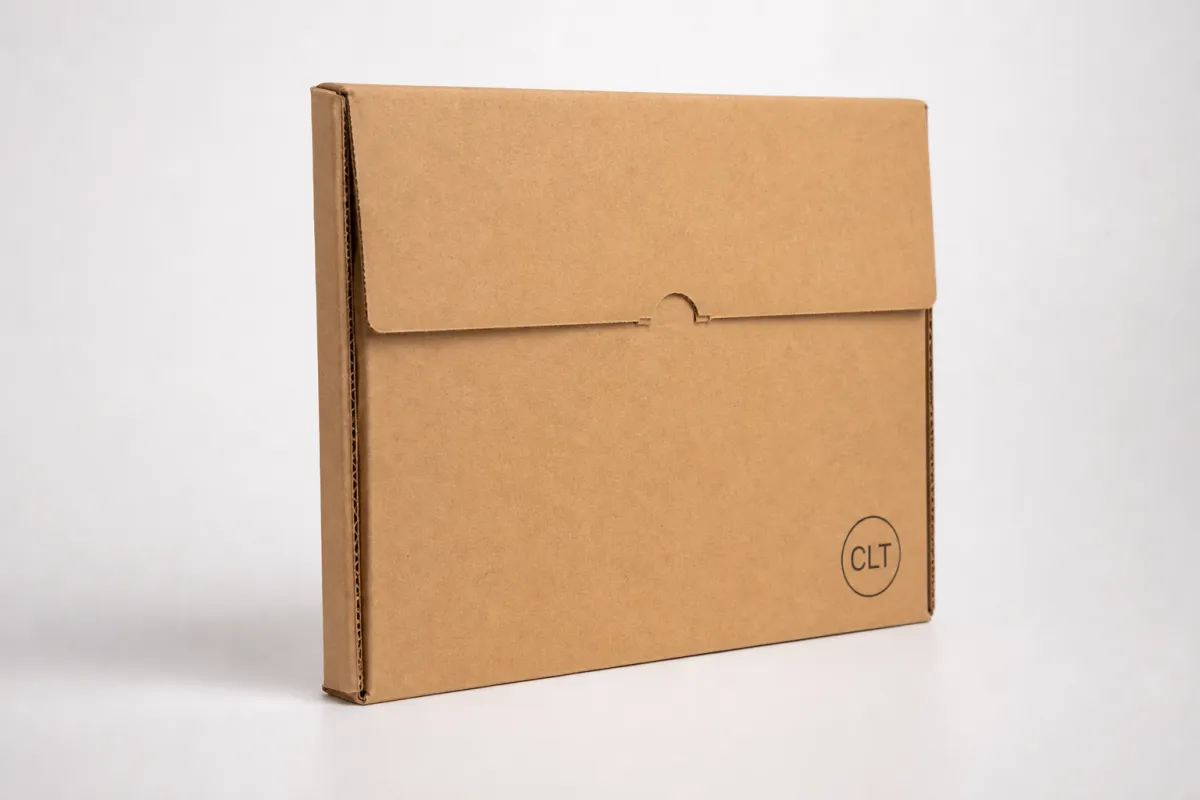
Kraft corrugated mailers are mail-ready protective packages made from kraft-facing corrugated board. They are built for flat items that need more protection than a poly mailer can offer, but do not require a full rigid carton. Common uses include documents, books, apparel, prints, stationery, small subscription items, and lightweight ecommerce goods. They sit in the practical middle ground where cost and protection finally meet without a lot of drama.
The structure matters. A typical mailer uses an outer kraft liner, a corrugated medium in the middle, and an inner liner that gives the package its shape. Flute choice affects thickness, stacking behavior, and crush performance. Even closure style changes the quote. A self-locking mailer, a tuck-in flap, a tear-strip style, and a book-style mailer each use different amounts of material and different converting steps, so the kraft corrugated mailers price changes with every design decision.
Buyers usually choose from a few common formats:
- Self-locking mailers for fast pack-out and a clean closure.
- Tuck-in flap mailers for simple use and lower tooling complexity.
- Tear-strip mailers for easier opening and a more deliberate unboxing feel.
- Book-style mailers for flat media, manuals, and premium kits that should open neatly.
The shipping stack matters as well. Kraft corrugated mailers usually outperform poly mailers where crush protection matters, and they are often lighter and less expensive than rigid cartons when the product stays flat. If you are weighing formats, compare them against Custom Poly Mailers for soft goods and against Custom Shipping Boxes for bulkier or more fragile products. That side-by-side view usually clears up the decision quickly.
What most brands appreciate about this category is simple: the right spec can reduce void fill, cut packing time, and lower transit damage. If the item shifts around, the pack fails before it reaches the carrier. If the mailer is snug and the board is correct, the whole operation feels more controlled. That is why kraft corrugated mailers price should never be judged without fit and function in view.
The cheapest mailer on paper can become the most expensive one once it is tied to a live shipping account. Damaged goods and re-ships are not abstract problems. They show up as invoices.
Specifications That Shape Performance and Cost
If you want a clean quote, send the real specs. That means actual packaging details, not “something around this size.” The most useful inputs are internal dimensions, board grade, flute type, wall structure, closure method, and print requirements. Those choices determine most of the kraft corrugated mailers price before anyone opens a design file.
Dimensions matter more than many buyers expect. A mailer that is too loose wastes freight space and lets the product move. A mailer that is too tight can slow packing and create scuffing or edge crush. Inside dimensions should match the product plus a small allowance for insertion and closure, not a guess based on outside measurements. When the fit is off, the price problem starts long before the invoice arrives.
Board choice is the next major lever. Thinner board usually lowers the kraft corrugated mailers price, but the tradeoff is less crush resistance and weaker stack performance. Heavier board costs more, though it holds its shape better in parcel networks, especially when cartons sit in warehouse stacks or take a rough ride in transit. E-flute is common for lighter mailers. B-flute or a stronger build is often chosen when the package needs more stiffness. Double-wall is not common in this category, but it can fit certain special applications.
Printing and finishing also affect the number. A natural kraft look is usually the least expensive branded direction. A single-color logo remains manageable for many runs. Full-color print, coating, and special surface treatment all add cost. Matte and gloss finishes can improve presentation, but they do not come free. If branding is subtle and the product sells on performance, a simpler build often delivers a better kraft corrugated mailers price without hurting the customer experience.
Several smaller details matter more than people often expect:
- Adhesive strength has to hold through temperature swings and warehouse handling.
- Tear-strip consistency matters if the end user is meant to open the mailer cleanly.
- Score quality affects folding speed and the way the flap sits after closure.
- Sample testing should happen before production, not after the product is already on a truck.
If formal testing matters to your team, ask whether the build lines up with parcel-style drop and vibration checks such as those referenced by the ISTA test protocols. If sustainability claims are part of the sourcing conversation, ask about FSC-certified liners and documentation through the FSC certification standards. Those references do not magically improve a package, but they do keep claims grounded.
From a buyer's standpoint, the right quote is the one that spells out the spec clearly enough to compare apples to apples. Otherwise, kraft corrugated mailers price becomes a guessing game, and guessing is how procurement gets burned.
Kraft Corrugated Mailers Price, MOQ, and Unit Cost
Here is where many buyers get the biggest surprise. Kraft corrugated mailers price drops as volume rises, but not in a smooth line that makes everyone happy. It falls in steps because setup, converting, print preparation, and waste have to be absorbed somewhere. At small quantities, those fixed costs sit on fewer units. At larger quantities, the unit cost starts behaving like a normal manufacturing number.
MOQ matters for the same reason. A lower minimum sounds appealing, but the per-unit price usually climbs because tooling and setup are spread across a small batch. If a supplier agrees to make 500 custom mailers, the price per piece is usually higher than it would be for 5,000 or 10,000. That is not greed. That is basic production math. The most honest kraft corrugated mailers price is the one that reflects that math instead of hiding it behind a polished quote.
Here is a practical comparison for common buying scenarios:
| Build Type | Typical MOQ | Typical Unit Price | Best For | Main Tradeoff |
|---|---|---|---|---|
| Economy unprinted kraft mailer | 500-1,000 units | $0.32-$0.70 | Budget-sensitive flat goods, internal packing, low-risk shipments | Less branding and a simpler presentation |
| Standard custom single-color mailer | 3,000-5,000 units | $0.24-$0.48 | Ecommerce brands, books, apparel, kits, regular parcel shipping | Needs cleaner artwork and tighter spec control |
| Premium heavy-board or full-color mailer | 5,000-10,000+ units | $0.45-$0.95 | Subscription boxes, premium unboxing, fragile inserts, branded launches | Higher setup cost and more print-related variables |
Those ranges are not fantasy numbers, and they are not a promise either. They are the kind of real-world brackets buyers use once a supplier has enough detail to quote properly. The same size can move quite a bit if the board changes, the print coverage changes, or the closure style changes. That is why a “cheap” kraft corrugated mailers price often disappears once the spec is finished.
Hidden costs can make a low quote look better than it deserves:
- Custom tooling for special sizes or closure styles.
- Print plates or setup charges for branded artwork.
- Freight if the quote is ex-factory and not landed.
- Overrun allowance that can raise the true paid quantity.
- Poor nesting efficiency that increases carton count and shipping cost.
If two quotes do not match on size, board grade, print coverage, and delivery terms, they are not comparable. That sounds obvious, yet it gets ignored constantly. A supplier can make kraft corrugated mailers price look lower by trimming board weight, changing the liner, or excluding freight. Fine. Just do not treat that as the same product.
The blunt version is the useful version here: ask for itemized pricing, then compare the landed cost, not the shiny unit number. A quote that includes material, converting, packaging, and standard delivery terms is usually far easier to trust than a bare-bones number with half the details missing.
Process, Timeline, and Lead Time From Quote to Delivery
A clean order starts before the quote is approved. The clearer the spec, the faster the job moves. A sensible flow usually looks like this: spec confirmation, artwork review, sample or dieline confirmation, production, inspection, shipping. Every skipped step tends to come back later as a delay. Those delays can also affect kraft corrugated mailers price indirectly by creating rush freight or extra revision costs.
Clean specs shorten lead time. Final inside dimensions should be ready. Board preference should be named. Print files should be print-ready. The shipping destination should already be known. If a buyer sends “rough size,” “maybe one-color logo,” and “we will sort out freight later,” the quote may still arrive, but the process will crawl. That is how a simple order starts acting complicated.
It also helps to separate sample time from production time. A sample can take 5-10 business days depending on line load and whether any new setup is needed. Full production often takes 12-20 business days after proof approval for straightforward custom runs. If new tooling or heavier print work is involved, the schedule stretches. Then freight transit gets added on top. A supplier who quotes only factory time is giving you half the picture.
Here is the timeline I would want before paying a deposit:
- Proof approval date so the artwork handoff is clear.
- Sample sign-off date if a sample is part of the order.
- Production window with a real start and finish estimate.
- Inspection step to confirm print, die-cut, and closure quality.
- Transit time based on the actual shipping method, not a hopeful guess.
This matters because kraft corrugated mailers price is not only about the carton. It is about how much time and labor the order consumes before it is ready to ship. A supplier that manages that process well is usually worth more than a supplier that sends a low number and disappears for several days.
One more practical note: stock-like builds move faster than fully custom builds. If the size is standard and the print is simple, the order can turn around relatively quickly. If you want a custom size, heavier board, a special tear-strip, and full-coverage branding, expect a longer schedule. That is normal, and pretending otherwise helps nobody.
Why Choose Us for Kraft Corrugated Mailers
From a packaging buyer's point of view, the real value is control, not hype. A factory-direct supplier can usually give tighter control over materials, fewer middleman markups, and more consistent repeat quality. That matters when you reorder the same kraft corrugated mailers price structure month after month and expect the mailer to look and perform the same way every time.
What should you expect from a serious supplier? Honest pricing. Clear spec sheets. Sample support. Realistic lead times. Fast answers. That sounds basic because it is basic. Still, plenty of quotes arrive with missing dimensions, vague board descriptions, or freight assumptions hiding in the fine print. A clean packaging partner removes that noise instead of adding more of it.
Customization has direct business value. The right mailer fits the product better, which means less movement and fewer transit issues. The right print keeps the brand looking deliberate instead of generic. The right closure speeds pack-out on the line. All of that affects labor and customer experience, not just the carton itself. If you care about kraft corrugated mailers price, those operating costs belong in the conversation too.
Here is what a dependable sourcing relationship usually looks like:
- Production inspection before shipment, not after a customer complaint.
- Batch consistency so the second reorder matches the first one.
- Clear tolerances on size and print so everyone knows the acceptable range.
- Practical recommendations on whether your item should use mailers, cartons, or another format.
If you are building a larger packaging program, a supplier should be able to show you how this product fits alongside other formats, not just push one option. That is where a broader catalog matters. Some items belong in Custom Packaging Products. Some are better in Custom Poly Mailers. Some need Custom Shipping Boxes. A decent supplier tells you the truth even when the truth is that the first suggestion is not the best one.
The point stays simple. You do not need drama. You need a supplier who quotes accurately, builds to spec, and ships what was promised. That is how you keep kraft corrugated mailers price under control without turning procurement into a guessing contest.
Good packaging is boring in the best possible way. It fits, it closes, it ships, and it does not create a trail of problems behind the scenes.
Next Steps to Get an Accurate Kraft Corrugated Mailers Price
If you want a fast quote that actually holds up, send the right information first. The more complete your request, the less back-and-forth you will deal with, and the better the kraft corrugated mailers price will reflect your real order. Start with internal dimensions, quantity, board preference, print needs, shipping destination, and target budget. That is enough for a supplier to stop guessing.
I also recommend asking for two or three options instead of one. Give yourself an economy build, a standard build, and a premium build. That way you can compare the tradeoffs instead of forcing every decision into a single line item. In many cases, a slightly better board or a cleaner closure adds only a small amount to the kraft corrugated mailers price while improving the way the product ships.
Before approval, check these items carefully:
- Inside dimensions match the actual product, not the outside footprint.
- Board grade and flute are clearly written on the quote.
- Print coverage is defined in plain language.
- Freight terms are included or clearly separated.
- Tooling and setup charges are visible before you sign.
If the item is fragile, premium, or high-volume, ask for a sample or a small pilot run. That is cheap insurance. It tells you whether the mailer actually fits, whether the closure holds, and whether the board survives the handling your product truly sees. In practice, a short test run saves more money than it costs, especially when the first full production order would otherwise lock in the wrong kraft corrugated mailers price.
The last step is straightforward: compare the final quote against freight, setup, and any custom tooling before you approve production. Then keep the same spec for the reorder. Consistency is where packaging buyers earn their margin. If you gather the specs first and request the quote second, the final kraft corrugated mailers price is far more likely to be accurate the first time.
FAQ
What is included in kraft corrugated mailers price?
Usually the quote covers material, converting, and the basic packing configuration. Printing, special coatings, tooling, and freight may be separate depending on the supplier. Ask for an itemized quote so you can compare real landed cost, not just the headline kraft corrugated mailers price.
Why does kraft corrugated mailers price per unit drop with higher MOQ?
Setup costs are spread across more pieces, so the unit cost falls. Larger runs also improve material efficiency and production speed. The best savings usually show up after the order passes the supplier's standard setup threshold, which is why kraft corrugated mailers price usually looks better at scale.
How do I compare kraft corrugated mailers price across suppliers?
Match the same size, board grade, print coverage, and closure style. Confirm whether freight, plates, sampling, and overrun allowances are included. A lower quote is only useful if the spec and delivery terms are actually the same, because otherwise kraft corrugated mailers price is not a real comparison.
What is a practical MOQ for custom kraft corrugated mailers?
MOQ depends on size, print complexity, and whether tooling is required. Simple stock-like builds can usually support lower MOQs than fully custom packaging. If the run is too small, the unit price often jumps hard because setup dominates the order, which is why kraft corrugated mailers price can move so quickly at low volume.
How long does production take after artwork approval?
Lead time depends on material availability, print method, and whether samples are already approved. Simple orders move faster than custom printed builds with new tooling. A realistic schedule should include production time, inspection, and transit, not just factory floor time, because that is what makes the kraft corrugated mailers price meaningful in the real world.
If you want the quote to land correctly, gather the specs first, compare the options second, and approve the build only after the numbers match the product. That is the cleanest way to keep kraft corrugated mailers price honest, keep the packing line moving, and avoid finding out too late that a cheap quote was only cheap because half the job was left out.