Labels Fabric Personalized: Order Custom Clothing Tags
For buyers searching for labels fabric personalized, the real question is not whether a mockup looks tidy on screen. It is whether the label still looks right after it is cut, folded, sewn, washed, packed, and handled by the customer. A good label makes a garment feel finished. A weak one can make an otherwise solid piece feel temporary.
That tiny strip of fabric carries more weight than it seems to. It identifies the brand, supports size and care information, and often signals the level of finish a product can be expected to hold. If the spec is off, the problems show up quickly: blurred text, scratchy edges, a crooked fold, or a tag that curls after the first wash.
The practical challenge is simple to describe and easy to get wrong. The label has to fit the garment, survive real use, and match the brand’s price point without creating sewing headaches. That means choosing the right construction, the right finish, and the right amount of information for the space available.
“A label is one of the few garment components that the customer touches before they trust the product.”
That is why labels fabric personalized deserves the same attention as fabric weight, seam quality, or trim selection. It sits close to the skin, travels through laundry cycles, and often carries the last impression a brand leaves behind.
What labels fabric personalized really means for finished garments
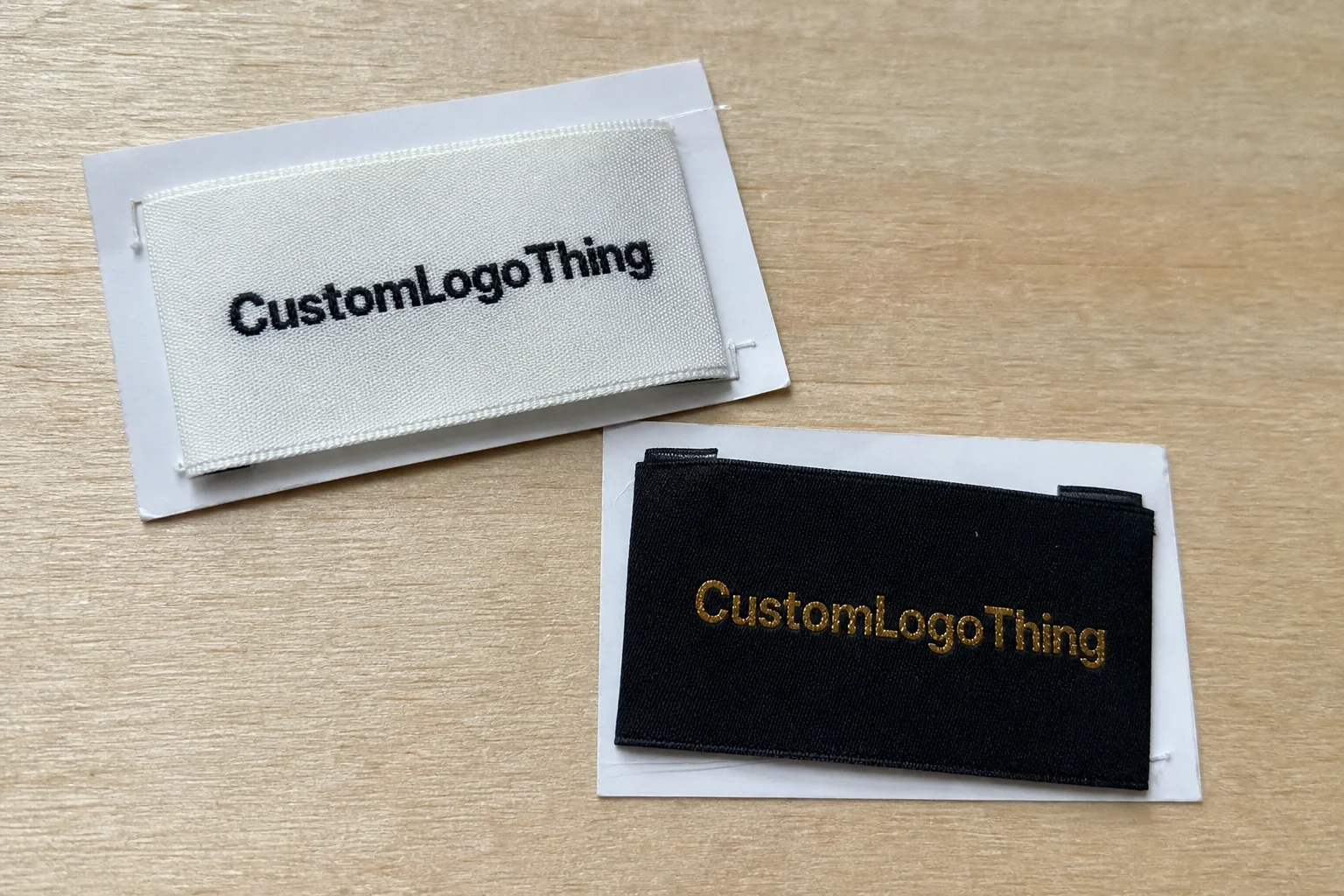
In production terms, the phrase covers several label types, each with a different job. Woven labels are built from thread and usually offer the most textile-like, durable finish. Printed fabric labels use ink on cloth and can reproduce smaller text or more detailed artwork without the density of weave. Heat-transfer labels skip the sewn tag entirely and move the branding onto the garment surface. Sewn-in care labels remain the standard for fixed information such as size, fiber content, and washing instructions.
The biggest buyer mistake is assuming all labels are interchangeable. They are not. A neck label for a heavyweight hoodie has different needs from a care label inside a children’s bodysuit or a side-seam label in lightweight loungewear. One is about brand presence and comfort. Another is about compliance and readability. A third may simply need to survive frequent washing without becoming irritating or unreadable.
The right label also depends on how the product is sold. A boutique tee that sits on a hanger in a retail shop can tolerate a slightly firmer woven label if the finish feels premium. A garment meant for direct skin contact, however, usually benefits from a softer construction or a tagless approach. The label should support the garment, not fight it.
Small details change perception fast. A clean, well-sized label can make a small batch brand look disciplined and retail-ready. A rough edge or vague care text can make the same garment feel unfinished. Customers may not know exactly what failed, but they usually notice that something does not feel resolved.
The most useful way to think about personalized fabric labels is as a functional trim, not decoration. Once that mindset is in place, the rest of the decisions become easier to judge: where the label sits, how much of it stays visible after sewing, how it feels against skin, and whether the information remains readable after repeated laundering.
How the label production process moves from artwork to sewn-in tag
The process usually starts with the artwork file. Before anyone quotes a firm price, the supplier needs to know whether the design can be reproduced at the intended size, whether the copy is legible, and whether the artwork needs cleanup for thread mapping or print conversion. Small type is where problems begin. A logo that looks sharp on a laptop can collapse once it is reduced to 20 mm wide.
Next comes the proof. This is the point where the buyer should check layout, fold style, color interpretation, edge treatment, and attachment method. A proof is not just a preview. It is the control point where the expensive mistakes can still be caught. If the proof is rushed, the label may still be usable, but it often ends up being a compromise rather than a deliberate choice.
Woven and printed constructions behave differently. Woven labels translate artwork into thread structure, which gives a polished textile feel and good longevity, but very fine details can soften if the design is too busy. Printed fabric labels can hold thin line art, gradients, and small text more easily, and they usually feel lighter in the garment. For highly detailed artwork or shorter runs, printing is often the cleaner choice. For premium hand-feel and long wear, woven construction usually makes more sense.
After approval, the label moves into finishing. That may include cutting, folding, heat sealing, bundling, and final inspection. Even a simple label passes through several checkpoints because a tag that is frayed, off-center, or packed incorrectly creates waste later on the sewing line. Small pieces are unforgiving in production. If the count is wrong or the fold is inconsistent, the problem spreads quickly across the run.
One spec that should be settled early is the fold type. Center folds, end folds, straight cuts, and loop styles all affect how much label remains visible after sewing and how it sits inside the garment. Changing the fold late in the process can force a size change or a revised allowance. That is one reason the quoting stage can feel slower than expected. The label is small, but the production decisions around it are not.
Care and compliance text should also be reviewed early. Different markets and garment categories may require fiber content, care symbols, language conventions, or country-specific information. A supplier can print what is provided, but the buyer still owns the accuracy of the content. If the garment will be sold across multiple regions, the label should be planned with that in mind before the first proof is approved.
Materials, folds, and finishes that change comfort and durability
Material choice changes both the look and the feel of the label. Woven damask is a strong option when a brand wants sharp detail and a polished surface. Satin is smoother against skin and often works well for garments where comfort matters more than structure. Printed fabric keeps the hand-feel light and is useful when the artwork is simple or the order needs a softer finish than a woven label can provide.
| Label type | Best use | Typical strength | Typical tradeoff |
|---|---|---|---|
| Woven damask | Premium apparel, long-wear branding | Sharp detail, durable finish | Can feel firmer at very small sizes |
| Printed fabric | Fine text, simple branding, softer touch | Good for small runs and lightweight labels | May show wear sooner under heavy laundering |
| Heat transfer | Tagless neck branding, activewear | Very smooth against skin | Needs careful wash testing and application control |
| Sewn-in care label | Compliance, fiber content, care instructions | Fixed placement and clear information | Less flexible if seam space is limited |
Fold style is just as important as material. A center fold is common for neck labels because it allows the tag to sit neatly in a seam. End folds are useful when a visible edge needs to lie flat. Straight cut labels are common for side seams or care information. Loop labels can work for decorative or hanging applications, but they are not the default for most clothing. The wrong fold can twist, poke, or bunch inside the garment.
Edge finish and backing choices affect comfort more than many buyers expect. If the edge frays, the label looks tired before it even leaves the warehouse. If the backing is too stiff, it can irritate the skin at the neckline or waist. If it is too soft, it may wrinkle or distort when sewn. A good sample is not just visually clean; it should also be tested on the actual garment fabric in the actual position where it will live.
Detail level matters too. A label with too many colors, thin lines, or tiny lettering often loses definition after repeated washing. That is a common issue with labels fabric personalized orders that start with a dense logo or long legal text. A simpler mark often ages better than a decorative version packed with fine elements that do not survive production well.
For activewear, children’s clothing, boutique basics, and accessories, the comfort target shifts. Activewear usually needs a low-profile application and strong wash resistance. Children’s garments need softness and clear legibility. Boutique basics often aim for a clean branded impression without stiffness. Accessories can usually tolerate a wider range of label textures, as long as the tag does not dominate the item visually.
Cost, pricing, and MOQ: what drives your quote up or down
Quote differences usually come from the same variables: quantity, size, number of colors, label construction, fold style, and special finishing. Increase any of those and the price tends to rise. Simplify the artwork or standardize the dimensions and the quote usually becomes easier to control. That pattern holds whether the order is 500 pieces or 50,000.
Minimum order quantity has a real effect on unit cost. Proofing, setup, file prep, and production planning are spread across fewer labels on a small run, so the per-piece price climbs quickly. A buyer ordering 250 labels will almost always pay more per unit than a buyer ordering 5,000, even if the label specification is identical. That is a structural cost, not a markup trick.
For planning purposes, many buyers see simple woven labels land roughly around $60-$180 per 1,000 pieces, printed labels around $40-$140 per 1,000, and heat-transfer labels around $90-$250 per 1,000. Small orders are usually much higher per unit because the setup cost has fewer pieces to absorb it. These are planning ranges, not a quote, but they are useful when comparing options and deciding how much complexity the design really needs.
The best quote is not always the cheapest one. A slightly more expensive woven label can reduce complaints and support a higher retail price if the product is meant to feel premium. A printed label can be the smarter choice when the artwork is detailed, the launch is small, or the business is still testing which SKU will move fastest. The right answer depends on product positioning, not just the lowest unit price.
| Cost driver | What usually happens | Buyer takeaway |
|---|---|---|
| More colors | Setup and production cost rise | Simplify artwork if the brand mark allows it |
| Smaller quantity | Unit cost increases sharply | Order with replenishment in mind |
| Special fold or backing | Extra finishing time and material cost | Use only when the garment really needs it |
| Complex typography | More proofing and a higher risk of rework | Keep text short and readable at final size |
It also helps to compare quotes on the full landed cost, not just the headline unit number. Ask whether sampling, revisions, folding, packaging, and shipping are included. A lower quote can disappear fast if every change is billed separately. Clear specs reduce back-and-forth, and that usually saves time as well as money.
If future replenishment is likely, order with that in mind. Re-quoting a small top-up later is often more expensive than placing a slightly larger run now, especially if the artwork and fold style are not expected to change. For broader product planning, Custom Labels & Tags is a practical place to compare label constructions before locking the spec.
Lead time and turnaround: realistic timing for samples and bulk runs
Lead time starts once the proof is approved, not when the first email is sent. From there, the schedule depends on label type, finishing complexity, queue position, and shipping method. A straightforward woven or printed label order often moves faster than a mixed-spec order with multiple sizes, custom folds, or special backing. If the proof changes several times, the practical production clock resets even if the calendar does not.
Sampling and bulk production are different stages. A sample can be ready relatively quickly because it is made in a small quantity, but it still needs the same design review and usability check. For many orders, a sample may take 3 to 7 business days after artwork is confirmed. Bulk production commonly falls in the 7 to 15 business day range after approval, though complex jobs or heavy seasonal demand can push that longer.
Most delays are predictable. Artwork cleanup takes time. Font corrections take time. A size change after proof approval takes time. If the label needs to be tested on the actual garment, that adds another step before the order is released. None of that is unusual. It is the difference between a digital file and a physical component that must survive sewing and washing conditions.
Rush service can help when a deadline is real, but it comes with tradeoffs. Revision time shrinks, and the unit cost usually rises. The safer approach is to build a buffer into the schedule and treat the sample as the final quality gate, not a rough draft. For a seasonal drop or a trade show launch, a few extra days spent on proofing is usually cheaper than discovering a sizing or readability problem after production starts.
Common mistakes that make sewn-in labels scratchy, faded, or unreadable
The most common failure is artwork that is too detailed for the label size. Tiny icons, thin serif fonts, and long legal copy may look elegant in a design file, but they often become unreadable once woven or printed at production scale. A label is a small physical object, and small physical objects punish overdesigned copy.
Contrast is another frequent miss. Dark thread on a dark background or pale print on a light surface can leave the branding weak and hard to read. If the label has to do real work, the design needs enough separation to remain legible in poor light, after folding, and after repeated laundering. That does not mean every label should be high-contrast, but the decision should be deliberate.
Material mismatch creates a different kind of problem. A label may look fine in hand, then start to irritate once it is stitched into a neckline or waistband and rubbed for a full day. This is especially true for garments worn close to the skin. The fix is often simple: choose a softer face, reduce stiffness, or move the label to a less sensitive location.
Wash testing is worth the time. Some labels look excellent on delivery and then fail after a few wash cycles because the construction or ink system was not suited to the application. If the garment will go through heavy home laundering, test the label under similar conditions before approving the full run. A short wash test usually reveals more than a digital proof ever will.
Placement planning matters as well. Poor placement can create visible seams, twisting, bunching, or a tag that sits crooked inside the garment. Sewing teams need a clear plan for where the label starts, where it ends, and how much allowance is built in. If that plan is vague, the label may still be technically correct and functionally annoying.
QC should cover more than appearance. Check readable text at final size, color consistency across the run, fold symmetry, edge finish, and how the label feels after it is sewn into the garment. That final step matters because a label can pass a print check and still fail a wear check. For personalized fabric labels, the goal is not just to print something attractive. It is to produce a small component that stays useful.
Next steps: finalize artwork, verify specs, and place a reorder-ready plan
Start with the label type, then lock the size, fold, and attachment method. After that, prepare the artwork and decide exactly what must appear on the label. For apparel, that usually means the brand name, size, and any required care or fiber information. If the space is tight, prioritize the details the wearer actually needs after purchase.
Before requesting a proof, gather the details that slow projects down when they are missing: brand name, size range, garment category, artwork file, care text, and any legal copy. If the label needs a softer hand-feel, say so. If it must survive aggressive washing, say that too. Specific input usually shortens the proof cycle and reduces revisions.
If the garment is sensitive, request a sample or short production proof first. That is especially useful for necklines, children’s apparel, and anything worn directly against the skin. A one-piece test on the real fabric tells you more than a screen mockup ever will. It also exposes problems with thickness, stitching, and placement before the full order is committed.
For repeat orders, keep a clear spec sheet. Record size, fold type, material, color references, attachment method, and the approved artwork version. That way future runs do not drift in dimension, finish, or readability. A reliable spec sheet is usually the difference between an easy reorder and a round of unnecessary corrections.
Handled this way, labels fabric personalized becomes a controlled part of production rather than a last-minute fix. The first order should establish the standard. After that, the label can do what it is supposed to do: fit the garment, carry the brand, and stay consistent from launch through replenishment.
Are personalized fabric labels better woven or printed?
Woven labels usually feel more premium and hold up well over time, especially when the design is simple and the brand wants a polished textile look. Printed fabric labels can be better when the artwork has fine detail, the hand-feel needs to stay soft, or the order is small enough that simplicity matters more than texture. The right choice depends on wash demands, artwork complexity, and where the label will sit on the garment.
What should I include on custom fabric clothing labels?
Start with the brand name and size, then add care instructions or fiber content if the garment category calls for it. Keep the copy short and readable, because tiny text is usually the first thing to fail in production. If the label space is limited, prioritize the information the wearer actually needs after purchase.
How many labels do I need for a small apparel order?
Order enough for the full production run plus a margin for samples, spoilage, and future replacements. If the product has multiple sizes, leave room for the faster-moving sizes so packing does not stall later. A modest buffer is usually cheaper than reopening the quote process for a shortage.
Can personalized fabric labels be sewn on or ironed on?
Sewn-in application is the most common and durable choice for clothing labels. Iron-on backing can work for some garments, but it should be tested on the actual fabric before the full run is approved. The best attachment method depends on wash load, fabric texture, and whether the label needs to stay soft against skin.
How do I request a quote for labels fabric personalized?
Provide the label size, quantity, artwork, fold style, attachment method, and target delivery date. Include any special requirements such as a soft-touch finish, wash durability, or a specific placement goal. The clearer the spec, the faster the quote and proof process usually moves.