Large Custom Cardboard Boxes solve a very practical problem: oversized products do not behave nicely inside standard cartons. They shift, crush void fill, scrape corners, and sometimes arrive with that familiar corner blowout that makes everyone involved wish the box had been built for the product instead of borrowed from a generic size catalog. For brands shipping furniture parts, equipment, framed items, displays, or bundled kits, large Custom Cardboard Boxes can be the difference between a clean delivery and a costly damage claim.
From a packaging buyer’s point of view, the real value is not just the bigger footprint. It is the exact fit, the right board grade, and the ability to build the carton around how the product actually ships. That can affect freight class, pallet layout, stack strength, and even how much labor your packing team spends closing and taping each unit. In other words, sizing is not a minor detail. It is the whole system.
If you also need branded packaging or Custom Printed Boxes, the carton becomes part protection, part operations tool, and part presentation. That is where practical packaging design starts paying for itself.
What large custom cardboard boxes actually solve in shipping
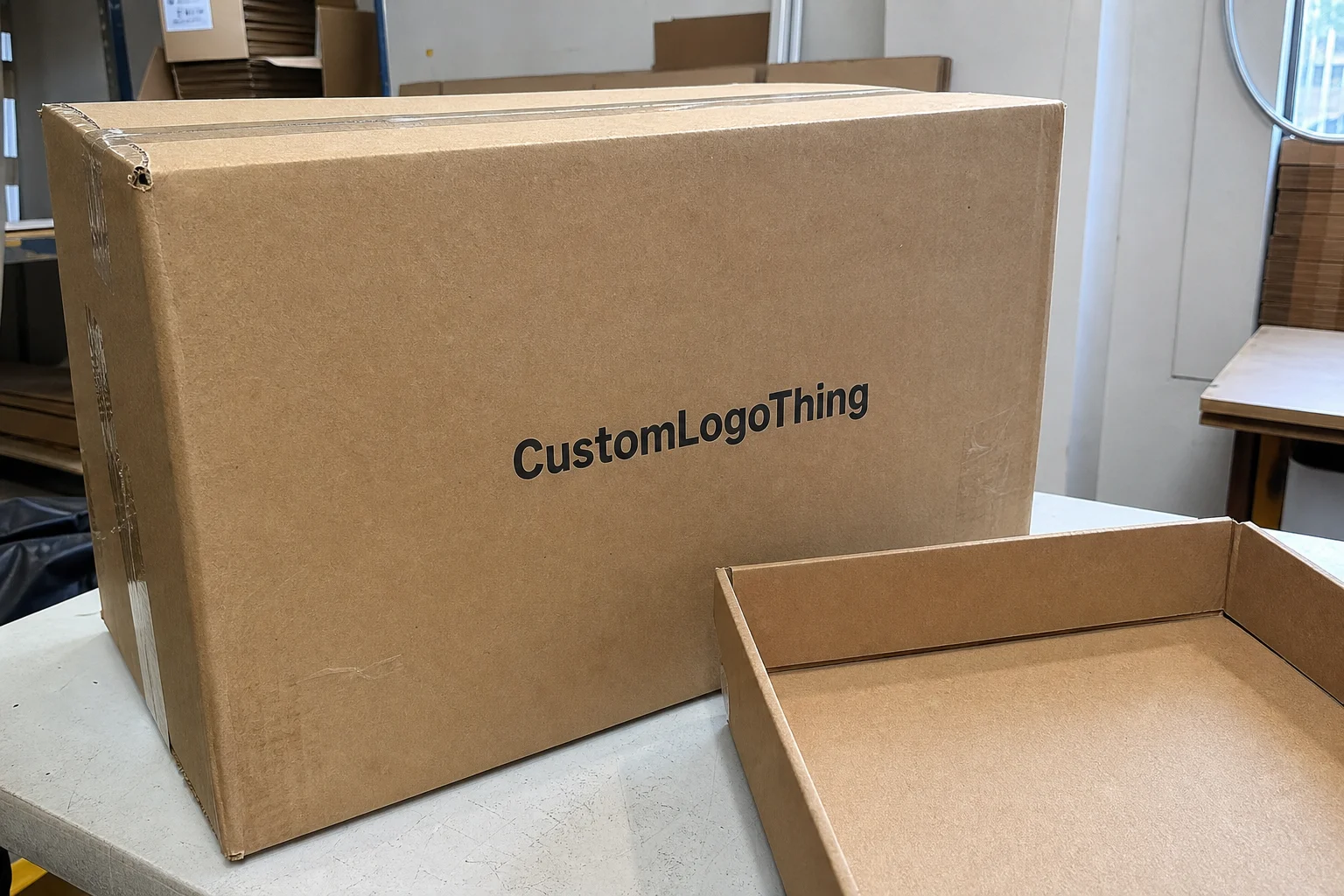
Standard stock cartons work fine for many products, but oversized or awkward items push them past their comfort zone. A product that rattles inside the box often needs more cushioning, more tape, or more internal fill than anyone planned for. Too much empty space can mean the item slides during transit, while too little space can make packing slow and messy. Large Custom Cardboard Boxes solve that by matching the internal dimensions to the actual shipment, not just a rough estimate.
The biggest practical benefit is control. When the carton is built to the product’s length, width, and height, you reduce movement and usually reduce the amount of void fill required. That matters for fragile product packaging, but it also matters for heavier goods where a loose fit can create corner impact, edge wear, or load shifting on a pallet. A well-sized box also tends to stack better, which is a quiet but very real cost saver in warehousing and freight.
There is also a branding angle. For retail packaging, display components, and DTC shipments, the box may be the first physical touchpoint a customer gets. Clean print, a properly sized profile, and predictable assembly all support package branding without turning the carton into an expensive showpiece.
“If the carton is 3 inches too big in two directions, you may not just be wasting material; you may also be paying to ship dead air.” That is one of the most common mistakes I see buyers make.
For buyers comparing Custom Shipping Boxes against stock options, the real question is whether the shipment needs ordinary containment or engineered performance. Heavy, fragile, branded, or unusually shaped products usually deserve the second option.
How custom sizing, board grade, and construction work
Corrugated packaging sounds simple until you start matching the box to an actual product. The board itself is usually made from linerboard and fluting, and the flute profile affects both cushioning and compression performance. Single-wall construction is common for many shipments, but larger cartons often need double-wall because the bigger the panel span, the more the board has to resist bulging, crush, and stacking pressure.
In practice, the choice often comes down to how much abuse the carton will see. Light to moderate loads can sometimes ship in a single-wall box with the right flute and internal support. Heavier or longer-distance shipments may call for double-wall, especially if the box will be palletized or stored under other cartons. Common flute combinations include B flute, C flute, and E flute, though large formats often lean toward stronger combinations when compression matters more than a thin profile.
Box style matters too. Regular slotted cartons are familiar and cost-effective, but overlap styles are often used when the box is long or the flaps need extra coverage. Die-cut alternatives can work when the product shape is unusual or when the pack-out process needs a precise closure, locking feature, or built-in display panel. The right structure depends on both the item and how your team assembles it.
Internal dimensions are the ones that matter. Outside dimensions can mislead you, especially if you are comparing suppliers. Even a small difference in score line placement or manufacturer tolerance can change fit, so it is smart to leave enough room for inserts, paper cushioning, foam corners, or hand packing clearance. If the product is delicate, a few millimeters of bad planning can create a real problem.
Optional features can improve performance without overcomplicating the run:
- Reinforced edges for better crush resistance on tall cartons.
- Partitions or dividers for bundled items, bottles, or components.
- Custom inserts in paperboard, corrugated, or foam for fixed positioning.
- Print coatings when branding or scuff resistance matters.
For sourcing support beyond one box size, many buyers also review Custom Packaging Products so the carton, insert, and labeling plan stay aligned from the start.
Industry standards can help you judge whether a supplier is thinking clearly. ISTA test methods are widely used to evaluate shipping performance, while ASTM compression and material testing helps quantify how a carton will behave under load. If you need fiber sourcing credibility for retail packaging or branded packaging programs, FSC certification from FSC.org is worth asking about.
Key sizing, strength, and branding factors to compare
The best spec is not always the strongest box or the cheapest one. It is the box that fits the product, survives the route, and does not create unnecessary friction in operations. Start with weight. A lightweight oversized item may not need the same compression strength as a dense machine part, but it still may need structure if the box is long or stacked. Compression load becomes a bigger issue once cartons are palletized or stored in a warehouse for more than a short time.
Cushioning should be part of the box discussion, not an afterthought. If the shipment needs void reduction, the carton dimensions should account for the actual inserts, paper wrap, foam corners, or molded packaging components. Otherwise, you end up with a box that is technically correct on paper and still wrong in the pack line.
Branding adds another layer. One-color flexographic print may be enough for handling marks, product codes, and a clean logo, while full-color graphics make more sense for shelf-facing or customer-facing shipments. Printing can influence lead time, but it also affects cost and plate setup. For many buyers, a restrained print zone is the sweet spot: enough to support package branding without turning the box into a complex print project.
Fulfillment realities matter more than most first-time buyers expect. If the box is too large for your carton erector, too awkward for manual assembly, or difficult to stack efficiently on a pallet, that hidden labor cost can exceed the difference between two board grades. Large Custom Cardboard Boxes should support the workflow, not fight it.
| Option | Typical use | Strength profile | Best fit for |
|---|---|---|---|
| Single-wall RSC | Light oversized items | Moderate | Lower-weight goods, short transit |
| Double-wall RSC | Heavier or stackable shipments | High | Warehouse storage, palletized loads |
| Overlap style | Long or wide cartons | Higher flap coverage | Large products that need extra closure area |
| Die-cut custom carton | Special shapes or premium presentation | Depends on design | Retail packaging, display kits, precise fit |
If your team handles custom printed boxes for recurring programs, consistency becomes part of quality control. A carton that looks good but stacks poorly can create more trouble than it solves.
Process and timeline: from dieline to production steps
The cleanest projects follow a predictable path. First comes the product data: dimensions, weight, orientation, shipping method, and any insert or seal requirements. Then the packaging supplier recommends a structure, often based on board grade, box style, and how much protection the shipment needs. After that, a dieline is created so artwork and dimensions can be reviewed against the actual carton layout.
Once the structure is approved, artwork gets checked for bleed, safe zones, panel placement, and print feasibility. This is where a lot of delays happen, because a logo can look fine on a screen and still land over a score line or a flap once the box is flattened and folded. If the carton needs a sample, prototype, or pre-production proof, that step pays off by revealing problems before full production starts.
For large Custom Cardboard Boxes, the sample is especially useful because scale changes everything. A small test box can behave beautifully while a larger version bows, flexes, or shows weak closure points. Seeing the actual size in hand helps confirm not just the fit, but also the way the carton opens, folds, stacks, and tapes.
Timelines vary, but a simple branded carton often moves faster than a complex die-cut or heavy-duty build. In many production environments, a straightforward run can land in roughly 12 to 15 business days after final approval, while more involved jobs may take longer if tooling, inserts, or revisions are involved. Missing measurements and incomplete artwork are the usual timeline killers, not the manufacturing itself.
Here is a practical sequence many buyers follow:
- Send exact dimensions, weight, and use case.
- Review a structural recommendation and quote.
- Approve the dieline and artwork placement.
- Check a physical sample or pre-production proof.
- Confirm production, freight method, and reorder details.
That process is especially helpful if your product packaging must support both shipping and presentation, because the same carton may need to satisfy operations, marketing, and customer experience.
Cost and pricing: what drives unit cost on oversized boxes
Pricing for oversized cartons is mostly about material, setup, and efficiency. Bigger boxes use more board, which is the simplest part of the equation. The harder part is that large cartons often cut less efficiently from sheet stock, so yield drops and scrap can rise. Add print plates, die tooling, or special inserts, and the unit price climbs further.
Quantity matters a lot. At lower volumes, setup work is spread across fewer boxes, so the per-unit cost looks higher. As order volume rises, the unit price usually improves, but storage space becomes the tradeoff. That is why minimum order quantity conversations should happen early, not after you have already decided on the carton size.
For buyers trying to balance protection and budget, it helps to request multiple quotes with different board grades or print approaches. You may find that moving from a premium print spec to a cleaner one-color layout saves enough to upgrade from single-wall to double-wall, which is usually a better trade for shipping performance. That kind of comparison is where real value shows up.
| Cost driver | How it affects price | Buyer note |
|---|---|---|
| Box size | More board per unit | Larger cartons usually cost more to make and freight |
| Board grade | Stronger board raises material cost | Do not under-spec if the box must stack or travel far |
| Print coverage | More inks, plates, and setup | Simple graphics often reduce both cost and lead time |
| Tooling or dies | One-time setup expense | Amortized better at higher quantities |
| Quantity | Better tiers at higher volume | Balance unit savings against storage space |
It is also worth thinking about freight economics. Large cartons occupy more cube, so even if the product itself is light, the shipment may cost more simply because the boxes take up space. That is one reason right-sizing is so valuable: less dead air can mean better pallet efficiency and lower transportation waste.
Common mistakes buyers make with oversized carton specs
The most common error is measuring only the product. A real shipment includes tape folds, closure allowance, inserts, surface protection, and sometimes a little clearance for imperfect pack-out. If you do not measure for the package system, you are not really measuring the shipment.
Another mistake is choosing the lightest board grade just to lower the quote. That can backfire quickly if the carton must stack in a warehouse, ride on a pallet, or survive a long carrier network. A lower price per box is not a win if the box fails compression or requires rework at the fulfillment stage.
Artwork errors cause their own headaches. Missing bleed, low-resolution logos, or badly placed text can slow a run even after the structure is approved. Print files need to be built for the actual carton layout, not just copied from a web graphic or sales sheet.
Storage is easy to ignore until it becomes a headache. Large Custom Cardboard Boxes can consume a surprising amount of rack space or floor space, especially if they are produced in higher quantities to reach a better unit price. If your warehouse is already tight, that factor should be part of the buying decision from day one.
Expert tips for ordering the right fit the first time
Give the supplier the real story, not just the dimensions. Share exact product measurements, weight, photos, shipping method, and any inserts, pads, or sealing tape you plan to use. If the product can ship in more than one orientation, say so, because the box may be designed differently depending on how the item sits inside it.
Ask for a sample with the actual product inside it. A carton that looks right on a flat drawing may reveal problems once it is loaded, sealed, and stacked. That is especially true for larger formats, where panel flex and closure tension become more noticeable. Sample approval should include fit, closure, print placement, and handling.
If the boxes will be palletized, ask about compression strength, edge crush, and stacking performance. Those numbers matter more than most people realize. The supplier should be able to guide you toward a board grade that fits the route, not just the weight of the product itself.
For recurring programs, consistency matters as much as strength. Reorders should match the first approved version closely enough that your pack line does not have to relearn the workflow every time. That stability is one of the underrated benefits of well-managed packaging design.
A quick checklist helps:
- Exact internal dimensions
- Product weight and orientation
- Insert or cushioning details
- Print zones and logo files
- Shipping method and pallet plan
- Reorder expectations
Next steps for requesting a quote and approving samples
If you are ready to price out large custom cardboard boxes, start with a clean spec sheet. Include dimensions, weight, quantity, board preference if you have one, print needs, shipping method, and any special handling requirements. The more complete the request, the less back-and-forth it takes to get a useful quote.
When you are unsure whether to prioritize lower cost or maximum protection, compare at least two structural options. For example, one single-wall version and one double-wall version may show you very quickly where the performance-to-price sweet spot lives. That comparison is often more useful than arguing about tiny differences in print detail.
On the sample, review four things carefully: fit, closure, compression feel, and print alignment. Make sure the team that will actually pack the box has a chance to handle it, because the people on the line often catch friction points that the office cannot see from a drawing. If it is hard to assemble, it will be hard to scale.
Before final approval, confirm lead time, freight method, and reorder details. If you are ordering custom printed boxes for a recurring program, ask how the file and spec will be stored for consistency. That small step prevents a lot of avoidable variation later.
Done well, large custom cardboard boxes are not just bigger cartons. They are a practical shipping tool that protects the product, supports operations, and presents the brand cleanly. The smartest move is to spec the box around the real shipment, not around a guess.
How do I measure large custom cardboard boxes for the right fit?
Measure the product’s length, width, and height in the orientation it will ship in, then add room for inserts, cushioning, and sealing. Use internal dimensions when comparing quotes, because outside measurements do not tell you whether the contents will actually fit.
What board grade is best for large custom cardboard boxes?
Single-wall can work for lighter oversized products, while double-wall is often a better choice for heavier loads, palletized shipments, or long transit routes. If the cartons will stack or sit in storage, ask for edge crush or compression guidance before you approve the spec.
Do large custom cardboard boxes usually require a minimum order quantity?
Yes, many custom runs have an MOQ because setup, cutting, and print preparation take time and materials. Higher quantities usually lower the unit cost, so it helps to compare your usage forecast with your storage space before you commit.
How long does production usually take for oversized custom cartons?
Simple designs with standard print choices can move faster than complex structures or jobs that need samples and revisions. Artwork approval, sample approval, and material availability are the biggest timeline factors, so complete specs at the start save time later.
What should I send when requesting a quote for large custom cardboard boxes?
Send exact dimensions, weight, quantity, print needs, board preference, shipping method, and any insert or palletizing requirements. Product photos or a sample can help too, because visual context often reveals structural needs that measurements alone miss.


