Buyer Fit Snapshot
| Best fit | large format shipping tubes uses costs practices for packaging buyers comparing material specs, print proof, MOQ, unit cost, freight, and repeat-order risk where brand print, material, artwork control, and repeat-order consistency matter. |
|---|---|
| Quote inputs | Share finished size, material target, print colors, finish, packing count, annual reorder estimate, and delivery region. |
| Proofing check | Approve dieline scale, logo placement, barcode or warning zones, color tolerance, and any recyclable or compostable wording before bulk production. |
| Main risk | Vague material claims, crowded artwork, or missing packing details can create delays even when the unit price looks attractive. |
Fast answer: Large Format Shipping Tubes Uses Costs Practices: Cost, MOQ, Proof, and Reorder Checks should be specified like a repeatable production item. The safest quote includes material, print method, finish, artwork proof, carton packing, and reorder notes in one written spec.
What to confirm before approving the packaging proof
Check the product dimensions against the actual filled item, not only the sales mockup. Ask for tolerance on folds, seals, hang holes, label areas, and retail display edges. If the package carries a logo, QR code, warning copy, or legal claim, reserve that space before decorative graphics fill the panel.
How to compare quotes without losing quality
Compare board or film grade, print process, finish, sampling route, tooling charges, carton quantity, and freight assumptions side by side. A lower quote is only useful if the supplier can repeat the same color, closure quality, and packing count on the next order.
Large Format Shipping Tubes: Uses, Costs, and Best Practices
I have watched a set of large format shipping tubes save a $480 reprint on a 48-inch trade show graphic leaving a bindery in Tempe, Arizona, and I have also watched one weak cap turn a clean print job into a corner-crushed mess before it reached a customer in Atlanta. That gap tells you almost everything. A tube that costs under a dollar can protect work worth 50, 100, or even 200 times more, which is why I take this category seriously when I talk with print shops, architects, and ecommerce shipping teams. Plain packaging can look forgettable, but on a conveyor in Louisville or a dock in Newark, forgettable is exactly what you want. The trick is making the package do its job without making the whole operation more complicated than it needs to be.
If you ship posters, blueprints, banners, maps, or other rolled materials, the right tube is more than packaging. It sits inside your package protection strategy, your order fulfillment flow, and the first impression your customer gets when the carton lands on a desk, a warehouse floor, or a jobsite trailer in Phoenix. I have seen teams save more money by changing tube specs than by renegotiating freight, because dimensional weight, damage claims, and reshipments stack up fast. One print buyer in Columbus told me the tube was "just the container," and three weeks later the claims file showed $1,260 in preventable damage on 180 shipments. The spreadsheet usually learns the lesson after the carton does, which is kinda brutal, but it is also how the numbers behave.
What Are Large Format Shipping Tubes?
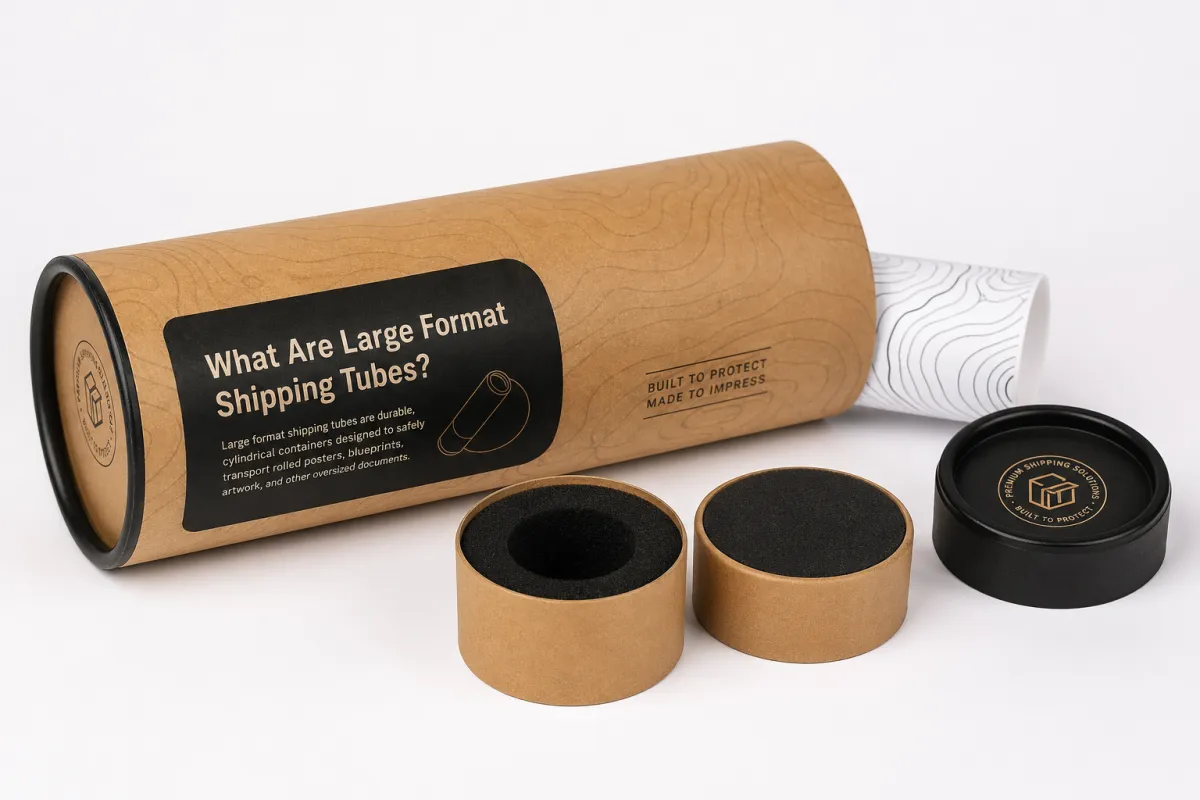
Large format shipping tubes are rigid cylindrical containers built to move oversized rolled goods without letting the edges get smashed, scuffed, or folded. The product sounds plain, yet the job it does is not plain at all. A good tube has to hold a 24-inch poster as confidently as a 60-inch engineering drawing, and it still has to survive conveyor drops, truck vibration, and the kind of rushed warehouse handling that happens when someone is moving too fast with a blade in hand. I have a special appreciation for packaging that can survive a 42-inch drop test in a fulfillment center outside Dallas without making a scene.
Most buyers first meet large format shipping tubes through three basic versions. Stock tubes are the off-the-shelf choice, usually available in common diameters like 3, 4, or 6 inches and lengths like 24, 36, 48, or 60 inches. Custom tubes are sized or printed for a specific job, often with a logo, instruction panel, or branded finish. Specialty tubes add closures, reinforced walls, tear-strip openings, or adhesive labels when the delivery experience needs tighter control. A shop in Charlotte may buy a 3 x 36 stock tube for same-day poster mailers, while a packaging buyer in Guadalajara may order a 4 x 48 custom print run with a kraft wrap and a two-color logo.
The shape does a lot of the work before any tape ever touches the package. A round body resists crushing better than loose wrap, and the enclosed form gives carriers a cleaner handoff. You do not have loose corners to snag, and receivers get a package that is easier to identify, stack, and open. That matters in both ecommerce shipping and B2B distribution, where the same package might pass through a sort center in Indianapolis, a pallet staging area in Ontario, California, and a front desk in Boston before anyone sees the contents. I have watched a dock team move a pallet of tubes faster than a stack of flat cartons simply because the round shape stayed neat and easy to grab.
I learned that lesson in a client meeting with an architecture firm in Seattle that had been shipping blueprints in flat wraps and oversized sleeves. They were losing about 1 in 30 sets to edge curl and crease marks, mostly on 20-pound bond and vellum rolls. After switching to large format shipping tubes with acid-free tissue, 0.125-inch wall fiberboard, and tighter cap tolerances, their damage rate dropped sharply, and the customer service team stopped fielding the same complaint every Monday morning. That Monday call, by the way, was always delivered with the same exhausted tone, which is how I know the change actually worked.
Here is the practical way I frame the category: large format shipping tubes are not the whole packaging system, they are the core of it. The fit, the closure, the labeling, the storage method, and the receiving instructions all decide whether the tube performs like a protective device or just a round box with a cap on each end. I am opinionated about this because I have seen beautiful tubes fail for stupid reasons, and there is nothing more annoying than a good material being let down by lazy process, especially after someone spent money on a 5,000-piece run in Dongguan or Monterrey.
- Poster and print work: useful for event graphics, retail signage, and exhibition posters that need edge protection on 24-, 36-, or 48-inch rolls.
- Technical documents: common for architectural drawings, engineering plans, and map rolls where crease prevention matters on bond, vellum, or coated sheets.
- Brand presentation: custom printing turns large format shipping tubes into part of the unboxing, not just transit packaging, especially when a clean logo and a matte finish are paired with a sturdy instruction card inside.
For teams comparing formats, I often point them toward Custom Packaging Products first, because not every oversized item belongs in a tube. Flat items, rigid boards, and some promotional kits may ship better in other structures. The right answer depends on the material, the route, and how much abuse the parcel is likely to see by the time it reaches the end user. A rolled poster headed from a Chicago printer to a Denver reseller needs a different build than a map package moving from a plant in Pune to a distributor in Dubai, and that is where the details start paying rent.
How Large Format Shipping Tubes Work in Transit
Large format shipping tubes protect contents through three mechanics: shape, rigidity, and fit. The round profile spreads pressure instead of concentrating it on one edge. The wall resists deformation. The caps keep the roll from sliding around inside the tube. When all three are sized properly, the package becomes far more stable than a soft mailer or a loose roll wrapped in stretch film. That is the whole trick, really: make the package behave like a structure instead of a suggestion, whether it is moving through a UPS hub in Hodgkins, Illinois, or a regional freight dock in Birmingham.
Think about what happens inside a parcel network. Boxes ride conveyors, hit diverters, get stacked with other cartons, and sit under load in trucks for hours. A tube is not immune to that stress. If the contents are loose, a 36-inch print can shift 2 or 3 inches with every stop, and that movement creates edge wear. If the cap is weak, a single compression event can pop it open. If the wall is too thin, the whole body can ovalize and press against the artwork. I once saw a tube come off a truck with a clean oval dent right where the cap should have been secure, and the package looked embarrassed about it, which was fair because the route had only been 180 miles from Memphis.
I like to use a simple mental model: the tube is a protective system, not a single object. The system includes the roll diameter, the wall thickness, the end closures, the internal sleeve or tissue, and the outer label placement. If one part is under-specced, the whole package weakens. That is true whether you are shipping one architectural drawing or 5,000 branded posters through order fulfillment. I have learned to trust the boring details, because the boring details are what keep the phone from ringing later, usually at 7:15 a.m. on a Monday.
Internal packing matters more than many buyers expect. A print rolled against the grain can spring open and scrape the inside wall. Tissue or a thin sleeve can reduce abrasion, especially for coated stock or digitally printed graphics. For adhesive-backed materials, I have seen a slip sheet prevent self-tack and cut down on curl by a noticeable margin. The exact setup depends on weight, finish, and humidity, and the best result often comes from a small amount of testing rather than a guess made at the quoting stage. A 12-inch strip of silicone release liner can be the difference between a clean unroll and a customer service ticket.
Carriers also treat parcels differently depending on the network. Parcel shipping tends to create more belt friction and more handling touches, while freight can introduce higher stack pressure but less repeated belt contact. That is why large format shipping tubes for ecommerce shipping should not be specified the same way as tubes used for trade show freight. The route changes the risk profile, and the package needs to be built around that route rather than around a generic spec. A tube designed for a 2-day parcel lane from Nashville to Richmond should not be copied blindly into a LTL shipment from Fresno to Orlando.
In one supplier negotiation in Shenzhen, I watched a buyer push for the lowest possible wall spec on a 4-inch printed tube. The quote dropped by $0.09 per unit, which looked smart until we ran a test shipment. After a few vibration cycles and one corner drop, the cap line showed stress. We moved up a wall grade, paid the extra nine cents, and cut claim risk enough that the total landed cost was actually lower. That is the kind of math people miss when they only compare unit prices. I still remember the buyer's face when the "cheap" option turned into the expensive one, especially after the third sample came back with seam scuffing.
When the material is fragile, humidity-sensitive, or permanently mounted, large format shipping tubes may not be the best answer. A rigid mailer or flat carton can be smarter if the item should not be rolled. For that reason, I usually compare tubes against Custom Shipping Boxes and, for lighter textile-based pieces, Custom Poly Mailers. The point is not to force every product into a tube. The point is to choose the package that best protects the item through the route it will actually travel, from the first pickup scan to the last mile in a neighborhood like Plano or Mississauga.
For teams that want to validate their setup, I recommend checking the shipment plan against ISTA test methods. You do not need a lab for every SKU, but a basic drop, vibration, and compression mindset keeps surprises out of production. A quick ISTA 3A pass, even on a single 18 x 24 sample pack, can expose the weak cap, the loose label, or the roll shift that would otherwise show up in a claims meeting two weeks later. I would rather see the problem in a test than in an angry email with photos attached.
Key Factors That Shape Tube Performance
The first question I ask about large format shipping tubes is size. Diameter determines how tightly the contents need to roll. Length determines whether the print has room to settle without pushing on the caps. Wall thickness determines how much abuse the body can absorb before it bends. All three affect package protection, but they also affect shipping cost and warehouse handling, which is why a clean quote should always be tied to a real product dimension rather than a guess. I have seen too many teams skip that step because they wanted a number "just to get started," and that shortcut usually costs them later, often by the time a 500-piece reorder hits the dock in Atlanta.
Size and wall thickness
For lighter poster jobs, a 3-inch tube with a 0.060-inch wall can work well if the roll is snug and the route is controlled. For heavier graphics, I usually want a 4-inch or 5-inch diameter and a stronger wall, especially if the piece is traveling through multiple hubs. Once you get into longer lengths, like 48 or 60 inches, I pay even more attention to rigidity because long tubes flex more easily and are more likely to pick up scuffs at the ends. A long tube that bows in the middle is not "close enough" in my book; it is just a future complaint waiting to happen, and on a 60-inch construction drawing that can mean a reprint worth $65 or more.
Materials and closures
Paperboard and reinforced fiberboard are the common structures in this category. Paperboard is usually the economical choice for standard print work. Reinforced constructions hold up better when the shipment is dense, long, or handled roughly. Closures matter just as much. A tight friction-fit cap can be enough for a simple poster, but a cap that is too loose can undo every other design choice. I have seen a weak cap create a claim on a $90 shipping tube job that ended up costing $260 after reprint and customer service time, and that was before the buyer counted the second outbound freight label.
There is also a brand layer here. Custom printing, barcodes, handling icons, and return instructions all help the tube do more work in the warehouse. In a busy fulfillment center, a clearly marked tube gets picked faster and sorted more confidently. That matters when you are moving 300 units a day and every second saved in order fulfillment adds up in labor, accuracy, and fewer misroutes. I like packaging that gives the warehouse fewer chances to improvise, because warehouse improvisation is usually just another word for problems, usually expensive ones with a forklift in the middle of them.
One detail that gets ignored a lot is label placement. A barcode wrapped across the seam can fail to scan. A return label hidden by a cap can force manual processing. A shipping label that sits on a curved surface and peels at the edge can slow the whole line. Those are small failures, but in large format shipping tubes they become expensive because the parcel is awkward to rework and easy to mishandle once it leaves the pack station. I have watched a good team lose 20 minutes to a label that should have been moved half an inch, and that kind of delay adds up across a 2,000-order week.
I also pay attention to product type. A poster on heavy 16-point stock behaves differently from a map printed on lightweight bond. Fabric graphics can accept a tighter roll, but coated art paper can crack or edge-mark if over-compressed. Adhesive-backed materials need more protection from self-stick. Each of these products changes the way the tube should be spec'd, and that is why one diameter or wall thickness rarely fits every job in a catalog. Anyone who says otherwise is probably selling inventory, not solving shipping problems, especially if their only warehouse is in a single ZIP code.
For buyers who care about sourcing, recycled content, or chain-of-custody claims, the material story matters too. If your brand needs a certified fiber source, look at FSC standards before you approve the final build. That is especially useful when your customers ask for proof, not just a sustainability claim on a sales sheet. A clean paper trail from a certified mill in British Columbia or a recycled fiber mill in Wisconsin can make the sustainability conversation a lot easier once procurement starts asking for documents.
Here is the part many people get wrong: the strongest tube is not always the best tube. If the item weighs 0.5 pounds and the carrier surcharge jumps because the tube is oversized, you may be paying for protection you do not need. If the item is 6 pounds and the wall is too light, you may be underpaying until the first damage claim lands. The right answer sits between those extremes, and the only way to find it is to line up product weight, route risk, and handling conditions in the same conversation. I am very fond of that unglamorous middle ground, because it is usually where the actual savings live, and savings show up best when you have 10,000 pieces moving out of a plant in Juarez or a converter in Gujarat.
| Tube Option | Typical Use | Example Unit Price | Typical Lead Time | Notes |
|---|---|---|---|---|
| Stock 3" x 36" tube | Posters, lightweight prints | $0.42-$0.68 at 1,000 units | 2-5 business days | Best for standard, repeat orders with low setup cost |
| Custom plain 4" x 48" tube | Blueprints, maps, midweight graphics | $0.58-$0.92 at 5,000 units | 10-15 business days | Good balance of fit, cost, and package protection |
| Custom printed 4" x 36" tube | Branded ecommerce shipping | $0.78-$1.25 at 5,000 units | 12-18 business days | Higher marketing value, better unboxing, more setup work |
| Reinforced specialty 6" x 60" tube | Heavy graphics, long rolls, trade show work | $1.30-$2.10 at 10,000 units | 15-20 business days | Higher protection, higher dimensional weight exposure |
Those numbers are examples, not promises. Still, they show the real pattern: as large format shipping tubes get larger, stronger, or more branded, the unit price rises, but the cost of damage can rise much faster if you cut corners. I would rather see a team spend $0.18 more per unit than lose one $38 print job every week, because that weekly leak turns into a real budget problem before anyone notices. More than once, I have watched a small savings plan quietly turn into a recurring headache that nobody wanted to own, especially after the first quarter freight review.
Large Format Shipping Tubes Pricing: What Drives Cost?
Large format shipping tubes are priced by a mix of material, dimensions, print complexity, closure design, and volume. That sounds obvious, but the quote sheet can be misleading if you do not know where the cost sits. Two tubes may both be 4 inches wide and 36 inches long, yet one may cost 40 percent more because it uses a heavier wall, a premium closure, or full-color branding. I have sat in enough pricing meetings to know that people love a low unit price right up until the freight bill shows up and ruins the mood, usually with a line item from zone 7 to zone 8.
Material grade is usually the first cost lever. A basic fiberboard build can be economical for standard print work, while reinforced constructions add cost but improve crush resistance. Wall thickness changes both protection and freight exposure, because heavier tubes can increase dimensional weight and sometimes actual weight. If your carrier pricing is sensitive, that difference matters more than people expect, especially when a long parcel crosses a zone boundary. In my experience, the carrier does not care that your tube "only weighs a little more"; the rate table never developed a sense of humor, and neither does the 3PL billing team in Kansas City.
Customization is the second big lever. Printed tubes, custom sizes, insert cards, and special end closures all require setup, proofing, and extra production steps. That setup cost is easier to absorb at 10,000 units than at 500 units. This is why many buyers are surprised by a quote that looks high on a small run but very reasonable on a larger one, once the tooling and press time spread across the full order. I like to remind teams that packaging is one of those categories where scale can be your best friend, if you actually plan for it and give the supplier a clean dieline and final artwork.
Here is a comparison I use in client meetings when the finance team wants the cheapest number on paper.
- Stock tube: lowest setup, faster dispatch, limited branding, usually best for standard shipping materials and repeat SKUs.
- Custom plain tube: moderate cost, better fit, better protection, useful when standard sizes waste space or cause roll shift.
- Custom printed tube: higher setup, strongest brand impact, strong for premium ecommerce shipping and direct mail campaigns, especially with a two-color flexo print.
Freight can be the silent cost driver. A 60-inch tube can trip dimensional weight rules and push a shipment into a more expensive rate band even when the item inside is light. That is why unit price alone tells only half the story. A $0.62 tube that adds $1.40 in transportation charges may be worse value than a $0.95 tube that fits the carrier rules more cleanly. I have had to explain this to more than one buyer who thought transportation math would politely stay in the background. It never does, not once the pallet leaves a dock in Reno or El Paso.
In one buying conversation, a procurement manager tried to save $1,800 on a 20,000-piece run by moving from a custom 4-inch tube to a cheaper stock size. The quote looked better until we ran the carrier math. The smaller price on the tube was erased by higher returns, more insert labor, and a 12 percent increase in Dimensional Weight Charges. The smarter choice was the tube that fit the product, not the one that looked cheapest on the spreadsheet. That lesson tends to stick once the monthly freight statement lands on the desk, usually with the kind of red ink that no one wants to explain at the next budget meeting.
If you are building a branded packaging program, I would also compare the economics against other formats in the same family, especially Custom Packaging Products. Sometimes a printed tube is the right answer for a poster campaign, but a printed box or mailer will do more for the brand if the item is flat and light. The price conversation should follow the product, not the other way around, because the wrong structure can add labor and waste that never show up in the first quote. A sturdy insert card, for example, may improve presentation far more than another pass of ink on the tube wall.
My rule of thumb is simple: the right large format shipping tubes should lower total landed cost, not just the per-piece quote. Total landed cost includes the tube, the freight, the labor, the waste, and the risk of replacement. If one of those numbers goes sideways, the apparent savings can disappear quickly. That is not me trying to sound dramatic; it is just what the numbers do, especially in runs of 5,000 units or more.
Step-by-Step Process and Timeline for Ordering Tubes
Ordering large format shipping tubes works best when the requirements are written down before anyone requests a quote. I start with the rolled diameter, the finished length, the print weight, the shipping method, and whether the tube needs branding or plain stock. If those five details are missing, the quote will usually be vague, and vague quotes cause trouble later. I have a personal dislike for vague quotes because they always seem cheap until they are no longer cheap, usually after proof approval and a second revision cycle.
Start with a spec sheet
A simple spec sheet can save days. Include the tube diameter, wall thickness, cap style, finish, artwork file format, and target carrier. If the product is going through parcel shipping, note that. If it is going through freight, note that too. I have seen a 4-inch tube approved for a print roll that actually needed 4.5 inches of usable space once the tissue and end padding were added. That half-inch mistake caused a rework that delayed launch by 3 business days, and the entire schedule slipped because the team had to re-cut labels and re-pack the first run. Everyone in that room had the same expression: mild disbelief followed by the quiet realization that the fix was obvious in hindsight.
Quote, proof, and sample
After requirements come the quote and proof stage. This is where buyers should check whether the cap is friction-fit or taped, whether the print wraps across the seam, and whether barcode placement leaves at least 0.25 inches of clear margin. For custom work, I always ask for a physical sample or at least a pre-production prototype if the run is large enough. A digital proof will not show crush performance, and it will not show how the label behaves on a curved surface. I have been burned by perfectly attractive proofs that performed like a wet noodle in the real world, especially on a 36-inch tube with a glossy label stock.
"We stopped treating the tube like an afterthought, and the claims vanished by almost half." That is what a print production manager in Cincinnati told me after his team moved from generic tubes to a written packaging spec with test samples, taped end caps, and a printed instruction card.
Lead time depends on whether you are buying stock or custom. Stock large format shipping tubes can ship in 2 to 5 business days if inventory is on hand. Custom plain tubes often need 10 to 15 business days. Printed or specialty tubes usually land in the 12 to 20 business day range once artwork approval, tooling, and queue time are included. If you are ordering near a holiday or a trade show season, build in an extra buffer of at least 3 to 5 business days so a press delay does not become a launch delay. I have seen one delayed tube order create a ripple effect that annoyed three departments, and that is a very efficient way to make everyone unhappy at once, especially if the shipment was tied to a Las Vegas show date.
For quality control, I want at least four checks before the shipment leaves the plant: dimensional verification, closure fit, label scan test, and a visual check for body damage or seam lift. On large runs, I also like a compression sample or a basic crush test. You do not need to over-engineer a tube, but you do need to know it will survive the actual route. If a sample comes back with a bent edge or a cap that feels loose, I would rather hear about it in the plant than from a customer on the receiving end. A 10-second scan test on the dock in Charlotte can save a 10-day argument later.
After production, the handoff matters. Receiving teams need to know how the tubes are packed, whether they are nested or banded, and how much stack height the pallet can support. Fulfillment teams need to know where the labels go and how the caps are supposed to be closed. If those operational details are undocumented, even good large format shipping tubes can get handled badly. Packaging only works if the people touching it understand what "good" looks like, from the first carton on a pallet to the last tube in a pick bin.
In a factory-floor visit at a Midwest print converter in Milwaukee, I saw a team storing rolled products horizontally on a warm dock beside a loading bay. The tubes were fine, but the process was not. The adhesive-backed graphics softened in the heat, and the team had to recondition a full skid before dispatch. The lesson was plain: transit packaging is only one piece of the system, and storage conditions can matter just as much once the pallets leave the press line. I still think about that dock every time someone tells me temperature "probably won't matter," usually right before a thermometer reads 86 degrees.
My recommendation is to treat the order as a repeatable workflow, not a one-time purchase. Save the specs, save the approved art, save the carrier rules, and save the tube dimensions in your purchasing file. That way, the next reorder takes minutes, not a week of back-and-forth emails. And if you have ever spent a week chasing measurements that should have been documented the first time, you know exactly why this matters, especially on a reorder cycle that has to hit a Tuesday pickup in Newark.
Common Mistakes With Large Format Shipping Tubes
The most common mistake with large format shipping tubes is getting the size wrong. Too small, and the content has to be forced inside, which can curl the edges or scratch the surface. Too large, and the roll moves around during transit, which creates scuffing and weakens the closure. I have seen both problems in the same week, often from teams that thought they were saving money by choosing a "near enough" size. Near enough is a lovely phrase for a vacation itinerary, but a terrible phrase for packaging, especially on a 48-inch print going into a parcel lane out of San Diego.
Weak sealing is the second big failure. A loose cap, weak adhesive strip, or rushed tape wrap can turn a decent tube into a claim. The failure is rarely dramatic at first; it starts with cap creep, a little ovaling, or a seam that lifts under pressure. By the time the receiver notices, the job has already been damaged. That is why end closures deserve the same attention as the tube wall. I have had more than one production person tell me the cap "looked fine," which is a phrase that always makes me nervous because "fine" is not a measurement.
Humidity and temperature swings are another blind spot. Rolled prints, coated stocks, and adhesive-backed materials react to moisture differently. If the tube sits in a cold dock for 10 hours and then rides in a warm truck, condensation can create edge issues. Not every material is sensitive, but the ones that are will punish sloppy planning. This is one of those small process details that looks harmless on a work order and expensive on a claims report, especially when a shipment crosses from a dry inland climate in Albuquerque to a humid coastal lane in Charleston.
Labeling mistakes are smaller but still expensive. A barcode placed over a seam can fail scan validation. A shipping label wrapped too far around the cylinder can get torn on a conveyor. A handling note that says "do not bend" may help if it is visible, but it will not fix a weak tube. The package has to work before the message matters. I am a little cynical about warning labels for that reason; they are useful, but they are not magic, and they do not make up for a 0.040-inch wall on a heavy roll.
There is also an operational mistake I see all the time: nobody tells the recipient how to open the tube safely. If the cap is tight, the receiver reaches for a blade and cuts too deep. If the print is rolled very tightly, they yank it out and crease the edge. A 3-line opening note on the outside of the tube can avoid a lot of that friction, and it costs almost nothing compared with a damaged graphic. I would argue that a calm opening note is one of the cheapest forms of customer service you can buy, especially if the package is headed to a jobsite trailer in Austin or a design studio in Portland.
Here is a simple damage-cost example. Suppose a tube costs $0.74, but a damaged poster means a $42 reprint, $18 in extra labor, $11 in reshipping, and one angry customer email that your team spends 15 minutes answering. The $0.74 package was not expensive. The mistake was choosing a tube that did not protect the work. That is why I push teams to think in total-cost terms, not unit-cost terms. The spreadsheet may resist this at first, but the customer will not, and neither will the returns department after the fifth claim in a month.
One of my sharper memories is a supplier call where a buyer insisted that all large format shipping tubes were interchangeable. We tested that theory with a 36-inch architectural set, a 48-inch event banner, and a 60-inch map roll. The banner liked a lighter wall, the map needed more diameter, and the architectural set needed the tightest closure of the three. Same product family, three different outcomes. Interchangeable? Not even close. I nearly spilled my coffee laughing, though the buyer did not find it quite as funny once the samples started failing for different reasons in the second round.
If your item is flat, rigid, or better protected in a sleeve, it may be smarter to move out of tubes entirely and into Custom Shipping Boxes or another format. A lot of damage happens when teams force the wrong package style onto the wrong product just because the tube is familiar. Familiar is comforting, but comfort does not pay damage claims, and it does not stop a cracked corner on a 24 x 36 print.
Expert Tips and Next Steps for Large Format Shipping Tubes
My first recommendation is to build a one-page spec sheet for large format shipping tubes. Include the finished print size, rolled diameter, tube diameter, wall thickness, cap style, artwork requirements, carrier, and target monthly volume. If you hand that page to a supplier, your quotes get sharper immediately. If you keep it in your purchasing file, your reorders get faster and your team makes fewer mistakes. I know "one-page spec sheet" sounds unexciting, but so is not replacing damaged product, and a clean sheet from a packaging buyer in St. Louis can save three emails and a missed deadline.
Second, run a sample shipment before you lock the program. One tube sent through your real route tells you more than five internal opinions. Check whether the roll shifts, whether the cap stays closed, whether the label scans cleanly, and whether the receiver can open it without damage. A single test can expose problems that a spreadsheet will never show, especially when a package looks fine in the warehouse but behaves differently in a moving truck. I trust real transit more than I trust confident guesses, and that preference has served me well on shipments moving from Raleigh to Miami and from Salt Lake City to Boise.
Third, compare pricing on a total-cost basis. That means tube cost, freight, labor, waste, and risk of replacement. A quote that is $0.11 cheaper per unit can still cost more if the tube adds 0.5 pounds of dimensional weight or causes a 2 percent damage rate. I have seen that math turn a "low-cost" option into the most expensive choice in the room. In other words, the cheap option is often the one you keep paying for later, usually in a claims spreadsheet nobody wanted to open twice.
Fourth, make the reordering process boring. Save approved art files, note the final dimensions, document the cap type, and keep the carrier rule in the file name. That turns large format shipping tubes into a repeatable item in your order fulfillment system instead of a custom project every time someone needs a reprint shipped. Boring is good here. Boring means predictable, and predictable means fewer emergency emails at 4:45 p.m., which is a very fine goal in any shipping department.
Finally, match the package to the product. If the item is a rolled poster or banner, tubes are often the right answer. If the item is a flatter promotional piece, a mailer may be better. If the item is bulky or rigid, a box may protect it better. For lighter flat shipments, I sometimes steer teams toward Custom Poly Mailers because the lower profile can reduce freight and simplify handling, especially on 0.25-pound kits moving through a fulfillment center in Nashville.
My honest view is that the best packaging decisions are usually the least flashy. The right tube does not call attention to itself. It simply gets the job from print room to receiver with fewer touches, fewer claims, and fewer surprises. That is a quiet win, but in packaging, quiet wins are the ones that compound. I have always preferred a quiet win to a loud mistake, especially when the loud mistake costs $65 in reprint and another $14 in outbound freight.
If you are choosing large format shipping tubes for the first time, start with one measured SKU, one sample run, and one carrier route. Measure the rolled diameter, confirm the wall spec, request a sample, and test it under real conditions. Do that, and large format shipping tubes stop being guesswork and become a controlled part of your packaging system. The practical next step is simple: document the SKU, ship one test unit through the actual lane, and keep the spec that survives the trip without shifting, crushing, or scuffing.
How do large format shipping tubes protect oversized prints?
The rigid cylindrical shape spreads force better than loose wrapping, and the fitted end caps reduce shifting, edge scuffing, and curl during transit. Protection improves when large format shipping tubes are matched to the print weight, roll diameter, and shipping method. I like to think of the tube as a small piece of armor that only works if it fits properly, like a 4-inch tube holding a 36-inch poster with 0.125-inch caps and an acid-free liner.
What size large format shipping tubes do I need for posters?
Measure the rolled diameter first, then choose a tube with enough clearance for easy insertion without excessive movement. Add length for end caps and any tissue, sleeve, or insert you plan to use. If you are unsure, test one sample Before You Order a full run of large format shipping tubes. That one sample can save you from a stack of avoidable returns, especially on a 24 x 36 poster rolling into a tube that should be 3 inches wide but ends up needing 3.5.
How much do large format shipping tubes cost?
Cost depends on diameter, length, wall thickness, quantity, printing, and closure style. In quotes I have seen, stock versions can start around $0.42-$0.68 per unit at 1,000 pieces, while custom printed builds can climb above $1.00 per unit. The cheapest option is not always the best value if it leads to damage, returns, or reshipment, and a $0.74 tube that prevents a $42 reprint is doing real work. That is the part finance usually cares about once the first claim lands.
How long does it take to make custom large format shipping tubes?
Lead time usually depends on whether the tube is stock or custom, plus artwork, quantity, and queue length. Stock tubes may ship in 2 to 5 business days, while custom orders often take 10 to 20 business days. For a standard custom run approved on Monday, a typical production window is 12-15 business days from proof approval at a plant in Dongguan or Ohio, with shipping added on top. Build in extra time if the tubes must arrive before a launch, event, or seasonal shipping peak, because one late truck can erase a month of planning.
What is the most common mistake with large format shipping tubes?
The most common mistake is choosing the wrong size, which can let the contents move or make insertion too tight. Weak sealing is another frequent failure point, especially when caps or tape are not matched to the tube design. A simple pre-shipment checklist catches most of these issues before they become claims, and that checklist is worth more than another round of guesswork with large format shipping tubes. If you ask me, a checklist is far cheaper than a reprint, a weekend of overtime, and a headache that starts in receiving and ends with finance.


