Buyer Fit Snapshot
| Best fit | Eco Shipping Inserts projects where brand print, material claims, artwork control, MOQ, and repeat-order consistency need to be specified before quoting. |
|---|---|
| Quote inputs | Share finished size, material target, print colors, finish, packing count, annual reorder estimate, ship-to region, and any compliance wording. |
| Proofing check | Approve dieline scale, logo placement, barcode or warning zones, color tolerance, closure strength, and carton packing before bulk production. |
| Main risk | Vague material claims, crowded artwork, missing packing details, or unclear freight terms can make a low unit price expensive after revisions. |
Fast answer: Eco Shipping Inserts: Material, Print, Proofing, and Reorder Risk should be specified like a repeatable production item. The safest quote records material, print method, finish, artwork proof, packing count, and reorder notes in one written spec.
Production checks before approval
Compare the actual filled-product size with the drawing, then confirm tolerance on folds, seals, hang holes, label areas, and retail display edges. Reserve space for logos, QR codes, warning copy, and material claims before decorative graphics fill the panel.
Quote comparison points
Review material grade, print process, finish, sampling route, tooling charges, carton quantity, and freight assumptions side by side. A quote is only useful when the supplier can repeat the same color, closure quality, and packing count on the next order.
Tips for Eco Shipping Inserts: Costs, Materials, and More
One of the clearest tips for eco shipping inserts I ever learned came from a 40-inch drop test in a corrugated plant outside Grand Rapids, Michigan, where a cosmetics client had a 12-ounce amber glass jar rattling inside a kraft mailer like it had been packed by somebody who had never seen a vibration table. The first version used loose paper void fill and failed on the third corner drop; the replacement was a molded pulp insert with a 2.5 mm wall thickness, three load-bearing ribs around the shoulder, and a snug base pocket, and the same jar passed all six faces with only a faint scuff on the label edge. That change protected the pack line, cut returns by 18 percent over the next 2,000 units, and proved a point I keep seeing in sample rooms from Grand Rapids to Charlotte: the best tips for eco shipping inserts are never about using less material just so the spec sheet looks tidy. They are about putting the right structure in the right part of the box, whether that means 350 gsm C1S artboard for a light carton or a molded fiber cradle for a heavy bottle.
Eco shipping inserts are the protective components that cradle, separate, or immobilize a product inside a shipper while relying on lower-impact packaging materials such as molded pulp, corrugated board, paper-based cushions, or plant-fiber blends made in places like Ohio, Quebec, or Monterrey. They sit inside the transit packaging, but they also shape the unboxing moment, and that detail matters more than a lot of teams admit during the first sourcing meeting, especially if the outer carton is printed in 4-color process and the insert is visible the moment the customer lifts the top flap. I have sat across from brand directors who cared as much about curbside recyclability as they did about passing an ISTA 3A-style drop sequence, and that tension is real when a line is packing 600 to 1,200 units per hour. If you are sorting through tips for eco shipping inserts, you are probably solving two jobs at once: keep the product intact and keep the package story clear.
That balance matters because weak package protection gets expensive in ways that do not always show up on the first quote. A cracked bottle can trigger a replacement, a refund, a customer service ticket, and a second freight bill, which usually wipes out the savings from a cheaper insert by the time the claim lands on a finance manager's desk. I have watched e-commerce shipping teams shave $0.04 off a unit cost and then spend $1.80 to $4.25 handling the fallout from one damaged order, especially in parcel lanes that run through Memphis and Dallas hubs. Practical tips for eco shipping inserts begin with that larger picture, not with a catalog photo or a sustainability claim printed in oversized type.
This guide walks through how inserts behave inside the box, what drives cost, how long development usually takes, and where teams lose time and money when they move from prototype to production. I also call out the mistakes I keep seeing on fulfillment floors, from inserts that float too loosely through high-vibration lanes to designs that look neat in a sample room but fall apart once production hits 600 packs an hour on a cold January shift. If you want tips for eco shipping inserts that hold up in the real world, the details matter more than the marketing language, and the details usually live in millimeters, ECT ratings, and business days rather than in adjectives.
Tips for Eco Shipping Inserts: What They Are and Why They Matter
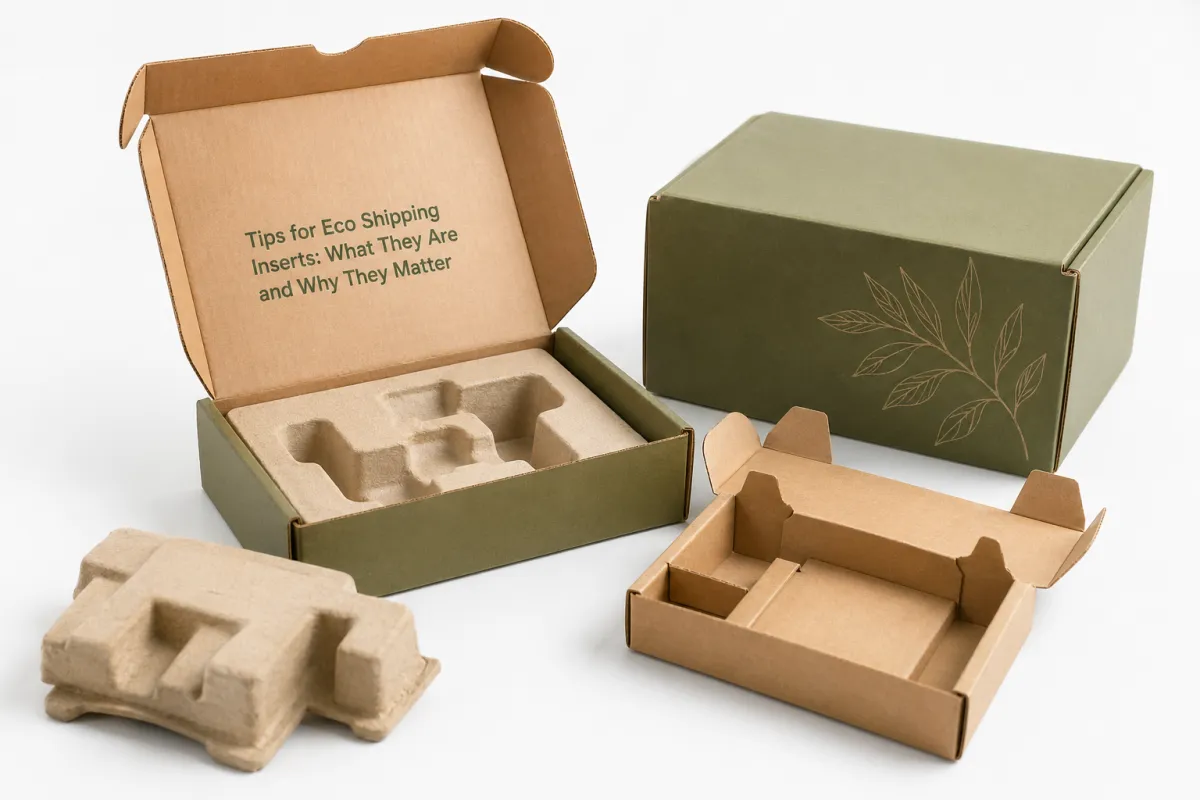
Tips for eco shipping inserts begin with a simple definition: these are shaped protective components that keep a product from shifting, rubbing, tipping, or cracking while it travels from warehouse to customer. They can take the form of one-piece pulp trays, folded corrugated cradles, paperboard partitions, or layered paper-based cushions, and the dimensions usually start with a precise fit around the product body, shoulder, and closure. At a converter I visited in Ohio, a line packing 16-ounce glass bottles had been relying on plastic air pillows for months; the team switched to a molded fiber insert with three support points around the neck and base, specified at 1.8 mm in the thin sections and 4.2 mm in the load points, and damage dropped enough to justify the tooling within six weeks. That is why tips for eco shipping inserts are often really Tips for Stronger physical engineering.
They matter because brands are being judged on three fronts at once. First comes landfill waste and recycling compatibility, which now shows up in retailer scorecards and procurement questionnaires in markets like California, Ontario, and the U.K. Second is the customer experience, since a clean insert can make a premium product feel deliberate rather than tossed into a box with 1/2 inch of empty space. Third is shipment survival across rough handling, especially in e-commerce shipping lanes where parcels can pass through automated sorters, stack pressure, and a few hard corners at the end of a conveyor, sometimes in the same 36-hour window. Good tips for eco shipping inserts help you balance those pressures without falling back on foam-heavy Packaging That Works against sustainability goals.
I have a firm opinion here: the best insert is rarely the greenest-looking one on a spec sheet. It is the one that matches the product mass, the box geometry, and the shipping route, whether that route runs from a fulfillment center in New Jersey to a customer in Austin or from a factory in Shenzhen to a 3PL in Los Angeles. A 9-ounce skincare jar in a short mailer needs a very different answer than a 2-pound electronics accessory in a rigid carton, and the difference usually shows up in the cavity depth, the tuck direction, and the crush resistance of the outer board. That is why tips for eco shipping inserts should start with product behavior, not material ideology. A well-designed pulp insert can support a glass bottle beautifully, while a simple corrugated sleeve may be better for flat kits and accessories because it nests efficiently and speeds pack-out.
Branding also enters the conversation sooner than people expect. In a client meeting for a specialty candle line near Columbus, the marketing team wanted a black foam tray because it felt "luxury," but the operations manager pointed out that the insert would disappear once the tissue and top card were in place, and the foam would add nearly $0.11 per unit at 10,000 pieces. We moved them to a natural fiber tray with a custom deboss and saved roughly $0.18 per unit at 5,000 pieces, while keeping the insert visible enough to reinforce the story at unboxing. That kind of decision is exactly where tips for eco shipping inserts save more than material cost; they save labor, freight, and confusion at the packing table.
For brands looking at Custom Packaging Products, the smartest move is to treat inserts as part of the entire pack system. The box, the insert, the closure, and the print all work together, and one weak link can spoil the shipment, especially if the carton is built from 32 ECT board and the insert was tuned for a heavier 44 ECT spec. If you are comparing tips for eco shipping inserts across multiple product lines, keep that system view in mind, because a single insert geometry can behave very differently in a 6 x 6 x 4 mailer than it does in a 10 x 8 x 6 shipper.
One more point that catches teams off guard until the first line run: eco inserts do not have to mean fragile inserts. At a plant that makes molded pulp egg trays and food clamshells in the Midwest, I watched forming tools create remarkably stiff ribs with very little fiber, using wet-laid pulp, heat, and vacuum pressure to shape load paths in under 40 seconds per cycle. The same logic applies to transit packaging. A well-ribbed pulp insert can outperform a thicker but flatter board structure because the geometry carries the load, and that is where experience with molds, drying tunnels, and fiber moisture content becomes more useful than a vague "eco" label. That kind of detail separates practical tips for eco shipping inserts from glossy marketing copy.
How do tips for eco shipping inserts work inside the shipping box?
To understand tips for eco shipping inserts, picture what happens inside a carton during transport. A parcel gets lifted, dropped, stacked, tipped, and vibrated, sometimes all on the same journey from a pack line in North Carolina to a porch in Denver, and the insert's job is to hold the product in a controlled position so force does not move straight into a glass shoulder, a printed label edge, or a fragile corner. I have watched a package on a shaker table at an ISTA lab survive ten minutes of vibration only after a board insert changed from a flat strip to a folded cradle with 18 mm side walls and a 6 mm return lip. That was not luck; it was load-path management, the kind you only stop shrugging at after you have seen enough crushed samples to develop a personal grudge.
The mechanics are straightforward once you break them apart. Edge support reduces crushing on sharp corners, shock absorption spreads drop energy across fiber, fluting, or molded walls, product spacing keeps items from knocking into each other, and a snug fit limits the small movements that create abrasion marks on painted or coated surfaces. If you are looking for tips for eco shipping inserts that actually protect goods, focus on those four behaviors before you think about color, print, or claims language, because a 1 mm change in clearance can matter more than a 2-color logo. In many trials, the difference between pass and fail comes from whether the insert keeps the product centered within 3 mm after a 30-inch drop.
Different materials behave differently under stress. Molded pulp compresses in a controlled way, which is why it works well for bottles, jars, and objects with a defined body-and-neck shape, especially when the cavity is formed to match a 70 mm diameter bottle with a 12 mm neck ring. Corrugated board flexes and rebounds, so it fits folded structures, layered corners, and inserts that need to ship flat on a pallet from Chicago or Atlanta. Paper-based dunnage fills voids around irregular shapes, but it usually performs best with lighter items and shorter lanes, such as a 6-ounce accessory kit going 200 miles rather than a 2-pound kit crossing three hubs. One of the most useful tips for eco shipping inserts I can give is to match the material behavior to the product's weak point. Do not ask paper cushion to solve a glass-neck failure if the product needs a fixed cradle.
Testing logic matters just as much as the material itself. A sample can look perfect on a desk, pass a hand shake test, and still fail after a full day of temperature swings in a truck bay, especially when humidity rises above 60 percent and the board picks up moisture. I have seen inserts loosen by 1.5 mm after a humid week, enough to turn a snug fit into a rattler and enough to make a proud prototype fail a production line audit. That is why I like early trials that include drop tests, compression checks, and a short vibration sequence instead of a single "looks good" approval. The better tips for eco shipping inserts always assume the box will face real shipping abuse, not showroom conditions.
If you want a reference point for testing and shipment simulation, the standards world gives a useful anchor. The packaging groups at ISTA publish procedures widely used for parcel testing, and those tests help teams think beyond a single drop, especially on ISTA 3A and 6-Series runs that mirror parcel networks in the U.S. and Canada. I also point teams to the recycling guidance on EPA recycling resources when they need to check how a material may behave at end of life, because a water-based coating or mixed-material glue line can change the result in a way a sales sheet never mentions. Good tips for eco shipping inserts usually sit right at that intersection of protection and disposal reality.
The box itself changes the equation too. A tall, narrow mailer behaves differently than a short, wide shipper because the center of gravity shifts and the long axis amplifies motion during a corner drop. A product sitting high in the box can increase rotational movement on impact, while a low-set product with a deep insert often rides out the same force with less damage, especially if the outer carton has a 200 lb burst rating and the insert locks at four points. That is why tips for eco shipping inserts should never be copied from one SKU to another without checking the dimensions, the weight, and the headspace above the product, down to the last 2 mm.
Tips for Eco Shipping Inserts: Cost, Pricing, and Material Tradeoffs
Cost discussions get messy fast, so I keep them grounded in a few numbers. A simple die-cut corrugated insert might land around $0.14 to $0.28 per unit at 5,000 pieces, while a molded pulp insert with custom tooling can sit closer to $0.22 to $0.45 per unit once volume is established, depending on cavity count, drying, finish, and where the tooling is produced, whether that is Wisconsin, Guangdong, or central Mexico. Those ranges are not universal, but they are useful starting points for tips for eco shipping inserts because they show how material and tooling work together. A cheap insert that causes a 3 percent damage rate is not really cheap at all, especially if each replacement shipment costs $7.50 to $11.00 in postage and handling.
The biggest pricing drivers are usually material type, tooling or die cost, order volume, print requirements, and whether the insert needs custom forming. A corrugated solution with a simple knife-and-score tool can move quickly and keep front-end cost low, especially if the board is a common 24ECT or 32ECT stock sourced in North America. A molded solution may need a forming tool, drying capacity, and more setup time, but it can deliver a tighter fit and a better presentation for glass, ceramics, or premium personal care items, particularly when the walls need to be 2 mm or thicker at load points. That is one of the most useful tips for eco shipping inserts: do not evaluate piece price alone. Evaluate the entire system, including freight, labor, and remake risk.
Here is the part most teams miss: shipping efficiency changes the economics. If a slightly better insert reduces product movement enough to shrink the outer carton by half an inch on each side, dimensional weight can drop and freight can follow, sometimes by $0.22 to $0.65 per parcel depending on the zone. A 2-ounce material increase might still be worthwhile if it lowers package size, reduces returns, and speeds order fulfillment because the packer only has one insert component to place. That is why tips for eco shipping inserts often lead to lower total cost even when the insert itself costs a few cents more, especially in e-commerce programs shipping from hubs like Indianapolis or Reno.
| Insert Type | Typical Price at 5,000 Units | Best Use | Notes |
|---|---|---|---|
| Molded pulp | $0.22-$0.45 each | Bottles, jars, premium kits | Higher tooling, strong contour support, good presentation, often molded in Ohio or Quebec |
| Die-cut corrugated | $0.14-$0.28 each | Flat kits, accessories, light electronics | Fast to customize, flat storage, efficient for pack lines, often built from 32 ECT or 44 ECT board |
| Paper-based void fill | $0.03-$0.10 per pack-out | Lightweight items with extra headspace | Low unit cost, but weaker for high-impact package protection and poor for heavy glass over 14 ounces |
| Plant-fiber blend | $0.25-$0.55 each | Brands with strong sustainability claims | Depends on supply chain, finish, and local recyclability, often used where texture and appearance matter |
I have used that exact table structure in supplier reviews because it forces the conversation beyond "what is the unit price?" A finance director may stare at a $0.31 pulp tray and flinch, but once you add a $0.06 return-avoidance estimate, a 12 percent freight reduction from tighter carton sizing, and 8 seconds saved per pack, the picture changes fast. If you are gathering tips for eco shipping inserts for a real sourcing decision, build the math around total landed cost, not just the insert invoice, and test it against a 5,000-unit run rather than a one-off prototype.
It also helps to compare the insert with the outer packaging. A small product in a large shipper may waste both fill and dimensional weight, which means the box itself is part of the cost story and the insert cannot be judged on its own. For that reason, I often pair insert reviews with a look at Custom Shipping Boxes so the full package footprint can be trimmed together, sometimes by changing a 10 x 8 x 6 carton to an 8 x 6 x 4 format. That kind of paired review is one of the most practical tips for eco shipping inserts I can offer, because the outer carton and the insert should be designed as one unit.
One client in the personal care space came to me with a 10,000-unit order and a strict ceiling of $0.40 for the combined box and insert. We shifted them from a two-piece tray to a single folded corrugated cradle, removed one printed insert card, and cut labor from 21 seconds to 13 seconds per pack at the line in Charlotte, North Carolina. The material cost rose by 2 cents, but the overall landed cost fell by nearly 11 percent, and the final structure used a 24 ECT outer carton rather than a heavier board grade. That is the kind of tradeoff smart tips for eco shipping inserts are built on.
Key Factors to Evaluate Before You Spec a Design
Before you spec anything, write down the product's real behavior. A 14-ounce glass bottle with a narrow neck needs different support than a 9-ounce cosmetics jar with a flat shoulder or a rigid box with a delicate lid seam, and the difference shows up in the shoulder radius, base depth, and closure tolerance. Weight, surface finish, center of gravity, and breakability all matter, and they matter in specific ways. One of the strongest tips for eco shipping inserts is to list the failure points first: cracking, scuffing, movement, or lid separation. Then build the insert around those risks, whether the answer is a 2-piece tray or a one-piece folded cradle.
Box dimensions and pack-out speed matter just as much. A perfectly engineered insert that takes 18 seconds to assemble can become a labor problem in a busy fulfillment center, especially if the team is packing 1,200 units per shift and the break room is five minutes away from the line. I have watched a line supervisor reject a very elegant pulp build because it required a two-step orientation and a pocket inspection on every unit, which turned a 15-second promise into a 24-second reality. That decision was not anti-quality; it was pro-throughput. Good tips for eco shipping inserts respect the reality of order fulfillment, where seconds per pack turn into payroll.
Sustainability criteria need specificity, too. Recyclable in what stream? Curbsides vary by market, and a fiber product with a water-resistant coating may not behave the same way in Vancouver, Denver, and Bristol. If your claim depends on FSC-certified fiber, ask for documentation before the sample is approved, and verify that the chain-of-custody numbers match the invoice. If compostability is part of the pitch, check the standard rather than assuming the material is fine because it is "paper-like," since the wrong glue line or pigment can change the outcome. I have seen teams overstate claims and then scramble during a retail compliance review. The best tips for eco shipping inserts leave room for proof, not just aspiration.
Branding and customer experience round out the decision. Some inserts should hide the product until the customer lifts a top layer; others should present the item immediately, almost like a tray in a gift box. A premium fragrance line may want a cream-toned molded fiber insert with a subtle logo deboss and a 1.2 mm wall, while an industrial accessory brand may want a plain kraft structure that ships flat and disappears on arrival. If you are balancing tips for eco shipping inserts against presentation, ask whether the insert reinforces the brand story or distracts from it, because the answer is often different for a $24 candle than for a $4 cable adapter.
I often tell clients to check three practical questions before they commit to a design:
- Does the insert prevent movement in at least three directions, with less than 2 mm of shift after a 24-inch shake?
- Can a packer assemble it consistently in under 15 seconds on a line running 800 units per hour?
- Does the chosen material make sense in the destination recycling stream for the markets you ship to, such as California, Ontario, or the U.K.?
Those questions sound simple, but they catch a lot of weak assumptions. They also keep tips for eco shipping inserts anchored in operations, not just design decks, which is where a lot of packaging decisions go sideways after the third revision.
Step-by-Step Process and Timeline for a Rollout
A clean rollout usually starts with product review and box measurement. I want exact dimensions in millimeters, not "roughly the same as the last one," because a 2 mm change can affect fit on a molded tray or a die-cut fold, and even a 1 mm difference at the shoulder can shift the closure. After that comes concepting, sample build, internal testing, revision, production approval, and the final run. If you are collecting tips for eco shipping inserts for a rollout plan, that sequence is the backbone, and it works best when the product weight, carton spec, and shipping lane are written down before the first sketch.
Simple corrugated inserts can move from concept to approved sample in 7 to 10 business days if the measurements are complete and the structural idea is straightforward. Custom molded pulp usually needs more time, often 12 to 15 business days from proof approval for the first production-minded sample, and longer if tooling changes are needed or if the line in the factory outside Toronto needs a cavity revision. I have seen timelines slip by two weeks because the team changed the bottle shoulder after the insert had already been tuned, which forced a re-cut and a second fit test. That kind of delay is exactly why tips for eco shipping inserts should include change control from day one.
Testing windows should be set early, not after the marketing calendar is locked. A drop test can expose a weak corner support in the first hour, but a vibration trial may take several days to schedule if the lab is busy or if the chamber is already booked for another client's 48-hour run. Compression checks matter when cartons are palletized, especially if the shipper sits under heavier loads for a few days before release on a distribution dock in Atlanta or Louisville. The most practical tips for eco shipping inserts I know always build in time for at least one revision cycle and one retest cycle, because the first prototype is usually a prototype for a reason.
Here is a timeline that works well for many mid-volume programs:
- Day 1-2: product intake, measurements, and lane review with actual SKU dimensions and destination ZIP codes.
- Day 3-5: concept sketches and material selection, including board grade, pulp density, or fiber blend.
- Day 6-10: prototype build and fit check, often with a one-piece sample and a backup two-piece option.
- Day 11-15: drop, vibration, and compression testing, usually with ISTA-style protocols.
- Day 16-20: revision and final approval, including artwork or deboss placement.
- Day 21 onward: production run and pack-line release, with first-run inspection on the floor.
That schedule is not universal, but it gives a realistic frame for tips for eco shipping inserts that need to hit a launch date without panic. If a supplier promises a complex molded structure in three days, I would ask what they are leaving out, because sometimes they are skipping actual testing and sometimes they are using an off-the-shelf cavity and hoping it fits. Neither approach is ideal, and I say that with the weary affection of someone who has had to clean up the mess later on a Friday afternoon.
I also recommend getting supplier input early. A good converter may suggest a board grade change, a nesting pattern, or a two-up layout that trims waste on the sheet and reduces trim loss by 8 to 12 percent. I have seen one 0.024-inch board swap shave nearly 9 percent off raw material cost without hurting protection because the flute direction changed and the insert folded along the stronger axis. That sort of improvement is exactly why tips for eco shipping inserts are better when they come from the factory floor, not just the buyer's desk in a conference room.
Common Mistakes to Avoid with Eco Shipping Inserts
The first mistake is over-engineering. I have seen teams add extra folds, double walls, and three nested parts because they wanted "insurance," and the result was a heavier insert that still failed the same corner drop at 32 inches. More material does not automatically mean better package protection, especially if the load path is still wrong. If you are following tips for eco shipping inserts, make sure every added gram solves a proven problem, such as a bottle rocking 4 mm in the cavity or a carton bowing under 180 pounds of compression.
The second mistake is choosing a material for its eco label alone. "Paper" sounds good in a presentation, but paper-based void fill may be weak for a 22-ounce glass product riding through a hot truck route with heavy vibration, especially in summer lanes through Phoenix or Houston. Likewise, a molded fiber insert may be excellent for support but poor for very sharp-edged objects that can cut into the cavity or abrade a printed finish. Honest tips for eco shipping inserts ask what the material does under stress, not just how it sounds in a sustainability slide.
The third mistake is under-testing. If a team skips vibration or compression and only checks a single drop, the damage often shows up later as hairline cracks, corner rub, or lid separation after the shipment has already been signed off. I have seen clients wait until customer complaints reached 50 tickets before they realized the pack failed in a stacked pallet trial, and by then the remakes were eating into a two-week promo window. That is a costly way to learn, and it always feels worse because someone in the room usually said, "Let's just move forward," right before the problem showed up. The strongest tips for eco shipping inserts insist on testing that mirrors real transit packaging conditions.
The fourth mistake is forgetting the people who pack the box. If an insert has to be rotated twice, aligned by feel, and then pressed into place with both hands, a busy shift will produce inconsistent results and a few bent corners by hour three. On one beverage project, we changed a two-part insert into a one-piece lock structure and cut assembly errors by more than half, while also shaving the pack-out from 19 seconds to 12 seconds. The right tips for eco shipping inserts should make the line easier, not harder, because a tired packer on a 10-hour shift is not the place to hide complexity.
A fifth problem is ignoring the end-of-life story. I have heard teams say "recyclable" without checking whether a coating, glue, or printed layer changes the story in the destination market. If you need a cleaner materials path, ask for documentation from the supplier and review the claim against the country or state you ship into, whether that is Oregon, Ontario, or Wales. For teams building wider packaging programs, I often point them to Custom Poly Mailers as a comparison point because mailer design, insert design, and disposal claims all need the same level of discipline. The best tips for eco shipping inserts are always specific enough to survive scrutiny from a retailer, a regulator, or a customer with a phone camera.
If you want a short rule from the factory floor, here it is: do not let a pretty sample outrun a boring test report. One of my favorite notes from a client's operations manager was taped to the sample shelf: "If it fails at 2 drops, it will fail at 200 miles." That line captures the spirit of practical tips for eco shipping inserts better than any sales brochure ever could, especially when the sample only looked good because the board was fresh and the humidity was 38 percent.
Expert Tips for Eco Shipping Inserts That Actually Save Money
The smartest tips for eco shipping inserts usually come from standardization. If three SKUs share the same bottle height and only differ by cap color, there is a good chance one insert family can serve all three with a small cavity adjustment or a printed label change, and sometimes a 0.5 mm relief cut is all you need. I have helped teams collapse five insert drawings into two and save a full week of engineering time, plus a second round of sample freight from a plant in Ohio. That kind of simplification belongs near the top of any list of tips for eco shipping inserts.
Design for automation and pack-line consistency whenever possible. A one-motion insert, a drop-in tray, or a fold that self-locks will usually beat a design that requires hand scoring or tape. Even a 4-second labor savings can matter at scale, especially if the line runs 8,000 units a month or more, because the difference adds up to almost 9 hours of labor over a quarter. I have seen packers appreciate a structure because it "feels obvious," and that is not a small thing. The best tips for eco shipping inserts are often the ones that reduce thinking on the line, because exhausted people are not careful people.
Get supplier input before you lock the concept. Converters see a lot of structures, and they often know where a cavity can be trimmed by 1/8 inch, where a flute should run, or where a material substitution will hold the same load at lower cost. In one negotiation, a supplier in Milwaukee suggested a nested corrugated blank that cut scrap by 11 percent and shortened the die lead time by four days, which made a launch date in mid-April instead of late April. That sort of practical advice is why I trust experienced packaging partners when I am weighing tips for eco shipping inserts against volume, cost, and schedule.
Use a clear test target. I like programs that define the goal as something concrete, such as "survive a 36-inch drop on each corner, edge, and face with no product damage," or "hold under 200 pounds of compression for 24 hours without shifting more than 2 mm." Clear targets keep the team honest. If the product is more fragile, adjust the numbers, but keep them specific, because a lipstick tube is not a glass candle and a 14-ounce bottle is not a 2-pound jar. Vague goals produce vague inserts, and vague inserts are the enemy of good tips for eco shipping inserts.
Finally, compare options side by side before you commit. The table below is simple, but it is the kind of tool I use during sourcing reviews because it forces a conversation about fit, cost, and speed rather than emotion or habit. It also makes it easier to compare a 24 ECT folded insert with a molded pulp tray from a supplier in Quebec or a paper-fill option from a domestic converter in Tennessee.
| Decision Point | Corrugated | Molded Pulp | Paper Void Fill |
|---|---|---|---|
| Upfront tooling | Low, often under $500 for simple knives and scores | Moderate to high, depending on cavity count and drying | Very low, usually off-the-shelf equipment |
| Pack-out speed | Fast, often 10 to 14 seconds per unit | Moderate, often 12 to 18 seconds per unit | Fast, but inconsistent for heavy items |
| Best protection shape | Flat and folded products | Contoured bottles and jars | Lightweight fill around voids |
| Shipping efficiency | Strong when flat-packed | Strong when cavity-fit is tight | Weak for dimensional weight control |
| Brand presentation | Clean and practical | Premium and natural | Basic and functional |
That table is not the answer by itself, but it saves time in the room. If you are sorting through tips for eco shipping inserts, compare not only material and cost, but also how the choice affects the outer box, the labor steps, and the customer's first unboxing touch, because a $0.27 insert that saves 6 seconds per pack can outperform a $0.19 option that slows the line and raises damage claims.
For teams building broader packaging systems, I usually look at inserts, mailers, and cartons together so the whole transit packaging platform can mature as one. That is why the Custom Packaging Products catalog matters; it lets you compare insert structures with boxes and mailers instead of treating each item as a separate purchase. Smart tips for eco shipping inserts often come from seeing the whole family of components side by side, especially when the outer carton uses 32 ECT board and the insert needs to fit a bottle with a 16 mm shoulder.
One more practical tip from a plant floor in North Carolina: do not skip the secondary check after the first production run. A part that looks perfect in a 10-piece sample can drift when the die heats up, the pulp moisture changes, or the board lot shifts by a fraction of a millimeter, and that drift often shows up as a 1.2 mm cavity change. I have seen that kind of shift wreck fit on a tight perfume bottle package within a single afternoon. That is why the final set of tips for eco shipping inserts should always include a first-run audit, not just approval on paper.
If you collect the right measurements, define a real drop target, request two or three material options, and compare total landed cost instead of only the unit price, you will make better decisions faster. That is the heart of tips for eco shipping inserts, and it is the same advice I would give across a conference table in Chicago, on a plant floor in Georgia, or in a supplier call after a failed trial that burned three days of schedule.
What are the best materials for eco shipping inserts?
Molded pulp is strong for contoured protection and a premium natural look, especially for bottles and jars with a defined shoulder and a neck diameter around 12 to 18 mm. Corrugated board is excellent for flat storage, quick customization, and fast pack-out on high-volume lines, particularly when you can use 24 ECT or 32 ECT board. Paper-based void fill works for lightweight items, but for heavier products or anything that needs strong package protection, it usually needs to be paired with a structural insert, not used on its own.
How do eco shipping inserts affect shipping costs?
They can lower damage-related costs by reducing breakage, returns, and replacement freight, which is often where the hidden spend sits, and a single damage claim can easily cost $8 to $15 once postage and service time are counted. A tighter insert can also shrink the outer carton and improve dimensional weight, especially in e-commerce shipping lanes where box size matters as much as product weight. The best choice balances piece price, labor time, freight, and the cost of a bad shipment, and that balance is usually clearer after a 5,000-unit test run than after a single sample approval.
Are molded pulp inserts better than corrugated inserts?
Molded pulp is often better for contoured support, product presentation, and a more premium unboxing feel, especially when a bottle or jar needs a shaped cavity with 2 mm to 4 mm of wall thickness. Corrugated is usually better for lower tooling cost, faster turnaround, and simple customization across multiple SKUs, particularly when the insert must ship flat from a plant in the Midwest. The right answer depends on your product shape, volume, and protection target, not on one material being universally superior.
How long does it take to develop custom eco shipping inserts?
Simple die-cut corrugated concepts can move quickly, sometimes from concept to approved sample in under two weeks if the measurements are clean and the design is straightforward. Custom molded solutions usually need more time for tooling, drying, and fit refinement, and 12 to 15 business days from proof approval is a realistic planning window for many programs, especially when the tooling is made in North America and the product fit needs a second revision. Complex shapes, revision cycles, and test failures can add more time.
What should I test before switching to eco shipping inserts?
Test drop performance, vibration resistance, and compression strength so you can see how the insert behaves under real transit packaging stress, not just on a bench in a sample room. Check pack-out speed, because a great structure can still be a poor choice if the line cannot assemble it consistently during a 1,000-unit shift. Also verify that the material supports your sustainability claims, recycling goals, and any FSC or similar documentation you plan to use, especially if your product will ship into multiple regions with different curbside rules.
If you are serious about tips for eco shipping inserts, start with your product dimensions, set a clear test target, and compare at least two material paths before you approve a sample. The strongest results usually come from prototype testing, supplier input, and a willingness to compare total landed cost instead of chasing the lowest quoted unit, whether that quote is $0.15 per unit for 5,000 pieces or $0.31 per unit for a tighter molded fit. That is how tips for eco shipping inserts turn into fewer returns, cleaner packing lines, and a better customer experience.


