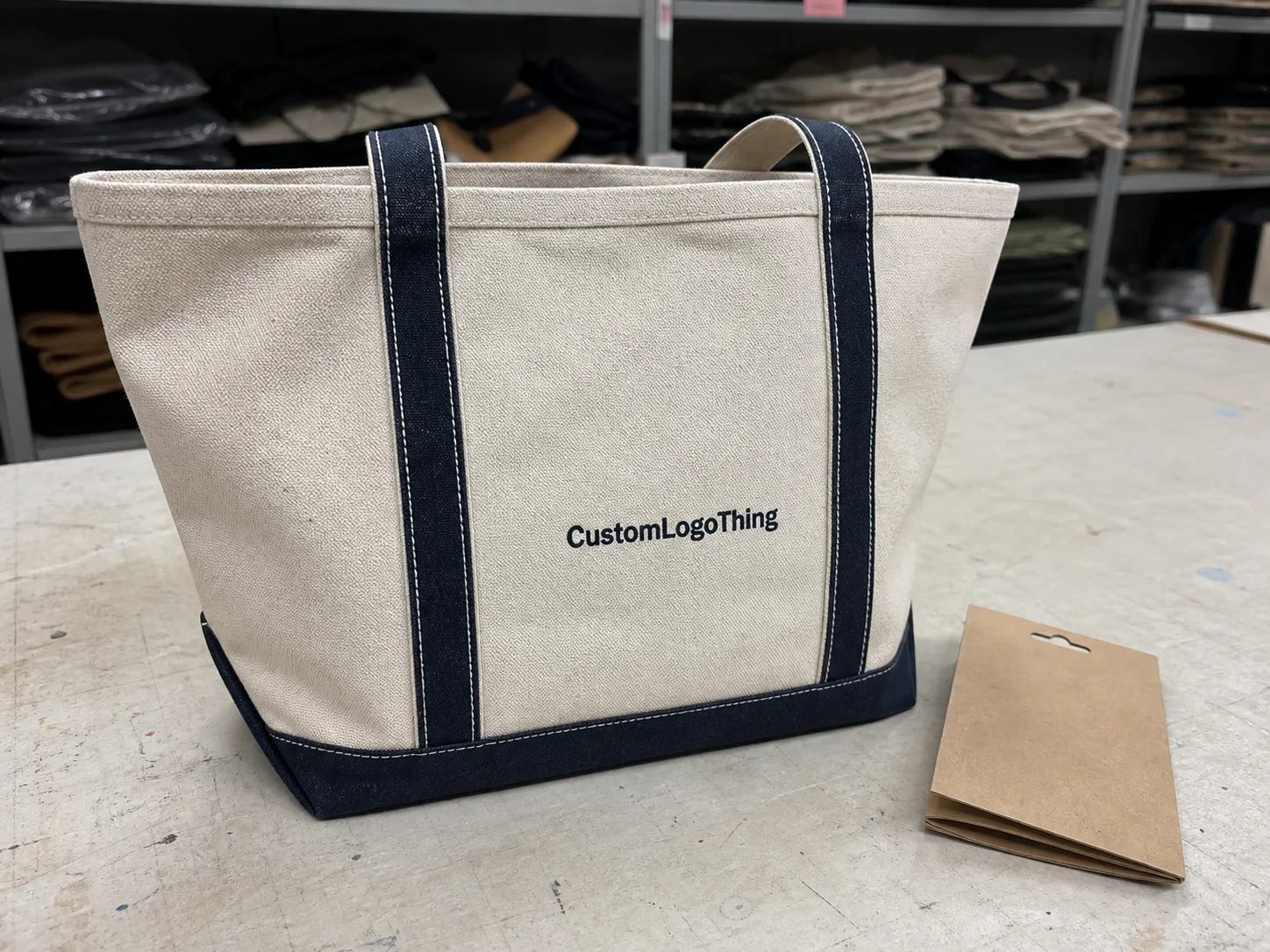
The LL Bean custom boat and tote bag stays in buyer conversations because it is familiar, durable, and straightforward to customize. It is not a trend piece. It is a practical canvas tote that works for initials, names, and simple logos without forcing the design to do too much.
That matters when the buyer wants the item to feel premium without turning the order into a complicated production project. A well-spec'd tote can hold weight, look intentional, and quote cleanly. A weak spec, by contrast, makes even a good bag harder to approve and more expensive to produce.
Why This Canvas Tote Still Outsells Flashier Bags
Flashy bags may get attention, but practical canvas totes get used. That is why this format keeps winning for gifts, retail add-ons, conference kits, employee onboarding, and simple monogram orders. The shape is familiar, so buyers understand the use case immediately.
The construction also helps. A classic boat and tote gives you a flat front panel, enough canvas weight to hold shape, and a decoration area that works with embroidery, screen print, or a patch. The format is easy to approve because it is hard to overcomplicate.
From a packaging perspective, that is the appeal: the bag already feels useful before decoration. If the canvas is sturdy and the logo treatment is restrained, the finished piece reads as a real product rather than a promo throw-in. Thin canvas or crowded artwork breaks that effect quickly.
"If the bag feels flimsy in hand, the logo does not rescue it."
The smoothest orders usually begin with the end use. A family monogram, a retail resale item, and a corporate gift all need different specs. One wants subtle decoration. Another needs a mark that reads at a distance. The size, handle length, and imprint method should follow that decision, not replace it.
- Sturdy canvas improves perceived value and day-to-day use.
- Clear decoration space keeps names and logos readable.
- Familiar shape reduces hesitation for buyers and recipients.
- Simple construction supports easier production and quality control.
How Customization Works From Blank Bag to Finished Tote
The process is simple in theory: choose the size and color, pick the decoration method, place the art, approve the proof, produce the order, inspect it, and ship it. In practice, the order can slow down at any step if the artwork, placement, or quantities are vague.
Decoration method has the biggest impact on the final look. Embroidery is a common choice for initials, names, and compact logos because it feels finished and durable. It also handles smaller artwork better than buyers expect, provided the stitch area is not squeezed too tightly. Screen print works better for bold brand marks and cleaner graphics, but it needs enough contrast and line weight to survive on canvas.
Heat transfer and patches can work as well, but they should solve a specific design problem. If the artwork is simple, the simplest decoration method usually produces the cleanest result. Extra steps do not automatically improve the tote. They just add more places for the order to drift.
Artwork quality is where many projects go off track. A logo that looks sharp on a screen can fail on a tote if it is too small, too close to a seam, or too subtle against the canvas color. The proof stage is there to catch those issues before production starts, not after the bags have already been decorated.
Good vendors will ask for logo placement, thread or ink color, font treatment if text is involved, and whether the decoration goes on one side or both. If the tote is part of a branded packaging or retail packaging program, it should be treated as part of the full presentation, not as a separate afterthought.
For buyers comparing tote options with other packaging formats, it helps to review the broader mix of Custom Packaging Products before locking in the decoration plan.
LL Bean Custom Boat and Tote Bag Cost Breakdown
Pricing makes more sense once you break it into parts. A LL Bean custom boat and tote bag quote usually includes the bag itself, the decoration, setup or digitizing, and freight. If you only ask for the decoration rate, you are not seeing the full landed cost.
Small runs feel expensive because setup costs are spread over fewer units. Larger runs reduce the unit price because the same prep work gets divided across more bags. That is why a 25-piece order can look high while a 250-piece run appears much more reasonable.
| Order profile | Typical landed unit price | What usually drives the number |
|---|---|---|
| 25 to 49 pieces | $24 to $38 each | Setup, digitizing, and shipping dominate the total |
| 50 to 149 pieces | $16 to $28 each | Better spread on setup, solid middle ground for events |
| 150 to 500 pieces | $11 to $20 each | Repeat decoration lowers the per-unit cost |
| 500+ pieces | $8 to $16 each | Depends on art complexity, packaging, and freight zone |
These ranges are practical, not guaranteed. A single-color monogram is cheaper than a multicolor logo. One decoration location costs less than two. Rush orders cost more because production loses flexibility. If the bags ship to multiple addresses, expect additional handling.
The cleanest comparison is a landed quote, not a partial one. Ask for all of these before approving the job:
- Bag cost: depends on size, canvas weight, and trim.
- Setup or digitizing: often $20 to $85 for embroidery-based work.
- Decoration: commonly $3 to $12 per bag, depending on stitch count or print colors.
- Freight: small carton shipments can run $12 to $35, while larger pallet moves vary by zone.
- Rush fees: usually a percentage add-on or an upgraded production slot.
If the tote is part of a larger branded package, budget the full program together. Otherwise, the bag can absorb margin that was already allocated to boxes, inserts, or mailers. That is a common mistake and an avoidable one.
Production Timeline and Turnaround Expectations
Most delays happen before production begins. The normal sequence is quote, proof, approval, production, quality check, and shipping. If artwork approval takes two days, the schedule usually moves by two days. Production does not recover that time automatically.
For simple personalization, a realistic timeline is often 7 to 12 business days after proof approval. More complex logo work, multiple decoration locations, or artwork cleanup can push that to 12 to 18 business days. Shipping adds another 2 to 5 business days for most domestic deliveries.
Rush service is available, but it trades away flexibility and usually costs more. There is less room for proof edits, rework, and shipping error correction. If the bags support a launch or event date, that tradeoff can become expensive fast. A calm timeline is usually cheaper than a panic timeline.
For transit handling and shipping performance, ISTA standards are worth knowing: ISTA. If the tote is part of a larger product packaging system, the carton and insert need to survive the route too. A good bag in a crushed box still creates a customer service problem.
Build in buffer time. If the bags are for gifting, a launch, or an event giveaway, do not schedule final approval for the day before they are needed. Emergency orders almost always cost more and leave less room to fix mistakes.
- Proof approval: same day to 2 business days if the art is clean.
- Production: usually 1 to 3 weeks depending on complexity.
- Shipping: 2 to 5 business days for most domestic deliveries.
- Rush options: available, but they reduce flexibility and raise cost.
Size, Material, and Decoration Choices That Matter
Size affects more than capacity. It changes the look, the perceived value, and the shipping cost. Small bags work for light carry, sample kits, and retail add-ons. Medium is the safest everyday choice because it balances portability and useful volume. Large makes sense for travel, trade show kits, and premium gifts where the bag itself needs to feel substantial.
Canvas weight matters just as much. A lighter weave can work for promotional use, but a heavier canvas usually holds shape better and reads as more premium in hand. Common ranges are around 10 oz, 12 oz, and 16 oz, depending on the vendor and bag style. Heavier canvas costs more and weighs more, which affects freight.
Handle length and closure style also affect how the bag is used. Longer handles are better for shoulder carry. Shorter handles feel more classic and are often easier to carry by hand. An open top keeps the bag simple, while a zipper or snap adds utility and cost. Buyers often choose the largest format available because it feels safer; sometimes that is right, and sometimes it is just paying for extra fabric.
Decoration placement is not a cosmetic detail. If the logo sits too low, it visually collides with the bottom seam. If it is too wide, it crowds the handle drop. If the color contrast is weak, the logo disappears at normal viewing distance. Good packaging design uses contrast on purpose, and branded totes should do the same.
Material claims should be checked rather than assumed. FSC applies to paper-based materials and packaging components, not every textile tote on the market. That distinction matters because sustainability language gets used too loosely. Ask for the actual spec sheet and actual certifications where they apply.
- Small: best for light gifts, event handouts, and low-bulk items.
- Medium: best default for everyday carry and general merchandising.
- Large: best for travel, merch bundles, and higher perceived value.
- Heavier canvas: better structure, more premium feel, higher cost.
- High contrast art: easier to read and more reliable across production runs.
Common Ordering Mistakes to Avoid
The first mistake is trying to fit too much art into too little space. Tiny text, thin lines, and dense graphics do not translate well to canvas. Texture eats detail, and stitching adds its own limitations. If the design needs a magnifying glass on the proof, it is already too busy.
Low contrast is another easy way to weaken the result. Dark thread on dark canvas or pale ink on a natural bag can look technically correct and visually forgettable. The bag is not supposed to hide the logo. It is supposed to carry it clearly.
Placement errors happen because mockups flatten the real object. A digital image does not show seams, handle drop, pocket structure, or how the eye reads the panel once the bag is full. That is why measured proofs matter more than pretty renderings. The useful proof shows width, height, and distance from the edge. If those numbers are missing, the approval is too loose.
One sample also does not prove the whole run. Thread tension, canvas lot variation, and operator setup can all shift the final look. That is normal manufacturing behavior, not a defect by default. The buyer’s job is to narrow the spec enough that the output stays consistent from first piece to last.
- Do not overdesign the artwork.
- Do not ignore contrast against the bag color.
- Do not approve placement without measurements.
- Do not assume one sample tells the whole story.
Expert Checks Before You Place the Order
Before approval, lock the basics: bag size, material weight, decoration method, placement, color, unit cost, setup fee, shipping method, and minimum order quantity. If one of those is vague, the order can drift. Drift is expensive. It usually shows up as a change order, a delayed ship date, or a final invoice that no one expected.
Ask for a proof with measurements, not just a visual mockup. The difference matters if the bag is being resold, gifted, or used in a retail packaging program. A proper proof should show logo dimensions, clear space, and placement relative to seams. If the vendor cannot answer those questions clearly, the quote is not strong enough yet.
When the schedule allows it, order a test piece. One sample can catch sizing, contrast, or placement issues before the full run starts. That is much cheaper than discovering a problem on bag 137. Buyers who understand packaging design usually compare the tote against the rest of the branded packaging stack too.
The larger product packaging spec should lead the tote, not the other way around. The right bag matches the offer, the audience, and the shipping plan. Fancy does not matter if the order lands late or the logo looks off.
- Confirm the full landed price, not a partial quote.
- Check the proof for size and placement, not just appearance.
- Request one sample if the deadline gives you room.
- Keep the spec sheet tight enough that production can repeat it.
FAQ
How much does an LL Bean custom boat and tote bag usually cost?
Cost depends on bag size, decoration method, and quantity, so single-piece orders usually carry the highest unit price. A practical range for smaller runs is often $24 to $38 per bag landed, while larger runs can drop into the low teens if the artwork is simple. Ask for a landed quote that includes setup, decoration, and shipping so you can compare offers cleanly.
What size works best for a personalized boat and tote bag?
Medium is the safest default for most everyday use because it balances capacity and portability. Small works well for light gifts or retail add-ons, while large is better for travel, merch kits, or high-capacity carry. Choose the size based on the actual load, not just what looks biggest in the photo.
How long does a custom boat and tote bag order take?
Simple personalization usually moves faster than multi-color or multi-location decoration. Proof approval, artwork edits, and shipping are the usual schedule killers, not the embroidery itself. Build in buffer time if the bags are tied to a deadline, especially for gifting or events.
Can I put a logo and a name on the same LL Bean custom tote?
Yes, if the decoration area is large enough and the layout stays readable. Keep the design compact so the logo and name do not crowd each other or run into seams. Request a measured proof before production so the spacing is locked in on the LL Bean custom boat and tote bag order.
What should I check before approving a custom boat and tote quote?
Verify MOQ, unit cost, setup fees, decoration method, and shipping before you approve anything. Check the proof for size, placement, and color contrast instead of assuming the mockup will match reality perfectly. Confirm the turnaround window in writing so the LL Bean custom boat and tote bag order does not quietly slip past your deadline.