Buyer Fit Snapshot
| Best fit | Logo Embossed Paperboard Boxes projects where brand print, material claims, artwork control, MOQ, and repeat-order consistency need to be specified before quoting. |
|---|---|
| Quote inputs | Share finished size, material target, print colors, finish, packing count, annual reorder estimate, ship-to region, and any compliance wording. |
| Proofing check | Approve dieline scale, logo placement, barcode or warning zones, color tolerance, closure strength, and carton packing before bulk production. |
| Main risk | Vague material claims, crowded artwork, missing packing details, or unclear freight terms can make a low unit price expensive after revisions. |
Fast answer: Logo Embossed Paperboard Boxes: Design, Cost, Timing should be specified like a repeatable production item. The safest quote records material, print method, finish, artwork proof, packing count, and reorder notes in one written spec.
Production checks before approval
Compare the actual filled-product size with the drawing, then confirm tolerance on folds, seals, hang holes, label areas, and retail display edges. Reserve space for logos, QR codes, warning copy, and material claims before decorative graphics fill the panel.
Quote comparison points
Review material grade, print process, finish, sampling route, tooling charges, carton quantity, and freight assumptions side by side. A quote is only useful when the supplier can repeat the same color, closure quality, and packing count on the next order.
Logo embossed paperboard boxes tend to look more expensive than cartons covered in heavy ink because people feel the logo before their eyes fully register the graphics. That first touch does a surprising amount of work. For brands that want restraint instead of noise, logo embossed paperboard boxes usually read as confident, not flashy, and that difference matters a lot on a shelf or in an unboxing moment.
The useful truth is pretty straightforward: logo embossed paperboard boxes do not need loud artwork to feel premium. They rely on texture, light, and shadow. When the emboss is handled well, the box creates a small reveal that feels deliberate, not like fake luxury dressed up for the shelf.
From a packaging buyer’s point of view, that matters because the finish can carry a brand harder than another layer of ink ever will. A raised mark on a carton can make a cosmetic set feel cleaner, a chocolate sleeve feel more giftable, and a supplement box feel more considered without piling on extra print effects. If you are sorting through Custom Packaging Products, this is one of those finishes that earns its keep instead of just eating budget.
Logo Embossed Paperboard Boxes: Why They Feel Premium
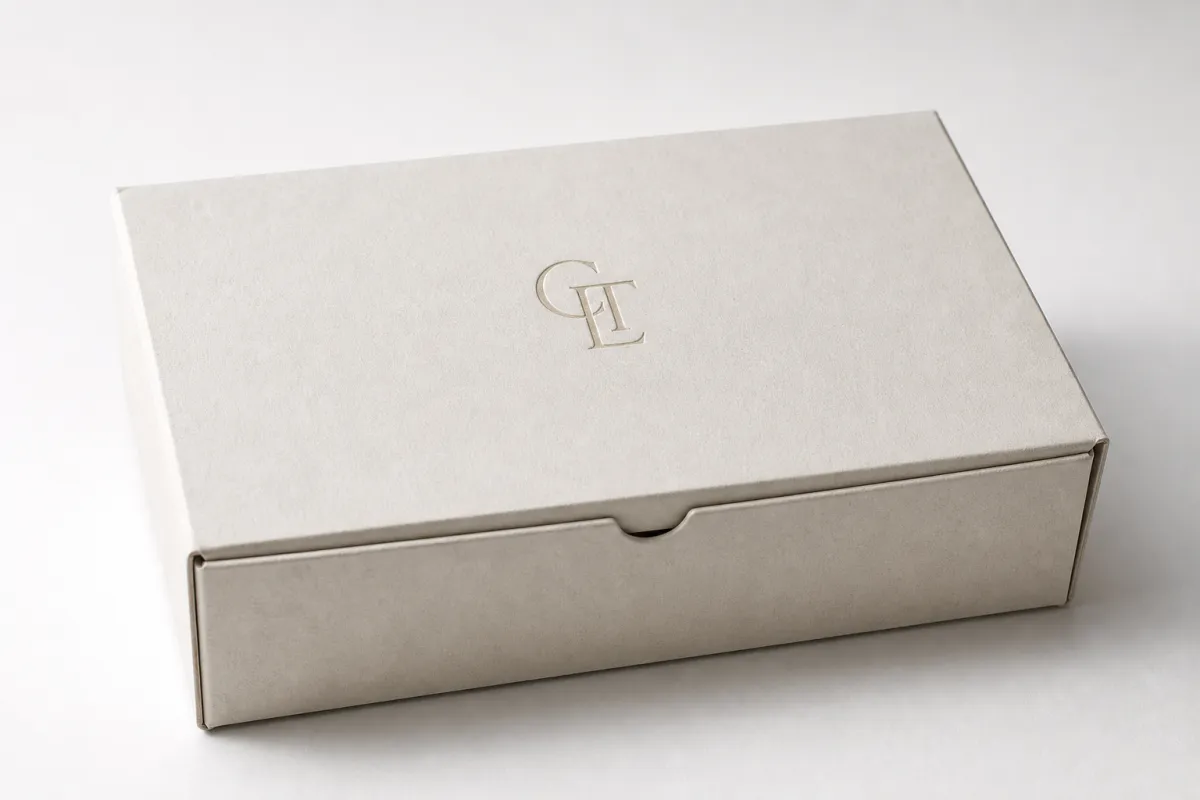
Logo embossed paperboard boxes work because they engage touch before the eye finishes the job. That sounds simple, but it is the whole trick. A person runs a thumb across the panel, catches the raised or recessed mark, and suddenly the box feels more intentional. Logo embossed paperboard boxes do not shout; they ask to be felt.
In practical terms, logo embossed paperboard boxes are paperboard cartons with raised or recessed logo detail pressed into the board using a matched die set. The logo can stand proud of the surface, sink below it, or pair with another finish like foil or matte coating. The result is still a paperboard box, just one with a more tactile brand message. If the tooling is right, the effect feels crisp instead of mushy, which is the line that separates premium from merely decorative.
The finish is subtle by design. That is why it works so well for cosmetics, chocolate, supplements, apparel, subscription gifts, and specialty retail. Those categories do not always benefit from a crowded front panel. Logo embossed paperboard boxes give you a focal point without turning the box into a billboard. That restraint is often the premium cue.
There is also a psychological layer to it. A glossy, print-heavy carton can look busy. A clean carton with logo embossed paperboard boxes feels quieter and usually more expensive because the detail is discovered, not announced. The best version of this finish is almost modest. It says the brand does not need thirty effects and a color circus to prove itself.
If a logo only looks premium in a mockup, the spec still needs work. Real embossing has to survive the press, the fold, the shipping lane, and somebody’s thumb.
After checking a lot of samples over the years, I can say this much: the boxes that impress in hand are usually the ones that respected the material from the start. Not the ones that tried to bully it. Logo embossed paperboard boxes can also pair nicely with an outer sleeve, a drawer-style carton, or a rigid-style presentation build, but only if the structure is clean. If the board is flimsy or the panel shape is off, the emboss exposes that in a hurry. Packaging has a way of telling the truth.
How Logo Embossed Paperboard Boxes Are Made
The production path for logo embossed paperboard boxes starts with the artwork file, but the real work begins when that logo is translated into a die. A die maker turns the logo shape into a matched male and female tool set. One side pushes, the other receives. That pressure creates the raised or recessed effect in the board. The quality of that die matters more than many buyers expect, and a cheap tool can leave the whole job looking soft around the edges.
The process usually moves in this order: artwork cleanup, dieline confirmation, material selection, die creation, press setup, test strike, final emboss run, then finishing and folding. For logo embossed paperboard boxes, each of those steps can affect the final look. A slightly wrong board grade or a rushed setup can flatten the detail or distort the panel. Once the press is set, tiny mistakes stop being tiny.
There are three common emboss styles. Blind embossing raises or recesses the logo with no ink or foil. Registered embossing aligns the emboss with printed art so the shape and graphics line up. Then there are combination treatments, where logo embossed paperboard boxes add foil, spot UV, or a soft-touch coating around the emboss. That can look strong, but it can also get messy quickly if every effect is fighting for attention.
Board selection is not a footnote. Paperboard thickness, coating, and fiber direction all influence how cleanly the emboss holds its shape. A coated 350 gsm carton often gives a nicer result than a flimsy stock with too much spring-back. Grain direction matters too. If the panel wants to move against the press direction, the emboss can look soft on one side and crushed on the other. That is one of those details people ignore right up until the sample arrives and the logo looks tired.
Logo embossed paperboard boxes are not the place to get clever with tiny detail. Very fine lines can break. Small counters can fill in. A serif font that looks elegant on screen can turn into mush under pressure. The cleaner the logo, the more likely the embossed result will stay readable after folding, filling, and handling.
Here is a practical way to think about finishes:
- Blind emboss is best when the logo shape itself is strong and the brand wants understatement.
- Registered emboss works when the print and relief need to reinforce each other.
- Emboss plus foil creates contrast, but it needs cleaner spacing and tighter press control.
- Emboss plus soft-touch can feel excellent, though some coatings resist deep detail if the artwork is too intricate.
If you are comparing substrates or trying to understand how different board structures behave under pressure, the ISTA framework is a useful reference for handling and transit testing. FSC-certified board is another point worth asking about when your packaging story needs to match your sourcing claims. A premium look means little if the spec cannot survive production, shipping, and actual use.
After all that, the last step is pressure control. Logo embossed paperboard boxes need enough force to define the logo, but not so much that the board fractures or the coating cracks visibly. That is the part many buyers never see. They just see whether the edge is crisp or vaguely apologetic.
Logo Embossed Paperboard Boxes Cost, Pricing, and MOQ
Logo embossed paperboard boxes cost more than plain printed cartons because the job adds tooling, setup, and an extra production step. No mystery there. A die has to be made, the press has to be adjusted, and the run has to be checked. That means front-loaded cost. Once the run gets bigger, unit pricing improves, but the setup never disappears.
In broad commercial terms, a simple blind emboss on logo embossed paperboard boxes might add a modest amount per unit at scale, while a more complex build with foil, spot UV, or soft-touch coating can add more. For example, many jobs land in a rough range like $0.18-$0.35 per unit at 5,000 pieces for a straightforward embossed carton, while more layered combinations can move into $0.30-$0.70+ per unit depending on board, coverage, and finishing. Those numbers are directional, not a quote. They are the kind of range a buyer should expect to hear before anyone pretends the pricing is simple.
MOQ behaves the same way. Many factories prefer 1,000-3,000 pieces for custom logo embossed paperboard boxes, though some will go lower if the size is standard and the artwork is simple. Lower runs usually mean higher per-unit pricing because the die cost and setup are spread over fewer boxes. If you are testing a new product, that tradeoff is normal, not unfair. It just means the first run is carrying the heavy lifting.
What pushes the price up most? Usually these five things:
- Die-making and tooling.
- Multiple press passes or combined finishes.
- Specialty board grade or heavier caliper stock.
- Additional proof rounds caused by artwork changes.
- Smaller order quantities that cannot absorb setup well.
Where can a brand save money without ruining the result? Start with one finish and one hero side panel. Keep the emboss simple. Use a board that is thick enough to hold the detail, usually something in the 300-400 gsm range for many folding carton projects, or around 14-24 pt depending on the structure. Do not over-optimize by dropping to a flimsy stock just to shave pennies. Weak board makes logo embossed paperboard boxes look like they were budgeted by someone who dislikes the brand.
Where should a buyer refuse to cut corners? On die quality and board quality. Cheap dies wear badly and lose edge definition. Weak board crushes. A beautiful logo embossed paperboard boxes spec can be ruined by saving a few cents in the wrong spot. That is the kind of false economy that looks clever in an email and embarrassing in hand.
| Emboss Option | Typical Added Cost | Best For | Watch-Out |
|---|---|---|---|
| Blind emboss | Low to moderate | Clean luxury cues, minimal branding | Small details can flatten on thin board |
| Registered emboss | Moderate | Print-led cartons that still need texture | Artwork alignment must be accurate |
| Emboss + foil | Moderate to high | Gift sets, cosmetics, premium retail | Too much shine can bury the emboss |
| Emboss + soft-touch | Moderate to high | Minimal packaging with a rich hand-feel | Some coatings soften the depth if specs are off |
If you are comparing quotes from a packaging supplier or through Custom Packaging Products, ask for the tool cost, the per-unit price at several quantities, and the expected lead time on dies. That is the only sane way to compare logo embossed paperboard boxes. A quote with one price and no detail is not clarity. It is just a number with a smile.
Design Choices That Make or Break the Embossed Effect
Logo size is the first design choice that matters. If the mark is too small, the emboss loses definition. If it is too large, the panel can start to look swollen instead of elegant. Logo embossed paperboard boxes work best when the logo has enough open space around it to breathe. Crowding is the enemy here.
Line weight matters just as much. Clean typography and simple icons usually emboss better than detailed illustrations, hairline borders, or ultra-fine serif text. A bold monogram, a crisp wordmark, or a simplified emblem usually holds shape better on logo embossed paperboard boxes than a busy graphic that needs every tiny curl to survive. The press is not interested in a bravery experiment.
Placement changes the mood. Centered embossing feels classic and formal. Corner placement feels more modern and slightly quieter. Wraparound embossing can make logo embossed paperboard boxes feel more tactile, especially on a sleeve or a drawer box, but that only works if the structural layout supports the effect. Put the emboss where fingers naturally land, not where the designer had leftover space.
Color and finish should help, not compete. A matte or satin surface usually allows the emboss to read better than a high-gloss flood coat. Heavy metallic backgrounds can work, but they often steal the eye from the raised mark. For a cleaner look, many brands let logo embossed paperboard boxes do the talking with restrained print, one dominant color, and one controlled accent.
That approach is especially useful in categories where the box has to feel premium without looking overdone. A supplement brand can use a debossed logo and one restrained ink color. A fragrance accessory box can pair embossing with soft-touch and nothing else. A chocolate gift carton can lean on a small foil hit and a larger blind emboss. The point is not to decorate everything. The point is to decide what deserves attention.
There is a reason good structural packaging teams talk about negative space as if it were a material. In logo embossed paperboard boxes, empty area gives the raised logo room to cast a shadow. That shadow is doing a lot of design work. If the box is overloaded with pattern, the emboss disappears into the noise.
For brands comparing formats, it helps to look at logo embossed paperboard boxes alongside other paperboard packaging options before locking the spec. Sometimes the clean printed carton is the right call. Sometimes a rigid build makes more sense. Sometimes the embossed carton wins because it gives you premium feel without pretending the product is something it is not.
Logo Embossed Paperboard Boxes Production Process and Timeline
Timeline starts with the brief. Not the artwork. The brief. If the supplier does not know the exact size, quantity, board preference, and finish mix, logo embossed paperboard boxes will wander through revisions like a lost tourist. A good brief should include the dieline, target quantity, intended product weight, and the finish stack you actually want to pay for. That keeps the project grounded before anyone starts cutting metal.
Once the dieline and logo artwork are approved, the die is produced and the press setup begins. That usually takes a few days before any real production starts. Then the factory runs a sample strike or proof, checks alignment, and confirms the emboss depth. For many logo embossed paperboard boxes jobs, proof approval is the schedule gate. The machine is rarely the problem. Waiting for sign-off is.
Simple jobs can move in roughly 12-15 business days after proof approval, especially if the board is standard and the emboss is straightforward. More complex logo embossed paperboard boxes, especially those with foil, specialty coating, or structural changes, often take 18-30 business days or more after final approval. If the supplier says longer, that does not automatically mean they are slow. It may mean they are being honest about the tooling and finishing steps.
Where do delays usually happen? Five places, almost always:
- Artwork revisions after the dieline has already been built.
- Structural changes after the emboss tool has been started.
- Material shortages or board substitutions.
- Slow approval of physical samples.
- Adding a second finish after the quote was based on one finish only.
There is one more issue that surprises brands: transit and distribution requirements. If the box is cosmetic packaging that sits on a shelf, one level of durability is enough. If it ships direct to consumer or moves through warehouses, logo embossed paperboard boxes may need more structural testing. That is where references like ISTA 3A style testing become useful. The structure should survive handling, not just look pretty in a photo.
Brands that care about sourcing should also ask about FSC-certified board, especially when the packaging story needs to match the brand story. The coating and inks matter too. A box can be visually premium and still be a bad fit if it clashes with the company’s environmental claims. No one gets points for a glossy contradiction.
Before production starts, approve these items early:
- Exact logo artwork and file format.
- Board thickness and surface finish.
- Emboss depth and whether it is blind or registered.
- Final dimensions and any insert or closure details.
- Quantity target and backup quantity range.
That kind of discipline keeps logo embossed paperboard boxes on schedule. It also keeps the supplier from guessing. Guessing is expensive, especially when a new die is already on the bench.
Common Mistakes With Logo Embossed Paperboard Boxes
The biggest mistake is treating embossing like a rescue plan. It is not. If the brand mark is weak, the emboss will not magically make it strong. Logo embossed paperboard boxes amplify what already exists. A good logo gets better. A confusing one just becomes a confusing texture.
The second mistake is stacking too many effects. Foil, spot UV, full flood color, emboss, metallic ink, and soft-touch all at once can make the box feel busy instead of premium. That kind of overdesign is common because everybody wants value. In practice, logo embossed paperboard boxes usually look stronger with one or two well-chosen effects than with a whole buffet of finishes.
The third mistake is choosing the wrong board. Too thin, and the emboss weakens or warps the panel. Too thick, and tiny details can lose definition or the press may struggle to define clean edges. The right board for logo embossed paperboard boxes depends on size, product weight, and the depth of the emboss. No one-size-fits-all answer exists, which is annoying, but true.
The fourth mistake is skipping a physical proof. A screen mockup does not tell you how the light will hit the logo, how the coating will reflect, or whether the panel will crush on the fold. Physical samples matter because logo embossed paperboard boxes are tactile products. If you are only approving pixels, you are guessing.
The fifth mistake is poor file prep. Low-resolution artwork, messy vector cleanup, and tiny detail inside the logo can create expensive correction rounds. If the factory has to redraw the logo from a fuzzy PNG, the project already lost time. Good vendors can help clean files, but they should not have to invent your brand mark from a blurry attachment.
Another common problem is ignoring the product inside the box. A lightweight carton for a dry cosmetic set is not the same as a carton carrying a heavier item or a product with sharp corners. If the board flexes too much, the emboss may look fine on day one and tired after handling. That is why logo embossed paperboard boxes should be designed as a system, not as a front panel alone.
Then there is the classic buyer mistake: asking for every premium option and still expecting bargain pricing. Embossing is a finishing upgrade. Foil is a finishing upgrade. Soft-touch is a finishing upgrade. They all add labor and tooling. If the budget is tight, the smarter move is to simplify the design rather than squeeze the factory until the result looks cheap and the schedule slips.
One practical rule helps here: if you cannot explain why each finish exists, remove one. That is usually how better logo embossed paperboard boxes get approved. Not by adding. By editing.
Expert Tips and Next Steps for Better Logo Embossed Paperboard Boxes
Start with one hero surface. Do not try to make every side of the box do the same job. Logo embossed paperboard boxes are strongest when the front panel gets the attention and the sides stay quiet. That approach keeps the design readable, keeps the tooling simpler, and usually keeps the quote from turning into a small hostage situation.
Use a logo size that survives handling. If the logo is so small that it only looks good in a render, it is too small. If it is so large that the emboss starts to distort the panel, it is too large. Most good logo embossed paperboard boxes sit somewhere in the middle, where the mark has enough width to read and enough margin to hold shape after pressing.
Order a sample or short proof run before you commit to volume. That is where you learn whether the emboss depth feels right, whether the coating helps or hurts the texture, and whether the logo still looks balanced in hand. On-screen approval is fine for color direction. It is not enough for logo embossed paperboard boxes, because the whole point is physical.
Build your quote request around a small set of decision points:
- Your brand goal: quiet luxury, modern minimal, giftable, or retail-forward.
- Your budget range per unit and total tooling tolerance.
- Your target quantity, plus whether you can split runs.
- Your finish stack: blind emboss, registered emboss, foil, soft-touch, or something simpler.
- Your deadline, including buffer for proofing and die production.
If you are comparing suppliers, ask for three things every time: a sample photo or physical sample, the die cost, and the unit price at multiple quantities. That is the most honest way to compare logo embossed paperboard boxes because it reveals where the price moves and where the risk sits. A quote that hides tooling is not cheaper. It is just less transparent.
For brands working through a packaging supplier, the fastest path is usually simple: bring the dieline, logo file, quantity range, and target ship date. Then ask what combination of board and emboss depth fits the job best. If the supplier pushes you toward a thinner stock just to make the quote look lower, ask why. If the answer sounds vague, that is your answer.
My practical take: logo embossed paperboard boxes are worth it when the packaging needs to feel elevated without becoming noisy, trendy, or overdecorated. They are not the cheapest box on the shelf, and they are not supposed to be. Used well, logo embossed paperboard boxes give you a tactile brand cue that most printed cartons cannot match. Used badly, they just create an expensive carton with a dent-shaped logo. Make the first version happen. Skip the second.
So the cleanest next step is simple: lock the dieline, choose the board, keep the logo bold enough to survive pressure, and approve a physical sample before volume. If the embossed mark feels crisp in hand and the structure still holds after folding and handling, you are in good shape. If not, adjust the artwork or the stock before the run starts. That is how logo embossed paperboard boxes earn their place instead of becoming an expensive lesson.
Are logo embossed paperboard boxes more expensive than printed boxes?
Usually yes, because embossing adds a die, setup time, and another production step. Logo embossed paperboard boxes also tend to need more careful press control than plain printed cartons. The price gap gets smaller at higher quantities, but small runs often feel noticeably more expensive per unit. A simple blind emboss is typically cheaper than embossing plus foil or a specialty coating.
What paperboard thickness works best for logo embossed paperboard boxes?
Medium to sturdy paperboard usually gives the cleanest result. Too thin, and the logo can look weak or distort the panel. Too thick, and small details can lose definition if the artwork is intricate. For many logo embossed paperboard boxes, a board in the 300-400 gsm range, or roughly 14-24 pt depending on the build, is a practical starting point.
How long does it take to produce logo embossed paperboard boxes?
Simple jobs move faster; custom dies, artwork revisions, and specialty finishes add time. In practice, logo embossed paperboard boxes with a straightforward blind emboss can often move in about 12-15 business days after proof approval, while more involved builds can take 18-30 business days or more. Proofing and approval are usually the schedule killers, not the press itself.
Can logo embossed paperboard boxes include color printing too?
Yes. Logo embossed paperboard boxes can be combined with full-color print, foil, spot UV, or matte coatings. The design just needs balance so the emboss still stands out instead of vanishing under too much decoration. For a cleaner look, many brands use restrained print and let the texture do the talking.
What is the minimum order quantity for logo embossed paperboard boxes?
MOQ depends on the factory, board type, and whether a custom die is needed. Many suppliers prefer 1,000-3,000 pieces for logo embossed paperboard boxes, though lower quantities are sometimes possible with simpler specs. The tradeoff is usually higher per-unit pricing because setup costs are spread over fewer boxes. If you are testing a new product, ask for sample pricing and production MOQ before you commit.