Buyer Fit Snapshot
| Best fit | Logo Printed Carton Labels projects where brand print, material claims, artwork control, MOQ, and repeat-order consistency need to be specified before quoting. |
|---|---|
| Quote inputs | Share finished size, material target, print colors, finish, packing count, annual reorder estimate, ship-to region, and any compliance wording. |
| Proofing check | Approve dieline scale, logo placement, barcode or warning zones, color tolerance, closure strength, and carton packing before bulk production. |
| Main risk | Vague material claims, crowded artwork, missing packing details, or unclear freight terms can make a low unit price expensive after revisions. |
Fast answer: Logo Printed Carton Labels: Design, Cost, and Process should be specified like a repeatable production item. The safest quote records material, print method, finish, artwork proof, packing count, and reorder notes in one written spec.
Production checks before approval
Compare the actual filled-product size with the drawing, then confirm tolerance on folds, seals, hang holes, label areas, and retail display edges. Reserve space for logos, QR codes, warning copy, and material claims before decorative graphics fill the panel.
Quote comparison points
Review material grade, print process, finish, sampling route, tooling charges, carton quantity, and freight assumptions side by side. A quote is only useful when the supplier can repeat the same color, closure quality, and packing count on the next order.
A plain carton gets product from A to B. Useful. Forgettable, but useful. Logo printed carton labels do the part a blank box cannot: they turn a shipping surface into a branded signal before anyone opens it. That first glance matters in a warehouse, on a retail shelf, and during unboxing. A good label makes a carton look organized and intentional. A bad one makes the whole package feel like somebody ran out of steam halfway through.
For packaging teams, logo printed carton labels are not decoration for decoration's sake. They sit right between design and operations, which is why they work so well for short runs, seasonal versions, and product lines that move fast. If you need packaging that can change without forcing a new carton order every time the artwork shifts, Custom Labels & Tags give you a lot more breathing room than direct printing alone.
Logo Printed Carton Labels: What They Are and Why They Matter
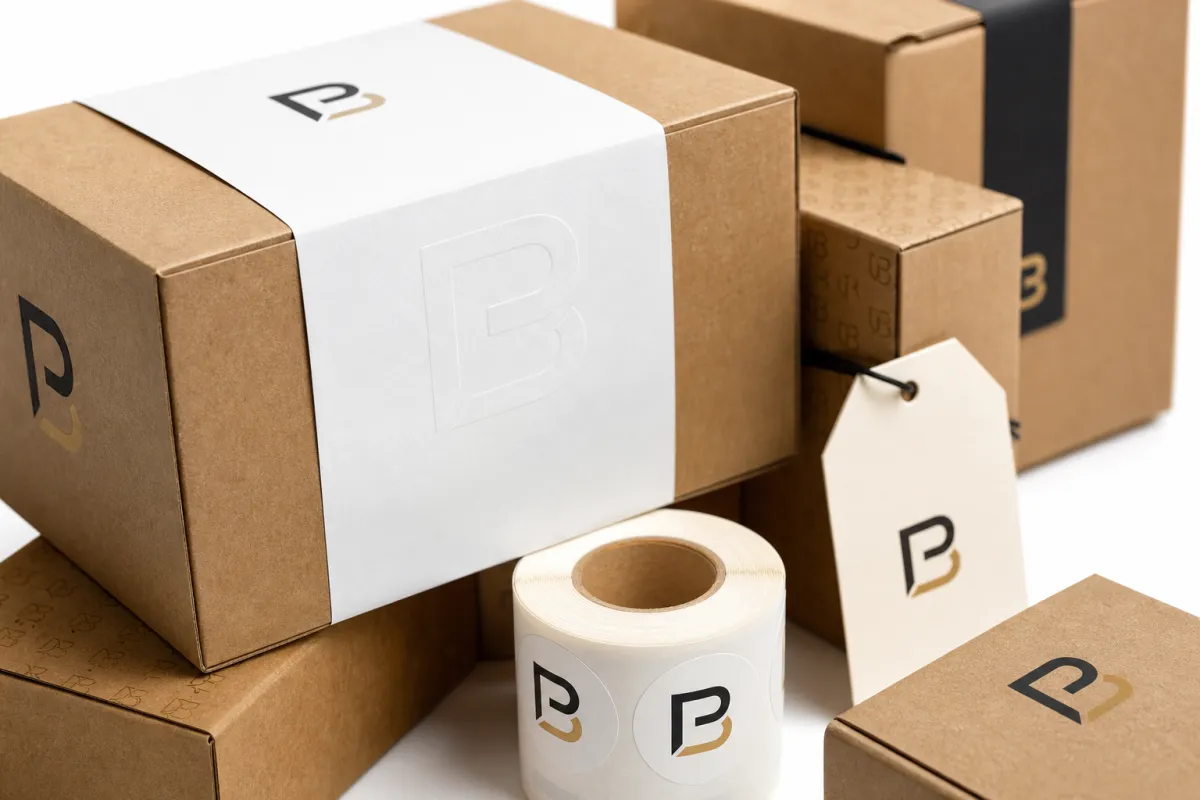
Logo printed carton labels are branded labels applied to shipping cartons, retail cartons, e-commerce boxes, and other secondary packaging. They can carry a logo by itself, or a logo plus product name, SKU, barcode, handling note, or compliance text. The carton stays the carton. The label gives it a branded face without locking you into one permanent print design.
That matters because cartons are usually bought for protection first and branding second. A buyer may choose a plain corrugated box for cost, strength, or availability, then use logo printed carton labels to add the polish where it counts. That keeps inventory simpler. It also avoids the lovely little headache of being stuck with cartons printed for one campaign when the next campaign wants a different message.
Direct carton printing can make sense at scale, especially for long production runs with stable artwork. Logo printed carton labels are more flexible. If the artwork changes quarterly, if you need multilingual versions, or if a product line is still being tested, labels are easier to update. They also let brand, operations, and procurement work from the same carton stock instead of forcing every change through a new carton specification.
From a packaging buyer's point of view, that flexibility is not a minor convenience. It is waste control. It is inventory control. It also helps with traceability, since a label can be updated with a lot code, date code, or route-specific information without retooling the base carton.
I have seen teams treat logo printed carton labels like a small extra. That misses the point. In practice, the label is often what keeps a packaging system agile. A carton can stay plain and structurally sound while the label makes it look deliberate, coordinated, and ready for market. That is not a tiny detail. That is the whole setup for a lot of brands.
If you want a broader view of packaging substrates, performance, and testing, industry education from packaging.org is a solid reference point. It is not flashy, but it is grounded in how packaging actually behaves.
How Logo Printed Carton Labels Are Made
The process for logo printed carton labels usually starts with artwork and ends with a finished label roll, sheet, or cut stack ready for application. That sounds tidy. It rarely is. A lot of quality issues are decided early. If the file is built badly, or if the substrate is wrong for the carton surface, the final label can look flat, lift at the edges, or fail during handling.
First comes the brief. A useful brief includes carton dimensions, substrate type, storage conditions, application method, and the exact information that must appear on the label. For logo printed carton labels, those details matter because the same design can behave very differently on a glossy carton, a recycled kraft box, or a rough corrugated shipping case.
Then comes artwork review and proofing. This is where registration, color, and logo size get checked. If the logo has thin strokes or small type, the proof should be viewed at actual size, not just on a monitor. A label that looks crisp in PDF can lose definition on press, especially if the board surface absorbs ink or the finish throws glare back at you.
After proof approval, the printer chooses the print method. Digital printing works well for short runs, frequent version changes, and variable data. Flexographic printing can be a better fit for repeat production and higher quantities, where setup cost gets spread across more units. Both can produce high-quality logo printed carton labels; the better choice depends on run length, color complexity, and how often the artwork changes.
Substrate choice matters just as much as print method. Paper labels can be economical and perform well on dry, clean cartons. Film-based labels usually hold up better when moisture, scuffing, or longer transit is a concern. If sustainability is part of the brief, FSC-certified paper stocks are worth asking about, especially when the label needs to support a sourcing story instead of fighting it.
Finishing comes next. Die-cutting defines the label shape. Lamination or varnish can change scratch resistance and visual depth. A matte finish feels quieter and more utilitarian. A gloss finish can pop under retail lighting but may also show fingerprints or reflections. For logo printed carton labels, the finish should support the brand story instead of stealing the spotlight.
Adhesive selection is the technical choice that gets ignored until it causes trouble. A permanent adhesive makes sense if the label must stay on through transit, warehousing, and handling. A removable adhesive is useful if cartons are repurposed, returned, or opened for inspection. On dusty board, cold surfaces, or curved corners, the wrong adhesive can turn a good label into a headache. A small sample test on the real carton is worth more than a polished mockup and a prayer.
For teams comparing label construction and performance against broader packaging benchmarks, the International Safe Transit Association publishes test methods and guidance at ista.org. That kind of reference ties label choices to real shipping conditions instead of only to print-room expectations.
Typical production flow for logo printed carton labels:
- Submit carton size, artwork, and application details.
- Review file setup, colors, and proof layout.
- Approve a digital proof or physical sample.
- Print the labels, then add die-cutting or finishing.
- Inspect the run, pack, and ship for application.
“A carton label should survive the route it was designed for. If it fails in transit, it was never really a branding decision; it was a packaging mistake.”
Key Factors That Affect Logo Printed Carton Labels
Several variables shape how logo printed carton labels look and perform. Some are visual. Some are mechanical. Some are operational. The final result is usually a mix of all three, which is why label specifications should be treated like a packaging decision, not only a graphic one.
1. Carton surface
A smooth coated carton behaves differently from a rough recycled corrugate. On porous board, ink can absorb faster and edges can show wear sooner. On glossy cartons, adhesion can be trickier because the surface resists bonding. If the carton has dust, fiber flare, or uneven caliper, the label needs more testing than a standard retail paper label.
2. Contrast and hierarchy
The logo must stay visible at a glance. That sounds obvious, but it is where many logo printed carton labels fail quietly. Beige on brown board can disappear. Thin lines can vanish on a textured surface. Crowded layouts often make the logo smaller than it should be, which weakens the brand signal from three feet away, let alone from a pallet.
3. Size and shape
Large labels can create strong shelf impact, but they also increase material cost and can overwhelm a carton. Smaller labels may be more economical, though they need sharper hierarchy to carry the same brand value. Square, circle, rectangle, and custom die-cut shapes each produce a different tone. A label that wraps around an edge or corner needs special attention so it does not wrinkle or lift.
4. Handling and transit
If a carton will be hand-packed, stacked, palletized, or sent through a distribution center, logo printed carton labels need abrasion resistance. A label that survives a gentle office test may fail after friction from tape, straps, or warehouse conveyors. That is why compression, rubbing, and temperature exposure should be part of the discussion early.
5. Compliance and information load
Many labels carry more than branding. They may include barcodes, lot codes, handling instructions, recycling information, or warning text. Once that happens, the label becomes a communication system. The logo still matters, but it has to share space with machine-readable and regulatory content. In that situation, whitespace and placement are not design flourishes; they are functional requirements.
6. Brand consistency across SKUs
A label system works best when every carton follows the same logic. That does not mean every label has to look identical. It means the logo placement, color family, and typography rules stay predictable. When that system is disciplined, logo printed carton labels can support many SKUs without creating visual noise.
Here is the part most teams miss: a small label can do a surprising amount of work if the design is focused. Strong logo placement, enough edge margin, and a finish that suits the carton can make even a modest package look much more intentional.
Helpful production checks before approving logo printed carton labels:
- Confirm the carton dimensions and printable area.
- Test the label on the actual board surface, not only on a proof sheet.
- Check barcode readability after application.
- Verify whether the adhesive must be permanent, removable, or freezer-safe.
- Review the label under warehouse lighting and retail lighting.
Logo Printed Carton Labels: Cost and Pricing Factors
Logo printed carton labels are often cheaper than direct carton printing when artwork changes often, quantities are moderate, or you want to avoid holding obsolete carton inventory. Pricing is not just the sticker price per label, though. Real cost depends on how the labels are made, how they are applied, and how much risk they remove from the packaging line.
The main cost drivers are quantity, label size, shape complexity, number of colors, substrate, adhesive type, and finish. A simple one-color paper label in a standard rectangle can be very different from a custom die-cut film label with a matte laminate and variable data. That difference can be a few cents per unit or much more, depending on the order size.
| Option | Typical Use | Common Unit Price Range | What It Is Good For |
|---|---|---|---|
| Digital paper labels | Short runs, frequent artwork changes, sample packs | $0.12-$0.35 each | Fast changes, lower setup cost, simple branding |
| Flexographic labels | Repeat production, higher quantities, stable artwork | $0.04-$0.15 each | Lower unit cost at volume, consistent reorders |
| Film labels with laminate | Abrasion, moisture, heavy handling, premium look | $0.10-$0.28 each | Stronger durability and better surface protection |
| Custom die-cut labels | Distinctive branding, unusual carton layouts | $0.15-$0.45 each | Stronger visual impact, but higher tooling and setup |
Those numbers are only a planning lens. A 1,000-piece order may carry noticeably more setup cost per unit than a 10,000-piece order. That is why logo printed carton labels often look expensive at first glance on small runs, then become very economical once quantities rise and the artwork stays stable.
There are hidden costs too, and they are usually the annoying ones. Artwork cleanup can add time if the logo file is low resolution or the dieline is incomplete. Proof changes can stretch the schedule. Custom dies may create a tooling charge. Shipping matters if the labels are heavy, oversized, or needed on a tight timeline. Application labor can be a real factor if the cartons are hand-applied rather than machine-applied.
The cheapest label is not always the best value. A low-cost label that peels in transit, smears under humidity, or looks dull on the carton may create more cost later through rework and lost brand value. In many packaging budgets, the smarter comparison is not label A versus label B. It is logo printed carton labels versus the total cost of carton printing, inventory risk, and production flexibility.
How to think about value, not just price:
- Short runs usually favor labels because setup risk is lower.
- Seasonal or limited-edition packaging almost always benefits from label flexibility.
- High-volume programs may justify direct carton printing if artwork is stable.
- Products with rough transit conditions often need a more durable material, even if it costs a little more.
If you are building a sourcing comparison, it helps to look at the label as part of the whole packaging system. That includes carton cost, printed artwork, fulfillment labor, and changeover time. In many cases, Custom Labels & Tags reduce inventory risk enough that the total economics improve even if the label line item is not the lowest number on the page.
Process and Timeline for Logo Printed Carton Labels
The schedule for logo printed carton labels usually moves through six steps: request, artwork review, proof approval, production, finishing, and delivery. The actual pace depends on how ready the files are and whether the carton environment is already known. A clean order can move fast. A messy one can stall on file corrections alone.
For a straightforward project, many suppliers can quote quickly and produce the labels within roughly 12-15 business days after proof approval. That can stretch if the label requires a custom die, a specialty adhesive, or a substrate that is not in stock. Rush work is possible, but it often narrows material choices and can push the unit price up. If the deadline matters, plan backward from the ship date instead of forward from the artwork file.
The first place delays usually appear is file preparation. Logos pulled from low-resolution web images often need cleanup. Barcodes need the right quiet zone. Color references need to be clear, especially if the brand expects a specific Pantone match. If the carton is already on hand, a physical sample can be checked against the real surface before production begins. That step can save days later.
Sample testing is worth the time because carton surfaces are unpredictable. Recycled board can be dustier than expected. Cold-chain packaging can change adhesion behavior. Glossy stock can act like a different material altogether. Testing logo printed carton labels on the actual carton is how you find out whether the spec works or just looks good in a meeting.
For shipping-sensitive products, many teams also think about transit simulation. That is where ISTA methods become useful. If the carton is going through distribution, compression, or vibration, the label should survive the same conditions the package will experience in the channel. That is a practical way to think about packaging quality: not by ideal conditions, but by the route the carton actually takes.
A realistic planning window for logo printed carton labels:
- Simple repeat order: 5-10 business days if artwork and specs are already approved.
- New artwork with proofing: 10-15 business days in many cases.
- Custom shape or specialty finish: 15-20 business days, sometimes longer.
- Rush order: faster turnaround may be possible, but stock and pricing may change.
Another detail that helps scheduling is deciding who owns approval. If design approves the artwork, operations approves the carton fit, and quality approves the adhesive and barcode legibility, you reduce the risk of last-minute changes. In practice, logo printed carton labels move faster when one person or one team is clearly responsible for final sign-off.
Brands that need a sourcing-friendly paper stock can also review FSC-certified options through the FSC network at fsc.org. That matters when the label itself is part of a broader sourcing message rather than a purely functional identifier.
If you are comparing production windows, keep one rule in mind: the label schedule has to support the packing schedule, not fight it. A carton line waiting on labels is a carton line burning time for no good reason.
Common Mistakes With Logo Printed Carton Labels
The most common mistake with logo printed carton labels is annoyingly simple: designs that look fine on screen but disappear on the carton. Low-contrast artwork is especially risky on kraft, recycled brown, or textured corrugated board. A pretty layout that cannot be read at a distance is not doing its job.
The second mistake is choosing the wrong adhesive. Dusty cartons, cold rooms, and curved corners can each interfere with bond strength. A label that seems secure during application can start lifting at the edges after a few hours or a few handling cycles. Once that happens, the package starts to look neglected even if the product inside is perfectly fine.
People also overload the label. They try to fit the logo, address block, barcode, handling symbols, compliance copy, and a promotional message into a tiny space. The result is clutter. Clutter makes logo printed carton labels feel cheaper, not richer. A clean hierarchy is usually more persuasive than adding another graphic element that nobody asked for.
Skipping samples is another familiar trap. A proof on a monitor does not reveal how a label reacts to dust, humidity, or compression. If the carton is irregular, oversized, or stored in changing temperatures, a test label is a smart expense. It is much cheaper than discovering the issue after a full order is already in the warehouse and nobody wants to own the mistake.
There is also a logistics mistake that shows up more often than it should: forgetting to measure the real carton dimensions after production tolerances. If the box is slightly larger or smaller than expected, label placement can drift, and the layout no longer feels centered. That small misalignment can make even premium logo printed carton labels look off.
Most preventable errors:
- Poor contrast between logo and carton color.
- Using a label material that does not match the storage environment.
- Ordering before verifying carton dimensions.
- Ignoring abrasion, scuffing, or moisture during transit.
- Approving artwork before checking barcode and handling information.
One more thing. A label can be technically correct and still feel weak if the logo treatment is inconsistent from SKU to SKU. That usually happens when different teams revise the label without a shared template. A strict master spec keeps logo printed carton labels from drifting over time.
Expert Tips and Next Steps for Stronger Carton Branding
If you want logo printed carton labels to work harder, start with a clear spec sheet. List the carton material, label size, finish, adhesive, application method, and the environment the carton will face. Include humidity if it matters. Include freezer or cold-room exposure if that matters. Include whether the carton will be hand-applied or machine-applied. The more concrete the brief, the less guesswork later.
Order a small test run before you commit to the full volume. That small run can reveal problems with contrast, bond strength, or layout that would be costly to discover after the main production batch is printed. A test pack is especially useful for cartons with recycled content, heavy texture, or a print surface that changes from one supplier lot to the next.
Simplify the design system. One strong logo lockup is better than three almost-identical versions. One disciplined color palette is better than a stack of near-matches that drift by season. One repeatable placement rule is better than a different label position on every SKU. This is the quiet part of good packaging work, but it is where logo printed carton labels become a real brand asset instead of a one-off graphic.
It also helps to separate the decision into operational and visual questions:
- Will the carton be stored dry, chilled, or exposed to moisture?
- Do we need a permanent bond or a removable label?
- Does the logo need to be visible from across a room or only at close range?
- Are we branding a shipping carton, a retail carton, or an e-commerce box?
- How many artwork versions will we need over the next cycle?
Practical next steps:
- Compare a few cartons under real lighting conditions.
- Ask for samples of the label stock you are considering.
- Test the label on the actual board, not just a mockup.
- Confirm barcode, lot code, and logo placement before sign-off.
- Build reorder timing into your production calendar so you are not rushed.
For teams looking for a broader packaging range, browse label and tag options that can be adapted to cartons, shipping needs, and branded outer packs. The right format depends on the carton surface, the application method, and how often the artwork changes.
My blunt view: the best logo printed carton labels are the ones that look effortless because the spec was thoughtful. They are sized to the carton, matched to the adhesive, and planned around the real shipping environment. Get those parts right, and the label does more than decorate a box. It steadies the brand presentation, cuts packaging friction, and makes every carton work harder from the first scan to the final unbox.
If you are starting from scratch, begin with the carton itself, then choose the label structure around it. That order saves time, avoids a bunch of avoidable rework, and usually produces a better result anyway.
How do logo printed carton labels differ from direct carton printing?
Labels are usually better for short runs, seasonal versions, and artwork that changes often. Direct carton printing can be efficient at larger volumes, but it is less flexible when the design needs to change frequently. Labels also let you separate branding from carton inventory, which helps reduce waste and keep stock simpler.
What materials work best for logo printed carton labels on corrugated boxes?
Paper labels can work well for dry indoor storage and cost-sensitive applications. Film-based materials are often better when abrasion, moisture, or rough handling is a concern. The carton surface matters just as much as the label stock, so testing on the actual box is the safest way to confirm performance.
How long does a logo printed carton labels order usually take?
Simple orders can move quickly if the artwork is ready and the carton specification is already confirmed. Proofing, sampling, and material selection add time, especially for custom shapes or special finishes. Planning backward from the ship date helps avoid rush fees and production bottlenecks.
What affects the price of logo printed carton labels the most?
Quantity, size, color count, material, adhesive, and finishing are the main cost drivers. Setup work and custom tooling matter more on small orders than on larger ones. Shipping and application labor should also be included when you compare options, because the label line item is only part of the total.
How can I make logo printed carton labels look more premium without overspending?
Use strong contrast, clean spacing, and a focused logo treatment instead of adding unnecessary effects. Choose one finish that supports the brand story rather than layering multiple upgrades. Test the design on the actual carton so the final look feels intentional, not overdesigned.