Buyer Fit Snapshot
| Best fit | Logo Printed Poly Mailer Sleeves projects where brand print, material claims, artwork control, MOQ, and repeat-order consistency need to be specified before quoting. |
|---|---|
| Quote inputs | Share finished size, material target, print colors, finish, packing count, annual reorder estimate, ship-to region, and any compliance wording. |
| Proofing check | Approve dieline scale, logo placement, barcode or warning zones, color tolerance, closure strength, and carton packing before bulk production. |
| Main risk | Vague material claims, crowded artwork, missing packing details, or unclear freight terms can make a low unit price expensive after revisions. |
Fast answer: Logo Printed Poly Mailer Sleeves: Film, Print, MOQ, and Carton Packing should be specified like a repeatable production item. The safest quote records material, print method, finish, artwork proof, packing count, and reorder notes in one written spec.
Production checks before approval
Compare the actual filled-product size with the drawing, then confirm tolerance on folds, seals, hang holes, label areas, and retail display edges. Reserve space for logos, QR codes, warning copy, and material claims before decorative graphics fill the panel.
Quote comparison points
Review material grade, print process, finish, sampling route, tooling charges, carton quantity, and freight assumptions side by side. A quote is only useful when the supplier can repeat the same color, closure quality, and packing count on the next order.
Logo Printed Poly Mailer Sleeves: Practical Buying Guide
Logo printed poly mailer sleeves look plain on a spec sheet. Then they show up on a porch or a packing table and do the one job that matters: they make an ordinary shipment look considered. Not loud. Not trying too hard. Just deliberate. Customers notice packaging before they read the thank-you card, so even a simple sleeve can shift the whole first impression.
That is the appeal. You keep a standard mailer, add branding on top, and avoid locking yourself into a fully custom bag before the packaging strategy is settled. For brands comparing Custom Poly Mailers with a lighter branding layer, logo printed poly mailer sleeves often land in the practical middle. They are easier to test, easier to update for a campaign, and easier to store than a separate printed bag for every SKU or seasonal drop.
The catch is simple: logo printed poly mailer sleeves are not a magic fix. If the size is off, the print is muddy, or the material fights the pack line, the whole thing falls apart fast. I have seen teams spend good money on a sleeve that looked sharp in a mockup and then wrinkled into nonsense the moment it hit real packout. So the real question is not whether the sleeve can be printed. The real question is how to spec logo printed poly mailer sleeves so they fit, hold up, and earn their keep.
One more thing before the details. The term gets used loosely. Some suppliers mean a true outer sleeve or wrap. Others mean a belly band. A few mean a printed overlay that is closer to a presentation band than a shipping component. Ask for the physical construction up front. Otherwise you are kinda buying a description, not a product.
What Are Logo Printed Poly Mailer Sleeves?
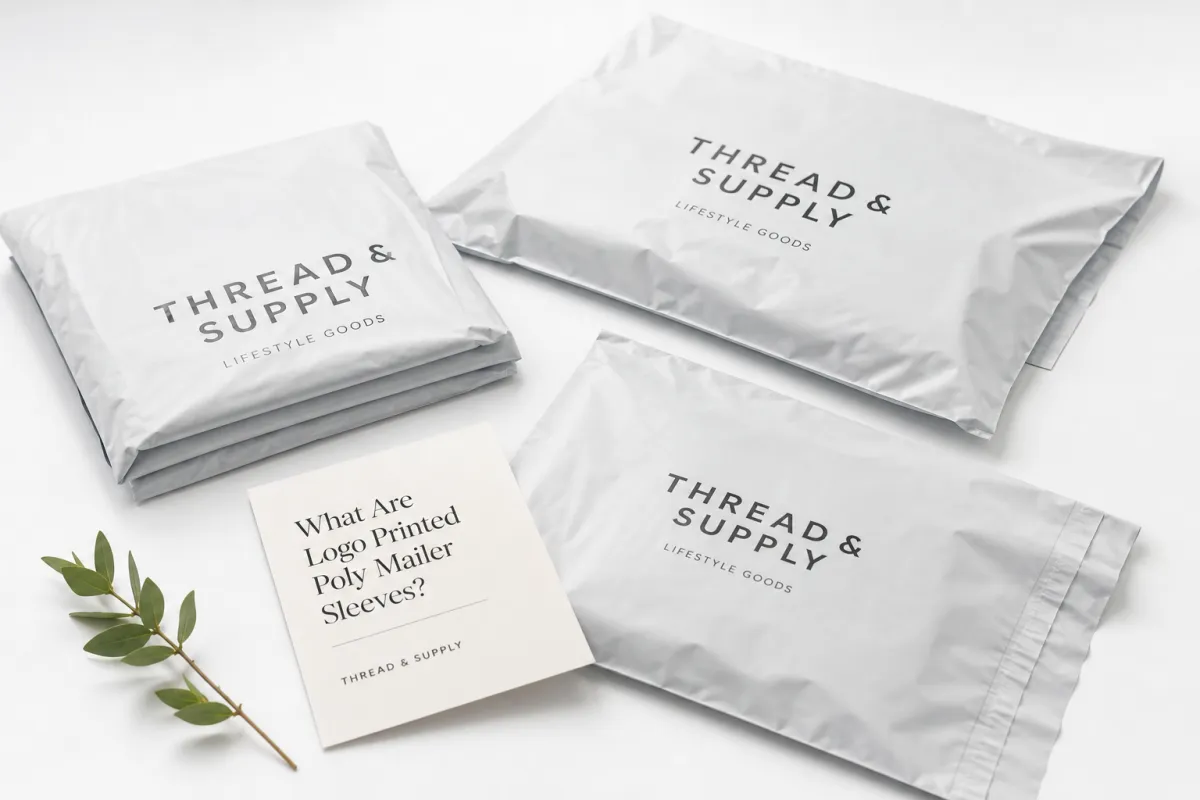
Logo printed poly mailer sleeves are printed wraps, bands, or overlays that sit on top of a standard poly mailer. In plain English, they are the branded outer layer. The mailer still does the shipping work. The sleeve handles the presentation. That split gives brands room to keep using a standard base mailer while changing the look for launches, seasonal promos, subscription shipments, or product drops.
That flexibility is why logo printed poly mailer sleeves make sense for brands that do not want to commit to a dedicated custom bag run for every campaign. One month you want a holiday graphic. The next month you want a stripped-down everyday version. Later, maybe a limited collaboration. Sleeves let you shift without ending up with dead inventory eating shelf space. For a lot of e-commerce teams, that is the entire point. Nobody wants a warehouse full of last season's design collecting dust because someone over-ordered in a hurry.
They also fit a very common operational pattern. Small apparel labels, beauty brands, accessory sellers, and subscription businesses often need a faster visual upgrade than a fully custom printed bag can justify. Logo printed poly mailer sleeves let those teams add brand presence without resetting the whole packaging system. If you also need labels, inserts, or kit components, it helps to think about Custom Packaging Products as a broader toolbox instead of treating the sleeve as a one-off purchase.
There is a practical reason brands keep coming back to sleeves: risk. If you are testing a new design direction, launching a limited drop, or managing several fulfillment nodes, sleeves reduce the amount of committed inventory sitting around waiting for the “right” moment. I have watched that save more than one launch from becoming a storage problem. Less dead stock, less regret. Pretty nice combo.
Here is the part people skip. Logo printed poly mailer sleeves are only as good as the setup behind them. The fit has to be right. The artwork has to read clearly on the actual substrate. The finish has to survive handling. A sleeve that looks great in a flat proof can still shift, crease, or lose impact once it meets real packing conditions. So yes, logo printed poly mailer sleeves are flexible. No, they are not a shortcut around basic package engineering.
Most brands choose logo printed poly mailer sleeves for one of three reasons: they want more visual impact, they want lower inventory risk, or they want multiple branded looks without ordering separate mailers for each variation. Fair enough. Packaging does not need drama. It needs to do its job and make the brand look awake.
How Logo Printed Poly Mailer Sleeves Work
The structure is straightforward. Logo printed poly mailer sleeves are printed separately from the base mailer, then applied as a wrap, belly band, or outer sleeve during packing. The sleeve may cover the front, the back, or most of the visible surface depending on the design. In practice, the sleeve becomes the branded face of the package while the mailer underneath handles protection and closure.
Production usually starts with the artwork and dimensions. That part matters more than people expect. A logo printed poly mailer sleeves file is not just a logo dropped onto a rectangle. It has to account for folds, overlap, trim, and the part of the package that is actually visible after application. If the sleeve wraps around a mailer, the brand mark cannot sit too close to the edge or it may disappear into the fold. If the sleeve is a belly band, the overlap has to be enough to hold position without creating a bulky seam.
In a decent production flow, the sequence looks like this:
- Choose the poly mailer size and closure style.
- Confirm the sleeve dimensions and visible print area.
- Approve artwork and any text hierarchy.
- Review a proof or prototype against the actual mailer.
- Print the sleeves, inspect the output, and pack for shipment.
That proof step is not busywork. It is the difference between a sleeve that fits and one that merely exists. A sleeve that works on a 10 x 13 mailer may look awkward on a 12 x 15 mailer unless the artwork was built with enough margin. Logo printed poly mailer sleeves can sometimes work across multiple mailer sizes, but only if the dimension plan is built around the largest variance you expect to use. If you want one sleeve to cover two or three sizes, design for the biggest body and accept that the smaller sizes may show a bit more overlap. That is not a flaw. That is how dimensional reality works.
There are also different presentation styles. Some brands use logo printed poly mailer sleeves as a simple belly band that shows the logo and campaign message. Others use a full wrap that covers nearly the entire visible surface. Full wraps give you more room for color blocks, photography, or a stronger retail feel, but they are less forgiving if the packout folds are messy. A clean band can look sharper than a sloppy full sleeve. Packaging is rude like that. It shows the work.
Application quality matters too. The more consistent the fold, wrap, and closure, the more premium the package looks. A wrinkled or skewed sleeve makes even good artwork feel cheap. If your fulfillment team is hand-applying logo printed poly mailer sleeves, give them a simple placement guide. If the process is automated or semi-automated, confirm the sleeve feed path and the tolerance before you place a large order. Packaging specs are never just print specs. They are also workflow specs, and that is where a lot of teams get tripped up.
I usually tell buyers to think about the sleeve as a visible tolerance test. If the sleeve design gives the pack line zero room to breathe, somebody is gonna spend time fighting corners and fixing crooked wraps. A little margin in the artwork and a little margin in the fold sequence can save a lot of headaches later.
Pricing Factors for Logo Printed Poly Mailer Sleeves
The price of logo printed poly mailer sleeves is driven by a handful of inputs that sound boring until you pay the invoice. Size, quantity, print coverage, material, finish, and production method do most of the heavy lifting. Change one of those and the quote moves. Sometimes a little. Sometimes enough to make the “cheap” option less cheap than it looked at first glance.
Short runs almost always cost more per unit. That is not a conspiracy. It is setup math. A 1,000-piece order spreads prep, press setup, proofing, and handling across fewer sleeves than a 10,000-piece order. So if a supplier gives you a quote for logo printed poly mailer sleeves, check the quantity breaks before you compare unit prices. A run of 2,500 may cost more per sleeve than 5,000, but the total spend may still fit the launch budget better.
For planning purposes, these ranges are common enough to be useful, even if the exact build still Drives the Final number:
| Option | Typical Use | Indicative Unit Cost at 5,000 Pieces | Tradeoff |
|---|---|---|---|
| Paper belly band | Simple logo, campaign text, lighter presentation | $0.08-$0.16 | Lower cost, but less coverage |
| Full wrap paper sleeve | Retail-style branding, stronger shelf impact | $0.12-$0.24 | More visible, but more sensitive to fold quality |
| Printed film sleeve | Durability, moisture resistance, clean outer look | $0.10-$0.20 | Tougher, but can feel less premium than paper |
| Short-run digital sleeve | Launches, tests, small SKU counts | $0.18-$0.45 | Fast and flexible, but unit cost is higher |
That table is not a quote sheet. It is a reality check. If a supplier is far outside those ranges, ask why. Sometimes there is a clean reason, like specialty finishing, heavier stock, or extra-wide dimensions. Sometimes the quote is padded because the spec was vague and they had to assume the worst. Vague briefs are expensive. They also waste time, which is a quieter but equally annoying way to lose money.
Other common cost drivers include:
- Print colors: more colors usually means more setup and more opportunities for variance.
- Finish: matte, gloss, soft-touch, and protective coatings change both look and cost.
- Art prep: file cleanup, die-line work, and proof rounds can add separate charges.
- Rush timing: compressed schedules tend to bring rush fees or freight premiums.
- Special handling: pack-inserts, banding, bundling, or kitting add labor.
The cleanest way to compare logo printed poly mailer sleeves is to ask for the same inputs every time: exact dimensions, quantity band, print coverage, material, finish, and delivery target. Otherwise you are comparing apples to oranges, and one of those apples is missing half the quote detail. For brands that want a better sustainability story, ask whether paper-based sleeves can be sourced with FSC-certified paper. That does not solve every packaging question, but it does answer one of them in a concrete way.
From a value standpoint, the best logo printed poly mailer sleeves are not always the lowest unit price. A better substrate that resists scuffing, a cleaner print that reads from three feet away, and a size that does not fight your packing line can save waste faster than a penny-off quote. Cheap packaging that creates rework is just expensive packaging wearing a discount tag. I have yet to meet a warehouse manager who was thrilled to re-open a box of “savings.”
Ordering Process and Timeline
The ordering process for logo printed poly mailer sleeves usually moves through a few predictable stages: size selection, artwork prep, proof approval, production, inspection, and shipping. If any of those steps gets fuzzy, the timeline gets fuzzy too. That is the rule, and packaging rules are annoyingly consistent.
In a typical run, artwork readiness is the biggest early variable. If you already have press-ready files, the proof stage can move quickly. If the design still needs adjustments, you may lose several business days to back-and-forth. The production slot matters too. Some jobs can move in 10-15 business days after approval; others need 15-20 business days if the spec is more complex or the schedule is crowded. Then add freight time. A fast print job can still arrive late if shipping is treated like an afterthought, which is a classic mistake and a very avoidable one.
For logo printed poly mailer sleeves, the worst delays usually come from three places:
- Artwork changes after the proof is already in motion.
- Size changes that force a new layout or a fresh dieline.
- Approval lag from too many internal reviewers.
A lot of buyers underestimate the last one. The supplier cannot print the order while five people debate whether the logo should sit 3 mm higher. Pick a reviewer, get the signoff, and move. Otherwise the launch date turns into a suggestion. I have seen a three-day delay turn into a two-week headache because someone decided the brand color looked “slightly off” after approval. Slightly off is still approved, by the way, unless you want to pay for the rework.
The sleeve that arrives on time and fits badly costs more than the one with the slightly higher quote.
That is why timeline planning needs a buffer. If the sleeves are tied to a launch, build in extra time for proof corrections, transit, and packout testing. It is also smart to tell the fulfillment team how the logo printed poly mailer sleeves will be applied before the order lands. The pack line should not be guessing where the fold goes on the first hundred shipments. Inconsistent application makes the whole brand look sloppy, and customers do not care that the spreadsheet was “close.”
If shipping protection is part of your concern, it can help to review transit testing guidance from the ISTA standards. You do not need to turn a sleeve into a lab project, but basic transit awareness is useful. Packaging that looks good on a desk and fails in a truck is not finished packaging. It is a draft with tape on it.
My rule of thumb: if the sleeve needs a custom fold, a specific application direction, or a special overlap, bake that into the timeline from day one. Do not let it show up as a “small clarification” after the proof is approved. Small clarifications have a bad habit of becoming expensive.
Common Mistakes to Avoid
The most common mistake with logo printed poly mailer sleeves is bad sizing. Too tight, and the sleeve buckles or splits at the fold. Too loose, and it shifts around, which makes the package look unplanned. Neither outcome is subtle. Both make a brand look like it ordered the first thing that fit the budget instead of the thing that fit the mailer.
Another mistake is over-designing the print. Tiny text, weak contrast, too many colors, and busy background graphics are all easy ways to burn money. Logo printed poly mailer sleeves need clear hierarchy. The logo needs to read quickly. The supporting message needs to be short. If the design tries to say everything, it usually says nothing. That is true on screen and even more true on a piece of packaging that gets handled, stacked, and sometimes scuffed before the customer sees it.
Material behavior also matters. Some finishes look beautiful in a proof but crease at the corner, show fingerprints, or rub off during packing. If the sleeve will be folded, stacked, or touched a lot, do not choose a finish just because it photographs well. Choose it because it survives real handling. Logo printed poly mailer sleeves are branding tools, yes, but they are still physical objects. Gravity remains involved.
Another issue I see a lot: teams approve a sleeve without testing it on the actual product load. A flat mailer with no contents is one thing. A packed mailer with a garment, bottle, kit, or boxed item inside is another. That extra thickness changes how the sleeve sits, how much overlap you really have, and whether the print lands where you expected. Skip that test and you are gambling on the part of the process that is easiest to fix before the order prints and hardest to fix after.
Here are a few other errors that show up often:
- Skipping a sample: a flat proof is not the same as a sleeve wrapped on the actual mailer with actual contents inside.
- Ordering too deep too soon: buying a large quantity before testing fit can leave you with a spec that is merely expensive and not usable.
- Ignoring the packing method: hand-applied sleeves and machine-applied sleeves do not behave the same way.
- Forgetting scuff resistance: light-colored art can look dirty fast if the surface is not suited to shipping.
A solid test plan does not have to be complicated. Check the sleeve on the real mailer. Check it with a full packout. Check how it stacks, folds, and seals. Then check whether your team can actually apply it at speed without cursing the art department. That last one is usually a good sign.
If the order is headed toward a big volume run, a prototype is cheap insurance. It can catch the small stuff that becomes expensive later: a logo sitting too close to the seam, a fold line crossing a key message, or a size that looks fine until it is loaded with product. Logo printed poly mailer sleeves should reduce friction, not create more of it.
One more honest note: not every package needs a sleeve. Sometimes a plain mailer with a strong label or insert is the better call. If the brand story is already carrying enough weight, adding another printed layer can be overkill. Good packaging choices are not about adding more pieces. They are about adding the right piece.
Expert Tips for Better Branding and Less Waste
The strongest logo printed poly mailer sleeves are usually the simplest. One strong logo. One short message. One accent color or block that gives the package identity. A crowded design can feel busy in a mockup and dull in the hand. Clean structure ages better, reads faster, and is easier for fulfillment teams to repeat without error.
Think in systems, not one-off jobs. If your packaging changes every month, build logo printed poly mailer sleeves that can support that rhythm. Keep the base structure stable and swap the campaign line, color panel, or seasonal graphic. That way the packaging stays recognizable even when the artwork changes. Brands that do this well look organized without having to shout about it.
Choose the right material for the job
The material should match the way the package is handled, not just the way it looks in a render. If the sleeve is going through a warehouse with a lot of stacking and surface contact, prioritize crease resistance and scuff protection. If the sleeve is mostly a presentation layer for direct-to-consumer orders, you may care more about print clarity and tactile finish. Logo printed poly mailer sleeves can be paper-based, film-based, or a hybrid build, and each one has a different personality. Use that to your advantage.
If you are buying paper-based logo printed poly mailer sleeves, ask whether the substrate is FSC-certified or available with responsible paper sourcing. The certification does not make a package perfect, but it gives you a clearer sourcing story. For a lot of brands, that matters because customers are paying attention to packaging waste, and they should be. Waste is not a branding feature.
Material choice also affects how forgiving the sleeve feels in the hand. A heavier stock can hide minor handling marks better. A lighter stock can cut cost, but it may telegraph every crease from the packing line. That tradeoff is real, and it is usually more important than the last decimal on the quote.
Protect the packout flow
The best graphic in the world will not save a process that is slow or awkward. Before you place a large order, make sure the fulfillment team has a simple placement guide: where the sleeve starts, how much overlap is needed, and what finished look is expected. Logo printed poly mailer sleeves should fit the pace of the line. If the application step adds too much friction, the cost shows up later in labor and inconsistency.
That is also why repeat-order files matter. Save the final artwork, the exact dimensions, the approved material, and any notes about fold direction or placement. The next reorder will be faster if the information is already locked. Nothing wastes time like re-litigating a spec you already solved six months ago.
One more practical point: test the sleeve under normal abuse, not ideal conditions. Stack it. Slide it. Let it sit in a warm area if that matches your logistics reality. If logo printed poly mailer sleeves are going to travel through distribution, they should be treated like package components, not marketing posters. That sounds obvious, but plenty of jobs fail right there.
For brands that want a sensible standard, a short durability check is enough to catch most issues: fit, fold, print, handling, and transit. You do not need to turn the project into a science fair. You just need enough discipline to avoid paying for the same mistake twice.
The waste part matters too. A sleeve that is too complicated to apply often gets misused, reworked, or scrapped. A sleeve that fits the team’s actual workflow gets used consistently. Less scrap, fewer remakes, less dead inventory. That is the dull stuff that quietly improves margins.
Next Steps for Logo Printed Poly Mailer Sleeves
If you are ready to move forward, start with a one-page spec sheet. Keep it simple: mailer size, sleeve dimensions, print colors, quantity range, finish, and target ship date. That little sheet is the difference between a focused quote and a guessing game. Logo printed poly mailer sleeves are easy to price when the inputs are clear and surprisingly annoying when they are not.
Request samples or a prototype before you commit to a big run, especially if the sleeve will be seen by retail buyers or used on a launch that matters. A sample shows how the logo printed poly mailer sleeves look on the actual mailer, how the material folds, and whether the visual balance survives real handling. A flat proof can never tell you all of that. It tells you the file is printable. That is not the same thing as telling you it is good.
Then compare quotes using identical inputs. Same size. Same quantity. Same print coverage. Same finish. Same delivery target. Once those variables are locked, the price differences are easier to understand, and the “cheap” quote stops hiding behind ambiguity. If you need a wider packaging plan, you can also use Custom Packaging Products to coordinate the sleeve with inserts, labels, or outer mailers instead of treating each piece as a separate problem.
One practical way to keep the project from drifting is to define the one thing the sleeve must do. Is it supposed to feel premium? Speed up seasonal branding? Reduce inventory risk? Support a campaign launch? Pick the main job first. Logo printed poly mailer sleeves do best when they solve one clear problem instead of trying to carry five.
At the end of the process, the goal is simple: logo printed poly mailer sleeves should arrive ready to use, not ready to troubleshoot. If the spec is tight, the artwork is clean, and the fulfillment flow is realistic, the sleeve does its job without drama. That is what good packaging looks like in practice. It does not try to be clever. It just works.
If you only take one thing from this guide, make it this: build the sleeve around the actual mailer, not around a design file. Measure the real product, test the real fold, and approve the real finish before the order goes deep. That one habit prevents most of the expensive mistakes.
And yes, logo printed poly mailer sleeves can make a very plain shipper look better almost immediately. That is the point. They give you a strong first impression without forcing you into an all-in custom mailer commitment, which is exactly why so many brands keep coming back to them.
FAQs
What are logo printed poly mailer sleeves used for?
They add branding and messaging to a standard poly mailer without forcing you into a fully custom bag. That makes logo printed poly mailer sleeves useful for launches, seasonal promos, subscription shipments, and brands that want flexibility across multiple mailer sizes. They are also handy when you want to test a new visual direction without buying a huge custom run.
How much do logo printed poly mailer sleeves usually cost?
Price depends on size, quantity, print colors, and finish, with small runs costing more per unit than larger orders. For most buyers, logo printed poly mailer sleeves become much easier to compare once the quote includes exact dimensions, setup fees, proofing, shipping, and any rush charges. If those pieces are missing, the quote is not really a quote yet. It is just a rough guess with a logo on it.
What material works best for printed poly mailer sleeves?
Choose the material based on handling, print clarity, and whether the sleeve needs to feel premium or simply protect branding. If the sleeve will be folded, stacked, or handled a lot, prioritize durability and crease resistance over flashy finishes. That is usually the smarter buy. Paper can be the right answer, film can be the right answer, and sometimes a hybrid build is the better fit. The use case decides.
How long does it take to produce logo printed poly mailer sleeves?
Turnaround depends on artwork readiness, proof approval speed, production slot, and shipping distance. The biggest delays usually come from artwork changes and slow approvals, not the actual printing. Once the file and spec are locked, logo printed poly mailer sleeves can move much faster. If the schedule is tight, build a little buffer for transit and packout testing so the launch does not get squeezed at the finish line.
Can logo printed poly mailer sleeves fit different mailer sizes?
Yes, if the sleeve dimensions are planned with enough tolerance and the visual layout still looks balanced across sizes. Test the sleeve on the actual mailer before ordering a full run, because small size differences can create sloppy fit. That is one of those details that sounds minor until it ruins the unboxing feel. If you need to cover several mailer sizes, design around the largest one and check how the artwork lands on the smaller versions before you commit.


