Buyer Fit Snapshot
| Best fit | Low MOQ Poly Mailers projects where brand print, material claims, artwork control, MOQ, and repeat-order consistency need to be specified before quoting. |
|---|---|
| Quote inputs | Share finished size, material target, print colors, finish, packing count, annual reorder estimate, ship-to region, and any compliance wording. |
| Proofing check | Approve dieline scale, logo placement, barcode or warning zones, color tolerance, closure strength, and carton packing before bulk production. |
| Main risk | Vague material claims, crowded artwork, missing packing details, or unclear freight terms can make a low unit price expensive after revisions. |
Fast answer: Low MOQ Poly Mailers: Film, Print, MOQ, and Carton Packing should be specified like a repeatable production item. The safest quote records material, print method, finish, artwork proof, packing count, and reorder notes in one written spec.
Production checks before approval
Compare the actual filled-product size with the drawing, then confirm tolerance on folds, seals, hang holes, label areas, and retail display edges. Reserve space for logos, QR codes, warning copy, and material claims before decorative graphics fill the panel.
Quote comparison points
Review material grade, print process, finish, sampling route, tooling charges, carton quantity, and freight assumptions side by side. A quote is only useful when the supplier can repeat the same color, closure quality, and packing count on the next order.
Low MOQ poly mailers give brands a way to ship with a branded, polished look without locking money into packaging that may sit around longer than the product itself. That matters for new apparel lines, influencer kits, seasonal launches, and smaller ecommerce shops that need packaging to feel intentional from the first order. The smartest packaging choice is not always the biggest commitment; sometimes it is the one that keeps size, print, and timing under control while the business is still figuring out what really sells.
For a packaging buyer, the value of low MOQ poly mailers is easy to understand in practical terms. They let you present a clean exterior, keep cost visible, and avoid ordering far beyond current demand before the artwork, dimensions, or shipping rhythm have settled. If you are comparing options across Custom Poly Mailers, broader Custom Packaging Products, or the quick answers in our FAQ, the job stays the same: Choose the Right spec, at the right quantity, for the stage your brand is in.
The cheapest mailer is not always the least expensive choice. In practice, the costliest mailer is the one bought too early, in the wrong size, or with a print plan that does not match how the business actually packs and ships.
Why Low MOQ Poly Mailers Make Sense for Growing Brands
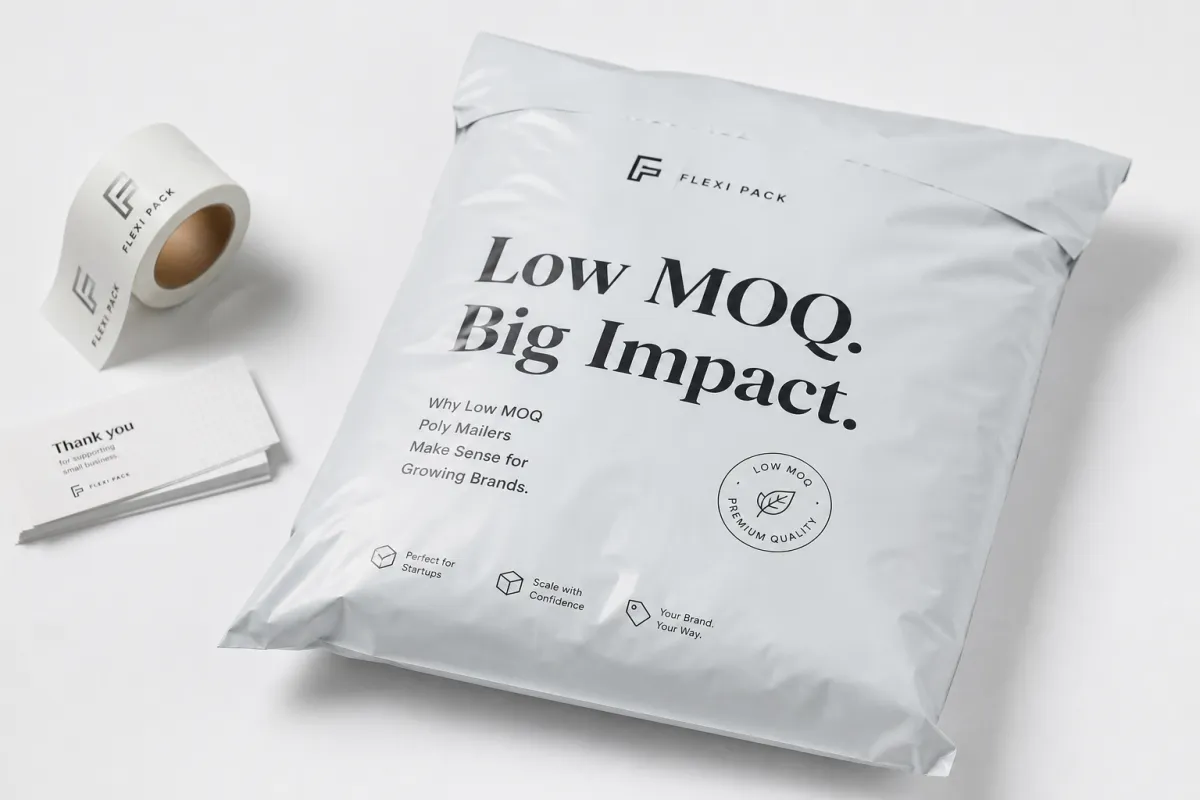
A familiar shipping problem shows up again and again: a brand has a product ready, the carton program is still being finalized, and the team wants the package to look polished from the first outbound order. That is the moment low MOQ poly mailers start to make sense. They let a brand launch with branded packaging without forcing a huge inventory buy before it is clear whether the size, artwork, or seasonal look will stay in rotation.
From the buyer’s side, low MOQ poly mailers are about risk control more than novelty. A short run gives room to test a new logo treatment, a holiday graphic, a marketplace-specific version, or an influencer drop with limited volume. If the artwork needs to change, the business is not stuck with a warehouse full of the wrong design. If the item takes off, the next reorder comes with better information about what actually fits and ships well.
That flexibility carries real value for ecommerce launches, subscription kits, regional promotions, local drops, and limited-edition programs. It also matters when a brand is moving between pack sizes. A shirt, a hoodie, and a soft accessory may all ship cleanly, yet not in the same bag. Ordering low MOQ poly mailers gives you room to try a 10 x 13, a 12 x 15.5, or another format before locking into a repeat spec.
The presentation benefit is just as real. Even a small order can leave the facility looking fully branded, and customers notice the outbound package long before they touch the product inside. A custom mailer can carry your logo, brand colors, return details, or a seasonal graphic without waiting for bulk inventory levels that may not fit a younger business.
Flexibility should not be mistaken for a free pass, though. Good low MOQ poly mailers come with tradeoffs: unit cost usually runs higher than a large production run, print options may be narrower, and some finishes simply do not make sense at very small quantities. A supplier worth trusting should explain those limits directly instead of burying them under polished language. That kind of honesty saves time and keeps the order from needing rework later.
Brands usually do best when they treat low MOQ poly mailers as a controlled test program. Start with a usable size, a print approach that fits the budget, and a quantity that covers the next few weeks or months of shipping. That approach beats ordering a warehouse full of packaging that looks good in a mockup but does not match the way real products fold, stack, and move through the pack line.
There is also a less obvious benefit: a short run keeps the team paying attention to what happens after the package leaves the building. If a certain size gets crushed in transit, if a matte finish scuffs more than expected, or if a flap adhesive feels weak in cold weather, the issue shows up fast and the next order can be adjusted before the brand commits to a bigger run. That kind of feedback loop is worth a lot, and honestly, it is one reason low-volume packaging programs often end up smarter than the first big order.
Product Details: What Low MOQ Poly Mailers Are Made To Do
Poly mailers are built to protect lightweight goods while keeping shipping fast and economical. Most use LDPE or a co-extruded film structure, with heat-sealed seams and a pressure-sensitive adhesive closure that forms a secure fold-over seal. In daily use, low MOQ poly mailers are expected to resist moisture, handle ordinary parcel abuse, and keep the item contained without adding much weight to the shipment.
The format is simple, yet the details shape the experience. Opaque white mailers are popular because they look clean and retail-ready while protecting privacy. Black and colored mailers can create a stronger visual identity and mask the contents more effectively. Clear mailers are used less often for branded ecommerce because they reveal the product, though they can work in some fulfillment programs or promo kits where visibility helps. With low MOQ poly mailers, available color and print options often depend on the supplier’s setup and the print method used.
Common custom features include logo printing, full-coverage graphics, tear strips, writable panels, and return-address zones. Some buyers want a simple one-color logo near the center or flap. Others want the entire exterior covered with pattern, brand messaging, and social handles. Low MOQ poly mailers can support a surprising amount of branding, but the smaller the run, the more important it is to confirm exactly what the quoted spec includes.
Operations teams care about more than appearance. A useful mailer should fold cleanly, seal with consistent pressure, stack without slipping, and survive the normal bumps of parcel handling. A bag that looks good but slows the pack line is not a smart buy. The point of low MOQ poly mailers is to combine presentation and handling efficiency so the team can keep product moving without friction.
That is also why some short-run programs limit customization. A supplier may cap the number of print colors, the total print area, or the number of available size options at the low-quantity level. Those limits are not automatically a warning sign. In many cases, they are the reason the MOQ stays manageable. The key is getting those constraints spelled out before the quote is approved, so the buyer knows whether the order fits the brand and the workflow.
Another practical detail is how the film feels in hand. A thin mailer can be perfectly acceptable for soft apparel, yet still feel flimsy if the product has hard trims, buttons, zippers, or a cardboard insert. A thicker bag may feel more premium, but it can also add cost and bulk. The right answer is not always the thickest option; it is the one that protects the item, seals well, and does not make fulfillment a pain. That balance is a big part of why low MOQ poly mailers deserve more thought than they usually get.
Specifications: Sizes, Thickness, and Performance Checks
Size selection is one of the easiest places to save money or create waste. A mailer that is too small forces the packer to work the product into the bag, and the seam may not close cleanly. A mailer that is too large leaves the shipment looking loose and can waste space in transit. For low MOQ poly mailers, the best sizes usually follow the way the product folds, not just the flat dimensions listed on the box.
Apparel shows the issue clearly. A light T-shirt may fit neatly in a 10 x 13 mailer, while a hoodie or thicker soft good may need something closer to 12 x 15.5 or 14 x 20, depending on the fold and whether inserts are included. Accessories, socks, and compact retail kits often work best in smaller formats that keep excess air down and control cost. A strong low MOQ poly mailers program should match the mailer dimensions to the actual product volume, not only to the marketing description of the item.
Thickness is usually described in mil or micron, and it affects puncture resistance, hand feel, and how confidently the bag survives transit. Thinner film can work well for soft apparel shipped in a controlled ecommerce environment. Thicker film is usually the better choice for items with sharper corners, heavier contents, or parcels moving through rougher distribution paths. For many low MOQ poly mailers orders, the practical range sits around 2.5 mil to 4 mil, though the right spec depends on the product and the carrier route.
Buyers should also ask about seal strength and edge weld quality. A mailer can look strong and still fail if the side seams or flap adhesive are weak. If a supplier says the bag is fit for normal shipping, ask what that means in real terms: what product weight, what handling pattern, and what transit conditions. If your team wants a more formal check, transit testing frameworks from ISTA can serve as a useful reference point for rough handling, vibration, and distribution simulation.
Opacity deserves a close look as well. A sample may appear opaque on a table, then reveal more than expected once backlit or stretched. That matters for privacy, presentation, and returns. Recyclability claims should be checked with the same care. If a supplier says a bag contains recycled content or can be recycled through a particular stream, ask for documentation rather than relying on broad marketing language. The EPA recycling guidance is a useful starting point for source reduction, material recovery, and claims that should be backed up.
Print coverage and artwork placement matter just as much. Dense coverage can affect how the bag folds, how the adhesive flap closes, and how the finished mailer stacks at the packing station. A heavy design also raises questions about color matching and production consistency. With low MOQ poly mailers, requesting a proof or sample before the full order is usually the safest move, especially when the same artwork will be used across several sizes.
Ask for the spec sheet. Ask for a sample. Compare the feel in hand, the seam quality, and the closure behavior. Those checks take time, yet they cost far less than discovering a weakness after cartons of mailers are already on the floor. In my experience, the sample is where a lot of assumptions disappear. A bag that sounds perfect on paper can feel a little slick, fold oddly at the flap, or leave the seam line just where you do not want it. Better to catch that early, kinda before the whole order is in motion.
Low MOQ Poly Mailers: Cost, Pricing, MOQ, and Quote Factors
Pricing for low MOQ poly mailers usually follows the same basic logic as any other custom packaging run, though the smaller quantity makes every line item easier to see. Minimum order quantity is often shaped by the print method, the size of the bag, and the setup work required before production begins. When the order is small, the setup cost gets divided across fewer pieces, which pushes the unit price higher.
That does not mean short runs are overcharged. It means the math is honest. A buyer comparing low MOQ poly mailers against a higher-volume program should look at the real cost per piece, not only the quoted unit price. Setup charges, tooling fees, proofing, and freight can move the landed number more than many people expect. Ignore those costs and the quote can look better on paper than it really is.
Here is a practical way to frame it. A small order of 500 custom bags may land around $0.42 to $0.80 per piece depending on size, print coverage, and finish. At 2,500 pieces, a buyer might see something closer to $0.22 to $0.38 per piece. Around 5,000 pieces, some programs can move into the $0.18 to $0.28 per piece range if the print is simple and the film spec is standard. Those figures shift with artwork complexity, dimensions, shipping lane, and the supplier’s production method, so they should be treated as planning ranges rather than promises.
The main pricing drivers are straightforward: film thickness, bag dimensions, number of print colors, total print coverage, special features like tear strips or writable panels, and the shipping destination. Even the choice between a white opaque base and a colored base can change the quote. If the artwork needs a plate or tooling step, that can add cost up front. For low MOQ poly mailers, these details matter because a short run does not have much volume to absorb extra charges.
It helps to compare custom bags with stock mailers plus labels. Stock mailers can look cheaper at first glance, especially if you only need to get products out the door and do not care about full bag branding. Once labor for label printing, manual application, and the visual inconsistency of placement are added in, the total operational cost can climb. For some brands, low MOQ poly mailers become the better value because the packaging itself carries the branding and the packing line stays cleaner.
Below is a simple comparison many buyers use during early planning:
| Option | Typical MOQ | Approx. Unit Cost | Best For | Tradeoff |
|---|---|---|---|---|
| Stock poly mailers with labels | Very low | $0.10-$0.25 plus label cost | Fast start, minimal branding | Manual labor, less polished appearance |
| Low MOQ poly mailers | Short run custom | $0.18-$0.80 depending on quantity | Brand launch, testing, small campaigns | Higher setup burden per piece |
| Higher-volume custom mailers | Large production run | $0.08-$0.22 depending on spec | Stable SKUs, repeat shipping, bulk pricing | More inventory tied up upfront |
The table is not meant to steer every buyer toward one answer. It shows the logic behind the quote. If a brand needs tighter cash control, short-run custom mailers often make sense even when the unit cost is higher. If demand is already proven, bulk pricing can be the stronger move. A good supplier should be able to explain that tradeoff clearly and without pressure.
When you request a quote for low MOQ poly mailers, send the supplier the exact size, estimated quantity, artwork format, color count, ship-to address, and target timing. If you want an apples-to-apples comparison, include whether the finish should be matte or gloss, whether recycled content is required, whether tear strips are needed, and whether opacity is a priority. The cleaner the input, the cleaner the quote.
One more pricing truth that tends to get glossed over: a small order can be the right financial move even when the piece price is not the lowest available. If the packaging lets you launch sooner, avoid dead inventory, and keep the brand presentation consistent, the real savings show up in time and risk, not just in the line-item cost of the mailer. That is the part buyers often miss when they are only staring at a spreadsheet.
Process and Timeline: From Artwork Review to Delivery
The order flow for low MOQ poly mailers is usually simple on paper, though each step still matters. It begins with a quote request, moves to spec confirmation, artwork submission, proof review, production approval, and shipment. That sequence sounds basic, yet delays usually happen because one of those steps was handled too casually.
Prepress is where small mistakes are caught before they become expensive. Artwork files need to be checked for image resolution, bleed, panel placement, and color expectations. If the mailer has a flap, a seam, or a repeat pattern, the design needs to respect those physical limits. With low MOQ poly mailers, the proof stage matters even more because the production window is often tighter than on a larger run, and changes after approval can slow the schedule quickly.
Many buyers ask about the timeline, and the honest answer is that it depends on proof approval, print method, and freight lane. A realistic planning model is often 1 to 2 business days for proofing if the artwork is ready, 10 to 18 business days for production on a short custom run, and then additional transit time based on the shipping destination. If the order moves by ground freight, add a few more days. If it ships cross-country or internationally, the delivery window needs extra room.
Common delay points are easy to spot. Missing artwork dimensions force the design team to wait. Slow proof approvals push the job back in the queue. A buyer who changes size after the quote may need a new spec review. If the production slot is already scheduled, even a small change can move the order. For low MOQ poly mailers, the best way to avoid that problem is to plan backward from the launch or replenishment date instead of forward from the quote date.
Proof approval matters for another reason: the finished bag still has to work in the pack line. Does the mailer seal without wrinkling? Does the artwork line up cleanly when folded? Is the return address readable at arm’s length? These are small questions, yet they shape how the finished shipment feels when the team is moving quickly.
Brands usually get the smoothest result when they treat the job as a packaging decision rather than a graphics-only decision. The artwork matters, but the bag still has to close, stack, and move through operations without friction. That is exactly why low MOQ poly mailers are worth planning carefully instead of rushing to print the first design that looks good on screen.
There is also a timing advantage to being deliberate. When a brand rushes a run, it often discovers too late that the mailer is a little too narrow for the product after the final fold, or that the print should have been shifted so the logo sits higher once the flap is closed. Those are the small, annoying issues that can slow a pack line more than anyone expects. A cleaner timeline now saves a lot of hand-wringing later, which is the kind of tradeoff nobody misses once they have lived through it.
Why Choose Low MOQ Poly Mailers From Custom Logo Things
Custom Logo Things is a practical fit for buyers who want straight answers on materials, pricing, and production limits instead of inflated claims. For low MOQ poly mailers, that kind of support matters because the buyer often needs more than a price. They need help narrowing the right size, the right film strength, and the right print approach before the order moves forward.
A good supplier saves time by reducing guesswork. If the product is soft apparel, the recommendation may differ from a product with corners, inserts, or a higher risk of puncture. If the artwork is simple, the print path may be easier and the quote may stay tighter. If the brand wants a more detailed design, the supplier should explain how that affects setup charges and whether the finish still makes sense at a short run. That kind of guidance turns low MOQ poly mailers into a workable program instead of a trial-and-error exercise.
Consistency matters too. A small launch run can become a repeat reorder, and a repeat reorder can become a dependable packaging system if the original spec was chosen well. That is where technical packaging guidance earns its place. It supports better packing speed, better protection in transit, and a cleaner unboxing experience without forcing the business to overbuy.
Brands also appreciate clear communication around the real limits of a custom run. Not every finish is available at every quantity. Not every thickness suits every product. Not every artwork layout fits every bag size. When those limits are explained early, low MOQ poly mailers still feel organized and professional, even when the order is small.
If your packaging plan includes other pieces, such as inserts, branded tape, or shipping cartons, it helps to review them together so the mailer does not clash with the rest of the system. That is one reason buyers often move between the product pages and the broader Custom Packaging Products section while building a launch kit. Good packaging works best as a set, not as disconnected parts.
For buyers who want a focused starting point, the most useful question is not, “What can you print?” It is, “What should this mailer do in real shipping conditions?” That question leads to better decisions, especially with low MOQ poly mailers where every square inch of print and every point of cost per piece matters.
There is also a trust factor that matters more than people sometimes admit. Packaging is easy to make look good in a mockup. It is harder to make it hold up during a real ship day, when items are folded a little differently, bags are grabbed in a hurry, and the dock temperature is not exactly friendly. A supplier who can speak plainly about those details usually saves the buyer from unpleasant surprises. That is the kind of partner you want when the packaging has to work, not just photograph well.
Next Steps: What to Prepare Before You Request a Quote
Before you request a quote, gather the basics: target mailer size, estimated quantity, artwork files, preferred shipping location, and any special requirements such as recycled content, tear strips, or an opaque finish. If you are still deciding between a few sizes, make a short priority list. Is the goal the lowest unit cost, the strongest film, the fastest turnaround, or the best print appearance? That one decision list will make the quote process easier.
For low MOQ poly mailers, it also helps to ask for a sample, a proof, and a written quote. The sample helps with feel and function. The proof helps with artwork placement. The written quote helps you compare total cost, including setup charges, tooling fees, and freight. If you compare only the base price, you are not really comparing the order.
It can help to think through how the mailer fits into the rest of the shipping system. Does it need to match boxes, inserts, or branded tape? Does the pack line rely on a certain fold, label area, or return-address panel? If the answer is yes, mention that early. Low MOQ poly mailers can absolutely support a polished shipping program, but the spec needs to be chosen with the rest of the workflow in mind.
If you are ready to move forward, start with the product page for Custom Poly Mailers, check the common questions in the FAQ, and then send over the size, quantity, and artwork details. That gives the team enough information to build a quote that is actually useful, not just a number on a page.
The strongest orders are the ones planned with a little discipline. When you take the time to match the bag to the product, the artwork to the format, and the quantity to the real launch need, low MOQ poly mailers become a smart operational tool. They let a brand look established, stay flexible, and keep inventory under control while the business grows.
A good rule of thumb is pretty simple: start with the smallest mailer that still protects the folded product, ask for a proof before production, and make sure the quote reflects the full landed cost rather than just the printed bag price. If those three pieces line up, the packaging program is probably headed in the right direction.
Frequently Asked Questions
What is the minimum order for low MOQ poly mailers?
Minimums vary by size, print method, and material spec, so the most accurate answer comes from a quote built around your exact job. Smaller quantities usually carry a higher unit price because setup and production costs are spread across fewer pieces. If you need a test run, ask whether the supplier offers a sample order or a short-run custom option.
Can low MOQ poly mailers be fully custom printed?
Yes, many low MOQ programs support custom logos, artwork panels, and brand colors within the limits of the print method. Coverage, color count, and finish can all affect minimums and pricing, so the artwork should be reviewed before the order is approved. If your design is detailed, ask for a proof to confirm placement and readability on the actual mailer size.
How do I choose the right thickness for my poly mailers?
Match thickness to the product weight, any sharp edges, and the shipping conditions your packages will face in transit. Lighter apparel often works with standard film, while heavier or higher-value items may need extra puncture resistance. If you are unsure, ask for a recommendation based on the items you ship most often.
What information do I need to get an accurate quote?
Provide the mailer size, estimated quantity, artwork files, print color count, and destination zip or shipping address. Include any special requirements such as recycled content, tear strips, or specific opacity needs. The more complete your request, the faster the supplier can return a useful quote.
How long does production usually take for low MOQ poly mailers?
Lead time depends on proof approval, print method, and the current production schedule, so there is no single timeline that fits every order. Transit time should be added on top of production time, especially if the order is shipping cross-country or internationally. Ask for a timeline that separates proofing, manufacturing, and delivery so you can plan your launch accurately.
For brands that want a cleaner presentation without tying up too much cash, low MOQ poly mailers are one of the most practical packaging choices available. The key takeaway is straightforward: choose the smallest size that fits the product, confirm the film thickness and closure strength with a sample, and ask for a quote that includes setup, freight, and any print-related extras. That keeps the package looking finished, the workflow staying sane, and the inventory risk low.