Buyer Fit Snapshot
| Best fit | Branded Kraft Mailer Bags projects where brand print, material claims, artwork control, MOQ, and repeat-order consistency need to be specified before quoting. |
|---|---|
| Quote inputs | Share finished size, material target, print colors, finish, packing count, annual reorder estimate, ship-to region, and any compliance wording. |
| Proofing check | Approve dieline scale, logo placement, barcode or warning zones, color tolerance, closure strength, and carton packing before bulk production. |
| Main risk | Vague material claims, crowded artwork, missing packing details, or unclear freight terms can make a low unit price expensive after revisions. |
Fast answer: Branded Kraft Mailer Bags: Film, Print, MOQ, and Carton Packing should be specified like a repeatable production item. The safest quote records material, print method, finish, artwork proof, packing count, and reorder notes in one written spec.
Production checks before approval
Compare the actual filled-product size with the drawing, then confirm tolerance on folds, seals, hang holes, label areas, and retail display edges. Reserve space for logos, QR codes, warning copy, and material claims before decorative graphics fill the panel.
Quote comparison points
Review material grade, print process, finish, sampling route, tooling charges, carton quantity, and freight assumptions side by side. A quote is only useful when the supplier can repeat the same color, closure quality, and packing count on the next order.
A mailer reaches the customer before the product does, and that first touch can shape the whole order experience. That is why Branded Kraft Mailer bags are more than a decorative layer. If the outer bag feels flimsy, overworked, or generic, the brand starts off at a disadvantage before the customer even gets to the garment, candle, or kit inside.
That first impression matters because Branded Kraft Mailer bags sit right where fulfillment, shipping stress, and brand presentation all collide. The better versions handle three jobs at once: they protect light goods, they keep packing speed steady, and they make the doorstep feel intentional instead of thrown together at the last minute. That balance is harder to get right than it looks on a mockup.
Most buyers do not need a pile of packaging jargon. They need straight answers on sizing, build quality, Pricing, Lead Times, artwork, and the mistakes that quietly eat margin. So this piece stays focused on those decisions, because a pretty bag is not much help if it tears open, slows the line, or lands late for a launch. I have seen plenty of nice concepts go sideways for exactly those reasons, and it is a pretty avoidable mess.
Branded kraft mailer bags: what they are and why they stand out
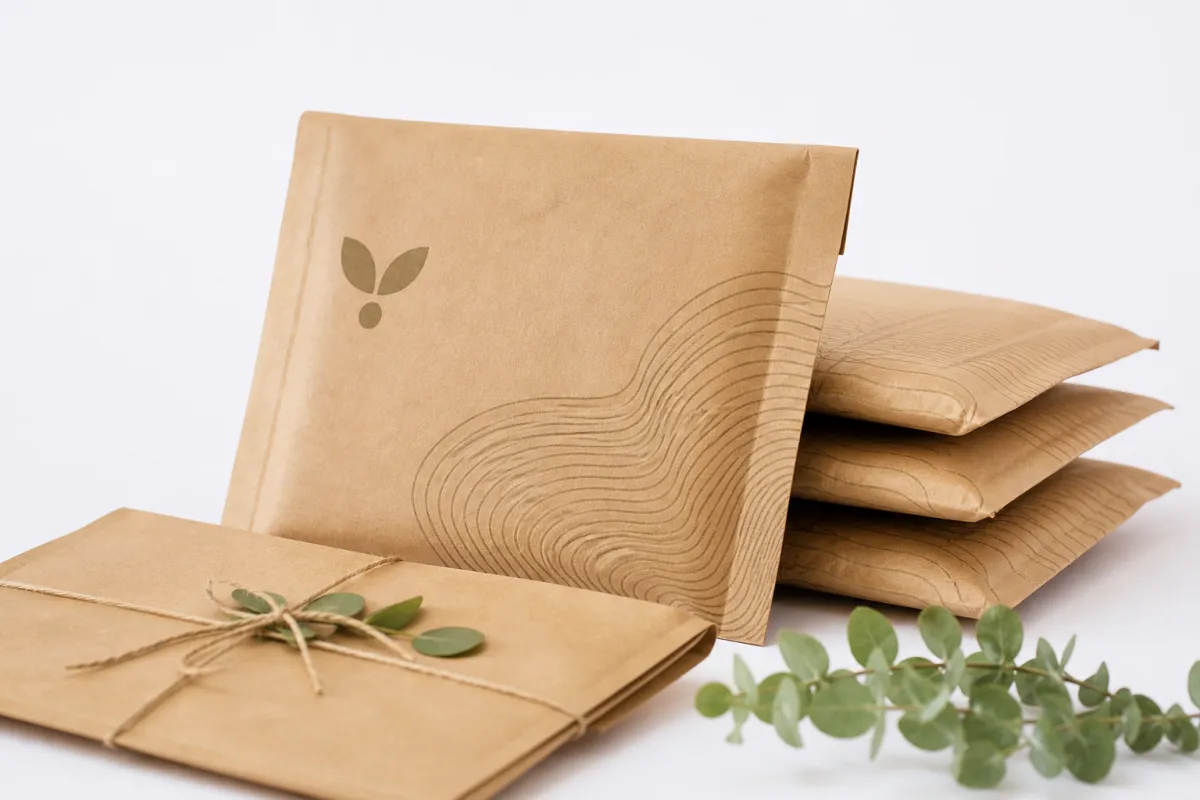
Branded Kraft Mailer bags are paper-based shipping mailers used for apparel, lightweight retail goods, subscription kits, and giftable e-commerce orders. Think of them as a paper envelope with more backbone: gussets for extra volume, a closure strip for packing speed, and enough stiffness to keep their shape instead of collapsing into a wrinkled sheet halfway through the order.
They stand out for a pretty basic reason. Plain mailers disappear into the shipment. Branded kraft mailer bags do the opposite. They turn the outside of the parcel into a small brand surface, and they make a modest order feel more considered. Few packaging choices lift presentation and perceived value this directly without making the pack-out process more complicated.
There is also a practical reason many brands keep moving toward branded kraft mailer bags: paper supports the sustainability story a lot of buyers want to tell. That does not mean every paper mailer is automatically recyclable, or that it is the right fit for every lane. Coatings, adhesives, inks, and local recycling rules all affect the result. A supplier should be able to explain those pieces clearly. If the answer gets fuzzy, that usually tells you enough.
Branded kraft mailer bags are not right for every shipment. They fit light to medium-weight items, usually folded apparel, accessories, soft goods, and compact kits. Heavy products, sharp corners, moisture-heavy routes, and rough cross-country handling may call for something tougher, such as a reinforced paper structure or one of the Custom Poly Mailers options when moisture resistance matters more than the paper look.
That tradeoff is where buyers often get tripped up. The logo panel gets all the attention, while the structure gets treated like an afterthought. Backwards. A mailer that looks polished but tears, peels open, or slows the line is not premium. It is expensive theater, plain and simple.
Branded kraft mailer bags make the most sense when the item is light, the outside should help tell the brand story, and presentation is part of the value proposition. Premium tees, beauty kits, and small gift orders are usually a strong fit. Heavy items belong in a different package, no matter how good the print looks on paper.
How branded kraft mailer bags work in fulfillment
Good packaging has to survive actual order flow, not just a neat table-top mockup. With branded kraft mailer bags, the process is usually straightforward: pick the item, fold or insert it, place it in the mailer, peel and seal, add the label, and send it out. The less friction the closure creates, the less time the team spends fighting packaging and the more time it spends filling orders.
Construction details matter more than most buyers expect. A useful branded kraft mailer bags spec usually includes a kraft outer layer, gusset depth, adhesive quality, and a tear strip or easy-open feature. Weak adhesive slows packing because staff start pressing, re-pressing, and checking seals like they are trying to launch a satellite. That is not efficiency. That is a line of people waiting on a package that should have behaved the first time.
Shipping performance comes down to compression, corner stress, and moisture. Courier systems are not gentle. Bags get stacked, dragged, dropped, and squashed against boxes with no manners whatsoever. Branded kraft mailer bags with reinforced seams and heavier paper handle that abuse better than lighter, cheaper versions. The outside can still crease, because kraft is paper and paper shows the journey. It should not split open because somebody stacked a carton on top of it.
Branding needs to work while the package is in motion too. Print placement, logo size, and contrast should stay visible from a short distance, often 3 to 6 feet away at the door or on a shelf. On kraft stock, a simple mark usually outperforms a crowded design. Branded kraft mailer bags do not need a six-color spectacle to work. One strong logo, clear spacing, and a clean layout usually read better than a packed design full of tiny claims and decorative noise.
A neat mailer does not fix a bad pack plan. It just makes the bad plan more expensive.
That is why buyers should treat branded kraft mailer bags as part of fulfillment, not just branding. If the bag slows packing by a few seconds per order, those seconds build up quickly across a month of volume. If it seals properly, labels cleanly, and protects the product without extra void fill, then you get presentation and speed in the same package.
For a practical reference on packaging design and material choices, the Packaging Institute offers useful industry context. If your team wants a better handle on transit abuse, the ISTA transport testing standards are the kind of material that separates shipping reality from polished sales copy.
Branded kraft mailer bags cost, pricing, and MOQ
Branded kraft mailer bags are priced by a handful of variables, and none of them are mysterious once you know where to look. Size, paper weight, print coverage, number of ink colors, closure style, coating, and order quantity all move the number. Quantity matters a lot. Small runs carry more setup burden per unit, which is why the per-piece cost can feel high if you only want a few hundred.
The blunt version is simple: branded kraft mailer bags in lower quantities often cost more than people expect, while higher quantities usually bring the unit price down faster. The catch is storage. Buy too many because the break points look tempting, and you end up paying for boxes of packaging that sit in a back room for months. Cheap packaging that occupies valuable square footage is not actually cheap.
Typical pricing ranges vary by spec, but buyers often see something like this at trade quantity levels:
| Option | Typical unit price | What drives the cost | Best for |
|---|---|---|---|
| Plain kraft mailer | $0.12-$0.22 | Size, paper weight, adhesive | Testing, low-budget shipping |
| One-color branded kraft mailer bags | $0.18-$0.35 | Print setup, coverage, quantity | Apparel, direct-to-consumer orders |
| Two-color branded kraft mailer bags | $0.24-$0.45 | Extra ink, tighter registration | Retail-ready presentation |
| Special finish or heavier build | $0.30-$0.60+ | Coating, reinforcement, custom features | Premium unboxing or heavier soft goods |
Those ranges are not universal. They shift with order size, freight, and how demanding the artwork becomes. They still give you a realistic buying frame. A supplier quote that ignores setup charges or shipping is not a complete quote. It is a headline dressed up as an answer.
The hidden costs are where buyers get surprised. Artwork setup, plate charges, sample fees, freight, and rush production can all change the landed cost. Branded kraft mailer bags that look inexpensive on paper can become expensive once air freight gets added because the launch date slipped by a week. That is not really a packaging problem so much as a planning problem, but the invoice still lands in packaging.
MOQ, or minimum order quantity, usually rises as the spec gets more custom. A stock-style custom run might start around 1,000 to 3,000 units, while a more tailored build can move closer to 5,000 or 10,000 units depending on the factory and print method. Smaller runs cost more per bag. Larger runs lower the unit cost but lock up cash. There is no perfect answer, only a better fit for your sales pace and storage space.
The cleanest way to compare quotes is to ask for two or three quantities, not one. That shows where the price break actually lands. Often, the jump from 3,000 to 5,000 units tells you more than the jump from 5,000 to 10,000, because it shows whether the lower price is worth the extra inventory risk. Branded kraft mailer bags should be bought like any other production item: with numbers, not guesswork.
If your team needs examples of how buyers balanced cost against presentation, the Case Studies page is a useful place to see what different packaging choices can look like in real production runs.
Production steps and lead time for branded kraft mailer bags
Most delays in branded kraft mailer bags happen before the machine starts printing. The production path is usually short, but there are enough moving pieces to cause trouble if one of them gets sloppy: sizing, artwork review, proofing, sampling if needed, printing, converting, packing, and shipping. That sounds linear, but one weak step can drag the whole order down.
The most common bottleneck is artwork. Low-resolution logos, missing dielines, unclear Pantone targets, and last-minute copy changes cause more pain than people like to admit. A supplier can only print what it can interpret. If the logo file is fuzzy and the color reference is vague, the factory ends up guessing. Guessing is not a production strategy. It is a refund waiting to happen.
Simple branded kraft mailer bags orders often move faster than fully bespoke versions. A stock-based build with one-color print and standard adhesive can sometimes turn around in about 12 to 18 business days after proof approval, then ship by freight depending on the destination. Custom sizes, special inks, and extra finishing can stretch the schedule. If somebody promises a complex custom order in a suspiciously short window, ask what they are leaving out.
Lead time also includes the parts buyers forget to count. Proof review may take a day. Sample approval may take another day or two. Freight can add a week or more depending on the lane. So yes, the factory might finish production in two weeks, and the bags may still not reach the shelf for three. That is normal. Annoying, but normal.
Branded kraft mailer bags need buffer time because the consequences of delay are ugly. If they miss a seasonal launch, a holiday drop, or a retail event, the brand pays twice: once for rush freight, and again for the missed presentation opportunity. It is far cheaper to pad the schedule by a few days than to pay for emergency shipping and a stressed operations team.
Sampling deserves real attention before any commitment. A sample lets you check size, seal feel, print clarity, and product fit in the real world. That is why brands with tighter quality control often review a prototype or working sample before a larger order. It also helps to compare related packaging formats through our Custom Poly Mailers page, just to see what each structure does in transit.
Branded kraft mailer bags should also be checked against practical shipping standards. If a supplier claims strong transit performance, ask what tests they use. Good partners can speak to burst resistance, drop tests, and conditioning, or at least explain why their build suits the route. The details matter more than a cheerful brochure. If the bags are made from responsibly sourced fiber, ask for chain-of-custody paperwork or FSC documentation through FSC certification guidance. That is a straightforward trust check, not a ceremonial one.
How to choose size, strength, and print specs
The smartest way to spec branded kraft mailer bags starts with the product, not the package. Measure the item flat, add room for tissue, inserts, or a return card, and then check how much extra width you need for easy packing. A bag that is too tight crushes the presentation. A bag that is too loose wastes material and makes the shipment look sloppy.
Size choice should reflect how your team actually packs. If a folded sweatshirt fits on paper but the operator has to force it in every time, that is the wrong size. If a smaller bag only works on the best day, with perfect folding and no insert, that is the wrong size too. Branded kraft mailer bags should pack comfortably without leaving so much empty space that the mailer bulges into a lumpy rectangle.
Strength comes from several layers of boring details, and boring is exactly what you want here. Paper weight, gusset design, seam reinforcement, and adhesive quality all matter. For light apparel, a well-built kraft structure can be enough. For bulkier soft goods with zippers, snaps, or sharp corners, step up the paper weight or add reinforcement where the stress lands. Sometimes the difference between a good run and a rejected one has nothing to do with the logo. It is whether the seam holds after the bag gets flexed ten times in transit.
Print specs are where buyers tend to overcomplicate things. On kraft stock, contrast does a lot of the heavy lifting. A strong one-color logo, a clean typeface, and enough white space often read better than a crowded design full of tiny taglines and decorative marks. That is one reason branded kraft mailer bags usually look better with restraint. Kraft paper has texture. It already brings visual interest. You do not need to force more onto it.
If your design depends on color accuracy, ask for a proof and stay realistic about how paper absorbs ink. Dark lines can soften. Fine details can disappear. Metallic or glossy effects may need a different process and a different cost structure. There is no free trick here. The print method has a ceiling, and the material does not care about the mood board.
Sustainability claims deserve discipline too. If the bag is recyclable, say so only if that claim is supportable in the target market and by the actual construction. If it contains recycled fiber, say how much and what kind, if the supplier can document it. Vague green language has become background noise. Buyers notice. So do retailers and regulators.
Branded kraft mailer bags should be chosen with the product, route, and brand story in mind. If one bag has to cover three radically different SKUs, odds are high that at least one of them is being forced into the wrong spec. Better to test the hero item first and build outward from there.
Common mistakes when ordering branded kraft mailer bags
The biggest mistake is buying on unit price alone. Cheap branded kraft mailer bags can get expensive fast if they tear, print badly, or arrive late. A low quote does not help if you have to reorder, rework, or rush ship replacements. That is how a savings decision turns into a line item nobody wants to explain in a meeting.
Another common error is weak artwork prep. Tiny logos, low contrast, and overdesigned graphics often look muddy on kraft surfaces. If the logo depends on delicate gradients or thin lines, simplify it for the mailer. The package is not a billboard on a freeway. It is a handheld shipping surface viewed briefly, sometimes under bad light, often while the customer is carrying groceries or standing at the door.
People also forget the warehouse side. A beautiful mailer that sticks too aggressively, tears at the seam, or slows packing is a real operational cost. Branded kraft mailer bags should support the team, not become another reason for a supervisor to walk the line with a grim face and a clipboard. Speed matters. Consistency does too.
Shipping route is another place where assumptions go bad. A light paper mailer may work well for dry local delivery and turn into a poor choice for rough long-haul routes, humid climates, or products with sharper edges. That does not make the format bad. It just means the route is different. Packaging should be chosen for the actual lane, not the idealized one.
A one-size-fits-all approach is usually lazy. One product line often needs a different bag than another, even inside the same brand. A slim tee and a boxed accessory do not behave the same way. If you force one spec to cover both, one of them loses. Often both do.
Good packaging is the one that disappears into the process until the customer notices it for the right reasons.
That is the real test for branded kraft mailer bags: they should protect, seal, print, and ship without drama. If they need constant babysitting, they are too fragile, too awkward, or too ambitious for the job.
Expert tips and next steps for branded kraft mailer bags
Order samples in the exact size and finish you plan to use, then test them with real products. Not empty air. Not a folded napkin. Real product, real insert, real closure. That is the only way to learn whether branded kraft mailer bags fit the way the spec sheet claims.
Compare two print directions before you commit. One can be a clean logo-led layout. The other can use a more patterned brand treatment. Put both in front of the team and ask which one reads better in hand and from a short distance. That conversation usually reveals more than a week of speculation. It also keeps the final design from becoming a committee souvenir.
Ask for quotes at multiple quantities, and make the supplier include freight. A landed cost that includes setup, packaging, shipping, and any rush fees gives you a real buying picture. If the unit cost looks good but the freight is ugly, you have not saved money. You have hidden the bill in a different column.
Build a simple internal checklist before placing the order. Size verified. Artwork approved. Timeline confirmed. Storage space cleared. Backup plan for a sample failure. That checklist is boring, which is exactly why it works. Branded kraft mailer bags fail most often because one boring detail gets missed, not because the branding concept was wrong.
Use standards and documentation to keep the process honest. If your team needs to verify print quality, order one extra sample and inspect it under the same lighting you use in fulfillment. If the route is rough, ask about ship testing. If the fiber story matters, ask for FSC documentation. If the seller starts talking in broad marketing language instead of specifics, press for details. That part can feel a little tedious, sure, but it saves real money later.
Here is the practical path forward:
- Choose one hero product and measure it properly.
- Pick a bag size with enough room for easy packing and a clean seal.
- Request a sample of branded kraft mailer bags in the exact print style you want.
- Test the sample on the packing line and in transit.
- Review price at two or three quantities before placing the order.
- Build a lead-time buffer so launch dates are not held hostage by freight.
Do that, and branded kraft mailer bags become a useful packaging asset instead of a decorative problem. That is the real goal: clean presentation, predictable production, and a bag that holds up long enough to make the customer feel the brand before the product even comes out.
Are branded kraft mailer bags better than poly mailers for apparel?
They usually feel more premium at first touch, and they fit brands that want a paper-based look and a cleaner unboxing. Poly mailers still have the edge for moisture resistance and rough shipping lanes. For apparel, the better choice depends on route, product finish, and how much presentation matters.
What size should I order for branded kraft mailer bags?
Measure the product flat, then add room for tissue, inserts, or a return card. Do not squeeze the item into a tight fit, because that hurts presentation and seal quality. If you ship several SKUs, test the best-selling one first and then expand the size range from there.
How much do branded kraft mailer bags usually cost?
Price depends on size, paper weight, print coverage, closure style, and quantity. Smaller runs usually cost more per unit, while larger runs drop the price faster. Ask for quotes that include setup, freight, and any rush charges so you can see the real landed cost.
What artwork works best on branded kraft mailer bags?
Simple logos with strong contrast usually print best on kraft stock. Thin lines, tiny text, and busy gradients can disappear or look muddy. If the logo is detailed or color-sensitive, request a print proof before production.
How long does it take to produce branded kraft mailer bags?
Lead time depends on whether the bag is stock-based, fully custom, or finished with special print effects. Artwork approval, sampling, production, and freight all affect the timeline. Build in a buffer so the bags arrive before launch, not during it.
If you want branded kraft mailer bags that actually help the business, keep the brief simple, the spec honest, and the timeline realistic. That is how you get a package that looks good, packs well, and does not turn into a problem the minute the orders start shipping.


