Mailing Address Labels Personalized: Buy the Right Fit
Plain address labels do the job. They also slow people down, invite handwriting errors, and make a package look like it was assembled in a hurry. Mailing Address Labels Personalized fix that without turning a simple shipping task into a branding exercise. The practical benefit is boring in the best way: faster prep, fewer misreads, and a cleaner first impression when the package lands.
That matters whether you are mailing invoices, sending return packages, shipping wholesale cartons, or slipping branded inserts into Custom Labels & Tags orders. A good label is not just a logo and an address. It is a small production tool. It keeps outgoing mail consistent, reduces reprints, and makes the packing bench easier to run.
A return address that is easy to read is not decoration. It is a control point. If the label is hard to scan, easy to peel, or cluttered with too much design, the problem shows up downstream.
Personalized does not have to mean loud. It can be a logo, a return address in the right place, a QR code for customer support, a color band that matches your mailers, or just a clean type treatment that feels intentional. The best labels usually look ordinary in the right way: readable, reliable, and hard to mess up.
Why personalized mailing labels matter more than they look
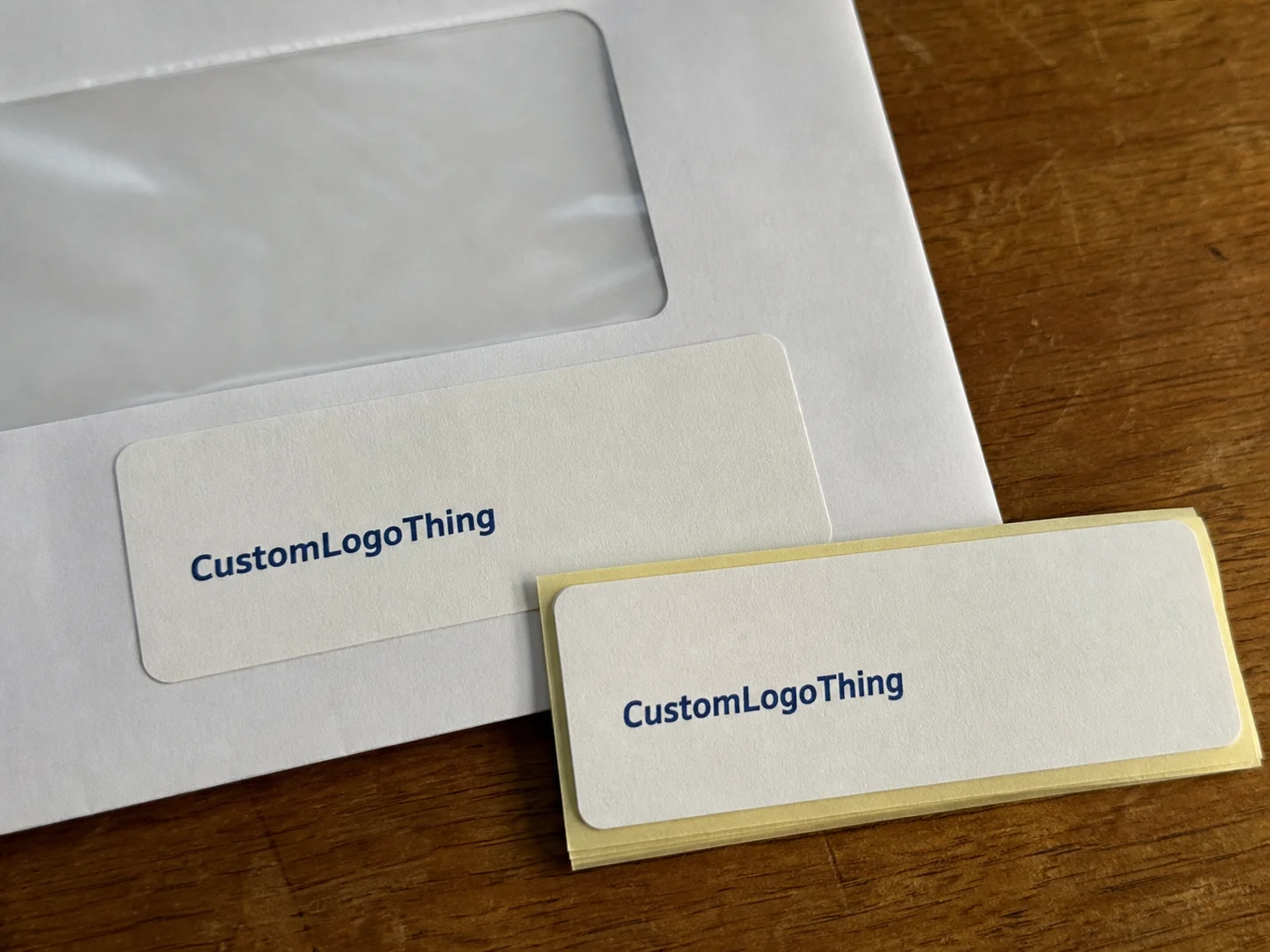
Most buyers start with appearance and end up caring about workflow. That is normal. A neat label looks better, yes, but the real value shows up on a busy packing table. It saves staff from handwriting addresses, cuts down on corrections, and helps packages move through the system without second-guessing.
Here is where these labels actually show up:
- Outgoing mail for invoices, samples, and customer correspondence.
- Package returns where the return address needs to be readable at a glance.
- Wholesale shipments that need the same brand look across cartons and envelopes.
- Branded inserts that sit beside apparel tags, care cards, and thank-you notes.
For smaller brands, the unit cost is usually modest compared with the time saved. A label that costs a few cents but prevents a mis-ship or a messy correction is doing its job. That matters most when order volume jumps around and your team needs a repeatable system instead of one-off fixes.
There is another practical benefit that often gets missed. Personalized labels reduce ambiguity. If the return address, order number, and support contact always follow the same format, customer service has less trouble tracing parcels. The back office feels that immediately, and so does the customer.
Brand consistency matters too. If your outer mailers are minimal and the label looks like it came from a different vendor entirely, the package feels stitched together. Pairing address labels with Custom Poly Mailers helps keep the shipment coherent from shipping to unboxing.
How mailing address labels personalized are made and applied
The workflow is simple, but the details matter. It starts with artwork setup. Someone checks the address format, logo placement, type size, bleed, and any variable details like department names or QR codes. Then a proof gets created. After approval, the labels are printed, cut or slit depending on the format, inspected, packed, and shipped.
Material choice changes how the label performs. Paper labels are the common low-cost option for office use and short-run mailing. They work well on envelopes and clean indoor packaging, but they are not the right choice if the label may rub against rough surfaces or pick up moisture. A weather-resistant film costs more, but it holds up better on shipping cartons, poly mailers, and parcels that see friction or damp handling.
| Format | Best For | Typical Price Range | Notes |
|---|---|---|---|
| Paper sheet labels | Office mailing, envelopes, short runs | $0.03-$0.08 per label at larger quantities | Easy to store, easy to apply by hand, good for laser printers |
| Roll labels | Faster application, higher-volume fulfillment | $0.04-$0.12 per label depending on stock and print coverage | Better for dispensers and semi-automated workflows |
| Film labels | Moisture, scuff resistance, shipping cartons | $0.06-$0.15 per label | Usually worth it when reprints or damage are expensive |
| Removable adhesive | Temporary use, internal routing, sample packs | Slightly higher than standard paper labels | Useful when labels need to come off cleanly |
Sheet labels make sense for small offices and desk-based operations. Roll labels are usually the better fit once labels are being applied constantly. If you print in-house, compatibility matters just as much as format. Laser printers, inkjet printers, thermal printers, and dispensers all have different tolerances. A label that feeds perfectly in a thermal setup can become a headache in a desktop laser printer, and the other way around.
Finish affects readability, not just appearance. Matte stock reduces glare and usually makes text easier to read. Gloss can make logos pop, but it may reflect light under scanners or warehouse lighting. If you want a label that looks sharp and still behaves properly, test the stock, adhesive, and printer type before ordering a full run.
For labels that will face rough handling or mixed shipping conditions, it helps to compare your spec against common transit abuse. ISTA standards are useful here, not because a return address label needs lab-level testing, but because they remind you what actually happens to a parcel in transit. A label that fails after a damp dock or a long conveyor ride is cheap only on paper.
Mailing address labels personalized: cost, pricing, and MOQ basics
Pricing usually comes down to five things: quantity, material, size, print colors, and finishing. Add adhesive type and complexity, and the quote moves quickly. A single-color paper label in a standard size is usually the cheapest path. Add full-color branding, specialty film, or a custom cut, and the price climbs. That is normal print production, not a mystery.
Small runs cost more per label because setup gets spread over fewer pieces. Larger runs bring the unit cost down, sometimes sharply. A 500-piece order may carry a setup cost that feels annoying in isolation, while a 5,000-piece order often looks much better on a per-label basis. Setup charges for custom label work commonly land around $25-$75, though complex artwork or specialty tooling can run higher.
For a realistic buying range, expect simple short-run labels to land somewhere around $40-$120 for a few hundred pieces, depending on size and print coverage. Higher-volume runs in standard materials can bring unit pricing well below ten cents each. If a quote looks strangely cheap, check what is missing. Proofing, shipping, die charges, and reprint policy can change the real number fast.
Compare the full quote, not just the unit price. Ask whether it includes:
- Digital proofing
- Bleed setup and file checks
- Standard shipping
- Reprint policy for defects
- Any plate or die charges
If one vendor is a few cents lower but charges extra for proofing and freight, the deal may not be a deal. That gets worse on low-volume orders, where fixed charges hit harder. Buyers who only compare unit price often end up paying more for the privilege of a cheap quote.
Material sourcing can matter too. If you want paper stock with responsible forestry documentation, FSC certification gives you a clear chain-of-custody framework. Not every order needs certified stock, but some brands and retailers require it. It is easier to ask early than to rebuild the spec later.
Production steps and timeline for a typical order
A normal order follows a familiar path. You Request a Quote, submit artwork, receive a proof, approve it, and then production starts. After that comes printing, finishing, inspection, packing, and shipping. The longest part is usually not the press. It is approval.
Delays almost always come from missing information. Common culprits include low-resolution logos, font substitution issues, inconsistent address formats, and changes after proof sign-off. If you move the target after approval, the schedule moves too. That is not a vendor problem. That is workflow.
Typical timing looks like this:
- Simple standard order: often 5-7 business days after proof approval.
- Custom size or finish: often 8-12 business days after approval.
- Larger or more complex order: often 12-15 business days, sometimes longer if specialty stock is involved.
Rush service helps only if the files are ready. If the design needs cleanup, the clock starts later than you expect. That is where people waste time. They ask for a rush, then send a logo pulled from a website header. That is not a print-ready file. It is a future problem.
Planning matters more once labels are tied to a launch, a seasonal drop, or a wholesale shipment. If your boxes, inserts, and Custom Labels & Tags all need to land together, build in buffer time for proofing and freight. A three-day delay on the label can become a shipping delay on the whole order if nobody planned around it.
When packaging needs extra handling strength or distribution testing, it is worth looking at the wider shipping environment too. Internal carton labels, parcel labels, and outer mailers all behave differently under pressure. You do not need overkill, but you do need a format that survives the route it will actually travel.
Design details that affect readability and brand impact
Address labels live or die on readability. Brand styling comes second. That sounds plain until the first misrouted parcel lands back on your desk. Use type that stays clear at small sizes, keep the address block clean, and leave enough white space so the eye knows where to stop.
Use contrast like you mean it. Dark text on a light field is still the safest choice because it prints cleanly and scans well. Light gray on beige may look refined on screen and useless on a box. Trendy colors are fine as accents, but they should not reduce legibility.
A few practical rules help a lot:
- Keep the return address small, but still readable, usually no smaller than 6 pt for dense layouts.
- Give the recipient address priority and avoid crowding it with logos or slogans.
- Place barcodes and QR codes away from edges and folds so they do not get cut off or damaged.
- Match the label format to the use case, not the mood board.
Typography matters more than most teams want to admit. Serif fonts can work if they are sturdy and not delicate. Sans serif usually reads better at small sizes. If the label will be used by multiple people, pick a layout that does not require design judgment every time someone prints one. Consistency beats cleverness.
Brand consistency should extend across the whole package. If the shipping mailer, insert card, and address label feel like separate projects, the customer notices. The package still functions, but it loses polish. Matching your labels with Custom Poly Mailers and related packaging materials helps the order feel planned instead of patched together.
If your operation uses variable data, leave room for it. Apartment numbers, suite lines, care instructions, tracking references, and contact details all compete for space. A label that looks elegant with one line of text can fall apart the moment a second line gets added. Design for the messy version first.
Common mistakes when ordering personalized address labels
The biggest mistakes are usually avoidable. Low-resolution files sit near the top of the list. If the logo is fuzzy in the proof, it will not magically sharpen in production. The next common issue is ignoring bleed or trim. Designs that sit too close to the edge can lose type or look cramped after finishing.
Wrong adhesive choice causes more pain than people expect. A removable adhesive on a shipping carton may fail too early. A permanent adhesive on a sample pack may be annoying to remove. That is why the substrate matters. Smooth envelope paper, kraft mailers, coated cartons, and poly surfaces all behave differently.
Proofing errors are another classic. Misspelled street names, missing apartment numbers, outdated ZIP codes, and old return addresses still show up in real orders. The printer cannot fix bad source data. Someone has to catch it before approval. That person should probably not be the intern who is also answering the phone.
Ordering by unit price alone is how buyers end up with labels that jam printers, peel at the corners, or arrive with poor registration. Cheap material can cost more in labor and reorders than a slightly better spec ever would. If the label touches real production, treat it like production.
One more mistake deserves a hard warning: skipping sample approval on anything with small text, brand color matching, or variable data. A digital proof is not the same as an actual printed sample. A proof tells you layout. A sample tells you what the label really does on the stock you chose.
Expert tips for ordering labels that actually work
If the labels will face moisture, friction, or repeated handling, order a small test run first. That is especially smart for labels going on poly mailers, parcel boxes, or products that move through several hands before reaching the customer. A fifty-piece test is cheap insurance compared with replacing a thousand units.
Standardize your sizes wherever you can. One size for outgoing mail, one for returns, maybe one for internal routing. Beyond that, the workflow starts to get messy. Inventory gets harder to track, and the packing station turns into a small museum of almost identical rolls.
Ask for substrate and adhesive recommendations based on the actual surface. Smooth paper envelopes do not need the same label as textured kraft stock. Cold storage, humid warehouses, and fast-moving fulfillment lines all change the decision. Good vendors should ask about application method, storage conditions, and ship-out timing before they recommend a material.
A simple buyer checklist helps keep orders sane:
- Final address copy
- Logo file in vector format if possible
- Label size target
- Quantity range
- Application method: hand, dispenser, or printer
- Ship date target
- Surface type and storage conditions
That checklist sounds basic because it is. Basic is good. Basic is what keeps packaging from becoming a series of preventable calls about why the labels do not fit the envelope, the barcode does not scan, or the adhesive fails on the first carton.
If your brand already has a visual system, keep the label inside it. Same type family if possible. Same color logic. Same tone. You do not need the address label to be the star. You need it to support the package without fighting it.
Next steps: choose a format, request a quote, and confirm your proof
Start by deciding what you actually need: sheet labels for office work, roll labels for higher-volume application, or a printer-compatible format for in-house use. That decision changes the quote more than people expect. Then gather the exact copy, logo files, size target, and quantity range before asking for pricing.
Compare two or three quotes on the same spec. If the size, adhesive, Finish, and Proofing terms are not the same, the prices are not the same. Ask for a digital proof and confirm the turnaround before approving anything. Guessing is not a production strategy. It is how deadlines get expensive.
If the labels are part of a larger packaging order, keep the whole system aligned. The label should work with your mailers, inserts, and shipping materials, not fight them. That is where a good order feels intentional instead of pieced together from whatever was easiest to buy that week.
For buyers who want a complete packaging setup, pairing address labels with Custom Poly Mailers and Custom Labels & Tags keeps branding and handling consistent across the shipment. The final step is simple: choose the format, verify the proof, and leave enough buffer for printing and shipping so the order arrives before the labels run out. That is the practical way to buy mailing Address Labels Personalized without paying for avoidable mistakes.
FAQs
Are mailing address labels personalized worth it for small orders?
Yes, if you want faster packing, cleaner presentation, and fewer address mistakes. Small runs usually cost more per label, but they make sense when brand consistency matters more than bare-minimum pricing.
What size should personalized mailing address labels be?
Choose the size based on how much text you need and whether the label must fit on envelopes, mailers, or shipping boxes. Leave enough white space so the address stays readable and the label does not look cramped.
What affects the price of mailing address labels personalized the most?
Quantity is the biggest driver, followed by material, finish, label size, and number of print colors. Setup, proofing, and shipping can also change the total cost, so compare the full quote, not just unit price.
How long does production usually take for personalized address labels?
Simple orders can move quickly once artwork is approved, but custom specs or changes after proofing add time. The safest approach is to confirm turnaround before ordering and build in buffer time for shipping.
Can personalized mailing labels match other clothing label packaging?
Yes, and they should if you want the package to feel consistent across shipping, inserts, and branding. Match type style, color palette, and logo treatment so the whole order feels intentional instead of stitched together.