Buyer Fit Snapshot
| Best fit | Mailing Bags Bulk Order projects where brand print, material claims, artwork control, MOQ, and repeat-order consistency need to be specified before quoting. |
|---|---|
| Quote inputs | Share finished size, material target, print colors, finish, packing count, annual reorder estimate, ship-to region, and any compliance wording. |
| Proofing check | Approve dieline scale, logo placement, barcode or warning zones, color tolerance, closure strength, and carton packing before bulk production. |
| Main risk | Vague material claims, crowded artwork, missing packing details, or unclear freight terms can make a low unit price expensive after revisions. |
Fast answer: Mailing Bags Bulk Order: Pricing, Specs, and Process should be specified like a repeatable production item. The safest quote records material, print method, finish, artwork proof, packing count, and reorder notes in one written spec.
Production checks before approval
Compare the actual filled-product size with the drawing, then confirm tolerance on folds, seals, hang holes, label areas, and retail display edges. Reserve space for logos, QR codes, warning copy, and material claims before decorative graphics fill the panel.
Quote comparison points
Review material grade, print process, finish, sampling route, tooling charges, carton quantity, and freight assumptions side by side. A quote is only useful when the supplier can repeat the same color, closure quality, and packing count on the next order.
Mailing Bags Bulk Order: Pricing, Specs, and Process The bag price is rarely the biggest number on a shipping spreadsheet. A weak seal, a bag that runs small by half an inch, or one bad production lot can wipe out savings in a week. A Mailing Bags Bulk order is really a control decision disguised as a procurement task: it affects shipping cost, damage rates, warehouse speed, and how your brand shows up in a customer’s hands.
I learned that the hard way during a packaging review for a mid-sized apparel brand. The lowest quote looked smart on paper, but the team spent the next month taping split seams and reworking oversized returns. The unit savings were real; the total savings were not. That gap is where a lot of buyers get tripped up, and honestly, it is the part most quote sheets gloss over.
Mailing Bags Bulk Order: Why Bulk Buying Pays Off
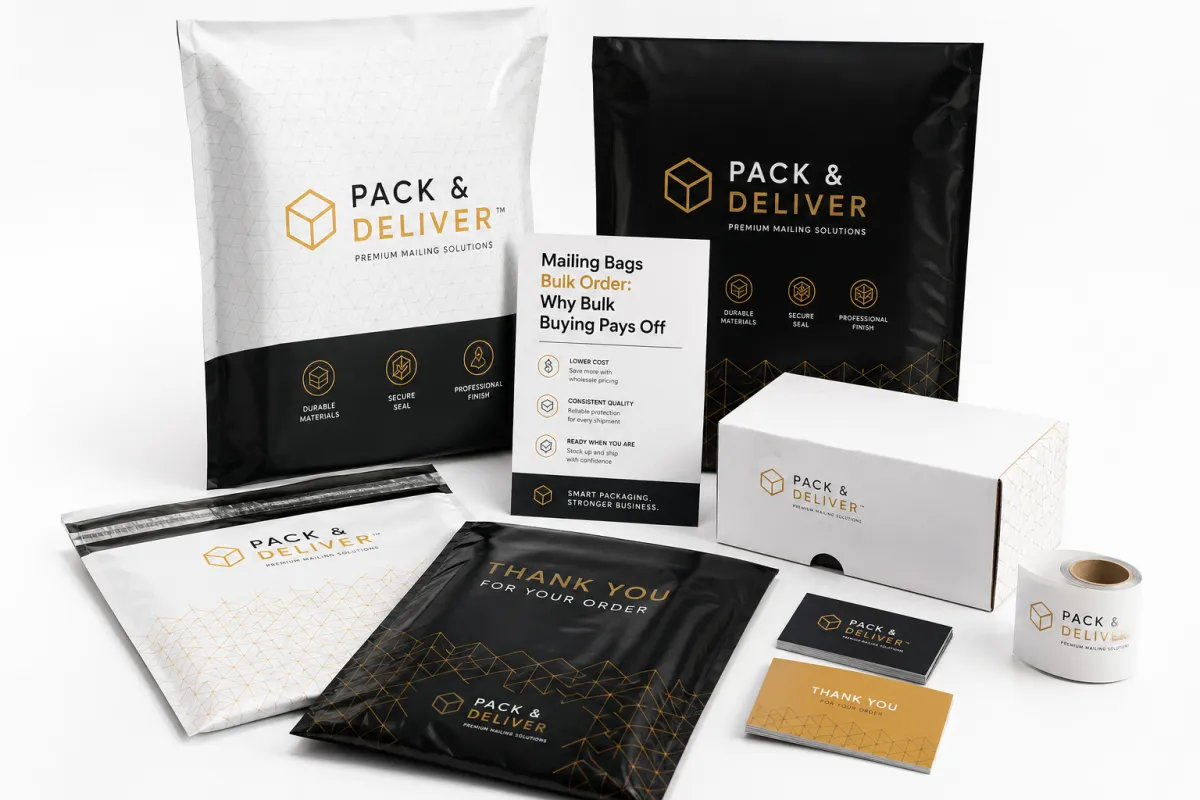
If you ship at volume, the blunt answer is simple. The main benefit of a mailing Bags Bulk Order is not only a lower unit price. It is the stability that comes from one specification holding steady across hundreds or thousands of shipments. A consistent bag size, a reliable seal line, and print that lands where it should mean your fulfillment team spends less time improvising and more time moving orders out the door.
Hidden costs are where margin leaks
Take a hard number. Say you place an order for 8,000 mailing bags and choose the lowest quote because it is $0.04 cheaper per bag. On paper, that looks tidy. Then the seal fails on 1.2% of shipments and customers start reporting opened mailers. That is 96 replacements. At $6.50 in average re-ship and handling cost, the unit savings disappear fast. A mailing Bags Bulk Order lives or dies on failure prevention, not price alone.
Size errors create a second drain. Too-small mailers force extra tape, repacking, and rework. Too-large mailers raise dimensional shipping costs because carriers bill by size, not by how optimistic your pack plan looked in procurement. The extra spend hides in labor, delays, and wasted space long before it shows up as a line item.
People confuse “cheaper per bag” with “cheaper total cost” all the time. Those are different questions. A disciplined mailing bags bulk order separates material cost from failure cost, and that distinction changes the buying decision.
Volume stabilizes fulfillment and cuts overhead
Steady brands benefit from repetition. Reordering the same spec every quarter means the team does not have to relearn bag feel, print orientation, or seal settings every time a shipment arrives. Less variation means fewer training hours, fewer packing mistakes, and fewer awkward questions about which version was approved.
A mature mailing program usually pays off in four ways: lower unit cost, predictable branding, fewer stockouts, and cleaner handoffs between design, QA, and fulfillment. For subscription kits, seasonal launches, and DTC replenishment products, that predictability often matters more than a few cents of quote difference.
“A good mailing bags bulk order is not the loudest purchase in the room. It is the one that keeps your team from reaching for tape, extra padding, and emergency reorder emails.”
The mistake that keeps happening
Price-only buying is how people end up with the wrong seal strength, the wrong film thickness, and the wrong weight class. Bags fail at the point where the order is already packed and the carrier is already in motion. That failure is expensive precisely because it arrives late.
A mailing bags bulk order should be treated as a quality decision. Match bag strength to product weight and the handling path it will face. If you guess wrong, the warehouse tells you quickly. I have seen a line supervisor spot the issue in ten minutes because the adhesive edge started curling under warm room conditions. That kind of feedback is worth more than a polished product photo.
Mailing Bags Bulk Order Product Details and Material Options
Poly film gets treated like a commodity, but the details matter. A mailing bags bulk order is a technical spec hidden inside a plain-looking pouch. The right choice depends on film grade, closure type, print setup, and surface finish, not just the image on a sales page.
Core mailer formats and what to use
Plain mailers are the baseline when branding can happen through a label, insert card, or invoice insert. They usually cost less and work well when the product or insert already carries the brand voice.
Printed mailers create recognition before the package is opened. They cost more, and that extra spend makes sense for brands that want the outer package to do part of the selling.
Tamper-evident seals are practical for gift lines, accessories, and retail return programs. They are not decorative. They reduce loss and show whether a package has been opened.
Opaque finishes suit premium or branded goods better than clear film in many cases. Clear film can expose contents, create visual clutter, and make photography look messy. Semi-opaque and matte options reduce glare and protect the appearance of the product inside.
Handles and double adhesive strips help with heavier soft goods. A garment bag that gets pulled, stacked, and shifted through warehouse flow needs stronger closure points than a lightweight accessory pouch. Double strips are not mandatory for every run, but they belong in the conversation whenever rough handling is part of the route.
Material choices in real terms
Low-density polyethylene (LDPE) single-layer film is simple, flexible, and economical. It performs well for lightweight garments and easy-shipping accessories.
Co-extruded film adds structure and usually improves puncture resistance and corner durability. It is the better fit for heavier items or odd shapes that press against the corners of the bag.
The rule of thumb is practical rather than fancy. Short-haul and lightweight shipments often do well with LDPE. Long transport lanes, multiple transfer points, or frequent stacking usually justify co-extruded film. That tradeoff is one of those boring decisions that saves money later, which is kinda the point.
Recycled content and sustainability claims
Recycled content helps, but it needs evidence. Suppliers may offer options such as 30%, 50%, or even 100% post-consumer recycled film, depending on performance requirements and their material stack. A mailing bags bulk order can go wrong here if “recycled” is treated as a marketing label rather than a technical choice. Ask for a material declaration and test data for tensile strength and seal consistency before approving a large run.
Recycled film can lower environmental impact without making the bag unusable. It is not identical to virgin film in every mechanical property, so performance specs still matter. If a supplier references FSC, ask what part of the packaging the certification actually covers. FSC generally applies to fiber-based components such as cartons or inserts, not plastic film itself. Check the certification path at FSC standards documentation and get the claim in writing before you commit to volume.
Claims should be precise. If a film is described as compostable, recyclable, or responsibly sourced, the proof should match the wording. Packaging language travels fast, and the wrong claim can become a costly problem later.
Use cases that actually work
Apparel and soft goods often perform best in wider gusseted mailers with moderate gauge and dependable flap closure. For lighter tees and accessories, 60-80 µm is a practical starting range.
Subscription kits often carry fragrance, sample packs, and small tools. They need extra depth for insert cards and enough slack to stop items from bunching together inside the bag.
Returns and reverse logistics benefit from reinforced lower seams and stronger seals. If customers are expected to open and reseal the package, adhesive performance matters more than a pretty finish.
Need a practical starting point? Review Custom Poly Mailers for proven film profiles, then move into custom variants once the fit is confirmed. That keeps a mailing bags bulk order anchored in real product behavior instead of guesswork.
Sizes, Thickness, and Printing Specs for Mailing Bags Bulk Order
Many buyers stop at width x height from a supplier PDF. That misses the part that breaks fulfillment. A mailing bags bulk order that ignores inserts, folded thickness, and seal placement can look right on paper and still fail at the packing bench.
Picking size without guessing
Start with the largest packed dimension: product length, width, and height once packaging is included. Then add room for real packing conditions:
- +15 to +30 mm for flexible soft goods that compress.
- +30 to +60 mm if bubble wrap, tissue, or a branded card is part of the pack.
- +40 to +70 mm if the item includes a zipper pull or other sharp protrusion.
This is not a formula to memorize. It is a way to avoid two common failures: bags that burst when they are closed and bags so oversized that carriers charge for unused air.
Return slips, invoice inserts, and one layer of tissue all add bulk. A mailing bags bulk order based on bare product size alone usually creates overfilling errors and urgent replacements.
Thickness and film gauge by risk, not fashion
Thickness is often sold as “light” or “heavy,” which is nearly useless unless it is tied to risk. The point is not prestige. The point is whether the bag survives your route.
Light garments, soft home goods, and smaller boxed accessories often work in 60-70 µm films.
Heavier garments, padded inserts, and longer transit routes usually need 80-100 µm.
Bulky or rough-handled products, especially those exposed to puncture, often justify 100-120 µm or an equivalent structural upgrade. Heavier film is not automatically better. It raises cost and can slow folding and packing. Over-specifying quietly drains budget.
For higher-risk lines, ask for puncture and tear resistance targets in writing. Many vendors talk about strength without giving numbers. Request a tear test standard and sample pass/fail criteria based on actual product simulation.
Printing specs that stay readable in real life
One-color printing is often the most efficient option for a mailing bags bulk order. If the design only needs a logo and a line of text, one color can cut plate costs and shorten approvals.
Four-color printing supports richer branded campaigns. It costs more and usually takes longer, but it becomes worthwhile when exact color match matters to the brand.
Ask for:
- Bleed: usually 3 mm minimum around graphics.
- Safe zones: keep text at least 8-10 mm away from edge seals and adhesive strips.
- Print count: one-sided print is faster and lower risk, while multi-side print improves shelf presence once quality is stable.
Color matching on film is less forgiving than on paper. Matte surfaces can mute the image, glossy finishes can blow out highlights, and black ink on thin film can visually crowd the seam area. If brand color has to be exact, approve digital and physical proofs before the full run starts. That boring step saves real money.
Performance specs that actually matter in fulfillment
Use concrete terms when talking to a vendor:
- Peel strength and seal consistency at the chosen temperature range.
- Puncture resistance for expected corners and edges.
- Tear resistance for repeated folding and conveyor handling.
- Opacity and print contrast for scan visibility.
- Machine compatibility if the line uses auto-sealers or bagging equipment.
If your packing line is automated, confirm minimum heat seal width and pressure tolerance. A production lot should never double as the experiment that tells you whether the machine settings were wrong.
Carrier routing matters too. Urban sorting, multiple drop points, and transfer-heavy lanes call for more closure confidence than a short local run. A mailing bags bulk order should reflect the route, not just the warehouse.
Barcode windows, warning text, tear strips, and return instructions all work, but they need space. Keep them away from the seal area. A barcode half-covered by adhesive can trigger sorting problems in larger fulfillment systems.
Reference standards for stress tests
Suppliers that can map specs to recognized test logic are easier to trust. For transit-like durability and handling behavior, many teams compare against ISTA handling protocols and relevant EPA packaging recycling guidance on material claims. That is practical risk control, not decoration.
Mailing Bags Bulk Order Pricing, MOQ, and Cost Breakdown
Cost conversations get emotional quickly. A mailing bags bulk order sounds straightforward because people expect one line item. In practice, unit price is only one part of the bill, and often not the part that matters most once setup is fixed.
How pricing is built
Most quotes break into four cost buckets:
- Production material (film, lamination, adhesive).
- Print setup (plates, color separations, prepress work).
- Special handling (die cuts, windows, embossing, anti-static layers).
- Freight and packaging logistics (cartons, pallet count, destination rules).
A small spec change can move landed cost more than a large unit discount if setup and freight are not considered. A 2% shift in bag spec can be more expensive than a 10% quote difference from another supplier.
Minimum order quantity reality
MOQ feels harsh because it is tied to tooling setup, waste control, and proofing. Those steps require a minimum volume to remain commercially sensible. Plain stock mailers usually carry lower MOQs. Custom prints and custom film usually push the number up.
Typical ranges often look like this:
- Plain unprinted runs: often under 1,000 depending on size and stock availability.
- Simple one-color custom print: often 2,000 to 5,000.
- Multi-color or complex custom geometry: commonly 5,000 to 10,000 or more.
These are directional ranges, not fixed pricing rules. A mailing bags bulk order with custom windows or tamper features can shift the threshold.
What changes a quote fast
Four variables move price faster than most teams expect:
- Bag size: larger formats can shift cost by up to 25% even with the same design.
- Gauge: heavier film can add 20-60% depending on line complexity.
- Color count: one color versus full color affects both setup and unit cost.
- Closure style: adhesive strip type and anti-tamper features raise both cost and rejection risk.
Ask for a split quote by spec layer. If one design is locked and another is still under review, keep them separate. A mailing bags bulk order should be priced like-for-like, not blended into one fuzzy estimate.
Price comparison table
| Volume | Plain stock unit | 1-color printed unit | 4-color printed unit | Typical setup | Delivery window |
|---|---|---|---|---|---|
| 1,000 pcs | $0.11 - $0.17 | $0.22 - $0.34 | $0.40 - $0.57 | $120 - $250 | 8-12 business days |
| 5,000 pcs | $0.09 - $0.14 | $0.18 - $0.29 | $0.30 - $0.44 | $160 - $320 | 10-16 business days |
| 10,000 pcs | $0.08 - $0.12 | $0.16 - $0.25 | $0.26 - $0.40 | $210 - $380 | 12-18 business days |
| 25,000 pcs | $0.07 - $0.10 | $0.13 - $0.22 | $0.22 - $0.34 | $300 - $500 | 14-21 business days |
Those numbers will move with film source, complexity, and shipping lane, but the pattern stays steady. Larger committed lots lower unit cost. Rush changes tend to raise setup fees and extend lead time.
Cost-control tactics that work
Standardize where possible. Use the same inner width across multiple SKUs. Keep the printed edge spacing identical. Keep the label position fixed across collections. Every variable removed lowers the chance of reruns.
Limiting ink colors during the first production cycle is another smart move. Expansion can happen later once demand is proven. A two-color launch is often 20-30% faster and usually creates fewer rejections than a design-heavy first run.
Forecast first, then buy in planned cycles. A mailing bags bulk order that lands in quarter batches usually beats emergency replenishment on cost, lead time, and consistency.
Ordering Process and Timeline for Mailing Bags Bulk Order
Process is where momentum gets lost. The mailing bags bulk order path stays manageable if each step is locked before the next one starts. Skip a step and you pay for corrections.
Step by step, no surprises
- Submit final product dimensions, weight, and packing method.
- Confirm bag style: plain, printed, tamper-evident, opaque, handle, or reinforced variants.
- Approve file format and print placement; include artwork proof files at target resolution.
- Review and approve digital proof and then sample test.
- Sign PO with locked specs and revision cap.
- Run production, then QA inspection and dispatch.
- Track shipment and gate quality on first lot in your warehouse.
Handled well, most issues are caught before full volume starts moving. Handled poorly, the team spends days untangling color bleed, weak seals, or closure mismatch that should have been resolved at proof stage.
What drives timeline
Lead time is more than “days to print.” It covers the time from approved brief to in-warehouse arrival:
- Stock film + simple print: often 7-12 business days.
- Custom film + multiple colors: usually 12-20 business days.
- Large jobs with revisions: add 3-7 days per revision cycle.
Artwork revision should never be treated as a side task. Every late edit sends the job back through the queue. If the launch date is tight, simplify the design and use a standard stock size first, then plan the upgraded run later.
“For a mailing bags bulk order, the fastest route is usually the one with fewer variables and one clean proof cycle.”
Samples and proofs
Digital proofs matter, but they do not simulate shipping. They confirm layout, text size, and color placement. They do not show fold memory, seam behavior, or how much heat the seal actually needs.
Physical samples are where the real decision is made. Test with your real products. Test with your normal operator, not a rep. Test with your normal heat-sealer, not a sample table. If the sample fails in your own setup, production quality does not matter.
Shipping time is part of lead time
Manufacturing completion is not the same as inventory arrival. Domestic freight often adds 2-5 business days after production. International freight can add customs checks and inspection delays. Seasonal launches need those days built into the plan.
For any large mailing bags bulk order, ask for freight and customs assumptions before the order starts. Procurement only becomes realistic when shipping time is included from the beginning.
Why Choose Us for Your Mailing Bags Bulk Order
“Who can I trust with a mailing bags bulk order?” is the right question, not a side question. The best answer is usually straightforward: a supplier that holds spec steady and communicates clearly when something changes.
Reliability beats marketing copy
Reliable partners do not change closure recommendations after the order is confirmed. They do not shift target specs halfway through production. They do not tell you to sort it out later.
Good teams know what works in practice:
- Fixed artwork windows and clear file standards.
- Honest lead times from start to warehouse.
- Transparent cost changes when spec changes happen.
If your operation runs to a fixed fulfillment rhythm, those basics matter more than polished sales decks.
Manufacturing depth that matters
A dependable packaging partner should have access to multiple film grades and print capacities. If one source becomes constrained, there should be a backup path that does not wreck quality. For a mailing bags bulk order, that matters when the launch date is fixed and the calendar does not move.
The right partner helps match packaging to the real shipping path, not only to the image on the artwork proof. That means guidance on seam orientation, insert space, anti-static behavior, and seal strength at the temperatures used in your operation.
Quality control in concrete checkpoints
Ask for explicit QC checkpoints before approval:
- Material verification: incoming film gauge and thickness tolerance checks.
- Seal verification: peel and burst behavior in controlled samples.
- Print inspection: registration, text alignment, and edge-to-ink clearance.
- Batch consistency: random sample pull every pallet and line-side inspection.
If a supplier cannot explain these steps clearly, that deserves attention before you sign. A quiet spec chain is not enough when the item will be shipped to real customers.
Support you can actually use
The best teams reduce back-and-forth. They provide file templates, clear resolution requirements, and sizing guidance that is usable in the real world. They also avoid adding needless complexity. The cheapest acceptable option is often the smartest one.
Repeat ordering should become easier, not harder. Once a first mailing bags bulk order is stabilized, repeat jobs can carry better price predictability and tighter QC tolerance. That is where the long game starts paying back.
If you need policy details, pricing logic, or recurring cycle timing, our Wholesale Programs section is the place to check thresholds and options.
What should you know before a mailing bags bulk order?
Here is the next move: stop guessing and start documenting. A mailing bags bulk order gets easier when the internal handoff package is complete.
Before you request a quote
- Final product dimensions (including inserts, tissue, and return materials).
- Max shipped weight and shipping distance assumptions.
- Desired finish: matte, gloss, semi-opaque, or full-color print.
- Final print file and color references (CMYK/RGB converted and labeled).
- Target quantity per quarter and required delivery window.
Include those details and the quote cycle gets cleaner, faster, and less emotional. It also reduces the kind of surprise rework that often gets buried in email threads.
Compare three things, then buy
- Total landed cost: unit price plus setup, freight, and potential waste.
- Seal performance: not just appearance, but actual handling and closure stability.
- Size headroom: enough room for inserts and packing errors.
Do not buy on one dimension alone. A mailing bags bulk order with a cheap bag and expensive returns is still expensive.
Run one low-risk validation
Test one sample run before you commit to full volume. Check exact fit with real products. Confirm whether the adhesive strip still performs after repeated open-and-close cycles in your team’s workflow. Make sure text placement stays clear and does not touch the seal edge.
Then lock the file once, not six times. That is where many teams lose money. Every revision cycle turns a good buying decision into a repeating cleanup job.
Go from inquiry to production quickly
Send one complete package, request a line-item quote, and require a clear revision cap. If speed matters, keep the first run simple and skip custom oddities.
If you are ready, move to a mailing bags bulk order with a final spec in hand and ask for production availability plus a proof timeline. It is faster to start correctly than to fix the same issue twice. For quick support on spec questions, the team answers common objections and process details in the FAQ.
Final action point: submit finalized dimensions, finish requirements, target volume, and delivery date together. A complete request moves faster from first message to confirmed booking and keeps your mailing bags bulk order from turning into a delayed shipping headache.
Mailing Bags Bulk Order FAQs
What is the typical MOQ for a mailing bags bulk order?
MOQ depends on size, print method, and film choice. A mailing bags bulk order with plain stock sizes often starts lower than a fully custom print run. Ask for MOQ by size and print method instead of one blanket figure, then compare it with your first planned shipment window.
How do I choose the right thickness for mailing bags bulk order shipping?
Match thickness to product weight, sharp edges, and route length. Lightweight apparel can work in thinner films. Heavier or awkward products usually need more puncture resistance. A thicker mailer is not always smarter, just better for certain handling conditions.
Can I get samples before placing a mailing bags bulk order?
Yes. That is the smart move when fit, seal behavior, or print placement affects fulfillment quality. Digital proofs help with artwork checks. Physical samples confirm closure behavior and handling performance for the exact products you ship.
What affects lead time on a mailing bags bulk order?
Lead time is affected by custom film availability, print complexity, and approved size. Artwork revisions add more time than most buyers expect. Freight, warehouse transfer, and customs can also add time after production is finished.
How can I lower the cost of a mailing bags bulk order without hurting quality?
Use standard sizes first, limit ink colors, and consolidate repeat runs by forecasted quarter volume. The best strategy is not the lowest custom spec, but the best-fit specification for your shipping path. A good mailing bags bulk order should be practical, testable, and repeatable.

