Buyer Fit Snapshot
| Best fit | Bulk Poly Mailers for Subscription Boxes projects where brand print, material claims, artwork control, MOQ, and repeat-order consistency need to be specified before quoting. |
|---|---|
| Quote inputs | Share finished size, material target, print colors, finish, packing count, annual reorder estimate, ship-to region, and any compliance wording. |
| Proofing check | Approve dieline scale, logo placement, barcode or warning zones, color tolerance, closure strength, and carton packing before bulk production. |
| Main risk | Vague material claims, crowded artwork, missing packing details, or unclear freight terms can make a low unit price expensive after revisions. |
Fast answer: Bulk Poly Mailers for Subscription Boxes: Board, Finish, Dieline, and Unit Cost should be specified like a repeatable production item. The safest quote records material, print method, finish, artwork proof, packing count, and reorder notes in one written spec.
Production checks before approval
Compare the actual filled-product size with the drawing, then confirm tolerance on folds, seals, hang holes, label areas, and retail display edges. Reserve space for logos, QR codes, warning copy, and material claims before decorative graphics fill the panel.
Quote comparison points
Review material grade, print process, finish, sampling route, tooling charges, carton quantity, and freight assumptions side by side. A quote is only useful when the supplier can repeat the same color, closure quality, and packing count on the next order.
Bulk Poly Mailers for Subscription Boxes: Smart Specs
Bulk Poly Mailers for subscription boxes sit in a funny place in shipping math. They look like a small line item, then they start acting like a margin lever. One pinhole, one weak seal, one corner split after sortation, and the economics shift fast. A brand sending 500 kits a month with glass bottles, compact powders, or metal components can burn through profit with one bad lot and a Packaging Choice That looked cheap on paper. The packaging cost was never the whole cost. The replacements were.
Buyers keep coming back to bulk poly mailers for subscription boxes because repeatability matters. They want the same size every cycle, stable print standards, predictable closure behavior, and a quote that does not drift after the third reorder. That discipline makes it easier to benchmark the mailer program against the rest of the pack-out stack, whether the team is sourcing Custom Poly Mailers, other Custom Packaging Products, or replenishing through Wholesale Programs.
Value Proposition: Bulk Poly Mailers for Subscription Boxes That Protect Profit
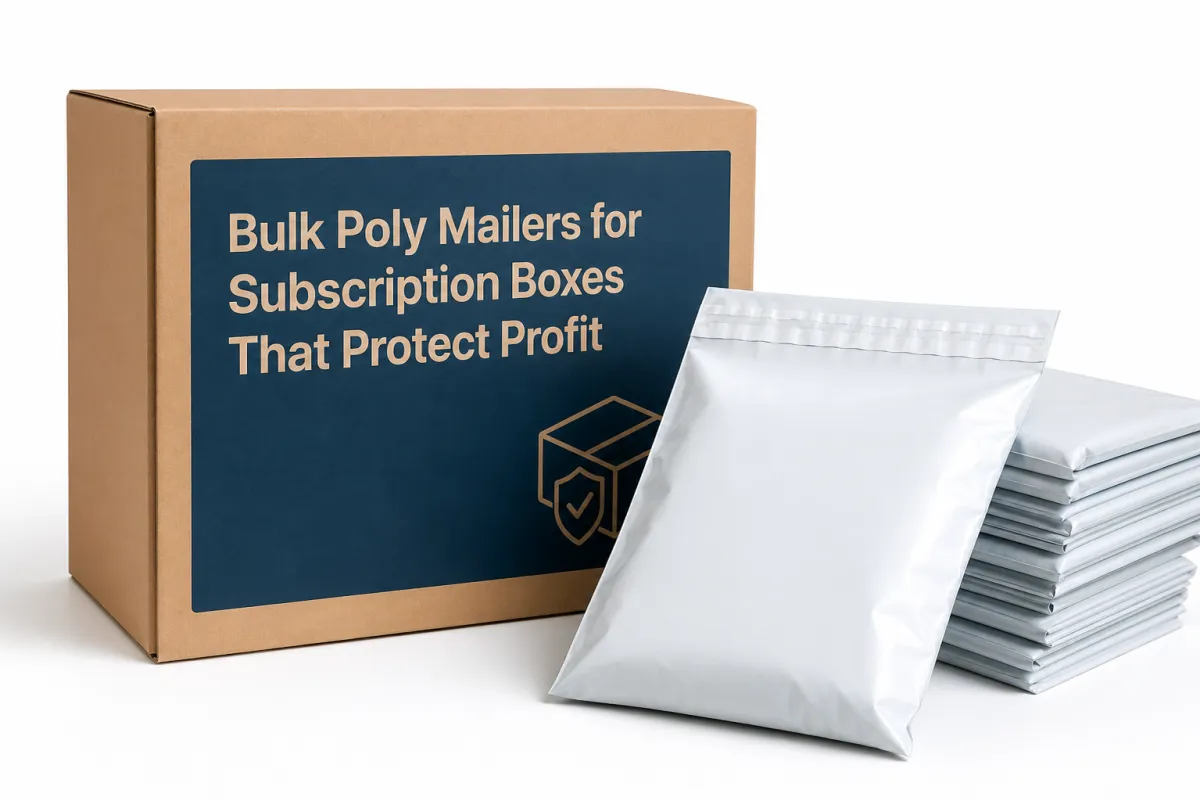
Bulk poly mailers for subscription boxes protect profit by cutting costs that never appear on the first invoice. A mailer that reaches a customer in one piece prevents a long tail of operational pain: fewer support tickets, fewer replacement shipments, fewer repicks, fewer hours spent sorting out transit failures. Packaging gets treated like a wrapper in a lot of org charts. In this category, it behaves more like a control layer for fulfillment quality.
The real comparison is not cheap versus premium. It is stable versus unstable. A low-priced option can pass a friendly desk test and still fail under conveyor pressure, cold brittleness, or stacked freight. Bulk poly mailers for subscription boxes have to answer practical questions: will the seal hold when parcels are loaded, will the corners resist pressure, will the print stay true through handling, and will the customer still like the delivery moment once the item reaches the doorstep?
Picture a monthly beauty box. The total weight can be modest, but the contents are often not gentle. Bottles concentrate pressure at corners. Compacts introduce hard edges. Folded inserts curl and shift. A thin film can look fine on paper and still fail once the product is packed, padded, sorted, and moved again and again. Better-performing bulk poly mailers for subscription boxes usually cost more than the thinnest spec on a quote sheet. They cost less in practice because they reduce spoilage, claims, and return logistics.
A mailer that is cheapest on paper can become the most expensive choice once shipping starts and the first claim lands.
That is why repeat orders matter so much in this category. Subscription boxes ship on a calendar, not by mood. A good mailer setup gets approved once and then re-ordered without drama. Bulk poly mailers for subscription boxes perform best when the supplier keeps unit pricing steady, keeps artwork consistent, and protects a recurring production window that does not threaten outbound deadlines.
Simple usually wins. Teams rarely need six film finishes, three closure types, and a rotating colorway every month. One durable structure. One closure profile. One approved print layout. Those habits tie bulk poly mailers for subscription boxes to a reliable procurement process instead of a recurring rework cycle.
Product Details: Materials, Barriers, and Construction Choices
Bulk poly mailers for subscription boxes are usually built from polyethylene-based films, but the film family is less important than how it performs in context. A plain PE structure can work well for soft goods and light inserts. Co-extruded PE constructions often feel stiffer and firmer at the touch, which can help at pack-out stations. Multilayer builds can improve puncture resistance, crack resistance, and flex durability, especially when parcels are compressed, dropped through chutes, or stacked beneath heavier freight. Thickness matters, but thickness alone does not explain outcomes. The better test is behavior under stress.
Material structures that behave differently
In bulk poly mailers for subscription boxes, appearance and function are tied but not identical. A matte exterior can create a premium doorstep feel, while gloss can give stronger contrast for logos and text. Anti-static treatment becomes useful when kits include electronics or friction-sensitive accessories. Humidity tolerance matters more than many teams expect for items like beauty formulas, powders, and printed inserts that can curl in storage. Sharp or rigid contents often justify stronger tear-stop layers and geometry that absorbs stress near seams.
Closure selection deserves the same level of scrutiny as film choice. Self-seal adhesive is common, but the adhesive system has to match warehouse conditions. Dust, cold, humidity, and pack-out speed determine whether the seal opens cleanly or creeps at the edges after repeated handling. Resealable variants become useful if return handling is expected. Tamper-evident strips matter for higher-value kits. A double-layer approach, where a secondary inner sleeve takes minor impact, can also reduce stress on the outer shell.
For teams that want a clearer packaging benchmark, resources from packaging.org help compare material families, performance tradeoffs, and practical construction choices. That context keeps bulk poly mailers for subscription boxes aligned with the broader supply chain instead of turning them into a stand-alone spec debate.
Print handling and finish
Bulk poly mailers for subscription boxes are not visual wallpaper. Print affects approval speed, production reliability, and acceptance quality. Flexographic printing often works well for longer runs and bold color blocks. Digital printing usually wins when runs are shorter or when variants change frequently. Spot varnish can elevate look and feel, but it can also add steps in drying, registration, and scuff behavior. Tight logo lockups and window placements require disciplined file control from the start because late changes are one of the fastest ways to push schedules off track.
There is a second reality many teams miss: these shipping pouches now live in social feed images and unboxing videos, not just in a warehouse. The finish has to hold up under camera close-up and conveyor friction at the same time. That tension is why clean proof files, moderate ink coverage, and realistic color expectations matter more than they first appear. A mailer that looks polished on a mockup and rubs off in transit is not premium. It is a complaint waiting to happen.
I have seen this play out in a way that was almost boring in its predictability. A brand liked the first sample because the print popped under soft lighting. Then the production lot hit a humid dock, the seal adhesive picked up dust faster than expected, and the scuffing showed up before the boxes even left the regional hub. It was a small miss, but it cost a week of back-and-forth. That is why field conditions matter as much as art approval.
Specifications Buyers Compare: Dimensions, GSM, and Failure Tolerance
Bulk poly mailers for subscription boxes win on fit first. Internal dimensions matter more than outside dimensions, and there has to be room for the product, insert, and flap without forcing the pack into a hard fold. A practical rule: measure the packed bundle, not the naked SKU, then add around a 1-inch drift buffer for irregular shapes or hard edges. That matters when a tray, card, and bottle share the same fulfillment mailer.
Thickness and seam design come next. Suppliers may present thickness in mil, microns, or even GSM, but the label is less important than performance. For film mailers, thickness in mil or microns usually tells you more than GSM does. How does the film respond under load? Heavier bulk poly mailers for subscription boxes usually require thicker wall structures, stronger corner tolerance, and a seal that resists creep when parcels flex during transport. Long routes and heavy stacking often justify a forgiving multilayer structure even if unit cost rises slightly.
Failure tolerance should be locked in before production starts. If the supplier can share seal strength, burst resistance, or puncture-related metrics, buyers gain a measurable baseline. Ask whether samples are evaluated using a recognized standard such as ISTA-style drop and distribution testing. It will not solve every variable, but it replaces guesswork with repeatable comparison. For bulk poly mailers for subscription boxes, that distinction is huge.
Visual acceptance is not cosmetic trivia. Check for ink rub, pinholes, seal wrinkles, edge cuts, misalignment, and early tear initiation. A warehouse may accept a mild flaw that a premium brand cannot. Acceptance criteria should match customer expectations, not only sorting-room tolerance. If the mailer is seen beside a curated insert or a styled sleeve, it should look intentional, not accidental.
A practical checklist helps keep teams grounded:
- Confirm internal dimensions against the packed SKU, not the loose product.
- Use a 1-inch buffer for irregular shapes and sharp-edged items.
- Record product weight plus insert and packaging weight before finalizing size.
- Note warehouse temperature swings and humid storage before artwork finalization.
- Require seal, puncture, and visual acceptance criteria before approval.
If the shipment includes rigid accessories, cosmetic products, or metal edges, bulk poly mailers for subscription boxes may need a wider seal band or stronger corner reinforcement. Moisture-sensitive kits need an additional question: can the film and adhesive hold under humidity, seasonal temperature variation, and multi-hop sorting? A mailer that excels in one lane can fail in another, even with the same product mix.
Documenting the route makes the difference between a clean launch and post-mortem chaos. Bulk poly mailers for subscription boxes can be excellent in one shipping corridor and weak in another. Specification is partly a logistics decision, not just packaging.
Pricing, MOQ and Cost Drivers for Bulk Poly Mailers for Subscription Boxes
Pricing for bulk poly mailers for subscription boxes gets clearer when it is broken apart. Material cost is the base. Size influences resin use and film area. Print coverage influences prep and press workflow. Matte finishes and specialty coatings usually move the unit price above plain gloss. Reinforcement and custom closures also increase cost. Buyers who understand these levers generally negotiate better because the quote starts making sense instead of feeling arbitrary.
MOQ follows the same logic. Common sizes and common colorways often allow smaller starting runs. Custom artwork, unusual finishes, and reinforced builds usually require larger quantities to stay efficient. Subscription programs get the best economics when one mailer size can be reused consistently with minimal artwork churn. That spreads setup cost over cycles and makes bulk poly mailers for subscription boxes easier to forecast financially.
Below is a practical starting point for bulk poly mailers for subscription boxes:
| Mailer Option | Typical MOQ | Unit Price at 5,000 pcs | Best Fit | Notes |
|---|---|---|---|---|
| Standard PE mailer | 1,000-3,000 pcs | $0.09-$0.15 | Light apparel, soft inserts | Lowest entry cost, basic print coverage, good for simple repeats |
| Co-extruded PE build | 3,000-5,000 pcs | $0.11-$0.18 | Mixed subscription kits | Better stiffness and handling feel, useful where scuff resistance matters |
| Multilayer reinforced mailer | 5,000-10,000 pcs | $0.14-$0.24 | Fragile, rigid, or sharper contents | Stronger puncture tolerance and more stable seal performance |
| Custom printed premium mailer | 5,000+ pcs | $0.18-$0.32 | Brand-led subscription launches | Higher visual impact, more proof steps, better for customer-facing unboxing |
These ranges are directional, not fixed. Film thickness, artwork coverage, finish, and freight can move the final price. Even with that variance, the bands help identify quotes that look low but hide setup and rework costs. Bulk poly mailers for subscription boxes should also be judged against failure cost. A cheaper program that increases damage claims is not actually a lower-cost choice.
Negotiation opportunities matter:
- Book seasonal runs early to stabilize pricing volatility.
- Consolidate SKUs where possible to reduce proof and setup complexity.
- Use preapproved dieline variants to shorten turnaround.
- Limit artwork revisions and control color changes early.
For recurring programs, a replenishment contract usually beats ad hoc ordering. If the product line repeats each month, ask for a plan that treats each cycle as a continuation, not a fresh project. That is where bulk poly mailers for subscription boxes become easier to manage operationally and financially.
Aligning mailers with the wider packaging calendar also lowers cost. Cartons, labels, inserts, and Custom Poly Mailers can be coordinated as one cadence, rather than purchased on separate urgent timelines. Brands moving through Wholesale Programs often find this synchronization reduces administrative drag. I have watched teams save more from timing discipline than from a tiny per-unit discount, which can feel almost backwards until the POs start landing.
Quote structure is as important as unit cost. A low unit price can vanish under hidden plate fees, proof adjustments, or reprint charges if the artwork shifts late. Bulk poly mailers for subscription boxes are repeat business, so true cost should be total landed cost across multiple cycles, not one invoice.
Process and Timeline: Sample, Approval, Production, and Shipment
Bulk poly mailers for subscription boxes move quickly when process discipline is strong. Intake should capture dimensions, print needs, closure type, finish, route, and required ship date. If the packed SKU profile already exists, intake can move in roughly one business day. Sample proof and QA sign-off often take 2-4 days when the dieline is simple and artwork is stable. Pre-production approval may add 1-2 days. Production usually lands in 3-7 business days for common specifications, and freight timing follows route and destination. Ask for this timeline upfront.
Common delays come from a short list: complex dielines, non-standard films, multiple color separations, and late revision cycles. Custom logos are manageable if the art freeze date is clear. Bulk poly mailers for subscription boxes do not tolerate endless correction cycles. They perform better with locked inputs and scheduled checkpoints.
What to lock before proof
Before proof approval, lock internal dimensions, closure method, print version, and quantity logic. Versioned filenames help because the supplier, design team, and buyer should all review the same file at every step. Programs with multiple SKUs benefit from a dimensional matrix that ties each SKU to an approved mailer profile. That one habit prevents repeated confusion when bulk poly mailers for subscription boxes are reordered across several months.
Client and supplier checkpoints should be explicit. Ask for a sample inspection criteria sheet. Confirm whether there will be pre-shipment random checks, lot-level visual audit, or both. Require sign-off on pallet labels, carton counts, and external condition before carrier pickup. These controls keep bulk poly mailers for subscription boxes dock-ready instead of forcing last-minute sorting.
Before palletization, inspect seal line, trim consistency, print registration, and scuffing from sample handling. Check that outer cartons can endure the route and that stacking patterns do not crush film seams. If there is a new size, new artwork, or a new adhesive, give the sample stage extra time for internal testing. A small pause often saves a full rework cycle later.
The strongest operations teams treat these bulk poly mailers for subscription boxes like any controlled input: one owner, one master spec, one proof trail, one reordering rule. Once that structure is in place, fulfillment gets quieter and surprises become manageable.
How do bulk poly mailers for subscription boxes hold up through the final mile?
Bulk poly mailers for subscription boxes that survive the final mile are not guessing at performance; they are built around route conditions. Distance, humidity, and transfer points create the real test. A subscription launch that passes short-distance city runs can still crack on cross-country lanes because of longer dwell time in sorting hubs and repeated drops.
At this stage, quality controls should include both lab and field signals. A few sample lanes through real carriers can reveal weak links that static testing misses. That is especially true for subscription packaging with hard or fragile inserts, where corner stress and compression failures accumulate over multiple handoffs. If the data shows seal creep, corner split, or print rub, the fix is often structural—thicker film, altered seam design, or a stronger closure—not cosmetic.
For brands balancing brand experience and performance, a premium shipping pouch style, a reinforced fulfillment mailer variant, or a protected mailing bag can make sense for specific SKU runs. In many programs, one or two variants are enough, while the rest stay on a stable, proven base line.
One more practical point: carriers do not handle every lane the same way. I have seen the same mailer perform perfectly for regional delivery and get roughed up on a longer hub-to-hub route. That is not a failure of packaging theory. It is a reminder to test the lane, not just the sample.
Why Choose Us for Reliable Subscription Mailing Performance
Buyers need more from bulk poly mailers for subscription boxes than a quote and a pallet. They need consistency. Repeat business usually comes down to clear specs, straightforward communication, and predictable behavior from month one to month six. At Custom Logo Things, that means helping teams settle material choice, artwork readiness, and order timing before the PO is issued, because these shipping mailers are manageable when details are fixed early.
Execution reliability starts with traceability. A reliable supplier should confirm the production batch, approved proof version, and exact release quantity. It seems basic, yet that transparency often separates smooth cycles from warehouse emergencies. Bulk poly mailers for subscription boxes feel simple only when repeatability is part of the process design.
Lead times should be explicit. A repeat order with locked artwork should move faster than a first-order custom run with a new seal format and new print coverage. This matters because subscription brands cannot afford ambiguous promises during campaign periods. The strongest bulk poly mailers for subscription boxes program is one where the supplier explains what is inside the timeline and what would push it off course.
Quality proofing is strongest when it stays practical: dimensional checks, visual acceptance, and post-bond inspection. If the kit is fragile, sample testing should reflect actual route risk, not just desk-based review. Buyers need confirmation that these mailers will hold up to real handling, not just approval standards.
A phased rollout still works best for many programs. Start with a pilot lot, monitor transit performance, then move to a larger repeat once the loop is clear. It is a practical way to evaluate bulk poly mailers for subscription boxes without placing the whole operation at stake in one shipment.
For brands coordinating multiple pack elements, it helps to partner with a supplier that can support labels, inserts, and outer structures together. If the mailer sits inside a larger custom packaging system, the combined program reduces moving parts and coordination risk. In this setup, bulk poly mailers for subscription boxes perform better because they are part of one synchronized fulfillment design.
Action Plan and Conclusion: Final Steps for Bulk Poly Mailers for Subscription Boxes
The cleanest way to buy bulk poly mailers for subscription boxes is to treat them as a production input, not a generic envelope. Begin with item weight, route risk, and monthly volume, then build specs from there. If contents are sharp, rigid, or moisture-sensitive, optimize for failure tolerance first and only then optimize visual language. That order keeps the mailer performance tied to real shipping behavior.
Next, narrow options quickly. Confirm three likely sizes, identify the top three fragility risks, choose closure style, and lock the print version before requesting samples. Then review physical or 3D samples together across teams so fit, handling, and brand feel are evaluated in one pass. Teams usually move faster and reduce back-and-forth by consolidating reviews this way.
Then request a written quote that clearly states MOQ, lead time, sample terms, and every charge tied to artwork updates or reproofing. Compare it with internal assumptions for returns, repacks, and replacement shipment costs. If the spec clears internal quality thresholds, place a pilot, run one live cycle, then transition to recurring replenishment with modest buffer inventory. That is usually the calmest path to scale bulk poly mailers for subscription boxes without emergency reorder cycles.
The best outcome is not loud. It is reliable. The right mailers arrive on time. The kit looks intentional at the doorway. The fulfillment team does not revisit packaging specs every week. That is the standard bulk poly mailers for subscription boxes should meet, and it is the standard worth protecting across the subscription calendar.
How many bulk poly mailers for subscription boxes should I order to stay cost efficient?
Start with one SKU, then add 20-30% overage for damages, pack-out variance, and early testing losses. Compare unit price at each MOQ tier before choosing where the cost curve stabilizes. For recurring programs, a pilot lot to validate transit durability followed by a replenishment lot often works best.
What key specs matter for bulk poly mailers for subscription boxes with fragile inserts?
Prioritize wall thickness, seam strength, and closure reliability before decorative options. Test the heaviest and sharpest SKU first, then evaluate corners, seals, and pressure points that can start a tear. A physical sample after vibration or transit simulation usually provides stronger evidence than visual inspection alone.
Can custom printing and logos on bulk poly mailers for subscription boxes delay delivery?
Yes, especially when the artwork is not frozen and revisions continue after dieline lock. A clean production-ready print file with proper bleed, clear registration, and stable color profile usually fits standard production windows. Using one approved template per size variant reduces prepress churn and helps keep bulk poly mailers for subscription boxes on schedule.
What timeline is realistic for first sample and production of bulk poly mailers for subscription boxes?
A realistic path is intake, sample review, proof approval, production, then freight dispatch. Stable specs and locked artwork usually shorten the sample stage, while unusual materials and repeated revisions extend it. A realistic schedule is one that includes both proof time and pickup buffers, not production time alone.
How do I reduce returns and complaints when using bulk poly mailers for subscription boxes?
Match the mailer structure to how the product behaves in transit. Moisture-sensitive items, rigid products, and sharp edges often need thicker film and a stronger closure. Add opening checks, seal peel checks, and visual inspection on sampled lots, then track damage reasons by route so you can correct only the failure points that repeat.
Final takeaway: build the spec around the pack-out, the route, and the failure points you can actually see in testing. If the mailer passes those three checks, bulk poly mailers for subscription boxes stop being a disposable supply purchase and start doing real work for the business.