Buyer Fit Snapshot
| Best fit | Mailing Bags Supplier projects where brand print, material claims, artwork control, MOQ, and repeat-order consistency need to be specified before quoting. |
|---|---|
| Quote inputs | Share finished size, material target, print colors, finish, packing count, annual reorder estimate, ship-to region, and any compliance wording. |
| Proofing check | Approve dieline scale, logo placement, barcode or warning zones, color tolerance, closure strength, and carton packing before bulk production. |
| Main risk | Vague material claims, crowded artwork, missing packing details, or unclear freight terms can make a low unit price expensive after revisions. |
Fast answer: Mailing Bags Supplier: Production Spec, Color Control, and Delivery Risk should be specified like a repeatable production item. The safest quote records material, print method, finish, artwork proof, packing count, and reorder notes in one written spec.
Production checks before approval
Compare the actual filled-product size with the drawing, then confirm tolerance on folds, seals, hang holes, label areas, and retail display edges. Reserve space for logos, QR codes, warning copy, and material claims before decorative graphics fill the panel.
Quote comparison points
Review material grade, print process, finish, sampling route, tooling charges, carton quantity, and freight assumptions side by side. A quote is only useful when the supplier can repeat the same color, closure quality, and packing count on the next order.
One split seam and one damaged return can erase the savings from the cheapest invoice. That is the hard edge of a practical mailing bags supplier guide: it starts with failure rates, not branding flourishes. Packaging gets judged in motion. Does it survive the conveyor, the van, the porch, the return trip? If your team has ever watched a parcel split open in transit, the lesson lands fast. Mailers are not a decorative purchase. They are a cost-control decision with a delivery van attached to them. A practical mailing bags supplier guide also helps teams compare shipping mailers, poly mailers, and padded mailers without getting distracted by logo treatment alone. I have seen brands spend weeks debating print finish, then discover the real issue was a weak seam. That is the kind of mistake you only make once, if the numbers are visible.
How Do You Use a Mailing Bags Supplier Guide to Choose the Right Fit?
The first move in this mailing bags supplier guide is plain and practical: define what you are shipping before you compare quotes. Product shape decides more than people expect. Apparel behaves like fabric because it is fabric. It compresses. It folds. It forgives a small amount of extra room. Electronics accessories ask for more restraint. Their corners bite through weak film. Jewellery, perfume, and hardware each bring their own trouble, usually at pressure points that only show up after a bag has been stacked, dropped, and dragged around a depot. High return rates change the picture again. Reverse logistics punishes weak mailers just as hard as outbound shipping, sometimes harder, because the second journey often gets less care than the first. A mailing bags supplier guide is most useful when it starts with package behavior instead of packaging color.
Define the shipment profile, not the brand mood
Most buyers lose money here. They fall for a color first, then discover the bag is too narrow for the folded jacket, then compensate with a bigger size and a freight bill that climbs without warning. Start with a minimum spec sheet for each SKU. A good one should include:
- Typical packed weight in grams or pounds
- Package dimensions after folding, taping, and any inserts
- Number of sharp edges, corners, or pin points
- Target drop method and delivery distance
- Return rate history, even if the figure is only a rough 2-5% estimate
A one-inch change in width can push parcel pricing into a higher band, and that shift can add 8 to 12% to the shipping bill depending on the carrier and route. The bag itself may cost pennies. The freight math does not care.
This mailing bags supplier guide matters because products behave differently once they are inside a sleeve. Soft goods tolerate more dimensional drift. Rigid items do not. A supplier who says “fits most” is selling confidence, not evidence. Ask for the maximum fill percentage they recommend, plus their view on seam reinforcement, top seals, and any corner protection your item class requires. A good answer is specific. A vague one tends to stay vague after payment.
Differentiate plain sleeves, protective mailers, and marketing wraps
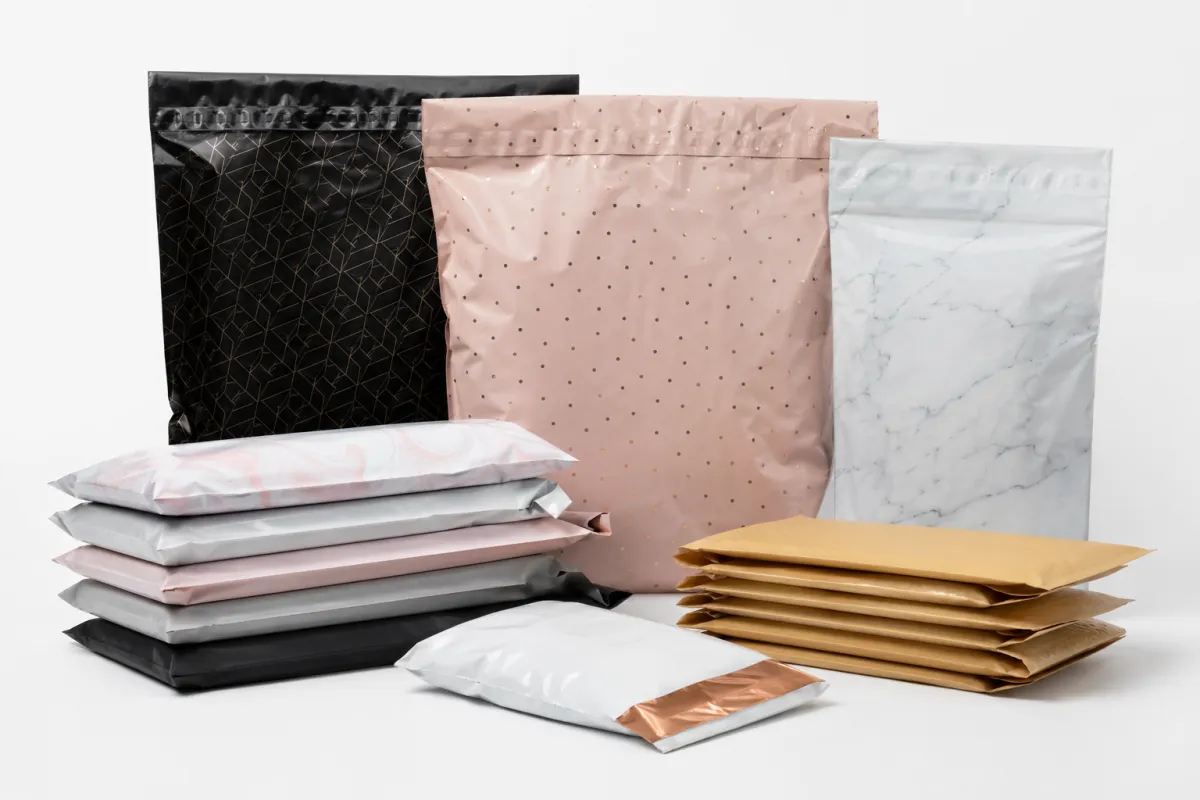
Poly mailers keep weight low and move quickly through a packing line. Padded mailers add shock absorption and help when corners need extra forgiveness. Custom-Printed Mailing Bags carry your logo, your color palette, your message, and the first impression. They do not automatically offer better protection. A full-color design on a thin film can still be a poor choice for brittle goods. A plain recycled poly bag with the right thickness and closure can beat a flashy alternative once replacement shipments and customer service time are counted.
Flat catalog inserts often do fine in stock bags if the dimensions are right. Stapled booklets, sample packs, and products with hard edges usually need stronger seams, better tear resistance, or a padded structure. One of the quieter errors in sourcing is confusing “looks premium” with “handles pressure.” Those are not the same thing. Shipping mailers and protective mailers can look similar in a catalog and perform very differently on a conveyor.
Use your mailing bags supplier guide to rank priorities before samples arrive. You are not buying a bag in isolation. You are choosing a bundle of outcomes: protection, packing speed, brand signal, and room to scale. Freight reduction, better unboxing, faster packing, and stronger branding all matter. They rarely matter equally. Pick one primary goal and two secondary goals per buying cycle, then stick to that order when quotes start competing for attention. A mailing bags supplier guide should also help you decide whether custom mailers are worth the added setup cost, or whether stock poly mailers can do the job just as well. If a team is still guessing on size, I usually tell them to start boring and precise, not aspirational.
Set a repeatable source-of-truth
Smaller brands often make the same mistake twice: they trust the most persuasive sales rep, then search for paperwork after the fact. Put the spec in one place before you source. Keep that document boring. Boring is efficient. A consistent template makes comparison cleaner and forces the discussion away from charm and toward performance. At minimum, record:
- Bag type and closure style
- Thickness in mils and microns
- Print method and ink type
- MOQ and per-bag price by tier
- Lead times for sample, production, and replenishment
“The first order is a pilot. Your next three reorders are the real evaluation.” That line belongs in every buying meeting.
In other words, your mailing bags supplier guide does not end with first approval. Stability across reorder cycles tells you more than a polished sample ever will. If a supplier can land the first batch and miss the second, that is not consistency. It is luck wearing a name badge. This is also where a mailing bags supplier guide should push teams to check the same sample against a second run, not just the showroom version.
Need a baseline before moving into custom work? Start with Custom Poly Mailers and compare a few standard sizes side by side. If fit is weak or breakage rises under normal handling, step up to padded or structured options before investing in artwork. For many brands, the cheapest custom mailers are the ones that fit the packing line the first time.
Mailing Bags Supplier Guide: Materials, Seals, and Protection
Plenty of teams skim this part of the mailing bags supplier guide and assume it is about aesthetics. It is not. It is about mechanics. A mailer is a small system with a film body, seams, closure, seal area, and sometimes cushioning. Each part fails in its own way. The seam peels under corner stress. The closure sticks too softly or too aggressively. The print rubs off and smears in a wet depot. Within days, operations feels the impact. A mailing bags supplier guide that ignores structure is usually reading the wrong metric. I have sat in enough warehouse walk-throughs to know the pattern: the samples look neat on a desk, then the conveyor exposes everything that was missed.
Know the structure before you approve artwork
Most mailers rely on LDPE or a co-extruded blend. The real question is how the film stands up to abrasion, tearing, and pressure when the parcel is stacked or dropped. Ask whether the bag uses a flat bottom, edge gusseting, or a reinforced panel. Failures often appear in places nobody stared at during approval. Packaging has a talent for proving that the obvious inspection point was not the right one.
Thickness deserves more respect than it gets. One mil equals 0.0254 mm. That means 2 mil is 0.0508 mm, while 4 mil reaches 0.1016 mm. The numbers look tiny. The result is not tiny. Moving from 1.5 mil to 3 mil can often lift puncture resistance sharply, depending on the film construction. Yes, cost rises with thickness. So does the cost of a replacement order, relabeling, and one unhappy customer posting photos of a torn parcel.
A practical rule helps here. Thin bags suit light, compressible products. Mid-range 2-3 mil works for mixed soft goods. Reinforced 3-4.5 mil is better for heavy or sharp-edged items. Your mailing bags supplier guide does not need a materials textbook, but it should clearly reflect that baseline. The same logic applies whether you are sourcing parcel bags for apparel or protective mailers for hard goods.
Seals and closure behavior in real packing flow
Self-seal closures are easy to underestimate. A packing room with twenty workers can turn a weak closure into a bottleneck. Manual heat-seal routines slow down the line. Self-seal, pressure-sensitive closures can cut 20-30 seconds from each order in some workflows. Multiply that by 1,000 orders a day and the labor hours stop looking small. The weekly savings can reach 8 to 10 hours, sometimes more if the line is already strained.
That is not theory. A bag with a slightly lower unit price can still drain margin if workers spend extra time resealing, fixing weak adhesion, or checking damage before dispatch. Ask the supplier about peelable top-seals, tamper indicators, side gussets, and whether the closure is suited to your packing height and table layout. The right seal saves more money than a fancy finish ever will.
Compatibility still matters. Adhesives, inks, and labels can react badly with certain films, especially when heat or pressure enters the picture. If you plan to add extra stickers, inserts, or resealable strip upgrades, ask for confirmation that the materials stay stable together during storage and transit.
Material choices: what you pay for beyond cost
LDPE stays common for a reason. It bends without complaint, costs less than many alternatives, and usually performs well for apparel and soft goods. Recycled poly can work well too, especially when the recycled content is disclosed clearly. In many runs that means somewhere around 20% to 40% recycled content, though the exact range depends on film grade and strength target. Compostable-looking options and bio-based films can photograph beautifully. Shipping performance tells a different story. Some feel softer under compression. Some do not hold their shape. Marketing language and courier reality often sit in different rooms.
If a supplier uses the word “compostable” and stops there, ask for the film formula, degradation test window, and moisture behavior. Bags are stored for weeks in fulfillment, then loaded into hot vans, cold depots, and wet doorsteps. A material that bends after humidity exposure or loses seam strength under temperature swings is not ready for serious use. Branding cannot rescue a weak film.
Mailing bags supplier guide buyers should ask two questions every time: can customers recycle this through the channels they actually use, and what do the tear and puncture tests show? If the answers feel slippery, treat the claim as decoration. A statement such as “50% post-consumer recycled (PCR) resin, with optional FSC-supported paper insert” carries more value than polished eco language with no substance behind it. A well-documented mailing bags supplier guide should also separate recyclable claims from actual local collection access.
Mailing Bags Supplier Guide: Key Factors That Separate Good Suppliers
Once the material debate is clear, the real separation appears: supplier discipline. Two suppliers can quote the same mailer and deliver very different outcomes because sample handling, process control, and reprint behavior vary more than buyers expect. A strong mailing bags supplier guide forces attention onto the unglamorous details. It also gives you a way to compare shipping mailers and custom mailers on the same scoreboard instead of relying on instinct.
MOQ, sizes, and SKU flexibility
Ask the same questions from the first conversation onward:
- What is your hard MOQ for the first run?
- Can I mix sizes and SKUs in one purchase?
- What surcharge applies for each size variant above the base run?
If a supplier says “MOQ 1,000,” pin down whether that means total units across all SKUs or 1,000 per SKU. The difference can reshape a launch plan. A brand with five variants and 200 units each can discover, too late, that the quoted minimum is actually impossible for a test run. I see that mistake often. The budget gets approved, the split costs arrive, and the launch lane disappears.
If you move 2,000 units a month across 12 size variants, mixed-SKU replenishment matters. A supplier who can handle that rhythm is usually more useful than one who only shines on a single large batch.
Printing options and hidden charges
Print method changes both cost and wear resistance. One-color screen-like or flexo-style printing often works well for simple positioning and lower volumes. Full-color digital or CMYK gives more detail, which suits premium lines, but the price climbs with every extra layer of complexity. Ask whether inside printing is possible. An internal message, care instruction, or brand note can lift the experience without changing the outside footprint.
Artwork charges catch a lot of new buyers off guard. A good supplier separates first proof, setup, and reorder pricing. That way the first order carries the initial admin cost, while repeats stay predictable. Repeated artwork edits on every 1,000 units should be budgeted from the start instead of treated like an afterthought. Your mailing bags supplier guide should capture recurring costs, not just the opening quote. If the quote is vague, the real price usually grows later.
Sustainability claims, with receipts
“Eco-friendly” is too vague to trust. Ask what the bag is made of and where the environmental claim stops being meaningful. Full recycled content at bag level is still uncommon for high-performance shipping film. A more realistic range is often 20%-60% recycled content depending on the strength target. If paper components are involved, ask for chain-of-custody details. FSC matters when paper layers, inserts, or mailer-paper hybrids enter the build. It tells you something useful there. It tells you less about pure plastic film unless the supplier explains the scope clearly.
Disposal behavior matters too. A mailer sold as recyclable but only accepted in specialty streams can create confusion for customers who live far from those systems. If your buyers mostly recycle through household bins, the material choice should match that reality. Otherwise the sustainability message can turn into support tickets and complaint emails.
Reliability signals: samples, proofing, lead times
Sample quality is the first reliability clue. Ask for a physical sample and a print proof. Compare shade, size, closure feel, and tear direction. A digital mockup can look clean while the seam bond fails under actual handling. The sample tells the truth the PDF can hide.
Response speed says a lot. If a supplier needs 72 hours to answer a basic technical question, production communication may move at the same pace. Proofing accuracy matters too. A supplier whose first proof is regularly wrong is telling you something about process discipline. Missed proof details become missed delivery dates. Those two things tend to travel together.
Stock strategy matters as well. Some suppliers make everything to order, while others keep common sizes in warm stock. Having inventory on hand can shave weeks off a replenishment cycle. For a brand with monthly launches, that speed is worth more than a small price cut.
For shipping and testing guidance, I cross-check supplier claims against references such as Packaging.org for material handling norms and ISTA practices for distribution stress conditions. Those sources do not replace your own trials. They do make it easier to tell serious suppliers from decorative ones.
Process and Timeline: How a Mailing Bags Order Actually Moves
Now the process. It looks simple on paper and messy in a real procurement thread. The sequence below is the one That Actually Works for a custom run:
- Inquiry with product specs and order goal
- Quote request and technical review
- Physical sample and/or digital mockup
- Artwork proof and revisions
- Approved sample and production start
- In-process quality check and final inspection
- Packing and dispatch planning
- Transit and receiving inspection
A mailing bags supplier guide only pays off if you know which step is already slipping. Delays rarely announce themselves. They drift in through missing dimensions, slow sign-off, or a proof that never got a proper read-through. That is especially true for custom mailers, where one missed revision can reset the whole schedule.
Timeline ranges that are usually real
Stock inventory bags can arrive in 2 to 5 business days when local inventory exists. Custom printed bags usually need 10 to 20 business days after artwork and sample approval, with longer windows during peak season. Add 3 to 7 days if custom tooling is required. Offshore supply can add another 7 to 14 days depending on port congestion, routing, and weather. The calendar gets long quickly once one handoff slips.
The tradeoff is easy to describe and hard to ignore: local production gives speed, while overseas production often gives scale pricing. Local runs may have fewer material options and higher unit costs. Overseas runs may be cheaper but less forgiving when the timeline changes. The right answer depends on launch pressure, stock depth, and how much slack your team can tolerate.
Bottlenecks that derail projects
Most delays come from familiar mistakes, not strange disasters:
- Missing print files or low-resolution art
- Unclear size spec, especially bag depth
- Last-minute color correction loops
- Late proof approval from internal teams
- Unconfirmed packaging line tests before dispatch
Notice what is missing: drama. The problems are ordinary, repeated, and preventable. Put controls around them and the whole process speeds up.
Timeline checklist that actually prevents panic
Ask for written dates at four points:
- Stock availability confirmation
- Sample dispatch date
- Production start date
- Estimated ship window with buffer
If a supplier cannot provide all four, the project is not ready for scale.
Reorder planning is another place where brands leak money. “Order when needed” sounds nimble. It usually becomes rush freight and awkward stockouts. A safer pattern is to reorder while 20%-30% inventory still sits in reserve. That cushion protects your line from emergency fees and keeps packing teams from reaching empty shelves at the worst possible moment. A strong mailing bags supplier guide should make that buffer feel non-negotiable, not optional.
Cost and Pricing in a Mailing Bags Supplier Guide
Now the money. The strongest mailing bags supplier guide discussions split cost into components instead of worshipping a single headline number. Unit price is only one piece. Setup, logistics, and reorder behavior change the actual cost per delivered bag. That is true whether you are buying poly mailers, padded mailers, or custom mailers with a full print finish.
What the total unit economics should include
Four main cost buckets matter:
- Unit cost: base material + manufacturing cost
- Setup costs: artwork, plate, registration, initial die checks
- Transport: freight, customs duty if relevant, insurance, and regional last-mile impact of added weight
- Operational overhead: packaging line adjustments, extra tape, returns, or failed packs
The ugly truth sits here: if returns rise by 1%, the effective cost can climb by 5% to 15% depending on product value. A low MOQ does not rescue a bad fit. A cheap bag that creates claims and replacements is not cheap for long.
MOQs versus unit economics: this is not a scam, this is math
Smaller orders buy flexibility. Larger orders buy lower unit cost. That tradeoff is healthy, not suspicious. A typical price curve looks like this:
- 500 units: higher unit cost, fastest validation
- 1,000 units: moderate savings, still manageable
- 3,000 units: often the first real step-down in price
- 10,000 units: lowest unit cost, but cash tied in inventory
Do not chase the lowest per-unit figure if sell-through is unproven. A warehouse full of 4,000 unused mailers can cost more than the small premium you avoided. Storage, cash flow, and dead stock all keep their own invoices. A brand can feel very smart right up until the finance team does the math.
Size, thickness, and feature impact on price
Pricing moves because larger bags use more material and thicker films cost more per square foot. If two bags differ only in thickness, the heavier one is usually more expensive. Seal method matters too. Heat-seal plus reinforcement tends to cost more than a simple peel-and-close structure for some SKUs. Add inserts, labels, or foil effects and the print budget climbs again.
Your mailing bags supplier guide should ask for a side-by-side matrix that isolates those variables before design sign-off. Otherwise nobody can tell whether the premium look bought actual value or only extra cost wrapped in gloss. A good comparison also shows where Recycled Poly Mailers sit relative to virgin film on both price and performance.
| Option | Material / Thickness | Typical MOQ | Unit Cost Range (500 / 1,000 / 3,000 / 10,000) | Best Fit |
|---|---|---|---|---|
| Standard stock mailer | LDPE 2.0 mil, standard peel strip | 500 | $0.18-0.22 / $0.16-0.20 / $0.14-0.17 / $0.11-0.14 | Soft goods, low-fragility, tight budgets |
| Recycled reinforcement mailer | LDPE blend with 30-40% PCR, 2.5 mil | 500 | $0.22-0.27 / $0.20-0.24 / $0.17-0.21 / $0.14-0.18 | Sustainability-led brand programs |
| Padded mailing bag | 3 mil bubble film + 70-90gsm cushioning | 1,000 | $0.38-0.47 / $0.34-0.43 / $0.30-0.37 / $0.24-0.31 | Hard goods, accessories, higher damage risk |
| Branded premium mailer | 3-4 mil film + full-color print + spot finish | 1,000 | $0.52-0.66 / $0.46-0.58 / $0.40-0.52 / $0.32-0.43 | Brand-forward launches and unboxing emphasis |
Compare landed cost, not factory quote
A low factory quote can still become an expensive purchase once shipping, customs, duties, and delays appear. A unit priced at $0.16 that lands at $0.21 because of freight is not a bargain. It is a premium item with poor visibility.
Ask for duty classification and shipping scenario upfront. Domestic buyers still need to account for regional freight differences. For frequent replenishment, ask for tiered quotes at 500, 1,000, 3,000, and 10,000 units, then calculate effective landed cost per delivered bag using your route assumptions. That exercise often exposes which quote is actually lean and which one only looks lean on paper.
Your mailing bags supplier guide should force one more question before sign-off: what does a same-spec reorder cost in 90 days? If that answer is missing, the quote is unfinished. It is also one of the quickest ways to spot suppliers who are good at opening bids but weak on long-term pricing.
Common Mistakes When Choosing a Mailing Bags Supplier
Let’s be blunt. Most sourcing errors come from pressure and incomplete checklists, not from stupidity. I keep seeing the same slips in buyer workflows.
Mistake one: price-only purchasing
“Cheapest unit” feels disciplined. In practice it often creates extra returns, reseals, and customer complaints. Scale makes the damage louder. Even a 2% increase in defects can erode margin fast. The right test is simple: compare expected damage and claims costs against the savings from the lower quote.
Mistake two: skipping samples
A sample is cheap insurance. Without a physical sample you do not know the fold depth, closure consistency, or how the seal behaves after repeated pack cycles. A catalog image cannot tell you whether the bag survives real handling. It can only tell you that somebody once used good lighting.
Mistake three: ignoring packing line ergonomics
If the opening direction is awkward, your team slows down. Three extra seconds per order sounds tiny until volume spikes. At 1,500 orders a day, those seconds turn into overtime, strain, and frustrated packers. Bag design should help the line move, not make workers fight the material.
Mistake four: assuming reorder speed from first order behavior
Some suppliers handle the first batch fast, then struggle when materials run short or larger clients get priority. Ask about reorder lead times during qualification, not after the first batch lands. If the answer is vague, lower that supplier’s weight in your scoring system.
Mistake five: assuming sustainability equals protection
This one hurts because it sounds noble. A supplier can use green language and still deliver weak seal chemistry or flimsy film. Performance has to pass your return-risk and courier-stress tests first. Sustainability belongs in the build, not as a substitute for the build.
The point is simple. The best mailing bags supplier guide approach is not an optional extra. It is a damage-control framework. No shipping program survives weak materials paired with a weak supplier relationship. If the supplier cannot explain how the mailers perform as shipping mailers under stress, keep looking.
Expert Tips and Next Steps for Your Mailing Bags Supplier Guide
If you are moving from “I need mailers” to “I need a sourcing standard,” your buying decisions get cleaner very quickly. Use the framework below before the next order goes out. A good mailing bags supplier guide turns scattered procurement into a repeatable process.
Request the three non-negotiables
Never skip these:
- Physical sample of exact spec
- Written quote with transparent line items
- Production timeline with dates, not vague lead-time words
If a supplier dodges any one of those, keep looking. A polite “we can provide later” is still a warning if launch day is close and inventory is not. That is not me being dramatic; it is just how projects slip.
Build a repeatable evaluation checklist
Use the same criteria for every supplier so the scoring stays fair. A useful scorecard usually includes material type, minimum order quantity, thickness, closure mechanism, print method, proof confidence, sample quality, lead time, and landed cost. Keep photos and notes from every sample run. After three rounds, the supplier with the nice sample but poor process discipline usually reveals itself.
Process tests help more than people expect. Run 50 packs through your actual station. Do a 1-pound squeeze test on folded corners. Simulate a weekend peak if your operation gets busier on Fridays. A bag that passes in silence but fails under real dispatch pressure is not a fit.
Match the bag to the job, not to the launch mood
For apparel, a light 2 mil option may be enough. For accessories with zippers, button backs, and metal hardware, a reinforced profile wins even if it costs 8 to 12 cents more each. High-return categories need stronger closure quality before visual extras. A nicer print will not fix a weak seal.
If your operations need speed, consider Custom Poly Mailers with simple print architecture first, then move into premium variants once sales data justifies the upgrade. For many teams, this is the point where a mailing bags supplier guide saves more money than any single price negotiation.
Next action plan for teams ready to buy
Shortlist two or three suppliers from real quotes. Order samples from all three. Run the process test. Choose the one that performs under pressure, not the one that sends the loudest PDF. The blunt answer is usually the correct one. And yes, that can feel a little anti-climactic when someone has spent an hour selling you on “brand presence,” but the warehouse will tell the truth every time.
Now the practical sequence:
- Month 1: spec clean-up + supplier request
- Month 2: sample evaluation + line test
- Month 3: pilot order + reorder negotiation
- Month 4: scale into your core run
If you follow that rhythm with discipline, your mailing bags supplier guide stops being a document and starts acting like a performance system. Quiet, unglamorous, effective. The best sourcing systems usually are.
Conclusion: The Mailing Bags Supplier Guide You Can Actually Use
The strongest packaging decisions are often the ones nobody notices because they work every single time. Good mailers protect product, move quickly through the line, and carry brand value without adding hidden costs. That is the point of this mailing bags supplier guide. It is a working playbook for teams that ship every day and feel the cost of failure immediately.
Keep one rule close: do not buy on appearance alone, and do not buy on promises without operational proof. Use clear criteria, physical samples, and landed-cost math. Check stock reality and reorder behavior before you commit to volume. Verify standards, test strength, then standardize with discipline. From a packaging buyer's point of view, that is how margins stay intact and avoidable returns stay low.
So yes, run your mailing bags supplier guide with eyes open. If a supplier cannot give you material specs, closure details, and reliable timelines in writing, keep moving. Customers never see the spreadsheet. They feel the result every time a package arrives damaged, late, or badly packed. That is why the best mailing bags supplier guide is less about procurement theater and more about repeatable proof. The actionable takeaway is simple: sample first, test in your own pack flow, then lock the reorder plan before the launch clock starts counting down.
How do I choose a mailing bags supplier for small orders?
Start with low minimum order quantities and clear reprint pricing so inventory does not pile up before demand is proven. Ask whether the supplier keeps standard sizes in local stock, because that usually shortens turnaround for small runs. Compare landed cost, not just unit price, since freight and handling can erase the advantage of a small order fast. A mailing bags supplier guide is especially helpful here because it keeps small-order decisions tied to evidence instead of impulse.
What should a mailing bags supplier quote include?
A useful quote should list unit price, printing setup, sample cost, production lead time, shipping terms, and any tax or duty charges that may apply. If the quote leaves out material thickness, bag size, or closure type, it is incomplete. Ask for tiered pricing at different order volumes so you can see where the cost breaks actually begin to matter. If a supplier gets fuzzy on the basics, I’d treat that as a warning sign, not a clerical hiccup.
How long does a custom mailing bags supplier order usually take?
Stock items can move quickly, sometimes within a few business days when inventory is on hand. Custom printed jobs need more time because of proofing, tooling, production checks, and transit, often taking several weeks. The fastest way to avoid delay is to approve artwork early and confirm the production window before payment timing is fixed. Build a buffer into the schedule, because one late approval can stall the whole run.
What material is best when comparing mailing bags suppliers?
LDPE stays common because it balances flexibility, toughness, and cost for many apparel and soft goods shipments. Recycled poly is a practical option if you want stronger sustainability messaging without giving up too much performance. Compostable-looking alternatives are not automatically better for shipping, so check how they behave under storage and transit before you scale them. If the supplier cannot explain the test data, keep asking.
How can I compare mailing bags suppliers without overpaying?
Use one standardized spec sheet for every supplier so size, thickness, print, and quantity stay identical across quotes. Compare landed cost, sample quality, lead time, and reorder reliability rather than the lowest number on the page. If your volume is meaningful, ask for a small test run so one bad choice does not become a costly full-scale mistake. That process sounds slow, but it usually saves money very quickly.