Buyer Fit Snapshot
| Best fit | Moisture Barrier Mailers for Cosmetics projects where brand print, material claims, artwork control, MOQ, and repeat-order consistency need to be specified before quoting. |
|---|---|
| Quote inputs | Share finished size, material target, print colors, finish, packing count, annual reorder estimate, ship-to region, and any compliance wording. |
| Proofing check | Approve dieline scale, logo placement, barcode or warning zones, color tolerance, closure strength, and carton packing before bulk production. |
| Main risk | Vague material claims, crowded artwork, missing packing details, or unclear freight terms can make a low unit price expensive after revisions. |
Fast answer: Moisture Barrier Mailers for Cosmetics: Film, Print, MOQ, and Carton Packing should be specified like a repeatable production item. The safest quote records material, print method, finish, artwork proof, packing count, and reorder notes in one written spec.
Production checks before approval
Compare the actual filled-product size with the drawing, then confirm tolerance on folds, seals, hang holes, label areas, and retail display edges. Reserve space for logos, QR codes, warning copy, and material claims before decorative graphics fill the panel.
Quote comparison points
Review material grade, print process, finish, sampling route, tooling charges, carton quantity, and freight assumptions side by side. A quote is only useful when the supplier can repeat the same color, closure quality, and packing count on the next order.
Moisture Barrier Mailers for Cosmetics: What to Know
A cosmetic parcel can pass a 1-meter drop test, survive a 24-hour UPS ground lane, and still arrive looking wrong after a cold warehouse in Chicago, a warm truck in Atlanta, and a damp porch in Orlando all take turns stressing the outer pack. I have watched that happen more than once, and it never gets less irritating. The bottle is fine, the inner wrap is intact, and yet the outside tells a different story: labels curling at the corners, cartons that feel soft to the touch, and a faint dullness on the printed surface that makes a polished order look tired. The cause is usually not drama, just humidity, condensation, and a weak protective layer that looked fine on paper and failed after three climate shifts in a single route. That is why moisture barrier mailers for cosmetics matter so much in beauty shipping, because customers are not gonna separate the brand story from a soggy box.
Most brands think about impact first, and honestly, I get it. A cracked jar is obvious the moment the customer opens the box, and a broken tube usually means a quick replacement ticket. Moisture damage is sneakier. It shows up as softened labels, puckered sleeves, clumpy powders, cloudy compacts, and the kind of support ticket that sounds minor until you add up returns, replacements, and lost repeat orders. I sat through a supplier review in Shenzhen where a serum brand was losing only 1.7% of shipments to moisture-related complaints, and that tiny number still cost more than their premium-mailer program after refunds, labor, and reship postage were counted. That is the trap. The damage looks small until the math gets a vote, and by then finance has already asked for a root-cause report in Excel. That is a kinda rude awakening, but it happens all the time.
Beauty e-commerce, sample packs, refills, subscription kits, and lightweight gift sets sit right in the sweet spot for moisture barrier mailers for cosmetics. They give brands more protection than a basic poly mailer, less bulk than a rigid shipper, and faster pack-out than overboxing every order with a separate carton, void fill, and tissue wrap. They are not the fix for every shipping problem, and I would never pretend otherwise. Glass-heavy palettes, fragile fragrance bottles, and stacked kits with crush risk still need a broader protection plan, often with a corrugated outer shipper and 350gsm C1S artboard inserts to keep the presentation tight. A mailer is one layer in a system, not the whole system, and treating it like the whole answer is how teams end up in a Monday meeting with ugly photos and worse questions.
At Custom Logo Things, I treat moisture barrier mailers for cosmetics as a control point, not a miracle material. The useful question is not, "Will the mailer survive?" The better question asks whether the packaging system can keep the product presentable after temperature swings, humidity spikes, and a rough transit route from Ningbo to Sydney or from Dongguan to Dallas. That shift in thinking saves money, time, and a lot of pointless blame-shifting between teams. I have seen more meetings blown up by packaging assumptions than by actual defects, which is a strange hobby for a warehouse to have, but here we are, staring at another sample batch and another stack of claims notes.
What Moisture Barrier Mailers for Cosmetics Are
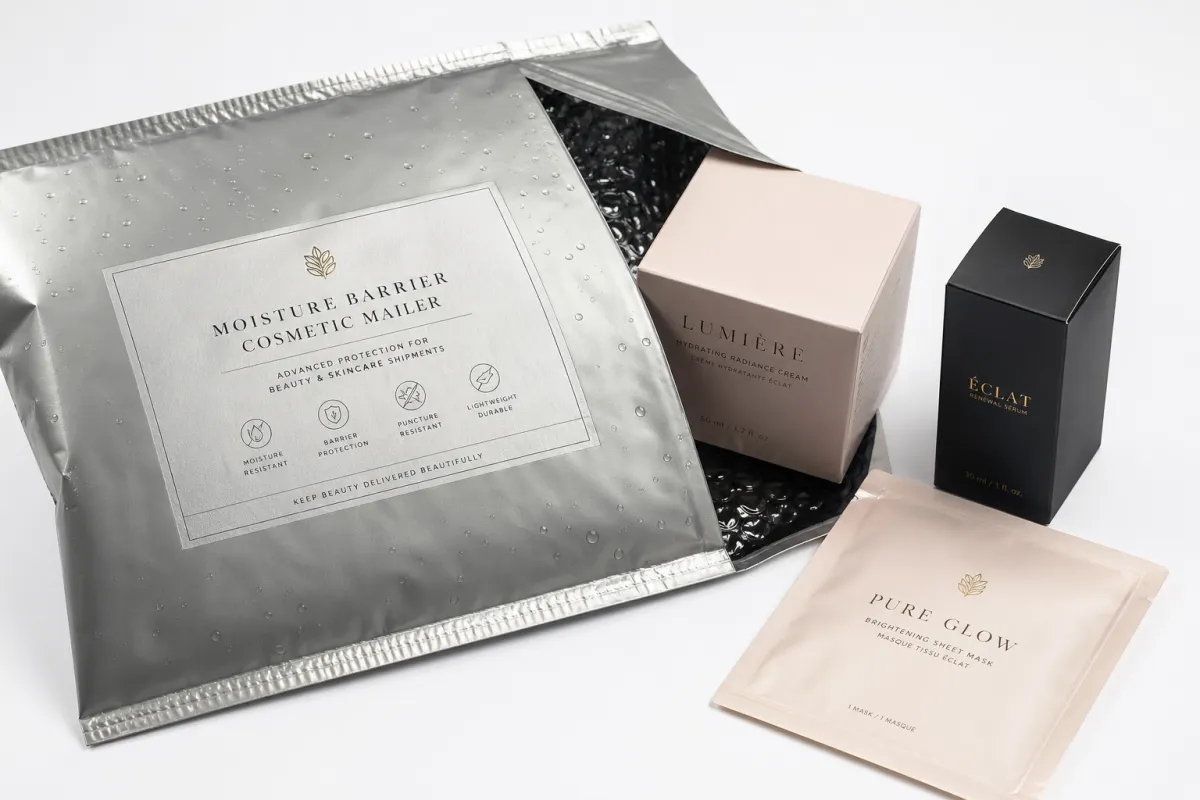
Moisture barrier mailers for cosmetics are poly mailers built with layered films, coatings, or seals that slow water vapor transfer and help protect shipments from condensation, damp air, and humidity exposure. Put simply, they act like a better raincoat for your order during a 10-day regional transit or a summer run through coastal Florida. They are not the same as a waterproof pouch, and they are not a substitute for rigid protection where breakage risk is high. Their job is narrower and more practical: they give beauty brands a better chance of delivering a clean, presentable package that still looks like it left the factory in one piece.
I have seen buyers confuse moisture protection with water resistance, and that mix-up leads to bad purchases. Water resistance usually means liquid water beads up and rolls off the outside for a while. Moisture barrier performance is about how much vapor passes through the film over time, often measured in grams per square meter per day or by an ASTM F1249 test report for moisture vapor transmission rate (MVTR). Those are different failures. A mailer can look sealed, feel thick, and still let humidity creep through over a long route from Guangzhou to Vancouver. That is why moisture barrier mailers for cosmetics are judged by film structure and seal quality, not just by how they look in a product photo.
They fit best in shipping stacks for orders that are light, compact, and sensitive to surface moisture rather than outright crushing. Cleanser refills, sheet masks, sample sets, lip products in outer cartons, and bundled skincare kits are common examples. A humid coastal warehouse in Savannah shipping into an inland fulfillment lane in Phoenix creates a different stress profile than a dry distribution center in Nevada sending to a January address in Minneapolis. I saw that exact pattern in a client meeting near Savannah: the cartons left the dock looking perfect, then arrived with a faint sticky feel and softened graphics because the packaging had no barrier layer at all. That kind of problem is maddening because the package seems "fine" until the customer has already made their judgment.
The limits matter just as much. Moisture barrier mailers for cosmetics will not rescue a brittle glass bottle that rattles around inside the package. They will not stop a heavy jar from bouncing in an oversized bag, and they will not replace cushioning when the product itself needs it. I usually describe them as a front-line defense, the packaging equivalent of a good front door seal on a warehouse in Portland. Useful. Reliable. Not magical. If somebody says one mailer can fix every transit issue, I start looking for the exit or at least a stronger coffee.
One practical note matters for volume sellers. The best use case is often the everyday SKU that ships 500, 5,000, or 50,000 times each month. A small improvement in consistency becomes obvious fast at that scale. That is where moisture barrier mailers for cosmetics earn their keep, because a tiny defect rate becomes a real budget line when multiplied across a Q4 launch, a Black Friday surge, and a full spring restock cycle.
How Do Moisture Barrier Mailers for Cosmetics Work?
The barrier effect comes from material layers that slow the movement of water vapor. Some moisture barrier mailers for cosmetics use multilayer polyethylene structures. Others add metallized layers, EVOH barrier films, or specialized coatings that raise resistance to moisture transmission. The core idea is simple: vapor has a harder time passing through a dense, well-built film than through a single thin layer of commodity plastic. In the factories I have toured in Dongguan and Suzhou, the better runs usually start with cleaner blown-film extrusion or co-extrusion control, because sloppiness at the film stage tends to come back later as headaches in the warehouse.
The seam matters just as much as the film. In real use, the weakest point is often not the mailer body but the closure. A strong peel-and-seal strip, a clean heat seal, or a well-designed tamper-evident closure carries real weight because a barrier is only as effective as its edges. I watched a production run for a skin-care brand where the film spec was excellent, but the adhesive strip drifted by 2 to 3 millimeters across the line at a plant outside Ho Chi Minh City. The result was a beautiful-looking mailer that failed in a rainy-season route test. Painful lesson. Common lesson. Also the sort of thing that makes a packaging engineer stare at the ceiling for ten full seconds.
Moisture barrier mailers for cosmetics slow diffusion; they do not block every droplet. That distinction matters. A package can be fully sealed and still develop interior condensation if temperature changes fast enough. Picture a refrigerated truck at 42 F in the morning, a warm sorting hub at 78 F by afternoon, and a humid front porch at 86 F by evening. The air inside the package can cross the dew point and leave micro-condensation on the inner surfaces. Better barrier performance does not cancel physics. It simply reduces how much damage physics can do. The laws of thermodynamics, annoyingly, do not care about your launch schedule or your sales target.
For technical buyers, water vapor transmission rate becomes a useful metric. If a supplier can show data from ASTM F1249 or a comparable method, that is far more useful than a vague "high barrier" claim. I also ask for seal-strength numbers in N/15 mm and a clear description of the closure method, whether that is a pressure-sensitive strip, a heat-seal bar, or a zipper-style reclose. If the supplier cannot explain how the seal behaves after compression or temperature swings, I assume the design still needs work. For transit standards and shipment testing, I often point teams to the International Safe Transit Association at ISTA. ASTM and ISTA are not the same thing, and that distinction matters more than some sales reps want to admit.
Temperature swings cause more trouble than most teams expect. A package leaving a refrigerated fulfillment zone at 45 F and entering a warm delivery van at 90 F can develop condensation in minutes, especially in July in Houston or Miami. Moisture barrier mailers for cosmetics help blunt that risk by slowing vapor exchange and protecting printed surfaces, outer cartons, and labels from the kind of dampness that makes a premium unboxing feel tired. The difference is small on a per-piece basis, but on a 20,000-unit shipment it becomes visible in complaint volume and photo evidence.
Thickness is not the same thing as barrier quality. A thicker single-layer film can still perform worse than a thinner multilayer structure if the structure is engineered better. That is why moisture barrier mailers for cosmetics need a real spec review, not just a hand-feel test in a conference room or at a sample table in Los Angeles. The film build, closure design, and print compatibility all deserve attention before a purchase order goes out. I have felt bags that seemed "tough" and turned out to be only bulky. Bulk is not a strategy, and a 100-micron bag with poor sealing can lose to a 75-micron bag that was designed properly.
If you are building a broader packaging program, our Custom Packaging Products page is a useful place to compare mailers against other shipper formats, and our Custom Poly Mailers page can help you benchmark the baseline before adding barrier features.
Key Factors That Decide Performance
The first factor is film structure and thickness. Those two variables usually create the biggest jump in protection. A 60-micron mono-layer bag does not behave like a 90-micron co-extruded structure with a barrier layer and a better sealing profile, and neither behaves like a 110-micron setup with a metallized PET laminate. In one procurement meeting in Chicago, a buyer pushed for a thinner bag to save a fraction of a cent. We ran the math, and one failed shipment wiped out the savings from nearly 18,000 units. That is not an abstract warning. That is the way packaging budgets get distorted, quietly and then all at once.
For moisture barrier mailers for cosmetics, the second factor is seal integrity. A strong adhesive strip, a consistent side seam, and clean machine application all matter. Pinholes are another issue. They can be tiny enough to miss during visual inspection and still large enough to undermine performance across a humid shipping lane from Charleston to Tampa. I prefer to test random samples by feel, by light inspection, and by route exposure. One lens is never enough. If a sample only looks good under showroom lighting, that is not a passing grade, especially when the carton has to survive a 72-hour regional delivery cycle.
Print and label compatibility come next. Cosmetics live in a visual category, so a mailer cannot smear, scuff, or lose adhesion the moment it meets a damp loading dock in Seattle or a salty coastal transfer in New Jersey. I have seen brand marks blur on glossy film because the ink system was not matched to the substrate. I have also seen shipping labels lift at the corners after a two-day run through a coastal corridor. That is why moisture barrier mailers for cosmetics should be evaluated with the actual print method, not just an attractive artwork proof. A gorgeous mockup that fails after one humid morning is just an expensive disappointment in a fancy jacket.
Product sensitivity changes the spec. Creams and lotions can leak or soften outer packs. Sheet masks can wrinkle and lose visual appeal. Powders may clump. Fragrance items can arrive looking tired if the carton absorbs moisture and picks up a dull finish. Serums are tricky because they often ship in slim formats that feel durable but still need protection from condensation. Moisture barrier mailers for cosmetics should be matched to the SKU mix, not chosen as a one-size answer. The more mixed the catalog, the more careful the standard has to be, especially if you are shipping both refill pouches and boxed prestige sets.
Sustainability adds another layer of tradeoff. Better barrier performance can conflict with simple recycling claims, especially when the structure uses mixed materials, metallized layers, or a foil-like barrier film. Some brands want a mono-material path, and I respect that goal. Others need the strongest possible protection for a high-value SKU and will accept a different end-of-life story. Neither choice is automatically wrong. A clear tradeoff beats a vague promise every time. I would rather hear a frank explanation than a recycled slogan dressed up as science, particularly if the factory is in Guangdong and the shipment is headed to a market with limited recovery infrastructure.
The Environmental Protection Agency's packaging and waste guidance at EPA recycling resources is a useful reminder that material reduction and recovery claims need context. A light package that fails in transit is not a win. A heavier package that prevents damage and keeps product in the market may be the lower-waste option overall. That comparison can feel uncomfortable, but it is honest, and it becomes especially relevant when a $14 serum kit is ruined by a $0.08 bag.
Custom sizing matters more than many teams expect. If a mailer is oversized by even 15 mm on each side, the product shifts. Movement creates rub marks, punctures, and stress on the seams. Moisture barrier mailers for cosmetics should fit the order profile closely enough to reduce movement without making pack-out miserable for the picker working a 9-hour shift. Packaging should help the line move faster, not slow it down. If the packer is wrestling the bag like it owes them money, the spec needs another round.
| Option | Typical Unit Cost at 5,000 Pieces | Moisture Protection | Best Use Case |
|---|---|---|---|
| Standard poly mailer | $0.05 to $0.08 | Low to moderate | Dry, low-risk apparel or accessory orders |
| Basic custom poly mailer | $0.07 to $0.11 | Moderate | General e-commerce with branded presentation |
| Moisture barrier mailers for cosmetics | $0.12 to $0.22 | High | Beauty SKUs exposed to humidity, condensation, or long transit routes |
| Barrier mailer with premium print and custom size | $0.18 to $0.32 | High | Subscription kits, sample packs, and premium unboxing programs |
The premium is real. So is the upside. The best buyers do not ask whether moisture barrier mailers for cosmetics are cheaper than every other option. They ask whether the added cents protect enough value to justify the spend, whether the route goes through humid regions like Florida or coastal Texas, and whether the unboxing impression justifies a slightly higher pack-out cost. That is a better procurement question, and it leads to better decisions. I have never seen a finance team complain about a packaging choice that quietly prevented chaos.
How Much Do Moisture Barrier Mailers for Cosmetics Cost?
Price is where most conversations get messy. A standard poly mailer may land around $0.06 per unit at 5,000 pieces. A moisture barrier mailer for cosmetics can move to $0.14, $0.19, or more depending on size, print coverage, closure type, and whether the structure uses a higher-performance barrier layer. Add custom sizing and specialty finishes, and the unit price can rise faster than people expect. I have seen a small indie brand budget for a $0.11 mailer and end up closer to $0.24 because they wanted a narrow fit, matte printing, and a stronger closure from a factory in Guangdong. The line item looked tiny until it became the line item.
That kind of movement is not always a problem. It becomes a problem only if the team compares the new mailer against the old one in isolation. A better comparison uses total cost per shipped order. If one moisture-related failure costs $18 in product, $7 in shipping, $5 in support time, and another $4 in reshipment handling, then a $0.12 premium starts to look small. Moisture barrier mailers for cosmetics should be measured against failure cost, not just against the cheapest quote in a spreadsheet. A packaging decision that saves $600 on purchase orders but loses $4,800 in returns is not a savings program.
There are hidden costs that never show up in a line-item quote. Refunds are obvious. Support tickets are less visible, but they eat time, especially when three customer service reps spend 15 minutes each explaining why a lotion carton arrived warped. So do chargebacks, reputation damage, and the internal churn that starts when operations blames marketing and marketing blames operations. I sat in one client meeting where the packaging team had reduced damage claims by only 2.4%, yet finance realized that change was enough to eliminate an entire month of customer service escalations. The savings came from avoidance, not from a neat discount line. That is the kind of math that actually matters.
Procurement should also weigh lead time. Stock mailers ship faster. Custom moisture barrier mailers for cosmetics need artwork approval, sample review, production scheduling, and freight planning. A realistic timeline is 12 to 15 business days from proof approval for simpler runs, then another 5 to 18 days depending on freight mode and destination. Add time if the team wants revisions. Add more if the route is international or if the supplier is coordinating from Shenzhen to Long Beach by sea. That is not a nuisance; it is the normal rhythm of custom packaging.
Minimum order quantity changes the math too. Low quantities usually push the unit price up because tooling, setup, and print prep are spread across fewer pieces. A brand ordering 1,000 bags may pay far more per unit than a brand ordering 10,000, and a 3,000-piece order often sits awkwardly in the middle. I tell buyers to plan around reorder cadence instead of wishful thinking. If a SKU sells 2,000 units per month, buying 1,000 is often just paying twice for setup. I have watched smart teams spend more time negotiating a lower MOQ than they would have spent managing a second reorder. That is a strange way to save money.
My favorite procurement lens is simple. Compare three numbers side by side: the cost per shipment, the cost of one failed delivery, and the added benefit of better brand presentation. If moisture barrier mailers for cosmetics improve all three, the premium usually makes sense. If they improve one and hurt the other two, keep shopping. A good decision can survive a spreadsheet with three columns and a hard conversation about what the customer actually sees.
Ask for data, not adjectives. A supplier can say "premium," "heavy-duty," or "high barrier" all day long. I care more about film thickness in microns, closure type, seal performance, and whether the supplier can point to a real test standard. If the team can speak to ASTM F1249, seal strength, and route exposure from a plant in Dongguan or Taicang, you are closer to a sane buying decision. I have learned to be suspicious of packaging praise that cannot survive one technical question and one sample pull test.
Step-by-Step Process and Timeline
The right starting point is a product audit and route analysis. Before You Order moisture barrier mailers for cosmetics, list the SKU dimensions, closure type, package weight, sensitivity to humidity, and the actual lanes your orders travel through. A shipment going from a dry inland warehouse in Nevada to a dry suburban address in Colorado does not need the same spec as one leaving a coastal fulfillment center in Savannah and heading into a hot, humid delivery zone in Miami. A packaging choice that ignores route data is just a guess with a purchase order attached, and guesses are expensive in this business.
After that, request samples and spec sheets. Compare film thickness, barrier structure, seal quality, print durability, and fit. I like to open sample packs by hand, reseal them, and check whether the closure behaves the same way every time. That small test reveals more than most teams expect. You learn even more if you leave the samples near a humid window for 24 hours and then inspect the labels, seams, and surface feel. Moisture barrier mailers for cosmetics should survive that kind of ordinary abuse without looking tired or sticky.
Testing works best in layers. Start with humidity exposure. Move to transit simulation. Then run real-route shipments to a small batch of customers or internal recipients in places like Phoenix, Tampa, and Seattle. If possible, use an ISTA-style shipping sequence such as ISTA 3A to reveal weak points before full rollout. The goal is not to punish the packaging for sport. The goal is to learn where it fails so a larger batch does not turn into a larger problem later. That is why packaging labs exist, and why real-world feedback still matters after the lab work is done.
The launch timeline usually includes sampling, artwork revisions, approval, production, and inbound freight. For custom moisture barrier mailers for cosmetics, a simple project might take three to five weeks end to end. More complex projects can run longer if the brand wants custom sizing, special print finishes, or a new closure format. If a team promises a launch in a week, I usually assume somebody is skipping the part where the order gets tested. That shortcut almost always comes back with a bill attached, usually after the first 2,000 pieces land with a misaligned seal or a color shift.
Plan the operational details early. Who checks incoming quality? Who confirms dimension tolerances? Who decides whether the first shipment gets released to customers? Where will reorder points sit in the ERP or spreadsheet? A good launch checklist usually includes:
- Approved dimensions and film specification
- Closure type and seal standard
- Print artwork and barcode placement
- QC sampling rules for incoming cartons
- Reorder trigger point based on monthly consumption
- Escalation owner for defects or late freight
If you skip that planning, the first live shipment becomes the test. That is a costly way to learn, especially when a 5,000-piece order is moving through a warehouse that handles 1,200 parcels a day. Moisture barrier mailers for cosmetics work best with a controlled rollout, not a leap of faith.
I also recommend a one-page spec sheet before the first purchase order. Keep it plain. Include the exact dimensions, target film structure, print method, closure type, accepted tolerance, and what counts as a defect. Brands that do this consistently have fewer sourcing surprises later. They also negotiate better because they can compare suppliers against the same baseline instead of a moving target. That one page can save hours of email back-and-forth that nobody will ever miss, and it can stop a bad sample from becoming a production order.
For teams that want the whole packaging system aligned, the spec sheet should sit beside the other shipper standards. That makes it easier to coordinate inserts, labels, cartons, and any secondary protection used inside the mailer. In my experience, moisture barrier mailers for cosmetics work best as part of a documented packaging standard, not as a one-off emergency buy from a rushed quote on a Friday afternoon.
Common Mistakes That Undercut Protection
The biggest mistake is choosing barrier features before measuring actual moisture risk. I have seen brands overspec the mailer because the buyer wanted "the safest option," then discover they paid for protection they did not need on a dry route between Denver and Salt Lake City. I have also seen the reverse: a team saved a few cents and shipped into a humid route without testing, then spent months fixing the damage through reships and support credits. Moisture barrier mailers for cosmetics should be sized to risk, not fear. Fear is a terrible procurement strategy, even when the PowerPoint has nice colors and the sample board is wrapped in linen paper.
Oversizing creates another quiet failure. Extra empty space invites movement, and movement leads to seam stress, label rub, and abrasion. A cosmetic sample pack can look secure in a large bag, then shift enough during transit to scuff the outer carton after one conveyor transfer and one dock drop. I have pulled apart mailers that were technically sealed but still damaged because the product had room to slide around. That is a packing error, not a material error. The package was basically given a chance to misbehave, and it took the chance.
Seal failures deserve more attention than they get. A weak adhesive strip, a sloppy heat seal, or a side seam with tiny pinholes can make an otherwise strong barrier film behave like a low-grade bag. The visual inspection may pass. The route test may fail. That is why I keep repeating this: moisture barrier mailers for cosmetics need material strength and closure discipline. If the seal line is sloppy, the whole spec starts wobbling, and the return rate tends to follow by the second reorder.
Incompatible inks, labels, and adhesives can create trouble too. Some print systems smear in humid conditions. Some label adhesives lose tack. Some matte finishes look elegant but show rub marks after a sorting line in New Jersey or a hot trailer in Texas. I once watched a fragrance brand lose most of its premium effect because the outer graphics scuffed in a warm warehouse, even though the product itself was fine. Customers judge the package first, and they judge it fast. They do not pause for the technical postmortem.
Another common error is buying on price alone without validation. The cheapest quote often hides a compromise in film structure, tolerance control, or seam consistency. It can also hide longer lead times if the supplier has less control over production scheduling in a plant near Xiamen or Ningbo. I am not against saving money. I am against false savings. Moisture barrier mailers for cosmetics should be purchased with data, sample checks, and route testing, especially for products whose appearance matters at unboxing.
One more mistake shows up in supplier negotiations: buyers ask for a "better barrier" but never define what that means. Better against what? Condensation? Humidity? Softened labels? Outer carton warping? Without a specific failure mode, the quote turns vague. Define the problem and the conversation gets useful. A supplier can then quote a 75-micron structure with a 25-micron barrier layer, or a different closure format, instead of guessing at what your team meant.
Not every cosmetic line needs the same level of protection. A powder refill shipped in a dry climate may be fine in a simple custom poly mailer. A cream-based kit headed into humid weather may need moisture barrier mailers for cosmetics plus an inner sleeve or desiccant. Blanket rules usually waste money or miss the real risk. Packaging should be chosen like a tool, not like a slogan printed on a sales deck.
Expert Tips and Next Steps for Better Cosmetic Shipments
Start by matching the mailer to the product mix, not the marketing mood. A single spec rarely fits every SKU in a cosmetics catalog. If your lineup includes sheet masks, cream jars, lip balms, and boxed serum sets, the barrier requirement will vary by item. I have seen brands save money simply by splitting the assortment into two or three packaging classes instead of forcing one large compromise. That is a smarter use of moisture barrier mailers for cosmetics, especially when the catalog spans both sample-size and full-size products.
Test seasonally if your shipping lanes change with weather. A route that behaves well in dry months may fail once humidity climbs. I remember a cosmetics brand shipping from a Dallas-area warehouse into Florida and Louisiana. Their packaging looked solid in winter. By late summer, complaints rose because labels wrinkled and cartons felt damp after 48 to 72 hours in transit. The fix was not a total redesign. It was a tighter barrier spec plus better inner protection. Moisture barrier mailers for cosmetics proved their value only after the team tested the hottest, dampest routes. I wish more teams would do that before the complaints start, but humans do love a surprise, apparently.
Layered protection can be a smart move. If the product is especially sensitive, pair the mailer with an inner sleeve, a sealed bag, or a small desiccant pack. Do not overcomplicate things if the SKU does not need it. Do not pretend a single bag solves every environmental problem either. In packaging, restraint and precision usually beat dramatic overbuilding. More parts does not automatically mean more protection; sometimes it just means more things to mess up, especially on a line that is already packing 800 orders before lunch.
Build a one-page standard and keep it current. Include approved dimensions, film structure, closure type, artwork restrictions, inspection criteria, and reorder rules. That document becomes your memory when staff changes, suppliers switch, or the catalog grows. It also gives procurement a real comparison point. If a new quote arrives, you can ask whether it meets the standard for moisture barrier mailers for cosmetics instead of arguing from memory.
If you want to compare your current setup against a different shipper family, our Custom Packaging Products page can help you map options by format. If you are evaluating a baseline custom bag before adding barrier performance, our Custom Poly Mailers page is a practical starting point. That comparison often reveals whether the issue is moisture, fit, print durability, or all three, and it usually costs less than learning through another wave of claims.
For organizations that care about responsible sourcing, keep certification and end-of-life claims grounded. If you are using paper components, ask about FSC-certified inputs and whether the paperboard is 350gsm C1S artboard or something lighter. If you are talking about recyclability, be specific about the structure and the local recovery stream in states like California or regions like the EU. The packaging industry is full of broad promises. Precision builds trust, and trust is harder to win back than it is to lose.
My final advice stays simple: audit your damage claims, order samples, test three route scenarios, and compare the cost of failure against the premium for better protection. That process is slower than choosing the lowest quote. It is also a lot cheaper than replacing product, defending a brand, and apologizing to customers after the fact. Moisture barrier mailers for cosmetics are worth it when the numbers, the route, and the product all point in the same direction.
I have rarely seen a cosmetics brand regret spending a few extra cents on the right mailer. I have seen plenty regret saving them, especially when the failed shipment came from a humid lane through Florida or a warm warehouse in Texas.
So yes, moisture barrier mailers for cosmetics can be a smart choice. The smart choice is never just the material. It is the fit, the seal, the route test, the print compatibility, the cost model, and the honesty to admit that not every SKU needs the same level of defense. If you only do one thing after reading this, test your worst shipping lane with the exact mailer, closure, and label you plan to use, then buy to that result. Get those pieces right, and moisture barrier mailers for cosmetics become a practical safeguard instead of another line item that looks good in a spreadsheet and fails in transit.
FAQ
What makes moisture barrier mailers for cosmetics different from standard poly mailers?
Moisture barrier mailers for cosmetics add barrier layers or coatings that slow moisture transfer, so the contents are less likely to face condensation damage during transit. They usually improve seal consistency and print durability, but they are still mailers, not waterproof boxes. A standard poly mailer may use a simple 60-micron or 70-micron film, while a barrier version may include a multilayer structure designed for humid routes and temperature swings.
Which cosmetics need moisture barrier mailers the most?
Liquid, cream, and fragrance products are usually the highest priority because humidity can affect texture, scent, and packaging appearance. Shipping into humid climates or across long transit lanes raises the need for moisture barrier mailers for cosmetics even for lightweight kits and sample packs. A serum set leaving a warehouse in Savannah for delivery in Orlando faces a different risk profile than a dry-climate shipment in Colorado.
How do I test moisture barrier performance before buying at scale?
Compare supplier specs for moisture transmission, seal strength, and film structure before you request a pilot run. Then run a small test batch through humidity exposure, transit simulation, and real-route shipments, and review both damage rates and customer feedback before you scale up moisture barrier mailers for cosmetics. A proper test plan often includes 24-hour humidity exposure, a 1-meter drop test, and a short regional shipment from a facility in Los Angeles or Dallas.
Are moisture barrier mailers for cosmetics worth the extra cost?
They are worth it when moisture-related refunds, reships, or brand damage cost more than the unit premium. Use a per-order failure cost model so the decision for moisture barrier mailers for cosmetics is based on total loss, not just the lowest supplier quote. For example, a $0.15 unit cost at 5,000 pieces can be the better buy if it prevents even a handful of $18 replacement orders each week.
How long does it take to source custom moisture barrier mailers for cosmetics?
Custom sourcing usually takes longer than stock mailers because the structure, print, and sealing performance need sample review and approval. Build time for revisions, production, and freight into the launch plan so your first shipment of moisture barrier mailers for cosmetics does not slip. A realistic plan is typically 12 to 15 business days from proof approval, plus freight time that can add another 5 to 18 days depending on where the goods ship from and where they land.


