Buyer Fit Snapshot
| Best fit | Recyclable Packaging Custom Printed projects where brand print, material claims, artwork control, MOQ, and repeat-order consistency need to be specified before quoting. |
|---|---|
| Quote inputs | Share finished size, material target, print colors, finish, packing count, annual reorder estimate, ship-to region, and any compliance wording. |
| Proofing check | Approve dieline scale, logo placement, barcode or warning zones, color tolerance, closure strength, and carton packing before bulk production. |
| Main risk | Vague material claims, crowded artwork, missing packing details, or unclear freight terms can make a low unit price expensive after revisions. |
Fast answer: Recyclable Packaging Custom Printed: Production Spec, Color Control, and Delivery Risk should be specified like a repeatable production item. The safest quote records material, print method, finish, artwork proof, packing count, and reorder notes in one written spec.
Production checks before approval
Compare the actual filled-product size with the drawing, then confirm tolerance on folds, seals, hang holes, label areas, and retail display edges. Reserve space for logos, QR codes, warning copy, and material claims before decorative graphics fill the panel.
Quote comparison points
Review material grade, print process, finish, sampling route, tooling charges, carton quantity, and freight assumptions side by side. A quote is only useful when the supplier can repeat the same color, closure quality, and packing count on the next order.
Recyclable Packaging Custom Printed: What to Know
I still remember a buyer standing in our Shenzhen, Guangdong facility, turning a handsome carton with a clear window in his hands and asking, "This is recyclable, right?" From three feet away, it looked like the kind of package a sustainability report would be proud to photograph. Under the surface, though, the story was different: a PET window, a soft-touch coating, and a glossy label had turned recyclable packaging custom printed into a lesson about fiber grade, adhesive, and finish rather than branding copy. For brands choosing recyclable packaging custom printed, those hidden layers matter more than the mockup, and they matter more than the polished sales pitch too. The sample had started life as a 350gsm SBS carton, but the window patch and lamination pushed it into a messier disposal path than the render suggested.
That gap between how a box looks and what a recycling plant in Suzhou, Chicago, or Birmingham can actually process is where most brands get caught. I have watched recyclable packaging custom printed protect a launch budget, and I have watched it add $0.12 to $0.40 per unit because someone wanted foil, lamination, and a natural kraft look all at once on a 5,000-piece run. Pretty boxes are pleasant. Boxes that move cleanly through the paper stream are better, and honestly, that is the part most people only think about after the PO is signed and everyone is already annoyed with the factory in Dongguan. Recyclable packaging custom printed works best when the structure is chosen first and the branding layers are built around it, not the other way around.
What makes recyclable packaging custom printed truly recyclable?
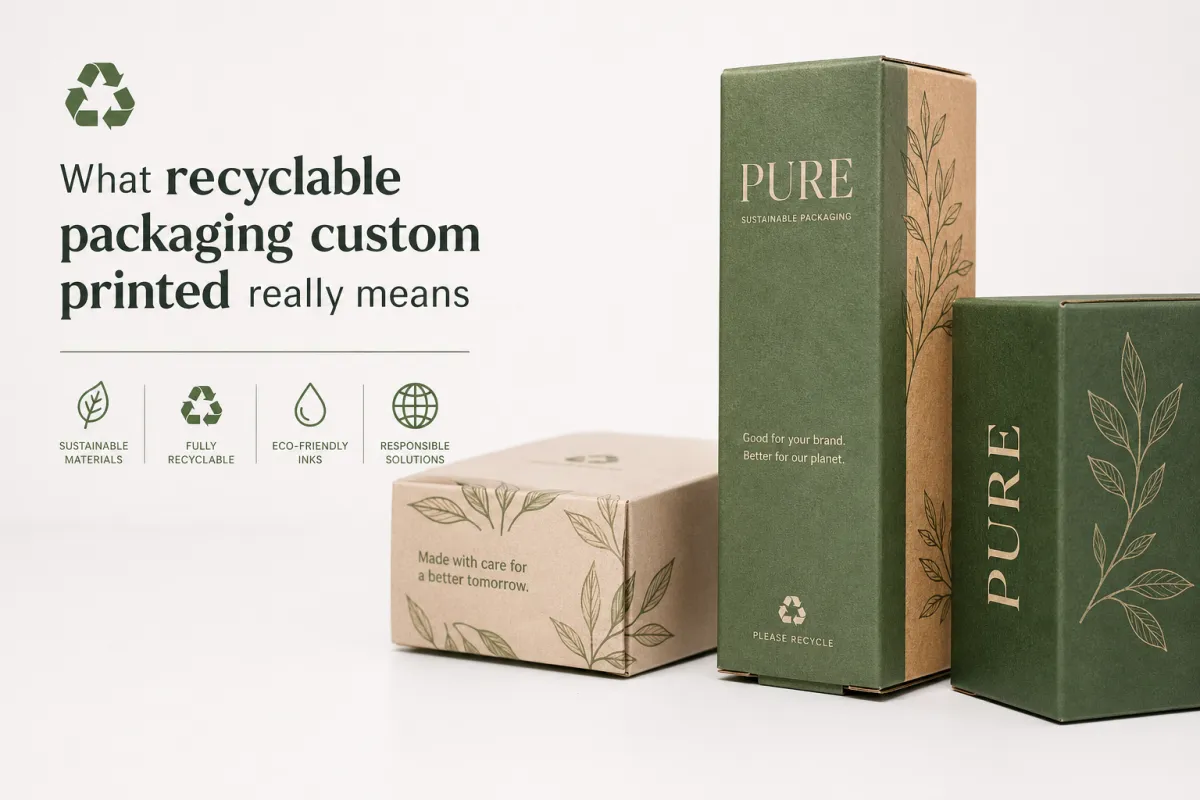
Recyclable packaging custom printed means the box, sleeve, mailer, or insert is made from materials that can enter a standard recycling stream after use, without extra trouble from mixed layers or hard-to-separate parts. That sounds tidy on paper. Real packaging is messier, because recyclability depends on the full structure, not just the main substrate listed on a quote. A 400gsm paperboard carton can still fail if it carries a PET window, a PE lining, or a heavy UV coat that a mill in Poland or Mexico will reject at the pulper screen.
People often mash together recyclable, recycled, compostable, and reusable as if they mean the same thing. They do not. Recyclable means the pack can be processed into new material in the right system. Recycled means some of the content came from recovered fiber or post-consumer material, such as 30% post-consumer board or 100% recycled corrugate. Compostable means it breaks down under specific conditions, usually industrial, not in a damp backyard bin after one weekend storm. Reusable means the package is built for multiple uses, which is nice if your customer keeps it and less nice if the construction pushes your unit cost from $0.26 to $0.54 before freight. Recyclable packaging custom printed should be judged against the recycling system your customer actually uses, not an idealized version of it.
Custom print does not automatically destroy recyclability. I have approved recyclable packaging custom printed on 350gsm FSC kraft board with four-color water-based ink and a light aqueous varnish that recycled cleanly in paper mills in Ningbo and Ohio. Trouble starts when brands treat the finish as decoration first and material science second. The recycler does not care that the pack "feels premium." It cares whether the fibers can be pulped without sending plastic bits through the system or clogging the screen room at the mill.
"The carton said kraft on the outside, but the inside had a plastic film. My recycler called it mixed waste, which is the polite version of 'no thanks.'"
That comment came from a beverage client who had already paid for 8,000 retail cartons at $0.31 each, freight from Shenzhen to Los Angeles not included. We changed the next run by removing the film, switching to a water-based varnish, and simplifying the locking tab to a straight tuck with a dust-flap trim. The unit cost fell to $0.24, and the box actually matched the recycling claim. That is the real work of recyclable Packaging Custom Printed: make the packaging look good, protect the product, and still behave like paper when it reaches the recovery line in a standard MRF.
How recyclable packaging custom printed works
Every recyclable packaging custom printed project has four basic layers: the substrate, the ink system, the coating or varnish, and any add-ons like inserts, windows, or closures. If one of those layers introduces a non-fiber material that cannot be separated, the whole pack becomes harder to handle. In practical terms, a clean paperboard carton can work well. A paperboard carton with a glued-in PET window, a foil stamp, and a soft-touch lamination usually creates a recycling headache no matter how polished the render looked in the pitch deck from Shanghai or London.
The most common recyclable materials I specify are kraft paperboard, recycled paperboard, corrugated board, and molded fiber. Kraft gets used often because it signals "natural" with almost no explanation. Corrugated is the workhorse for shipping and ecommerce because it survives compression, edge crush, and a 4-foot drop test better than most decorative sleeves. Molded fiber is a strong choice for trays and inner protection when you need shape without plastic, especially for skincare jars, headset trays, or a 1.2-kilogram glass bottle set. For paper-based packs, the EPA has a useful overview of recycling basics here: EPA recycling guidance.
Printing method matters as much as material choice. Digital printing is flexible for short runs, fast sampling, and variable data. Flexographic printing is common for corrugated because it handles large volumes with solid color consistency and lower setup waste. Offset printing gives the sharpest detail on premium folding cartons, especially when the design uses fine type or photographic branding. On a 5,000-unit run, I have seen digital quote at $0.28/unit, flexo at $0.19/unit, and offset at $0.34/unit, depending on size, board stock, and ink coverage. Recyclable packaging custom printed can work with all three. The structure just has to match the press, which sounds obvious until someone tries to force a luxury carton into a shipping-box workflow and wonders why the result looks strange in the plant in Foshan.
Recyclability in the real world comes down to a plain question: can this package enter the standard fiber stream without extra sorting pain? If the answer is yes in the target market, the claim has a solid foundation. If the answer needs a footnote, a special drop-off program, or a long disposal instruction, the claim gets shaky. I tell buyers to think like the recycling plant, not the marketing team. That plant runs by the ton, not by the slogan, and it definitely does not care how many mood boards the brand team built around the word "natural" or how long the brief took in Milan. Recyclable packaging custom printed should be simple enough that the recovery line can sort it without a second thought.
There is also a difference between technically recyclable and actually recycled. A package can be built from a recyclable substrate and still fail because local facilities do not accept the coating, adhesive, or liner. That is why I ask suppliers for exact material specs, not just "eco-friendly" language. A 300gsm board with aqueous coating and soy-based ink is one thing. A 300gsm board with PE lamination and a metallized label is another. Same size. Very different life cycle. Same box on a shelf in Amsterdam, completely different fate at the mill gate. For recyclable packaging custom printed, the difference usually starts with a single finish choice.
Key factors that affect recyclability, print quality, and cost
Material choice is the first lever in recyclable packaging custom printed. Virgin board prints beautifully and feels crisp, but it usually costs more than recycled board. Recycled board lowers material cost and often strengthens the story, though it can show more fiber specking and a slightly rougher print edge. Kraft board brings that natural look brands love for branded packaging, yet darker ink colors can swallow detail if the art direction is careless. Molded fiber performs well on sustainability optics, but it is not the answer for every product packaging job. I have had clients try to use it for glass jars that weighed 1.2 kilograms each, packed for air freight out of Shenzhen. Bad idea. Expensive lesson. Slightly dramatic meeting, too. Recyclable packaging custom printed only works when the substrate matches the product weight and the shipping route.
Ink coverage changes both cost and recyclability risk. Heavy dark solids, metallic effects, and full-bleed backgrounds increase ink usage and can slow production. On a 10,000-unit offset run, a dense black flood can add $0.02 to $0.05 per unit over a clean one- or two-color layout. It also makes de-inking harder in some recycling systems. That does not mean the design has to be dull. It means the color story should be chosen with some restraint. A tan kraft carton with one deep green spot color often reads stronger than a black box trying too hard to feel luxurious. I say that as someone who has spent too many hours staring at swatches under 5000K factory lights in Dongguan, which is a special kind of headache all its own. For recyclable packaging custom printed, restraint often prints better than spectacle.
Finishes are where people get clever and then regret it. Foil stamping, soft-touch lamination, full plastic wrap, and heavy UV coatings can all create problems for recyclable packaging custom printed. If the goal is a premium feel, aqueous varnish, water-based matte coating, or light embossing usually keeps the pack closer to fiber-friendly territory. I watched one cosmetics buyer spend $1,900 on tooling for a soft-touch sleeve, then replace it with an aqueous coat after a recycling test in Portland. The second version cost $0.07 less per unit and actually passed the plant's paper test. That was one of those rare moments where everyone in the room looked relieved and mildly annoyed at the same time.
Structure affects both performance and price. A straight tuck carton with no insert is cheaper than a carton with a glued-in tray, tear strip, and window patch. Structure also affects how well the pack protects the product in transit. If you are shipping direct to consumer, the box needs compression resistance and edge strength, especially for ecommerce and subscription product packaging. In those cases, I prefer corrugated with a simple printed sleeve, because the mailer takes the abuse while the sleeve carries the branding. The product stays safe, the customer sees the design, and the carton does not pretend to be more delicate than it really is during parcel handling in Chicago or Frankfurt. Recyclable packaging custom printed for ecommerce should be built around the shipping lane first.
Order quantity matters more than most first-time buyers expect. A 1,000-unit run might land at $0.41/unit because setup and plate costs are spread across a small batch. The same recyclable packaging custom printed at 10,000 units could drop to $0.23/unit, sometimes lower if the size is standard and the artwork stays simple. That is why low-volume custom runs work well for testing, but get expensive fast if you treat them like a long-term retail program. A 24,000-piece reorder in the same spec usually prices far better than three separate 1,000-piece emergency jobs.
| Structure | Typical unit cost at 5,000 pcs | Recyclability profile | Best use case |
|---|---|---|---|
| 350gsm FSC kraft folding carton, 4-color water-based print, aqueous varnish | $0.22-$0.31 | Strong paper-stream fit | Retail packaging, skincare, light consumer goods |
| 32 ECT corrugated mailer, 2-color flexo, no coating | $0.58-$0.82 | Very strong paper-stream fit | Ecommerce shipping, subscriptions, heavier items |
| 300gsm SBS carton, soft-touch lamination, foil accent | $0.34-$0.49 | Mixed or weak fit | Premium presentation, not ideal for simple recycling claims |
| Molded fiber tray with printed kraft sleeve | $0.41-$0.63 | Good if components separate cleanly | Gift sets, fragile product packaging, inserts |
If you want a broader menu of structures, our Custom Packaging Products page is a practical starting point. I send buyers there when they need to compare cartons, mailers, sleeves, and inserts without getting trapped in vague sales talk. It saves time, and it usually keeps the conversation grounded in real materials like 350gsm C1S artboard, 32 ECT corrugate, or molded pulp instead of hopeful buzzwords. For recyclable packaging custom printed, the right format usually becomes clear once you compare the structure stack side by side.
For sourcing paper-based packaging with chain-of-custody support, FSC certification is worth asking about. Not every project needs it, but when a brand wants proof on the supplier side, the FSC system is clearer than a vague "eco" claim. Their site is here: FSC certification information. If a supplier cannot explain the board grade, coating, and certification status in one sentence, keep your wallet closed for another 15 minutes and ask for a spec sheet from the mill in Zhejiang or Jiangsu. Recyclable packaging custom printed becomes a lot easier to defend when the paper trail is as clean as the structure.
Step-by-step process: from brief to production
A clean brief saves money. I have seen recyclable packaging custom printed projects move from a $1,600 quote to a $2,900 mess because nobody wrote down the product size, ship method, or recycling target. Start with the basics: product dimensions in millimeters, target weight, whether the box ships direct or sits on a shelf, and whether you need paper-stream recyclability or a broader sustainability story. If the brief includes a 2-ounce serum bottle, a 240mm retail shelf depth, and a 12-day launch deadline, the supplier can do real work instead of guessing. A one-page brief also cuts the back-and-forth with factories in Shenzhen, Yiwu, or Ho Chi Minh City. For recyclable packaging custom printed, a clear brief is usually the cheapest sustainability decision on the table.
Artwork and dieline come next. The printer needs exact measurements before anyone starts discussing gloss, texture, or print effects. A dieline is not a decorative outline; it is the map that tells the cutter where to fold, trim, glue, and lock. I once sat in a supplier meeting where a brand wanted to add a 3mm bleed correction after approval. That 3mm became a new die, a new proof, and a $420 tooling change at a plant in Dongguan. The fix was simple. The delay was not. I still remember how quiet the room got when the cost explanation landed.
Proofing is where recyclable packaging custom printed either stays clean or wanders into avoidable mistakes. Digital proofs help check layout and copy. Physical samples reveal whether the board feels too flimsy, whether print darkens on kraft, or whether the glue line shows in the wrong place. For color-critical brands, I ask for one round of printed samples and one final sign-off against the approved Pantone reference, usually under D50 light. If the buyer wants a custom PMS and a natural kraft substrate, they should expect variation. Kraft is not a white canvas. Pretending otherwise is how people end up annoyed in the proof room in Milan or Toronto.
Production usually moves in a predictable order: material sourcing, print setup, die cutting, folding and gluing, quality checks, then pack-out. On a standard 5,000-unit run, the schedule might look like 3 days for materials, 2 days for printing, 2 days for die cutting and finishing, and 1 to 2 days for assembly and inspection. That is before freight. If the project needs special testing, a new die line, or custom insert work, add another 4 to 7 business days. Recyclable packaging custom printed is not slow by nature, but it does punish rushed approvals. A realistic schedule is typically 12-15 business days from proof approval for a simple carton, and 15-22 business days for a complex retail pack.
"We can save 2 days if you skip the window patch," the plant manager told me in Dongguan, and he was right. The client kept the patch anyway, then complained about the calendar like the calendar caused it.
I have a simple rule from years of supplier negotiations: if the structure is simple, timelines stay sane. A flat carton with one-color print can move quickly. A layered retail pack with a specialty finish, custom insert, and two proof rounds will not. That is not pessimism. That is math, and packaging math has a habit of winning arguments whether the box is being made in Foshan, Jiaxing, or Kansas City. Recyclable packaging custom printed is easiest to schedule when the design does not ask the factory to perform magic.
Pricing and lead times for recyclable packaging custom printed
Buyers usually want one number. The honest answer is that recyclable packaging custom printed pricing breaks into substrate, print method, finishing, tooling, assembly, and freight. If you are ordering 2,000 units, setup costs can take a painful slice of the total. If you are ordering 20,000 units, the same setup gets diluted and the unit price starts behaving. I have seen a simple folding carton land at $0.18/unit for 10,000 pcs, then jump to $0.42/unit at 1,500 pcs. Same size. Same art. Different math. If your supplier quotes a 350gsm C1S artboard carton at $0.15 per unit for 5,000 pieces, ask whether that includes print, die cutting, and carton folding, or just board. Recyclable packaging custom printed should always be quoted on the full build, not the prettiest part of it.
Lead time has the same shape. Quoting can take 1 to 3 business days if the brief is clean. Sampling usually takes 5 to 10 business days, depending on whether the supplier has the board in stock and whether the print is digital or analog. Production can take 7 to 18 business days for a standard run. Shipping adds another 3 to 12 days based on origin, destination, and whether customs decides to be dramatic. The biggest delay I see is not the press. It is approval. One brand sat on a sample for 11 business days because three departments wanted to "review sustainability language." The box was fine. The email chain was the problem. For a straightforward carton out of Shenzhen, the total cycle is often 12-15 business days from proof approval before freight.
Custom features push both cost and calendar. Specialty inks can add $0.03 to $0.08 per unit. New dies can add $120 to $600 in tooling, depending on size and supplier. Inserts, windows, thumb cuts, and multi-panel designs also stretch the workflow. If speed matters more than theater, keep the structure flat and the number of unique parts low. If premium branding matters more, budget for extra proofing and a longer setup window. That is the trade. No mystery. Just a budget spreadsheet with better manners and a factory schedule that will not bend just because marketing wants a surprise launch. Recyclable packaging custom printed can be affordable, but only if the design stays disciplined.
For brands comparing a few approaches, this is the blunt version:
- Fastest: digital-printed kraft cartons with aqueous coating, usually 5 to 9 business days after proof approval.
- Cheapest at volume: flexo corrugated with one or two colors, often the best fit for shipping boxes above 10,000 units.
- Most premium: offset cartons with careful color control, usually the best balance for retail packaging and clean package branding.
I also tell clients to get freight quoted separately. A box that costs $0.24/unit ex-factory can become a $0.31/unit landed cost once ocean, inland trucking, and duties show up. That matters. I once watched a beverage brand celebrate a $0.06 unit savings and then lose $1,120 in freight variance because nobody checked the carton cube. That is not a packaging win. That is a spreadsheet prank, and it happens more often than people admit, especially on shipments moving from Shenzhen to Long Beach or Rotterdam. Recyclable packaging custom printed should be planned with the landed cost, not just the factory quote.
Common mistakes that make recyclable packaging less recyclable
The first mistake is mixed materials. Paperboard with plastic film, metallic laminate, or glued-in plastic windows looks harmless on a sample table, but it can ruin the recycling path. The same goes for thick foam inserts or non-fiber closures. I had one skincare client bring me a carton that had a paper outer shell and a PET inner tray. The outer shell was recyclable. The tray was not, at least not in the markets they sold into. That was enough to stop the claim until they redesigned the insert and moved to a molded fiber cradle from a supplier in Guangdong. Recyclable packaging custom printed needs a mono-material mindset whenever possible.
The second mistake is choosing finish first and recyclability second. Soft-touch lamination feels expensive in hand, and yes, it photographs well under soft lighting. It also adds a plastic layer that can interfere with fiber recovery. Foil stamping is another trap. A small logo stamp is usually manageable. A giant foil flood across the lid is a different story. I am not against premium packaging. I just think a brand should understand what it is buying before it pays for a surface that nobody can process cleanly at the mill in the Midlands or southern China. For recyclable packaging custom printed, the premium look should still respect the recycling stream.
The third mistake is overbuilding the structure. Every extra tuck, flap, tear strip, and insert adds labor and cost. Worse, each extra part gives the end user one more chance to mis-sort the pack. If the box needs to be explained like furniture assembly instructions, the design is probably trying too hard. Clean recyclable packaging custom printed usually performs better with 1 or 2 well-designed components than with 5 layered parts pretending to be elegant. A simple mailer and sleeve often beats a complicated tray system that costs $0.11 more and confuses every warehouse associate who touches it.
The fourth mistake is vague sustainability claims. "Eco-friendly" is not a spec. "Recyclable" is not a spec either unless you define the material, finish, and target market. Ask for the board grade, the coating type, the adhesive, and any certification or disposal guidance the supplier can provide. Then verify the claim against the market you are selling into. If a supplier cannot explain the difference between 350gsm recycled board and 350gsm SBS, they should not be writing your sustainability copy. A clear spec sheet from Shenzhen or Zhejiang will do more for credibility than a glossy one-pager. Recyclable packaging custom printed becomes easier to defend when the material stack is documented in plain language.
The fifth mistake is ignoring user behavior. If the customer has to separate three components, peel a label, and hunt for disposal instructions, many will simply throw the whole pack away. I do not blame them. People have better things to do than decode packaging design. One retailer I advised removed a paper band, cut the pack from 4 pieces to 2, and added a single disposal note on the bottom flap. Recycling rates improved because the decision became simpler. The change cost $0.03 less per unit and reduced assembly time by nearly 18 seconds on the line in Dongguan.
Expert tips and next steps for your packaging brief
Start with a one-page spec sheet. Put the material, print method, coating, insert details, recycling claim, and target market in writing before you ask for a quote. A supplier should be able to read that sheet and tell you whether recyclable packaging custom printed is realistic at your target price. If they need a day to understand the brief, that is fine. If they need five meetings, the brief is weak. A good spec should name the board weight, such as 350gsm C1S artboard or 32 ECT corrugate, and it should say where the box will be made, whether that is Shenzhen, Dongguan, or Ningbo. Recyclable packaging custom printed is far easier to source when the brief is specific enough to survive a factory review.
My second tip is to test one hero SKU first. Do not redesign the entire line at once unless you enjoy burning time and money in equal measure. I have seen a single hero carton validate a new sustainability direction in 14 days, while a full 8-SKU overhaul dragged for two months because the team argued over tiny differences in flap length and logo placement. Start with one pack, one size, one set of acceptance criteria. Then scale. A good first run might be 3,000 pieces of one skincare carton rather than 12,000 pieces across four shapes. Recyclable packaging custom printed often proves its value fastest on the simplest hero item.
Ask for a physical sample before you approve a full run. Better yet, ask the supplier how that sample should be disposed of in your target market. A supplier who knows the answer usually understands the material stack. If they say "it should be fine" and nothing else, keep looking. I would rather hear "this is recyclable in many curbside paper programs in the U.S., but not where film-coated paper is restricted" than hear a fuzzy promise with a smile attached to it. Honesty saves money, and it saves a lot of awkward follow-up emails too, especially when shipping to California, Germany, or Ontario. Recyclable packaging custom printed should come with disposal guidance that matches the actual market.
Compare at least three manufacturers on four things: structure, documentation, sampling policy, and turnaround. Price matters, sure. But a quote that is $0.03 cheaper and arrives with no material spec is not a deal. It is a future problem. If you need help building the sourcing side, our custom printed boxes and retail packaging options are a straightforward place to start comparing formats without guessing at the wrong structure. I would rather compare a carton from Suzhou, a mailer from Foshan, and a sleeve from Shenzhen than sign off on a mystery box with no board grade. Recyclable packaging custom printed works best when the sourcing side is as organized as the print side.
My last practical note is simple: keep the first recyclable packaging custom printed run clean, flat, and easy to separate. Use one substrate where possible. Use water-based ink or another fiber-friendly print system. Skip the plastic window unless the product absolutely needs it. If you want to launch with confidence, test disposal behavior with 5 to 10 people who are not on your team and watch what they do. That tells you more than a slide deck ever will. It also tells you which instructions are actually readable once real hands get involved at home, in a dorm room, or at a warehouse desk. Recyclable packaging custom printed should feel obvious to the person opening it and just as obvious to the person recycling it.
If you want a box that protects the product, supports package branding, and stays useful after opening, recyclable packaging custom printed is absolutely doable. You just need the right substrate, the right finish, and a supplier who understands that a recycling claim is not decoration. It has to hold up in the real bin, not just on the mockup. I have seen that lesson the hard way, more than once, and usually after someone tried to save $0.04 per unit with the wrong coating or the wrong window patch. Recyclable packaging custom printed is at its best when performance, print quality, and disposal all point in the same direction.
How much does recyclable packaging custom printed usually cost?
Cost depends on material, print method, finish, order quantity, and whether you need custom tooling or inserts. On a 5,000-unit run, I often see simple kraft or corrugated structures land around $0.22 to $0.82 per unit depending on format, while laminated or foiled packs climb higher. A 350gsm C1S artboard carton with a clean one-color print might quote near $0.15 to $0.19 per unit at 5,000 pieces, while a molded fiber tray with sleeve can sit closer to $0.41 to $0.63. Smaller runs usually cost more per unit because setup fees are spread across fewer boxes. That part never gets less annoying, even if you've been in packaging for years and have quotes from three factories in Guangdong to prove it. Recyclable packaging custom printed pricing usually becomes more manageable as the run size rises.
What is the typical timeline for recyclable packaging custom printed orders?
Most projects move through quoting, sampling, approval, production, and shipping in that order. A simple repeat order might be done in 7 to 14 business days after proof approval, while a new structure with custom dies can take 3 to 5 weeks. For a plain folding carton from proof sign-off, I usually expect 12-15 business days in production if the board is in stock in Shenzhen or Dongguan. The biggest delays usually happen during artwork approval and sample revisions, not the print run itself. I have lost more time to email threads than to machines, and that is saying something. Recyclable packaging custom printed schedules are usually predictable once the artwork is locked.
Can I use full-color printing and still keep packaging recyclable?
Yes, if the base material and finish still fit the recycling stream you are targeting. Full-color art on recyclable packaging custom printed is common on kraft board, recycled paperboard, and corrugated mailers. The usual problems are heavy coatings, plastic lamination, and mixed-material windows, not color itself. A 4-color process print on 350gsm recycled board with aqueous varnish is usually much safer than a 1-color box wrapped in soft-touch film.
Which materials work best for recyclable packaging custom printed?
Kraft paperboard, corrugated board, and molded fiber are common choices because they are widely accepted in paper recycling streams. Mono-material builds are usually easier to explain and recover than mixed-material structures. The best material depends on product weight, shipping stress, and the finish you want on the front panel. For a light retail SKU, 350gsm Kraft Folding Carton works well; for ecommerce, a 32 ECT corrugated mailer is usually stronger; for inserts, molded pulp from a plant in Jiangsu or Vietnam can be a practical option. Recyclable packaging custom printed should always match the recovery path as closely as it matches the product.
How do I verify a supplier's recyclable claim before ordering?
Ask for the exact material spec, coating type, and any certification or recycling guidance they can provide. Request a sample and confirm how the package should be disposed of in the target market. If the answer stays vague after one follow-up, treat the claim as marketing until you get documentation. I want to see the board grade, the adhesive type, and the finish called out in plain language, not just "eco carton" on a quotation from a factory in Shenzhen. Recyclable packaging custom printed should come with proof, not just a promise.
If you are planning recyclable packaging custom printed for a launch, the smartest move is not chasing the fanciest finish. It is choosing a structure that prints well, survives shipping, and actually belongs in the recycling stream. That is how I would spend the budget, and after too many factory-floor arguments over soft-touch lamination and plastic windows, I can tell you that simple usually wins. Start with the substrate, lock the finish, then confirm the recovery path with a real sample before you place the order. A clean 350gsm FSC kraft carton, a water-based ink set, and a 12-15 business day production window from proof approval will usually beat a flashy pack that costs $0.09 more and creates problems in the curbside bin. Recyclable packaging custom printed does not need to be complicated to be effective; it just needs to be built with care.

