Buyer Fit Snapshot
| Best fit | moq packaging affordable projects where brand print, material claims, artwork control, MOQ, and repeat-order consistency need to be specified before quoting. |
|---|---|
| Quote inputs | Share finished size, material target, print colors, finish, packing count, annual reorder estimate, ship-to region, and any compliance wording. |
| Proofing check | Approve dieline scale, logo placement, barcode or warning zones, color tolerance, closure strength, and carton packing before bulk production. |
| Main risk | Vague material claims, crowded artwork, missing packing details, or unclear freight terms can make a low unit price expensive after revisions. |
Fast answer: moq packaging affordable: pricing, specs, and process should be specified like a repeatable production item. The safest quote records material, print method, finish, artwork proof, packing count, and reorder notes in one written spec.
Production checks before approval
Compare the actual filled-product size with the drawing, then confirm tolerance on folds, seals, hang holes, label areas, and retail display edges. Reserve space for logos, QR codes, warning copy, and material claims before decorative graphics fill the panel.
Quote comparison points
Review material grade, print process, finish, sampling route, tooling charges, carton quantity, and freight assumptions side by side. A quote is only useful when the supplier can repeat the same color, closure quality, and packing count on the next order.
The first time a supplier told me their quote was moq packaging affordable, I almost believed them. Then the invoice added a knife fee, a plate charge, a sample fee, and a rework line that turned a tidy carton into a very expensive lesson. I was standing on a packing floor in Shenzhen, holding a 250 x 180 x 60 mm sample box, and the whole thing was kinda funny right up until the freight and handling charges showed up.
That is why I never judge packaging by unit price alone. moq packaging affordable is really about total landed cost, the actual MOQ, and whether the structure fits the launch instead of the fantasy version of it. Get those three things aligned and you can buy intelligently without ending up with boxes that look polished but behave like financial traps. A $0.28 carton at the factory door can become a $0.51 carton after inland trucking, export docs, and receiving fees.
Small brands can absolutely get moq packaging affordable results, but only when they stop requesting every finish under the sun. I watched a skincare founder in Los Angeles cut her unit cost from $1.42 to $0.39 by dropping foil, magnets, and a custom EVA insert on a 1,000-piece run. Honestly, I think that kind of discipline is more impressive than a flashy box. Anyone can spend money. Fewer people can protect margin without making the brand look cheap.
These ranges are working ranges, not promises. Paper markets move, labor changes, and freight can swing faster than people expect. I have seen a quote stay flat for ten days and then jump because the board stock was re-priced after a pulp increase. That is normal. It is also why a good brief matters more than a lucky number.
Why moq packaging affordable starts with the right mix
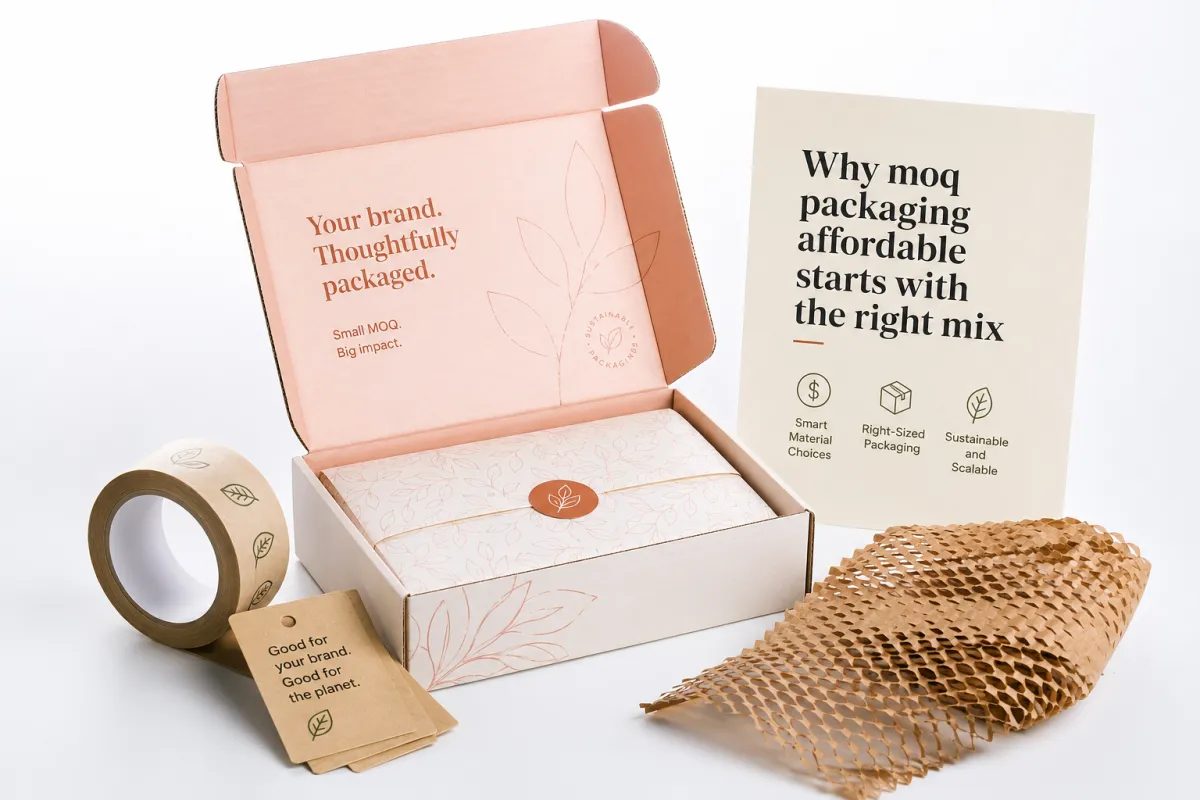
moq packaging affordable starts with structure, not wishful thinking. I once watched a supplier quote what looked like a bargain carton price on a 5,000-piece run, then add a knife fee, a plate charge, a sample charge, and another line for rework because the dieline was off by 4 mm. The box itself was fine. The math was the problem. By the time the cartons were packed into master cases, the "cheap" order had become an ordinary invoice with a fancy haircut.
That is the trap most buyers fall into. They compare the headline unit price and ignore setup, freight, sampling, and waste. I have sat in meetings with founders who were convinced they had found moq packaging affordable, only to discover the carton was 20% too large, the insert was custom die-cut, and the shipping carton had to be upgraded because the retail box could not survive parcel drops from 90 cm. Unit cost matters. So does everything around it that quietly eats margin.
The smartest buyers treat moq packaging affordable like a planning exercise. What is the launch plan? Is this a 500-unit test, a 1,000-unit seasonal drop, or a 5,000-unit retail push across California, Texas, and New York? A simple mailer box with one-color print can work beautifully for ecommerce. A rigid box with a magnetic flap may fit a gift set. Premium details are not the enemy. Paying for them before the product has earned them is.
The practical rule I use after years of walking factories and arguing over fee lines is simple: if the packaging does not help sell the product, protect the product, or reduce damage claims, remove it. That is how moq packaging affordable becomes real. You get a cleaner spec sheet, a better quote, and fewer surprises when the factory in Dongguan decides to "re-check" a line item that should never have been there in the first place.
"If you want the price to stay low, stop asking for three coatings and a magnet on a 1,000-piece order." That came from a carton manager in Dongguan after a 14-hour shift, and he was not being rude. He was doing math on a job that was already running at $0.47 per unit.
Timing matters too. Buyers chasing moq packaging affordable often forget that slow approvals cost money. A design that sits untouched for 10 days can push a shipping window, miss a retailer intake date, or force air freight instead of ocean freight. I have seen one missed dock appointment add $740 to a small run leaving Ningbo for a warehouse in Dallas. The packaging was fine. The schedule was not. That kind of thing makes me slightly feral, honestly, because the bill never shows up where the mistake happened.
The sequence I use is always the same: structure first, then material, then print, then finish. That order keeps moq packaging affordable because every decision supports the next one. It also keeps the supplier honest. A clear brief produces a clear quote, and that is usually where the savings begin. On a 350gsm C1S carton, for example, the price can move by 18% if the board size changes by just 6 mm and the fold line shifts.
Product details: what counts as affordable moq packaging
moq packaging affordable is not one box type. It is a range of package formats that make sense at lower volumes without bloating the budget. The most common ones I see are folding cartons, rigid boxes, mailer boxes, labels, inserts, and shipping sleeves. Each one has a sweet spot. Each one has a point where the price jumps because the structure gets too elaborate for the run size. A 1,000-piece folding carton in Guangzhou behaves very differently from a 1,000-piece rigid box in Shanghai.
Folding cartons are usually the easiest place to start. A 350gsm C1S artboard carton with four-color print and aqueous coating can be very competitive at 1,000 to 5,000 pieces. Mailer boxes made from E-flute or B-flute corrugated are strong for ecommerce, especially if the box needs to survive parcel handling in the UK, Canada, or cross-country U.S. shipments. Rigid boxes feel premium, but they are less forgiving on MOQ and labor. If you want moq packaging affordable, rigid usually needs a very good reason, not just a mood board and a dream.
A client in Los Angeles once brought me a hair serum carton spec that included foil stamping, embossing, soft-touch lamination, and a magnetic closure on a 1,000-unit run. The unit cost was ugly. We stripped it back to a printed folding carton, one Pantone spot color, and a matte aqueous finish. The box still looked sharp. More important, the order moved back into moq packaging affordable territory and the founder kept enough margin to fund a second SKU instead of sitting there with a beautiful box and no cash left to market the thing.
Different product categories behave differently. Cosmetics often need shelf appeal, but they also need clean typography and a strong brand color, not five special effects fighting for attention. Supplements want trust, legibility, and compliance space. Apparel packaging cares more about presentation and shipping efficiency. Food packaging carries more pressure on barrier performance and regulatory labeling, especially if it is moving through California or the EU. Gift packaging can tolerate more flourish, but the budget can disappear fast if you add ribbons, windows, and inserts on a short run. That is why moq packaging affordable is always category specific.
A practical reference point is the package itself, not the fantasy version of it. A simple Custom Printed Box with disciplined artwork often reads better than an overworked design that looks expensive on paper and tired in hand. I tell buyers to browse our Custom Packaging Products page for the structures we use most often on lean launches. That helps people see how moq packaging affordable still leaves room for brand personality without making the whole thing feel like it was assembled in a panic.
Brand stage matters too. A test run does not need the same box as a retail rollout with 40 stores in Chicago, Austin, and Atlanta. A subscription box does not need the same packaging as a one-time press kit sent to 25 editors. A seasonal drop can afford a little more decoration because the shelf life is shorter. If your launch is still proving demand, moq packaging affordable usually means keeping the structure simple and spending on clarity rather than ornament. Clear beats clutter almost every time, even if some founders hate hearing that.
Specifications that keep moq packaging affordable
The fastest way to wreck moq packaging affordable is to leave the specs vague. I want dimensions, board thickness, material grade, print sides, finish, insert style, and closure method locked before I ask for final pricing. If those details move around, the factory will rework the quote, and every rework adds cost. That is not a mystery. That is just production, with all its charming little ways of punishing vague briefs.
Exact sizing matters more than most buyers think. If the box is 8 mm too wide, you waste board, increase freight volume, and may need a different carton layout. If the insert is 3 mm too loose, the product rattles. If the insert is too tight, production slows down. I have seen a 2 mm error on a sleeve panel cause a whole stack of 2,000 pieces to be re-cut on the floor in Shenzhen. One tiny mistake turned a tidy order into a headache nobody wanted. moq packaging affordable loves precision.
For materials, I usually start with the simplest board that protects the product. SBS and C1S artboard are common for Printed Retail Boxes. Kraft works well for earthy branding and lower decoration. Corrugated is the right answer for shipping strength and parcel handling. Coated paperboard can look premium without draining the budget. If you are buying moq packaging affordable, ask whether the product really needs a specialty stock or whether a standard grade will do the job just fine. On many 500- to 2,000-piece launches, a standard 350gsm board is enough.
Finish selection is where people overspend for very little return. A full soft-touch lamination on every surface looks nice, but it adds labor and cost. The same goes for heavy foil coverage or multiple spot UV passes. In many cases, a single matte coat or a clean gloss varnish gives enough distinction. If the brand color is strong, the typography is sharp, and the dieline is well handled, moq packaging affordable can still look premium. I would take that over a box covered in expensive extras that distract from the product.
Artwork files matter too. Clean dielines, linked images, correct bleeds, and final dimensions reduce prepress delay. I have watched buyers send a PDF with missing fonts, wrong folds, and a logo placed inside a glue area. That always leads to proof revisions. Proof revisions lead to delays. Delays lead to money burned on rescheduling. If you want moq packaging affordable, send a file package that looks like someone cared about production, not just presentation. A proper art pack can shave 2 to 3 days off a quote cycle.
For shipping-sensitive packs, I also like to reference real test standards. If a mailer box or retail carton is going to move through parcel networks, I check whether the project should be tested against ISTA methods such as ISTA 3A, or similar drop and vibration expectations. You can review those standards at ISTA. That kind of check helps keep moq packaging affordable because it reduces damage claims later, and damage claims are a wonderfully annoying way to discover you saved the wrong money.
What keeps costs in line is short and plain:
- Use one box style per SKU unless the business case is strong.
- Keep print to 1 to 4 colors if the brand can support it.
- Avoid windows, magnets, and custom inserts unless they solve a real problem.
- Keep the dieline tight so the carton does not ship air.
- Approve final art once, then stop moving the goalposts.
The list looks simple because it is. moq packaging affordable is usually won or lost in the setup sheet, not in a dramatic last-minute discount that appears after three phone calls and a lot of sighing. On a 3,000-piece order, a 7% reduction in board waste can matter more than a headline "special price."
moq packaging affordable pricing and MOQ breakdown
moq packaging affordable pricing depends on setup, tooling, print method, paper grade, finishing, labor, packing, and freight. People want a single number. Suppliers want a spec sheet. The truth sits in the middle. Lower quantities usually mean higher unit cost, but the wrong MOQ can leave too much cash trapped in inventory. I would rather see a founder buy 800 well-specified boxes than 5,000 bad ones that look cheap in the spreadsheet and expensive everywhere else.
A 500-unit run may have a higher unit price because the setup is spread across fewer pieces. A 5,000-unit run may drop the per-unit cost sharply, but only if the box is simple enough for the line to run efficiently. That is why moq packaging affordable is not just about ordering more. It is about matching quantity to the actual sales curve, which is the part many people want to ignore because it is less exciting than choosing foil.
| Package type | Typical MOQ | Indicative unit cost | Best fit | Cost note |
|---|---|---|---|---|
| Folding carton, 4-color print, aqueous coat | 500 to 1,000 | $0.32 to $0.68 | Cosmetics, supplements, small retail runs | Strong entry point for moq packaging affordable if the size is tight |
| Kraft mailer box, single-color print | 300 to 1,000 | $0.95 to $1.60 | Ecommerce, subscription kits, apparel | Strong structure, but freight volume can change landed cost |
| Rigid gift box with insert | 500 to 2,000 | $1.80 to $4.50 | Premium gifting, PR kits, luxury retail | Looks expensive because it is expensive |
| Custom label or sleeve | 1,000 to 5,000 | $0.04 to $0.22 | Fast refreshes, secondary branding, promotions | Useful for moq packaging affordable launches that need low cash outlay |
Those numbers are not a promise. They are a working range based on common materials, standard print, and normal factory labor in places like Shenzhen, Dongguan, and Ningbo. A rigid box with a special insert can jump fast. A simple carton can stay low if the size is efficient. One client paid $0.18 per unit on 5,000 folding cartons because the art was clean, the board was standard, and there were no decorative extras. That is a very different story from the $0.72 unit cost on a 700-piece box with foil and embossing. Both were real. Only one was moq packaging affordable.
There is also a supplier quoting game that buyers need to watch. Some factories quote low on the box and make the money back on plates, sampling, export handling, or insert assembly. Others bury freight assumptions in the final number. I always ask for a line-by-line comparison and a landed-cost estimate to the delivery ZIP. That is how I compare moq packaging affordable options without getting fooled by a shiny headline that disappears the minute you ask one more question.
If you want to save money fast, ask for two quotes at once: one at your ideal spec and one with a simplified spec. Remove one finish, switch to standard board, or drop a custom insert. You will see exactly where the money moves. That exercise does more for moq packaging affordable than haggling over five cents on the wrong spec, which is a hobby some buyers seem to enjoy far too much.
Another point buyers miss: MOQ is not always the actual factory minimum. Sometimes the minimum is driven by paper sheet size, print press setup, or a finishing machine's changeover time. Sometimes a supplier can bend the number if the schedule is flexible and the artwork is simple. Sometimes they cannot. I respect suppliers who say no when the math is bad. That honesty is part of moq packaging affordable too.
Sustainability can affect pricing too. If you want FSC-certified paper or recycled content, the cost might move slightly. That is normal. I advise buyers to ask for chain-of-custody options early and to compare them against the brand story. For paper sourcing and chain-of-custody basics, FSC is a useful reference point at FSC. A clean sustainability choice can still fit moq packaging affordable if the rest of the spec is disciplined. On a 2,000-unit order, certification might add $0.03 to $0.08 per unit, which is manageable if the rest of the structure is lean.
moq packaging affordable process and timeline
The order flow for moq packaging affordable is straightforward if everyone does their part: brief, quote, dieline, artwork check, sample or proof, production, quality control, packing, and shipment. The job gets messy when a buyer skips the brief or changes the structure after the proof is already approved. That is where time and money leak out, usually in a way that looks completely avoidable in hindsight, which is always the most irritating kind.
A clean timeline for a simple carton can be 12 to 15 business days from proof approval to shipment, depending on quantity and finishing. A more decorative project with lamination, foil, or inserts may need 18 to 25 business days. Sampling can add 3 to 7 days before the production clock even starts. If someone promises moq packaging affordable and overnight speed on a complex box, I start asking who is absorbing the risk, because somebody always is. In practice, the fastest jobs usually come from Guangzhou or Dongguan when the dieline is already final.
One of my best factory-floor lessons came from a paper plant near Shenzhen where a buyer kept changing the bottle neck height after the sample was approved. Every change looked tiny on the screen. On the line, each one meant a new die adjustment and a new inspection. The job drifted by a week. The final boxes were fine, but the air freight bill was ugly. That is why I push clients to lock the spec sheet before they chase moq packaging affordable pricing.
There are three delay traps I see all the time. First, artwork revisions after approval. Second, unclear measurements that create fit issues. Third, late decisions on finish or shipping method. None of these are glamorous problems. All of them cost real money. If you want moq packaging affordable, the easiest fix is discipline: final dimensions, final art, final delivery address, then production.
Quality control is another reason to keep the process simple. On small runs, I prefer pre-production checks, a signed sample, and an in-line review before the full run is packed. That does not mean I want slow bureaucracy. It means I want fewer surprises. A supplier who checks carton crush strength, print registration, glue integrity, and fold accuracy is helping you protect margin. That is part of moq packaging affordable even if nobody puts it in the quote line. On a 1,500-piece run, catching a glue issue early can save $280 in rework.
Logistics can swing the final number more than the box itself. Ocean freight, air freight, domestic trucking, and warehouse receiving all change landed cost. A carton that looks cheap at the factory door can become expensive if the shipment is cubic-heavy and the destination is far from port. I always ask where the boxes are going, who receives them, and whether the buyer needs split deliveries. moq packaging affordable only matters if the boxes arrive where they are supposed to go. A freight quote from Shenzhen to Los Angeles can look very different from the same carton moving to Toronto or Hamburg.
For buyers who want a quicker decision path, use this order:
- Choose the box structure based on the product and channel.
- Lock dimensions around the actual product, not the product plus wishful thinking.
- Pick the simplest material that still protects the item.
- Limit finishes to the ones that change shelf impact or brand clarity.
- Request pricing at two or three quantities so the MOQ math is clear.
That process keeps moq packaging affordable because it prevents the usual last-minute chaos. No mystery. No drama. Just a decent spec sheet and a supplier who knows how to run it without pretending every quote can be rescued by optimism. On most jobs, a final proof approved by 3:00 p.m. can still keep the press slot for the next business day.
Why choose us for moq packaging affordable projects
We help buyers trim waste, avoid spec mistakes, and get pricing that makes sense for the quantity they actually need. That is the whole point of moq packaging affordable. Not magic. Not fake scarcity. Just better decisions and fewer surprise charges that show up like uninvited guests. If the run is 750 units, we build around 750 units, not a fantasy 7,500.
I have spent enough time on factory floors to know where suppliers hide cost and where real savings live. Sometimes the answer is a different board grade. Sometimes it is a tighter dieline. Sometimes it is as simple as changing the print layout so more pieces fit on a sheet. I remember one negotiation in Dongguan where the supplier tried to push a more expensive lamination on a 2,000-unit order. We switched to a standard aqueous coat, kept the same visual impact, and saved $310. That is the kind of win that actually matters in moq packaging affordable work.
Quality control matters just as much as price. Small runs have less room for error because every bad piece hurts more. We rely on pre-production confirmation, final spec sign-off, and practical inspection points like glue alignment, crease depth, color variance, and carton squareness. That is not fancy language. It is how you keep reprints off the schedule and protect moq packaging affordable margins. A 2% defect rate on 500 boxes is a bigger problem than people expect.
Supplier relationships also help. A factory that knows your target range can suggest a better board size, a more efficient print layout, or a shipping plan that avoids unnecessary repacking. I have seen a well-managed sourcing relationship shave two days off a schedule simply because the paper was already reserved in the right caliper. That sort of thing does not sound dramatic, but it is exactly how moq packaging affordable projects stay affordable. A reserved 350gsm sheet in the right size can beat a last-minute special order every time.
We are honest when the answer is not a discount. If a rigid box with foam inserts and foil stamping is the right choice, we will say so. If a simpler custom printed box is smarter for the first run, we will say that too. Buyers do not need theater. They need accurate pricing, clear specs, and a supplier who tells the truth before the order starts. That is how moq packaging affordable should work.
If you want to compare our options, start with a simple box, a standard stock, and two quantity breaks. Then compare that against your ideal spec. That side-by-side view usually exposes the real savings without gutting the branding. It is also the quickest way to see how moq packaging affordable can still support strong package branding and retail packaging goals. A 1,000-piece and 3,000-piece comparison often shows a $0.11 to $0.19 unit drop on simple cartons.
For basic ordering questions, our FAQ covers proofs, sampling, and file prep. If you are still comparing formats, our Custom Packaging Products page shows the structures most buyers use for branded packaging and product packaging projects that need to stay within budget. It is useful when you need to decide between a mailer box, a folding carton, or a sleeve before committing to a quote.
Next steps for moq packaging affordable orders
If you want a fast quote for moq packaging affordable, send the exact package type, dimensions, quantity, material preference, print colors, finish, and delivery location. Include artwork or a dieline if you already have one. If you have a target launch date, include that too. The more complete the brief, the fewer rounds of back-and-forth, and the faster the number makes sense. A proper brief can turn a 48-hour quote cycle into 24 hours.
I always recommend getting one quote on your ideal spec and one on a simplified spec. Maybe the first version uses a soft-touch finish and custom insert. The second version uses standard board and no insert. That comparison shows exactly where the savings live. It also keeps moq packaging affordable grounded in facts, not wishful thinking. The gap is often larger than people expect: I have seen $0.61 versus $0.36 on the same carton once the finish was stripped back.
Use this checklist before you send a request to a factory:
- Box type: folding carton, mailer box, rigid box, sleeve, or label.
- Dimensions: finished size, not just product size.
- Quantity: two or three break points for comparison.
- Materials: board type, caliper, and any FSC or recycled requirement.
- Print: number of colors, inside print, and any Pantone match.
- Finish: matte, gloss, aqueous, foil, emboss, or none.
- Delivery: ZIP code, Incoterm, and preferred shipping method.
That checklist sounds basic because it is. Yet basic is where moq packaging affordable gets won. A buyer who can answer seven concrete questions will get a better quote than a buyer who only says, "We need something nice and affordable." Nice is subjective. Affordable is measurable. And if I sound a little blunt there, well, that is because I have watched too many people pay extra for vague instructions.
If you need to lower the budget, do it in the right order. First simplify the structure. Then remove nonessential finishes. Then tighten the dimensions. Then compare landed cost at two or three quantities. That sequence usually protects the brand while cutting waste. It is also the cleanest way to keep moq packaging affordable without landing in a generic package that no one remembers. A 7 mm trim reduction can sometimes save more than a decorative upgrade costs.
One more practical point: do not negotiate on the wrong thing. A supplier can sometimes shave a few cents by changing the board size or shifting the print layout, but those gains disappear if the box is overbuilt or the insert is unnecessary. The strongest savings usually come from removing complexity, not squeezing the last cent out of a bad spec. That is the part people hate hearing, because it means the first fix is usually restraint.
How do you keep moq packaging affordable?
The cleanest answer is to control the spec before the factory starts cutting. Start with the product's real dimensions, then choose the simplest structure that protects it, then add only the finishes that improve shelf impact or reduce damage. That is the fastest route to moq packaging affordable because it cuts setup waste, trims freight volume, and keeps the minimum order quantity aligned with actual demand.
If you are buying custom packaging for a small launch, compare at least two versions: one ideal spec and one simplified version. That side-by-side view usually shows where the money disappears, whether it is in foil stamping, magnets, custom inserts, or oversized cartons. It also helps you choose between folding cartons, mailer boxes, and corrugated packaging with a clear eye on landed cost. For most brands, moq packaging affordable is less about chasing the lowest factory quote and more about removing the parts that do not earn their keep.
Good file prep matters too. Final dielines, accurate bleeds, and one approved artwork version reduce prepress delays and keep the timeline predictable. Add a delivery ZIP, quantity breaks, and any compliance needs, and the quote gets much more useful. That is the sort of discipline that makes moq packaging affordable practical instead of aspirational.
There is one more habit that helps. Ask the supplier to separate unit cost, setup cost, and freight cost. When those numbers are blended together, it becomes almost impossible to tell whether the cheap-looking option is actually cheap. Once the costs are split out, the best choice tends to reveal itself. Sometimes the lower MOQ is the smarter buy. Sometimes a slightly larger run lowers the landed cost enough to matter. The point is to see the whole picture before you sign.
How do I get moq packaging affordable for a small launch?
Start with a simple structure and skip the finishes that do not help sell the product. Ask for pricing at 500, 1,000, and 3,000 units so you can compare unit cost against cash flow. Keep dimensions tight and use standard materials whenever possible. That is the fastest path to moq packaging affordable without sacrificing the look. A 350gsm folding carton with one Pantone color can often stay under $0.40 per unit on a 1,000-piece run.
What is the lowest MOQ for affordable packaging orders?
It depends on the package type, print method, and setup burden. Simple cartons and mailers usually allow lower minimums than rigid boxes or highly decorated packs. The real question is not just the minimum count, but whether that quantity supports your margin and your launch plan. moq packaging affordable only works if the MOQ fits the business. A 300-piece mailer may be possible, but a 300-piece rigid box is usually a different price story entirely.
Why does moq packaging affordable pricing change so much between suppliers?
Different suppliers bundle setup, tooling, sampling, and freight in different ways. Some quotes look low until you add plates, inserts, finishing, or export handling. Always compare the same spec line by line before making a decision. That is the only way to compare moq packaging affordable quotes fairly. One factory in Shenzhen may include sampling in the unit rate; another in Ningbo may charge separately at $50 to $90 per proof.
Can I reduce MOQ without ruining the packaging quality?
Yes. Simplify the structure, choose materials that suit the run size, and keep the print clean. A well-printed basic box often looks better than an overdesigned one with cut corners. Quality comes from spec control and QC, not from stacking every upgrade onto the job. That is how moq packaging affordable stays practical. On a 1,200-piece run, dropping foil and embossing can preserve the look and cut the cost by 20% or more.
What details should I send for the fastest moq packaging affordable quote?
Send the exact package type, dimensions, quantity, material preference, print colors, finish, and destination. If you have artwork or a dieline, include that too, along with your target launch date. The more complete the brief, the fewer revisions and cost surprises. That is the cleanest way to get moq packaging affordable pricing quickly. A complete brief often gets a same-day estimate from a factory in Guangdong.
If you are still deciding between two formats, compare the landed cost, not just the unit price. A box that looks cheaper on paper can become the more expensive choice once freight, packing, and damage risk are counted. That comparison is where a lot of first-time buyers get tripped up, and it is usually avoidable with one more round of math.
Takeaway: lock the dieline, choose the simplest structure that still protects the product, and ask for two quantity breaks before you compare quotes. That one step does more for moq packaging affordable than any late-stage discount, because it cuts waste before the factory ever starts making boxes.


