Buyer Fit Snapshot
| Best fit | Candy Packaging Boxes Wholesale Bulk for Candy Brands projects where brand print, material claims, artwork control, MOQ, and repeat-order consistency need to be specified before quoting. |
|---|---|
| Quote inputs | Share finished size, material target, print colors, finish, packing count, annual reorder estimate, ship-to region, and any compliance wording. |
| Proofing check | Approve dieline scale, logo placement, barcode or warning zones, color tolerance, closure strength, and carton packing before bulk production. |
| Main risk | Vague material claims, crowded artwork, missing packing details, or unclear freight terms can make a low unit price expensive after revisions. |
Fast answer: Candy Packaging Boxes Wholesale Bulk for Candy Brands should be specified like a repeatable production item. The safest quote records material, print method, finish, artwork proof, packing count, and reorder notes in one written spec.
Production checks before approval
Compare the actual filled-product size with the drawing, then confirm tolerance on folds, seals, hang holes, label areas, and retail display edges. Reserve space for logos, QR codes, warning copy, and material claims before decorative graphics fill the panel.
Quote comparison points
Review material grade, print process, finish, sampling route, tooling charges, carton quantity, and freight assumptions side by side. A quote is only useful when the supplier can repeat the same color, closure quality, and packing count on the next order.
I have watched a 12,000-unit launch lose margin because the cartons crushed in transit after a switch from 280gsm to 250gsm board, and I have watched another launch protect its profit because the boxes were built with 350gsm SBS, a 1.5 mm insert, and a clean die line. That is why candy Packaging Boxes Wholesale bulk is never just a sourcing phrase. It is a margin decision, a shelf-read decision, and a reprint decision all at once. If the packaging is wrong, the candy pays for it twice. The box can be the quiet reason a product wins or the overlooked reason it stalls, and I have seen both happen from what looked like "just a box" on paper.
Candy Packaging Boxes Wholesale Bulk: Why the Math Changes Fast
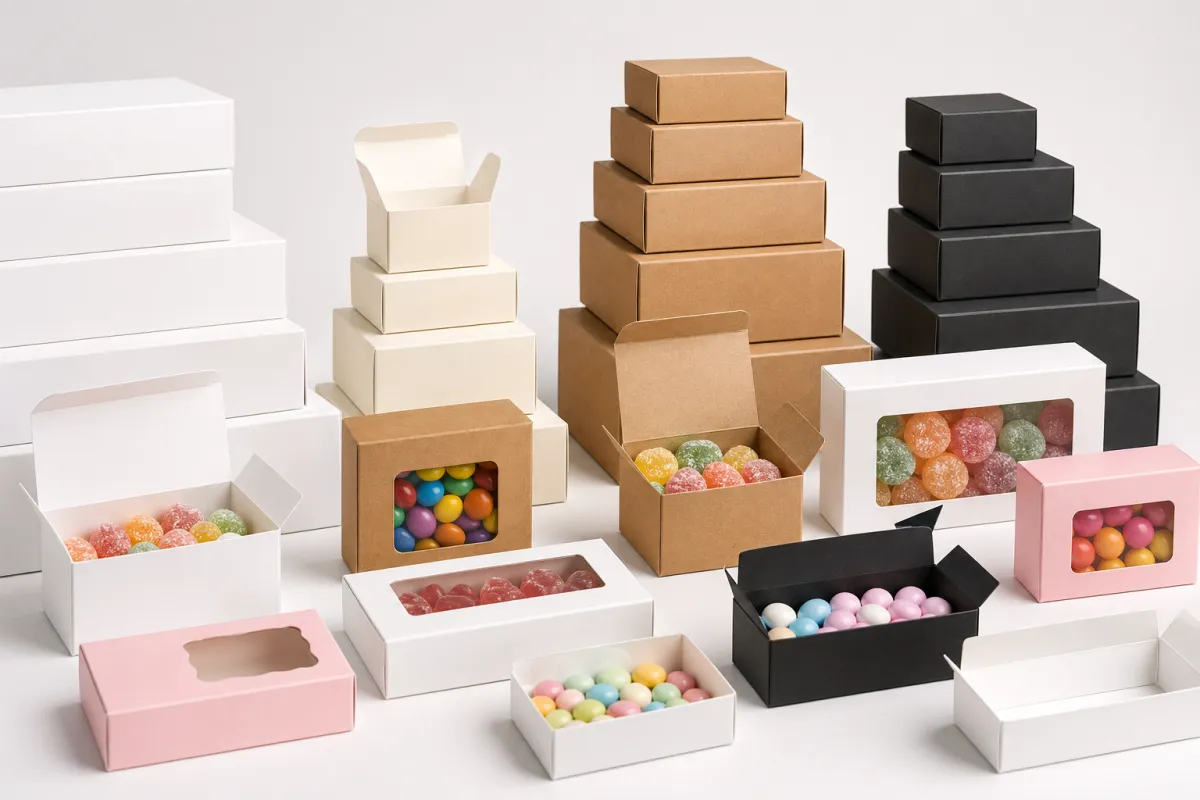
Small test runs let a buyer absorb waste. Candy packaging Boxes Wholesale Bulk does not. The math turns fast once returns, dented corners, and retail rejection enter the picture. I have seen a 24,000-piece gummy order where the product itself was fine, yet the presentation looked tired on shelf and the brand spent more on replacement cartons than it had expected to spend on print. That kind of mistake makes accounting go quiet in the worst way. Once freight, rework, and customer complaints are added in, the box stops behaving like a line item and starts acting like a profit lever. That is the reality behind Candy Packaging Boxes wholesale bulk, especially for launches in California, Texas, and Illinois where store checks happen quickly and buyers do not wait around for a second impression.
Wholesale bulk buying matters because savings compound in three places. First, unit cost drops: a simple 1-color kraft tuck box can sit around $0.16 to $0.24 per unit at 5,000 pieces, while the same project in 1,000-piece lots usually lands higher because setup cost is spread across fewer cartons. Second, reorders become easier when dimensions stay fixed at, say, 154 x 92 x 28 mm across a nine-SKU candy line. Third, shelf presentation stays consistent, which matters more than many founders admit when they are selling on end caps, in gift sets, and through specialty retail packaging channels in New York, Atlanta, and Seattle. I have sat in enough buyer meetings to know that consistency calms people down faster than any sales pitch, especially when the first purchase order is already locked at 5,000 units.
I learned that lesson in a client meeting in Chicago with a confectioner running six flavors of truffle bites and three seasonal SKUs. The brand wanted Custom Printed Boxes with different artwork for every flavor, but they also wanted the same outer size for pallet efficiency. We standardized the blank, moved to one shared dieline, and changed only the graphics. The result was a cleaner package branding system, fewer SKU mistakes at the pack line, and a quote that came in 11% lower than the first version. That sort of simplification usually beats a flashy structure, especially once the line starts moving through a 14,000-unit run. I know that sounds almost boring, but boring is often where the margin lives.
"If the carton cannot survive the trip from packing table to retail shelf, it is not a retail carton yet." A plant supervisor said that to me on a night shift in Suzhou after we pulled 18 sample units from a crushed master case, and he was right. I still remember the look on the operator's face like he had personally offended the laws of physics.
That is the sales-minded truth I want buyers to hear: candy Packaging Boxes Wholesale bulk has to protect product, support branding, and stay efficient enough to preserve margin. If you are comparing quotes, ask how the board thickness, print coverage, finish, and freight weight change the final landed cost. Then ask what happens on reorder number two. A good supplier will answer with numbers, not slogans, and will show where the savings appear when you standardize across multiple candy runs. The second order often reveals more than the first, which is annoying if you wanted a neat answer and useful if you wanted the truth. In factories near Shenzhen, Dongguan, and Guangzhou, that second-order clarity is often what separates a one-time purchase from a repeat program.
Box Styles and Structural Details for Candy Runs
The most common structures I see for Candy Packaging Boxes wholesale bulk are tuck-end cartons, sleeve boxes, window boxes, folding cartons, and rigid presentation boxes. Tuck-end cartons work well for wrapped pieces, mini bars, and 50 g confectionery packs because they are economical and ship flat without drama. Sleeve boxes fit sampler trays and subscription bundles because the slide-out motion adds perceived value without forcing the entire design into a rigid format. Window boxes help truffles, fudge, and mixed assortments because the buyer can see color and texture before opening the pack, which is a strong retail packaging cue. I have a soft spot for window boxes, probably because the first time I saw one done well in a Portland showroom, the product practically sold itself from six feet away.
Premium holiday assortments still justify rigid presentation boxes. They are heavier, yes, and they can push freight cost up by a few cents per unit, but they deliver a stronger first impression for gift sets in the $18 to $45 retail range. Folding cartons remain the workhorse for Candy Packaging Boxes wholesale bulk because they balance print quality, pallet density, and fold speed. I usually recommend a folding carton first unless the product itself demands a window, a tray, or a rigid shell. My opinion is simple: start with the structure that does the job instead of the one that looks dramatic in a sample room, especially if your target volume is 8,000 to 20,000 units.
Structural details decide whether the box feels premium or flimsy. A 300gsm or 350gsm SBS paperboard can be enough for standard candy boxes, while a 400gsm board gives more stiffness for heavier assortments. For rigid builds, 1.2 mm to 1.5 mm greyboard is common, and reinforced corners matter when the box will be handled by distributors or warehouse teams. Locking tabs help on e-commerce packs, and a cut PET window can lift shelf appeal if the candy has color contrast or layered shapes. Small details do more work than decorative language ever will, and decorative language is cheap anyway. The people who load cartons in Omaha or Newark usually notice the structure before they notice the copy.
In our Shenzhen facility, I once watched a 60,000-piece window box run slow to a crawl because the glue flap was 1.5 mm wider than the mockup. That tiny mismatch created a 9% jam rate at the folding stage. We fixed it by trimming the flap, adjusting the insert pocket, and rechecking the dieline before the second run. That is why I push candy packaging boxes wholesale bulk buyers to think about insert compatibility early. If the tray is 2 mm too loose, the candy moves; if it is too tight, the line stops. And when the line stops, everyone suddenly develops strong feelings about tolerances, usually by 2 p.m. in a plant that runs two shifts.
Standardizing dimensions usually improves both Price and Lead time. If one chocolate bar needs 120 x 35 x 18 mm and another needs 124 x 35 x 18 mm, the buyer is forcing two different tools for a difference that nobody sees on shelf. I would rather create one common blank for three flavors and vary the label panel or the inner wrap. That is the kind of packaging design decision that turns custom printed boxes into a repeatable product packaging system instead of a one-off project. A lot of brands overcomplicate this because they want each SKU to feel "special," and the factory just wants the carton to fold without arguments. Fair enough, right?
Candy Packaging Boxes Wholesale Bulk Specifications That Matter
Buyers get the cleanest quote when they send five core specs for candy Packaging Boxes Wholesale Bulk: exact dimensions, board type, print coverage, finish, window style, and closure method. I cannot overstate the difference between "roughly 5 inches wide" and a measured 127 x 89 x 31 mm blank. The first version invites assumption-driven pricing, while the second lets a factory calculate board yield, carton nesting, and finishing time with confidence. That is how the quote becomes trustworthy instead of decorative. I have had to decode vague specs that looked like they were written after a lunch meeting in Brooklyn; nobody enjoys that, least of all the estimator.
Exact dimensions matter more than most people expect. I have seen a 4 mm change in height shift a candy packaging boxes wholesale bulk quote by 8% to 14% because the carton count per sheet changed and the shipping master case no longer fit the original pallet plan. If the candy is filled by hand, even the fold sequence matters. A box that saves 3 seconds per pack across 18,000 units is real labor savings, and labor shows up quickly in the final number. That is the kind of math that makes a sales rep blink and a plant manager nod, especially in facilities that run 50,000 cartons a week.
Material choices should be discussed in plain business language. SBS paperboard is the cleanest option for high-resolution print and crisp retail branding. Kraft board gives a natural look and is popular with brands that want an earthy feel or a slightly tougher surface. Coated stocks can improve color hold on vivid artwork, especially for gummy packs with bright reds, blues, and yellows. For fragile assortments, heavier board or a paperboard tray can keep the candy from shifting during transit and lower returns. I usually tell people to pick the surface that supports the brand story, not the one that just sounds expensive in a spec sheet. A 350gsm C1S artboard is often a strong middle ground for candy lines that need sharp print and moderate stiffness.
Printing and finishing add value, but they also add cost. CMYK four-color print is standard for most custom printed boxes. Spot color can help a brand match a specific red or black across multiple SKUs. Matte lamination gives a quieter, premium look, gloss makes colors pop, soft-touch adds a velvety feel, foil catches light on shelf, and embossing can lift a logo panel. A light finish might add $0.03 to $0.08 per unit, while foil and embossing together can add more, depending on size and coverage. Not every candy line needs all of it, and a strong package does not have to wear every finish in the catalog. I have seen boxes dressed like they were trying too hard, and the candy was the only thing with restraint.
For food safety and compliance, I ask buyers to clarify whether the candy touches the packaging directly or sits inside an inner liner or tray. Direct-contact packs may need specific ink and coating approvals, while secondary packs have different requirements. If you are shipping into retail channels, ask for documentation and proof approval early, not after the carton is printed. For transit validation, I like to look at ISTA testing standards, and for fiber sourcing, FSC certification guidance matters if your buyer wants traceable paperboard. A brand selling into Canada, the EU, or California often needs that paperwork before the first pallet leaves the dock.
I have also seen buyers save themselves a reprint by approving the dieline before artwork. A mockup should show the exact fold direction, the glue flap, the window cut, and any copy that sits near a fold line. If the logo touches a crease, the final carton looks cheap even when the print quality is perfect. The best candy packaging boxes wholesale bulk projects are the ones where packaging design, product packaging, and the production team all agree on the same flat file before the first sheet is cut. That agreement saves more money than a last-minute discount ever will, and it saves a lot of muttered complaints on the factory floor in Dongguan or Ningbo.
- Exact width, depth, and height in millimeters
- Board type such as SBS, kraft, or rigid greyboard
- Finish such as matte, gloss, soft-touch, foil, or embossing
- Closure method such as tuck-end, sleeve, magnetic flap, or lock bottom
- Insert detail if the candy needs a tray, divider, or cavity
Pricing, MOQ, and What Actually Drives Cost
Pricing for candy packaging boxes wholesale bulk is usually simple at the surface and messy underneath. The unit cost falls as quantity rises, but the real savings depend on how standardized the blank is, how many colors are printed, and whether the job needs finishing steps like foil or an insert. At 5,000 pieces, a plain tuck box can live near $0.16 to $0.24 per unit, a window box might land at $0.28 to $0.46, and a rigid presentation box can sit anywhere from $1.10 to $2.40 depending on board and decoration. Those numbers change faster than most buyers expect once the spec gets fancy, especially if the job leaves a plant in Shenzhen and lands in a Midwest warehouse two weeks later.
| Style | Best Use | Typical Spec | Example Unit Price at 5,000 | Notes |
|---|---|---|---|---|
| Tuck-end carton | Wrapped candy, mini bars, trial packs | 300gsm SBS, CMYK, matte aqueous | $0.16 to $0.24 | Best for fast setup and repeat orders |
| Window box | Truffles, gummies, sampler assortments | 350gsm SBS, PET window, 4-color print | $0.28 to $0.46 | Costs more because of die-cutting and assembly |
| Sleeve + tray | Gift sets, subscription packs, layered candy | 350gsm sleeve, paperboard tray, soft-touch finish | $0.34 to $0.58 | Good balance of presentation and structure |
| Rigid presentation box | Premium holiday assortments, corporate gifts | 1.2 mm greyboard, foil, emboss, ribbon pull | $1.10 to $2.40 | Highest shelf impact, highest freight weight |
MOQ is not a random punishment from the factory. In candy packaging boxes wholesale bulk, the minimum often reflects setup efficiency, board yield, and finishing time. A simple one-color carton with standard dimensions can usually support a lower minimum than a box with a custom insert, a window, and two foil passes. If you want a small run, simplify the spec. If you want a complex structure, expect the MOQ to rise because the machine time and labor do not shrink just because the order is smaller. The machine does not care that the marketing calendar is breathing down our necks; it still wants its setup time, whether the line is in Huizhou or Foshan.
I always recommend tiered quotes. Ask for 3,000, 5,000, and 10,000 units at the same spec so you can see where the real breakpoint is. One supplier quoted a gummy brand $0.41 at 3,000 units and $0.27 at 10,000 units for candy packaging boxes wholesale bulk, which told the buyer exactly how much margin was hiding in scale. That is more useful than a single number because it shows how close the project is to the efficient band. If I could make every buyer ask for tiered pricing, I would; it saves everyone from guessing and gives finance a real basis for planning.
Freight and warehousing matter more than many buyers predict. A box that weighs 8% less can change a pallet count, reduce air shipment charges, and lower storage fees if your fulfillment center bills by cube. I once helped a brand move from 400gsm board to 350gsm board and cut pallet weight by 210 pounds across a 20,000-unit run. The difference was not dramatic on one carton, but it changed the landed cost enough to keep the launch on budget. That kind of result never makes a glossy brochure, but it absolutely shows up in a finance meeting in Dallas or Toronto.
A supplier negotiation taught me another lesson. A mill in Dongguan wanted a higher price because the order had foil on three panels and two custom inserts. We moved the foil to one front panel, standardized the insert cavity, and removed a back-panel flood coat. The quote dropped by 6% with no visible loss on shelf. That is the kind of tradeoff experienced buyers make in Candy Packaging Boxes Wholesale Bulk: keep the effect that customers notice, cut the detail that only the estimator sees. I have a deep respect for those quiet compromises; they are how launches survive.
Production Process and Timeline for Bulk Candy Boxes
The production path for candy packaging boxes wholesale bulk should be predictable: brief, quote, dieline, artwork setup, proofing, production, finishing, packing, and shipment. If any one of those steps is vague, the schedule slips. The most common delay is not the press itself; it is missing information. I have seen a buyer approve a quote on Monday and then spend four days deciding between two Pantone reds, which pushed the run past the original ship date by nearly a week. Color debates can become a hobby if nobody sets a deadline, and I say that with more exhaustion than irony.
A realistic timeline depends on the structure. Standard folding cartons with basic CMYK print can move in 12 to 15 business days from proof approval. Add windows, foil, embossing, or a custom insert, and the same job can stretch to 18 to 22 business days. Shipping then adds its own clock, especially if the cartons are crossing an ocean or moving through a consolidation hub. Candy packaging boxes wholesale bulk should be scheduled backward from the product fill date, not forward from the quote date. I would rather work from the deadline and reverse-engineer the rest than pretend time will behave itself, particularly when a cargo booking in Los Angeles or Rotterdam is already fixed.
I tell clients to lock the launch date before the artwork is final. That sounds backward, but it prevents the common mistake of treating packaging as an afterthought. One candy brand I worked with was preparing for a spring retail reset, and the cartons were approved only after the distributor had already booked receiving appointments. They missed the first shelf window by nine days. The candy sold later, but the merchandising slot was gone. Timing matters as much as print quality, and shelf timing can be more unforgiving than a production error because the store does not wait politely for a reprint. A three-day delay in April can undo a six-week sales plan.
Proofing is cheap insurance. A digital proof catches copy errors and panel alignment, while a physical sample confirms how the board folds and how the finish looks under real light. If the box uses a window, I want the buyer to see the cut edge; if it uses a tray, I want the cavity depth measured with a caliper. That level of checking is not overcautious. It prevents the kind of reprint that turns candy packaging boxes wholesale bulk into a rescue mission. I have seen a tiny typo on a seasonal box cause more headache than a late truck, which is ridiculous, but there it is.
There is also a coordination issue with filling and freight. If the boxes arrive before the candy, they should be palletized in a dry warehouse with a clear stack limit. If the candy arrives first, the production schedule should include a buffer of at least 3 to 5 business days before kitting begins. I have seen a pack line sit idle because the outer cartons showed up after the product had already been staged. That is avoidable with one call between packaging and logistics, though apparently one call is sometimes a small miracle when the warehouse is in Phoenix and the freight bill is sitting in someone else’s inbox.
One client quote still stands out to me. They said, "The candy is the easy part; the box is what scares accounting." That was a private-label confectioner with 14 SKUs, all of which needed different artwork but the same outer dimensions. We solved it by using one shared dieline, one print profile, and two finish options. The result was a cleaner wholesale program and fewer surprises during reorder season. That is what a disciplined candy packaging boxes wholesale bulk process should feel like: ordinary in the best way, with no last-minute fire drills.
Why Choose Our Wholesale Candy Packaging Program
At Custom Logo Things, the point of our wholesale candy packaging program is not to oversell the box. It is to make the numbers work across repeat orders. For candy packaging boxes wholesale bulk, consistency matters more than clever language. If one run prints at 98% color match and the next run matches at 99%, that difference sounds tiny, but the retail buyer notices if the red panel on a strawberry line shifts between shipments. Repeatable sizing, repeatable print, and repeatable communication are what reduce rework. I would rather be dependable than dazzling, and I mean that sincerely.
I think many brands get packaging backwards. They spend too much on one flagship box and then starve the rest of the line. A better approach is to build a shared system across flavors, formats, and seasonal promotions. That is where branded packaging starts behaving like a revenue tool. If one 8-piece assortment uses the same blank as a 12-piece assortment, just with a different insert and artwork panel, the brand gets scale without making the product feel generic. It also keeps me from having to explain why every SKU needs its own little pile of special parts, which is a conversation I could happily have fewer times in my life.
Our internal workflow is built for that kind of candy packaging boxes wholesale bulk order. We check files before print, flag copy and bleed issues, and confirm the dieline against the box structure instead of against a flat mockup alone. Buyers who need a wider catalog can review Custom Packaging Products, and recurring buyers can look at our Wholesale Programs to understand how repeat orders are managed. Those two pages matter because the second order is usually where the real savings show up. First orders are for learning; repeat orders are for efficiency. The setup is designed to support teams buying 5,000 to 50,000 cartons at a time.
I also value honest tradeoffs. If a box can save a few cents by dropping foil from three panels to one, I will say so. If a rigid structure is overkill for a 1.5-ounce candy assortment, I will say that too. The strongest packaging partner is not the one that says yes to every embellishment. It is the one that helps a buyer keep shelf appeal, product protection, and unit economics in the same conversation. That is especially true in candy packaging boxes wholesale bulk, where margin can disappear fast on a small mistake. I have seen a team fall in love with a finish and then act shocked when freight got expensive; the freight invoice, as always, was not impressed by the romance.
Here is the kind of practical support that saves time on a launch: artwork review within one business day, dieline confirmation before print, and a sample check that compares the proof against the final carton fold. Those steps do not sound glamorous, but they are the difference between a smooth production week and a 3 a.m. call from a fulfillment manager. In my experience, candy packaging boxes wholesale bulk succeeds when the process is boring in the best possible way. Boring means repeatable. Repeatable means profitable, and profitable is a much better story than dramatic.
"The right packaging partner should make the repeat order easier than the first one." That came from a buyer managing 11 confectionery SKUs, and it is the standard I use when I evaluate any wholesale packaging program. I keep that line in my head whenever someone tells me the artwork is "basically done," which usually means it still needs at least one more proof and a hard look at the dieline.
Next Steps for Candy Packaging Boxes Wholesale Bulk
If you want a sharp quote for candy packaging boxes wholesale bulk, gather four items first: exact dimensions, target quantity, print goals, and a few reference images. A sketch is enough if the measurements are clear. If you already have a dieline, send it. If you do not, a rough layout with panel dimensions will still get the conversation moving. The better the starting data, the faster the estimate becomes real instead of hypothetical. I have quoted enough packaging jobs to know that a precise file saves everyone from playing detective, whether the buyer is in Miami or Manchester.
I recommend comparing at least two quantity tiers, one structural option, and one premium finish option. For example, compare a 5,000-piece tuck box at 300gsm SBS against a 10,000-piece version at the same spec, then ask what happens if you add a window or soft-touch lamination. That three-point comparison often shows where the best value sits. Candy packaging boxes wholesale bulk should never be bought on a single quote alone, because the price breakpoints tell you more than the headline number. The shiny number is nice; the pattern behind it is what actually helps.
Before you finalize the order, confirm the fill method, shipping method, and carton count. If the candy is being packed by hand, the box needs enough opening tolerance to keep line speed steady. If it is machine-filled, the tolerances tighten and the dieline matters more. If the boxes are crossing a distributor network, the master carton needs to hold up under stack pressure. I have seen a 9.5-inch master carton crush because the corner score was too shallow by 0.8 mm, and that kind of detail is exactly what a clean quote should catch. Tiny measurement errors are rude like that; they wait until the expensive part to show themselves.
My advice is simple: request a sample, approve the proof, then lock the production dates. That order prevents avoidable delays. A buyer who waits until artwork is final to think about freight is usually the buyer who pays for express shipping later. With candy packaging boxes wholesale bulk, the smartest move is to solve the details before the boxes exist, not after the cartons are already on the water. I know that sounds cautious. It is. It also saves money, which is usually the whole point.
When the specs are clear and the timing is right, candy packaging boxes wholesale bulk can support better margins, cleaner shelf presentation, and fewer reorders across every flavor in the line. That is the real value: not just printed paperboard, but a packaging system that keeps the candy moving and the numbers under control. A good box does not shout. It simply holds up, sells well, and makes the next order easier than the first one. And if the box does its job quietly, I consider that a small victory worth celebrating.
What Should Buyers Check Before Ordering Candy Packaging Boxes Wholesale Bulk?
Before you place a candy packaging boxes wholesale bulk order, confirm the measured dimensions, board weight, print method, finish, insert requirements, and delivery window. Ask for a dieline, a digital proof, and one physical sample so the folding carton, window cut, or sleeve structure is verified before production. I also tell buyers to check whether the candy touches the pack directly, because food-safe coatings and inner liners can change the material stack. If the order includes custom printed boxes for multiple SKUs, standardize the blank and vary only the artwork or insert. That one choice usually keeps the quote cleaner and the reorder simpler.
Frequently Asked Questions
What is the usual MOQ for candy packaging boxes wholesale bulk orders?
MOQ depends on box size, board type, print coverage, and finishing complexity. A plain tuck box in standard dimensions can often support a lower minimum than a window box with foil and a custom insert. In candy packaging boxes wholesale bulk, standardized sizes and simpler graphics usually allow lower minimums, while rigid boxes and multi-step finishes usually require larger runs to stay efficient. If a supplier gives you a strangely low MOQ for a very complex box, I would ask a few more questions before celebrating, especially if the plant is quoting from a base in Shenzhen, Dongguan, or Yiwu.
How do I price custom candy packaging boxes wholesale bulk without guessing?
Start with exact dimensions, quantity, board type, print method, and finish options. Then compare base price, setup fees, freight, and add-on finishing costs. I like to request one quote with a standard spec and one with premium finishes so the unit-cost difference is visible. That approach usually shows whether candy packaging boxes wholesale bulk should stay simple or whether a premium finish still fits the margin. A useful quote should make the tradeoffs plain enough that even a tired buyer can read them at 5 p.m. and still understand the breakpoints at 3,000, 5,000, and 10,000 units.
Which material is best for candy packaging boxes wholesale bulk?
SBS paperboard is usually the best fit for retail presentation because it prints cleanly and holds color well. Kraft board works for brands that want a natural look or a sturdier feel. Heavier board or inserts make more sense for fragile assortments, layered gift boxes, or premium candy packaging boxes wholesale bulk that need more stiffness during shipping and shelf handling. My personal bias is to pick the material that protects the candy first and tells the brand story second, because a damaged box tells a story nobody wants. A 350gsm C1S artboard is often a practical middle option for mid-range confectionery lines.
How long does a bulk candy box order usually take?
The timeline depends on proof approval, quantity, and finishing requirements. Standard runs can move in 12 to 15 business days after proof approval, while jobs with windows, foil, embossing, or custom inserts usually need more time. If you want candy packaging boxes wholesale bulk to stay on schedule, approve artwork and dielines early and keep the launch date fixed before production starts. The calendar is far less forgiving than most people hope, and I have not found a way to charm it. Shipping from South China to the U.S. West Coast can add another 18 to 25 days, depending on the freight mode.
Can candy packaging boxes wholesale bulk be food-safe?
Yes, but you need to confirm whether the candy touches the packaging directly or sits in an inner liner or tray. Ask about inks, coatings, and any compliance documentation tied to your market. For direct-contact applications, request proof of the material stack before approving the order. That is the safest way to handle candy packaging boxes wholesale bulk without creating a food-safety gap in the final pack. If the product is going straight into a retail shelf, I would double-check this rather than assume the friendly sample on your desk is the same as the production run.


