Buyer Fit Snapshot
| Best fit | Offset Printed Cartons Wholesale for Packaging projects where brand print, material claims, artwork control, MOQ, and repeat-order consistency need to be specified before quoting. |
|---|---|
| Quote inputs | Share finished size, material target, print colors, finish, packing count, annual reorder estimate, ship-to region, and any compliance wording. |
| Proofing check | Approve dieline scale, logo placement, barcode or warning zones, color tolerance, closure strength, and carton packing before bulk production. |
| Main risk | Vague material claims, crowded artwork, missing packing details, or unclear freight terms can make a low unit price expensive after revisions. |
Fast answer: Offset Printed Cartons Wholesale for Packaging: Board, Finish, Dieline, and Unit Cost should be specified like a repeatable production item. The safest quote records material, print method, finish, artwork proof, packing count, and reorder notes in one written spec.
Production checks before approval
Compare the actual filled-product size with the drawing, then confirm tolerance on folds, seals, hang holes, label areas, and retail display edges. Reserve space for logos, QR codes, warning copy, and material claims before decorative graphics fill the panel.
Quote comparison points
Review material grade, print process, finish, sampling route, tooling charges, carton quantity, and freight assumptions side by side. A quote is only useful when the supplier can repeat the same color, closure quality, and packing count on the next order.
Offset Printed Cartons Wholesale for Smart Packaging
Offset Printed Cartons wholesale sounds simple until the first mockup lands on the table and the numbers start talking back. Shelf packaging has a tiny window to do a lot of work. In most retail settings, a carton gets only a few seconds of attention before a shopper moves on, and those seconds have to carry print quality, structure, finish, and brand credibility all at once. No pressure, right?
That pressure is exactly why brands keep coming back to Offset Printed Cartons wholesale for core retail SKUs. Offset lithography handles fine detail with a sharpness that short-run alternatives often struggle to match. Color stays steadier from run to run. Once setup costs are spread across a larger order, the unit price usually becomes far more sensible than the first quote suggests. Not bargain-basement. Sensible.
For products that need a premium look, reliable shipping performance, and a carton that does not bloat the budget for no reason, offset printed cartons wholesale often lands in the right place. The point is not to make packaging fancy for its own sake. The point is to build a carton that sells, stacks, ships, and reorders without becoming a recurring headache.
I have seen brands spend weeks debating a shade of gold foil only to discover that the real problem was a weak tuck flap. That happens more often than anyone admits. A carton has to survive warehouses, retailers, and the occasional rough-handed receiver before it ever meets the consumer.
Why Offset Printed Cartons Wholesale Still Win on Shelf
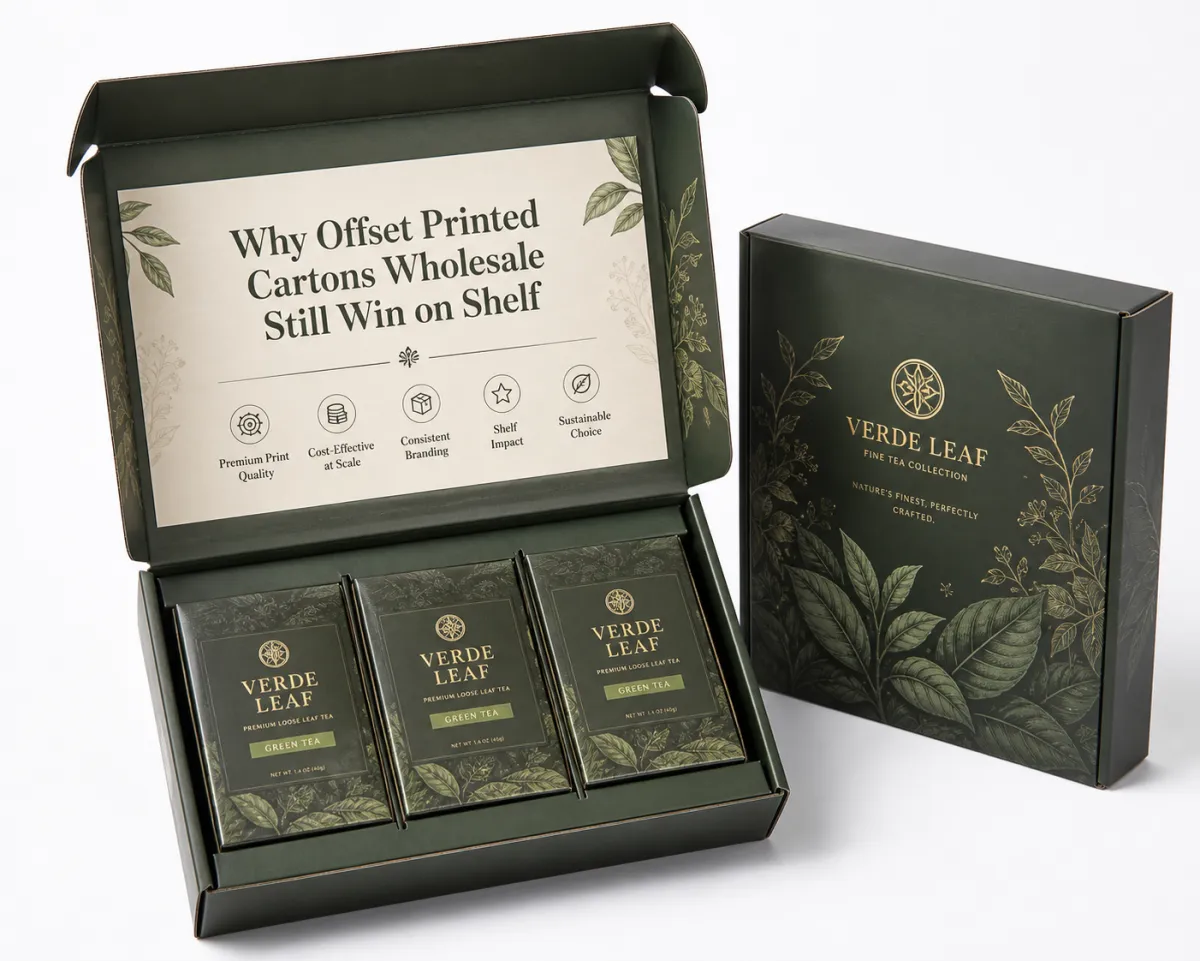
A shopper does not study a spec sheet before deciding what to buy. They scan shape, color, typography, contrast, and finish, then decide in a fraction of a second whether the product feels credible. That is the carton’s job, and offset printed cartons wholesale performs that job well because offset print brings crisp text, tight registration, and a polished surface that can hold up under close inspection.
Offset printing also has a practical advantage at scale. Fine gradients reproduce cleanly. Solid colors stay dense. Brand reds, deep blacks, and muted neutrals keep their identity instead of drifting from run to run. Packaging buyers know this matters, even if it rarely gets discussed out loud. A carton that comes back slightly off on a reorder can make an entire product line look unstable, which is a strange thing for a piece of folded board to do, but there it is.
Wholesale pricing is the other half of the story. Plates, setup, and prep all carry upfront cost. That is the price of quality. Once the order moves beyond the tiny-run stage, the unit price can fall quickly, which is why offset printed cartons wholesale becomes more attractive as volume rises. A 500-piece test and a 10,000-piece reorder are not even in the same lane.
The unglamorous side matters too. The carton has to protect the product in transit, survive warehouse handling, and arrive looking like it belongs on a premium shelf. Pretty is welcome. Function is non-negotiable. The strongest offset printed cartons wholesale balance both without pretending one replaces the other.
A carton that looks expensive but collapses in shipping is not premium. It is expensive with better lighting.
Cosmetics, supplements, specialty foods, electronics accessories, and giftable consumer goods feel this most. The outer carton is the first physical brand contact point, and offset printed cartons wholesale turns that first touch into something deliberate instead of improvised.
For buyers comparing vendors, the real question is not, "Can you print a box?" The real question is whether the supplier can deliver offset printed cartons wholesale that fold correctly, keep their color, and reproduce the same standard six months later. That is a different level of work.
One practical benefit gets overlooked often: multi-SKU brands stay visually tighter when wholesale carton buying is done as a system. Same board family. Same print standard. Same finishing logic. Retail displays look planned instead of stitched together from leftovers.
Offset Printed Cartons Wholesale: What You Actually Get
Offset printed cartons wholesale usually refers to Printed Folding Cartons, tuck-end cartons, sleeves, lock-bottom cartons, and other retail-ready paperboard formats. The right structure depends on product weight, shelf presentation, and how much assembly the buyer wants to handle. Some cartons ship flat and are folded on packing lines. Others arrive pre-glued for faster filling. The structure matters because a carton that looks efficient on paper can become a labor problem later.
Offset printing is strongest where image clarity matters. Fine type, small legal copy, barcodes, gradients, and brand colors all reproduce with a sharpness that makes the package feel intentional. If the design uses multiple panels, offset printed cartons wholesale also keeps front-to-back alignment steadier across a large run. That sounds minor until a side panel lands crooked and the entire batch starts looking cheaper than it should.
The physical build matters just as much as the print. A carton may use SBS, C1S artboard, kraft board, or another paperboard grade depending on the product and target price point. Thickness often falls somewhere around 14 pt to 24 pt for folding cartons, though the real choice should follow product weight and how the carton will be handled. A light beauty carton and a heavier supplement carton do not belong in the same board discussion.
Finish options add another layer. Matte and gloss coatings are the usual workhorses. Aqueous coating helps when the buyer wants a balanced finish with decent durability. Soft-touch lamination gives a velvet-like feel and usually belongs on premium items that get handled in-store. Spot UV can lift logos or pattern details. Foil, embossing, and debossing push presentation further, but they only pay off when the brand can use the added shelf impact.
Here is the part many buyers miss: not every upgrade is useful. Soft-touch feels nice, but if the product sells from a warehouse club or rides inside a shipper, that surface may never earn its keep. A stronger board grade or a better glue flap does not photograph as well, yet it can reduce damage and returns. Those are the upgrades that often matter most in offset printed cartons wholesale.
For brands comparing format choices against their order structure, our Wholesale Programs give a clearer picture of how volume changes packaging economics. If you need a broader view of what can be produced, our Manufacturing Capabilities page lays out the main structure and finishing options.
Useful rule: spend on the finish the shopper sees, and spend on the structure the product needs. The rest is decoration.
Specifications That Matter for Offset Printed Cartons
Good quotes begin with good specs. Bad quotes begin with guesses, and then everyone acts surprised when the carton costs more than expected. For offset printed cartons wholesale, the first thing a supplier needs is exact dimensions: length, width, and depth, plus the product orientation inside the carton. A box that is two millimeters off can create fit issues, movement during shipping, or bulging on shelf. That kind of miss is kinda annoying to fix after the die is already made.
The next spec is board stock. That means the paperboard grade, thickness, and whether the carton needs extra stiffness because of inserts, bottles, jars, or fragile items. A flimsy carton might save a few cents, but it becomes expensive when product protection fails. Overbuilt cartons create the opposite problem: they protect well and waste money. The right choice depends on product weight and how the carton will be used.
Artwork details affect pricing more than many buyers expect. Bleeds, dielines, Pantone matches, barcode placement, overprint settings, and image resolution all change both production and final appearance. If the barcode sits too close to a fold or a legal line lands inside the trim zone, the whole job may need correction. Offset printed cartons wholesale rewards clean files. Messy files usually get billed in time, money, or both.
Here is the short checklist I would want before asking for a quote:
- Final carton dimensions and structure type
- Board grade and thickness target
- Print count, including PMS colors if used
- Finish choice: matte, gloss, aqueous, soft-touch, spot UV, foil, embossing
- Quantity per run and expected reorder volume
- Shipping method: flat-packed or pre-glued
- Product weight and any insert or divider needs
- Artwork files, dieline, and regulatory copy
Compliance can matter too. Food-contact requirements, child-resistant structures, tamper-evident elements, and retail barcode standards can all affect the carton build. If the package must pass distribution testing, ask for methods aligned with ISTA distribution testing guidance. If the board needs to be sourced responsibly, FSC-certified materials can be requested through FSC certification. Those are not decorative acronyms. They matter when the carton has to survive the real supply chain.
Another practical point: ask for sample approval before full production. A physical sample shows folding behavior, print density, and how the finish behaves under light. Digital proofs help, but they do not tell you if the carton feels too soft, too slick, or too thick at the fold lines. Offset printed cartons wholesale should be judged with the real material in hand whenever possible.
For high-volume retail programs, checking carton squareness, glue seam strength, fold memory, and barcode readability pays off. Those details do not win design awards. They prevent headaches. That is the better trade.
Offset Printed Cartons Wholesale Pricing, MOQ, and Value
Pricing for offset printed cartons wholesale makes sense once you stop staring at unit price alone and start looking at how setup costs spread across the run. Offset printing has plates, prep, and finishing steps that cost more upfront than digital print. That is normal. The upside is that per-unit cost usually drops hard as quantities rise. Small run? The setup stings. Larger run? The math starts behaving.
MOQ depends on structure and finish. Simple folding cartons can often start around 500 to 1,000 pieces if the job is straightforward. More complex cartons, heavy coatings, foil, embossing, or unusual die-cutting may need 1,500 to 2,000 pieces or more to stay efficient. Those are not hard rules, because every job has a different cost structure, but they are realistic starting points for buyers comparing offset printed cartons wholesale quotes.
Here is a practical pricing view at around 5,000 pieces. These are broad ranges, not promises carved into stone, because artwork coverage, board choice, and finishing can move numbers quickly. I am giving you the range I would use in a real procurement conversation, not a fantasy spreadsheet:
| Carton Type | Typical Use | Approx. Unit Price at 5,000 pcs | Notes |
|---|---|---|---|
| Basic folding carton | Lightweight retail goods, simple graphics | $0.18-$0.32 | Best for controlled budgets and repeat SKUs |
| Matte or gloss carton | Beauty, wellness, food items | $0.22-$0.38 | Strong balance of shelf look and cost |
| Soft-touch with spot UV | Premium consumer packaging | $0.30-$0.55 | Better hand feel, stronger visual contrast |
| Foil or embossing package | High-end presentation cartons | $0.40-$0.75 | Use when shelf impact justifies the spend |
That table helps separate the real cost from the hopeful cost. Unit price is only part of the invoice. Setup, tooling, freight, inserts, sample charges, and packing method all shape the total. A quote that looks cheap on paper can turn ordinary once the rest of the line items appear.
To compare quotes properly, break them into these parts:
- Setup and plates: the front-loaded cost that drops as quantity rises.
- Board and print: the core material and color work.
- Finishing: coating, foil, embossing, window patching, or lamination.
- Die-cutting and gluing: the structural labor that turns flat sheets into cartons.
- Packing and freight: the cost of getting usable cartons to your facility.
Offset printed cartons wholesale is usually the right move when the SKU is stable, the product will stay in market long enough to justify tooling, and the brand wants consistent shelf presence. It also fits multi-store rollouts and replenishment programs where the packaging has to look the same every time. If your design changes every two weeks, digital may be the better temporary tool. If the carton is becoming a core brand asset, offset is the more sensible long-term buy.
One last pricing truth: a wholesale order should be judged against inventory reality, not just the invoice. Saving 8 cents per carton means very little if the carton arrives late or the finish is wrong. Cheap packaging that misses launch is not cheap. It is late and expensive in a different way.
How Long Does Offset Printed Cartons Wholesale Take?
The production path for offset printed cartons wholesale is straightforward, but only if the buyer keeps information moving. It usually starts with an inquiry, then spec review, dieline confirmation, artwork prep, proofing, plate creation, printing, finishing, die-cutting, gluing, and packing. That sounds long because it is long. Packaging manufacturing is a sequence, not a magic trick.
A realistic timeline usually runs in stages. Quotation and spec review may take one to two business days if the details are clean. Proofing can take one to three days depending on revision count. Plate work and print setup can add several days. After that, finishing and die-cutting can take another few days, and gluing, packing, and final quality checks need time too. For many offset printed cartons wholesale orders, 12 to 15 business days from proof approval is a reasonable planning window. Special finishes, complex structures, or seasonal demand can stretch that.
What speeds everything up? Final artwork on day one. Correct dimensions. One person with authority to approve the proof. Clear expectations on finish and quantity. Buyers often think the plant is the bottleneck, but the slowest part is usually the back-and-forth over missing bleed, low-resolution images, or a last-minute color change after proof approval. Those delays are self-inflicted. Packaging does not appreciate being redesigned midstream.
Slow points are easy to spot once you have seen enough runs. Someone changes the carton depth after the dieline is cut. Legal copy gets added after layout is final. A barcode shifts too close to a fold. The Pantone reference is verbal instead of written. Each one sounds small. Each one can delay offset printed cartons wholesale by several days.
Production quality should be checked at a few points, not only at the end. Proof colors should be reviewed against approved brand references. Glue strength should be checked on sample cartons. Fold accuracy and squareness matter before the entire run leaves the line. If the project includes distribution testing, confirm the requirements early instead of pretending they will sort themselves out later.
Shipping runs on a separate clock. Production can finish on time and still miss launch if freight timing was guessed instead of planned. That is why a good order conversation includes the delivery address, the shipping method, the receiving schedule, and any hard launch date that actually matters to sales. Offset printed cartons wholesale only works smoothly when production and freight are treated as two different deadlines.
For buyers who want a cleaner path through the process, our Manufacturing Capabilities page is a useful place to verify finish options and structural limits before files are finalized. The fewer surprises before print, the fewer expensive conversations afterward.
Practical tip: ask for a production calendar in writing. A calendar beats a vague promise every time.
Why Choose Us for Offset Printed Cartons Wholesale
What matters most in offset printed cartons wholesale is not a loud promise. It is whether the supplier can keep the job stable when the order scales up, the artwork changes, or the buyer needs a reorder without rebuilding the entire file package. That is where process matters more than hype.
Custom Logo Things is built around practical packaging work: clear specifications, useful proof guidance, and consistent print handling. The point is not to impress you with jargon. The point is to keep the carton looking like the approved carton when it reaches your facility. Buyers who order offset printed cartons wholesale tend to care about three things above all else: color consistency, clean finishing, and fewer surprises. Reasonable ask, really.
Experience shows up in the details that protect your budget. A good supplier catches structural issues before they become expensive. A tuck flap that is too short. A board choice that collapses under product weight. A finish that looks excellent on screen but fingerprints immediately. Those are the kinds of mistakes that create waste. Preventing them is where wholesale value actually lives.
We also plan for the unglamorous side of packaging: reorder timing, carton storage, and how a design behaves after it has been stacked, moved, and opened dozens of times. A cleanly printed carton is good. A carton that still looks good after a warehouse shift and a retailer reset is better. That is the gap between a nice sample and a practical supply program.
Offset printed cartons wholesale should feel predictable once the spec is set. Predictable color. Predictable fit. Predictable delivery. That predictability is what turns packaging from a recurring fire drill into a stable part of the product line.
Next Steps for Ordering Offset Printed Cartons Wholesale
If you are preparing an order for offset printed cartons wholesale, the best next step is not a broad brainstorm. It is a tight spec package. Start with dimensions, product weight, board preference, quantity, finish, and the target ship date. Then gather the dieline, artwork, and any regulatory copy in one place. The cleaner the handoff, the cleaner the first proof.
From there, ask for sample cartons or a digital proof depending on how much the structure changes from your previous packaging. A sample is especially useful if you are testing a new board grade, a premium finish, or a carton that needs to fit tightly around the product. One sample can reveal more than three rounds of email guessing.
If the project involves multiple SKUs, keep a single system for naming, color references, and approval authority. That small discipline prevents confusion later. It also makes reorders easier, which is where offset printed cartons wholesale starts to show its real value. The first order is the visible one. The second and third orders are the proof that the workflow makes sense.
When the packaging is treated as part of the product, not an afterthought, the result is usually better. Fewer defects. Better shelf presence. Less waste. And a carton that does its job without asking for applause.
Frequently Asked Questions
What is the best use case for offset printed cartons wholesale?
It is strongest for stable retail SKUs that need crisp graphics, consistent color, and a professional shelf finish. Beauty, wellness, food, and giftable consumer products often benefit most from offset printed cartons wholesale because the print quality and paperboard options support a polished presentation.
Is offset printed cartons wholesale better than digital printing?
Not always. Digital works well for very short runs, frequent artwork changes, or fast test launches. Offset printed cartons wholesale usually becomes the better value as quantities rise and the design stays fixed, because setup costs spread across more units and the per-carton price drops.
Which finishes work best for offset printed cartons wholesale?
Matte, gloss, aqueous coating, soft-touch lamination, spot UV, foil, embossing, and debossing all have a place. The right choice depends on how the carton is handled, where it is sold, and whether the finish supports the product story. In many cases, a stronger board grade matters more than an extra effect.
How do I get an accurate quote for offset printed cartons wholesale?
Send final dimensions, board grade, finish choice, quantity, product weight, dieline, and artwork files. Add any compliance requirements, such as tamper-evident or food-contact needs. Accurate specs reduce revision time and keep offset printed cartons wholesale pricing closer to the real cost.
How long does production usually take?
A typical run can take about 12 to 15 business days after proof approval, though complex finishes or seasonal demand can extend that. The fastest orders usually come from complete artwork, clear approvals, and stable specifications from the start.
Can offset printed cartons wholesale be used for premium packaging?
Yes. In fact, premium brands often prefer offset printed cartons wholesale because the print detail, color control, and finish options create a higher-end feel. Soft-touch, foil, and spot UV can add contrast and texture, but the carton still needs to protect the product and fold correctly.
What should I avoid when ordering offset printed cartons wholesale?
Avoid vague dimensions, low-resolution artwork, last-minute changes, and choosing finishes that do not match how the carton will be used. A beautiful carton that fails in transit or slows packing lines is a poor trade, no matter how good it looks in a mockup.
What is the clearest takeaway for a first-time buyer?
Lock the dimensions, board grade, finish, and approval process before asking for prices. If those four pieces are fixed, offset printed cartons wholesale becomes much easier to compare, faster to produce, and far less likely to surprise you at the wrong moment.


