Buyer Fit Snapshot
| Best fit | Offset Printed Poly Mailers projects where brand print, material claims, artwork control, MOQ, and repeat-order consistency need to be specified before quoting. |
|---|---|
| Quote inputs | Share finished size, material target, print colors, finish, packing count, annual reorder estimate, ship-to region, and any compliance wording. |
| Proofing check | Approve dieline scale, logo placement, barcode or warning zones, color tolerance, closure strength, and carton packing before bulk production. |
| Main risk | Vague material claims, crowded artwork, missing packing details, or unclear freight terms can make a low unit price expensive after revisions. |
Fast answer: Offset Printed Poly Mailers: How They Work and Cost should be specified like a repeatable production item. The safest quote records material, print method, finish, artwork proof, packing count, and reorder notes in one written spec.
Production checks before approval
Compare the actual filled-product size with the drawing, then confirm tolerance on folds, seals, hang holes, label areas, and retail display edges. Reserve space for logos, QR codes, warning copy, and material claims before decorative graphics fill the panel.
Quote comparison points
Review material grade, print process, finish, sampling route, tooling charges, carton quantity, and freight assumptions side by side. A quote is only useful when the supplier can repeat the same color, closure quality, and packing count on the next order.
Offset Printed Poly Mailers do quiet, unglamorous work. They protect the shipment. They carry the brand. They also show up everywhere: on a packing line, at a doorstep, in a customer photo, and sometimes in the one unboxing video your marketing team will replay for six months.
That visibility is why a clean, well-printed mailer matters more than people expect. A dull, muddy bag makes the whole order feel cheaper. A crisp one does the opposite. Not magic. Just packaging doing its job well.
Offset printed poly mailers are a smart Fit for Brands that want a polished look without moving into a carton. They work best when artwork is stable, order volume is steady, and the spec is realistic. If you are comparing broader packaging options, our Custom Packaging Products page and our Custom Poly Mailers page can help you see where this format fits in the shipping mix.
The real question is not whether the mockup looks nice on a screen. The real question is whether the printed mailer holds color, survives transit, seals properly, and lands at a unit cost that still makes sense. That is the practical test. Offset printed poly mailers work best when appearance, protection, and volume all line up.
What Offset Printed Poly Mailers Are and Why They Stand Out
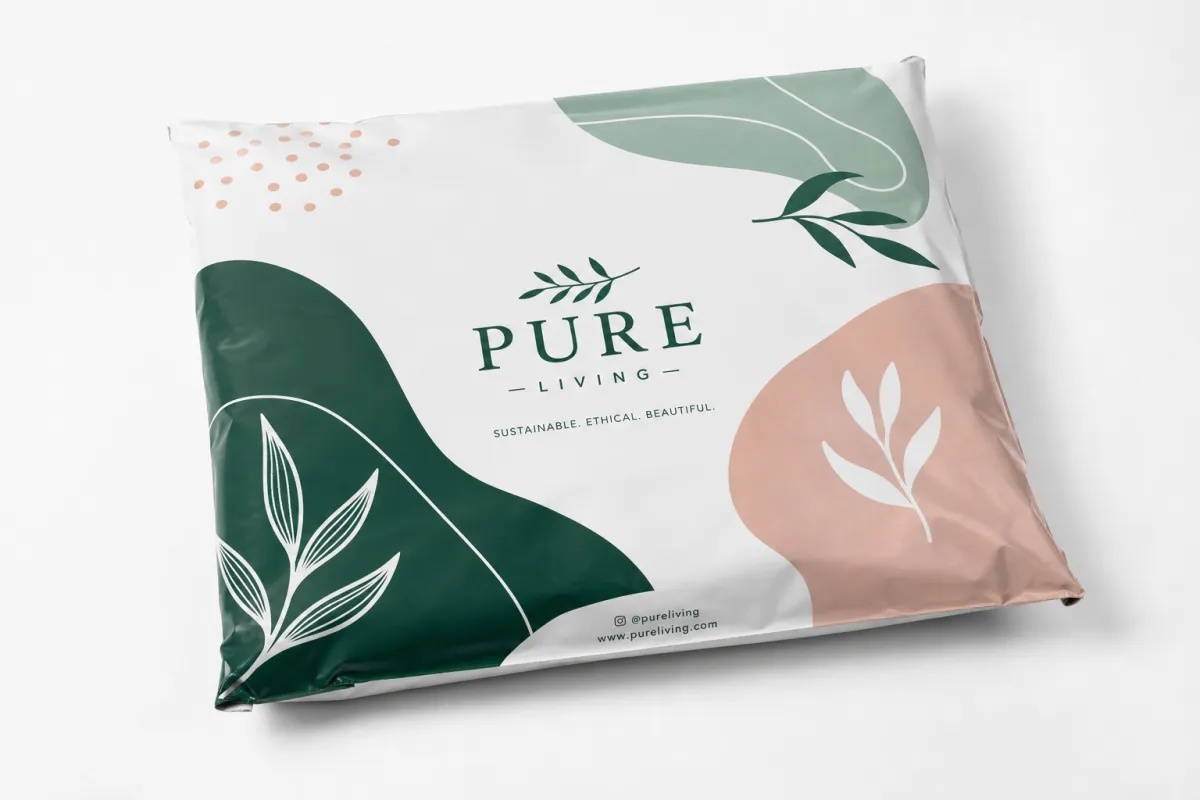
In plain terms, offset printed poly mailers are shipping bags printed with an offset-style process before the mailer is formed and finished. The process is plate-based, which is why it can deliver tight registration, sharp text, and solid control over large color areas. That matters when a logo, pattern, or branded background needs to look consistent across a long run.
Here is what gets overlooked: a shipping bag often gets seen more than the product label itself. Customers handle it. Couriers scan it. Fulfillment teams stack it. Sometimes it ends up in social content whether the brand planned for that or not. So yes, the bag matters. A lot.
These mailers are a good match for apparel, accessories, cosmetics, supplements, printed goods, and other small items that do not need a box. If the volume is steady, the artwork is locked, and the brand wants a cleaner presentation, offset printed poly mailers can feel premium without adding much weight or complexity. That balance is the whole appeal.
They also sit in a useful middle ground between print methods. Digital printing makes more sense for very short runs or artwork that changes all the time. Flexographic printing is often the practical choice for long runs with simpler graphics. Offset printed poly mailers make sense when the design needs a refined look, color has to stay predictable, and the run is large enough to justify setup. You are paying for control, not just decoration.
The best-looking mailer is not always the busiest one. A clean two-color layout with strong contrast can outperform a crowded full-coverage design by a mile. Offset printed poly mailers tend to reward disciplined artwork. Layout, scale, and material choice all matter together.
If you are trying to place a custom bag inside a broader shipment program, our Manufacturing Capabilities page can help frame what gets produced efficiently, what takes more setup, and where the print process starts affecting price. That context gets useful fast when you are comparing offset printed poly mailers against cartons, labels, or simpler mailer formats.
How Offset Printed Poly Mailers Are Made
The production sequence for offset printed poly mailers starts before a press ever runs. Artwork gets reviewed first, because small issues in type, color separation, or bleed can become expensive delays later. The prepress team checks the file, confirms the print dimensions, and prepares the plates or imaging needed to carry the artwork cleanly onto the printable surface.
Once the artwork is locked, the job moves into color separation and proofing. Brand colors are broken into print units so the press can reproduce them consistently. Sharp logos depend on registration, which is just the alignment of each color layer. Good registration is why offset printed poly mailers can hold fine type and neat edges so well, even with multiple colors or small line work.
After the print image is transferred, the film is converted into finished mailers. The printed web is formed, sealed, trimmed, and prepared with the requested closure style, such as a flap-and-peel seal. In a well-run line, the print stage and the converting stage work as one continuous quality check. Pretty ink on weak seams solves exactly nothing. With offset printed poly mailers, the bag has to look right and function right.
Quality checks happen at several points. Teams inspect color consistency from side to side and run to run, verify dimensions, check seal strength, and look for scuffing or rubbing that could dull the finish during handling. A strong supplier will also watch for film stretch, wrinkle patterns, and print-panel shift, since those defects can make offset printed poly mailers look uneven even when the artwork itself is fine.
The process is not mysterious. It is a sequence of controlled steps: file preparation, proofing, printing, converting, inspection, and packing. That predictability is part of the appeal. You are not buying magic. You are buying repeatable production discipline, which is a lot less glamorous and a lot more useful.
For brands that care about transit performance as much as appearance, it helps to ask whether the mailers are tested against shipping stress. Industry groups such as the ISTA publish widely used package performance test protocols, and those standards are a good reminder that a printed bag still has to survive compression, vibration, drop handling, and the usual abuse of distribution. That applies to offset printed poly mailers just as much as it does to any other shipping package.
If a supplier cannot explain how the print stage, converting stage, and inspection stage connect, that is a warning sign. Good offset printed poly mailers come from a process that is orderly, not improvised.
Key Factors That Affect Quality, Durability, and Appearance
Material choice has a huge effect on how offset printed poly mailers perform. Film gauge, resin blend, and opacity all influence tear resistance, stretch, and how the print sits on the surface. A thin film might save a few cents, but if the bag carries heavier items or anything with a sharp edge, the material needs enough body to resist puncture and seam stress.
Opacity matters too, especially for apparel or anything that should not show through the film. If the bag is too translucent, the product silhouette telegraphs through the plastic and cheapens the look. Better offset printed poly mailers use material that hides contents well and gives the printed ink a stronger visual foundation, so the brand color reads clearly and the package feels more intentional.
Artwork complexity is the other major quality factor. A simple one- or two-color design is usually easier to keep sharp than a design packed with gradients, photographs, and tiny reversed type. That does not mean complex artwork is impossible. It means the file has to be built carefully. A solid background, a clean logo, and one accent color often produce the best result, because offset printed poly mailers usually look more polished when the layout is restrained.
PMS matching matters too. If the brand color is specific, call it out early and ask how the match will be checked. White underprint can matter as well, especially on darker films or when the design needs to stand out strongly. The more contrast your artwork has, the less chance there is for the print to wash out. That is one reason offset printed poly mailers are favored for polished brand presentation: the process can hold controlled, repeatable color when the spec is clear.
Performance details should never get treated as an afterthought. Seal strength, flap design, load profile, and the way the bag behaves when stuffed all affect whether the mailer holds up in the real world. A bag that looks great on a proof can still fail if the adhesive is weak, the seam is narrow, or the contents push too hard against a corner. Good offset printed poly mailers are built with the shipment in mind, not just the artwork.
Sustainability claims deserve a careful read too. Some structures include recycled content, downgauged film, or source-reduction benefits, but each option still has to pass performance checks. That is where buyers need to stay practical. A recycled-content option is only useful if seal, opacity, and tear resistance remain acceptable. The EPA’s packaging and waste guidance at EPA packaging resources is a useful reminder that material reduction and recovery claims should connect to real end-use performance, not just marketing language. The same caution applies to offset printed poly mailers.
Honestly, the smartest buyers treat the bag spec like a three-part equation: looks, protection, and production fit. If one of those parts is weak, offset printed poly mailers stop being a smart buy and start becoming a compromise.
Cost and Pricing for Offset Printed Poly Mailers
Pricing for offset printed poly mailers starts with setup and ends with unit cost. Setup can include artwork cleanup, plate or imaging preparation, prepress checks, proofing, and color matching. Those costs do not disappear. They get spread across the run. That is why quantity has such a big effect on the final price per unit.
The biggest price drivers are usually quantity, size, film thickness, print coverage, and the number of colors in the design. A large bag with full-coverage print will cost more than a smaller bag with a simple logo. A thicker film also costs more than a lighter one. If the artwork needs multiple passes or a white base layer, the price can climb quickly. Offset printed poly mailers are not priced like commodity stock mailers. They are priced like a custom production run.
For a directional example, a standard run of offset printed poly mailers might land somewhere around $0.16 to $0.32 per unit on 5,000 to 10,000 pieces, depending on size, thickness, and coverage. Larger runs may drop below that, while smaller runs or more complex color work may sit above it. Those numbers are not universal, but they are useful for rough planning. If a quote lands far outside that pattern, ask what is different in the spec before calling it a bargain or a problem.
Hidden costs can sneak in. Freight is the obvious one, especially for heavy pallets or distant delivery. Rush fees can appear if the schedule is tight. Revisions after proof approval can trigger rework. Artwork changes after plates or film are already in motion can get expensive fast. A buyer comparing offset printed poly mailers should ask for a quote that lists exactly what is included and what is not, because vague pricing often ends up costing more than it first looked.
One mistake I see all the time is comparing two quotes that are not actually the same bag. If one supplier is quoting 1.5 mil film, another is quoting 2.5 mil, and the artwork coverage is different, the lower price is not really lower. It is just a different spec. That is why the simplest rule for offset printed poly mailers is also the most useful: compare apples to apples, not headline price to headline price.
| Order Profile | Typical Setup Load | Directional Unit Range | Best Fit |
|---|---|---|---|
| 5,000 pieces, 1-2 colors, moderate coverage | Lower setup spread, lighter proofing | $0.16-$0.32 each | Growing brands with steady replenishment |
| 10,000 pieces, 3-4 colors, stronger brand coverage | Moderate setup spread, more color control | $0.11-$0.24 each | Retail and e-commerce brands with stable artwork |
| 25,000 pieces, high coverage, thicker film | Setup costs spread widely across the run | $0.08-$0.18 each | Higher-volume programs and seasonal stocking |
That table is directional only, but it shows the basic reality behind offset printed poly mailers: setup gets less painful as quantity rises. If your order history is inconsistent or your artwork changes every month, another print method may be better. If demand is stable and the same branded bag ships all year, offset can become a very efficient choice.
If you are comparing custom formats beyond mailers, it helps to look at the broader menu of Custom Packaging Products before locking the spec. Sometimes a buyer starts with offset printed poly mailers and discovers that a split program, where only some SKUs use the custom bag, is the cleaner financial decision.
Production Timeline: From Proof to Delivery
The production timeline for offset printed poly mailers usually follows a clear sequence: project brief, artwork review, proofing, approval, printing, converting, inspection, and shipping. The schedule only works smoothly if each handoff is clean. If artwork is incomplete or the proof needs revisions, the clock starts stretching almost immediately.
Color correction is one of the most common delays. A logo may look fine on a laptop screen and still need adjustment to match an actual printed target. Missing file information is another common delay, especially bleed, safety margins, or Pantone references. The more complete the file package, the faster offset printed poly mailers move through prepress and into production.
Lead times are best discussed in windows, not promises. For many orders, the full process may land around 12 to 20 business days after proof approval, then freight time sits on top of that depending on distance and shipping mode. Larger runs, seasonal congestion, or limited film supply can push the schedule longer. Buying offset printed poly mailers without a schedule buffer is risky if the bags are tied to a launch or holiday promotion.
Approval speed matters more than most teams realize. A supplier can only hold a press slot if the proof gets approved on time. If the brand team needs internal review, legal signoff, or a retailer check-in, those extra days become part of the timeline whether anyone likes it or not. With offset printed poly mailers, the fastest jobs are usually the ones where the buyer is prepared before the supplier asks for the final sign-off.
It also helps to ask how inspection and packing are handled. Some suppliers batch-count, poly-wrap, and palletize before freight booking. Others stage the order differently. None of that is unusual, but it does affect timing. A good production schedule is not just about the press run. It is about the steps that move offset printed poly mailers from finished goods to your dock.
For larger programs, align the ordering rhythm with your actual shipment cadence. If you ship steadily, reorder earlier than you think. If peaks are tied to launches or promotions, reserve production time well ahead of the window. That is how brands keep offset printed poly mailers from turning into the bottleneck that delays fulfillment.
I would rather see a buyer pad the schedule by a week than miss a launch by a day. Packaging delays are rarely dramatic. They are just expensive in exactly the wrong way.
Common Mistakes When Ordering Offset Printed Poly Mailers
Overcrowding the artwork is a common mistake. Buyers sometimes try to use every inch of the bag for logos, patterns, social icons, and promotional copy. The result can feel busy and less premium. Offset printed poly mailers usually look strongest when the layout has room to breathe, because the eye can land on the brand mark instead of bouncing around a wall of information.
Choosing the wrong size or the wrong gauge is another problem. A bag that is too small can stress the seams or distort the closure. A bag that is too light can split when the product has corners, dense packing, or repeated handling. This is where actual product dimensions matter more than guesswork. The best offset printed poly mailers are chosen around packed size, not just product size.
Color approval can also go wrong if the buyer relies only on a screen. A monitor helps with layout, but it is not a reliable color authority. A printed proof, draw-down, or press match is safer, especially for brand colors that need to stay consistent from reorder to reorder. I have seen too many offset printed poly mailers approved from a screen image, only to arrive with a color cast nobody wanted.
Comparing quotes without matching specs is another trap. One quote may include a thicker film, a better seal, and a more controlled print setup. Another may not. If the buyer only looks at the bottom line, the lower offer can look attractive while quietly giving up durability or print quality. This happens often with offset printed poly mailers, because the bag is flexible enough that small spec differences do not jump out until production is already underway.
Then there is the schedule mistake: ordering too late. Even a good supplier needs time for proofing, approval, printing, inspection, and freight. If the bags are needed for a launch, the time to start is before the launch calendar becomes urgent. That advice sounds basic, but it saves a lot of grief when offset printed poly mailers are part of a fixed shipping promise.
A mailer that looks great on screen can still fail in the warehouse if the size is off by an inch or the seal margin is too narrow.
That line is worth repeating because it captures the real buying lesson. A good-looking concept is not the same thing as a production-ready specification. Offset printed poly mailers reward buyers who treat the bag as an engineered item, not just a branded surface.
If you are unsure how to judge the bag itself, ask the supplier to show how the material, closure, and print method fit the shipment profile. In many cases, the right answer comes from a combination of offset printed poly mailers and a realistic use case, not from the prettiest sample on the table.
Expert Tips and Next Steps for Better Ordering
Start with order history, not a mood board. That is the most useful advice I can give on offset printed poly mailers. If you know how many units you ship each month, what sizes move fastest, and how often reorders happen, the mailer spec becomes much easier to ground in reality. Packaging should support actual shipment behavior, not just a rendering.
Size should come from the packed product, the closure allowance, and the handling room a packer needs at the station. A pouch that works on paper may be too tight in the warehouse. A slightly larger mailer can improve packing speed and reduce waste, but only if the extra space does not let the product shift too much. The strongest offset printed poly mailers are chosen with those tradeoffs clearly in mind.
Ask for a proper proof package before approving the job. That should include artwork placement, color targets, dimensions, and any special notes about white layers or spot colors. If brand color consistency matters, call that out early and ask how the supplier will verify it. A good spec sheet for offset printed poly mailers should make the job easier to approve, not harder to understand.
Match the artwork ambition to the run size and budget. Heavy coverage, full-background color, and complex art can look fantastic, but they also make the production job more sensitive to setup and color control. If the volume is modest, a cleaner design can deliver more value. A disciplined layout often lets offset printed poly mailers look more expensive than they actually are.
It helps to think about the supplier’s production strength before placing the order. If they can explain color control, film handling, converting, and inspection with confidence, that usually means they have a repeatable process, not just a sales pitch. A buyer who understands those basics can compare suppliers more fairly and choose offset printed poly mailers on real merit instead of headline promises.
When you are ready to move, gather four things first: quantity, size, artwork files, and ship date. Then ask each supplier to quote the exact same spec. That makes the comparison honest and keeps the conversation on the real decision points. If the production team and the brand team are aligned, offset printed poly mailers become a straightforward order instead of a stressful project.
From where I sit, the best results come from clear planning and modest expectations about timing. The process is manageable, but only if the buyer gives the supplier the information needed to do the work properly. That is the path to offset printed poly mailers that look good, ship well, and stay on budget.
Frequently Asked Questions
Are offset printed poly mailers better than digitally printed poly mailers?
They are usually better for longer runs, stable artwork, and tighter color control. Digital printing often makes more sense for shorter runs or frequent artwork changes, while offset printed poly mailers tend to shine when the goal is consistent color and a polished appearance at scale.
What artwork file is best for offset printed poly mailers?
Vector artwork is usually the safest choice because it keeps edges clean and scales without softening logos or type. Brand colors should be called out clearly, and the file should include bleed, safety margins, and any required white layers so offset printed poly mailers can be produced without guesswork.
How do I estimate the price of offset printed poly mailers?
Start with size, film thickness, quantity, and the number of print colors, then ask whether setup charges and proofs are included. Freight, rush timing, and artwork revisions can change the final number, so compare quotes only when the specs match. That is the fairest way to judge offset printed poly mailers.
How long does production usually take for offset printed poly mailers?
Timing depends on proof approval, setup, printing, converting, inspection, and shipping distance. For many jobs, the process may run around 12 to 20 business days after approval, but that can change with seasonality or supply constraints. The safest move is to build buffer time into any order for offset printed poly mailers.
Can offset printed poly mailers be made with recycled material?
Yes, some structures can include recycled content, but the exact option depends on the required performance and print method. Always confirm seal strength, opacity, and tear resistance before approving a recycled-content version, and ask the supplier to verify any sustainability claim tied to offset printed poly mailers.
If you want a branded shipping bag that feels clean, controlled, and built for repeat use, offset printed poly mailers are worth serious consideration. The best results come from a clear spec, honest volume planning, and artwork that respects the production process. Do that, and you will get a mailer that looks sharp, ships reliably, and does not turn into a budget headache later.


