Buyer Fit Snapshot
| Best fit | Eco Poly Mailers projects where brand print, material claims, artwork control, MOQ, and repeat-order consistency need to be specified before quoting. |
|---|---|
| Quote inputs | Share finished size, material target, print colors, finish, packing count, annual reorder estimate, ship-to region, and any compliance wording. |
| Proofing check | Approve dieline scale, logo placement, barcode or warning zones, color tolerance, closure strength, and carton packing before bulk production. |
| Main risk | Vague material claims, crowded artwork, missing packing details, or unclear freight terms can make a low unit price expensive after revisions. |
Fast answer: Eco Poly Mailers: Material Claims, Seal Quality, and Freight Cost should be specified like a repeatable production item. The safest quote records material, print method, finish, artwork proof, packing count, and reorder notes in one written spec.
Production checks before approval
Compare the actual filled-product size with the drawing, then confirm tolerance on folds, seals, hang holes, label areas, and retail display edges. Reserve space for logos, QR codes, warning copy, and material claims before decorative graphics fill the panel.
Quote comparison points
Review material grade, print process, finish, sampling route, tooling charges, carton quantity, and freight assumptions side by side. A quote is only useful when the supplier can repeat the same color, closure quality, and packing count on the next order.
Eco Poly Mailers: How to Choose the Right Fit for Brands
If you are sorting through Eco Poly Mailers how to choose, start with the boring truth: shipping is where pretty packaging claims get tested by reality. A lightweight apparel brand can cut postage by moving out of boxes, then get burned when two mailers with nearly identical marketing copy behave very differently once the route gets wet, a corner catches, or a return shipment squeezes the film again. That gap between label language and transit reality is where packaging budgets quietly leak money. The phrase eco poly mailers how to choose sounds simple, but the real decision covers fit, protection, documentation, and total cost. Not just the nicest green claim on the bag.
Two mailers can sit next to each other on a shelf and still perform like different products once moisture, tearing, postage rules, and returns enter the picture. One may use recycled content and still have weak seals. Another may be thinner, lighter, and easier to recover in some systems, yet too flexible for rough handling. That is why eco poly mailers how to choose is less about finding a single “best” bag and more about matching the bag to the product, the lane, and the promise your brand makes to customers. For brands that want a broader packaging view, Custom Packaging Products can help frame the options beyond mailers alone.
In plain terms, eco poly mailers are lightweight shipping bags made from polyethylene film, often with some recycled content or a structure that may fit certain recycling streams more cleanly than mixed-material alternatives. That is not the same thing as recyclable everywhere, and it is definitely not the same thing as compostable. The smartest way to approach eco poly mailers how to choose is to compare recycled-content, recyclable, biodegradable, and compostable claims separately, then ask what those claims mean in actual disposal systems. The bag should support your brand values without turning the bin into a guessing game.
I keep seeing the same first mistake: buyers chase the most flattering environmental language instead of the right balance of protection, presentation, and cost. A better framework for eco poly mailers how to choose is blunt and useful: protect the product, reduce avoidable waste, document the claim, and keep the math honest. Get those four pieces right and the packaging usually behaves. Ignore them and the invoice gets cute while the returns pile up.
Eco poly mailers how to choose: what buyers miss first
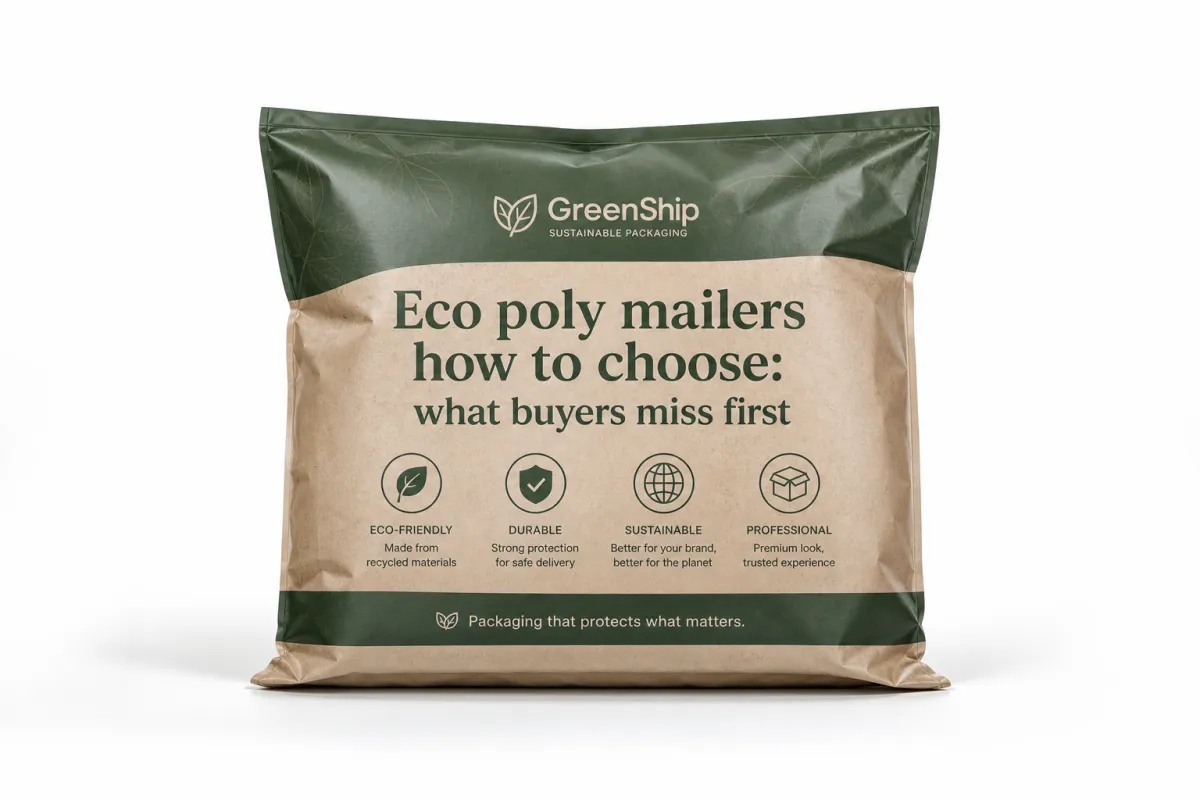
The first thing buyers miss in eco poly mailers how to choose is not the material claim; it is the shipping context. An apparel brand sending a folded tee across a nearby zone has a very different risk profile than a DTC store shipping denim, knitwear, or boxed gift sets to multiple regions. A bag that looks fine for a local order may fail in a longer lane where conveyors, weather, and repeated handling all stack up. So the real question is not “Which eco bag sounds best?” It is “Which eco poly mailers how to choose for this product, this route, and this budget?”
There is also a psychology problem. Green packaging feels safer than it is because the claim sounds responsible. Yet eco poly mailers how to choose correctly means separating the visuals from the evidence. A mailer printed with recycled imagery may still be mostly virgin resin. A mailer labeled recyclable may only be accepted in store-drop film collection, not curbside pickup. Those distinctions matter. The EPA recycling guidance is a useful reminder that local collection rules, contamination, and end-market access shape what actually gets recovered.
To make eco poly mailers how to choose less abstract, define the core claim types:
- Recycled-content means the film contains post-consumer or post-industrial material, usually listed as a percentage.
- Recyclable means the material can be recycled in some systems, but not necessarily all of them.
- Biodegradable means it can break down under certain conditions, which may be slow, partial, or a mess in real disposal streams.
- Compostable usually requires a specific industrial composting environment and should be documented carefully.
That list sounds basic, but in practice those terms get tangled together constantly. If you are comparing vendors, eco poly mailers how to choose should include a documentation check. Ask for resin specifications, recycled-content proof, and any third-party support for the environmental claim. If the supplier cannot explain what the claim means in plain English, that is a signal to slow down.
A mailer that saves two cents but adds one return shipment is not really cheaper.
That line is blunt, but it captures the real decision. Eco poly mailers how to choose is ultimately about total performance. If the mailer protects well, fits neatly, and supports your brand story without bloating postage or waste, it earns its place. If it only looks good on a quote sheet, the savings are fragile.
One more point buyers miss: the best eco option is often the one that lets you ship with less material overall. A smaller mailer, tighter fold, and cleaner seal can reduce excess film more effectively than a louder claim. That is the practical edge in eco poly mailers how to choose. Not marketing theater. Material discipline.
How eco poly mailers work: materials, seals, and end-of-life
To understand eco poly mailers how to choose, you need the basics of how the bag is built. Most poly mailers are made from polyethylene film, either low-density or linear low-density resin, because the material is light, flexible, and moisture resistant. Eco versions may use post-consumer recycled content, post-industrial recycled content, or a mono-material structure that is simpler to sort in some recycling systems. That last point matters. If the film and closure system are compatible, the package is easier to handle later. If not, the claim gets weaker.
Film thickness matters too. In trade terms, people talk about gauge or mil, and those numbers usually tell you more than a “premium” or “eco-friendly” label ever will. A thinner mailer can reduce material use and lower freight weight, but it can also stretch more or puncture sooner. A thicker bag may survive rougher routes, yet use more resin. For eco poly mailers how to choose, the goal is not the thickest bag. It is the thinnest bag that still protects the product consistently.
Then there is the seal. A strong peel-and-seal closure, or a tamper-resistant adhesive strip, affects more than convenience. It shapes theft resistance, return handling, and customer confidence the moment the parcel lands. If the adhesive opens too easily, the package feels flimsy. If it bonds too aggressively, returns become annoying and the customer experience drops. In eco poly mailers how to choose, the seal is not a side note. It is part of the product.
Features like tear strips and second adhesive strips can improve the unboxing and return process, especially for apparel. A return-friendly strip is useful when the item is likely to be tried on and sent back. That does not make the mailer more “eco” by itself, but it can reduce the need for an extra return package. Sometimes the best sustainability gain is simply fewer accessories and fewer touchpoints. That gets missed fast if you only compare film claims.
End-of-life is where many buyers get tripped up. A mailer may be made from recyclable polyethylene, but local recycling access still determines what happens next. Collection rules vary. Contamination matters. A clean film bag can be accepted in some store-drop programs, while a bag with labels, tape, or mixed layers may be rejected. Eco poly mailers how to choose should therefore include a disposal reality check, not just a materials check.
For transit durability, packaging buyers often reference testing logic similar to the methods used in distribution standards such as ISTA. That does not mean every mailer needs the same laboratory treatment as a heavy shipment, but it does mean your bag should be judged against actual handling conditions: vibration, compression, drops, and moisture. A mailer that survives a neat office shelf but splits in a parcel network is not fit for purpose.
From a practical point of view, moisture resistance, stretch resistance, puncture resistance, and opacity work together. Moisture resistance protects the fabric. Stretch resistance helps the bag tolerate a snug fill. Puncture resistance matters for zippers, buttons, and seams. Opacity matters for privacy and presentation. If you are evaluating eco poly mailers how to choose, ask how those four features behave together instead of asking for one headline claim.
A useful rule: the more fragile the contents, the more you should focus on seal integrity and puncture resistance; the more standardized the contents, the more you can optimize thickness and size. That is why a T-shirt and a denim jacket should not automatically share the same mailer spec. Same bag family, maybe. Same exact spec, not always.
Eco poly mailers how to choose the right size, thickness, and certification
Size selection sounds basic until you start shipping real products. For eco poly mailers how to choose, start with the folded product dimensions, then add room for inserts, barcodes, or return labels, and only then decide whether the bag should fit one item, a bundle, or a return-ready pack. A mailer that is too tight can stress the adhesive seam. A mailer that is too loose wastes film and makes the parcel look sloppy. Snug is usually the sweet spot, but “snug” still needs a little breathing room for the warehouse crew.
Thickness is the next decision. Many brands think thicker is automatically safer, but that is not always true. A 2.25 mil mailer with good seal quality can outperform a heavier bag with a weak closure, and vice versa. The right answer in eco poly mailers how to choose depends on the contents, the carrier mix, and the damage tolerance of your business. If returns are expensive, extra film may pay for itself. If your products are light and consistent, a slimmer gauge may be the better environmental and financial choice.
Certification and documentation are where a buyer can separate marketing from proof. Ask vendors for recycled-content statements, resin traceability, and any third-party support behind the environmental claim. If the mailer is printed, ask what happens to the print layer in recycling streams. If the supplier says “eco” but cannot show a spec sheet, that is a warning. In eco poly mailers how to choose, documentation is part of quality control, not an optional extra.
It also helps to ask whether the bag is mono-material or built with multiple layers. Mono-material designs are often easier to sort in some recovery systems than composite structures, although local infrastructure still controls the outcome. Recycled content is good; simple structure is good; clean labeling is good. Put those together, and eco poly mailers how to choose starts to look less like a branding exercise and more like a packaging engineering question.
Printing choices influence both cost and perception. A white mailer with a modest logo can look sharp and still use recycled content underneath, while heavy ink coverage may add cost and obscure the natural tone of the material. If your brand uses a bold graphic, test it on the actual substrate. Recycled film can print differently from virgin film, and small shifts in color density are common. For eco poly mailers how to choose, the print strategy should support the sustainability story, not fight it.
| Mailer option | Typical bulk price per unit | Best use | Tradeoff |
|---|---|---|---|
| Standard poly with recycled content | $0.11-$0.18 at 5,000 units | Light apparel, low-damage lanes | Less margin for rough handling |
| Custom printed recycled-content mailer | $0.15-$0.26 at 5,000 units | Brand-forward DTC shipments | Higher setup and print cost |
| Heavier-duty film with tear strip | $0.18-$0.32 at 5,000 units | Returns, dense apparel, mixed routes | Uses more material per bag |
| Return-friendly premium mailer | $0.24-$0.40 at 5,000 units | Subscriptions, premium apparel, high return rates | More features raise landed cost |
The table above matters because it shows how fast the “best” option changes once the route or business model changes. For a brand with low returns and predictable products, eco poly mailers how to choose may point toward a simpler bag. For a brand with constant exchanges, a premium closure and tear strip may save money overall, even if the unit price is higher.
If you need a broader packaging mix, including secondary shipping supplies or branded materials that sit alongside mailers, Custom Poly Mailers is a logical place to compare formats and specifications. Side-by-side review helps because eco poly mailers how to choose usually gets clearer once you compare them against the rest of your shipping setup, not in isolation.
One more technical point: ask for the test data behind the quote. In many cases that means tensile strength, dart impact, and seal performance data from the supplier, plus a practical shipment test in your own workflow. If the vendor can speak in numbers instead of adjectives, you are in better shape. Numbers make eco poly mailers how to choose much easier to defend internally.
Cost and pricing: what eco poly mailers really cost
Price quotes can be misleading if you look only at the per-piece number. In eco poly mailers how to choose, the better metric is landed cost: unit price, freight, duties if any, setup fees, minimum order quantity, and the cost of storing inventory until you use it. A low quote with a high freight bill is not a win. A cheap bag that increases damage rates is not cheap. A bag that reduces return shipments may be the best economic choice even if it costs a bit more upfront.
The main cost drivers are easy to list and easy to underestimate. Material type matters. Recycled-content percentage matters. Custom printing matters. Seal upgrades, tear strips, larger bag sizes, and zipper-style closures all add cost. Order volume matters a lot. In practice, the first price break often matters more than buyers expect, because a move from 1,000 to 5,000 units can cut unit pricing sharply before it flattens out. That is one reason eco poly mailers how to choose should include a volume model, not just a quote comparison.
Lead time has a cost too. If a seasonal launch forces air freight or emergency replenishment, the packaging can become much more expensive than it looked on paper. That is why eco poly mailers how to choose should include a simple question: what happens if the stock arrives two weeks late? Sometimes the answer is a rushed substitution, and that substitution can cost more than the original savings from the “cheaper” bag.
For teams comparing in-house and outsourced shipping, the economics are not just about packaging unit price. They also include labor, waste disposal, and damage handling. A smoother mailer can speed pack-out. A more reliable seal can lower complaints. A lighter bag can reduce postage in some lanes. If you run the numbers carefully, eco poly mailers how to choose becomes a systems decision, not a purchasing one.
Here is a practical way to compare options without drifting into spreadsheet theater:
- Estimate your annual unit volume.
- Set a target damage rate and return rate.
- Ask for landed pricing at two or three order quantities.
- Include freight, setup, and any print changes.
- Compare the cost of one damaged shipment against the extra cost of a better bag.
That framework looks dry, but it stops a common error: buying the cheapest bag and paying for the same order twice. In eco poly mailers how to choose, the right question is not “What does this bag cost?” It is “What does this bag cost after it survives the route, protects the contents, and matches the customer experience?”
There is also brand value that can be quantified, even if only roughly. A cleaner unboxing moment can improve retention. A better sustainability explanation can reduce complaints. A tighter fit can make the package look more deliberate. None of that is magic. It is just the compounding effect of better packaging choices. For many businesses, that is where eco poly mailers how to choose pays back beyond the invoice.
Suppose one bag costs $0.16 and another costs $0.22, but the cheaper bag raises damage and replacement rates by even 1% to 2% across a busy apparel line. The “savings” disappear fast. That is why experienced buyers keep returning to the same principle: eco poly mailers how to choose should be based on total cost of ownership, not the lowest line item.
Process and timeline: sampling, testing, and rollout
The sourcing process matters as much as the spec sheet. For eco poly mailers how to choose, a smart workflow starts with an RFQ, then sample review, then artwork proofing, then a test shipment, then full production. The long pole is often not manufacturing itself. It is the back-and-forth around dimensions, print placement, and approval of claims language. If your launch window is fixed, build time for revisions into the calendar from the start.
Sample testing should use real SKUs, not just a placeholder item. A folded hoodie, a zipper hoodie with a return insert, a boxed accessory, and a thin tee each behave differently in the same mailer. That matters. A sample that looks perfect with a flat tee might be too tight for a heavier item, and a sample that feels roomy with a thin product may be wasteful. For eco poly mailers how to choose, test the actual mix you ship most often.
Use a simple internal scorecard. Rate size fit, seal strength, print clarity, puncture resistance, opening experience, and return usability on the same scale. Keep the scoring boring and consistent. The easiest way to make a good decision is to stop improvising the criteria. A real test run makes eco poly mailers how to choose less subjective and much easier to explain to finance, operations, and marketing.
Timeline planning should account for what actually slows things down. Sample review often takes a few days. Proofing can take longer if artwork is changing or if recycled material print behavior needs adjustment. Production lead time varies by order size and season. Inbound freight can add another layer. A typical project may move in 2 to 4 weeks from first sample to confirmed production, but complex custom orders can stretch beyond that. For eco poly mailers how to choose, assume the calendar will be used up faster than the quote suggests.
Seasonal launches deserve special attention. If you cannot afford a stockout, avoid waiting until the last minute to validate the bag. A rushed substitution can change both performance and brand look, and that usually costs more than a planned order with a bit of buffer stock. I would rather see a buyer place a smaller pilot order early than chase a perfect spec late. That is often the cleaner route in eco poly mailers how to choose.
Testing should not stop at your warehouse. Ship a few real orders through your normal carrier mix and watch what happens. Check for scuffs, seal failures, label adhesion, moisture marks, and customer feedback. A lab result is useful, but the warehouse and carrier network are where the bag earns its keep. That field check is one of the most practical steps in eco poly mailers how to choose.
Common mistakes when choosing eco poly mailers
The first mistake is buying on environmental language alone. I see this all the time in eco poly mailers how to choose: the quote looks good, the claim sounds responsible, and nobody asks for proof. Then the supplier’s definition of “eco” turns out to be vague, or the recycled-content percentage is much lower than expected, or the disposal claim only works in a narrow system. That is not sustainability. That is a label with nice lighting.
The second mistake is oversizing. Extra room seems harmless, but it increases film use, can push postage up, and makes the parcel look less intentional. A bag that is too large can also allow the product to shift, which raises wear and presentation issues. In eco poly mailers how to choose, a snug, clean fit usually beats a roomy one. More material is not automatically more value.
The third mistake is ignoring seal quality and puncture resistance. A weak adhesive strip can open in transit. A thin film can split at the corner of a boxy item. The hidden cost is not just the damaged shipment; it is the replacement item, the service ticket, and the brand impression that follows. If you are serious about eco poly mailers how to choose, pressure-test the closure and the corners.
The fourth mistake is assuming compostable is always better. It is not. Compostable claims depend on access to suitable collection and processing systems, which are uneven in the real world. If the item is headed into a regular trash stream, the environmental benefit may be limited. That is why eco poly mailers how to choose should begin with the destination of the package, not the prettiest claim on the catalog page.
Another trap is treating print as an afterthought. Heavy coverage can change cost and alter how the recycled substrate looks on press. If your brand wants a crisp white logo on a recycled-toned film, test it before you commit. A small proof run is cheaper than correcting a color mismatch after 20,000 units arrive. For eco poly mailers how to choose, the print spec should be part of the buying decision from day one.
There is also a process mistake: failing to align procurement, operations, and marketing. Procurement may want the lowest quote. Operations may want the easiest bag to pack. Marketing may want the cleanest sustainability story. Those are not the same goals, but they can be reconciled if everyone sees the same sample and the same scorecard. That cross-check is one of the most underused parts of eco poly mailers how to choose.
Finally, do not skip the reorder plan. If your lead time is 3 weeks and you wait until the last pallet is nearly gone, you are building risk into the system. Better to identify a reorder point, a safety stock level, and a backup bag that still meets your minimum requirements. Good planning is a quiet part of eco poly mailers how to choose, but it saves the most headaches.
Next steps: choose eco poly mailers with confidence
At this point, eco poly mailers how to choose should feel more like a checklist than a mystery. Confirm the product size. Confirm the material claim. Confirm recycled content and documentation. Confirm seal strength. Confirm print needs. Confirm MOQ and lead time. Then compare the landed cost, not just the quote. If a supplier cannot answer those questions clearly, keep looking.
Before you place a larger order, request at least three samples and score them against the same criteria: fit, closure, puncture resistance, appearance, and end-user experience. A simple side-by-side test tells you more than a polished catalog ever will. That is the practical heart of eco poly mailers how to choose: make the decision with evidence, not packaging jargon.
A short pilot shipment is worth the time. Send real orders, monitor damage rates, ask customer service for feedback, and watch how the warehouse team handles the bag. If the pack-out gets faster and complaints stay flat or fall, you are moving in the right direction. If not, adjust. Eco poly mailers how to choose is rarely a one-shot decision; it is usually a tight loop of testing and refinement.
If you are building out a broader sourcing plan, align the mailer choice with the rest of your shipping supplies. That means labels, inserts, return handling, and any branded outer packaging should all work together. The best result is not the bag with the loudest claim. It is the package that protects the product, supports the brand, and keeps waste in check. That is where eco poly mailers how to choose becomes a business advantage instead of a purchase task.
So keep the checklist simple, keep the evidence visible, and keep your reorder point close. The takeaway is straightforward: choose the eco poly mailer that fits your product, matches your actual disposal reality, and survives your shipping lane without padding the budget with avoidable damage or waste. That is the decision That Holds Up.
FAQ
Are eco poly mailers recyclable everywhere?
No. Recyclability depends on local collection programs, contamination rules, and whether the mailer is accepted in a film-plastic stream. A recyclable label does not guarantee curbside acceptance, so buyers should check local rules before assuming the bag will be recovered.
How do I choose the right size eco poly mailers for apparel?
Measure the folded product first, then add room for inserts or return labels, and choose the smallest mailer that still closes cleanly without stretching. A snug fit usually cuts waste, improves presentation, and lowers the chance of movement inside the bag.
Are recycled-content eco poly mailers strong enough for shipping?
Yes, if the film gauge, seal quality, and puncture resistance are matched to the product and route. Recycled content alone does not predict performance, so sample testing is the safest way to confirm the bag is fit for use.
What should eco poly mailers cost in bulk?
Bulk pricing usually improves as order volume rises, but the real figure to compare is landed cost, not just the per-bag quote. Freight, setup, minimum order quantity, and custom-print charges can change the final number more than buyers expect.
How long does it take to source custom eco poly mailers?
Expect time for sampling, proof approval, production, and freight, so the full process can stretch well beyond the first quote date. Seasonal launches need extra buffer because artwork changes and supplier backlogs are common delay points.


