A cheap bag becomes expensive when the header tears, the print scuffs, or store staff have to rebag product before it reaches the peg. An opp header bags Unit Cost Breakdown should focus on usable pieces, not just the lowest number on a quote sheet.
OPP header bags are common for apparel accessories, stationery, cosmetic tools, stickers, craft supplies, small promotional kits, phone accessories, and lightweight retail items that need clear product visibility with a branded hanging area. They sit between plain poly bags and more expensive rigid boxes or laminated pouches.
OPP Header Bags Unit Cost Breakdown Starts With Waste
The first cost problem is often waste. If 3% to 8% of packed bags are damaged during handling, retail setup, or display, the actual cost per usable package changes. A $0.075 bag can behave like a $0.09 bag once rework, replacement packaging, slower packing labor, and damaged presentation are counted.
Retail packaging does not need to be overbuilt, but it does need to survive the job. A thin OPP bag with a weak header may work for warehouse bundling. It may fail in a retail program where staff hang, remove, scan, and rehang the product several times.
A useful cost breakdown includes film gauge, bag size, adhesive flap, hanging hole style, header card material, print method, quantity, packing method, and freight volume. Leave one out and the quote can drift through change charges, higher freight, or failed samples.
Practical buying rule: bring dimensions, artwork, order quantity, and packing requirements before asking for pricing. Vague quote requests get vague pricing.
Custom Logo Things can price header bags in useful tiers once the structure is defined. Without that structure, the conversation turns into guesswork instead of sourcing.
What You Are Actually Buying: Bag, Header, Print, and Packout
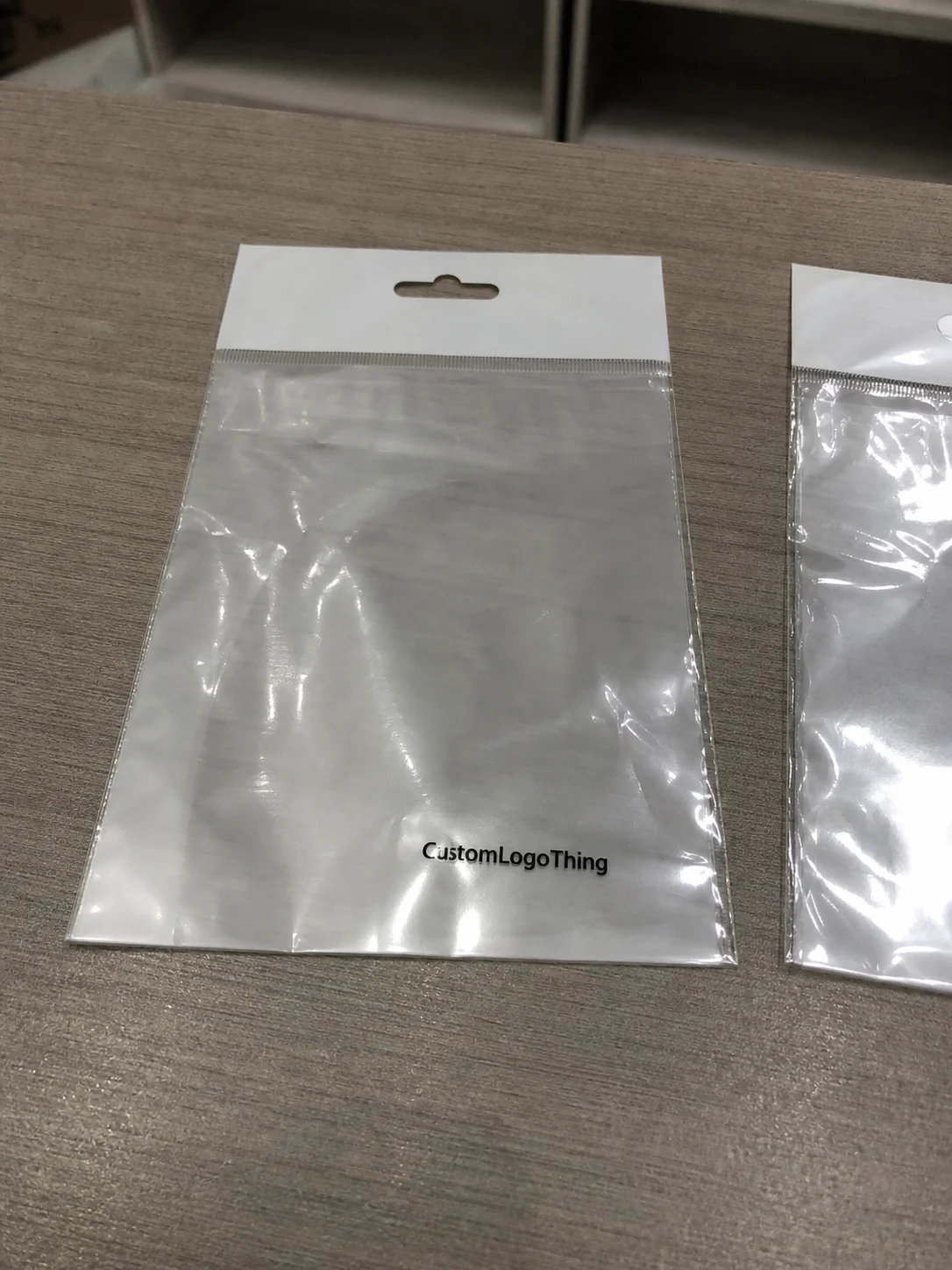
An OPP header bag is not just a clear bag with a logo on top. The finished package usually includes a clear OPP body, an adhesive closure or flap, a printed header card or printed header zone, a hang hole, an optional euro slot, inner packing, and export cartons. Each part adds cost and can cause problems if specified poorly.
Two constructions appear most often. The first uses a separate printed header card, usually folded, stapled, heat sealed, or attached to the bag. This often looks more retail-ready because the card has stiffness, cleaner graphics, and better barcode readability. It also adds card material, print cost, and assembly labor.
The second uses a printed header area on the OPP itself. This can reduce separate card handling, but the economics depend on design, print registration, opacity needs, and run size. Direct printing on film is not automatically cheaper.
OPP performs well for high clarity, crisp product visibility, low weight, light moisture resistance, and clean shelf presentation. It is a sensible fit for hair accessories, jewelry findings, socks, sample kits, craft beads, stickers, small toys, light hardware, and promotional sets under roughly 200 to 500 grams, depending on shape and handling.
OPP has limits. It is not a heavy-duty protective pouch, a puncture-resistant industrial bag, or a premium barrier pouch for oils, liquids, powders, or products that need serious moisture or oxygen protection.
Match the structure to the product. Soft goods can often use lighter film. Sharp corners need thicker material, rounded insert cards, or a support board. Premium retail lines may justify a stronger header card, especially when the display depends on the hang hole staying clean through repeated handling.
How Do You Calculate an OPP Header Bags Unit Cost Breakdown?
To calculate unit cost, start with the quoted unit price, then add setup charges, sample costs, expected waste, packing labor, cartons, freight, duties if applicable, and rework risk. Divide the total landed packaging cost by the number of usable bags, not just the number ordered.
Example: 50,000 bags cost $4,500 ex-factory, so the apparent price is $0.09 each. Add $350 in setup, $180 in sampling, $900 in freight, and 4% expected handling waste. The practical cost lands closer to $0.123 per usable piece before internal labor.
Separate factory price from delivered cost. Factory price tells you what the supplier charges to make the package. Landed cost tells procurement what it pays to get usable packaging into the operation. Retail packaging unit cost sits between those numbers and the shelf, where the package either holds up or exposes every shortcut.
Use the same formula across every supplier quote. Compare the same bag size, OPP film thickness, header card, print coverage, packout, and shipping assumption. Otherwise one vendor may look cheaper because they priced thinner film, a smaller header, fewer cartons, or a different freight method.
Specifications That Move the Price More Than Buyers Expect
Accurate custom OPP header bag pricing starts with specific inputs: bag width, bag height, flap size, header height, film thickness, header card size, hole type, print colors, order quantity, barcode needs, and desired packing count per carton.
Size is one of the largest cost drivers. A bag that grows from 100 mm x 150 mm to 120 mm x 180 mm can change cutting yield, carton quantity, and freight volume. Across 50,000 units, small dimension changes can move both material cost and landed cost.
Film thickness should match the product. Lightweight flat items may work with thinner OPP around 25 to 35 microns. Retail handling, thicker contents, or items with corners often push buyers toward 40 to 50 microns or more. Product weight and geometry matter, so sample testing is part of cost control.
Header materials also change the quote. Standard paperboard can keep cost controlled. Coated card improves print appearance. Recycled board may support sustainability goals, though color and surface consistency can vary. Foil, specialty coatings, textured stock, and heavy board can make the package feel more premium, but they add line-item cost.
Print choices matter. A one-color logo is usually the lowest-cost custom route. Full-color process printing adds setup, color control, and inspection time. Foil stamping, spot UV, embossing, and matte or gloss coating can work for giftable or premium products, but they increase setup charges and can lengthen the sample stage.
Recognized standards help when testing matters. ASTM packaging test methods can frame material and performance checks, while ISTA procedures are useful for distribution testing when packaged goods need to survive transit. For paper-based header cards, FSC certified stock may be requested if a retail channel requires responsibly sourced paper.
Always confirm fit with samples before production. A technically correct size can still be slow to pack if the item is thick, folded, flexible, or inconsistent from batch to batch. That packing friction becomes labor cost.
Pricing, MOQ, and Unit Cost Ranges for Custom Header Bags
Simple custom OPP header bags may land around $0.04 to $0.18 per unit at higher quantities, depending on size, film gauge, header construction, print coverage, and freight method. Larger bags, heavier cards, full-color retail printing, barcode control, and special finishes can push the cost per piece higher.
Many custom runs start around 5,000 to 10,000 units. Better bulk pricing often appears at 25,000, 50,000, and 100,000 units because setup, tooling fees, make-ready, production waste, and labor are spread across more pieces.
A useful quote separates the visible and hidden cost components: OPP film, header card stock, printing plates or setup, ink coverage, cutting, hole punching, adhesive strip, card attachment, QC, inner bags, cartons, and freight. If a quote only shows one number, ask what is included.
| Specification Choice | Typical Use | Unit Cost Impact | Buyer Tradeoff |
|---|---|---|---|
| Thin OPP, simple printed header | Flat stickers, light stationery, small inserts | Often lowest, roughly $0.04-$0.09 at larger runs | Good clarity, less strength for rough retail handling |
| Medium-gauge OPP with coated header card | Hair accessories, socks, craft kits, sample sets | Moderate, often $0.08-$0.16 depending on size and print | Better shelf presence, higher material and assembly cost |
| Full-color header with euro slot | Retail peg displays and branded product lines | Moderate to high due to print control and punching | Cleaner retail display, more setup attention needed |
| Premium card with foil or spot UV | Giftable accessories and higher-margin retail goods | Higher due to finishing and added setup charges | Stronger brand feel, slower sampling and higher MOQ risk |
Small orders cost more because setup does not shrink with quantity. Printing plates, dielines, machine make-ready, first-article checks, and waste all exist whether the order is 3,000 or 30,000 units. Request two or three quantity tiers. A quote at 10,000, 25,000, and 50,000 units usually shows where the meaningful price break starts.
Compare landed unit cost, not just ex-factory cost. Packaging is light, but bulky cartons can raise air freight through dimensional weight. A slightly taller header card or wider bag may reduce the count per carton and raise freight more than expected.
The most accurate cost view identifies which charges are one-time and which repeat on every order. A printing plate fee may disappear on a reorder if the artwork remains unchanged. Freight, paperboard, film, ink, labor, and carton costs continue to move with quantity and market conditions.
Process and Timeline From Quote to Retail-Ready Bags
A clean process keeps cost under control: confirm specifications, review artwork, provide a quote, approve the dieline, produce a proof or pre-production sample, approve the sample, run production, inspect finished goods, pack cartons, and ship.
Quoting can take 1 to 3 business days when the buyer provides complete details. Artwork and dieline approval often takes 2 to 5 business days, depending on file quality. Sampling can take 5 to 10 business days for standard work, and longer for specialty finishes, unusual card stock, or complex assembly.
Production for many custom OPP header bag orders runs 12 to 25 business days after sample and artwork approval. Larger volume orders, heavy print coverage, foil stamping, special paper, or extra QC requirements can extend that timeline. The final schedule depends on specification and factory capacity.
Common delays include missing dimensions, low-resolution artwork, unconverted fonts, unclear header construction, barcode changes after proof approval, and product dimensions that change after sampling.
Freight timing matters. Express shipping is fast but expensive. Air freight can support launch deadlines for moderate volumes. Ocean freight is usually cheaper for large runs but adds weeks and requires better inventory planning. The cheapest production option can become the wrong option if the delivery date is fixed and freight is not planned.
Lock final product dimensions before sampling. Design the bag around the real item, not an estimated measurement. If the product has fabric thickness, folded parts, loose components, or sharp corners, send photos and actual samples where possible.
Common Quote Mistakes That Inflate the Final Bag Price
The first mistake is asking for the cheapest option without defining the retail requirement. A bag for warehouse bundling is not the same as a bag that needs to hang straight, show a barcode, survive handling, and look acceptable under retail lighting.
Overspecifying creates the opposite problem. Too-thick film, oversized headers, premium card stock, and unnecessary full-coverage print can raise unit cost without improving sell-through. A clean one-color header on coated board may do the job better than a full-bleed design that adds setup charges and slows approval.
Underspecifying is just as expensive. Weak header cards can tear at the hang hole. Thin film can split near corners. Poorly placed adhesive flaps can make packing slower. A low-cost header bag that creates returns, messy shelves, or retail complaints is not a low-cost package.
Artwork mistakes are another quiet cost driver. Low-resolution logos, RGB colors, missing bleed, unconverted fonts, and vague color references can trigger reproofing fees or production delays. For print, send vector logos where possible, provide Pantone references for spot colors, and keep barcodes at a scannable size with proper quiet zones.
Freight blind spots hurt buyers who only compare factory unit price. A bag that is 10 mm wider may reduce carton packing count enough to change the shipping math. The same applies to header height. If cartons get larger, dimensional weight may move the landed cost even when the factory price looks similar.
Use the same specification for every supplier quote: same bag size, film gauge, header material, print colors, and packing method. A proper opp header bags Unit Cost Breakdown only works when every vendor is pricing the same job.
Next Steps to Get an Accurate Header Bag Quote
To get accurate pricing from Custom Logo Things, send the details that drive the quote: product dimensions, product weight, photos of the item, desired bag opening direction, header height, hanging hole preference, print artwork, barcode needs, and target order quantity.
- Product size: width, height, depth, and any folded or compressed dimensions.
- Target bag size: if known, include body size, flap size, and header height in millimeters or inches.
- Material preference: OPP thickness target, header card stock, coated or uncoated finish, and any FSC requirement.
- Print details: logo files, number of colors, full-color artwork, barcode, bleed, and finish requests.
- Commercial details: MOQ target, quantity tiers, destination, carton packing needs, and deadline.
A current packaging sample or competitor reference helps. Physical references reduce guessing and make it easier to quote comparable construction. Photos are useful, but a real sample answers questions about stiffness, header height, hole placement, and how the product behaves inside the bag.
Choose three quantity tiers before requesting a quote, such as 10,000, 25,000, and 50,000 units. That gives procurement a practical view of inventory risk versus lower unit cost. Sometimes the jump from 10,000 to 25,000 units saves enough to justify holding stock. Sometimes it does not.
The best quote conversation covers unit price, setup charges, sample cost, MOQ, production lead time, carton quantity, carton dimensions, and shipping options. Ask for those details before comparing vendors.
FAQ
What affects an OPP header bag unit cost the most?
The biggest cost drivers are bag size, film thickness, header card material, print coverage, number of colors, order quantity, assembly method, and freight volume. For many orders, size and quantity create the biggest price swings because they affect both material use and production efficiency.
What MOQ should I expect for custom OPP header bags?
Many custom OPP header bag projects start around 5,000 to 10,000 units, depending on size, print method, and header construction. Better unit pricing usually appears at 25,000 units and above because setup, make-ready, and production waste are spread across more bags.
Are printed header cards cheaper than printing directly on OPP bags?
It depends on the design and construction. A simple printed header card can be cost-effective and gives a strong retail presentation. Direct printing on the OPP header area may reduce separate card handling, but print setup, registration, opacity needs, and material choices can change the final cost.
How long does custom OPP header bag production take?
A typical project can take 12 to 25 business days for production after artwork and sample approval. Sampling, complex print finishes, large runs, and freight method can extend the total timeline, so launch orders should be scheduled early.
How do I get the most accurate OPP header bags pricing quote?
Send exact product dimensions, target bag size, header size, film thickness preference, artwork, quantity tiers, packing requirements, and destination. Ask for landed pricing or freight estimates when possible, because the cheapest unit price is not always the cheapest delivered cost. A disciplined opp header bags unit cost breakdown keeps the quote honest from the first round.