Buyer Fit Snapshot
| Best fit | Order Compostable Poly Bags projects where brand print, material claims, artwork control, MOQ, and repeat-order consistency need to be specified before quoting. |
|---|---|
| Quote inputs | Share finished size, material target, print colors, finish, packing count, annual reorder estimate, ship-to region, and any compliance wording. |
| Proofing check | Approve dieline scale, logo placement, barcode or warning zones, color tolerance, closure strength, and carton packing before bulk production. |
| Main risk | Vague material claims, crowded artwork, missing packing details, or unclear freight terms can make a low unit price expensive after revisions. |
Fast answer: Order Compostable Poly Bags: Specs, Pricing, MOQ should be specified like a repeatable production item. The safest quote records material, print method, finish, artwork proof, packing count, and reorder notes in one written spec.
Production checks before approval
Compare the actual filled-product size with the drawing, then confirm tolerance on folds, seals, hang holes, label areas, and retail display edges. Reserve space for logos, QR codes, warning copy, and material claims before decorative graphics fill the panel.
Quote comparison points
Review material grade, print process, finish, sampling route, tooling charges, carton quantity, and freight assumptions side by side. A quote is only useful when the supplier can repeat the same color, closure quality, and packing count on the next order.
I’ve watched more than one brand Order Compostable Poly bags expecting a simple swap from conventional polyethylene, then get blindsided by the reality: two “eco” films can behave very differently in sealing, shelf life, and tear resistance. I remember one beauty client who assumed every compostable film would run at 0.06 mm and perform the same. Their first samples split at the bottom seal after 18 drop tests, while the second sample passed the same test and held up for six weeks in a humid warehouse. That gap matters, because the buyer is not shopping for a philosophy. The buyer needs a bag that protects product, supports brand presentation, and keeps margin intact, often on a budget that starts around $0.15 per unit for 5,000 pieces and changes fast once print or certification gets added.
Many packaging conversations go sideways for a simple reason. Sustainability gets the spotlight, performance gets a passing mention, and price arrives too late to rescue the plan. In the factory floor meetings I’ve sat through, the order is usually more direct: can it seal on existing equipment, what is the MOQ, and how much does it add to landed cost? If you plan to order compostable poly bags for apparel, supplements, stationery, or light industrial parts, those questions decide whether the project gets approved. Not the marketing copy. Not the Pinterest mood board. Just the numbers and the fit, often after a 350gsm C1S artboard prototype or a film sample reaches the table in Shenzhen, Dongguan, or Ningbo.
The good news is that compostable packaging can do real work. It can reduce visible plastic footprint, support eco-friendly packaging claims, and align with a brand’s move toward a lower carbon footprint and a more circular economy. It can also look clean on shelf and behave predictably in ecommerce fulfillment if the spec is right. I’ve seen well-made compostable bags outperform paper alternatives in moisture resistance by a wide margin, especially for products that need clarity, seal integrity, and a compact footprint in transit. Honestly, I think a lot of buyers underestimate how much a good bag can do until they’ve had one ruined in a damp storeroom in Leeds, Atlanta, or Rotterdam, which happens more often than people admit.
Paper wins in some channels and loses in others. Conventional polyethylene still wins on cost, puncture resistance, and long storage stability. Compostable film sits between those two worlds: it offers a better end-of-life story than standard plastic, but it asks for more discipline in selection, storage, and approval. That tradeoff is manageable. You just need the right brief before you order compostable poly bags, whether the bags are destined for a warehouse in Birmingham or a fulfillment center outside Dallas.
Order compostable poly bags: why buyers switch now
Buyers usually make the switch for one of four reasons: brand positioning, retail requirements, customer expectations, or a procurement team that wants fewer fossil-based inputs. I’ve seen all four in the same meeting. A stationery brand in Manchester told me their buyers started asking for green packaging language on the carton copy. A second customer, an apparel startup in Bristol, wanted to cut down on visible plastic because their audience already associated them with zero waste values. A third was a supplement company in Chicago where the sales team had simply lost a big retail account over packaging sustainability language. Same bag category. Different trigger. Same headache for procurement, and often the same quote round spanning 500, 5,000, and 25,000 units.
The value proposition is practical, not romantic. A well-specified compostable bag can protect garments from dust, keep accessory kits together, and present a clean branded face at unboxing. It can also help a brand tell a more credible sustainability story without sacrificing transit protection. That matters in ecommerce because a damaged arrival costs more than just the replacement unit. It adds a support ticket, a reshipment, and a bit of brand trust that is hard to win back, especially if the bag was supposed to survive 12-15 business days from proof approval to dispatch and instead arrived in a condition nobody wanted to photograph.
I’ve had clients ask whether they should move straight from polyethylene to paper instead. Sometimes the answer is yes. Paper is strong in printability, stackability, and perceived premium value. But if the product is moisture-sensitive, if you need product visibility, or if your pack line is already built around flexible film, compostable film is often the more sensible route. That’s especially true for order compostable poly bags projects where the bag needs to fold neatly around apparel, stationery sets, or small hardware. In one run for a homeware brand in Melbourne, a 40-micron compostable film held a folded tea towel set better than a 60-micron paper wrap, and the shipping cube dropped by 14%.
There’s also a cost reality that often gets ignored. Paper may look simpler on paper—no pun intended—but it can cost more once you factor in structure, coating, and shipping volume. Conventional polyethylene is still usually cheaper per unit, especially at scale. Compostable film typically costs more than standard poly, but it can justify that premium if it reduces rework, supports a retail pitch, or helps the brand stay inside procurement rules. That’s the buying logic. Not ideology. A plain stock compostable bag might come in at $0.09 to $0.16 per unit for 1,000 to 3,000 pieces, while a printed custom version can move closer to $0.22 to $0.45 depending on size, film, and certification.
Here’s the practical rule I use: if the bag must be clear, lightweight, moisture resistant, and easy to seal, you should at least order compostable poly bags samples before dismissing the format. I’ve seen brands assume the material will be too weak, then discover that a 40-micron certified compostable film with the right seal profile performs better than a thicker, poorly chosen alternative. Material selection matters more than the label, and a bag made in Jiangsu or Guangdong with the right blend can outperform a generic “eco” bag by a wide margin.
“We thought compostable meant fragile,” one procurement manager told me after a sampling round. “What we really needed was the right blend and the right gauge.” That single comment captured the whole project.
For related packaging formats, some buyers pair bag orders with Custom Poly Mailers so the outer shipper and inner pack align on size and branding. Others keep their sourcing broader by browsing Custom Packaging Products before committing to a full rollout, especially when they need multiple formats shipped into London, Los Angeles, and Toronto on the same replenishment cycle.
Product details: what compostable poly bags actually are
Plainly put, compostable poly bags are flexible protective bags made from compostable or plant-derived resin systems designed to break down under defined composting conditions. That “defined” part matters. If you plan to order compostable poly bags, you need to know whether the film is industrial compostable, home compostable, or merely marketed as biodegradable. Those are not interchangeable claims, and in packaging compliance they are absolutely not the same thing. I get a little twitchy when a spec sheet uses those terms interchangeably. It’s how good intentions turn into expensive reprints, especially when a 10,000-piece run is already scheduled for a warehouse in New Jersey or Frankfurt.
Industrial compostable material is typically tested to standards such as ASTM D6400, EN 13432, or equivalent regional frameworks. Home compostable films use a different standard and usually need a more demanding formulation because the breakdown conditions in a backyard compost bin are less controlled. I’ve had buyers insist on “compostable” without asking which environment was actually certified. That is how labeling problems start. Certification paperwork should match the claim printed on the bag, and the bag should match the channel it’s going into. Otherwise, you’re inviting an awkward conversation with compliance and, honestly, nobody enjoys that call when the cartons are already sitting on a loading dock in Sydney.
Common resin systems include PLA, PBAT blends, starch-based films, and certified compostable lamination structures. Each one brings its own strengths. PLA can deliver clarity and decent stiffness. PBAT improves flexibility and seal performance. Starch-based systems can reduce petroleum content, but they can also change how the film behaves in humid storage. In real production, suppliers often blend materials to balance clarity, heat behavior, and puncture resistance. That balance is what you are paying for when you order compostable poly bags, and it is why two samples with the same outside dimensions can have wildly different real-world performance.
Functional features buyers ask for most often
- Resealable closures for accessories, subscription kits, and retail returns.
- Adhesive strips for apparel and stationery packs that need a clean first-open impression.
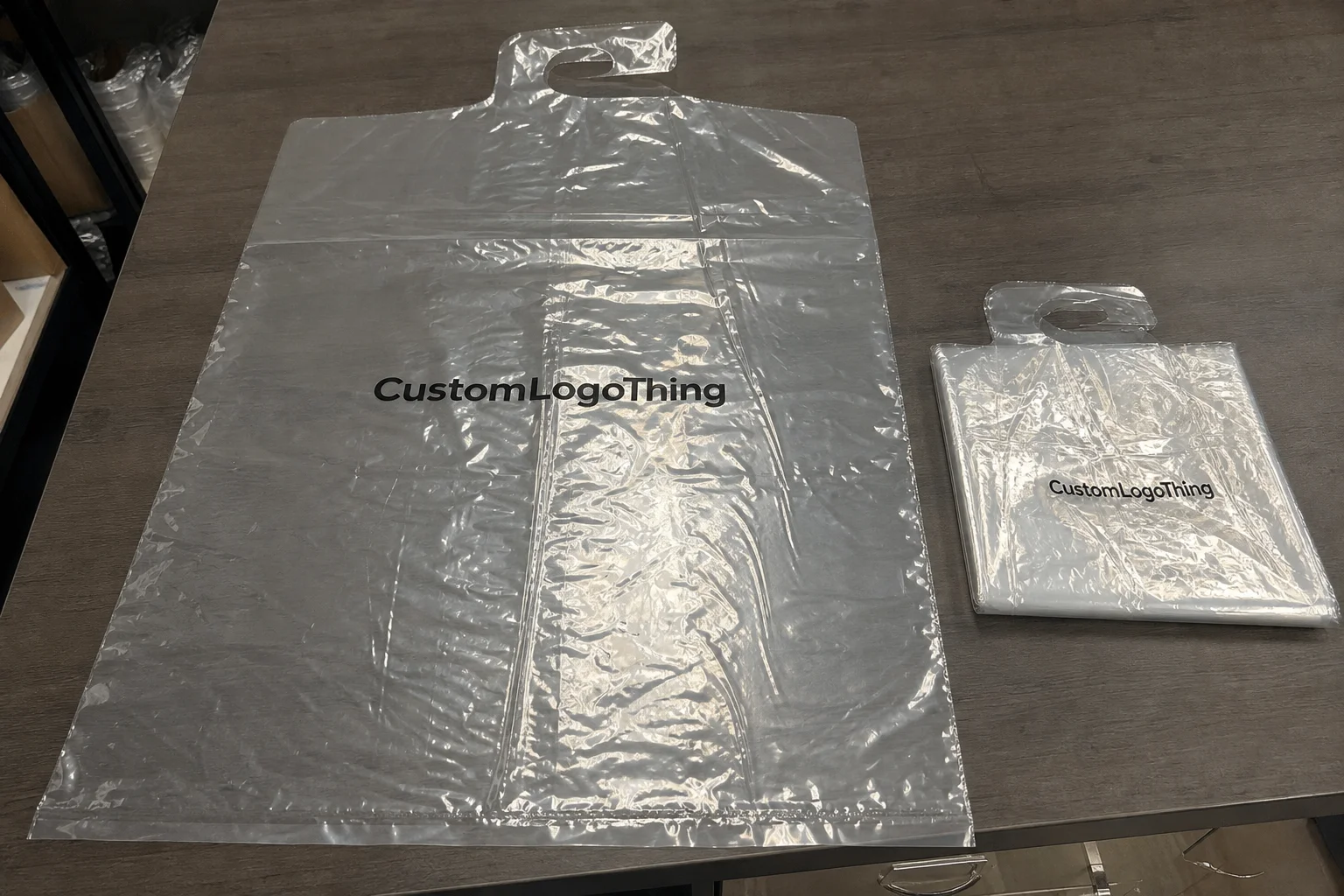
- Hang holes for peg display and store shelving.
- Perforation lines for easy opening in fulfillment centers.
- Vent holes when trapped air affects pack shape or insertion speed.
- Print options for logos, care instructions, and certification marks.
There are limitations, and buyers deserve to hear them before they order compostable poly bags. Compostable film can be more heat-sensitive than standard polyethylene, so seal temperature and dwell time need to be set carefully. Some films are also less puncture resistant than virgin plastic at the same gauge, which is why thickness selection is not optional. Storage matters too. I’ve seen a warehouse in Birmingham leave a pallet near a loading bay door where afternoon heat spiked. The result was a batch that looked fine on arrival but handled worse after three weeks. A cool, dry room at 18-22°C would have avoided the headache. Simple? Yes. Easy to forget? Also yes.
Still, the branding upside is real. Clear compostable bags can show the product while keeping the package light and tidy. Printed compostable bags can carry a logo, a size indicator, or a sustainability message without turning the pack into a billboard. That balance is useful for ecommerce and retail alike. If your packaging is part of the customer experience, the right bag can do two jobs at once: protect the product and communicate the brand.
One clothing brand I advised printed a small compostable mark on the back seam and kept the front clear. Their unboxing photos improved because the product stayed visible, while their sustainability claim remained legible and modest. That’s better than shouting across the bag surface. It feels more credible. Less “look at us,” more “we actually thought this through,” especially when the artwork file was approved on a Tuesday and production started the following Monday in Dongguan.
Specifications to confirm before you order compostable poly bags
If you want the order to go smoothly, the spec sheet needs to be tight. When buyers order compostable poly bags, the most common mistake is asking for “something around A4 size” or “roughly 0.05 mm thick.” That language creates guesswork, and guesswork creates rework. Use exact measurements. Measure the product, the inserts, and any folding or sealing allowance before you request a quote. I know that sounds basic, but the amount of money I’ve seen lost to a missing 5 mm is almost insulting, especially when the fix is often just one adjustment to a 210 mm x 297 mm bag or a 250 mm x 350 mm bag.
The core specifications should include width, height, thickness, closure style, print coverage, color, and certification placement. If the product is apparel, account for folds. If the product is boxed, allow for panel depth. If the bag will be heat sealed on a line, tell the supplier the seal width and machine type. I once watched a production supervisor reject a batch because the bag width looked correct on the drawing, but the gusset clearance was 8 mm too tight for the cartoning insert. That tiny error cost two days. Two days! In packaging time, that’s practically a geological event, whether the bags came out of a factory in Ningbo or a converter in Ho Chi Minh City.
Film thickness is not just a number. It changes feel, seal behavior, and durability. For lightweight retail packs, common ranges might be around 30 to 60 microns depending on material structure and use case. But do not treat that as a universal rule. The right gauge depends on the resin blend and the product weight. A 50-micron film in one compostable formulation may outperform a 60-micron film from another supplier. Ask for tensile strength, elongation, and seal integrity data if the order volume is significant. If you are placing 20,000 units or more, ask for the test report rather than a verbal assurance.
Compliance details that can save you from a reprint
Certification language matters. If the bag is industrial compostable, the printing and sales copy should say exactly that unless the certification allows a broader claim. If the bag touches food, request food-contact documentation. If the bag is sold into a market with local labeling rules, ask what mark or statement must appear on-pack. These details are not decoration. They protect you from costly relabeling after the shipment lands, whether the final destination is Amsterdam, Houston, or Auckland.
For buyers who need stronger authority references, I often suggest checking the standards bodies directly. The ASTM and local compostability frameworks are not light reading, but they are useful. Packaging engineers and compliance teams also lean on industry associations such as packaging.org and testing organizations like ISTA when they need shipment performance context. If the brand is making environmental claims, the EPA is another useful reference point for broader waste and materials guidance.
Artwork specs matter just as much as resin specs. Before you order compostable poly bags, confirm file format, bleed, safe area, Pantone matching, and the maximum ink coverage the film can handle without looking muddy. Compostable surfaces can behave differently from conventional poly under certain inks, so a proof is not a formality. It is the point where a good idea becomes a usable package. I’ve seen otherwise polished artwork come out weirdly flat because someone assumed the substrate wouldn’t matter. It absolutely matters, especially if the print includes a 2 mm certification mark or a small QR code that needs to scan from 15 cm away.
- Dimensions: exact width x height, plus gusset if needed.
- Thickness: microns or mils, stated clearly.
- Closure: open-top, self-seal, zipper, heat seal, or fold-over.
- Print: one color, two color, CMYK, or no print.
- Compliance: industrial or home compostable certification, food contact if required.
- Sample approval: pre-production sample or digital proof.
One more practical point: always approve a physical sample when the order is custom. I’ve seen digital proofs hide registration drift, and that can show up only after the first production run. For a buyer placing a serious order compostable poly bags program, a $60 to $150 sample round is cheap insurance against a $6,000 mistake. In one case, that sample caught a 4 mm shift in the logo placement before a 15,000-piece run went to a distribution center in Pennsylvania.
Pricing and MOQ: what changes the cost when you order compostable poly bags
Pricing is where the conversation gets real. If you want to order compostable poly bags, the unit cost will usually depend on seven variables: material blend, bag size, thickness, closure style, print complexity, certification requirements, and volume. Larger orders almost always lower the unit price, but not always by enough to justify stuffing a warehouse with old inventory. That is the trap. Cheap per unit can still be expensive overall if the product line changes in six months. I’ve seen that movie, and it ends with someone trying to “find a home” for 40,000 bags that no longer match the new packaging system, even though the original quote looked brilliant at $0.11 each for 10,000 pieces.
I’ve seen procurement teams compare only the unit price and miss the actual landed cost. That creates a false win. Shipping, customs, palletization, warehousing, and even moisture-protective storage can change the real number by 10% to 25%, depending on destination and order size. If your supply route runs through a busy port or you are importing to multiple distribution centers, budget accordingly. A container entering Long Beach, Felixstowe, or Rotterdam can add different fees, delays, and storage charges, and those are not theoretical line items.
MOQ is often misunderstood as a random supplier rule. It usually reflects setup time, printing plates or cylinders, resin sourcing, and line changeover costs. If you want a plain stock-size bag, MOQ can be lower. If you want a fully custom print, MOQ rises because the supplier needs to recover tooling and setup. That is normal. It is not a red flag by itself. What matters is whether the MOQ matches your sales forecast and inventory turnover. A 3,000-piece test order may be smarter than 25,000 pieces if your SKU is still proving itself in Denver or Dublin.
| Option | Typical MOQ | Indicative unit cost | Best for |
|---|---|---|---|
| Plain stock-size compostable bag | 1,000 to 3,000 units | $0.09 to $0.16/unit | Fast trials, small launches, internal testing |
| Custom size, no print | 3,000 to 10,000 units | $0.12 to $0.22/unit | Brands needing exact fit without branding |
| Custom size with one- to two-color print | 5,000 to 20,000 units | $0.16 to $0.35/unit | Retail, apparel, and ecommerce branding |
| High-spec printed bag with certification marks | 10,000+ units | $0.22 to $0.45/unit | Regulated claims, premium packaging, larger rollouts |
Those are working ranges, not promises. A 120 mm x 200 mm bag with a single-color logo will price differently from a 300 mm x 400 mm bag with a zipper and multiple compliance marks. If a supplier gives you a number without seeing the spec, they are either guessing or selling stock. Neither is ideal when you order compostable poly bags for a launch tied to fixed dates. I’ve seen a small print change move a quote by 18% because the supplier needed a second plate set and a different ink mix.
Unprinted bags usually cost less, but printed bags can still be efficient if the brand wants the packaging to carry a message that replaces a separate insert. Stock sizes are cheaper than custom sizes, though not always a fit for the product. A bag that is 20 mm too long can waste material and look sloppy. A bag that is too short can fail on the line. The cheapest option is the one that works first time, not the one with the lowest line item in a spreadsheet.
Budget for samples, artwork changes, and test runs. I usually advise clients to set aside 5% to 8% of the bag budget for pre-production work, especially if this is the first time they plan to order compostable poly bags. That buffer pays for proof revisions, compliance checks, and a little breathing room when the first sample needs one more seal adjustment. A $120 sample process can save a $4,800 reprint, and that is a trade most teams will take.
One of my more memorable supplier negotiations was with a co-packer who wanted a 12% price cut after asking for a thicker compostable film, a zipper, and full-surface print. The math did not support it. We trimmed the print area, removed one custom feature, and got the unit cost down by 14% while keeping the bag functional. That is the kind of compromise that protects both margin and package performance, whether the run is 8,000 units in Shenzhen or 80,000 units across two warehouses in the Midwest.
Process and timeline for your compostable poly bag order
The order process is straightforward if the brief is complete. First comes the quote request. Then spec confirmation. Then sample review, artwork approval, production, and shipment. If you want to order compostable poly bags without schedule slip, every stage needs a named owner. I’ve seen projects drift because marketing owned artwork, procurement owned pricing, and operations owned the delivery date. Three owners, no decision. Classic. In one project, that split added 11 days before the supplier in Guangzhou could even start the proof.
Timelines vary. A simple stock-like run may move in 10 to 15 business days after approval, depending on supplier capacity and whether the material is in stock. A custom printed project often needs 12 to 20 business days for production after proof approval, plus shipping time. Ocean freight can add several weeks, while air freight can cut the transit time but increase cost materially. The actual clock depends on the route, the artwork, and the certification review. For a well-run order, the most common production window is 12-15 business days from proof approval, and that is before the cartons are booked onto the truck.
What slows a project down most? Incomplete artwork, last-minute size changes, unresolved certification questions, and sample revisions. None of these are exotic. They are all preventable. The fastest way to lose time is to say “we’ll finalize the logo later” and then discover the compliance mark needs to sit on the back panel with a minimum 5 mm clear space. That happens more often than it should. And then everyone acts shocked, as if the bag teleported itself into existence from a press line in Suzhou or a warehouse in Kent.
How proofing prevents costly errors
Proofing is the moment to catch issues in seal placement, registration, legibility, and label compliance. A good proof should show exact dimensions, print position, and certification text. If your team is placing a substantial order compostable poly bags, I recommend approving both a digital proof and, where possible, a physical sample. The physical sample can reveal things a screen will not: surface sheen, film noise, zipper feel, and how the bag hangs when filled with a 250 g, 500 g, or 1 kg product.
Storage after delivery matters too. Keep compostable films in a cool, dry room away from direct sunlight and heat. Seal the cartons until use. Rotate inventory so older stock moves first. That advice sounds basic, but I’ve seen expensive product compromised by nothing more than a hot loading bay and a forgotten pallet. Compostable materials are designed for controlled end-of-life conditions, not prolonged warehouse abuse. A room held at 15-25°C and away from UV light is a better bet than a mezzanine floor in midsummer.
If your fulfillment team wants a broader package strategy, the order often sits alongside inner bags, outer mailers, and retail kits. Many buyers pair the bag program with our Wholesale Programs when they need repeat supply terms and clearer replenishment planning. That reduces repeat quoting and keeps lead time expectations steadier across SKUs, especially for brands shipping from both Manchester and Nashville in the same quarter.
Why choose us when you order compostable poly bags
Brands come to Custom Logo Things because they want packaging advice grounded in production reality, not vague green packaging language. When you order compostable poly bags through a partner who knows the difference between a good claim and a risky one, you reduce the chance of expensive surprises. That sounds simple, but in practice it saves time, budget, and a lot of back-and-forth. A misread spec can cost more than the entire sample round, particularly if the first shipment is 6,000 or 10,000 units.
I prefer suppliers who verify specs instead of repeating them. A supplier should ask for product dimensions, fill behavior, storage conditions, and the exact claim the marketing team wants to print. If they do not, they are skipping the part that protects you. Good sourcing discipline means film consistency, clear documentation, and lead times that are honest enough to plan around. I’d rather hear “15 business days from proof approval” than a vague promise that the bags will be ready “soon.”
We also support custom capability in the parts that matter: sizing, print, closures, and packaging format. If your bag is for apparel, we will talk about fold allowances and shelf appearance. If it is for supplements, we will focus on clarity and seal strength. If it is for stationery or accessories, we will look at nesting, opening behavior, and display fit. That product-specific view is the difference between a decent bag and a useful one, whether the final spec is 180 mm x 260 mm or 300 mm x 450 mm.
“What I needed was not just a price,” a buyer told me after a sourcing review. “I needed someone to tell me which spec combination would actually survive the supply chain.” That is the right question.
We are also direct about limits. Compostable packaging is not magic. It will not solve poor fulfillment, bad warehouse conditions, or unrealistic shelf-life expectations. It can, however, be the right answer when the product profile and channel fit the material. That honesty is part of trust. It is also the fastest way to avoid over-specifying, under-specifying, or paying for a certification you do not need. The better comparison is not compostable versus perfect. It is compostable versus the real handling conditions in your route from factory to customer.
For businesses that want to build a broader packaging system, we can coordinate compostable bag orders with other formats from Custom Packaging Products so the materials, sizing, and presentation all work together. If you want help sorting options before you commit, our FAQ covers common sourcing questions and order basics, including proof timing, artwork handoff, and repeat order planning.
Here’s the bottom line: if your goal is to order compostable poly bags that meet the product, the budget, and the timeline, you want a partner who treats the spec as a commercial tool, not a slogan. That is how you protect margin and keep the brand credible, whether the bags are going to a launch in San Francisco or a re-stock in Glasgow.
How to order compostable poly bags: next steps
The easiest way to move forward is to build a clean spec checklist before you request quotes. If you want to order compostable poly bags with fewer delays, gather the product dimensions, estimated quantity, print requirements, target certification, and any storage or retail constraints. That one document will save repeated emails and make pricing more accurate. I know checklists sound boring, but boring is underrated when thousands of bags are on the line. A complete brief can turn a three-day quote cycle into a one-day answer.
- Measure the product in millimeters, including inserts or folded margins.
- Choose the compostability claim you actually need: industrial or home.
- Decide on print coverage and whether certification marks must appear.
- Request two or three quote configurations so you can compare cost against performance.
- Ask for samples before approving a full run.
- Prepare artwork files with bleed, safe area, and Pantone references.
- Plan storage so delivered inventory stays cool, dry, and sealed.
If you are still comparing packaging formats, a short side-by-side review can help. Some buyers order compostable film for the inner pack and keep a separate outer shipper. Others move both components into a lower-plastic system over time. The best choice depends on how the product is sold, how long it sits in inventory, and how much visibility the bag needs to provide. There is no single answer that works for every brand, and a 2,000-unit launch in Edinburgh may call for a very different structure than a 40,000-unit run in Phoenix.
My advice after years of seeing packaging decisions from both the sourcing side and the floor side is simple: approve samples first, then scale. Do not let a low quote push you into a spec that fails in real use. A bag that tears, prints poorly, or misses compliance language costs more than a slightly higher unit price ever will. I have seen one 5 mm adjustment save an entire launch calendar.
When you are ready to move, submit the specs, review the samples, and place the order once the bag fits the product, the budget, and the timeline. If that means starting with a smaller test lot before a larger launch, that is often the smarter move. Better to validate the structure with 3,000 units than discover a problem after 30,000 have shipped. That is how experienced buyers order compostable poly bags without drama, and it is how a packaging decision stays a commercial decision instead of becoming a cleanup project.
FAQs
How do I know if I should order compostable poly bags or reusable bags?
Choose compostable poly bags when you need short-term product protection, a clean retail or ecommerce presentation, and a clearer end-of-life story for the packaging. Choose reusable bags when the customer is likely to use the bag multiple times and the structure can tolerate that repeated handling. For many apparel and accessories brands, I’d compare product weight, shipping needs, and customer behavior before deciding. A reusable option can be great, but it is not always the cheapest or the lightest route, especially if the item ships from a factory in Vietnam to a warehouse in New Jersey.
Can I order compostable poly bags in custom sizes and prints?
Yes. Custom sizes and printed designs are standard for most projects, and that is where the bag becomes useful for the brand rather than just the warehouse. You will need exact dimensions, artwork files, and a clear answer on print coverage. Custom work usually raises MOQ and adds a few business days to the timeline, especially if certification marks or color matching are involved. A straightforward project can still move in 12-15 business days from proof approval once the artwork is locked.
What certifications should I ask for before I order compostable poly bags?
Ask for proof of industrial or home compostability depending on the market and the claim you want to make. If the bags will contact food, request food-contact documentation as well. Make sure the certification language matches the copy you plan to print or say in marketing. If the label says one thing and the certificate says another, that creates problems fast, especially if the shipment is headed to a retailer in California, Ontario, or the UK.
What is the usual MOQ when I order compostable poly bags?
MOQ depends on whether the bag is stock or fully custom, whether it is printed, and what size and closure style you need. Printed custom bags generally need higher quantities than plain stock bags because setup costs have to be spread across the run. Ask for multiple quote tiers so you can compare unit cost at different volumes. That often reveals a smarter order point than guessing from one number, whether the best fit is 1,000 pieces for testing or 10,000 pieces for a rollout.
How should I store compostable poly bags after delivery?
Store them in a cool, dry place away from direct sunlight and heat. Keep the cartons or inner packs sealed until use so the film keeps its quality longer. Rotate inventory and use older stock first, especially if you run several packaging versions at once. I’ve seen proper storage extend usable performance far more than people expect, while a hot warehouse can ruin a pallet in a surprisingly short time. A 20°C storeroom in Leeds will do more for quality than a sealed carton left beside a dock door in midsummer.
If you are ready to order compostable poly bags, the next move is practical: send your dimensions, quantity, print needs, and certification requirements, ask for sample sets, and compare the quote against the real job the bag has to do. That is the quickest route to a package that performs, supports your brand, and keeps your numbers under control. If the brief is complete, the production path is usually clear, the timeline is usually 12-15 business days from proof approval, and the final bag is usually much better than the first guess.