Buyer Fit Snapshot
| Best fit | Order Custom Kraft Sleeve Bulk projects where brand print, material claims, artwork control, MOQ, and repeat-order consistency need to be specified before quoting. |
|---|---|
| Quote inputs | Share finished size, material target, print colors, finish, packing count, annual reorder estimate, ship-to region, and any compliance wording. |
| Proofing check | Approve dieline scale, logo placement, barcode or warning zones, color tolerance, closure strength, and carton packing before bulk production. |
| Main risk | Vague material claims, crowded artwork, missing packing details, or unclear freight terms can make a low unit price expensive after revisions. |
Fast answer: Order Custom Kraft Sleeve Bulk: Pricing, Specs & Lead Times should be specified like a repeatable production item. The safest quote records material, print method, finish, artwork proof, packing count, and reorder notes in one written spec.
Production checks before approval
Compare the actual filled-product size with the drawing, then confirm tolerance on folds, seals, hang holes, label areas, and retail display edges. Reserve space for logos, QR codes, warning copy, and material claims before decorative graphics fill the panel.
Quote comparison points
Review material grade, print process, finish, sampling route, tooling charges, carton quantity, and freight assumptions side by side. A quote is only useful when the supplier can repeat the same color, closure quality, and packing count on the next order.
Ordering custom kraft sleeve bulk is one of the cleanest ways to make a product look finished without blowing up the whole packaging program. The sleeve is usually the first thing shoppers see. The carton can stay exactly where it is. That is the appeal. You get stronger shelf impact, a tighter brand story, and a quicker path to production without rebuilding the box from scratch.
That matters for subscription boxes, bakery cartons, cosmetic cartons, apparel mailers, gift sets, and seasonal promotions where the pack has to look intentional, not cobbled together at the last second. The business logic is pretty simple. Less structural change. Easier artwork updates. Better presentation. The base package keeps doing its job while the sleeve handles the branding. If you are planning to order custom kraft sleeve bulk for a launch or a steady replenishment program, the real work is not deciding whether sleeves are useful. It is specing them correctly so the run stays consistent, the print behaves on kraft, and the landed cost does not wander off like it has somewhere better to be.
Bulk sleeves make the most sense when repeatability matters. They stack well, die-cut cleanly, and apply easily on a line or at a co-packer. That is why a lot of teams use them as the middle ground between plain cartons and fully Custom Printed Boxes. I have seen that choice save a launch more than once, usually because the carton was already approved and nobody wanted to start over just to get a logo on the front. The sections below walk through material choices, sizing rules, pricing logic, production timing, and the practical steps to order custom kraft sleeve Bulk Without Guesswork.
Order Custom Kraft Sleeve Bulk for Faster Shelf Impact
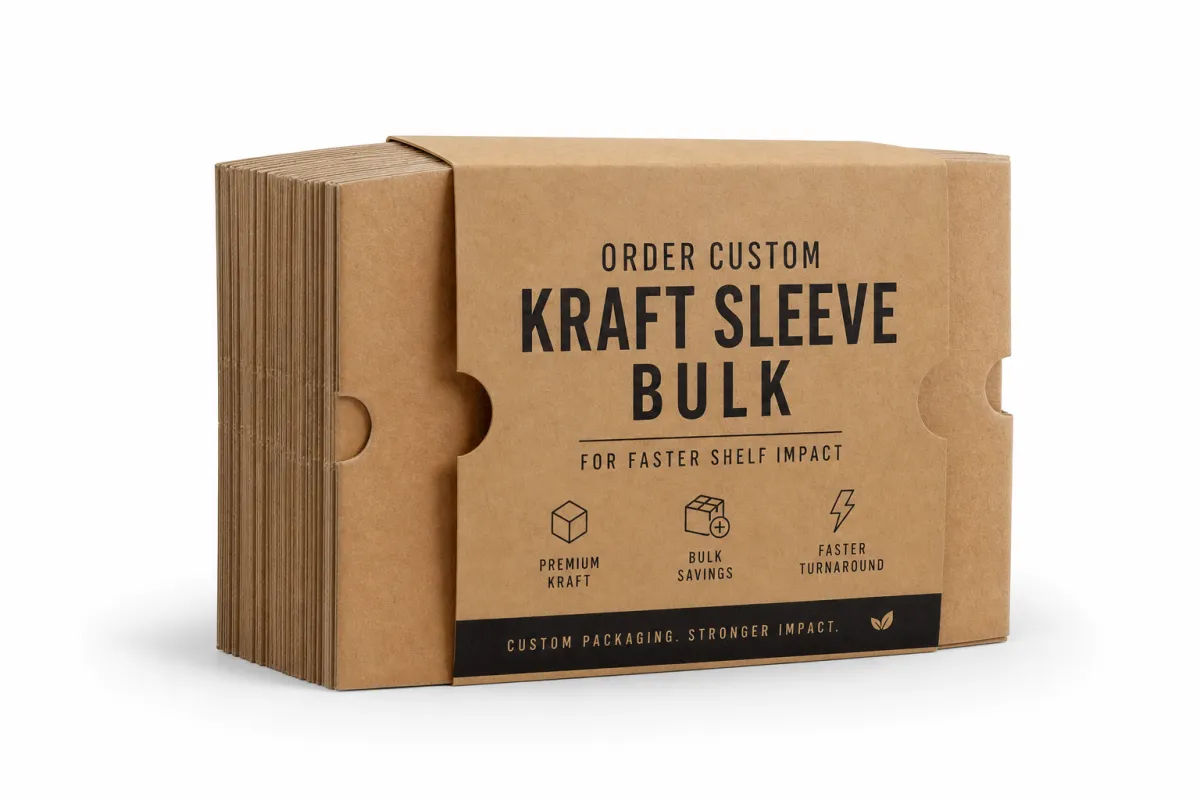
A kraft sleeve can change the way a product reads in the aisle faster than a full carton redesign. That is not hype. It is just production reality. You are changing one visible surface, not reengineering the whole pack. That means branding can move quickly while proven box dimensions and supply handling stay put. When teams order custom kraft sleeve bulk, that is usually the point: more shelf impact, less disruption.
Bulk sleeves work best where the package already has a decent structure and just needs a more convincing visual cue. A subscription box can go from plain to branded with a belly band. A bakery carton can pick up a seasonal face without changing the tray. A cosmetic carton can feel more premium with a cleaner wrap and a sharper logo treatment. Apparel mailers and gift sets benefit too, because the sleeve creates a front panel that is easy to swap for promos, bundles, or limited editions. Packaging should respect the line, not pretend the line does not exist.
There is also a production reason buyers order custom kraft sleeve bulk instead of chasing a full redesign. Sleeves repeat. Once the dieline is locked and the artwork is set, the next run behaves more like a managed component than a one-off design exercise. That helps with forecasting, inventory planning, and quality control. It also makes it easier to keep the base carton stable while refreshing the graphics for a new campaign. Honestly, that is where sleeves shine. They let you move fast without pretending the packaging world is all mood boards and nice vibes.
Common use cases for bulk kraft sleeves:
- Subscription boxes that need a stronger unboxing impression.
- Bakeries and specialty food brands that rotate seasonal artwork.
- Cosmetic and skincare cartons that benefit from a natural, earthy look.
- Apparel mailers and gift sets where a branded band is easier than a full box change.
- Retail packaging programs that need faster artwork updates without changing the structure.
A sleeve should finish the box, not wrestle it. If the wrap lands centered, stays put, and prints with the right contrast, the whole package feels more deliberate. If it misses those basics, the brand ends up paying for a fancy mistake.
For brands comparing options, a sleeve is often the most efficient step between a plain shipper and full custom printed boxes. It can carry logo placement, promo copy, product descriptors, and even compliance details when the panel layout is planned well. If you need a broader mix of solutions, it is worth browsing Custom Packaging Products to see how sleeves fit alongside cartons, inserts, and mailers. Buyers who manage volume across channels can also use Wholesale Programs to keep replenishment aligned with demand instead of placing panic orders at 4:55 p.m. on a Friday.
One mistake shows up constantly: assuming all kraft sleeves read the same. They do not. Natural brown kraft, brighter kraft-faced board, and coated paperboard each change the final look in a different way, and the print method shifts the result again. If the goal is a clean, natural appearance with honest texture, a kraft sleeve is usually the right call. If the goal is bright color accuracy or heavy photographic coverage, the spec needs to be tightened before you order custom kraft sleeve bulk.
Custom Kraft Sleeve Product Details: Materials, Print, and Fit
A kraft sleeve is a paperboard wrap, band, or belly band that slides over a box, tray, or mailer to add branding while leaving the base package unchanged. That sounds simple because it is simple. The sleeve carries the visual story. The carton handles structure and protection. For many brands, this is the most sensible form of retail packaging because it gives a branded face without forcing a full structural redesign.
Material choice drives a lot of the final result. Natural brown kraft gives an earthy, recycled look that works well for food, wellness, and artisanal products. Brighter kraft stocks, or kraft-faced boards with a cleaner surface, improve print contrast and make text and logos easier to read. Heavier boards help when the sleeve has to hold its shape across a wider panel or when the product moves through distribution and needs more stiffness to stay aligned. When you order custom kraft sleeve bulk, the board choice should match both the look you want and the abuse the pack will actually see.
Printing options matter just as much. Single-color flexographic printing is often efficient for simple branding, repeat logos, and high-volume programs where the design stays stable. Multi-color offset printing gives more control for gradients, fine detail, and richer brand palettes. Digital printing becomes attractive when artwork changes often, quantities are lower, or the brand is testing versions before committing to a larger run. That is usually the point where packaging design stops being a mood board and turns into a cost decision.
Fit is the part that gets ignored until a sample comes back too loose or too tight. Sleeve length, panel width, overlap area, score placement, and opening style all affect how the wrap sits on the finished carton. A sleeve should be snug enough to stay centered in transit, but not so tight that it tears during assembly or drags on carton edges. If the sleeve slides over a filled package, the product height, board thickness, and any glossy finish on the base carton should all be checked before you order custom kraft sleeve bulk.
Uncoated kraft behaves differently from coated stock. Ink absorbs faster, colors look warmer and darker, and small type can lose sharpness if the artwork is not prepared with enough contrast. White ink or a white underprint can improve readability, but it adds cost and another process step. That is why proofing matters so much. On kraft, the substrate is part of the design, not just the background.
| Option | Best For | Typical Print Behavior | Relative Cost |
|---|---|---|---|
| Natural brown kraft | Earthy branded packaging, food, wellness, handmade goods | Muted color, strong texture, warmer tone | Low to moderate |
| Brighter kraft or kraft-faced board | Cleaner logos, retail packaging, stronger contrast | Better legibility and color lift | Moderate |
| Heavier board sleeve | Premium presentation, larger cartons, tighter structural control | More rigidity, less flex | Moderate to higher |
| Digital print sleeve | Short runs, versioned artwork, quick updates | Good for variable graphics and small changes | Higher unit cost at scale |
| Offset print sleeve | Longer runs, color consistency, sharper detail | Best for controlled brand color and cleaner images | Better unit economics at volume |
For distribution programs, sleeve durability should also be checked against real handling conditions, not just the proof table. If a carton is moving through palletization, parcel shipping, or retail replenishment, the sleeve has to stay aligned through vibration, compression, and occasional scuffing. Resources like the ISTA testing standards are useful when you want to think beyond appearance and confirm that the package survives actual shipping stress. Likewise, if a paper sourcing claim is part of the brief, FSC certification can matter when the buyer needs traceable fiber sourcing.
When brands order custom kraft sleeve bulk, they should think about fit and finish as one decision. The sleeve has to work on the line, read clearly on shelf, and hold up once it leaves the production room. Beautiful print does not rescue a bad seam. Centered graphics do not rescue a sleeve that slides around in transit. The best packaging programs start with the board, the dieline, and the assembly method before they ever get to color.
Order Custom Kraft Sleeve Bulk: Specifications That Keep Runs Consistent
Good bulk packaging starts with clean information. If you want to order custom kraft sleeve bulk without delays, the quote should include finished sleeve dimensions, board thickness, artwork placement, print colors, bleed, and any opening or locking style. Those details tell the plant what the sleeve must do, how it folds, and where the branding has to land after assembly. Miss one small dimension and the whole run can wobble later, especially if the sleeve has to wrap a specific face or hide a seam on the base carton.
The dieline is the foundation. It controls the fold lines, the seam location, the overlap, and the overall panel layout. If the dieline is wrong, the graphics can be perfect and still land off-center. People sometimes treat a sleeve like a strip of paperboard with opinions. It is not. The die layout is what makes it function as product packaging instead of a loose wrap. A good dieline also helps the prepress team place logos, barcodes, and instructions so they stay readable after folding.
Tolerances need to be discussed early, not after the sample shows up and everybody suddenly becomes interested in precision. In bulk production, you want enough allowance for machine variation, but not so much slack that the sleeve shifts or wrinkles. A common target for paperboard components is a tolerance band around 1 to 2 mm, although this depends on the format, the board, and the assembly method. If the sleeve has to slide over a filled carton, the acceptable variation may need to be tighter. If the base carton has a matte finish, the sleeve may behave differently than it would on a gloss-coated surface. These are not tiny details. They are the details that decide whether the line runs cleanly or becomes a long afternoon of complaints.
Compatibility issues also show up once the product is in motion. Humidity can soften board edges and change how a sleeve grips the carton. Seasonal changes in product height, especially for hand-packed goods, can alter the fit. Gloss coatings on the base carton can reduce friction and make the sleeve move more than expected. If the sleeve is being applied to a filled product, the final height should be measured from real samples, not estimates from a concept sketch. That is exactly why teams order custom kraft sleeve bulk only after they confirm the product dimensions in the field.
A proof should never be treated like a checkbox. A digital mockup can catch panel order, barcode placement, and logo positioning before anyone spends money on steel. A physical sample is even better when the sleeve must wrap tightly or sit precisely on a retail face. On natural kraft, color contrast can surprise people. Deep reds, blues, and dark grays may read softer than expected, while white copy may need a stronger underprint. If accuracy matters, request the proof before the production run and compare it against the actual carton, not just the screen.
If a buyer gives me only one piece of information, I want the finished sample carton. That one item tells me more about fit, seam behavior, and shelf presentation than a long email thread ever will.
For buyers who want a practical path, the order of operations is hard to improve on: measure the carton, confirm the sleeve position, lock the seam location, prepare the art, and review the proof against the real product. That sequence cuts risk and keeps the bulk run moving. It also makes it easier to compare related forms of branded packaging if the team is still deciding between sleeves, cartons, inserts, or a different wrap format.
When you order custom kraft sleeve bulk, the best results usually come from a clear technical brief rather than a vague branding request. The more precise the dimensions, print targets, and application method are at the start, the fewer surprises show up later in production.
How Do You Order Custom Kraft Sleeve Bulk Without Fit Problems?
Start with the finished carton or mailer, not the mockup. Measure the actual width, height, board thickness, and any glue flap or closure that changes the sleeve path. Then confirm where the front panel should sit, where the seam should hide, and how much overlap the sleeve needs to stay stable. That is the boring answer, which is usually the correct one. If the fit is wrong, pretty artwork just gives you a prettier failure.
The easiest way to avoid problems is to approve a physical sample before the full run. A flat proof shows design. A sample shows behavior. You can see whether the sleeve grabs the carton, slides too easily, or catches on edges during assembly. You can also confirm whether the print contrast works on brown kraft and whether the barcode, logo, or promo panel lands where it should. If you plan to order custom kraft sleeve bulk, that sample stage is not optional busywork. It is the part that keeps a stack of avoidable mistakes from becoming inventory.
One more thing: do not guess at tolerances. If the sleeve is going over filled products, ask for recommended clearance so the wrap does not bind once the box is packed. If the program is seasonal, test the sleeve on the highest and lowest fill levels you expect to ship. A little extra work here saves a lot of annoyed emails later. And yes, the emails will be annoying.
Order Custom Kraft Sleeve Bulk: Pricing, MOQ, and Unit Economics
Pricing for a kraft sleeve depends on size, board choice, print complexity, number of colors, coating needs, and whether a custom die can be reused or has to be created from scratch. Two sleeves can look almost identical on a mockup and still land in very different quote brackets once the job hits the production floor. A small wrap with one-color print and an existing tool can be economical. A larger sleeve with full coverage, tight registration, and a fresh die will price differently. If you want to order custom kraft sleeve bulk without surprises, ask for the quote to separate material, tooling, prepress, and finishing whenever possible.
MOQ works the way most packaging buyers expect. Setup costs get spread across the run, so the per-piece price drops as quantity rises. Very short runs carry more overhead because press setup, die setup, and proofing effort do not shrink just because the order is smaller. Larger runs spread those fixed costs over more units, which improves unit economics even if the paperboard itself is not dramatically cheaper. In plain terms, the savings usually come from production efficiency, not from using a flimsy material and hoping nobody notices.
Here is a realistic way to think about pricing if you plan to order custom kraft sleeve bulk:
- 1,000 units: often about $0.42 to $0.70 each, depending on size, print coverage, and tooling.
- 5,000 units: often about $0.18 to $0.28 each when the dieline and setup are stable.
- 10,000 units: often about $0.12 to $0.20 each for simpler configurations with controlled print.
Those are working ranges, not promises. Every sleeve has its own mix of coverage, board, seam behavior, and shipping requirements. Still, the ranges are useful for budgeting. A buyer who only looks at unit price can miss the larger financial picture. Freight, palletization, cartons, sampling, and any rework caused by unclear artwork can change the true landed cost. It is smarter to compare total landed cost instead of staring at one line item on the quote and pretending that solves math.
Hidden cost factors deserve a spot in the first conversation. Prepress work can be simple or messy depending on whether the supplied file is press-ready. Sampling may be included, or billed separately. Tooling can be straightforward if an existing die is available, or it can require new fabrication. Revisions matter too, because multiple proof changes can slow the schedule and increase admin time. If the sleeve needs a special fold, a perforation, a thumb notch, or a lock feature, say so from the start. When buyers order custom kraft sleeve bulk and skip those details, the quote often changes later.
The most cost-efficient runs are usually planned around real demand. If the brand knows it will sell through 8,000 units over a quarter, a 10,000-piece order may be safer than three smaller rush orders. If the artwork will change every month, digital printing may make more sense even if the unit price is higher. That is where packaging design becomes practical instead of decorative. The best option is not always the cheapest piece price. It is the option that supports the sales plan, the storage plan, and the production plan together.
Supply chain also matters. Bulk sleeves are compact relative to fully assembled cartons, so they can reduce storage burden when inventory space is tight. That can help brands that do not want to tie up too much room in finished-goods storage. Even so, if the sleeves are part of a seasonal retail packaging push, confirm warehouse space, pallet height, and reorder timing before you order custom kraft sleeve bulk. It is easier to hold the right quantity than to spend a Friday moving pallets like you invented warehouse Tetris.
For buyers comparing programs, the question is usually not whether a sleeve can save money. It can. The question is how much cost you can remove while still protecting print quality, fit, and delivery timing. That balance is what makes a bulk sleeve program work for branded packaging at scale.
Process and Timeline for Bulk Kraft Sleeve Orders
The standard sequence is predictable, and that is part of the appeal. First comes the inquiry, then the dimensions review, then dieline creation or confirmation, followed by artwork setup, proof approval, production, finishing, and shipment. If the brief is clear, the work moves quickly. If the sleeve has an unusual fold or the base carton is still changing, the schedule stretches. For anyone planning to order custom kraft sleeve bulk, the timeline usually depends more on approval speed than on machine time.
The longest step is often artwork approval and dieline revision. Press time can be fast once the job is locked, but prepress can slow down if the logo sits too close to the seam or if the panel order changes after the first draft. That is why it helps to send finished dimensions, editable vector artwork, exact color targets, and clear instructions for barcode placement up front. If you already know the panel that will face the consumer, say so. If the sleeve must hide a glue seam or avoid a manufacturer mark on the carton, that should be visible in the first proof cycle.
What speeds things up? Simple things, mostly. A clean AI, EPS, or PDF vector file. A sample carton or a confirmed dieline. A clear note on which panel is front-facing. If a white underprint is required, mention it early. If the sleeve needs to match another item in the line, give the reference file or the previous sample. A well-run project to order custom kraft sleeve bulk can move through approval far faster than a loose project with incomplete art and uncertain dimensions.
Lead times vary by order size, print method, coating or lamination, and the time of year. Simple digital runs can often move in about 7 to 10 business days after proof approval, while offset runs with more finishing steps often land in the 12 to 18 business day range. Freight adds another layer. Domestic shipping may be quick, but longer routes, seasonal congestion, and pallet scheduling can extend the delivery window. If the sleeves are tied to a launch date, build in a small buffer so final review does not turn into a fire drill.
Here is a helpful way to think about the schedule:
- Share dimensions and target quantity.
- Confirm the dieline and seam position.
- Review the artwork proof on the actual panel layout.
- Approve color, barcode placement, and finish.
- Release the run and allow for transit time.
Keeping one sample carton or product mockup nearby during approval helps a lot. Once the sleeve is in hand, fit issues are much easier to spot. A seam that looked harmless on a flat proof may crowd the carton edge. A barcode that looked centered may end up too close to the fold after assembly. Catching those issues before the run is one of the easiest ways to protect cost and schedule.
When teams order custom kraft sleeve bulk and keep the process tidy, the result is calmer on both sides. The printer gets fewer revisions. The buyer gets a cleaner schedule. The product launches with packaging that looks intentional instead of rushed. That is a strong outcome for any branded packaging program, especially when the sleeve sits inside a broader retail launch.
Why Choose Custom Logo Things for Kraft Sleeve Programs
Custom Logo Things is a practical packaging partner for brands that need material, print, and sizing choices to match the real demands of the product and the distribution channel. That should be normal. A sleeve is not just decoration. It has to print well, fold well, travel well, and arrive ready to use. When buyers order custom kraft sleeve bulk, the supplier should understand how those pieces work together instead of treating the job like a graphics-only request.
Technical guidance matters more on bulk sleeve programs than many teams expect. One client might need better sleeve fit because the carton wall is thick. Another may need stronger print contrast because the logo sits on brown kraft. Another might want to balance production efficiency with a retail presentation that still feels premium. These decisions affect the final result, and they affect the quote. A supplier that can explain those tradeoffs clearly saves time and prevents rework that nobody budgeted for.
Consistency and accountability matter too. Clear proofs, direct communication, and realistic production expectations are worth more than polished claims that evaporate the minute a seam moves. A good packaging partner should be able to tell you when a sleeve needs a different board, when a design is too tight near the seam, or when a rush timeline is not realistic. That kind of honesty protects a bulk order. It also helps preserve the brand once the product reaches retail packaging shelves or ships through a fulfillment channel.
Bulk sleeve programs work best when the supplier understands presentation and production at the same time. A sleeve can look beautiful in a mockup and still fail in line handling if the overlap is wrong. It can save money on the print side and still cost more overall if the freight plan is poor. That is why brands looking to order custom kraft sleeve bulk often value a partner that thinks in terms of total package performance, not just artwork output.
If your program is part of a larger packaging rollout, keep the supplier loop connected to the rest of the line. That means thinking about mailers, inserts, cartons, and labels together rather than treating each item as a separate island. The more coordinated the plan, the easier it is to keep package branding tight across the whole experience. For ongoing reference and support, the FAQ page can also help with the common questions buyers raise before they commit to a run.
There is no magic here, just disciplined packaging work. The right sleeve choice, the right print method, and the right approval process create a dependable result. That is the goal, and it is exactly what most buyers want when they order custom kraft sleeve bulk.
Next Steps to Place Your Bulk Kraft Sleeve Order
The next step is simple: measure the base package, confirm where the sleeve should sit, gather artwork, and decide what quantity fits the budget and forecast. If the carton is already in production, pull a sample unit and record the exact width, height, and any overlap needed for a secure wrap. If the sleeve has to frame a logo, barcode, or promo panel, map that out before the files are finalized. Those small decisions save time later. Strange how that works.
Request a dieline review before you lock the graphics. That is especially useful if the sleeve must wrap around a seam, avoid a closure, or carry both branding and instructions. A good dieline review will catch panel order issues, fold conflicts, and barcode placement problems while changes are still cheap to make. It is much easier to adjust artwork on screen than to rework a production run after the fact.
Prepare one sample carton or product mockup if possible. Real dimensions are always better than estimates. Even a few millimeters can matter when a sleeve has to slide cleanly over a finished package. If you are evaluating whether to order custom kraft sleeve bulk or split the program into smaller test quantities, ask for pricing at two or three volume breaks. That lets you compare MOQ, unit cost, and inventory storage without guessing.
As the order gets closer to approval, review the proof with the same care you would give a carton that is going straight to retail. Check the panel order, the seam, the color contrast, the bleed, and any special handling notes. If the sleeve is part of a launch, seasonal promotion, or gift set program, confirm the delivery window before release so there is enough time for freight and final receiving. Once that is done, order custom kraft sleeve bulk with confidence instead of hope.
For teams that want a broader packaging plan, it can also help to review the rest of the product line and see how sleeves fit into the larger assortment of custom printed boxes, mailers, and inserts. That is often where the smartest packaging decisions show up, because the brand keeps the visual identity tight while the production strategy stays efficient. In the end, the best time to order custom kraft sleeve bulk is when the proof is approved, the quantity is right, and the timeline is clear enough that everyone knows what will arrive and when.
FAQ
What is the minimum order for custom kraft sleeve bulk?
MOQ depends on sleeve size, print method, and whether a custom die is required. Larger runs usually lower the per-piece cost because setup gets spread across more units. Share the target quantity early so the quote can reflect the best production method for your order custom kraft sleeve bulk request.
How do I size a sleeve when I order custom kraft sleeve bulk?
Measure the finished width, height, and overlap needed for a secure wrap, and provide a sample box or exact dieline whenever possible. Account for board thickness and any product expansion that could affect fit, especially if the sleeve will be applied after filling. That is the safest way to order custom kraft sleeve bulk without fit problems.
Can I print both sides on a bulk kraft sleeve?
Yes, if the panel layout supports it and the artwork is prepared for both faces. Front-facing branding usually gets priority, while inside copy can carry instructions or messaging. Ink coverage and contrast should be checked on natural kraft before approval, particularly if you order custom kraft sleeve bulk with dense color fields.
What affects lead time on a custom kraft sleeve bulk order?
Artwork approval, dieline revisions, print complexity, and finishing steps are the biggest schedule drivers. Rush requests are easier when dimensions and files are final from the start, and shipping distance can also affect the delivery window. If you need to order custom kraft sleeve bulk for a launch, build in a small buffer.
Will colors look different on brown kraft stock?
Yes, natural kraft changes how colors appear because the brown base absorbs and modifies ink. White ink or a white underprint can improve brightness and contrast. A proof is the best way to confirm color before the full run, especially when you order custom kraft sleeve Bulk for Retail Packaging.

