Buyer Fit Snapshot
| Best fit | Order Recyclable Corrugated Produce Trays That Ship Well projects where brand print, material claims, artwork control, MOQ, and repeat-order consistency need to be specified before quoting. |
|---|---|
| Quote inputs | Share finished size, material target, print colors, finish, packing count, annual reorder estimate, ship-to region, and any compliance wording. |
| Proofing check | Approve dieline scale, logo placement, barcode or warning zones, color tolerance, closure strength, and carton packing before bulk production. |
| Main risk | Vague material claims, crowded artwork, missing packing details, or unclear freight terms can make a low unit price expensive after revisions. |
Fast answer: Order Recyclable Corrugated Produce Trays That Ship Well should be specified like a repeatable production item. The safest quote records material, print method, finish, artwork proof, packing count, and reorder notes in one written spec.
Production checks before approval
Compare the actual filled-product size with the drawing, then confirm tolerance on folds, seals, hang holes, label areas, and retail display edges. Reserve space for logos, QR codes, warning copy, and material claims before decorative graphics fill the panel.
Quote comparison points
Review material grade, print process, finish, sampling route, tooling charges, carton quantity, and freight assumptions side by side. A quote is only useful when the supplier can repeat the same color, closure quality, and packing count on the next order.
When buyers tell me they need to order recyclable corrugated produce trays, I usually ask one question before anything else: how much loss are they already carrying from crushed corners, damp docks, and trays that flex under stack pressure? I remember standing on a packing floor in Salinas, California, where one pallet looked fine from ten feet away, then started leaning like it had a personal grudge against gravity once the cooler door shut at 36 F. I have watched more fruit get downgraded by compression and moisture than by miles on a truck, and that is exactly why the right tray matters. At Custom Logo Things, the goal is not to sell a box-shaped object and call it packaging; the goal is to order recyclable corrugated produce trays that protect product, move quickly on the packing line, and still make recycling sense at the end of the trip. On a 5,000-piece run, the difference between a flimsy tray and a specified build can be as little as $0.03 to $0.06 per unit, which turns into real money once you stack 18 pallets for a weekly shipment.
Growers and shippers choose to order recyclable corrugated produce trays because corrugated gives them a lighter, recyclable alternative to rigid plastic without giving up stack strength, clean presentation, or print space for branding and lot coding. Honestly, I think that balance is the whole point. The buying decision usually comes down to six things: dimensions, board strength, venting, moisture resistance, unit cost, and the timeline to launch. If those six items are clear on day one, you can order recyclable corrugated produce trays with less friction, fewer sample rounds, and fewer surprises when harvest windows get tight. Fewer surprises is a nice phrase, because packaging teams usually meet surprises in the form of a damaged pallet at 5:30 a.m. in Fresno or Yakima. A clean spec sheet can save one full revision cycle, which often means 3 to 5 business days that would otherwise vanish into email threads.
One thing people often miss is that a tray does more than hold produce. It controls airflow around berries, supports pallet patterns in cold storage, and keeps the pack-out crew from fighting flimsy corners during a 10-hour shift. I saw that firsthand at a berry facility outside Santa Maria, where a 32 ECT build looked fine on a desk, then collapsed slightly after a night in a cool room with 88% humidity and a 2,200-pound pallet load. The team had to order recyclable corrugated produce trays with a better liner and a tighter fold because the cost of one bruise on the packing line was far higher than the difference in board price. That is one of those moments that sounds small until you realize it touched labor, freight, and shrink all at once. A 1.5% damage rate on 20,000 clamshells can erase a whole month of savings if the tray is underbuilt.
Why Should You Order Recyclable Corrugated Produce Trays?
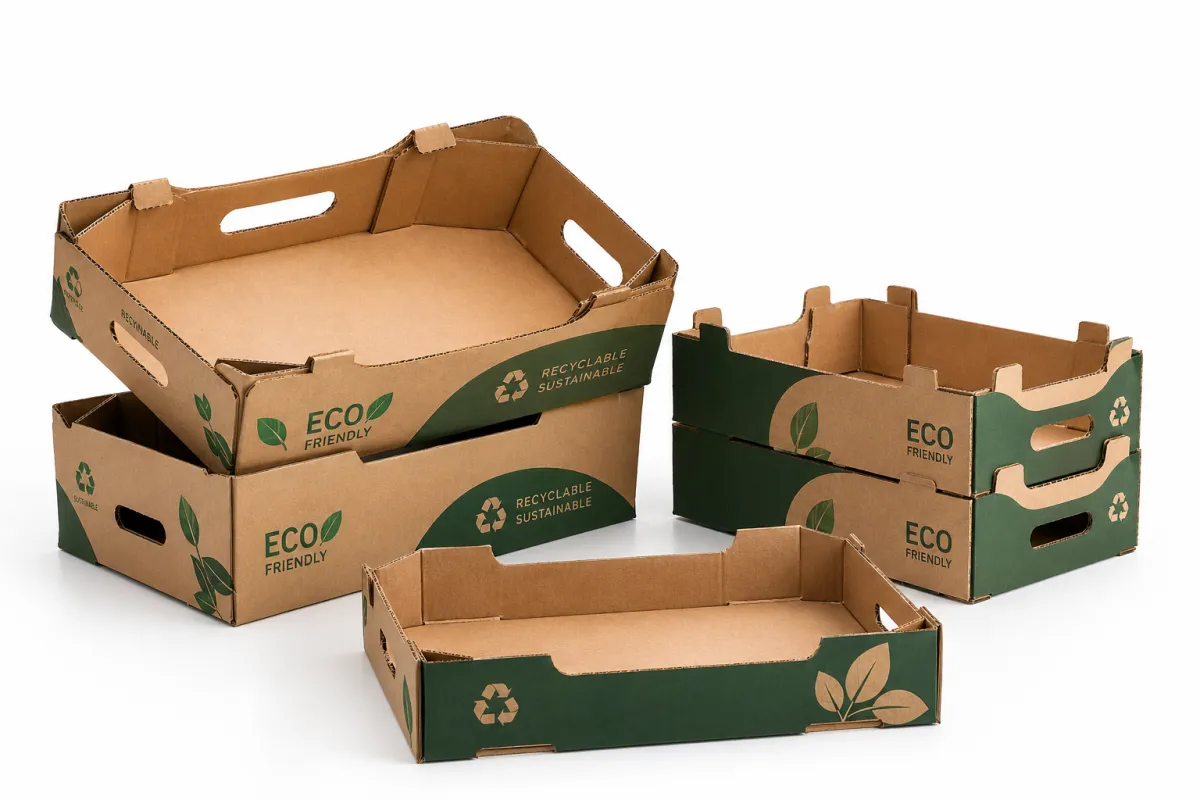
There is a simple reason buyers keep deciding to order recyclable corrugated produce trays: they solve a real handling problem without adding unnecessary weight or making the packer work harder. A well-built tray helps fruit stay aligned, reduces bounce inside the carton, and makes pallets more stable during forklift moves across a cooler floor. That matters whether the shipper is sending tomatoes to a regional distributor in Phoenix or stone fruit to a retailer with strict display requirements in Denver. I have seen operations improve line speed by 8 to 12 cases per minute simply because the tray opened more cleanly and sat flat on the conveyor after they chose to order recyclable corrugated produce trays with a better die-cut profile. That kind of gain is not flashy, but it pays bills, especially on a 14-hour shift where every extra case per minute compounds across 60,000 units.
A lot of packaging trouble starts when a buyer treats the tray as a commodity sheet item instead of a piece of working equipment. In a citrus meeting I sat through in the Central Valley, the grower wanted a recyclable format, the retailer wanted cleaner presentation, and the packing manager wanted a tray that would survive a 36-case-high stack in a cold room at 34 F. We ended up walking through flute direction, vent slot count, and pallet overhang before anyone even talked price. That is the right order. If you order recyclable corrugated produce trays from the start with the load path in mind, you usually avoid the ugly middle ground where the price looks good but the product arrives bruised or leaned over on the pallet. And yes, I have seen that "good price" turn into a very expensive headache more times than I want to admit. One failed pallet can cost more than the full tray premium on 8,000 units.
Another reason to order recyclable corrugated produce trays is sustainability that is practical instead of performative. Corrugated fiberboard fits standard curbside recycling streams in many markets, but not every coating, liner, or contamination level is treated the same way everywhere. Buyers who need documentation can often source paperboard with FSC chain-of-custody options if that matters to a retailer or foodservice customer. For packaging teams trying to document material choices, the EPA's recycling guidance at EPA recycling resources is a useful reference point, while corrugated industry's technical guidance helps explain fiber recovery and design tradeoffs. I have found that customers are far more comfortable when they can order recyclable corrugated produce trays and still explain the material story in one sentence to a buyer, a grower, or a retailer's sustainability team. Nobody wants to ramble through a three-page materials script before breakfast, especially not at 6:15 a.m. before a loading crew arrives.
Here is the real buying checklist I use on factory floors: confirm the produce size, confirm the fill weight, confirm the pallet pattern, and confirm the humidity exposure in the packhouse and cooler. If one of those numbers is fuzzy, the tray spec usually ends up fuzzy too. That is why I push customers to order recyclable corrugated produce trays only after they know what the product actually does in motion, not just what it looks like in a photo on a desk. A tray that looks elegant in a mockup can still be a disaster once a sweaty pallet jack, a cold room, and a rushed crew get involved. I would rather work from a 48 x 40-inch pallet drawing and a 12.5-pound fill target than a vague note that says "same as before."
Recyclable Corrugated Produce Trays: Product Details
When you order recyclable corrugated produce trays, you are usually choosing between a few common constructions rather than inventing something from scratch. The most common option is single-wall corrugated with a flute profile chosen for the load, often B-flute, E-flute, or a custom combination when print quality and crush resistance both matter. Some trays are die-cut with finger openings or handholds so packers can move them quickly without pinching edges, and many include vent slots on the sidewalls to help air circulation in cold chain storage. For higher-volume runs, a fold-and-glue style can save time on the line, while a one-piece die-cut build may reduce assembly steps and fit a tighter budget if the geometry is simple. I have a soft spot for simple builds that still behave well under pressure; they are the packaging equivalent of a dependable old truck that starts in 28 F weather without complaint.
The produce categories that benefit most from choosing to order recyclable corrugated produce trays include berries, tomatoes, mushrooms, citrus, stone fruit, and greens that need continuous airflow. Berries are sensitive to pressure points, so a tray with a good bottom panel and consistent wall height matters. Mushrooms need careful moisture behavior, because condensation can soften the package and shorten shelf life. Citrus may need more stack strength than a casual buyer expects, especially if the fruit is moving from a humid dock in Oxnard into a refrigerated trailer bound for Las Vegas. I have seen all three of those products fail for different reasons, which is why no one should order recyclable corrugated produce trays based on appearance alone. Pretty does not equal capable, and a bright one-color print cannot rescue a tray with a weak corner crush rating.
Tray geometry is not a cosmetic detail; it is a handling tool. A tray with a slightly deeper wall may improve stack stability but make hand loading harder if workers need to place 12 pints per case in a 30-second cycle. A tray with wide vents may help airflow but reduce corner integrity if the board grade is too light. I remember a mushroom packer in Watsonville telling me, after a long night shift, that a 3 millimeter change in sidewall fold made the difference between a tray that "sat like a brick" and one that slid half an inch every time the belt started. That is the kind of lesson that tells me when to order recyclable corrugated produce trays and when to keep testing the dieline. Small geometry changes can have annoyingly large consequences, which is not a sentence anyone in operations likes, but there it is. A 2 mm crease shift can change fold accuracy by enough to matter across 40,000 units.
Branding also matters, but it should stay useful. Water-based printing on a natural kraft or white top liner can carry a logo, harvest code, country-of-origin marking, and retailer SKU without adding a foil layer or a heavy coating. If a customer needs lot coding or date coding, that can be built into the print plan or applied inline with minimal disruption. I like that balance because it lets buyers order recyclable corrugated produce trays that look clean on the shelf while still doing the administrative work the supply chain needs. There is a difference between polished and overworked, and good packaging should land on the right side of that line. If the program also needs a retail sleeve, 350gsm C1S artboard is a common add-on for printed inserts or belly bands, especially in 10,000-piece programs where the sleeve carries the brand story and the tray carries the load.
"If the tray looks beautiful but fails in the cooler, it is not a good tray. The carton has to survive the line, the dock, the trailer, and the retailer's back room."
If you want to cross-check packaging terminology while building your own spec sheet, the fiber and fiberboard references from ISTA testing guidance are a good technical companion to the actual production sample. I do not suggest treating every tray like a shipping crate, but I do suggest understanding how load, vibration, and compression interact before you order recyclable corrugated produce trays for a commercial run. I have seen too many "we'll figure it out later" choices end up being figured out with a pallet rework and a tense phone call, usually after a trailer in Salinas or Modesto has already been sealed and dispatched.
For customers who also need outer cartons or mixed-pack secondary packaging, it can help to compare the tray plan with our Custom Shipping Boxes so the whole distribution chain uses compatible dimensions and stacking loads. I have seen more than one project go sideways because the tray and the master case were designed by different people who never looked at the same pallet drawing. That is a special kind of chaos, and it is entirely avoidable. A 42-pound master case paired with an underbuilt tray is a mismatch you can catch on paper long before it becomes a warehouse problem.
Specifications for Recyclable Corrugated Produce Trays
Before you order recyclable corrugated produce trays, you need the spec inputs in plain, measurable form. Start with inside length, width, and wall height, then add the target fill weight, expected produce dimensions, stack load, and pallet pattern. If the tray sits eight-high on a 48 x 40-inch pallet, that information should be written down before the quote goes out. I also want to know whether the tray is going through an ice room, a wash-down area, or a humid dock, because those three environments change the board recommendation faster than people expect. Without those numbers, buying becomes guesswork, and guesswork is expensive when you are trying to order recyclable corrugated produce trays for a harvest run. I have never met a packhouse manager who enjoys guesswork, and honestly, I do not blame them. A spec that misses by 0.25 inches can force a full tray redesign.
Moisture and cold-chain performance deserve special attention. A tray that performs well at 68 F in a packing office may behave differently at 34 F in a cooler with condensation on the floor and vapor in the air. For that reason, I often specify wet-strength liners, stronger adhesive systems, or a coating choice that resists softening without creating a recycling headache. That is not always necessary, and I would never oversell it, but I have seen a 40-point liner outperform a lighter board by a wide margin when the customer needed to order recyclable corrugated produce trays for a cold, wet distribution flow from Yakima to Portland. The best answer depends on the load and the storage conditions, not on a brochure headline with too much confidence and too little evidence. A tray that survives 18 hours in a 34 F cooler is a different animal from one that only has to sit in a dry warehouse.
Quality checkpoints matter just as much as material selection. In production, I look for crush resistance, caliper consistency, die accuracy, glue bond strength, and repeatable dimensions from the first case to the last. If the board thickness varies too much, the tray can go from tight to sloppy, and that causes trouble on automated erecting equipment as well as manual pack lines. A tray that is 1 or 2 millimeters off in key areas can create a stack issue that only shows up after 20 pallets are built, which is why I push buyers to order recyclable corrugated produce trays from a supplier that understands both spec control and the actual shop floor. The shop floor is where the truth lives, whether the sales deck likes it or not. Even a 0.5 mm crease error can show up as a lopsided pallet in the truck yard.
I also recommend presenting the spec in a simple comparison format so the decision is easier to sign off. Standard, modified, and fully custom should be compared side by side with dimensions, board grade, venting, print coverage, and turnaround. That approach saves time in email threads and helps the team decide whether they need the lightest viable option or a tray built for a rougher chain of custody. Here is a format I often use when customers want to order recyclable corrugated produce trays without waiting through three rounds of vague revisions:
| Option | Typical Use | Board / Build | Example Unit Price | Typical Lead Time |
|---|---|---|---|---|
| Standard | Common berry or tomato packs with steady dimensions | 32 ECT single-wall, B-flute, one-color print | $0.15/unit at 5,000 pieces | 12-15 business days from proof approval |
| Modified | Seasonal crops needing extra vents or stronger corners | 44 ECT single-wall, E-flute or B/E combo, water-based print | $0.22/unit at 10,000 pieces | 15-18 business days from proof approval |
| Fully Custom | Retail programs, unusual dimensions, or special handling | Custom die, reinforced corners, optional wet-strength liner | $0.29/unit at 25,000 pieces | 18-24 business days from dieline approval |
Those numbers are examples, not promises, and they move with board market conditions, print coverage, and freight from hubs like Los Angeles, Chicago, or Atlanta. But the table shows the logic well enough: if you want to order recyclable corrugated produce trays for a crop with short shelf life and a known pallet pattern, the right spec can save more money in reduced damage than a cheaper tray ever saved on the quote. I will take fewer damaged cases over a slightly lower per-unit price almost every time. A 2% reduction in bruise-related rejection on 50,000 units can outweigh a half-cent savings per tray.
Another point that matters in the real world is how easy the tray is to explain to operators. If the line crew needs to fold a corner, tuck a tab, and confirm a vent alignment before every case, you will lose speed by the tenth pallet. I learned that at a tomato house in Fresno where a tray redesign shaved only four seconds from each pack cycle, yet the team gained nearly an hour of productive time over a long run. That is the kind of gain that makes people glad they chose to order recyclable corrugated produce trays with the line in mind instead of the render in mind. A pretty mockup is nice; an extra hour of output is better. Four seconds on 900 cases is 60 minutes of labor back in the shift.
Pricing and MOQ for Order Recyclable Corrugated Produce Trays
Pricing starts with material, but it does not end there. When you order recyclable corrugated produce trays, the unit cost is shaped by board grade, flute type, print coverage, coating choice, tray size, custom tooling, and total order volume. A smaller tray can still cost more than a larger one if it needs a complex die cut, tighter tolerances, or a heavier liner. If the artwork has multiple colors or a flood of ink coverage, that also changes press time and waste. I have sat through enough quote reviews to know that the cheapest-looking option on paper is often not the cheapest tray once production and freight are both counted. Paper quotes can be charming liars, especially when someone forgets to mention a $185 die charge or a $0.04 ink pass.
MOQ is another place where buyers need clear language. A sample run is not a commercial run, and a short production run is not the same as a seasonal buyout. If you need to order recyclable corrugated produce trays for a test market, a 500-piece prototype may be enough to confirm fit and print placement. If you are running a regional program with multiple pack dates, a 5,000 to 10,000-piece minimum may be more realistic because it spreads setup cost across enough units to keep the price in line. For full commercial orders, larger volumes usually improve per-unit cost because make-ready time, sheet waste, and changeovers are all distributed across more finished trays. That part is not glamorous, but it is where the math actually works. At 25,000 pieces, a tray can drop from $0.22 to roughly $0.17 per unit simply because the setup gets absorbed.
I like to be direct about landed cost because it keeps the conversation honest. Freight, pallet count, and storage all affect the real number the buyer pays, not just the tray price itself. If your warehouse pays to store 18 pallets for six weeks, that matters. If the product ships to three regions and each region needs a different pallet pattern, that matters too. Buyers who order recyclable corrugated produce trays without considering these extra costs can end up with a good unit price and a weak total economics story, which is exactly the opposite of what a purchasing manager wants to report. The finance team will notice, and they will notice with a straight face that somehow feels judgmental. A quote that ignores $420 in freight surcharges is not a quote, it is a partial story.
Here is the way I usually explain volume economics to a crop manager: lower quantities buy speed and flexibility, while higher quantities buy lower unit cost and fewer interruptions. A 5,000-piece run may cost more per tray than a 25,000-piece run, but if the crop is uncertain or the variety is still being evaluated, that higher per-unit cost can be the right tradeoff. Once the program stabilizes, you can order recyclable corrugated produce trays in larger batches and usually see the board, converting, and freight math improve enough to justify the commitment. In practice, a little caution at launch often saves a lot of pain later. One missed harvest window can cost more than two months of storage on a finished tray line.
I also recommend asking for a quote that breaks out the cost drivers line by line. If the board grade adds three cents, say that. If the die charge is amortized into the unit cost, say that too. Transparency is especially useful when a team needs approval from finance, operations, and sustainability in the same meeting. It is much easier to order recyclable corrugated produce trays when everyone can see how a 44 ECT build, a wet-strength liner, or a custom vent pattern changes the number by a predictable amount. Vague pricing makes people suspicious, and suspicious people slow down approvals. Specific pricing, on the other hand, can move a decision from three meetings to one.
Process and Timeline for Order Recyclable Corrugated Produce Trays
The best projects move in a straightforward sequence. First comes the discovery call, where we confirm crop type, fill weight, dimensions, and storage conditions. Then we review the spec or dieline, decide whether the tray should be standard or fully custom, and determine whether a sample is needed. After that, you approve the proof, production gets scheduled, quality checks happen during converting, and the shipment is booked on the pallet pattern you actually need. That is the cleanest way to order recyclable corrugated produce trays without losing a week to preventable back-and-forth. I have seen the opposite too, and it usually involves a trail of half-read emails and a lot of finger-pointing. A 15-minute kickoff call can save a 5-day delay if it catches the wrong wall height early.
For timing, stock-like builds can move in 12 to 15 business days from proof approval, while fully custom trays often need 18 to 24 business days because of die setup, production sequencing, and testing. Artwork revisions can add a few days, and a last-minute change to pallet count can trigger a rework of the stacking plan. I have watched a crop buyer lose an entire shipping window because someone changed the fill count after the quote was signed, then assumed the tray would still fit the same pallet footprint. That kind of delay is exactly why I tell people to order recyclable corrugated produce trays only after the spec is locked, not while the harvest calendar is still floating. Harvest does not pause while a drawing gets revised, which is rude, but true. A 3-day slip can matter when a variety peaks in one week and fades in the next.
There are a few delay points that show up again and again. Late measurements are one. Seasonal demand spikes are another, especially for crops that ship hard in a narrow window. The third is artwork approval, because branding teams often want one more logo adjustment after operations has already signed off on the dimensions. If you want to order recyclable corrugated produce trays on time, the easiest move is to assign one decision-maker for dimensions, one for artwork, and one for final approval. That cuts noise quickly. It also saves everyone from reading the same thread seventeen times, which is a special kind of workplace misery. One named owner per task can shave 48 hours off the approval chain.
Here is the milestone checklist I recommend before release:
- Confirm inside dimensions, wall height, and target fill count.
- Approve the die line or sample tray, including vent locations and handhold cuts.
- Lock the quantity, pallet count, and freight destination.
- Verify print copy, lot code placement, and any retailer labeling requirements.
- Release the production order only after all three teams sign off.
If you already have supporting packaging in place, it can help to review our Wholesale Programs before you lock the tray plan, especially if the tray will ship alongside other corrugated items in recurring volumes. That is often where buyers find the best purchase rhythm for a full season. I have seen it work well for packers who want to order recyclable corrugated produce trays in a repeating cycle rather than playing catch-up every harvest. Predictability is boring in theory and beautiful in practice. A fixed monthly replenishment of 10,000 trays can be easier to manage than three emergency orders of 3,500 each.
One more practical note: sample approval should happen under real conditions, not only at a clean desk. Put the sample in a cooler, stack it on the pallet, and let the line crew handle it for 30 minutes. If the tray bows, slips, or slows the packer down, you will know immediately. That is the difference between a pretty sample and a working tray, and it is why I tell clients to order recyclable corrugated produce trays with actual line testing whenever possible. The cooler is the truth serum. A tray that passes a 34 F, 30-minute test is much more likely to survive the real week.
For packaging teams that need to coordinate around stock counts, customer service, and order status, our FAQ page is a handy place to answer the routine questions before they become email threads. It saves time, especially when you are trying to order recyclable corrugated produce trays during a busy shipping week and nobody wants to hunt for a missing spec sheet. Missing spec sheets have a way of multiplying like rabbits, and a single missing dieline can stall three departments at once.
Why Choose Us for Recyclable Corrugated Produce Trays
I spend a lot of time talking about the factory floor because that is where packaging earns its keep. At Custom Logo Things, we do not look at trays from a distance; we look at them from the corrugator, the die-cutter, the glue station, and the pack-out area where one poor fold can throw off a whole shift. That matters to customers who want to order recyclable corrugated produce trays from a team that understands why a 1/8-inch miscut on the handle can slow an operator by several seconds per case. The advice is practical because it comes from real production work, not just quoting software. I trust that more, and I suspect most buyers do too. A 7-second delay on 1,200 cases is 2.3 hours of lost line time.
Quality control is where the difference shows up. We pay close attention to board selection, cut accuracy, glue integrity, and how the tray fits on the customer's actual line. I have seen a tray that looked perfect in a photo fail because the glue line opened after a humid hold in a dock, and I have seen the reverse: a simple tray, built with the right board and the right crease, performed better than a fancy design with too much ornamentation. If you want to order recyclable corrugated produce trays that behave well in the field, the key is matching the structure to the load, not to a marketing board. Fancy graphics do not save bruised fruit. A well-placed 44 ECT liner does more than a full-bleed illustration ever will.
Responsive communication matters just as much as build quality, especially when harvest timing is tight. If a customer needs a dimensional check at 7:00 a.m. because trucks are loading at noon, that answer should come fast and in plain language. I have sat in supplier negotiations where the slowest part was not the production machine but the back-and-forth over unclear measurements. A clear team can help you order recyclable corrugated produce trays with fewer delays, fewer assumptions, and better confidence that the first pallet will match the tenth. That confidence is worth more than most people admit in a spreadsheet. When a supplier can turn around a revised proof in 24 hours, the whole launch feels less like guesswork and more like a plan.
Sustainability, strength, and line speed have to work together. If you optimize only for recycled content, you can end up with a tray that collapses under cold storage. If you optimize only for strength, you can end up overbuilding and adding unnecessary board cost. If you optimize only for line speed, you may sacrifice product protection. The best tray sits in the middle, where it protects the crop, supports the packing crew, and still fits the recycling goals the customer has to report. That is the balance I try to preserve every time someone wants to order recyclable corrugated produce trays for a new program or a seasonal refresh. I would rather explain a balanced tray than defend a flashy one that failed in the trailer. A tray that saves 0.4 ounces of board but loses 2% of product is not efficient, it is expensive.
I also appreciate that corrugated lets us build a tray with useful print rather than clutter. A clean logo, harvest code, and retailer-facing details can live on the panel without making the tray feel busy. That can be a real advantage in mixed-pack or retail-facing produce programs where the tray is part of the shelf story. If the buyer wants to order recyclable corrugated produce trays that still look disciplined and professional on the display table, this is where the design space becomes valuable instead of decorative. Clean is not boring when it is done with intent. A black one-color mark on kraft can look sharper than a crowded four-color panel from 3 feet away.
And because our packaging work often sits beside other supply needs, we can help a buyer think beyond a single SKU. A tray program often sits next to master cases, display cartons, or shipper boxes, and the whole chain performs better when the dimensions and stack loads are aligned. That is one reason repeat customers keep coming back to order recyclable corrugated produce trays through a team that understands the broader packaging system, not only one part of it. The whole chain matters, even if procurement only sees one line item at first. When the tray, shipper, and pallet pattern all share the same footprint logic, warehouse mistakes drop fast.
What to Prepare Before You Order Recyclable Corrugated Produce Trays
If you want an accurate quote, send the details that actually affect the build. I need produce dimensions, fill weight, tray count, pallet footprint, storage conditions, and print requirements before I can tell you whether a standard tray or a fully custom version is the smarter buy. If you can include a photo of the current pack-out, that helps even more, because a photograph often shows spacing, hand clearance, and stacking behavior in a way that a written note never can. The better your input, the easier it is to order recyclable corrugated produce trays that land right the first time. I would rather work from good inputs than spend an afternoon decoding "roughly the same as before" (which is not, in fact, a measurement). A clear sheet with 6 numbers is worth more than a paragraph of adjectives.
Supporting material speeds things up. A sketch of the current tray, a sample from the line, or a photo of the retail display can save a lot of guessing. I once had a client send three cell-phone photos from a cooler and a rough hand sketch on yellow paper, and that was enough to identify a wall-height problem that would have cost them a week if we had guessed wrong. That kind of detail is why the smartest buyers order recyclable corrugated produce trays with as much visual reference as they can gather before the quote is finalized. The sketch did not need to be pretty. It just needed to be honest. A simple reference photo from a warehouse in Salinas can do more than a polished PDF with missing dimensions.
Here is the order of operations I recommend, based on what keeps projects moving:
- Confirm measurements and fill weight with the packing team.
- Request a sample or prototype if the tray is new or the crop is sensitive.
- Review pricing tiers for different board grades and quantities.
- Approve the spec, including print, venting, and pallet pattern.
- Schedule the first production run with enough lead time for QC and freight booking.
That sequence keeps surprises down and helps finance, operations, and procurement stay aligned. If a buyer waits until the week before harvest to order recyclable corrugated produce trays, the choices narrow quickly and the pricing usually gets less attractive. If they plan early, they can compare board options, test samples under actual storage conditions, and choose the unit cost that fits the margin rather than chasing the lowest sticker price. I am biased toward planning early because I have seen the opposite, and it is not cute. A 14-day head start can be the difference between a clean launch and a rushed freight charge from Oakland.
For buyers who care about wholesale structure and repeat ordering, we can also map the tray program into Wholesale Programs so seasonal replenishment is easier to manage. I have seen that simple planning step reduce late-season panic orders more than once. The same principle applies whether you are launching a new berry pack, adjusting a tomato tray, or trying to order recyclable corrugated produce trays for a mixed produce program with several pack dates. Predictable replenishment beats emergency pleading every time. A monthly reorder point of 6,000 units can be easier to budget than a string of Friday-afternoon rush requests.
So send the measurements first, then the photos, then the target count per pallet. If you already know the artwork, include that too. The faster the inputs arrive, the faster we can quote the right structure and help you order recyclable corrugated produce trays that ship cleanly, stack reliably, and support the recycling story your buyers want to hear. That is the kind of project I like: clear numbers, honest materials, and a tray that does its job from packout to delivery. No drama, no mystery, no tray that decides to collapse right when the camera crew shows up. A tray built from a 350gsm C1S artboard sleeve, a 44 ECT corrugated base, and a proof approved on Monday can still hit a 12-15 business day window if the approvals are clean.
How do I choose the right size when I order recyclable corrugated produce trays?
Measure the produce itself first, then add the clearance needed for loading, ventilation, and safe stacking, because a tray that fits the fruit but not the workflow creates problems on the line. Confirm the fill count per tray and check how the tray sits on the pallet pattern you already use, especially if you are building eight-high or ten-high stacks. If the crop varies in size, build around the largest average piece so the tray still works through the full harvest run, not just the first day. I usually ask for a sample against the actual product because paper dimensions and real fruit do not always get along on the first try. A 1/4-inch mismatch can be enough to pinch berries or leave citrus rolling around in transit.
Are recyclable corrugated produce trays strong enough for cold storage?
Yes, if the board grade, flute profile, and liner selection are matched to the load and humidity conditions. Ask for samples that can be tested in the actual cooler or cold room, not only at room temperature, because condensation changes board behavior faster than most buyers expect. Verify stack compression and moisture exposure before approving a full production run, and if the tray will sit in a damp dock for several hours, specify that in the quote. I have seen good trays fail simply because everyone assumed the dock would be "fine" (it was not fine). A 44 ECT tray with wet-strength adhesive can behave very differently from a standard 32 ECT build at 34 F and 90% humidity.
What affects pricing when I order recyclable corrugated produce trays in bulk?
The biggest drivers are board grade, tray size, print coverage, coating choice, and whether custom tooling is required. Higher quantities usually lower unit cost because make-ready time gets spread across more trays, which is why a 25,000-piece run often looks better than a 5,000-piece test. Freight method, pallet count, and storage needs also affect the total landed cost, so the tray-only quote should never be the only number you review. If the quote seems suspiciously simple, that usually means something got left out. A quote that says $0.15 per unit on 5,000 pieces without freight, tooling, or proof costs is only half the story.
Can I get samples before placing a full order for recyclable corrugated produce trays?
Yes, and I strongly recommend it, because a sample or prototype run is the best way to confirm fit, handling, and line speed before production. Use the sample to check dimensions, stacking, venting, and whether workers can fill the tray comfortably during an actual shift, not just during a quick inspection. If print is involved, approve both structural fit and artwork placement before the first full run so you do not correct two problems at once. I would rather catch a bad corner on one sample than discover it after 14,000 units are already on a truck. One prototype run in Monterrey, Nuevo Leon can save a full truckload of rework in Texas or California.
What is a realistic lead time for custom recyclable corrugated produce trays?
Stock-like builds move faster, while fully custom trays take longer because of dieline approval and tooling setup. Seasonal demand, artwork revisions, and material availability can add time to the schedule, especially during peak produce windows. The safest approach is to lock the spec early, especially before harvest or peak shipping windows, so you are not trying to solve a design change while trucks are already booked. I know that sounds obvious, but I have also seen it ignored, which is how surprises become expensive. If the proof is approved on a Tuesday, a standard run often ships in 12-15 business days; a custom die can stretch to 18-24 business days.
If you need a tray that presents well, survives the cooler, and supports recycling goals without slowing down the pack line, the next step is straightforward: gather the dimensions, fill weight, pallet pattern, and a photo of the current pack-out, then let us help you order recyclable corrugated produce trays that are built for the actual job. I have spent enough time on factory floors to know that a good tray is never an accident; it is the result of clear specs, honest material choices, and a supplier who understands what happens between the first case and the last pallet. If that is the outcome you want, order recyclable corrugated produce trays with the details in hand and the rest becomes much easier. And if the current tray is already making trouble, well, I have bad news: the tray is not going to fix itself. A clean order today can keep 2,400 pounds of produce from wobbling in tomorrow's cooler.

