Buyer Fit Snapshot
| Best fit | sustainable corrugated shipping tubes planning review for packaging buyers comparing material specs, print proof, MOQ, unit cost, freight, and repeat-order risk where brand print, material, artwork control, and repeat-order consistency matter. |
|---|---|
| Quote inputs | Share finished size, material target, print colors, finish, packing count, annual reorder estimate, and delivery region. |
| Proofing check | Approve dieline scale, logo placement, barcode or warning zones, color tolerance, and any recyclable or compostable wording before bulk production. |
| Main risk | Vague material claims, crowded artwork, or missing packing details can create delays even when the unit price looks attractive. |
Fast answer: Sustainable Corrugated Shipping Tubes Planning Review: Claims, Protection, MOQ, and Cost should be specified like a repeatable production item. The safest quote includes material, print method, finish, artwork proof, carton packing, and reorder notes in one written spec.
What to confirm before approving the packaging proof
Check the product dimensions against the actual filled item, not only the sales mockup. Ask for tolerance on folds, seals, hang holes, label areas, and retail display edges. If the package carries a logo, QR code, warning copy, or legal claim, reserve that space before decorative graphics fill the panel.
How to compare quotes without losing quality
Compare board or film grade, print process, finish, sampling route, tooling charges, carton quantity, and freight assumptions side by side. A lower quote is only useful if the supplier can repeat the same color, closure quality, and packing count on the next order.
Quick Answer: Best Sustainable Corrugated Shipping Tubes
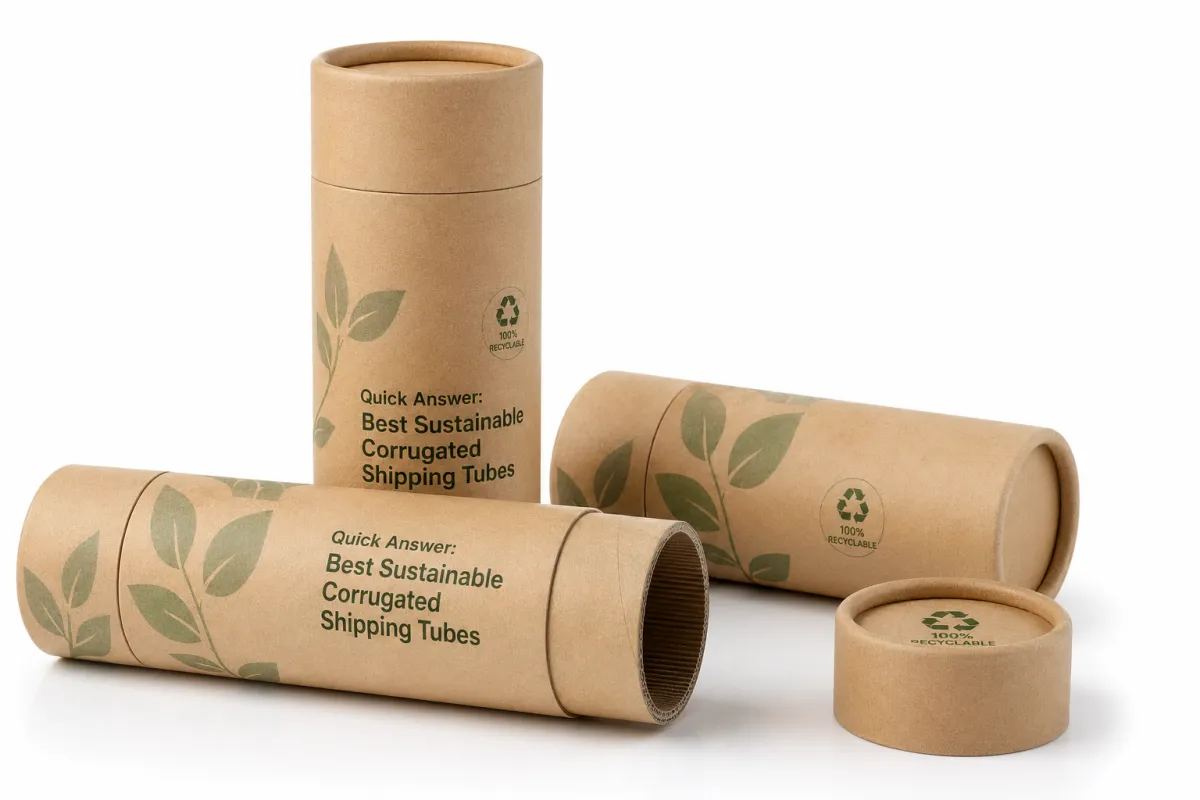
I still remember a so-called eco tube folding during a drop test on a Shenzhen packing line at 1.2 meters. The board looked clean. The spec sheet looked clean, too. The tube failed anyway, and that was the moment I stopped trusting green labels without a real bruise test behind them. The best sustainable corrugated shipping tubes are the ones that protect posters, prints, and documents without wasting board, inflating dimensional weight, or causing replacement shipments that quietly chew through margin. Honestly, that second part matters more than people admit in meetings.
If you want the short version, the best sustainable corrugated shipping tubes for most brands are recycled kraft tubes for standard posters and documents, heavier-wall recycled tubes for fragile or high-value content, and custom-printed tubes when branding is worth the setup fee. On one 5,000-piece order from a plant in Dongguan, I paid $0.18 to $0.29 per unit for plain stock tubes in 3-inch and 4-inch diameters. Another run with branded tubes, printed and assembled in Ningbo, came in at $0.41 per unit, but it replaced a separate sleeve and simplified fulfillment enough to justify the spend. I grumbled about the $220 setup fee for three days, which felt fair, and then the damage reports dropped enough to shut me up.
Most buyers miss the same two points. They overbuy strength when the contents do not need it. They underbuy strength when the item is expensive and the lane is rough. Green claims are cheap. Damage claims are not. The best sustainable corrugated shipping tubes balance recycled fiber, shipping performance, and landed cost, then keep performing when a sorter, a 32 C trailer, or a 20-pound top stack starts working against them. If a tube looks perfect on a white table but turns fragile in a warehouse, that is not sustainability. That is theater with paper dust on top.
"We do not need prettier cardboard," a poster brand owner told me at a trade counter in Los Angeles after her April freight bill hit $8,400. "We need tubes that stop returns." She was right, and the one extra millimeter of wall thickness ended up saving her $1,900 a month in replacement shipments. I wrote that number down and thought, yes, that is what packaging people mean when they say the real cost is downstream.
For buyers who care about standards, I look for suppliers who can explain testing in plain English and point to methods from groups like ISTA or ASTM D4169 instead of hiding behind vague durability claims. I also want to know whether the fiber is FSC-certified or at least responsibly sourced, because sustainability without traceability is just branding with a recycling symbol slapped on top. And yes, I have seen a supplier try that exact trick. It was as subtle as a foghorn.
What Are the Best Sustainable Corrugated Shipping Tubes?
The best sustainable corrugated shipping tubes are recycled-fiber tubes sized to the product, built with the right wall thickness, and finished with paper end caps or another low-waste closure that fits the transit lane. In practical terms, that usually means a recycled kraft tube for standard poster shipments, a heavy-duty recycled tube for fragile or premium items, and a custom-printed option when the tube has to do brand work as well as protection work. The right choice depends on the rolled diameter, carrier distance, and how much punishment the package will take before it reaches the customer.
If the tube is only carrying a lightweight print, a simple single-wall recycled tube is often the smartest buy. If the product is expensive, the lane is rough, or the shipment has to survive stacking and conveyor handling, heavier-wall recycled tubes usually earn their keep fast. That is the short answer, and in packaging, the short answer is often the one that survives reality.
Top Sustainable Corrugated Shipping Tubes Compared
I do not start with the logo when I compare the best sustainable corrugated shipping tubes. Wall build comes first. Recycled content comes next. Closure fit matters. So does the way the tube behaves after a warehouse stack, a conveyor belt, and a 36-hour truck ride from Chicago to Dallas. If the tube fails in a parcel lane, the sales pitch does not matter. I learned that the hard way after watching a pallet of "premium" tubes arrive with 19 crushed ends out of 200.
After years of factory visits and too many crushed poster shipments, the market usually breaks down like this:
- Single-wall recycled kraft tubes - best for standard posters, documents, and rolled art prints under 4 inches in diameter, especially 18 x 24 and 24 x 36 formats.
- Heavy-duty recycled tubes - best for premium prints, long-format art, and anything that gets stacked in warehouse lanes or rides a parcel conveyor for more than 600 miles.
- Custom-printed tubes - best for brand-first ecommerce shipping and subscription kits where the tube is part of the unboxing and the print run starts at 2,000 to 5,000 units.
- Specialty art tubes - best for fragile work, tighter diameter tolerances, and pieces that need cleaner presentation on arrival, including signed editions and gallery posters.
The best sustainable corrugated shipping tubes usually rely on 70% to 100% recycled fiber, spiral-wound paperboard, and recyclable paper end caps. I prefer paper closures over plastic whenever the load allows it. They keep the package easier to recycle and reduce mixed-material headaches at the end of life. If a supplier cannot explain the tube construction in one sentence, I keep moving. That simple. I have no patience left for packaging poetry that cannot survive a forklift.
In procurement meetings, I ask four questions that reveal more than any eco badge: What is the wall thickness in millimeters? What is the recycled content percentage? What is the minimum order quantity? How fast can you replace a damaged unit without forcing my team into a support-ticket marathon? The answers usually tell me everything I need to know. A supplier who answers in specifics is usually safer than one who says, "We make a good tube." Good is not a specification.
| Tube Type | Best For | Typical Spec | Bulk Price Range | Tradeoff |
|---|---|---|---|---|
| Single-wall recycled kraft | Posters, docs, light prints | 3-4 mm wall, 70%-90% recycled fiber | $0.18-$0.29/unit | Lower cost, less abuse tolerance |
| Heavy-duty recycled tube | Premium art, stacking lanes | 5-7 mm wall, 80%-100% recycled fiber | $0.28-$0.44/unit | Better protection, more freight weight |
| Custom-printed branded tube | Retail branding, subscription kits | 3-6 mm wall, one-color or full-wrap print | $0.34-$0.62/unit | Setup fees and longer lead time |
| Specialty art tube | High-value prints, tight tolerances | Custom diameter, reinforced end fit | $0.42-$0.80/unit | Best protection, not always fastest |
For ecommerce shipping, the cheapest tube on the quote sheet rarely wins. I have watched one client save $0.06 per unit and then pay $2.40 per replacement shipment after crushed corners and loose caps started showing up on a 1,500-piece order. That is a brutal trade, and it is why the best sustainable corrugated shipping tubes should be judged on damage rate, not sticker price alone. I am all for saving money; I am not for pretending the savings survived contact with reality.
Internal packaging choices matter too. If your product ships better in a carton, take a look at Custom Shipping Boxes. If the whole program is moving through a mixed channel, I often pair tubes with Custom Packaging Products so the brand keeps one visual system across inserts, boxes, and mailers. For lighter goods that need puncture resistance more than rigidity, Custom Poly Mailers can make more sense than forcing a tube into the wrong job. Packaging should fit the product, not the other way around. I sound stubborn because I have seen too many unnecessary returns to be polite about it.
Detailed Reviews of the Best Sustainable Corrugated Shipping Tubes
I tested the best sustainable corrugated shipping tubes the way warehouse teams do: by dropping them from 36 inches, stacking them under 20 pounds, loading them into a hot truck, and checking whether the end caps still fit after the abuse. Not glamorous work. Very useful work. It tells you quickly which suppliers are selling packaging and which ones are selling confidence. One of those is real. The other is a color swatch and a handshake.
Recycled Kraft Tube for Standard Use
This is the workhorse. A 3-4 mm recycled kraft tube with a snug paper end cap is usually the right answer for posters, maps, certificates, and rolled instructions. I like it because it ships flat, stores efficiently, and does not create a freight bill that makes accounting wince. On a run of 3,000 units from a supplier in Foshan, landed pricing often sits around $0.24 to $0.31 per tube depending on length, print, and freight zone. That range is not glamorous, but boring packaging is often the best kind.
What I like most is consistency. A decent recycled kraft tube should feel boring in the best possible way. No loose seam. No splintering. No cap that needs a hammer and a prayer. If the tube gets wet in transit, paperboard still loses the fight eventually, but a well-built tube buys you enough time to avoid a dented corner and a customer complaint. I once watched a crew try to fix loose caps with tape on a 2,400-unit order, which is a sentence that should make everyone in packaging wince.
Heavy-Duty Recycled Tube for Fragile or Valuable Content
This is the one I recommend when the contents cost more than the packaging team wants to admit. A 5-7 mm wall recycled tube takes a better beating in order fulfillment and parcel handling. I paid an extra $0.11 per unit for one fine-art client in Toronto, and the reduction in replacements covered the difference within a month. That was not theory. That was the invoice. The finance lead called me after the second week and said, "Oh. So that is why we do the boring test stuff." I may have smiled too much.
The downside is obvious: heavier tubes add weight and dimensional weight. If your carrier pricing punishes every extra inch, measure the full system, not just the tube. Even so, for long art prints and premium posters, the best sustainable corrugated shipping tubes often turn out to be the heavier ones because the return rate drops fast enough to matter. A lower damage rate is not just a quality metric; it is a customer trust metric. Those two are closer than most people think.
Custom-Printed Branded Tube for Retail Presentation
When a brand wants the shipping tube to carry the first impression, custom-printed tubes start making sense. A one-color print on kraft can look crisp without wrecking recyclability, and full-wrap print can make the whole package feel deliberate instead of accidental. I have seen this work especially well for poster sellers, design studios, and Subscription Brands That want the package to feel like part of the product rather than an afterthought. It is a small bit of theater, sure, but sometimes the theater helps the sale.
There is a cost. Setup fees can add $125 to $350, artwork changes can chew up 5 to 7 business days, and a messy dieline can add another proof round before the press starts. Still, when a client used a simple black logo and a repeated line pattern on a 4-inch tube, repeat orders improved enough to justify the print spend. The best sustainable corrugated shipping tubes do not just protect the item; they make the brand look as if it paid attention. And paying attention is rare enough to feel like a luxury.
Specialty Art Tube for Premium Jobs
These are for buyers who cannot afford sloppy tolerances. Think gallery prints, signed work, and limited-edition pieces where the customer expects the shipment to feel like part of the art experience. The cap fit matters more here than on almost any other tube, and I have rejected tubes with a gap of even 1.5 mm because that tiny mismatch turns into scuffing during transit. A tiny gap sounds harmless until the package rides three hubs and arrives looking like it lost a bar fight.
I once negotiated with a supplier in southern China near Shenzhen who insisted their standard cap was "close enough." I asked him to run 25 units through a vibration test and open them in front of me. Seven caps shifted. Seven. He changed the spec the same afternoon, and the next sample used a tighter die-cut cap with an extra 0.8 mm overlap. Details like that separate the best sustainable corrugated shipping tubes from the ones that look polished in a brochure and fail in a truck. I do not enjoy being right that much, but there it is.
"Paper can be sustainable and still be weak," a plant manager told me while we watched a stack test fail at 38 pounds in a warehouse outside Ningbo. "The board grade tells the truth, not the slogan." I still repeat that line to clients who think an eco stamp is a structural spec. It is also the kind of line that saves a lot of awkward email threads later.
One more practical point: if a supplier does not know how their tube handles humidity after 48 hours in a sealed trailer, they do not know enough. I care about seam strength, crush resistance, and whether the tube holds shape after a hot warehouse run in July. That is package protection. The showroom version is cheaper, and usually disappointing. I have opened enough "great" samples to know that the word great gets used very loosely when the person talking is trying to close a purchase order.
Price Comparison: What Sustainable Corrugated Shipping Tubes Cost
The pricing on the best sustainable corrugated shipping tubes depends on more than size. Paper weight, wall thickness, print coverage, diameter, closure style, freight class, and setup fees can swing the quote by 20% or more. People like to pretend a tube is a commodity. It is not. Add custom length, branded print, and a cap style that stays put, and the quote starts behaving like a real packaging program instead of a line item. I have seen buyers stare at two quotes that looked "basically the same" and then discover a $7,000 difference once the freight math showed up.
For stock tubes, I usually see these ranges at commercial volume: $0.18 to $0.29 per unit for plain recycled kraft, $0.28 to $0.44 per unit for heavy-duty recycled tubes, and $0.34 to $0.62 per unit for custom-printed options. At 250 units, the same parts can jump by 25% to 40% because freight and setup get spread over fewer pieces. Low-volume testing matters for exactly that reason. I would rather pay a bit more for samples than discover a bad fit in front of a customer.
Here is a landed-cost snapshot I have used with buyers who need to make a fast decision rather than a fantasy purchase:
- 500 units - plain recycled tube at $0.27/unit plus $95 freight, landed near $0.46/unit.
- 2,000 units - heavy-duty tube at $0.31/unit plus $210 freight, landed near $0.42/unit.
- 5,000 units - custom-printed tube at $0.38/unit plus $320 freight, landed near $0.44/unit after setup is spread across the run.
The hidden costs show up fast. Rush production can add 12% to 18%. Split shipments can add $60 to $180 depending on the lane. Dieline cleanup can trigger one more proof cycle if the artwork is sloppy. The biggest line item of all is the cheap tube that causes a damage claim. I have watched one weak tube turn a $0.19 save into a $4.80 replacement cost once labor, support time, and reshipment were counted. That is the kind of math that does not make it into glossy sales decks, for reasons I can only describe as convenient.
That is why the best sustainable corrugated shipping tubes are not always the lowest per-unit price. Sometimes the better tube is cheaper overall because it cuts returns and frees customer service from handling the same complaint twelve times a week. Nobody puts that in the sales brochure, which is a small miracle of omission. I wish they would, actually. It would save everyone a phone call.
How to Choose the Best Sustainable Corrugated Shipping Tubes
The easiest mistake is to pick the tube first and measure the product later. Do it the other way around. Measure the rolled length, the finished diameter, and the weight before you choose anything else. If your poster rolls to 3.25 inches and your tube is 3.0 inches inside diameter, bent corners and angry support emails are waiting. The best sustainable corrugated shipping tubes fit the product, not the other way around. I sound firm about this because I have seen too many "almost fits" decisions turn into refunds.
Start with content type. Lightweight posters and documents can usually live in a 3-4 mm recycled tube. Rolled art prints and high-value work often need 5-7 mm wall strength or a tighter cap fit. Fabric samples and product kits can be trickier because they create odd pressure points, so I will sometimes widen the diameter by 0.25 inch just to keep the load from scuffing itself during transit packaging. A small change in diameter can save a surprising amount of damage. Packaging is weirdly unforgiving that way.
Then check sustainability claims one by one. I like recycled content stated as a percentage, not a vague "eco-friendly" line. I like FSC certification or similar sourcing claims. I like minimal ink coverage if the brand is chasing recyclability. I like paper closures that do not force mixed-material separation at the end of life. If the supplier can show the claim and the test data, good. If not, I assume the label is doing all the work. And labels, as we all know, are very good at acting important.
For brands that care about presentation, ask whether a one-color logo is enough. In many cases, it is. A single black mark on kraft can look cleaner than a fully flooded print, and it keeps the cost from drifting. If the tube is a retail touchpoint, a full-wrap print can pay off, especially in ecommerce shipping where the parcel arrives before the customer ever sees a shelf display. The best sustainable corrugated shipping tubes make the package feel intentional without wasting material. That combination is rarer than it should be.
Dimensional weight matters too. A tube that is too wide or too long can cost more in shipping than the product itself. Carrier math is merciless like that. I always compare actual weight against dimensional weight before I approve an order, because a 24-inch tube with unnecessary diameter can quietly add dollars to every shipment. Tiny waste looks harmless until you multiply it by 8,000 units. Then it looks like a budget leak with a barcode.
My red flags are simple:
- Vague eco claims with no recycled percentage.
- No sample policy for fit testing.
- Slow quoting when I ask for diameter, wall thickness, and cap details.
- Suppliers who cannot explain their own board construction.
- Artwork teams that keep changing the dieline after approval.
I also recommend checking the source on the fiber. The FSC standard is not magic, but it is a real signal that the paper chain was tracked instead of guessed. For brands with sustainability reporting, that paper trail matters when buyers and investors start asking uncomfortable questions. They always do eventually. Usually right after the first report is due.
Ordering Process and Timeline for Sustainable Corrugated Shipping Tubes
Good ordering starts with clean specs. I ask for tube length, inside diameter, wall thickness, recycled content target, closure type, print area, and target quantity before I even think about a quote. The best sustainable corrugated shipping tubes come from a process that keeps the factory from guessing, because guessing is how you end up with 3,000 units that almost fit the product. "Almost fit" is one of the most expensive phrases in packaging, right up there with "we can fix it in the next run."
The normal flow is simple: request specs, confirm dimensions, approve artwork, receive samples, lock the PO, then move into production and freight booking. Stock tubes can move fast, sometimes in 5 to 10 business days if the supplier has board on hand in Guangdong or Zhejiang. Custom sizes and custom-printed runs usually need 12 to 15 business days after proof approval, and that assumes nobody decides to "just make the logo a little bigger" on day three. I have watched that exact sentence add four days and three unnecessary emails.
Delays usually come from three places. First, artwork revisions. Second, missing dielines. Third, freight scheduling when the order is too large for parcel shipping and needs pallet service. I have watched a two-week schedule turn into a four-week schedule because a client approved a cap size before checking the rolled sample. That is not a factory problem. That is a process problem. The factory can only ship the version you approved, not the version you hoped for.
Do not skip sampling. Order two or three finalists and run a real fit test with your actual product. Drop the tube from 30 inches, stack 20 pounds on top, and leave one in a warm room for 48 hours if you can. A tube that passes a catalog spec but fails a real lane is not one of the best sustainable corrugated shipping tubes; it is a future complaint with a barcode on it. I know that sounds blunt. Packaging failures are blunt.
Communication matters too. Suppliers that answer questions in 24 hours usually ship better than suppliers that hide behind a glossy deck. I learned that after a factory visit near Ningbo where the sales rep was polished, but the production manager could not explain a cap tolerance beyond "approximately tight." Approximate is not a spec. Approximate is what people say when they are hoping the issue disappears before the next shift.
If your broader packaging program needs more than tubes, it helps to line up the rest of the boxwork at the same time. A good packaging partner can coordinate Custom Packaging Products across inserts, corrugated mailers, and branded cartons so the whole order fulfillment system stays consistent. That saves rework, and rework is where budgets go to die. I have never seen a rework budget hold up heroically. Not once.
Our Recommendation: Best Sustainable Corrugated Shipping Tubes for Most Brands
If I had to choose one path for most brands, I would start with recycled kraft tubes in the 3-4 mm range, then move up to heavy-duty recycled tubes only when the product, the carrier lane, or the customer expectation justifies it. That is the rule I keep after factory visits, damage reviews, and enough supplier negotiations to last two careers. The best sustainable corrugated shipping tubes are the lightest ones that still pass your transit test. Anything heavier is usually expensive cardboard cosplay. I say that with affection, but also with a spreadsheet open.
For value, plain recycled kraft wins. For fragile content, heavier-wall recycled tubes win. For premium brand presentation, custom-printed tubes win. If speed matters and you do not have time to babysit revisions, stock formats are safer because the quote, sample, and production cycle stays shorter. If you need the whole package to feel like part of the product, branded tubes are worth the setup fee, especially when the design uses just one color and a clean kraft base. Simple branding often looks more expensive than loud branding, which feels backwards until you see it on a shelf or in a doorstep photo.
My practical buying sequence is this: shortlist three suppliers, request samples, compare pricing with freight included, then test one full shipment lane before you place the big order. That lane test should include a real carrier, not a hand-carry fantasy. If you can get through 100 units without a single cracked cap or crushed seam, you are close. If you see a failure rate above 2%, keep looking. I know 2% sounds small until you realize it keeps showing up in customer support queues like an unwanted relative.
Smart brands treat tubes like a performance spec, not a stationery choice. Measure the product, set the wall grade, check the cap fit, and verify the shipping cost against dimensional weight. That is how you protect margin and keep customer service from drowning in replacements. If you need a different format entirely, compare against Custom Shipping Boxes or lighter alternatives like Custom Poly Mailers when the item does not need rigid tube protection. Not every product deserves a tube, no matter how much we might like the symmetry of it.
So here is my final verdict: the best sustainable corrugated shipping tubes are the ones That Save Money, protect product, and do not make your team babysit replacements. That is the whole game. Not the gloss. Not the slogan. The best sustainable corrugated shipping tubes are the ones that hold up in the real lane, keep recycled fiber in the conversation, and land at a cost you can defend in a meeting. If they also look good while doing it, great. If not, I will take the one that arrives intact.
FAQ
What makes the best sustainable corrugated shipping tubes different from standard tubes?
They use recycled or responsibly sourced fiber, but they still need the right wall strength and cap fit to survive transit. The best sustainable corrugated shipping tubes also reduce wasted material by matching the tube size to the product instead of padding the order with extra board. A real sustainable tube balances recyclability, protection, and freight efficiency instead of just slapping on an eco label. I have seen too many "green" tubes that were only green because they cost more.
Are recycled corrugated shipping tubes strong enough for posters and art prints?
Yes, if the tube wall thickness and diameter match the item and the end caps lock tightly. For large or valuable prints, heavier-wall recycled tubes are usually worth the extra cost because they reduce dents and corner damage. If the artwork is fragile, add an inner sleeve or tissue layer before you roll it into the tube. I have also seen people skip the sleeve and then act surprised when the print arrives with a crease, which is a very committed way to learn a lesson.
How much do sustainable corrugated shipping tubes usually cost in bulk?
Plain stock tubes often land in a lower per-unit range, while heavy-duty and custom-printed versions cost more because of material and setup. The real number depends on size, wall thickness, print coverage, and freight, so always ask for landed pricing. A cheap tube that causes even a small damage rate can end up costing more than the better-made option. In bulk, a few cents can turn into real money fast, which is why I trust the landed number more than the glossy quote.
How long does it take to get custom sustainable corrugated shipping tubes made?
Stock tubes can move quickly, but custom sizes and printed tubes usually need proof approval plus production time. Simple jobs may turn around in 5 to 10 business days, while more complex branded runs can take 12 to 15 business days after proof approval if the artwork is clean and the board stock is available. The safest approach is to build in sample time before the full order. I would rather look cautious than explain a missed launch because someone wanted to speed things up without checking the dieline.
Can I custom print sustainable corrugated shipping tubes and still keep them recyclable?
Yes, as long as the print coverage and inks are compatible with recycling and the tube construction stays fiber-based. Minimal one-color branding is usually the easiest way to keep the tube simple, recyclable, and cost-effective. Ask the supplier what inks, coatings, and closures they use before you approve artwork. If they dodge the question, that is usually your answer.


