Buyer Fit Snapshot
| Best fit | Recyclable Packaging Pricing for projects where brand print, material claims, artwork control, MOQ, and repeat-order consistency need to be specified before quoting. |
|---|---|
| Quote inputs | Share finished size, material target, print colors, finish, packing count, annual reorder estimate, ship-to region, and any compliance wording. |
| Proofing check | Approve dieline scale, logo placement, barcode or warning zones, color tolerance, closure strength, and carton packing before bulk production. |
| Main risk | Vague material claims, crowded artwork, missing packing details, or unclear freight terms can make a low unit price expensive after revisions. |
Fast answer: Recyclable Packaging Pricing for: Material, Print, Proofing, and Reorder Risk should be specified like a repeatable production item. The safest quote records material, print method, finish, artwork proof, packing count, and reorder notes in one written spec.
Production checks before approval
Compare the actual filled-product size with the drawing, then confirm tolerance on folds, seals, hang holes, label areas, and retail display edges. Reserve space for logos, QR codes, warning copy, and material claims before decorative graphics fill the panel.
Quote comparison points
Review material grade, print process, finish, sampling route, tooling charges, carton quantity, and freight assumptions side by side. A quote is only useful when the supplier can repeat the same color, closure quality, and packing count on the next order.
Recyclable Packaging Pricing Guide for Smart Buyers in 2025
Use this recyclable packaging pricing guide to sort material costs, production drivers, and budget tradeoffs before you ask for quotes. I wish more teams in Chicago, Dallas, and Shenzhen started there, because it usually cuts the first-round quote confusion by 10% to 20% before anyone even opens a dieline.
I have spent enough time on carton lines in Illinois, corrugator floors in Ohio, and supplier conference rooms in Suzhou to know that a recyclable packaging pricing guide is never just about the number on the first quote. Two cartons can look nearly identical on a sample table and still land 18% apart once the plant runs them. One glides through a folder-gluer at 11,200 blanks an hour. The other needs handwork, a different aqueous coating, and a slower inspection pass that cuts output to 6,400 blanks an hour. That difference is not cosmetic. It is the whole story.
I remember one job in a Chicago-area plant near Elk Grove Village where a brand team kept insisting their carton was "basically the same" as the old one. It was not. The new version had a tighter score, a soft-touch finish, and a tuck flap that refused to stay put during bundle handling at 14 packs per minute. The operators had that look on their faces - the one that says, "Sure, let's pretend this is simple." The quote did not just move; the line slowed down too. That is why this recyclable packaging pricing guide matters. Recyclable packaging is not a slogan inside a factory; it is a set of practical choices involving paperboard, corrugated, molded fiber, aluminum, glass, and certain mono-material plastics that can move through real recycling systems when the structure is designed with care. A pack can look pristine in a sales deck and still be a headache on the line if the ink system, barrier layer, or closure makes it hard to convert, stack, or recycle.
Most buyers start in the wrong place. They ask for a "recyclable" carton or shipper, then treat price as if it were one clean material number. Real pricing is messier. It includes board grade, converting complexity, decoration, yield loss, freight, and whether the structure can be built quickly without extra labor. A useful recyclable packaging pricing guide has to expose those moving parts before the quote arrives. Otherwise you are comparing fiction to fiction, and I have seen that happen on 6,000-unit and 60,000-unit programs alike.
This is not a hunt for the lowest unit cost at any cost. The better question is which mix of shelf impact, product protection, brand presentation, and production speed makes sense across the full job. If you are comparing Custom Printed Boxes, retail packaging, or a lighter shipper for e-commerce, the best choice is usually the one that holds up in the plant and in the recycling stream, not just on the invoice. I know that sounds obvious, but the number of teams who ignore it still manages to surprise me.
Recyclable Packaging Pricing Guide: What Buyers Miss First
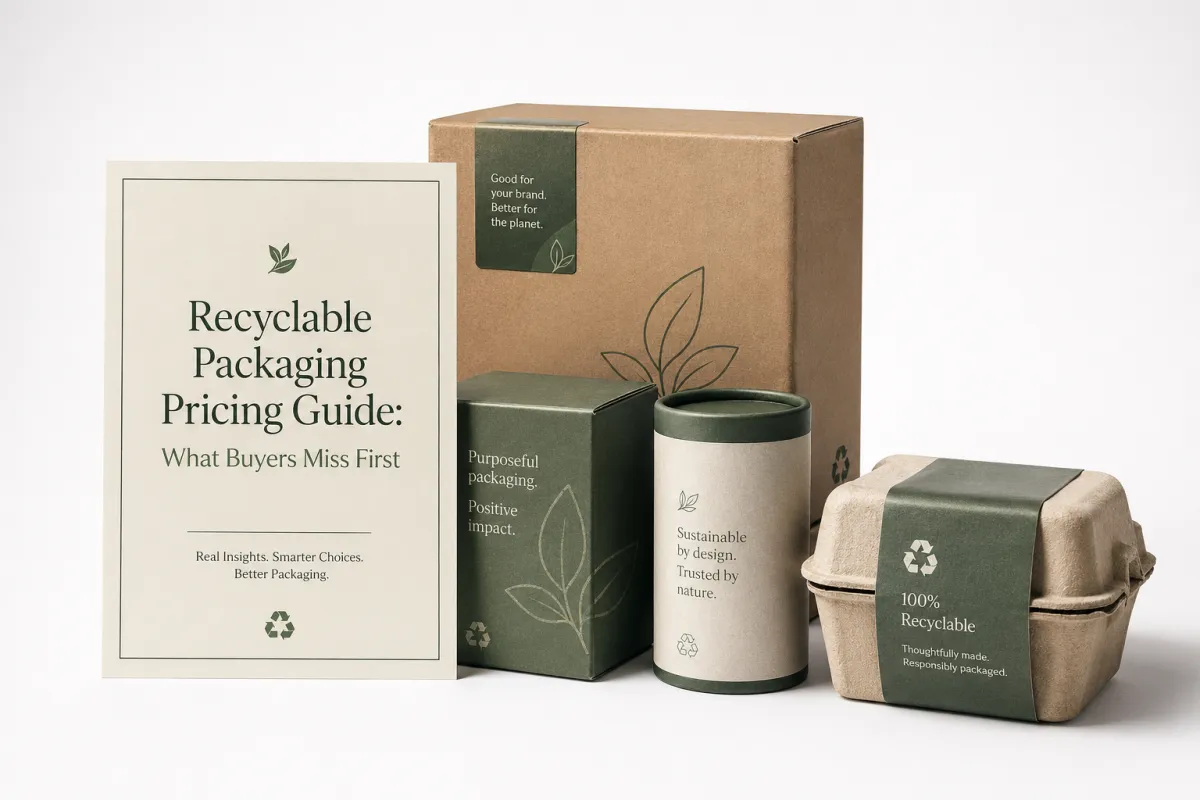
The first thing many buyers miss is that "recyclable" does not mean "cheap" or "expensive" by itself. A recyclable packaging pricing guide has to start with the substrate, because a 24-point SBS carton, a 32 ECT corrugated mailer, and a molded fiber tray behave very differently on press and on the line. In a Chicago-area plant I visited, one retail carton ran at 11,500 blanks an hour because the score lines were clean and the glue pattern was simple. A nearly identical version needed an extra score adjustment and three operators near the pack-out table because the tuck flap kept opening during bundle handling. That kind of tiny annoyance can cost real money, especially on 5,000-piece runs where every cent matters.
That is the kind of detail a quote sheet hides. Recyclable packaging can include paperboard, corrugated, molded pulp, aluminum, glass, and certain mono-material films, but each one carries a different scrap rate, conversion speed, and recycling reality. A paper-based mailer with a water-based coating may be widely accepted in curbside systems, while a multi-layer plastic structure can be technically recyclable in theory and still fail in practice because the local collection stream is not built for it. For a neutral baseline, the EPA recycling basics are still useful, especially if your product ships into California, Ontario, or the UK, where packaging claims tend to get examined more closely.
I also see buyers underestimate how much recyclable packaging pricing guide language gets softened by sales talk. "Eco-friendly" and "green" sound reassuring, but the real cost depends on whether the pack is a stock die line, a special size, or a custom structure that needs its own tooling set. If the package is going to sit on a retail shelf, print coverage and color matching matter as much as substrate choice. A brand owner often cares about disposal, yes, but not only disposal. Honestly, that is where a lot of teams lose the plot: they buy for the press release and forget the press line, the die line, and the 7:00 a.m. line start.
| Material | Typical run context | Directional unit cost | What pushes price up | Recycling note |
|---|---|---|---|---|
| Folding paperboard carton | 5,000 to 25,000 units for retail packaging | $0.15 to $0.38 each at 5,000 pieces; $0.09 to $0.24 each at 25,000 pieces | 6-color print, foil, window patching, special coating | Often widely recyclable if kept fiber-only |
| Corrugated mailer | 2,500 to 20,000 units for e-commerce | $0.24 to $0.60 each | Heavy board, custom insert, extra die-cutting, hand assembly | Commonly accepted in curbside systems |
| Molded fiber tray | 10,000 to 50,000 units for protection | $0.20 to $0.55 each | Tooling complexity, drying time, tight tolerances | Usually strong recycling story when uncoated |
| Aluminum rigid pack | Small-to-mid runs for premium product packaging | $0.45 to $1.10 each | Forming depth, decoration, secondary packaging, freight | Highly recyclable, though forming and finishing can be pricey |
| Mono-material PE pouch | High-volume flexible packaging | $0.08 to $0.28 each | Barrier needs, zipper style, print coverage, seal complexity | More recyclable than mixed laminates, depending on the collection stream |
Tooling is the other hidden piece of a recyclable packaging pricing guide. A die, plate set, or cutting rule might be a one-time charge of $350 on a simple sleeve or $2,800 on a complex corrugated shipper with dual inserts. That fixed cost matters far more on 2,500 units than on 75,000. I remember a client meeting in Louisville, Kentucky, where a brand team was stunned that a "small tweak" to a window size created a new die and a new plate set. The carton itself was only 8 cents more, yet the setup pushed the total job by more than $1,200. Nobody enjoys being the person explaining that kind of math, and the room goes very quiet very quickly.
Minimum order quantity changes the math in a way that is easy to miss when you are staring at a spreadsheet. On a high-speed folder-gluer in the Midwest, a factory might want a 10,000-unit run because it can absorb setup time and reduce waste. On a specialty line in Gujarat or northern Vietnam, the same factory may need 25,000 units to keep sheet utilization above 84% and avoid scrap-heavy offcuts. A careful recyclable packaging pricing guide looks past the unit price and asks how many cartons or shippers the line can produce before a changeover resets the clock.
Freight gets treated like an afterthought far too often. A palletized shipper that ships flat can save $0.04 to $0.11 per unit compared with an assembled format, but the landed cost can still rise if the pack requires split shipments, warehousing, or rush delivery from a plant in another region. A quote that excludes freight is not complete, and a good recyclable packaging pricing guide should say so plainly. I have seen more than one "great deal" collapse the minute someone adds shipping from Memphis or Rotterdam and realizes the bargain was hiding in the next room.
Recyclable Packaging Pricing Guide: How Pricing Is Built
Pricing starts with the substrate, but it does not end there. A recyclable packaging pricing guide has to account for the way a package is built, decorated, assembled, and shipped. The same board can land at very different prices if one design uses a simple straight tuck and the other uses specialty locking tabs, a window, a coating, and a hand-packed insert. That is why buyers who focus only on material weight often miss the biggest cost drivers by 15% or more.
Board grade is the first layer. Heavier paperboard can improve rigidity, yet it also raises material spend and may slow cutting or folding if the structure becomes too stiff. Corrugated works the other way sometimes: a lighter flute may save money, but if compression performance drops, damage rates climb and the "cheap" option stops being cheap. The real task in a recyclable packaging pricing guide is not finding the lightest possible pack. It is finding the lightest pack that survives the trip from the plant in Suzhou to the warehouse in Nashville.
Decoration is the second layer. Four-color process on uncoated kraft usually costs less than full-bleed work with tight Pantone matching on coated paperboard. Add white ink, metallic accents, embossing, or soft-touch finish and the price moves fast. In packaging design meetings, I have watched teams add three color changes because someone wanted one more accent on the side panel. That looked minor in the mockup. The press saw it as extra washups, more make-ready time, and a few hundred dollars added to the order. A practical recyclable packaging pricing guide keeps artistic ambition separate from press reality.
Sustainability specifications can raise or lower the price depending on how tightly they are written. Recycled content targets, water-based coatings, FSC-certified fiber, and mono-material structures all support a stronger packaging story, but each one has a price profile. Asking for 100% post-consumer recycled paperboard can reduce virgin fiber use, yet it can also introduce shade variation, lower stiffness, or a narrower purchasing window. If chain of custody matters, the FSC standards and certification guidance are worth checking before you sign off on the spec, especially if the board is being sourced from mills in Wisconsin, Sweden, or British Columbia.
Testing is another cost that hides in plain sight. A shipper that has to survive ISTA 3A testing, pass ASTM D4169 distribution cycles, or meet a retailer's drop and compression standard costs more than a basic brown box because the design has to be validated, not guessed. I have seen a molded fiber insert look perfect in a sample photo and then fail a 24-inch drop test because the product shifted 6 millimeters inside the cavity. The fix was a deeper nest and a tighter wall profile, which added 4 cents per unit and saved a much more expensive returns problem later. That tradeoff belongs in every recyclable packaging pricing guide.
Market forces still matter. Paper mill capacity, recycled fiber availability, resin pricing, labor rates, and transportation volatility can move a quote from one month to the next, especially on materials with thin margins. On one Southeast Asia sourcing trip, a supplier in Ho Chi Minh City explained that a 15% swing in linerboard availability had more effect on their quote than the actual die-cutting cost. I still remember thinking, "Well, that is a lovely way to make a spreadsheet cry." It was a reminder that a recyclable packaging pricing guide should include supply-chain timing, not just machine time and artwork.
There is also a practical split between retail packaging and transit packaging. If the pack is going to sit on a shelf in Seoul or Toronto, print quality, consistency, and presentation may dominate the budget. If it is traveling through distribution, compression strength, cube efficiency, and damage protection usually dominate. Those priorities change the material stack, the coating choice, and the final unit price. A buyer who wants a clean, recyclable carton for branded packaging should ask not only "How much?" but also "What machine, what test, and what delivery window?"
What Affects Recyclable Packaging Pricing the Most?
Package size is one of the biggest levers in any recyclable packaging pricing guide. A compact mailer for a 4-ounce beauty product, a 12-count retail carton for beverages, and a protective shipper for a ceramic item each require different caliper, flute, or fiber strength, and those differences show up quickly in the quote. A 7 x 5 x 2 inch carton may nest neatly on a sheet and waste very little board, while a 14 x 10 x 6 inch shipper can trigger a different die size, more board usage, and a higher freight class.
Print coverage matters almost as much as size. Four-color process on uncoated kraft is usually less expensive than a full-bleed design with heavy ink coverage and tight Pantone matching on coated paperboard, and the gap widens when a brand wants white ink, metallic accents, or a soft-touch finish. In packaging design meetings, I have watched teams add three color changes because someone wanted one more accent on the side panel. That looked small on the mockup, but it added press washups, extra make-ready time, and a few hundred dollars to the job. A practical recyclable packaging pricing guide should always separate visual ambition from press reality.
Sustainability choices can raise or lower the price depending on how they are specified. Recycled content targets, water-based coatings, FSC-certified fiber, and mono-material structures can support a strong package branding story, but each choice has a cost profile. Asking for 100% post-consumer recycled paperboard may reduce virgin fiber use, yet it can also introduce shade variation, lower stiffness, or tighter purchasing windows. If chain of custody matters to your team, the FSC standards and certification guidance should be part of the review before you lock the spec.
Testing and compliance are another quiet cost center in a recyclable packaging pricing guide. A shipper that must survive ISTA 3A testing, pass ASTM D4169 distribution cycles, or meet a retailer's drop and compression standard usually costs more than a basic brown box because the design has to be validated, not guessed. I have seen a molded fiber insert look perfect in a sample photo, only to fail a 24-inch drop test because the product shifted 6 millimeters inside the cavity; the fix was a deeper nest and a tighter wall profile, which added 4 cents per unit but prevented a much bigger returns problem later.
Market forces still matter. Paper mill capacity, recycled fiber availability, resin pricing, labor rates, and transportation volatility can move a quote from one month to the next, especially on materials with thinner margins. On one Southeast Asia sourcing trip, a supplier explained that a 15% swing in linerboard availability had more effect on their quote than the actual die-cutting cost, which is a reminder that a recyclable packaging pricing guide has to include supply-chain timing, not just machinery and design.
One useful way to think about it is this: if the package is for retail packaging, print, shelf appeal, and consistency may dominate the budget; if it is for transit packaging, compression strength, cube efficiency, and damage protection may dominate. Those priorities change the material stack, the coating choice, and the final unit price. That is why a buyer who wants a clean, recyclable carton for branded packaging should ask not only "How much?" but also "What machine, what test, and what delivery window?"
Recyclable Packaging Pricing Guide: Step-by-Step Timeline
A good recyclable packaging pricing guide should show the sequence, because timing affects price almost as much as material choice. The quote phase starts with specifications: external dimensions, product weight, load conditions, artwork files, target annual volume, ship-to location, and any sustainability claims that need support. If the buyer sends a vague request like "eco box for cosmetics," the supplier has to guess. Guessing usually makes pricing less accurate by 10% to 20%, and then everybody acts surprised, which is one of my least favorite rituals in procurement.
Step 1: Spec gathering. The buyer should share the dieline, product size, inserts, closure style, and print coverage. A simple flat mailer with one-color flexo and no inserts may be quoted in 24 to 48 hours, while a Custom Printed Boxes program with multiple SKUs and a special coating can take 3 to 5 business days just to model correctly. A thorough recyclable packaging pricing guide saves time here, because the supplier can compare apples to apples instead of rebuilding the job three times.
Step 2: Prototype and proof. I like to see a structural mockup before tooling is locked. In one Shenzhen facility I toured, the team printed a digital proof on 350gsm C1S artboard, cut a hand sample, and checked whether the tuck flap held after six open-close cycles. That tiny step prevented a much more expensive rework on a 40,000-unit run. A disciplined recyclable packaging pricing guide should remind buyers that a sample is not a luxury; it is a cost-control measure. If a person tells you samples are optional, they are usually about to discover why they should not have been optional.
Step 3: Tooling and procurement. Once the proof is approved, the shop orders plates, dies, or cylinders, then secures paperboard, liner, fiber, resin, or aluminum stock. A standard carton program might move from approval to tooling in 4 to 7 business days, while a molded fiber or custom barrier project can stretch to 2 to 4 weeks depending on mold complexity. If you are comparing supplier quotes, make sure every one of them uses the same lead-time assumptions, or the recyclable packaging pricing guide comparison will be distorted before production even starts.
Step 4: Converting and inspection. On the line, the package is printed, die-cut, folded, glued, and checked for defects. A stable run on a folder-gluer may hit 80% to 90% of theoretical speed once the line is warmed up, but a package with tight tolerances or tricky coatings can slow down if registration wanders or glue does not set cleanly. I once watched a 2-color kraft carton fail repeated glue tests because the aqueous coating interfered with the adhesive; the plant solved it with a small glue pattern change and a slower first pass, but the extra labor would have been invisible in a rushed quote.
Step 5: Shipment and receiving. A standard program may be ready 12 to 15 business days from proof approval, while a custom format with specialty fiber or coordinated inserts can take 20 to 35 business days. If the buyer needs staggered release shipments, the warehousing charge may add another 1% to 3% to the job. A strong recyclable packaging pricing guide treats time as a budget line, not a footnote.
Here is the practical rule I give brand teams: the more custom the structure, the more the quote depends on the proof cycle. If the job is a stock mailer or a simple kraft sleeve, the process is short. If it is a premium Custom Packaging Products program with branded packaging, multiple SKUs, and a shelf-facing print requirement, the review loop is where you protect the budget. That is one reason a careful recyclable packaging pricing guide is worth more than a one-line estimate from a sales rep.
Common Mistakes That Inflate Recyclable Packaging Costs
The biggest mistake I see is quoting before the pack spec is locked. A 2 mm change in carton depth, a switch from snap-lock to auto-bottom, or a move from 18-point to 24-point board can change the die line, the board usage, and the setup charge. That means the first quote is no longer useful. A solid recyclable packaging pricing guide should push buyers to freeze the dimensions before they compare suppliers.
Over-engineering comes next. Buyers often specify a heavier board or a more complicated closure because they want to feel safe, but the extra material is not always doing real work. I have seen a beauty brand demand a 400gsm carton with an inner insert and a magnetic flap for a 3-ounce serum, even though a 24-point paperboard structure and a simple paper insert would have passed shelf display and transit testing just fine. That overbuild added nearly $0.19 per unit, and a better recyclable packaging pricing guide would have caught it before tooling. Nobody likes paying for a magnetic flap that has the dramatic flair of a stage prop and the practical value of a paperclip.
Artwork chaos creates another kind of cost. If the logo changes after plates are made, if the Pantone shifts from 287 C to a darker custom match, or if the legal copy changes once the carton is approved, the shop may need a second proof, a new plate, or a press reset. In one client meeting, I watched a marketing team redesign package branding after a photo shoot, and the revision added 9 days and a few hundred dollars in remakes because the print vendor had already locked the plate order. That is exactly the sort of cost a practical recyclable packaging pricing guide is meant to prevent.
Another mistake is choosing a recyclable structure that is hard to run on standard equipment. A carton that technically recycles well but needs two operators to hand-load inserts, or a shipper that jams on a common folder-gluer, quickly becomes expensive because labor and scrap rise together. One plant in the Midwest told me a supposedly simple fold style was costing them 14% more scrap than the original dieline because the bottom lock was too tight for the glue line to settle. That detail rarely appears in an emailed quote, yet it changes the true cost in any recyclable packaging pricing guide.
Finally, buyers compare quotes that do not include the same scope. One supplier may include samples, freight, and a test run; another may only quote the board and print. A quote comparison without a scope checklist is close to useless. If you want a fair read, make sure the same carton size, artwork file, order quantity, testing standard, and delivery term are on every line of the recyclable packaging pricing guide spreadsheet.
Expert Tips to Lower Pricing Without Losing Recyclability
If I had to reduce a packaging budget by 10% quickly, I would start with structure, not with shaving paper weight by a fraction. Simplifying a closure, dropping an unnecessary insert, or removing a secondary sleeve often saves more than an aggressive material change. In a corrugated plant near St. Louis, one extra tuck or dust flap can slow the line just enough to make a 50,000-unit job noticeably more expensive, and that is exactly the kind of thing a smart recyclable packaging pricing guide should spotlight.
Design around standard sheet sizes whenever possible. A 28 x 40 inch paperboard sheet or a familiar corrugated blank layout can improve yield and reduce waste, especially in high-volume custom printed boxes. If your box dimensions force an awkward nest that leaves 15% of the sheet as trim waste, you are paying for air. I have seen a brand save more than $0.06 per unit just by shifting the carton width by 4 millimeters so it fit the press sheet more efficiently. Four millimeters. Smaller than a grain of rice, and somehow still worth real money. Packaging is humbling like that.
Use testing instead of assumptions when you compare recycled-content options. Sometimes a 100% recycled board is the right answer; sometimes a 30% recycled board with better stiffness saves more product damage, which lowers the total landed cost. The same logic applies to mono-material packaging: a recyclable film structure may cost a little more per pouch, but if it eliminates a second lamination step and runs faster on the sealer, the total program can still improve. That is a core lesson in any serious recyclable packaging pricing guide.
Standardize where you can. If you run 6 SKUs in 4 carton sizes, ask whether 3 sizes can do the job. Fewer unique formats usually mean fewer dies, fewer plates, simpler purchasing, and less chance of inventory getting stranded in the warehouse. I have watched a client cut packaging SKUs from 18 to 11 and save money not because the material got cheaper, but because the plant stopped switching between tiny jobs that never filled a full pallet. That kind of cleanup is often overlooked in a recyclable packaging pricing guide.
There are times to spend more, too. If a slightly stronger carton prevents a 2% return rate, or if a better insert keeps a glass bottle from rattling in transit, the extra 3 or 4 cents can pay for itself very quickly. In my experience, the cheapest quote is often the most expensive once damage, repacking labor, and customer complaints are counted. If you need help narrowing the options, review the Custom Packaging Products page and compare which formats fit your product packaging goals without adding unnecessary features.
One more tip: ask your supplier to quote a "good, better, best" set of options with the same dimensions and the same delivery term. That way you can compare a plain recycled paperboard carton, a better-finished branded packaging version, and a premium retail packaging option side by side. A disciplined recyclable packaging pricing guide is not just about cutting cost; it is about choosing the right cost for the right job.
Next Steps After You Read This Guide
Start with a packaging audit. Pull the current carton spec, the board grade, the insert count, the print method, and the damage rate from the last 3 to 6 months of shipments. A recyclable packaging pricing guide becomes much more useful when you know whether the carton is actually failing at the seal, the corner crush, or the artwork stage.
Then identify the top three cost drivers. For most jobs, those are material grade, print coverage, and order quantity, but sometimes freight or tooling is the real problem. If you are ordering 8,000 units with a 5-color litho print and a custom insert, the packaging budget may be dominated by setup charges rather than board cost, and that tells you where to negotiate first. That is a practical way to use a recyclable packaging pricing guide instead of treating it like a theory exercise.
Request at least two quotes with identical inputs: the same dimensions, the same artwork files, the same sustainability claims, the same volume, and the same delivery window. If one quote includes samples, tooling, and freight while the other excludes them, the comparison is already broken. I have seen a 14% pricing gap disappear once the second quote was corrected to include the missing coating and outbound freight, which is why a clean comparison sheet matters so much in a recyclable packaging pricing guide.
Build a simple scorecard and use it on every supplier response. I usually suggest five columns: unit price, tooling, lead time, recyclability, and damage protection. If you want to make the process easier, a short list of Custom Packaging Products can help you match structure to use case before you ask for numbers. The goal is not to crown the cheapest box; the goal is to choose the package that gives you the best total value for the product, the shelf, and the factory floor.
If you are still deciding whether to move forward, run a pilot. A 500-unit validation batch or a single proof approval can expose fit problems, ink shifts, and shipping damage before you commit to a full run of 25,000. That final discipline sits at the heart of a good recyclable packaging pricing guide: price matters, but price only makes sense when the structure runs well, protects the product, and fits the recycling stream you are trying to serve.
So if you remember only one thing from this recyclable packaging pricing guide, make it this: the smartest purchase is the one that balances price, performance, and recyclability across the full job, not just the first quote. I have seen too many teams chase a clean-looking number and end up paying for the mess later. Not a fun surprise, and not one you need to repeat.
What affects recyclable packaging pricing the most?
Material choice, structural complexity, print coverage, tooling, and order quantity usually drive the biggest swings in a recyclable packaging pricing guide. Freight, lead time, and testing can also move the final number more than buyers expect, especially on smaller runs under 10,000 units where a $350 die or a 2-week sample cycle can outweigh the board cost.
Is recyclable packaging always more expensive than standard packaging?
Not always. Some recyclable formats use common paperboard or corrugated substrates that stay competitive, especially when the die line is simple and the print is limited to 1 or 2 colors. Costs rise when the design needs special barriers, custom tooling, or lower-volume production, so a careful recyclable packaging pricing guide comparison is essential.
How long does a recyclable packaging project usually take?
Simple stock-based solutions can move quickly, sometimes in 7 to 10 business days, while custom recyclable packaging often needs 12 to 35 business days once you include prototyping, approvals, and tooling. Rushed schedules usually increase cost because they can trigger expedited freight, overtime, or limited material choices, which is why timing belongs in every recyclable packaging pricing guide.
How can I compare quotes fairly?
Use the same dimensions, volume, print details, sustainability requirements, and delivery terms for every supplier. Make sure each quote includes tooling, samples, testing, freight, and any added finishing work, or the recyclable packaging pricing guide comparison will be misleading from the start.
What is the easiest way to lower recyclable packaging costs?
Simplify the structure, reduce unique SKUs, and design around standard manufacturing sizes whenever possible. Also check that you are not over-specifying board weight, decoration, or performance features that the product does not need, because those small decisions can add up fast in a recyclable packaging pricing guide review.


