Buyer Fit Snapshot
| Best fit | Order Renewable Resource Mailer Sleeves for Brands projects where brand print, material claims, artwork control, MOQ, and repeat-order consistency need to be specified before quoting. |
|---|---|
| Quote inputs | Share finished size, material target, print colors, finish, packing count, annual reorder estimate, ship-to region, and any compliance wording. |
| Proofing check | Approve dieline scale, logo placement, barcode or warning zones, color tolerance, closure strength, and carton packing before bulk production. |
| Main risk | Vague material claims, crowded artwork, missing packing details, or unclear freight terms can make a low unit price expensive after revisions. |
Fast answer: Order Renewable Resource Mailer Sleeves for Brands should be specified like a repeatable production item. The safest quote records material, print method, finish, artwork proof, packing count, and reorder notes in one written spec.
Production checks before approval
Compare the actual filled-product size with the drawing, then confirm tolerance on folds, seals, hang holes, label areas, and retail display edges. Reserve space for logos, QR codes, warning copy, and material claims before decorative graphics fill the panel.
Quote comparison points
Review material grade, print process, finish, sampling route, tooling charges, carton quantity, and freight assumptions side by side. A quote is only useful when the supplier can repeat the same color, closure quality, and packing count on the next order.
Order Renewable Resource Mailer Sleeves for Brands
If your packaging needs to make a clean first impression without turning into unnecessary bulk, the decision to order renewable resource mailer sleeves usually comes down to the practical stuff: how the sleeve fits, how the print reads, which material gives the right stiffness, and how the finished piece behaves once it leaves the packing table. A well-made sleeve does two useful things at once. It protects the product or outer mailer, and it tells the customer the brand made an intentional material choice instead of grabbing the heaviest or most wasteful option nearby.
That matters because people who want to order renewable resource mailer sleeves are usually not shopping for decoration. They need a packaging layer that ships efficiently, stacks neatly, presents cleanly at the door or on a shelf, and supports broader packaging goals without making the line slower or harder to manage. In practice, the best sleeve is the one that fits the product, matches the print method, and lands at a sensible cost per unit without forcing the team to work around the packaging.
There is a commercial side to that choice too. A properly built sleeve can reduce excess material use, raise the perceived value of a mailer or kit, and create a more polished unboxing layer without adding much weight. That makes it especially useful for subscription brands, printed collateral, sample packs, and boxed product sets that need structure but do not need a full rigid carton. For a useful comparison point, our Custom Poly Mailers page shows how outer packaging choices can work alongside a sleeve system.
The smartest way to order renewable resource mailer sleeves is to talk in specifications, not slogans. Substrate, thickness, structure, finish, quantity, and artwork placement tell you far more than a broad sustainability claim ever will. That is the mindset we recommend on every project, because it keeps the conversation grounded and helps brands choose a sleeve that performs well in actual production, not just in a mockup. I have seen plenty of projects go sideways because everyone loved the concept, but nobody had pinned down the fold direction or the score depth.
Practical rule: if the sleeve cannot survive handling, fit the intended product, and print clearly at the agreed quantity, it is not the right sleeve yet, no matter how polished the sustainability message sounds.
Order Renewable Resource Mailer Sleeves: A Smarter First Impression
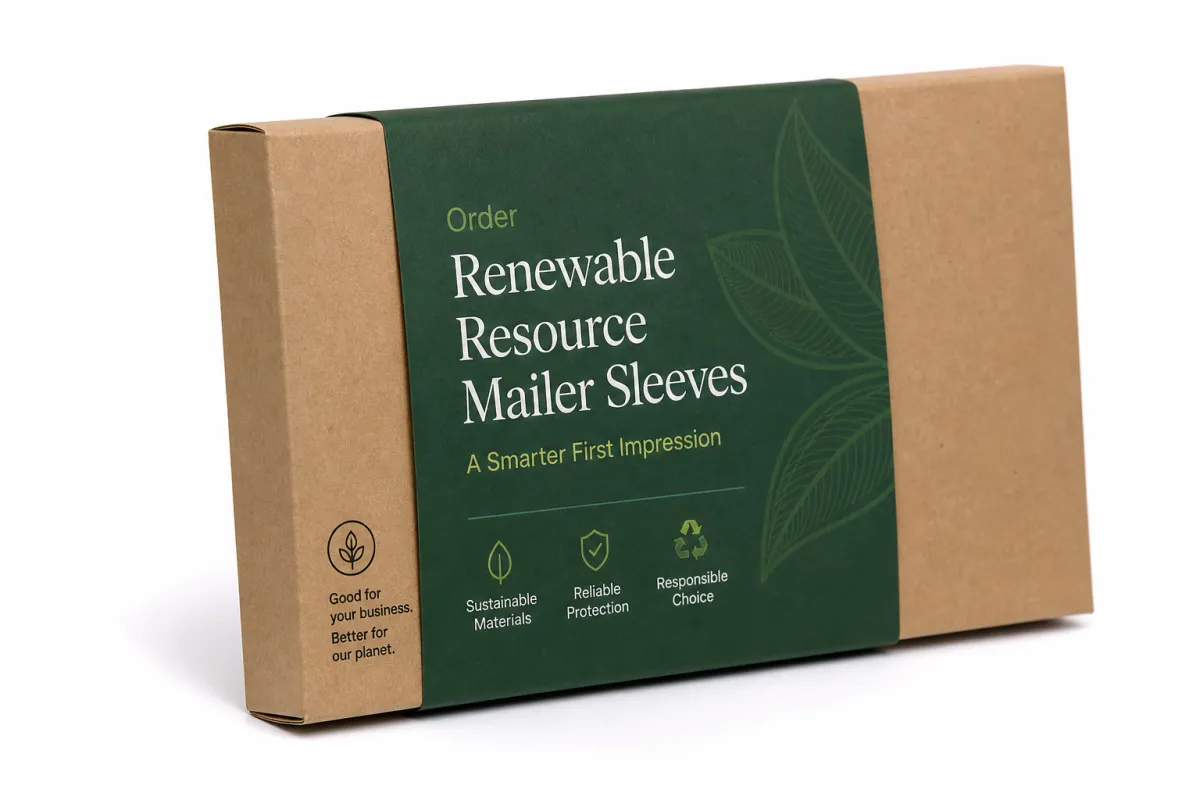
When a customer opens a parcel, the sleeve is often the first material they touch, which gives it a bigger role than people sometimes expect. That is why teams that order renewable resource mailer sleeves usually care about both appearance and behavior. The sleeve has to look deliberate, feel clean in the hand, and hold its shape after packing, shipping, and unboxing.
From a packaging buyer's point of view, there is a real advantage to choosing a sleeve made from paper-based or recycled fiber stock instead of reaching for extra layers that do not add value. A sleeve can keep the presentation sharp while staying lightweight, and that tradeoff is often better than overspecifying the outer pack. Many brands use order renewable resource mailer sleeves as a way to create a more refined reveal without increasing shipping weight by much.
Another reason people order renewable resource mailer sleeves is that these structures support packaging goals in a direct, practical way. Less excess material, fewer unnecessary coatings, and better material selection all matter, especially when the sleeve is part of a wider materials program. The EPA's guidance on sustainable materials management is a useful reference point here, and the core idea is simple: use the right material in the right amount for the job, rather than adding layers just because they exist.
In practical terms, the sleeve should be discussed through a few measurable variables:
- Substrate: paperboard, recycled fiber stock, or another renewable-resource option.
- Strength: enough rigidity to protect the printed face and maintain structure in transit.
- Print method: offset, digital, flexographic, or another process suited to the run size.
- Fit: enough clearance for insertion, but not so much that the sleeve slips or looks loose.
- Use case: shipping, retail presentation, sample distribution, or a hybrid of those needs.
That practical lens is also why the phrase order renewable resource mailer sleeves should stay tied to actual packaging performance. A sleeve can be renewable-resource based and still fail if the board curls, the fold lines crack, or the artwork shifts out of register. Buyers who know what they want usually ask for samples, proof files, and clear size checks before they approve a production run.
For brands that care about chain-of-custody or sourcing language, the Forest Stewardship Council is one of the main references for certified fiber sourcing. Not every sleeve needs certification, but many procurement teams like having a standard to compare against when they order renewable resource mailer sleeves for a larger program.
The bottom line is straightforward. If the goal is to present well, ship efficiently, and avoid unnecessary bulk, order renewable resource mailer sleeves is a sensible packaging strategy. It is not about making a grand claim. It is about choosing a sleeve that does its job neatly and predictably, which is kinda the whole point.
Materials and Build Options for Order Renewable Resource Mailer Sleeves
Material choice is where most projects succeed or fail. When teams order renewable resource mailer sleeves, they usually start with one of three broad material paths: paper-based board, recycled fiber stocks, or other renewable-resource substrates that fit the application. Each one has its place, and the right answer depends on the product weight, the print coverage, and how much protection the sleeve needs during handling.
Paper-based board is the most common choice for a crisp, clean presentation. It tends to hold folds well, supports strong branding, and gives the sleeve enough body to feel intentional. For lightweight retail sets, printed inserts, or catalog-style packs, this option is often the easiest to work with when you order renewable resource mailer sleeves.
Recycled fiber stock is a practical option when the brand wants a more subdued material story or when the project calls for a slightly softer, more natural look. It can be a good fit for brands that want visible fiber character, but you still need to check print behavior carefully because recycled content can affect ink holdout and surface smoothness. That does not make it worse; it just means the specification matters more.
Other renewable-resource substrates can include specialty papers, molded fiber elements, or paper-based combinations designed for a particular use. These are worth considering when the sleeve needs unusual stiffness, a distinctive tactile feel, or stronger presentation value. The key is to match the material to the role it plays in the package, not to the marketing headline.
Build details matter just as much as substrate. If you plan to order renewable resource mailer sleeves, confirm the fold style, seam location, opening direction, any tuck or insert slits, and whether the sleeve wraps a mailer, a boxed product, or a flat insert set. A good structural choice makes packing easier and reduces the chance of tearing at the point of stress.
Finish and coating deserve equal attention. A matte aqueous coating, uncoated surface, or soft-touch style finish can change how the sleeve feels, how easily it scuffs, and how much contrast your print retains. If the sleeve is moving through a courier network or being handled at a retail counter, the outer surface needs to resist rubbing without turning glossy in a way that fights the brand look. This is one of the details people often miss when they first order renewable resource mailer sleeves.
For brands that want to compare options quickly, this table is a useful starting point:
| Material Option | Best Use | Typical Strength | Print Appearance | Relative Cost |
|---|---|---|---|---|
| Paper-based board | Retail sleeves, product wraps, presentation mailers | Good rigidity and fold retention | Sharp, clean branding with strong contrast | Moderate |
| Recycled fiber stock | Eco-forward programs, natural-look packaging | Good, but depends on thickness | Warm, slightly textured appearance | Moderate to slightly higher |
| Specialty renewable substrate | Premium kits, brand statements, custom structures | Varies by construction | Distinctive finish and tactile feel | Higher |
Print coverage also changes the outcome. Heavy ink coverage, full-bleed backgrounds, and dense solids can make a sleeve feel richer, but they also raise drying, registration, and budget considerations. When teams order renewable resource mailer sleeves, I usually advise them to think about how much branding they really need on the visible panels and whether an edge, seam, or hidden face can be kept simpler to control cost and preserve a cleaner build.
For the right project, a sleeve can do a lot with very little material. That is why many buyers come back to order renewable resource mailer sleeves after trying heavier cartons or more complicated wraps. The part that looks simple on the shelf is often the result of a disciplined material and structure choice behind the scenes.
Specifications to Review Before You Order
If you want to order renewable resource mailer sleeves without costly revisions, the specification stage has to be treated with the same care as production. Dimensions, thickness, print area, finish, and folding requirements all need to be clear before anyone approves artwork or tooling. That sounds basic, yet it is where a lot of packaging projects drift off course.
Start with the product size. Measure the full width, height, and depth of the item being wrapped or enclosed, then account for any overlap, tuck depth, or insertion clearance the sleeve needs. A sleeve that looks perfect in a mockup can feel too tight once a real product with a slightly rounded edge or a thicker insert is placed inside. When you order renewable resource mailer sleeves, the fit should allow for actual production variation, not just the nominal dimension on a spec sheet.
It also helps to define whether the sleeve is wrapping a mailer, catalog, sample set, or boxed product. Those use cases do not behave the same way. A sleeve meant to slide over a flat mailer may need different tolerances than one that has to stay aligned on a retail carton, and that distinction affects scoring, seam placement, and the final visual line.
Thickness should be discussed in plain language and in measurable terms. In the paper world, buyers often speak in points, gsm, or board grade. The exact unit is less important than consistency and performance. What matters is that the sleeve has enough stiffness to stand up to packing, but not so much that it resists folding or cracks at the score. If you are working with a custom image-heavy piece, it is smart to review a physical proof before you order renewable resource mailer sleeves in volume.
A few specs should always be confirmed in writing:
- Dimensions: finished size and any folded size required for production.
- Thickness or board grade: enough detail to match the intended rigidity.
- Print area: visible panels, bleed, and any no-print zones.
- Color count: spot colors, full color, or a mix.
- Finish: matte, aqueous, uncoated, or specialty coating.
- Die-cut or folding needs: slits, windows, tabs, or lock features.
Versioning deserves attention too. Some brands need multiple sleeve sizes, regional copy variants, or seasonal artwork changes. Planning those versions early can save a great deal of time later, especially when the same base construction will be reused. If you expect to order renewable resource mailer sleeves for several SKUs, ask how the design can be standardized so only the variable face changes between versions.
Proofing is where the practical checks happen. Ask for artwork placement, bleed, fold direction, barcode position, and any regulatory copy to be verified before release. If the sleeve includes a product code, QR code, or compliance statement, the team should make sure the area is not near a score line where readability could suffer. These are small details, but they are the details that determine whether the sleeve feels professionally produced.
Helpful proofing checklist:
- Confirm final dimensions and fit allowance.
- Review panel orientation and fold sequence.
- Check all copy for spelling, legal text, and code readability.
- Approve color expectations against a printed proof or swatch target.
- Verify the sleeve will still function after packing and shipping.
When buyers order renewable resource mailer sleeves with these checks in place, production tends to run more smoothly, because the team is solving packaging, not guesswork. That is usually the difference between a sleeve that looks good in a mockup and one that works on the line.
Pricing, MOQ, and Quote Details for Renewable Resource Mailer Sleeves
Cost is rarely just a unit price. When brands order renewable resource mailer sleeves, the total budget depends on material selection, size, print complexity, finishing, quantity, and whether a custom die or special setup is needed. A simple sleeve in a standard size can be very manageable, while a highly branded, full-coverage piece with special finishing will naturally cost more.
The main cost drivers are easy to understand once you break them down. Heavier or specialty substrates raise material expense. Larger sleeves consume more board and may require larger press sheets or more waste. Full-color printing, coatings, embossing, or spot finishing add press time and setup. If you are trying to order renewable resource mailer sleeves for a launch with tight margins, those line items deserve attention early.
MOQ, or minimum order quantity, is another point buyers need to understand. Smaller runs often cost more per unit because the setup has to be spread across fewer pieces. That is especially true if the sleeve requires a custom die, multiple print passes, or a finishing step that cannot be amortized over a long run. If a supplier tells you the price improves at higher quantities, that is not a trick; it is how the production math works.
Here is a simple example of how pricing can shift as volume changes. The numbers below are directional only, because every sleeve spec is different, but they show the kind of breaks buyers should ask for when they order renewable resource mailer sleeves:
| Quantity | Typical Setup Profile | Relative Unit Cost | What Usually Changes |
|---|---|---|---|
| 1,000 units | Higher setup burden per piece | $0.45-$0.90 | Best for testing, pilot programs, or limited launches |
| 5,000 units | More balanced production run | $0.18-$0.35 | Setup cost spreads out, unit price becomes more efficient |
| 10,000 units | Improved economies of scale | $0.12-$0.26 | Often the range where branded sleeves become more budget-friendly |
A useful quote should be transparent. It should show unit cost, setup or tooling charges, proofing fees if any, shipping assumptions, and lead time. Without those details, it is hard to compare two vendors fairly. If you plan to order renewable resource mailer sleeves from multiple suppliers, ask for quotes at two or three quantities so you can see the price breaks clearly instead of guessing where the break-even point sits.
Do not forget freight. A sleeve may be light, but volume can still add up if the order ships on pallets or in cartons with high cube. A practical quote should explain whether freight is included, estimated, or billed separately. That matters a great deal when teams compare a local run to a longer-distance production option, and it helps avoid surprises when a procurement manager reviews the final invoice later.
For packaging buyers who manage repeat programs, it is smart to ask about reorders and whether the tooling or setup can be held for a future production cycle. If the sleeve construction is stable, repeat ordering is usually much smoother than the first round. That is why many teams prefer to order renewable resource mailer sleeves after the initial spec is locked and tested.
For larger purchasing programs, our Wholesale Programs page can be a useful next stop if your forecast suggests multiple replenishments or several linked SKUs. The point is not to push quantity for its own sake; it is to plan the run size around the packaging need so you are not paying more than necessary.
There is no honest way to price every project the same way. There is a reliable way to approach it, though: specify clearly, compare at more than one quantity, and ask exactly what is included. That is the best framework when you order renewable resource mailer sleeves for a commercial launch.
Process and Timeline: From Quote to Delivery
The cleanest production schedules usually come from the cleanest approvals. When brands order renewable resource mailer sleeves, the path from concept to delivery is usually straightforward: discovery, sizing discussion, artwork review, quote approval, proofing, production, finishing, packing, and shipment. The order of those steps matters because skipping one almost always creates more work later.
Discovery is where the real questions get answered. What is the sleeve wrapping? Is it mainly for transit, or does it need to sell the product on shelf as well? Does the brand care most about tactile feel, print sharpness, recycled fiber content, or a specific look? The clearer those answers are, the easier it is to order renewable resource mailer sleeves that fit the actual use case instead of a theoretical one.
Artwork review is usually the first schedule gate. Final files, dielines, bleed, and panel orientation should be checked before production begins. If artwork is not final, the quote may still be useful, but the timeline is not truly locked until the proof is approved. A small revision at the proof stage can be harmless, while a late structural change can move everything.
In practice, these are the variables that most often affect turnaround:
- Artwork readiness: final files move faster than draft files.
- Material availability: stocked substrates can shorten the schedule.
- Die complexity: unusual cuts, folds, or slits can add setup time.
- Print method: some methods are faster for short runs, others for larger quantities.
- Order history: repeat jobs usually move more quickly than brand-new specs.
For a straightforward run with final artwork and standard material availability, a typical timeline might fall around 12-15 business days after proof approval, though complex structures or specialty finishing can extend that. I would rather state that plainly than promise a number that ignores real production conditions. If you want to order renewable resource mailer sleeves on a tight launch calendar, fast feedback from the brand side matters more than almost any other single factor.
That point deserves repeating because it is often misunderstood: approval speed shortens schedules more reliably than production shortcuts. Every revision cycle adds time. A sleeve that moves through proofing in one clean pass is more likely to ship on time than a sleeve that keeps changing color, copy, or fold structure after setup has started.
Packaging professionals also look beyond the pressroom. Finished sleeves need to be counted, packed, and shipped in a way that protects the edges and corners from damage. If the order is going directly into a fulfillment center, the pack-out format should be discussed early so the receiving team can work efficiently. That is especially useful if you plan to order renewable resource mailer sleeves for recurring replenishment.
For teams that want stronger assurance on transit performance, testing standards can help frame the conversation. The International Safe Transit Association is a useful reference for package distribution testing, and while not every sleeve needs a formal test regimen, the mindset is valuable: simulate the handling conditions that matter before the run is locked. A sleeve that survives the actual supply chain is better than one that only looks right in a sample photo.
If the project is urgent, the best move is to prepare early. Send final dimensions, artwork files, print goals, and any compliance copy together, then review the proof quickly and carefully. That is the simplest way to keep the schedule tight when you order renewable resource mailer sleeves for a real launch window.
Why Brands Choose Us for Sustainable Packaging Projects
Brands usually come to Custom Logo Things for more than a quote. They want a packaging partner that understands both manufacturing constraints and brand presentation. That matters when you order renewable resource mailer sleeves, because a sleeve has to work as a production item first and a branding surface second. If either side is ignored, the result is usually more expensive or less consistent than it should be.
What clients tend to value most is practical guidance. Material selection, spec checking, and print recommendations are not glamorous topics, but they are the details that keep a project on track. If a sleeve needs stronger fold retention, a different board weight, or a simpler print layout to protect the budget, it is better to hear that early. That is the kind of support people want when they order renewable resource mailer sleeves for a launch that cannot afford surprises.
Experience matters because sleeves are deceptively simple. A good-looking proof can still fail if the seam pulls, the fold cracks, or the sleeve shifts after packing. A strong production partner knows how to read those risks before they become expensive mistakes. That is especially useful across repeat orders, where consistency is just as important as the first run's appearance.
There is also value in keeping the process straightforward. Some projects need special treatments, but many do not. The least complicated route is often the right one: standard structure, appropriate substrate, clean artwork, and a clear proof. That approach tends to deliver the best balance of cost, lead time, and presentation when you order renewable resource mailer sleeves.
Here is what a strong packaging partner should help you think through:
- Fit: does the sleeve actually match the product and insertion process?
- Print quality: will the artwork hold up on the selected stock?
- Production risk: are there special folds, coatings, or tolerances that need control?
- Repeatability: can the sleeve be reordered with the same result?
- Budget clarity: do the quote and the schedule make sense together?
That kind of help is especially valuable for teams with multiple packaging lines, seasonal resets, or several product sizes that need a shared branding system. If your project stretches beyond one sleeve and into broader purchasing, the internal structure of the program matters too. Some teams combine sleeve work with our Wholesale Programs so the supply plan stays consistent across replenishment cycles.
And if you are still comparing formats, the FAQ can help with basic questions before you request a formal estimate. It is not about pushing you to a quick yes. It is about making sure the request you send is specific enough to produce a meaningful answer.
Buyers choose us because they want plain answers, realistic lead times, and packaging advice that respects the realities of print, folding, and shipping. That is exactly the kind of support that makes it easier to order renewable resource mailer sleeves with confidence.
Next Steps to Order Renewable Resource Mailer Sleeves
If you are ready to order renewable resource mailer sleeves, the next step is simple: collect the dimensions, decide where the sleeve will be used, gather artwork, and note the quantity you want quoted. The more complete your starting information is, the more accurate the estimate will be, and the faster the project can move from concept to production.
As a practical checklist, start with the product size and the intended use case. Ask yourself whether the sleeve is mainly for shipping, retail presentation, sample distribution, or a combination of those roles. Then decide whether you prefer paper-based board, recycled fiber stock, or another renewable-resource substrate. That choice will guide the quote before print and finishing are even discussed.
It also helps to prepare the artwork early. Include logos, color expectations, product codes, regulatory copy, and any special notes about panel orientation or bleed. If the sleeve must fit a specific mailer, enclosure, or retail package, a proof or sample is worth requesting before full production. Fit is much easier to confirm on paper than after the run has already started. That is one of the main reasons teams order renewable resource mailer sleeves with a proof step built in.
A complete request should cover these points:
- Exact dimensions of the product or pack the sleeve will cover.
- Desired material or any sustainability requirement that must be met.
- Print needs, including full color, spot colors, or limited branding.
- Target quantity and any future reorder expectations.
- Deadline, ship-to location, and whether freight should be included.
If you want the estimate to be especially useful, ask for pricing at multiple breakpoints. For example, compare a pilot quantity, a standard production run, and a higher-volume price point. That way you can see how the unit price changes and decide whether the budget supports a longer-term ordering pattern. Buyers who order renewable resource mailer sleeves this way usually make better decisions because they can compare the real tradeoffs, not just the first number they receive.
One more recommendation: if your packaging program is growing, think beyond the first order. A sleeve that works now should ideally be repeatable later without a redesign. That means choosing a structure that is not overly complicated and a print approach that can be reproduced consistently. A little planning up front usually pays off every time you reorder.
If you are ready to move forward, send your spec request with dimensions, artwork, print needs, and quantity, and ask for a practical quote review. That is the cleanest path to order renewable resource mailer sleeves that fit the product, match the brand, and hold up in production. If you already have a sample in hand, even better; that gives everyone something real to compare against instead of guessing from a screen.
FAQ
What should I check before I order renewable resource mailer sleeves?
Confirm the exact product dimensions, including any insert depth or overlap needed for a secure fit. Decide whether the sleeve needs to protect during mail transit, present on shelf, or both, because that affects material and finish choices. Prepare the artwork and any compliance text early so the proofing stage does not slow production. If you are unsure about fit, ask for a proof or sample before you order renewable resource mailer sleeves in volume.
How much do renewable resource mailer sleeves usually cost?
Pricing depends on material choice, sleeve size, print coverage, and total quantity. Custom dies, special finishes, and lower MOQs generally raise the unit price. A useful quote should separate unit cost, setup, proofing, and freight so you can compare options cleanly. That makes it easier to order renewable resource mailer sleeves at the right quantity for your budget.
What is the minimum order quantity for custom mailer sleeves?
MOQ varies by construction and print method, especially when the sleeve requires a custom die or multiple setup steps. Smaller quantities are possible in some cases, but the per-unit cost is usually higher. If volume is uncertain, it is smart to ask for pricing at several breakpoints before committing. That is the most reliable way to order renewable resource mailer sleeves without overbuying.
How long does production usually take after I place an order?
Timeline depends on whether artwork is final, the material is in stock, and how complex the sleeve structure is. Proof approval is often the biggest controllable factor, so fast feedback can shorten the schedule. Repeat orders generally move faster than brand-new specifications because the setup is already confirmed. If you need to order renewable resource mailer sleeves on a tighter timeline, gather final files before requesting the quote.
Can renewable resource mailer sleeves be printed with full-color branding?
Yes, many sleeves can be printed with full-color branding as long as the substrate and print method support the artwork. Coverage, finish, and color accuracy should be reviewed during proofing so the final piece matches the intended presentation. If the design includes logos, product codes, or regulatory copy, those elements should be positioned before production starts. That is usually the best way to order renewable resource mailer sleeves that look polished and print correctly.
What makes a sleeve order more likely to go smoothly?
Clear dimensions, final artwork, and an agreed material choice make the biggest difference. If the team has already confirmed fold direction, panel orientation, and acceptable color range, there is less back-and-forth during proofing. A physical sample helps too, especially when the pack has a tight fit or a tricky insert. The smoother the specification, the easier it is to order renewable resource mailer sleeves without last-minute corrections.
Final takeaway: if you want a sleeve that looks intentional, ships cleanly, and stays honest about materials, build the request around fit, stock, print method, and quantity before you place the order. That simple habit saves time, controls cost, and gives you a better shot at getting renewable resource mailer sleeves that work the first time rather than needing a rework later.

