Clothing returns are not the glamorous part of packaging. They are the part customers notice only when something goes wrong. That is exactly why return labels personalized for the brand deserve more attention than they usually get. A clear, branded return label can turn a messy handoff into a process that feels orderly, which matters a lot when the buyer is already dealing with the inconvenience of sending something back.
For apparel brands, the return label carries a strange amount of weight. It is one of the few pieces of packaging a customer may use after purchase, and it often sits at the intersection of brand image, customer service, and warehouse workflow. A label that looks intentional helps the whole operation feel better organized. A label that looks improvised usually invites confusion. Simple as that.
That is why the best return labels do more than identify an address. They support the return flow, reduce avoidable questions, and match the rest of the packaging system. If the outer mailer, inserts, and product labels feel coordinated, the return label should not look like it came from a different company. For brands building a full packaging program, Custom Labels & Tags can keep the materials and visual language aligned across the shipment.
Why personalized return labels matter in clothing packaging
Most apparel teams spend their energy on the outward-facing side of the customer experience: box design, tissue, inserts, hang tags, and the first unboxing moment. Fair enough. That is the part people post. But the return experience is where a brand proves whether it can handle friction without making the customer do the work for it. Return labels personalized to the brand help that moment feel controlled rather than clumsy.
The difference between a generic return sticker and a personalized one is practical, not cosmetic. A generic label might only show a return address. A personalized version can include the brand name, support email, order reference, QR code, return instructions, or routing information for a returns portal. That extra structure matters because apparel returns usually involve size swaps, color changes, late deliveries, or damaged items. Customers do not want a scavenger hunt. They want to know what to do next.
There is also a trust angle. A well-designed return label suggests the brand has a system behind it. A sloppy one suggests the opposite. Buyers notice that, even if they never say it out loud. In packaging, small inconsistencies are rarely small to the person holding the parcel. If the return path looks disorganized, the brand does too.
From an operations standpoint, personalized labels can reduce support tickets and repetitive warehouse questions. They make it easier for fulfillment teams, customer service reps, and third-party logistics providers to work from the same information. That is especially useful when multiple SKUs, seasonal collections, or exchange flows are involved. If the label is doing its job, nobody has to explain it twice.
It also helps to think of the return label as part of the wider packaging stack. Many brands want the same tone across shipping labels, care cards, product tags, and return components. If that is the goal, Custom Labels & Tags can provide a consistent look without forcing every item into a separate design language.
Practical rule: if a return label needs a paragraph of explanation, it is already too complicated.
How personalized return labels work in the order flow
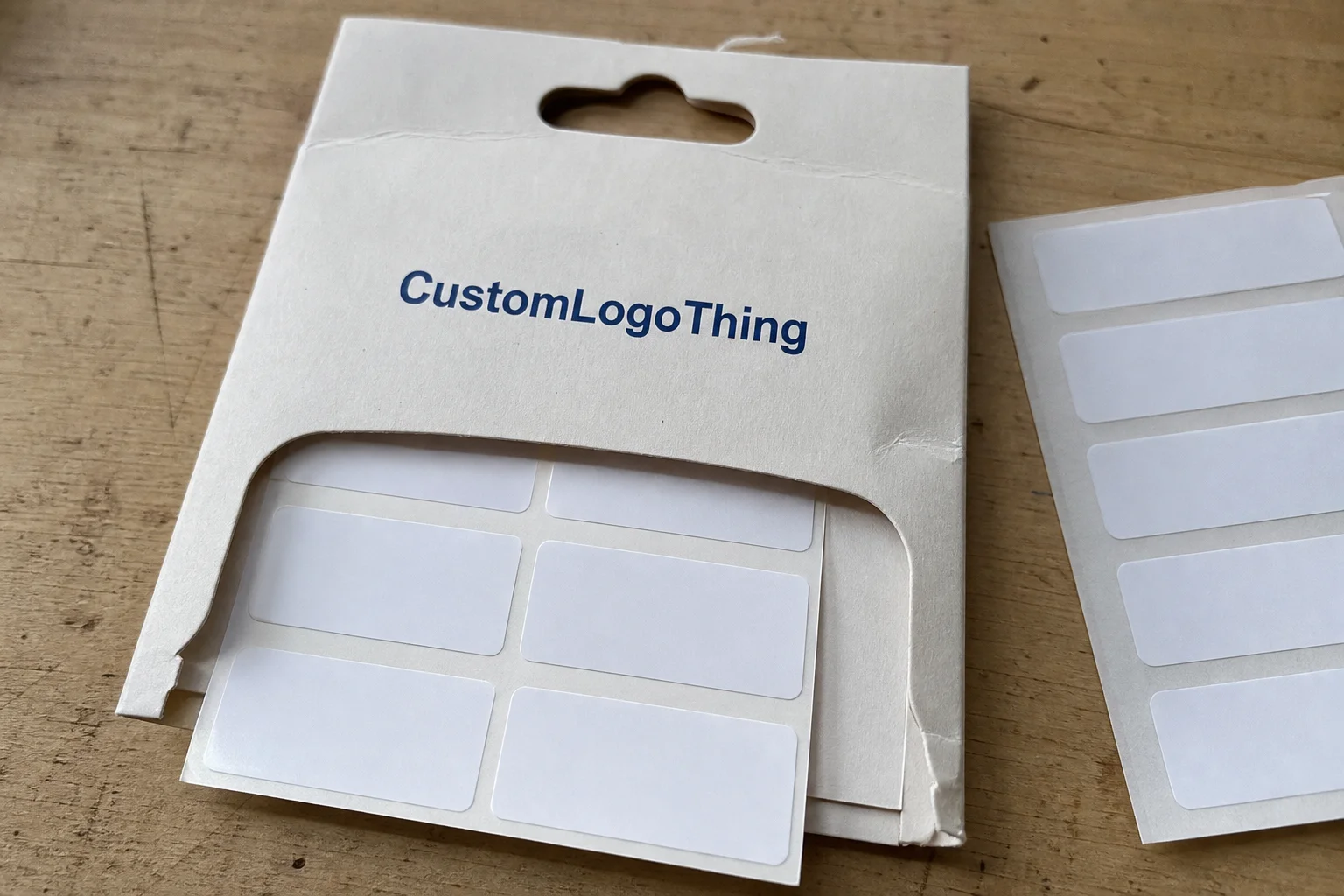
The basic workflow is simple. Labels are printed, finished, and either applied to the outer packaging or included inside the shipment as a return insert. Some brands want the customer to remove and reuse the label later. Others want the label to serve as a visible reference card with the return address and instructions. Both models work. The right one depends on how the brand handles returns and how much friction the customer will tolerate.
Typical personalization options include the brand name, return address, support contact, SKU, order number, barcode, QR code, and short instructions such as “Scan to start your return” or “Use within 30 days.” The challenge is hierarchy. Too many elements fight for attention. Too few leave the customer guessing. A good return label tells the customer what matters first and leaves the admin detail for the system behind it.
Different apparel businesses need different information density. A direct-to-consumer brand may want the label to route the buyer into a digital returns flow. A boutique label might only need the return address and customer service contact. Subscription apparel boxes often need a little more structure because the customer may be returning one item from a mixed shipment. Wholesale and promo programs care more about traceability and handling notes. Return labels personalized for those cases should fit the workflow instead of pretending every brand runs the same way.
There is also a split between cosmetic and functional labeling. Cosmetic labels support the brand image and explain the process. Functional labels connect to the actual systems behind the process, such as warehouse software, CRM records, or a returns portal. If variable data is involved, the artwork has to be built cleanly so the printed result remains legible, scannable, and tied to the right order. A label is only “branded” if it works in production.
For buyers, the useful question is not whether the label looks nice on screen. It is whether it reduces work once the box enters the real world. The better answer is both. That is where Custom Labels & Tags become useful, especially if the same layout needs to support several product lines without a redesign every month.
Cost, pricing, and MOQ factors for return label orders
Pricing usually comes down to five variables: size, stock, adhesive, print complexity, and quantity. A small paper label with simple one-color print costs less than a custom die-cut label with variable data and specialty finishing. That part is predictable. What catches buyers off guard is how much the end use changes the spec. A label that only needs to sit in a package is not the same thing as a label that has to survive handling, scuffing, or a damp transit route.
Material choice matters more than many teams expect. Paper works well for low-moisture, low-abuse applications. Polypropylene or other synthetic stocks are better when abrasion, moisture, or repeated handling are part of the picture. Adhesive matters just as much. A permanent adhesive that performs on smooth cartons may underperform on coated mailers, textured sleeves, or recycled paper surfaces with uneven fibers. If the label lifts before the return even starts, the cheap quote was never cheap.
| Label Type | Typical MOQ | Typical Unit Cost | Best Use |
|---|---|---|---|
| Paper return label, simple print | 1,000 to 5,000 | $0.05 to $0.10 | Low-cost branded returns with light handling |
| Poly or synthetic label, permanent adhesive | 2,500 to 10,000 | $0.08 to $0.16 | Mailers, cartons, and higher-abuse shipments |
| Custom die-cut label with variable data | 5,000+ | $0.12 to $0.24 | Serialized returns, QR workflows, and branded systems |
The table gives a rough benchmark, not a quote. Setup fees, proofing, finishing, data merging, and shipping can all move the total. If the order includes multiple versions or SKUs, the printer may need to manage version control, which can add cost. Buyers Should Ask whether the quoted price includes plates or setup, one proof or several, and whether variable data is part of the price or a separate line item.
MOQ affects the unit price more than most people expect. A larger run usually lowers cost per label because the setup gets spread across more pieces. A smaller test run costs more per piece, but it is useful when the brand wants to verify adhesion, scan performance, or print clarity before committing. That is especially sensible for return labels personalized to a niche clothing line with unusual packaging or a new return flow.
For serious procurement work, compare specs instead of just totals. Size, stock thickness, adhesive type, finish, and turnaround should all sit in the same quote. If sustainability claims matter, paper sourcing may need to point toward FSC-certified materials. If the label has to survive rough distribution, testing guidance from groups like ISTA can help teams judge whether a label is likely to hold up in transit.
Production steps and turnaround: from artwork to delivery
Most orders follow the same sequence: artwork review, proof approval, material selection, production, quality check, and shipment. That sounds routine because it is routine, but the job still goes sideways when the files are incomplete or the requirements are fuzzy. A clean production workflow is what keeps return labels personalized without making the order feel like a negotiation.
Turnaround depends on the format. Standard shapes move faster than custom die-cuts. Single-color work is faster than multi-layer printing, spot varnish, or exact color matching. If the job includes variable data, the production team has to merge and verify that data before full production starts. That extra step protects against misprints, but it also adds time. There is no free lunch here.
The usual delays are predictable. Missing dielines, low-resolution artwork, vague color targets, and last-minute copy changes all slow the job down. So does uncertainty about adhesive type or surface performance. A realistic schedule should include proof approval time, production time, transit time, and sampling time if the brand wants to test first. If the labels are needed before fulfillment peaks, order them before the calendar gets crowded.
For many apparel brands, a normal production cycle falls around 7 to 15 business days after proof approval, with shipping added on top. More complex orders can run longer, especially if they involve custom finishing or multiple versions. That range is useful only if the files are ready. If they are not, the schedule expands fast. There is no elegant way around that.
If the labels are part of a larger packaging refresh, coordinate them with other items in the same program through Custom Labels & Tags. Grouping the job specs helps the printer align materials, colors, and timing. Scattered orders create scattered deadlines.
Step-by-step guide to ordering return labels personalized
Start with the use case. Are the labels going on mailers, boxes, inserts, or return paperwork? Placement changes the material choice immediately. A label on a mailer needs better adhesion and more scuff resistance than one tucked inside a package as a reference. If the label will be handled after delivery, it should be built for that. If it only needs to survive a brief packing cycle, the spec can stay simpler.
Next, decide what actually belongs on the label. The best versions usually follow a simple order: brand identity first, return instructions second, and support or tracking information third. If a QR code is included, it should do real work. Sending customers to a dead page or a generic homepage is not clever. It is lazy. Return labels personalized around an actual workflow are easier for customers and easier for support teams.
Then choose material and finish based on handling conditions. Clothing packages get stacked, sorted, and rubbed against other parcels. They also see temperature changes, humidity, and sometimes condensation. Paper stock may be enough if the surface is smooth and dry. Synthetic stock is safer if the package will face more abuse. If the label needs to peel cleanly later, say that early. If it must stay on until the return is completed, say that too. Guessing is how bad spec sheets happen.
After that, build the artwork in a production-ready format. Leave proper bleed where needed, keep type sizes realistic, and use strong contrast. A label that looks fine on a monitor can become unreadable once it is printed at a small size on glossy or textured stock. If variable fields are involved, define them before production starts so the printer is not improvising the layout.
Finally, review the proof as if you were the customer and the warehouse at the same time. Check the return address, support email, spelling, order logic, and hierarchy. Confirm the label fits the package surface and that the QR or barcode scans at the printed size. Then order quantities that match the packing cycle, not just the cheapest line on the quote. That is the point where Custom Labels & Tags usually make sense: one system, one layout, fewer mismatched pieces.
Common mistakes that weaken return labels in apparel packaging
The most common mistake is overcrowding. Teams want the label to carry the brand, the return policy, the support line, the QR code, the order identifier, and still look clean. That is too much for a small format. Once the information starts fighting for space, the customer has to work harder than they should. Nobody wants to decode a postage stamp.
The second mistake is choosing the wrong adhesive. Packaging surfaces are inconsistent. A label that sticks well to a smooth carton may lift on a coated mailer or a textured insert sleeve. Cold storage, dust, or recycled paper can make adhesion worse. If the label fails in use, the cost is not just the reprint. It is the support time and the brand damage that comes with it.
Brand drift causes problems too. Outdated return addresses, old support emails, and policy language that no longer matches operations all make the label look careless. These errors are cheap to miss and expensive to fix, because they tend to show up only after the job is already printed. That is why proof review should be treated like a quality-control step, not a formality.
File issues are another common delay. Wrong dimensions, missing bleed, low-resolution art, and last-minute copy edits all stall production. The fix is not to push harder at the end. The fix is to lock the spec early and check it before the order enters the queue. That matters even more for return labels personalized with variable data, because one bad field can affect an entire run.
And then there is the operational mistake: designing a label that looks good but does nothing useful. If the customer still has to email support to figure out the return process, the label did not solve the problem. The design should reduce work, not create another step.
Expert tips for cleaner design and better performance
Use a clear visual hierarchy. The eye should land first on the brand or the return action, then on the supporting instructions. That usually means one dominant line, one supporting line, and any code or QR element placed where it does not compete with the headline. Whitespace is not wasted on small-format labels. It is what keeps the label readable after handling.
Keep the design aligned with the clothing brand, but do not let style wreck legibility. A label that looks premium but cannot be read under warehouse lighting has already failed. Contrast needs to be strong enough for quick scanning by both customers and fulfillment staff. If the parcel might sit on a porch, move through a dim sorting station, or get folded during packing, the label should still read cleanly.
Test the label on the exact packaging surface. That means the actual mailer, carton, or insert sleeve, not something that merely looks similar. Adhesion and readability change more than most teams expect depending on the finish and texture. For peel strength or adhesion comparisons, some buyers use methods like ASTM D3330 as a reference point. That does not replace real-world testing, but it gives the team a consistent baseline.
If the label includes a barcode or QR code, test it at the size you plan to print. A code that scans perfectly on screen can fail once it is shrunk, placed too close to a fold, or printed on a reflective stock. Keep it on a flat area, leave quiet space around it, and avoid crowding the code with decorative elements. That small layout choice prevents a lot of avoidable friction.
Build one master format that can flex by SKU or collection. That keeps the structure stable while letting you change the return address, routing note, or campaign message when needed. It is faster, cheaper, and easier to control than redesigning every version from scratch. More important, it keeps return labels personalized without turning them into one-off files that nobody wants to manage six months later.
Next steps before you place an order
Before requesting quotes, audit the return flow. Write down what the customer needs to see, what the warehouse needs to scan, and what should never appear on the label. That one exercise clears out a lot of bad assumptions. It also keeps the project tied to actual operations instead of a mockup that looks polished but solves nothing.
Collect three inputs before you talk to a supplier: target quantity, packaging surface, and the information that must appear on every version. Those three details narrow the price range quickly and help the printer recommend the right stock and adhesive. If you have multiple clothing lines, note whether the labels need to work across all of them or whether each line has its own return logic.
Ask for a proof that shows size, placement, adhesive notes, and text hierarchy. A useful proof should let you judge legibility without guesswork. If the proof does not show how the label sits on the package, ask for that before you approve anything. A few minutes here can prevent a full run from landing in the wrong format.
Compare lead time, unit cost, and material spec together. The cheapest quote is not useful if the labels arrive after fulfillment starts or if the adhesive fails on the packaging surface. If the goal is a cleaner return process, define the spec first, then order return labels personalized to the actual workflow. That is usually the shortest path to fewer questions, fewer reprints, and a return experience that does not make the brand look improvised.
What should be printed on return labels personalized for clothing orders?
At minimum, include the brand name, return address, and any customer-facing instruction that reduces confusion. Add barcodes, QR codes, or order identifiers only when they connect to a real workflow and can be scanned reliably at the printed size.
Are personalized return labels different from standard shipping labels?
Yes. They are built for the return experience, not outbound shipping, so the layout and information hierarchy are different. Some are purely branded, while others tie directly into a returns portal or support process.
What affects the price of return labels personalized most?
Material, adhesive, size, print method, finishing, and quantity are the main cost drivers. Variable data, special durability requirements, and low-MOQ orders can raise the unit cost.
How long does production usually take?
Turnaround depends on artwork readiness, proof approval, material choice, and whether the job includes variable data. Simple runs move faster than custom-cut or highly detailed orders, especially if revisions are needed.
What is the best way to test a new return label design?
Order a small production run and apply it to the exact packaging you use in fulfillment. Check adhesion, legibility, scan performance, and how the label holds up during handling and transit.