Personalized student id labels are not glamorous. They are a control system for small, forgetful humans and the adults who keep paying to replace missing hoodies, lunch boxes, water bottles, and PE bags. That is the point. If a label makes an item easy to identify, it earns its keep fast.
The catch is that a label only works if it survives real school use. Bags get dragged. Bottles get washed. Uniforms get folded, stretched, and tossed into laundry baskets without much respect for the printing process. A good label needs the right material, the right adhesive or attachment method, and a layout that stays readable after repeated handling.
That is why the details matter more than the artwork. A polished proof is nice. A label that still reads clearly after a term of use is better.
Why school labels fail when they are not personalized
Most label failures are not dramatic. They are ordinary and annoying, which is worse. The adhesive was wrong for the surface. The type was too small. The item was labeled in the wrong spot, so the label took the full hit from friction, heat, or moisture. Nothing mysterious there.
Personalized student id labels solve a practical problem: quick identification. A child’s name, class, room number, or icon gives staff and parents a fast way to match the item to the right owner. That matters for uniforms, shoes, folders, lunch kits, drink bottles, and after-school gear. Once the item is identifiable, lost-and-found stops being a black hole.
The real value is operational. Fewer replacements. Less handwriting that smears out. Less time spent sorting mystery items at the end of the day. If you are buying for a school, daycare, or a large family, the savings come from time as much as money.
There is also a behavior side to it. Children are more likely to recognize and keep track of an item if the label is clear and consistent. That sounds obvious. It still gets ignored.
If you need a starting point, the Custom Labels & Tags category covers the common formats without forcing every item into the same build.
The cheapest label is the one you do not have to replace. If it peels after one wash or fades before the term ends, it was not cheap.
How personalized student id labels work on clothing and gear
The product sounds simple. The structure is not. Personalized student id labels usually fall into four groups: iron-on labels for fabric, stick-on labels for smooth hard surfaces, sew-in tags for high-wear garments, and waterproof labels for bottles, lunch containers, and anything that lives near moisture. Each one is built for a different surface and a different kind of abuse.
Use the wrong format and the failure shows up quickly. A fabric label on a bottle has nothing to grip. A rigid sticker on a stretchy waistband lifts at the edges. A narrow tag on a curved bottle can wrinkle if the wrap is too short or the adhesive is too weak. The product choice should start with the object, not the design file.
Fabric labels are best for cotton, poly-cotton, and similar school wear. They are usually applied with heat or sewn in. Iron-on labels can work well on uniforms and tees, but the bond depends on clean fabric, correct pressure, and enough heat to activate the adhesive. Sew-in tags take more labor, yet they are hard to beat on jackets, sportswear, and items that get washed hard and often.
For hard goods, the label surface matters just as much as the material. Smooth plastic, coated metal, and glass are easy enough. Textured plastic, powder-coated bottles, and curved containers are less forgiving. A dishwasher-safe acrylic adhesive and a protective laminate usually hold up better than a basic sticker. If the item is handled with wet hands all the time, that extra durability is not a luxury. It is the difference between staying on and peeling off in a week.
Personalization is not only about names. A solid layout usually includes the student name, class or grade, and sometimes a room number or icon. Some families add a phone number, but that is a privacy decision, not a default. For younger children, large type and strong contrast matter more than decoration. Fancy fonts look cute in a proof and useless on a backpack strap at 7:45 in the morning.
- Iron-on labels for uniforms, tees, socks, and fabric bags.
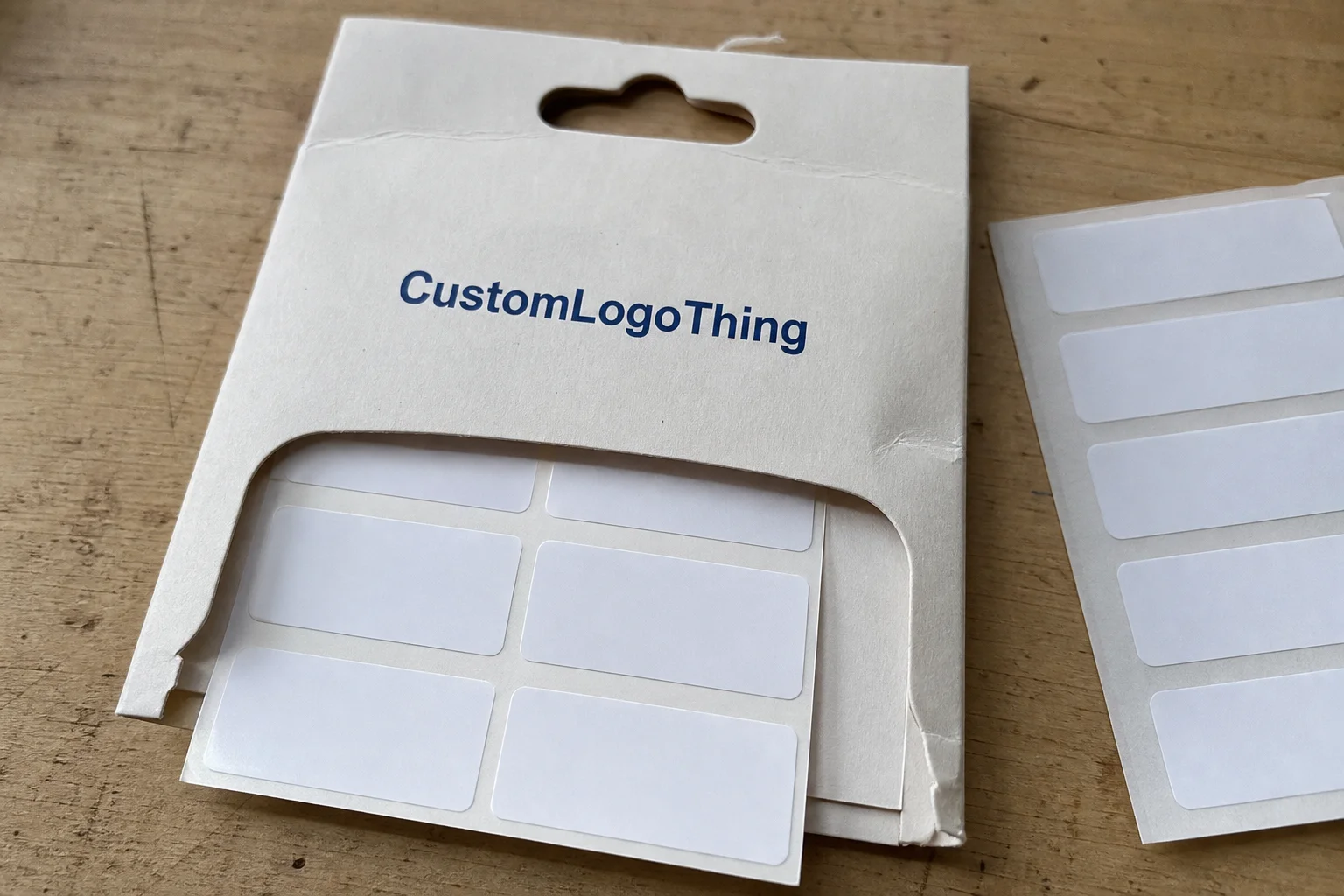
- Stick-on labels for bottles, lunch boxes, pencil cases, and folders.
- Sew-in tags for jackets, sports gear, and garments that take heavy wear.
- Waterproof labels for drinkware, meal containers, and daily-use items that see moisture.
There is no prize for making the order more complicated than it needs to be. One label type should usually cover one item category. Mixing formats is only useful when the items genuinely have different needs.
Production steps, proofing, and turnaround
A proper order moves through a predictable sequence: artwork setup, proof review, production, finishing, sorting, and packing. The proof stage is the one that saves money. It catches spelling errors, wrong grades, bad contrast, awkward line breaks, and privacy issues before they become a box of unusable stock. That is not exciting. It is just cheaper than reprinting.
Variable-data orders need more discipline. If every label carries a unique student name, one typo can create a sorting problem for the whole batch. Good file prep matters here. The cleanest setup is usually one master design and one separate roster file with names, grades, room numbers, and any special notes in a simple, consistent format.
Real quality control is not abstract. The shop should check spelling against the roster, verify the label size against the target item, confirm color contrast, and inspect cut accuracy before packing. For adhesive products, a decent process also includes a cure period before final packing, so the adhesive has time to settle properly. On hard goods, I would want a corner-lift check after application and a sample wash or soak test before full release. Cheap mistakes show up fast when those checks are skipped.
Timelines vary by format and workload. Simple single-name runs often land in the 5-8 business day range after proof approval. Multi-name school orders, custom shapes, or jobs with a lot of sorting usually move closer to 8-15 business days. Rush work can save time if the materials are in stock and the proof is clean. If the file needs rebuilding, rush means less than people hope.
Packaging can matter too. Some buyers want labels bundled with kits or shipped in bulk, and packaging tests may be requested for larger programs. If that is part of the spec, suppliers may use ISTA packaging test methods to check transport durability. For inserts, sleeves, or cartons, FSC-certified paper is a straightforward way to keep the paper side of the order clean.
The fastest orders are usually the boring ones. One size. One material. One data format. Once the box includes multiple label types, multiple item categories, or multiple proof revisions, the schedule stretches. That is normal.
Cost, pricing, and what changes your quote
Pricing is not random. It usually comes from five inputs: setup, material, print method, finishing, and shipping. If a quote looks cheap, check what was left out. Extra proof rounds, variable-data setup, special finishing, or packaging fees can appear later. A low headline price with a slow surprise invoice is not a bargain. It is a delayed problem.
For smaller family orders, personalized student id labels often cost more per piece than a larger school batch. That is normal. Setup costs do not spread as well across small runs. A 50-piece family order might sit around $0.45 to $0.90 per label depending on format. A 1,000-piece school run can often land around $0.18 to $0.40 per unit. Exact pricing shifts with material, coverage, whether every label is unique, and how much finishing is required.
MOQ matters too. Low minimums help parents and small classes, but they do not always produce the best unit price. If every child needs the same set, a slightly larger order often makes more sense than chasing the lowest sticker price. If the order is for a school or grade-level group, consistency can save more than a tiny per-piece discount ever will.
The main cost drivers are usually easy to identify once you ask the right questions. Full color is not always expensive, but variable names are. Soft-touch laminates and specialty finishes add cost. So does die-cutting a custom shape, especially if the outline is intricate and the order needs tight tolerance. Packaging can also move the number more than expected if each set has to be sorted individually.
| Label format | Best use | Typical unit price | Durability | Notes |
|---|---|---|---|---|
| Iron-on fabric label | Uniforms, tees, socks | $0.22-$0.45 | About 20-40 wash cycles | Good for fabric, not for bottles |
| Stick-on vinyl label | Lunch boxes, folders, bottles | $0.18-$0.38 | About 6-18 months | Best on smooth, clean surfaces |
| Sew-in woven tag | Jackets, sportswear, high-wear garments | $0.30-$0.70 | Often lasts the garment life | More labor, but very durable |
| Waterproof wrap label | Drinkware, meal prep containers | $0.25-$0.55 | About 12-24 months | Handles moisture better than standard stickers |
If you are comparing package options, the school label options become easier to price once you know the surface, quantity, and whether every label needs unique data. Those three details usually move the quote more than the artwork does.
Step-by-step ordering checklist for school buyers
Start with an item audit. List every garment and accessory that needs a label, then split them by surface type, wash frequency, and wear level. A backpack tag and a sock label do not face the same conditions, so treating them as identical usually ends badly.
Next, decide where each label will live before finalizing the artwork. Collar tags, waistband labels, inside seams, bottle decals, and bag tags need different dimensions. A proof can look clean on screen and still fail on a real item because the seam allowance is too narrow or the readable area is too small.
Gather the copy early. Exact student names. Grade or class. Room number if it is needed. Icons or color cues if they help younger kids. Contact details only if the school allows them and the parent wants them included. Clean copy shortens proofing time and reduces the back-and-forth that usually slows the order down.
- Audit the items that need labeling.
- Group them by material and wear level.
- Choose the label type for each group.
- Confirm the placement and label size.
- Collect names, classes, and any backup details.
- Approve one proof or sample on a real item before the full run.
That sample step is worth the time. Put the label on one item. Wash it once. Dry it once. Toss it in a backpack for a day. If it survives that, you have a useful baseline. If it fails, you just saved yourself from multiplying the mistake across the entire batch.
Schools and parents often overcomplicate the process. Usually the strongest setup is the plain one: one format, one size, one usage rule, one proof. Once the first batch behaves properly, scaling is easy. Guessing is what gets expensive.
Common mistakes that trigger peeling and confusion
The first mistake is tiny type. Labels can look neat in a mockup and turn unreadable once they are on a jacket, bottle, or lunch container. If the point is identification, the name has to be visible in real use. For younger children, larger text and stronger contrast beat decorative detail. Keep the main name readable from arm's length. Do not bury it under graphics.
The second mistake is mixing too many formats in one order without a clear reason. One material for fabric, another for hard goods, another for spare kits sounds flexible. It also creates more sorting work, more proofing complexity, and more room for mismatch during reorders. Mixed formats make sense only when the use cases are genuinely different.
The third mistake is choosing the wrong surface. A fabric-only label on a bottle will fail. A rigid sticker on a stretchy seam is nearly as bad. Surface chemistry matters. Cotton, nylon, coated metal, powder-coated bottles, and textured plastics all behave differently. If a supplier does not ask what surface the label is going on, that is a warning sign.
Another common issue is ignoring handling conditions. A label on a lunch box that gets washed daily needs a different build from a label on a spare sweater that sits in a cubby most of the week. Sun exposure, dishwashing, freezing, abrasion, and constant moisture all shorten life. That is not a defect. It is just reality.
Budgeting with zero spare labels is also a bad idea. Daily-use items disappear first. Water bottles, lunch gear, and sports clothing are the ones most likely to need replacements. If you order exactly the count you need and nothing more, the first replacement order will cost more than it should because you are buying under pressure. A 5-10 percent overage is usually enough to avoid that trap.
Expert tips and the next steps for a clean rollout
Rollout works better in phases. Start with the highest-loss items: lunch boxes, water bottles, sweaters, and sports gear. Those are the things that vanish most often and cause the most irritation when they do. Once one label format proves itself, move into lower-risk items like folders, spare clothes, or book bags.
Keep one master spreadsheet with exact spelling, class, grade, and reorder notes. That file becomes the reference point for the next batch. Small data drift causes more trouble than most people expect. One change in font size, spacing, or name format can turn a reorder into a new setup job. That is a dumb place to spend money.
Check the design against school rules before production. Some schools are fine with first name plus class. Others want fewer contact details on visible items. There is no universal answer. The right choice depends on age group, item type, and how public the item is likely to be. A lunch box in a classroom is not the same as a jacket worn on the way home.
Material finish should serve the use case, not the other way around. Matte finishes often read better under harsh light. Gloss can be fine on a bottle if glare is controlled. Soft-touch and specialty laminates can feel premium, but premium is not the point if the label has to survive a sink full of dishes. Readability and durability matter first. The rest is secondary.
If you want the cleanest first run, choose one label type, approve one sample, and test it on real school gear before ordering the full batch. That is the simplest way to make personalized student id labels pay for themselves without paying for mistakes twice.
The practical next step is straightforward: review the item list, match each surface to the right format, and keep the data clean. The best order is not the prettiest one on paper. It is the one that stays on the item and gets the gear back to the right child.
How long do personalized student id labels usually last on uniforms?
Iron-on and sew-in labels usually last longer on uniforms than peel-and-stick versions because they are built for fabric movement and repeated laundering. Dryer heat, harsh detergent, and heavy abrasion shorten life more than normal washing does. A quick sample test on one garment is the safest way to judge whether the finish matches the fabric.
Are personalized student ID labels safe for younger kids?
Yes, if the layout is low-profile, soft-edged, and placed where it will not rub the skin. Many buyers use a first name plus class or room number instead of full contact details for privacy. Avoid oversized labels near collars or seams that get constant friction.
What is a reasonable MOQ for personalized student id labels?
MOQ depends on the material, print method, and whether each label carries unique data. Small runs work well for families, while larger batches usually bring unit cost down fast. If a supplier offers a very low MOQ, check whether setup fees or higher per-unit pricing wipe out the benefit.
What should go on a student ID label besides the name?
Start with the student name and one backup identifier such as grade, class, or room number. Add a phone number only when the school or parent is comfortable with that level of contact detail. Icons or color coding help younger children identify their own items quickly.
Can I reorder personalized student id labels without remaking the artwork?
Yes, if the original file, size, font, and layout are saved cleanly. Reorders move faster when the supplier can match the previous proof instead of rebuilding the design. Keep a master record of names and specs so small changes do not turn into a new job.