Buyer Fit Snapshot
| Best fit | Order Transparent Recycled PET Sleeves projects where brand print, material claims, artwork control, MOQ, and repeat-order consistency need to be specified before quoting. |
|---|---|
| Quote inputs | Share finished size, material target, print colors, finish, packing count, annual reorder estimate, ship-to region, and any compliance wording. |
| Proofing check | Approve dieline scale, logo placement, barcode or warning zones, color tolerance, closure strength, and carton packing before bulk production. |
| Main risk | Vague material claims, crowded artwork, missing packing details, or unclear freight terms can make a low unit price expensive after revisions. |
Fast answer: Order Transparent Recycled PET Sleeves: Specs and Delivery should be specified like a repeatable production item. The safest quote records material, print method, finish, artwork proof, packing count, and reorder notes in one written spec.
Production checks before approval
Compare the actual filled-product size with the drawing, then confirm tolerance on folds, seals, hang holes, label areas, and retail display edges. Reserve space for logos, QR codes, warning copy, and material claims before decorative graphics fill the panel.
Quote comparison points
Review material grade, print process, finish, sampling route, tooling charges, carton quantity, and freight assumptions side by side. A quote is only useful when the supplier can repeat the same color, closure quality, and packing count on the next order.
Most brands do not lose money on transparent recycled pet sleeves because the resin is expensive; they lose money on execution gaps. We have seen small specification misses freeze a line for 36 hours while every stakeholder says they thought the brief was clear. Short-run overruns, delayed approvals, and quality holds create a cost wave that starts at the sleeve conversion table and ends in the launch calendar. That is why many packaging buyers now order transparent recycled pet sleeves as an operations decision, not a trendline check. Teams usually do it to reduce launch risk, because the package has to show product clearly, prove recycled content, and behave on line from carton to retail.
From a buyer perspective, transparency solves two jobs at the same time: it lets customers see what they are buying, and it keeps sustainability messaging visible enough for internal audits. Recycled PET helps with ESG reporting, especially when the existing base pack cannot be redesigned without blowing schedules. The real question is no longer whether transparent recycled pet sleeves should be considered, but how to order transparent recycled pet sleeves with the right material spec, MOQ, and timeline that can survive real production reality. For clear sleeve packaging, the strongest briefs are the ones where visual clarity, recycled-content targets, and machine fit are defined before quote requests even begin.
Industry guidelines from the EPA and ISTA are clear enough on one point: material choice and transit behavior need to be assessed together. A sleeve can look perfect in pre-production art and still fail in distribution if filling, sealing, carton geometry, and rough handling were not tested as one chain. Procurement teams that order transparent recycled pet sleeves with end-to-end thinking usually protect margin where it disappears first: logistics, rework, and delayed release decisions.
People ask for this format when marketing promises and operations constraints collide. I have seen teams ask for glossy alternatives only to come back after first fill and say the package does not read at shelf distance, which defeats the reason for a sleeve in the first place. A well-drafted transparent sleeve program rarely saves money because the film is cheap; it saves money because it reduces firefighting.
Why should you order transparent recycled pet sleeves?
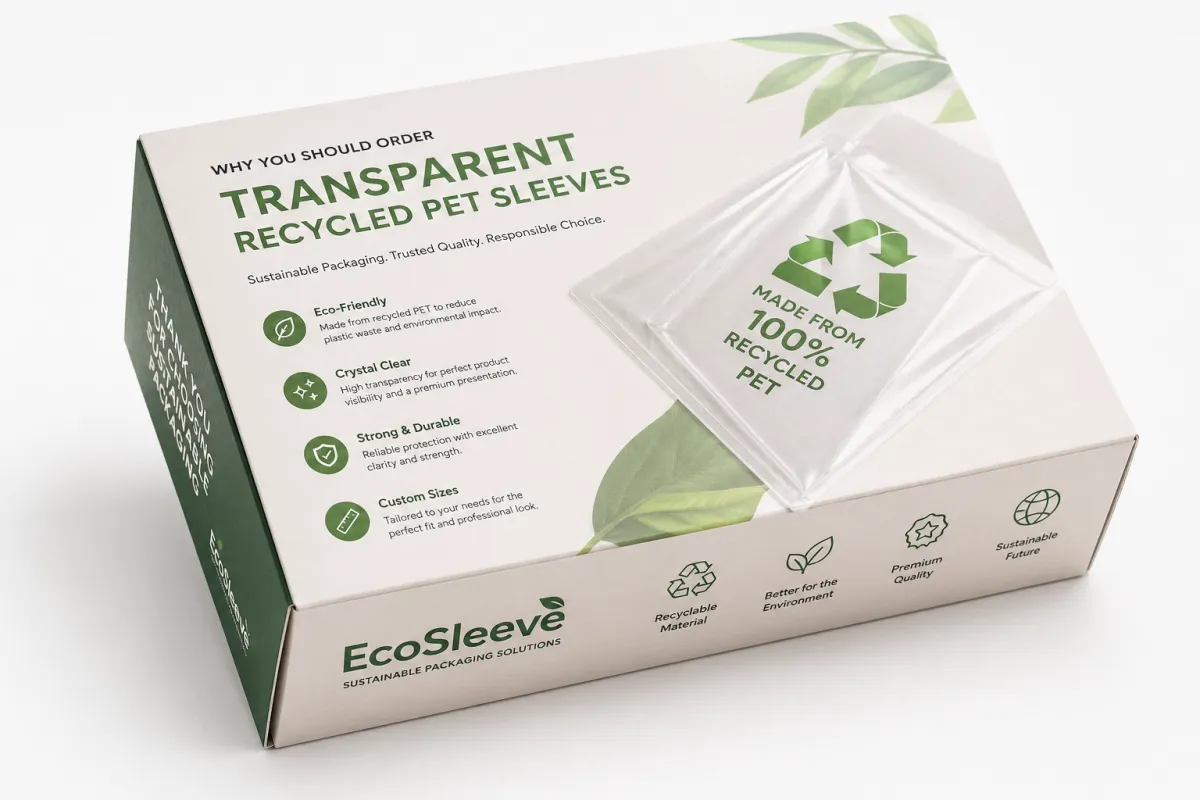
Transparent sleeves remove visual friction. Shoppers can confirm fill depth, color, and container orientation at a glance, which changes pre-purchase confidence in categories where look is part of trust. For liquids, supplements, and formula products, that immediate read matters more than a lot of teams expect from focus groups. A sleeve in this context is not décor; it is a trust conduit.
The other reason is practical: recycling commitments are moving from marketing language to procurement metric. Recycled content gets questioned by purchasing, sustainability, and quality teams, not just creative leads. A verified transparent recycled PET sleeve allows you to improve that declaration without forcing a full package redesign. In side-by-side reviews against opaque sleeves, paper-based wraps, and foil labels, teams often prefer transparent recycled PET because it keeps high visual transfer while preserving compliance visibility.
The costly part is almost never the clear material itself. We have seen a sleeve two cents cheaper on paper become the most expensive line item in a quarter when machine drift, manual rejects, or reprint cycles stacked up. Bad art version control, loose tolerances, and missing acceptance gates are usually the real margin killers. If you order transparent recycled pet sleeves on a vague brief, the first "savings" appears in someone else’s overtime sheet.
Conversion behavior is where the format proves its value. Transparent recycled PET sleeves generally run consistently on vertical and rotary systems when gauge and fit are set to machine envelope. In operations terms, I usually track three anchors: visual clarity, machine compatibility, and verified recycled-content documentation. Miss one anchor and the sleeve stops helping launch execution; hit all three and the team gets both shelf clarity and production confidence.
"A transparent sleeve does not need to look dramatic. It needs to run without drama, reveal the product clearly, and arrive with documentation everyone on the floor can use."
Launch windows expose weak briefs fast. A delayed sleeve shipment can block finished goods for more than one week, and carrying stock through a seasonal push can cost far more than any film delta. In practice, ordering transparent recycled pet sleeves is a supply chain decision first, and a marketing decision second. The winning formula remains shelf visibility, traceability, and fewer process handoffs that can derail timing.
If your team wants a full commercial structure, our Wholesale Programs page explains how volume bands usually shape pricing and setup expectations across order types. In projects where claims language, approvals, and format questions come up repeatedly, the FAQ is still a useful first pass before requesting formal quotation.
Bottom line: when a product benefits from clear visibility, credible sustainability claims, and stable production, the smart move is to order transparent recycled pet sleeves with stricter technical parameters, not weaker unit pricing targets.
Product Details: Materials and Performance of Transparent Recycled PET Sleeves
Most transparent recycled PET sleeves are based on post-consumer or post-industrial recycled feedstock blended into PET to meet specific clarity and compliance requirements. The exact blend ratio is never one-size-fits-all: it changes by region, film thickness, and performance target. Higher recycled content can strengthen sustainability messaging, but it can also increase haze variation and stiffness if process windows are not fixed early and monitored closely.
Many teams eventually agree on a performance window where light transmission is high enough to communicate product while maintaining dimensional consistency on line. The tradeoff is usually around haze, puncture behavior, and heat-seal response under actual machine settings. We treat haze, thickness tolerance, and cold-flow behavior as baseline data, because these variables shift fill consistency, capping reliability, and position stability across storage, transport, and retail handling. Teams that order transparent recycled pet sleeves with these values absent often revert to side-by-side visual judgment, which does not predict production risk.
Construction choices are more than material taxonomy. You can run mono-layer transparent PET, co-extruded structures, or engineered versions that include anti-static or UV control layers. Anti-static versions can be worth it for powder-heavy cosmetics, shampoos, or medical-adjacent products where dust attraction hurts presentation and acceptance. UV-capable films can help with light-sensitive formulas and some retailer-lit environments. Whenever those features are selected, they should sit as explicit budget lines, not informal assumptions.
Acceptance standards vary by category, even when the underlying geometry is the same. For nutraceutical bottles, visibility and scannability are often the gatekeepers. In pharma, migration language, documentation, and tighter material traceability usually dominate. In beauty, shelf behavior and scuff resistance can outperform absolute barrier in practical decision making. The same film family may still fail if your category rules are not mapped before order.
Handling is where hidden failures appear. Puncture resistance, seal integrity, and compression behavior in mixed-temperature routes are not theoretical: they drive shelf incidents, chargebacks, and line complaints. If shipping includes vibration, vibration plus stacked cartons, or mixed ambient/dry zones, test against that profile rather than a lab bench sample at room temperature. ISTA methods are useful not as a badge, but because they turn gut reaction into measurable acceptance gates.
Most teams focus on clarity first and regret it when a rejection report lands on Monday. The same project then shifts from "looks nice" to "why is this failing?" We recommend a different order of operations for teams that order transparent recycled pet sleeves: light transmission, haze, gauge variation, shrink response, and high-speed line-fit as a single baseline package. That is how you separate attractive samples from sleeves that actually pass production and transport.
Decision-making against other label options should begin with use-case mapping, not material hype. Transparent sleeves are strongest when product appearance is already a differentiator, container geometry is stable, and line tolerance allows strict dimensional consistency. If those conditions are missing, alternatives may be better; there is no shame in selecting another format early. That is where a lot of teams either save a quarter or lose one.
Specifications for Ordering Transparent Recycled Pet Sleeves
Good specs reduce interpretation, and interpretation is where most timeline damage starts. A supplier cannot optimize what is not defined in numbers. Leave width, length, thickness, and tolerance fields blank and you push uncertainty into samples, not negotiations. If you order transparent recycled pet sleeves with sparse information, hidden costs usually surface later as delays and rework, not resin invoices.
A practical baseline sheet should include sleeve width, cut length, thickness, inner/outer tolerances, clear window geometry, tear notch location, perforation and slitting details, and tolerance ranges for each element. In production planning, include artwork versioning, seal orientation, shoulder profile adjustments, and non-standard container geometry details from the start. That depth becomes critical for bottles with narrow necks, heavy bases, or irregular shape transitions.
Print readiness is often treated as decoration and then ignored until late. Recycled substrates can shift ink interaction, so print method needs early alignment with expected run volume and visual complexity. Digital has clear value in shorter runs and variable data, while flexo can be more cost-effective at higher ink coverage and volume. Registration, barcode contrast, and opacity limits on clear windows are quality gates that must be explicit before proof approval.
Quality criteria that sound technical are exactly what keep teams from arguing in production. Pinholes can look minor under good lighting and still become expensive if they show up across multiple pallets. Light transmission matters if product color is a sales driver, especially on transparent packaging. Puncture resistance is decisive near ribs or shoulder transitions. Shrink and heat-seal behavior matter when thermal finishing is in the route. None of these should stay verbal; each belongs in the order spec.
- Dimensional controls: sleeve width, length, thickness, cut tolerance, and tear notch placement.
- Print controls: color count, barcode contrast target, proof version, and registration tolerance.
- Quality controls: haze limits, light transmission targets, pinhole allowance, and puncture resistance.
- Packaging controls: carton count, pallet footprint, compression tolerance, and boxing method.
Acceptance testing should be defined before production, not after the first reject trend appears. A workable matrix includes visual checks under standard and retail lighting, fit confirmation on reference containers, and shelf-legibility tests at expected fill heights. Teams that order transparent recycled pet sleeves with this language get fewer post-PO debates because the success criteria are already aligned.
Logistics is part of the technical order, never a footnote. High-density pallet loading can reduce freight, but it can crush sleeves if compression tolerance is weak. Confirm carton dimensions, pallet pattern, and whether reinforcement packaging is required before the quote is finalized. That step avoids claims disputes later, when receiving teams call and report deformation rather than non-compliance.
Regulatory and semi-regulatory categories need documentation aligned to the same order structure as film and print. Recycled content statements, migration-related declarations, and chain-of-custody records should be requested when the order is placed, not after approval. A technical brief without these documents may look complete but is operationally incomplete for quality audits. Keep in mind claims language evolves by market and should be validated against your exact destination requirements.
One internal rule works across teams: if the supplier still needs follow-up on foundational points, the spec is not finished. Better to close that gap before scaling. When teams order transparent recycled pet sleeves, the most valuable improvement is often fewer clarifications, not more features.
Pricing and MOQ for Transparent Recycled Pet Sleeves
Pricing for transparent recycled sleeves is a system, not a single price tag. Recycled ratio, geometry, printing process, finishing, and setup intensity all move the needle in different directions. A line-item structure usually reveals real cost reality faster than a blended total quote. That structure also helps compare transparent sleeve packaging against alternate decorated formats with less guesswork.
Sample and early production bands commonly fall between $0.18-$0.35 per sleeve, depending on gauge, artwork density, and setup requirements. Commercial runs often improve to $0.10-$0.22 when volume and process stability increase, while tiny first pieces can still be materially higher because line tuning dominates early output. These are planning references, not universal fixed rates. Resin supply, region, printing complexity, and inspection scope shift all numbers in practice.
MOQ models usually follow staged thresholds: a pilot around 1,000-3,000, a small-to-standard ramp around 5,000-10,000, and commercial scale above that range. What matters is not just the floor at each tier, but the risk you trade off with each step. A controlled pilot can prevent a full launch correction, which is where one unnoticed alignment issue can multiply costs across tens of thousands of sleeves.
Teams that lead with per-unit cost alone often underestimate true landed economics. A pilot may look expensive, but it can prevent a line-stop event and multiple revision loops in the first production campaign. The better decision metric is often the value of risk reduction gained per batch. Freight assumptions, revision cycles, and approval lead times need to be included in the model before anyone declares the best price.
| Order Type | Typical MOQ | Indicative Unit Price | Best For | Risk Profile |
|---|---|---|---|---|
| Sample / bench approval | 50-500 pieces | $0.35-$0.90 | Artwork checks, fit confirmation, shelf mockups | Lowest volume, highest per-unit cost |
| Pilot production | 1,000-3,000 pieces | $0.18-$0.35 | Line testing, retailer review, first commercial trial | Moderate cost, strong learning value |
| Standard production | 5,000-20,000 pieces | $0.10-$0.22 | Repeat orders, established SKUs, stable artwork | Best economics when the spec is locked |
| High-volume program | 25,000+ pieces | Quoted case by case | National launches, recurring promotions, multi-site fulfillment | Lowest per-unit cost, highest planning discipline needed |
Freight, customs, inspection, and revision cycles can outweigh base material differences. Oversize cartons or destination handling requirements often shift total spend without warning. Late changes to proofs or language can quietly erase early savings. A quote that ignores these realities looks tidy on paper but rarely stays tidy in execution.
Risk drops most predictably when core variables are finalized early: recycled-content target, material grade, width and thickness, and color count. Optional finishes can then be priced as configurable adds, which keeps comparisons stable and prevents silent scope expansion. In our experience, that is where teams get the clearest view of true margin.
Use landed cost as the decision threshold. Add sampling, freight, inspection, revision burden, and launch-time loss before approving any supplier selection. A quote that appears highest can still be strongest after a full chain-cost review. This matters especially when transparent recycled pet sleeves support commitments that must pass both procurement and sustainability scrutiny.
Pricing note: regional recycled resin volatility and compliance requirements can change quarter by quarter, so a budget range agreed this quarter may not hold for all markets next quarter. That is a real production reality, not a negotiation trick.
Process and Timeline to Order Transparent Recycled PET Sleeves
Most teams move through six stages: intake, sample development, pilot, final release, production, and dispatch. Missing a gate in any stage creates timeline drag and responsibility overlap. Shared ownership across commercial, art, procurement, and production teams keeps decision rights clear. Teams that order transparent recycled pet sleeves with one visible checklist usually run cleaner and faster.
A typical timeline starts with 1-2 business days for intake and feasibility, 3-5 for proof iteration and first samples, then 5-8 for pilot once artwork is approved, and 10-15 for standard production after final spec lock. That is a common baseline, not a guarantee. Shipping and customs still add variance by route, mode, and destination checkpoint density. Fast-track windows can compress sequencing, but usually increase setup risk and tighten correction options.
Delay patterns repeat so predictably they feel scripted. Late dieline updates, incomplete recycling claims, barcode placement that changes after sign-off, and packaging notes arriving post-release are all common, and they usually correlate with incomplete brief input. A complete package normally contains approved art, container dimensions, machine speed, fill weight, carton plan, and delivery lane details. If you order transparent recycled pet sleeves without this base, the timeline starts behind from day one.
Fast-track is not just fewer days; it is fewer checkpoints. Standard programs leave room for controlled retests and adjustments. Fast-track works only when artwork, claims, and machine settings are already stable. If you are still changing those inputs, you are choosing cheaper short-term urgency at the expense of longer-term correction cost.
- Submit a complete brief: dimensions, fill weight, machine type, carton count, and target date.
- Lock proofing decisions: treat proof sign-off as a decision gate, not a courtesy step.
- Set testing requirements: confirm fit, visual quality, and transport checks before the first full release.
- Issue PO with revision matrix: define what can still move and what is frozen.
- Run stage checks weekly: keep decisions documented in one shared thread and reviewed at each gate.
The biggest difference between chaotic and controlled programs is communication quality. When updates move from verbal to written and every gate has an owner, surprise changes drop. A hidden-fix trap is still the main cause of rushed corrective action. Teams that order transparent recycled pet sleeves with this discipline avoid discovering late adjustments after dispatch decisions are already made.
Secondary packaging needs to be part of the same schedule, especially when cartons, shippers, and retail trays are integrated. A sleeve that is perfect at conversion can still miss launch if the carton dependency is unresolved. Mapping these links early avoids chain delays that nobody wants to explain to sales teams.
Quick test: ask the supplier to identify the next gating event and their decision owner at every update. If that answer is fuzzy, the job is not fully under control yet. Pause, tighten the brief, and then order transparent recycled pet sleeves with a cleaner release plan instead of hoping for fewer surprises.
Why Choose Us for Order Transparent Recycled Pet Sleeves
We approach each order as an execution problem, not a quote-and-pray exercise. Buyers who order transparent recycled pet sleeves through a structured workflow typically get fewer surprise changes and more predictable production outcomes. That matters when the package must support clear sleeve packaging, traceability, and a launch timeline at the same time.
Our process aligns commercial terms and manufacturing execution from the first file upload. Every request gets revision logs, proof history, and fixed approval milestones before release. You will be able to see which artwork version is active, and who approved it, without chasing emails. The operational effect is significant: fewer loops and less rework, especially where teams are running repeated launch cycles.
Technical support is usually underpriced by competitors and overvalued in practice. Clarifying clarity drop-off, seal behavior, migration expectations, and machine compatibility early prevents expensive production corrections. If sleeve behavior depends on fill temperature or line speed, that is data that belongs before first run, not after rejects are already counted.
Traceability is a core differentiator because audited claims are no longer optional in commercial procurement. Brands increasingly need current recycled-content declarations, batch metadata, and inspection evidence to satisfy both corporate sustainability committees and buyer due diligence. A partner that returns complete documentation in the right production window removes a big internal friction point and makes internal approvals less of a bottleneck.
"Our objective is plain: make approval easier, make production stable, and make documentation complete. Anything less adds avoidable cost before launch and after shipment."
Commercial comparisons get messy when every format starts with different assumptions. Some alternatives cut shelf visibility, some create line strain, and some raise decoration costs without changing shelf performance. Transparent recycled PET sleeves become the cleaner option when product aesthetics are already a strength and the team wants clarity without redesigning the pack architecture. If you order transparent recycled pet sleeves with that context, decision quality usually improves.
If you need broader context before quote, the Wholesale Programs page outlines how order size affects process and pricing behavior. The FAQ page still helps teams answer recurring questions quickly before formal commercial requests.
High-performing buyer teams ask the awkward questions: haze thresholds, reject-rate limits, inspection method, deviation response time, and claim validation support. Those questions matter most where visibility promises and operational stability are both mandatory. Over time, they make next-order planning more predictable instead of improvisational.
Reality check: no supplier can compensate for weak internal art governance or unresolved line constraints. We can build structure, but your team still needs clear ownership to keep the chain moving.
Next Steps: Finalize and Place Your Order for Transparent Recycled PET Sleeves
Move in this order: lock essentials first, then lock milestones. Finalize dimensions, recycled-content target, finish type, and machine settings before requesting a quote for transparent recycled pet sleeves. A complete brief improves quote quality and timeline integrity because the supplier no longer guesses your operating context.
Step 1: upload sleeve dimensions, fill weights, container drawing, and line speed targets. This helps confirm run behavior, waste risk, and packaging waste assumptions before tooling starts. Step 2: choose your sample model: pilot only, pre-production only, or both. Each choice changes testing scope, timeline, and approval overhead.
Step 3: define acceptance thresholds before PO release. Include clarity range, seam and seal strength, barcode readability, and reject limits in the scope language. Step 4: set shipping terms, destination handling standards, and cartonization requirements before commercial confirmation so freight assumptions are not discovered during invoice review.
Step 5: convert approved scope into a signed order with MOQ, milestone gates, and inspection criteria. Once that is in place, production can align to a finish line instead of adapting to ambiguous, moving inputs. In our teams, this is the point where the project stops feeling like a negotiation and starts feeling like execution.
Some of the strongest projects are not flashy; they are just exact. They avoid late creative churn, unclear recycled-content language, and shipping assumptions decided in a rush. A controlled order for transparent recycled pet sleeves combines measurable specs, realistic timing, and documentation discipline, so packaging is less likely to become the weak link.
Keep the FAQ and wholesale references as a pre-quote filter, then request formal quote once material and process variables are locked. Final quality is usually determined by preparation quality, not vendor luck. Teams that order transparent recycled pet sleeves with that discipline end up with cleaner approvals and fewer surprises between proof and distribution.
Conclusion: the most reliable way to order transparent recycled pet sleeves is to treat them as a production-ready component: specify dimensions, fit, recycled-content proof, quality gates, and schedule realities before press. When those boxes are checked, the sleeve becomes a predictable launch asset instead of a recurring source of revision drama.
Actionable takeaway: if you are under a deadline and your SKU already relies on visual trust at shelf, write the full order matrix first, then place the PO only after those criteria are signed off; skip that step and even a strong sleeve format will act like a weak launch.
FAQ
How can I order transparent recycled pet sleeves for a food-contact or beverage product?
Start with a product-safety package that covers intended food-contact type, intended market, processing temperature, and migration-test status. Ask for the technical specification sheet before artwork work begins, then compare it against your filling and sealing method. For food and beverage, request written compliance support for your target geography and confirm whether pre-printed sleeves and solvent-free sealing routes are suitable for your equipment. If you do not have finalized machine settings, request a validation note tied to your actual line profile before placing the purchase order.
What is a realistic MOQ when I first order transparent recycled pet sleeves?
Most suppliers split volume into sample, pilot, and production bands, and each band has a different cost profile. Ask for pricing at each stage so the unit-cost step-down is explicit. Lower MOQ reduces launch friction for testing, but can increase setup cost per piece. The practical decision is to compare landed cost, including freight and approval cycles, not only quoted unit rate. Approving artwork and dieline before pilot is usually the safer path when you order transparent recycled pet sleeves.
Can I print variable data on transparent recycled pet sleeves at scale?
Yes, variable data printing is possible at scale, but performance depends on ink chemistry, printing resolution, and contrast on recycled clear substrates. Request a press-check report tied to a similar production run and require a pre-production mock-up before final release. Validate fine text, traceability marks, and security codes under expected shelf lighting and fill conditions. That avoids hidden legibility failures that usually appear only after mass production starts.
How long does it take to order transparent recycled pet sleeves and launch a first shipment?
Build by milestones: file intake, sample confirmation, pilot validation, and final release. Missed checkpoints usually add calendar days, especially when artwork or claim language is still changing. Standard programs often move in about 10-15 business days after approval, while pilot timelines vary with setup complexity and freight routing. If you have a fixed launch date, lock shipping mode early and keep destination routing visible; that one decision shifts dispatch timing more than most teams expect.
What questions should I ask before choosing a supplier for transparent recycled pet sleeves?
Ask for written acceptance criteria, sampling plan, and dispute thresholds before purchase order issuance. Ask for recycled-content disclosure and supporting test documents from the same production window, not historical records from unrelated lots. Ask whether the supplier can run trials on your exact line speed and machine parameters. That single check usually exposes fit and performance risk early, which is exactly when it is still cheap to correct.

