Buyer Fit Snapshot
| Best fit | Order White Poly Mailers Bulk projects where brand print, material claims, artwork control, MOQ, and repeat-order consistency need to be specified before quoting. |
|---|---|
| Quote inputs | Share finished size, material target, print colors, finish, packing count, annual reorder estimate, ship-to region, and any compliance wording. |
| Proofing check | Approve dieline scale, logo placement, barcode or warning zones, color tolerance, closure strength, and carton packing before bulk production. |
| Main risk | Vague material claims, crowded artwork, missing packing details, or unclear freight terms can make a low unit price expensive after revisions. |
Fast answer: Order White Poly Mailers Bulk: Pricing, Specs & Timelines should be specified like a repeatable production item. The safest quote records material, print method, finish, artwork proof, packing count, and reorder notes in one written spec.
Production checks before approval
Compare the actual filled-product size with the drawing, then confirm tolerance on folds, seals, hang holes, label areas, and retail display edges. Reserve space for logos, QR codes, warning copy, and material claims before decorative graphics fill the panel.
Quote comparison points
Review material grade, print process, finish, sampling route, tooling charges, carton quantity, and freight assumptions side by side. A quote is only useful when the supplier can repeat the same color, closure quality, and packing count on the next order.
Why Order White Poly Mailers Bulk for Everyday Shipping
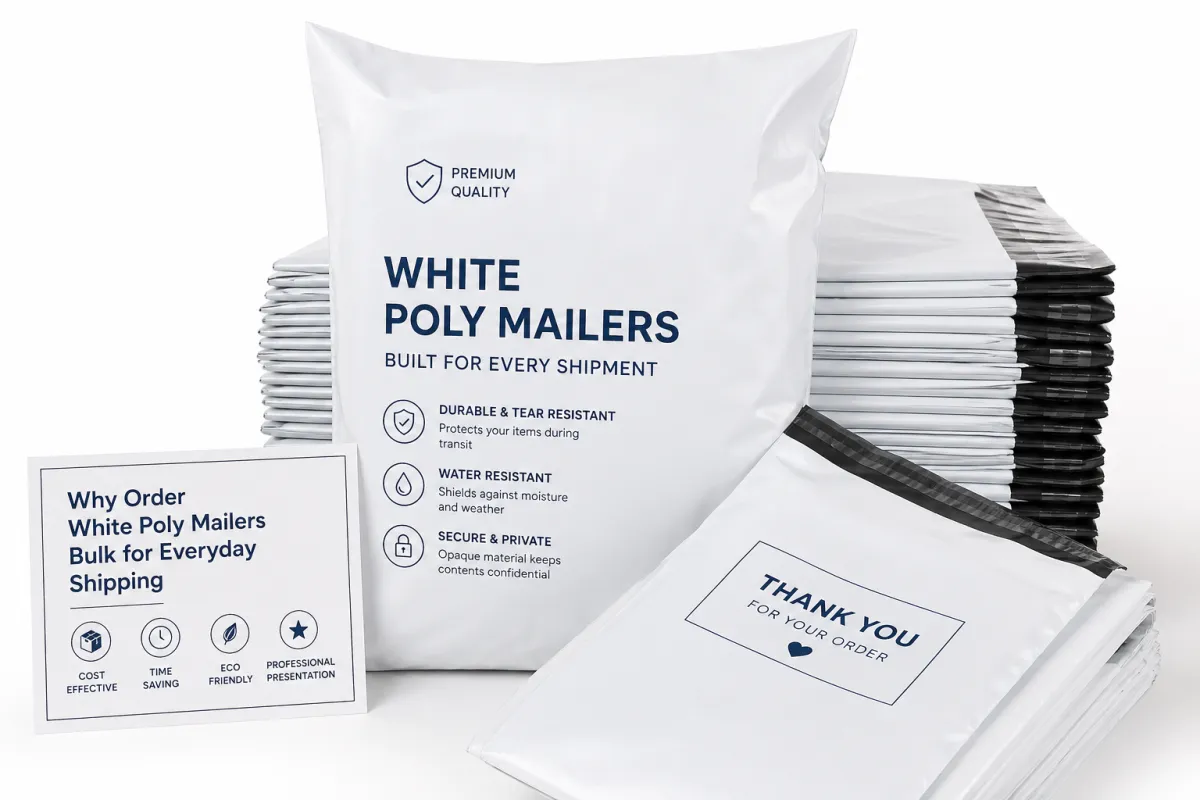
If you order white Poly Mailers Bulk, you are usually solving a very specific shipping problem: keep packaging light, clean, and quick to handle without letting costs creep into every outbound order. For apparel, accessories, and other soft goods, the mailer often ends up being the smartest outer layer because it adds almost no weight, takes up less room than cartons, and moves through a packing station faster than a box ever will. That sounds simple, but in ecommerce, simple saves money.
Postal costs react to small changes. A package that drops just a few ounces can change the postage class. A mailer that closes in one motion saves labor compared with a carton that needs folding, taping, and a second look. White also gives the shipment a consistent look, which matters more than many teams expect. The package that lands on a porch is part of the brand story, whether the marketing team planned for that or not. I have seen apparel brands shave seconds off each order just by switching from taped cartons to peel-and-seal mailers, and those seconds add up fast. That is one reason so many teams order white Poly Mailers Bulk instead of treating mailers as a last-minute buy.
The use cases are pretty straightforward. Folded garments, light accessories, print inserts, promotional kits, and ecommerce orders without crush risk all fit the format well. Rigid products, sharp edges, and fragile items call for something else. For lightweight shipments, though, order White Poly Mailers bulk often means fewer packing steps and less variation from one order to the next. These shipping envelopes also help teams standardize the packing bench instead of improvising for every SKU. That consistency is boring in the best way.
Bulk purchasing also cuts down on inconsistency. Packaging people rarely talk about that part with much enthusiasm, yet it matters. When the film gauge stays stable, the seal strip behaves the same, and the white tone does not drift from lot to lot, the warehouse works with fewer surprises. A buyer who chooses to order white poly mailers bulk is buying repeatability as much as packaging. That is the quiet part of the value proposition, and it is usually the part that makes the purchase worthwhile.
A simple framework usually drives the decision:
- Size controls how easily the product loads and whether the seal closes cleanly.
- Film thickness affects tear resistance and how the mailer handles transit stress.
- Seal strength matters for returns, long routes, and temperature swings.
- Opacity and color tone influence privacy and presentation.
- Print requirements determine whether you stay with stock white or move into branded versions.
- Order volume affects unit cost, freight, and the supplier's minimum run.
If you are comparing packaging options more broadly, browsing Custom Packaging Products can help place poly mailers beside cartons, inserts, and other formats. The smartest buy is rarely the prettiest one. It is the one that keeps orders moving, keeps costs controlled, and does not create extra work for the packing line. That is the part teams remember six months later.
White Poly Mailers Bulk: Product Details That Matter
A white poly mailer is usually made from polyethylene film with a smooth outer finish, a bright white face, and a peel-and-seal closure that speeds fulfillment. The build sounds simple. The details underneath are not. If you order white poly mailers bulk, film spec, seam quality, adhesive performance, and how the mailer behaves once loaded all deserve attention.
Film thickness is the first number most buyers should ask for. Lighter gauges work well for soft, low-risk contents. Heavier gauges help with denser products or routes that are harder on packaging. A 2.5 mil mailer and a 3 mil mailer may look nearly identical on a sample table, yet the heavier version usually feels sturdier in hand and resists accidental tearing better. That difference matters when you order white poly mailers bulk for recurring ecommerce volume.
Tear resistance and water resistance sound similar, but they solve different problems. Poly mailers shed light moisture well, which explains why warehouses like them for soft goods, though they are not rigid waterproof containers. The film and seals still need to match the transit path. Rough handling, stacking pressure, and long routes all push the material harder than a desk sample ever will. A mailer that looks fine on a catalog page can behave very differently after a few hundred miles in a carrier network.
Seam quality is another place where small mistakes create real cost. A weak side seal can split if the package is overstuffed or if the contents create a sharp internal edge. Good production should give you clean cuts, even lay, and consistent seams. When you order white poly mailers bulk, that consistency saves the packing station from becoming a quality-control bottleneck. Nobody wants the packer to become the last line of defense against a bad seal.
Size selection works the same way. A mailer should fit folded product dimensions without leaving so much empty space that the contents slide around. Too small and the packer fights the seal. Too large and you waste film, then often pay for extra postal space you did not need. For apparel, the better habit is to size the mailer against the folded garment plus any insert or tissue, not against the item on a hanger. That small shift in thinking saves a surprising amount of labor if you order white poly mailers bulk for ongoing weekly shipments.
Branding choices need a clear eye too. Some buyers stay with stock white mailers because speed matters more than print. Others want a one-color logo or a return address in a fixed location on the face or flap. Custom print can strengthen the customer experience, but only if it does not slow shipping. A branded mailer still has to load fast, seal cleanly, and keep labels readable after handling. If you want a branded path, compare stock and printed options in our Custom Poly Mailers category before you settle on a final spec.
Label adhesion deserves a test as well. Smooth white film usually accepts shipping labels without trouble, though the surface finish and print treatment can change how well a label holds under humidity or abrasion. That is one reason many warehouses test a sample before they order white poly mailers bulk. A mailer that looks perfect in a photo can behave differently once a label printer starts running at full speed.
The cheapest mailer is not the one with the lowest unit price on a quote sheet. It is the one that loads quickly, seals reliably, and arrives without forcing a repack or a claim.
Specifications for White Poly Mailers Bulk Orders
Before you request a quote, pull the spec details into one place. Complete information makes supplier comparisons far cleaner and prevents the usual back-and-forth over details that should have been settled at the start. If you want to order white poly mailers bulk, these are the specs that usually shape the final recommendation:
- Dimensions - finished width and length, usually quoted in inches or millimeters.
- Film thickness - often shown as mil or micron depending on supplier language.
- Color tone - bright white, soft white, or a slightly natural white finish.
- Seal type - peel-and-seal is standard, though some formats use additional tamper evidence.
- Print area - location, size, and number of colors if the mailer is branded.
- Carton pack count - important for warehouse storage and reorder planning.
- MOQ - minimum order quantity for stock or custom runs.
Thickness changes performance in a direct way. Lighter mailers are easier to handle and usually cost less, though they suit products that create little internal stress. Heavier mailers cost more per unit and often reduce damage risk while giving the finished shipment a better hand feel. If you order white poly mailers bulk for a subscription box program, retail apparel line, or high-turnover fulfillment operation, that extra strength can pay for itself in fewer headaches and fewer damaged pieces.
Opacity matters as well, especially for privacy. A good white poly mailer should hide the contents without looking chalky or oversized. That matters for branded apparel, consumer goods, and anything that should not be visible through the outer pack. Buyers often care about this more than they expect. Once the parcel enters the carrier stream, the outer layer becomes part of the brand impression, so if you order white poly mailers bulk, the finish should look deliberate rather than flimsy.
Dimensional tolerance is not just an engineering concern. If a mailer is meant to fit a folded garment of a certain width, even a small shift in finished size can slow loading, especially at stations that run on habit and muscle memory. The same problem shows up with print placement: if the panel shifts, the warehouse may need to adjust its labeling process. That is why a buyer should ask for a spec sheet, sample, or preproduction approval before they order white poly mailers bulk in a larger run.
Testing questions help too. Some buyers want to know whether the mailer has been checked for transit durability, seal integrity, or print stability under standard procedures. For broader shipping validation, many teams reference ISTA methods and packaging testing guidance from industry groups such as ISTA test standards. That does not mean every mailer needs a full lab report. It does mean a supplier should be able to explain how the product was qualified before you order white poly mailers bulk. Trust on packaging should be earned with details, not guesses.
If your operation also uses cartons, inserts, or merchandising materials, a packaging partner should help you compare the entire system instead of treating the mailer as an isolated purchase. For broader category planning, packaging industry resources can help when you need better language for specs, performance, and procurement. Clearer shipment definitions usually make it easier to order white poly mailers bulk with confidence, and that confidence is worth something.
Pricing and MOQ When You Order White Poly Mailers Bulk
Bulk pricing is not mysterious, though it is easy to misread if you only compare one unit price on a quote sheet. The real question is how price shifts with size, thickness, print, quantity, and freight. If you order white poly mailers bulk, the supplier will usually quote lower unit costs at higher quantities, but every option does not scale the same way. A heavier film, a wider format, or a custom printed face can change the economics quickly.
Minimum order quantity, or MOQ, is the next detail buyers need to weigh. Stock white mailers may be available at smaller quantities, while custom printed runs often require more cartons to justify the setup. That is normal. A buyer testing a new program might start with a smaller run to confirm fit and seal performance, then scale once the warehouse has proof the spec works. If you order white poly mailers bulk for the first time, that staged approach can save money and prevent a costly misfire.
The biggest cost drivers are easy to track:
- Resin and film thickness - more material usually means higher cost.
- Mailer size - larger formats use more film and often higher freight.
- Print coverage - one-color logos are simpler than full-panel branding.
- Setup charges - especially relevant for custom artwork or special runs.
- Carton pack and freight terms - shipping can matter as much as the unit price.
Planning in ranges can help. Stock white poly mailers may land around $0.08 to $0.18 per unit at meaningful quantities, depending on size and thickness. Custom printed versions often move into the $0.18 to $0.35 range or higher, especially if the run is smaller, the print is more complex, or the freight lane is expensive. Those numbers are working ranges, not promises, but they are useful when you order white poly mailers bulk and need to compare proposals without getting fooled by a single line item. If a quote looks too clean, I get a little suspicious, honestly.
It also pays to look at packaging cost per shipped order, not just the sticker price of the mailer. A slightly pricier mailer can reduce labor if loading is easier. It can also reduce damage claims or repacking. Those savings are often invisible unless someone measures them. That is one reason experienced procurement teams order white poly mailers bulk using the full fulfillment picture rather than chasing the lowest quoted price per carton.
Ask for a quote that includes these items so you can compare suppliers cleanly:
- Unit price at each quantity break.
- Carton count and pack configuration.
- Freight estimate to your receiving location.
- Lead time from proof approval or order confirmation.
- Setup or plate charges if printing is involved.
- Sample availability before production.
For teams that buy repeatedly, a simple spec sheet is worth keeping on file. It keeps quotes consistent and reorders cleaner. If you order white poly mailers bulk from the same approved setup, you also lower the odds that one purchasing cycle drifts away from the last one. That kind of drift is small, then annoying, then expensive.
| Option | Typical Use | Thickness | Approx. MOQ | Typical Unit Price at 5,000 Units | Notes |
|---|---|---|---|---|---|
| Stock white poly mailers | General ecommerce, apparel, inserts | 2.5 mil to 3 mil | 500 to 1,000 pieces | $0.08-$0.14 | Fastest to source; best for standard shipments |
| Heavy-duty stock white poly mailers | Denser soft goods, longer routes | 3 mil to 4 mil | 500 to 1,000 pieces | $0.12-$0.20 | Better tear resistance and stiffer hand feel |
| Custom printed white poly mailers | Branded ecommerce, retail shipments | 2.5 mil to 4 mil | 2,500 to 10,000 pieces | $0.18-$0.35 | Artwork setup and color count affect cost |
| Special spec or larger format mailers | Oversized soft goods, multi-item bundles | 3 mil to 4 mil | Varies by supplier | $0.16-$0.30 | Pricing moves with dimensions and freight |
That table is not a substitute for a formal quote, but it does show how much the spec shapes the price. Two mailers that look similar in a product photo can cost very differently once thickness, size, and print are included. If you plan to order white poly mailers bulk, the cleanest move is to compare options against one shared spec sheet so the numbers stay honest.
How Do You Order White Poly Mailers Bulk?
The ordering process is usually more predictable than buyers expect, provided the details are ready. If you order white poly mailers bulk, the path usually starts with confirming size, quantity, thickness, print needs, and delivery timing. Once those points are set, the supplier can narrow down stock or custom options and prepare a clean quote.
For a stock purchase, the process is fairly direct: confirm the spec, approve the price, and release the order. For a custom run, the process expands to artwork review, proof approval, and sometimes a sample or preproduction check. Those extra steps are not busywork. They keep a logo from printing too small, too low, or in the wrong color zone. If you order white poly mailers bulk with branding, proofing deserves real attention because a tiny placement error is hard to unsee once the cartons show up.
A normal production timeline depends on three things: whether the mailer is stock or custom, how quickly artwork is approved, and whether the supplier needs special packing or split cartons. Stock items often move faster than custom items, while printed runs usually need more lead time because setup and press scheduling take longer. Buyers often hear a figure like 12 to 15 business days from proof approval for a custom order, though the exact timeframe depends on quantity and finish. If you order white poly mailers bulk for a seasonal launch, that timing needs to be on the calendar early.
Production time and shipping time are different things. A quote may say the order is ready in a certain number of business days, yet freight transit still has to be added on top. That distinction matters if your warehouse is expecting inbound inventory before a promotion or a product release. A team that wants to order white poly mailers bulk without delays should account for both the production schedule and the delivery window.
Here is the usual sequence:
- Confirm the mailer size and thickness.
- Decide whether the order is stock or custom printed.
- Review artwork, logo placement, and color requirements if print is involved.
- Approve a proof or sample when needed.
- Release the order and confirm shipping address details.
- Receive, inspect, and stage the cartons before the pack line needs them.
Keeping the spec stable from order to order is one of the best ways to protect the schedule. Reorders move faster when the dimensions, print file, and carton configuration stay the same. That stability also lowers the risk of a dimensional mismatch or a print adjustment. If you order white poly mailers bulk as a recurring program, a single approved version on file can cut a lot of back-and-forth.
For buyers who want a broader look at sourcing and repeat purchase programs, our Wholesale Programs page is a useful place to start. A good wholesale relationship is about fewer surprises, not more paperwork. That matters even more when you order white poly mailers bulk for daily shipping and need a supplier that can stay aligned with the warehouse schedule.
Why Choose Custom Logo Things for Bulk White Poly Mailers
Custom Logo Things fits buyers who want packaging advice that stays close to the packing floor. The value is not in overselling the product. It is in helping you choose a mailer that loads well, seals cleanly, and matches the way your team actually ships. If you order white poly mailers bulk, that kind of support matters because the wrong spec can slow the line, create returns, or waste money on a package that is too light or too large.
A packaging supplier should be able to discuss film gauge in plain language, explain why one size fits folded apparel better than another, and help you decide whether a plain stock mailer or a custom printed version is the smarter purchase. That kind of guidance saves buyers from overbuying a package that looks fine in a catalog but fails in the warehouse. If your team wants to order white poly mailers bulk with fewer mistakes, clear spec conversations beat vague promises every time.
Quality control is another place where a good supplier earns trust. The mailers should arrive with consistent sealing, even color, and carton packing that is easy to stage and count. If the product is custom printed, the logo should land where the proof showed it would land, and the print should hold its shape cleanly against the white surface. Buyers who order white poly mailers bulk repeatedly tend to value this kind of predictability more than anything else, because it keeps the procurement side calm and the shipping side moving. Nobody has time to babysit a packaging issue every quarter.
Communication matters too. Procurement teams do not want to guess what is happening with a run, and warehouse managers do not want to learn too late that a delivery slipped. A supplier should be responsive on quote details, artwork questions, carton counts, and delivery timing. That is basic business discipline. If you order white poly mailers bulk, you need direct answers, not fog.
Good packaging teams think in terms of fit, transit behavior, and material use. That includes shipping validation methods, print clarity, and whether the mailer supports the process without extra waste. Teams that want to improve sourcing discipline often compare package performance against recognized transit testing language and material guidance before placing a large reorder. The best programs do not guess. They compare, test, and then buy once the spec makes sense.
When the use case is straightforward, the buying decision should be straightforward too. A practical mailer, a clear spec, a fair price, and a dependable schedule are usually enough. That is the sort of buying experience most teams want when they order white poly mailers bulk. If the mailer does its job every day, nobody has to think about it again, which is exactly how good packaging should work.
Next Steps After You Order White Poly Mailers Bulk
Once you are ready to order white poly mailers bulk, confirm the order details in writing so everyone stays aligned. Include the size, gauge, quantity, artwork status, delivery deadline, carton count, and whether you are buying stock or Custom Printed Mailers. Skipping those checks raises the odds of a mismatch fast, and that kind of mistake is annoying in a way only warehouse teams understand.
A useful checklist looks like this:
- Confirm the folded product size the mailer must hold.
- Choose the film thickness based on product weight and shipping route.
- Verify the minimum order quantity and any quantity breaks.
- Approve artwork placement if the mailers will carry a logo or return address.
- Request a sample or spec sheet before full production if the item is new.
- Check the freight timeline against the date the warehouse actually needs inventory.
Sample review is especially useful for new programs. A small test run can reveal whether the seal closes the way you expected, whether the mailer fits the product with enough room for inserts, and whether the label placement works at speed. Those details are hard to judge from a screen. Buyers who order white poly mailers bulk without a sample sometimes find out too late that the package is too tight or too roomy for daily use.
Inventory planning matters just as much. The warehouse should have enough lead time to receive, inspect, and stage the cartons before the packaging line needs them. That is especially true if the program depends on a launch date or a seasonal sales window. A strong procurement plan makes it easier to order white poly mailers bulk at the right moment instead of rushing into expedited freight that eats away the savings.
If you are comparing a few supplier options, compare them against the same spec sheet and the same delivery expectation. Then look at unit price, freight, lead time, and the confidence you have in the supplier's communication. That method is plain, but it works. It helps you order white poly mailers bulk on business terms instead of guesswork, and it keeps everyone focused on the same finish line.
For related packaging support, you can also review our FAQ page if you want quick answers on sourcing, quantities, and product selection. The goal is a clean purchase order, a verified spec, and cartons that arrive ready for the packing line. If you can get those three things right, you are usually in good shape when you order white poly mailers bulk.
The practical takeaway is simple: confirm the folded product size, choose the lightest gauge that still survives your route, lock the print or stock spec before the order goes out, and keep the same approved version on file for reorders. That is how you get the most value when you order white poly mailers bulk, and it is how you keep shipping steady without building extra work into the process.
FAQ
How many white poly mailers should I order in bulk for a new shipping program?
Start with a quantity that covers your average weekly volume plus a buffer for promotions, damaged units, and sudden spikes. If the size or print is new, a smaller trial run can help confirm fit and seal performance before you scale up. For recurring programs, it usually makes sense to match the order size to warehouse storage space and reorder cadence so you are not sitting on too much inventory. That part gets overlooked all the time, and then the stock room becomes the problem.
What size should I choose when I order white poly mailers bulk?
Match the mailer to the folded product dimensions rather than the item's retail size. Leave enough room for tissue, inserts, or a return slip if those are part of the shipment, but avoid oversized mailers that waste material and create slack. If you ship multiple SKU types, one or two standard sizes often work better than a long list of niche options. Fewer sizes usually mean fewer packing errors.
Are bulk white poly mailers waterproof or tear resistant?
Poly mailers are water resistant and can help protect shipments from light moisture, but they are not the same thing as a rigid waterproof container. Tear resistance depends on film thickness, seam quality, and how much stress the package sees in transit. Heavier gauges generally perform better for dense or sharper-edged contents, though no mailer is magic if the contents are badly packed.
How does pricing change when I order white poly mailers bulk?
Unit price usually drops as quantity increases, but total cost still depends on size, film thickness, print coverage, and freight. Custom printing can add setup or run costs, while stock mailers are often simpler to price and ship. The best comparison is cost per shipped order, not just price per mailer. That metric is less flashy, but it is a lot more honest.
What should I prepare before placing a bulk order for white poly mailers?
Have your target size, quantity, preferred thickness, and delivery timeline ready before requesting quotes. If you want printing, prepare logo files and confirm placement, color, and any brand approval requirements. Ask for samples or a spec sheet so you can confirm fit and performance before production starts. A little preparation here saves a ton of cleanup later.

