Buyer Fit Snapshot
| Best fit | packaging branding for ecommerce for packaging buyers comparing material specs, print proof, MOQ, unit cost, freight, and repeat-order risk where brand print, material, artwork control, and repeat-order consistency matter. |
|---|---|
| Quote inputs | Share finished size, material target, print colors, finish, packing count, annual reorder estimate, and delivery region. |
| Proofing check | Approve dieline scale, logo placement, barcode or warning zones, color tolerance, and any recyclable or compostable wording before bulk production. |
| Main risk | Vague material claims, crowded artwork, or missing packing details can create delays even when the unit price looks attractive. |
Fast answer: Packaging Branding for Ecommerce: Build a Memorable Brand should be specified like a repeatable production item. The safest quote includes material, print method, finish, artwork proof, carton packing, and reorder notes in one written spec.
What to confirm before approving the packaging proof
Check the product dimensions against the actual filled item, not only the sales mockup. Ask for tolerance on folds, seals, hang holes, label areas, and retail display edges. If the package carries a logo, QR code, warning copy, or legal claim, reserve that space before decorative graphics fill the panel.
How to compare quotes without losing quality
Compare board or film grade, print process, finish, sampling route, tooling charges, carton quantity, and freight assumptions side by side. A lower quote is only useful if the supplier can repeat the same color, closure quality, and packing count on the next order.
Packaging Branding for Ecommerce: Build a Memorable Brand
If two identical products land on your desk, one wrapped in a plain mailer and the other packed in a branded box with tissue, a clean insert, and a deliberate opening sequence, the difference is obvious before the product is even touched. That difference is packaging branding for ecommerce in practical terms. It is not ornament. It is the physical proof of the promise a brand made online, and it starts speaking before the customer sees the item itself.
Many stores still treat packaging as a shipping problem with a logo attached. That view is costly. Packaging branding for ecommerce shapes perceived quality, trust, giftability, and memory. A $28 product can feel considered and premium. A $120 product can feel rushed if it arrives in a flimsy sleeve that looks like it was chosen in a hurry. People notice the difference quickly, then remember it longer than most brands expect.
The job is bigger than printing a logo on a carton. Good packaging branding for ecommerce works as a connected system: outer shipper, inner protection, print, inserts, messaging, and the sequence of the unboxing itself. If the outside looks polished but the inside feels random, the customer still reads the package as inconsistent. And inconsistency is expensive. It quietly weakens trust, one shipment at a time.
That first physical touchpoint carries more weight than it should, and yet it does. Online brands spend heavily to earn attention, convert traffic, and build credibility on a screen. Then a box appears on a doorstep and becomes the first object the customer can actually hold. Packaging branding for ecommerce closes that gap. It confirms the story, or it punctures it. There is not much room between those two outcomes.
What Packaging Branding for Ecommerce Really Means
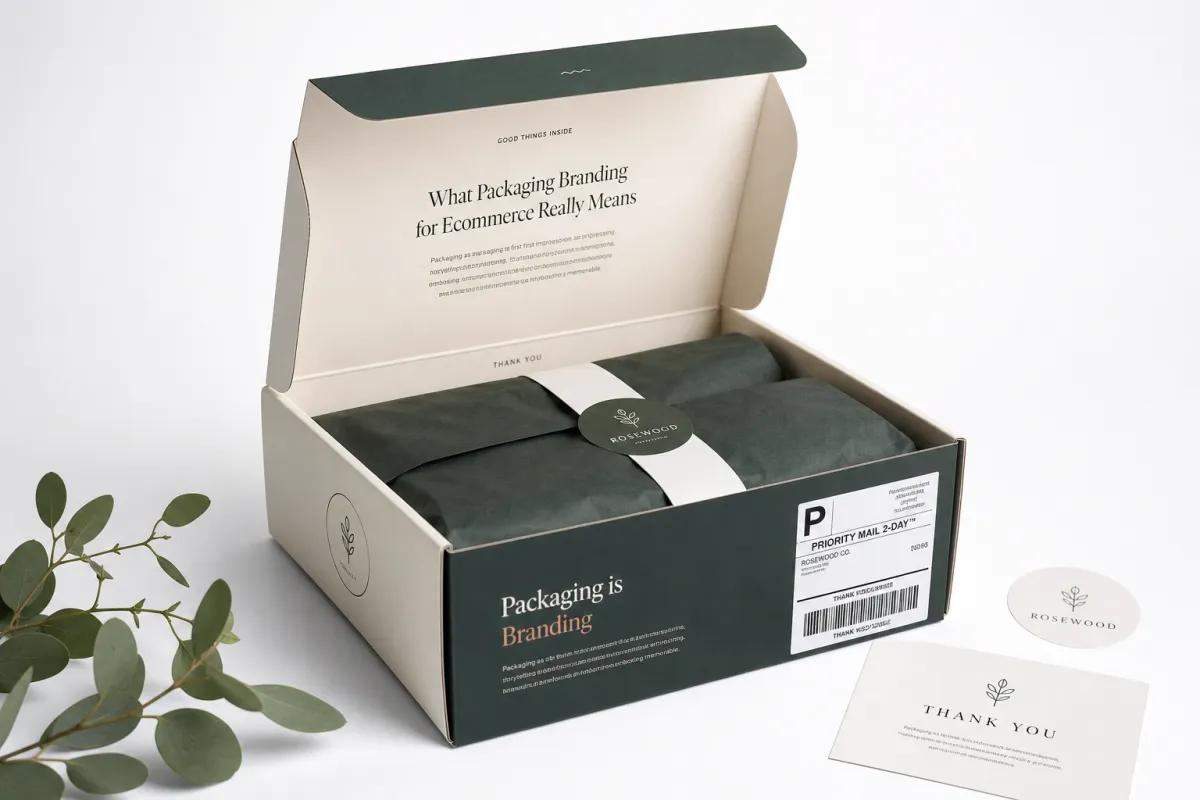
Packaging branding for ecommerce refers to the whole package experience, not a logo placement or a color choice on its own. It includes the outer mailer or shipper, the box or pouch, tape, tissue, inserts, labels, thank-you cards, and the order in which the customer encounters each layer. The strongest version feels deliberate from the first look to the final piece of material left on the table.
One detail gets overlooked all the time: packaging is not only visual. It changes how customers judge the product inside. A clean printed carton with the right finish suggests care, precision, and control. A generic mailer suggests the opposite. That is why packaging branding for ecommerce affects perceived quality, not just brand identity. It is design with consequences.
There is a practical side as well. Branded packaging can support gifting, social sharing, and repeat purchasing, but only if the structure protects the product and the fulfillment process still runs efficiently. Nobody needs a beautiful box that takes twice as long to pack or arrives crushed on a rainy Tuesday. In packaging branding for ecommerce, pretty only matters if the package survives the trip and the warehouse can still move orders on schedule.
The common mistake is to treat branding like a sticker on a box. Customers can tell when that is the whole strategy. Real packaging branding for ecommerce is a system built around brand identity, product protection, and shipping reality. One part can be simple. The system itself cannot be careless.
Think of the package as the first in-person sales interaction. The customer already saw the ad, browsed the product page, and clicked buy. Now the box has to prove the purchase was a good decision. That is why packaging branding for ecommerce matters so much. It turns online trust into something physical, and physical trust tends to stick.
From a buyer’s perspective, the real decision is straightforward: do you want packaging that merely contains the item, or packaging that actively strengthens the brand? The first option often looks cheaper. Later, the hidden costs show up in damage claims, rushed replacements, and a first impression that disappears as soon as the tape is pulled. Very efficient. Not actually.
How Packaging Branding for Ecommerce Works Across the Customer Journey
Packaging branding for ecommerce begins before the carton is sealed. It starts on the product page, where the customer forms expectations about value, care, and quality. If the site presents a premium product but the parcel arrives in a generic mailer with loose filler, the promise cracks. The reverse happens too: a modest product can feel more premium when the package arrives calm, organized, and consistent.
The journey contains several distinct touchpoints. Exterior packaging sets the first impression at delivery. Inner protection answers the “is this safe?” question. The opening sequence shapes the “is this worth showing?” reaction. Inserts and messaging affect the “will I remember this brand?” result. Packaging branding for ecommerce works best when those moments are planned as one sequence rather than assembled like spare parts from different projects.
Here is a simple way to think about it:
- Acquisition: branded packaging reinforces the promise made by ads, product photography, and copy.
- Retention: the package feels recognizable, so the next order feels familiar instead of improvised.
- Referral: people photograph what feels thoughtful, especially when one reveal lands cleanly.
Functional packaging and branded packaging do not need to compete. The better packaging branding for ecommerce resolves both at once. A corrugated mailer can be printed. A folding carton can protect a product. Tissue can feel refined and still keep an item from rattling around in transit. The smarter approach is to make function and brand identity reinforce each other instead of drawing from separate budgets like they have nothing to do with one another.
Mismatch is where the whole thing starts to wobble. A premium serum in a cheap pouch feels wrong. A rugged tool in a delicate presentation box looks theatrical in a bad way. A luxury candle in a mailer that dents on the way to the door no longer feels luxurious. In practice, packaging branding for ecommerce has to match the product, the price point, and the shipping method. If those three drift apart, customers spot the disconnect immediately.
One more detail matters: the package often lasts longer than the website visit. A customer forgets a homepage in minutes. They may keep a box, an insert, a sleeve, or a tag on a desk or shelf for days. That is part of why packaging branding for ecommerce has so much staying power. The physical object remains in view long after the checkout screen is closed.
For a practical reference point, Case Studies on packaging and fulfillment usually reveal the same pattern: small changes in structure and print can alter how customers describe the brand later. That is not magic. It is packaging doing exactly what it is supposed to do, with enough discipline to make the result visible.
Key Factors That Shape Packaging Branding for Ecommerce
The visual layer is the part most people notice first, but it is only one part of packaging branding for ecommerce. Color palette, typography, logo placement, pattern systems, and spacing all matter. White space matters too. A restrained design often feels more expensive than a box crowded with graphics, especially when the rest of the brand identity is already strong. Too much print turns the package into noise, and noise rarely reads as premium.
Structure matters just as much. Mailer boxes, folding cartons, rigid boxes, sleeves, and poly mailers each solve different problems. A lightweight skincare item may do best in a folding carton inside a shipper. A subscription kit might need a mailer box with inserts. A high-volume apparel order may fit better in a Custom Poly Mailer with strong graphics. Good packaging branding for ecommerce starts with the product, then chooses the structure that fits the actual shipping path.
Materials and finishes are where budgets become real. Kraft stock gives a natural, direct feel. Coated stock produces sharper graphics and richer color. Matte lamination creates a quiet, modern look. Gloss makes color pop, yet it also reveals scuffs more easily. Soft-touch feels premium, though it costs more and can show handling marks if the route is rough. Foil and spot UV can add impact, but they need a reason to exist. Use embellishment where it earns its keep, not because the sample looked impressive under showroom lights.
Practical shipping concerns are easy to ignore because they are boring. They are also expensive when ignored. Dimensional weight, crush resistance, product fragility, warehouse speed, and the cost of returns all influence packaging branding for ecommerce. If the package looks beautiful but slows the packing line or gets damaged by carriers, the brand pays for disappointment in installments. I have seen brands spend weeks perfecting a sleeve only to discover it added six seconds per order; on a busy fulfillment floor, that is not a detail, it is a line item.
Sustainability claims need discipline too. Recycled content, FSC-certified paper, and recyclable structures can strengthen the brand story, but only if the claim is accurate and easy to understand. For shipping durability standards, ISTA publishes test protocols used across the industry. For responsible fiber sourcing, FSC explains chain-of-custody certification and labeling. Those are useful guardrails, not decorative language.
Brand consistency is the last major factor. Different SKUs, different sizes, and seasonal campaigns still need to feel like one family. That does not mean every box must look identical. It means the system should share a common thread: the same logo logic, the same voice, the same color discipline, or the same insert style. Without that, packaging branding for ecommerce begins to feel like a pile of unrelated print runs from a brand that discovered design software yesterday.
Useful structure options usually come down to four things:
- Mailer boxes: strong for presentation, decent protection, and a clear opening sequence.
- Folding cartons: efficient for smaller products, especially when retail shelf readiness matters too.
- Poly mailers: lightweight and cost-conscious for apparel or soft goods.
- Rigid boxes: best for higher-margin items where presentation carries real weight.
If you need product-specific components to complete the system, Custom Packaging Products can help you map what belongs in the outer shipper, what belongs inside, and where Custom Labels & Tags may do more work than another expensive finish ever will.
Packaging Branding for Ecommerce: Step-by-Step Process and Timeline
Good packaging branding for ecommerce starts with a packaging audit. Look at what is shipping now. Look at damage rates. Look at customer complaints. Look at the parts that feel cheap, the parts that slow fulfillment, and the parts that waste money. Most brands already have enough data to identify the weak points. They have just never put it in one place and admitted what it says.
Next, define the goal and the guardrails. Who is the customer? What does the product margin allow? What shipping method is in play? Should the package feel giftable, premium, eco-conscious, rugged, or playful? Without that brief, packaging branding for ecommerce drifts toward decoration without direction. That is how teams end up approving pretty samples that make no business sense once the bills arrive.
Then comes design and prototyping. This is where dielines, copy, inserts, and structure choices are tested in reality instead of in a mood board. Sample a few options rather than betting on one idea. A package that looks excellent in a PDF can fail once it meets a closure that is awkward, a box that is too deep, or a print treatment that scuffs when stacked. In packaging branding for ecommerce, the sample stage is where mistakes become cheap enough to fix.
- Strategy and brief: about one week if stakeholders respond quickly.
- Design and revision: usually one to two weeks, depending on how many approvals are involved.
- Sampling: often two to four weeks, especially for custom structures or printed finishes.
- Production: commonly two to six weeks after sign-off, with longer lead times for specialty finishes or complex cartons.
Those ranges are practical, not theoretical. A simple run can move faster. A complicated one can take longer. If a supplier gives you a promise that sounds too neat, it probably is. Real packaging branding for ecommerce takes time because printing, converting, finishing, and freight all run on their own schedules, and they do not care about launch day.
Quality control should happen before a full rollout, not after the first angry email. Check fit. Check color. Check scuff resistance. Check assembly speed. Check how the package behaves in a real packing workflow. Does the insert slide too easily? Does the lid pop open in transit? Does the tissue wrinkle badly? These details sound small until they become repeated problems. That is the difference between a package that looks polished in a sample room and one that survives the warehouse floor.
A simple test plan helps:
- Drop and vibration review: move a few sample shipments through a rough handling simulation.
- Assembly timing: measure how long it takes a packer to build and close one order.
- Appearance check: inspect for rub marks, denting, print shift, and adhesive bleed.
- Customer reaction: send sample units to a small group and ask what they remember.
That is how packaging branding for ecommerce becomes a repeatable system instead of a one-off design project. The goal is not to create a dramatic package once. The goal is to build something that works across hundreds or thousands of orders without falling apart, literally or financially.
Cost and Pricing for Packaging Branding for Ecommerce
Pricing for packaging branding for ecommerce becomes easier to understand once it is broken into buckets. Design work. Tooling or setup. Printing. Materials. Finishing. Freight. Storage. Fulfillment labor. People ask for a unit price first, but that number only matters if you know what is included. A cheap box can become expensive once the things that actually matter are added back in.
The biggest cost drivers are volume, size, color count, special finishes, minimum order quantities, and how often the artwork changes. A small custom run with heavy print coverage will cost more per unit than a larger run with simple graphics. The same logic applies to specialty effects. Foil stamping, embossing, and spot UV look sharp, but they should earn their place. In packaging branding for ecommerce, the prettiest option is not always the smartest one.
| Format | Best Use | Typical Spec | Approx. Unit Cost at 5,000 Units |
|---|---|---|---|
| Printed mailer box | Premium unboxing and moderate protection | ECT-rated corrugated, 1-2 color print | $0.85-$1.60 |
| Folding carton | Smaller products, retail packaging, inserts | 300gsm-400gsm SBS or C1S stock | $0.18-$0.45 |
| Poly mailer | Apparel and soft goods | Printed LDPE or recycled film | $0.10-$0.35 |
| Rigid box | High-value, giftable presentation | Wrapped board with insert tray | $1.80-$4.50 |
| Custom inserts | Protection and presentation | Paperboard, molded pulp, or corrugate | $0.12-$0.80 |
Those ranges are a working reference, not a promise. Artwork complexity, freight distance, and finish choices can move the numbers up or down. Even so, they give a realistic view of how packaging branding for ecommerce behaves at scale. It is rarely one price. It is a stack of prices, and each line changes the margin equation.
There are hidden costs that people tend to ignore until they begin hurting. Product damage is the obvious one. Reprints are another. Slow packing lines matter too, because a box that takes longer to assemble costs labor every single day. Then come customer service complaints, replacement shipments, and the occasional refund that could have been avoided with better structural decisions. That is why a slightly better package can end up cheaper than the bargain option.
Here is the budgeting logic I use:
- Low-margin products: keep the structure simple and spend on one visible branding moment, like a printed mailer or insert.
- Mid-margin products: balance print, protection, and presentation so the package helps sales without eating margin.
- High-margin products: invest in the opening sequence, finish quality, and perceived value because the package is part of the product story.
If a brand sells a $24 item, a $3.50 rigid box can be hard to justify. If the same package supports a $95 order or a giftable set, the math changes quickly. That is the honest answer. Packaging branding for ecommerce should follow product economics, not someone’s taste in unboxing videos or a mood board that confuses luxury with excess.
One more practical point: a simple branded system often beats an overfinished package that looks impressive and drains cash. A well-printed corrugated mailer, a clean insert, and a strong label strategy can do more for packaging branding for ecommerce than a package loaded with expensive effects the customer barely registers.
Common Mistakes That Quietly Undermine Packaging Branding for Ecommerce
The first mistake is overdesign. People keep adding elements because every surface looks empty. Then the package becomes loud, crowded, and oddly cheap. Minimalism is not the same as emptiness, and clutter is not the same as personality. In packaging branding for ecommerce, restraint usually reads more confidently than stuffing every square inch with graphics.
The second mistake is treating packaging as an afterthought. If the team starts the conversation after the product is already locked, the result usually has fit issues, inventory gaps, or shipping cost surprises. Packaging branding for ecommerce works best when it is part of planning, not something shoved onto the checklist right before launch.
The third mistake is falling for samples that look good but fail in use. Some finishes scratch easily. Some papers dent. Some ink treatments smear. Some closures are slow in a fulfillment environment. A sample on a desk does not behave like a shipment on a conveyor. A package has to survive handling, stacking, and the occasional bad day in transit. That is not a dramatic request. It is just the job.
The fourth mistake is inconsistency across SKUs and reorders. A brand starts with one lovely package, then adds a second one that feels unrelated, then reorders from a slightly different printer and the colors drift. Before long, the identity looks patchy. Customers may not articulate why something feels off, but they can feel it. That is why packaging branding for ecommerce needs a system, not a one-off art file that gets recycled until it breaks.
The fifth mistake is chasing the lowest unit price without tracking the downstream costs. Cheap packaging can increase breakage, slow packing, raise shipping costs, and trigger more customer service work. That means the real cost is higher than the invoice. In practice, the lowest price on paper is often the most expensive choice after returns, damage claims, and replacement shipments are counted.
A few failure patterns show up again and again:
- Weak structure: the package looks fine until it gets stacked or dropped.
- Poor print planning: logos cut off, colors dull, or copy becomes unreadable.
- Generic inserts: the order feels unbranded as soon as the box opens.
- Mismatch with the product: the package tone fights the product category.
That is why packaging branding for ecommerce deserves more than a last-minute approval. A package can be functional, attractive, and cost-aware at the same time. It just rarely reaches that point by accident.
Expert Tips and Next Steps for Better Packaging Branding for Ecommerce
If you want stronger packaging branding for ecommerce without bloating the system, focus on one memorable moment. Do not try to brand every millimeter. Usually, one sharp reveal, one strong insert, or one clean message card does more than another layer of print ever will. That single moment becomes the part people remember, especially when the rest of the package is efficient and well organized.
Test real shipments before you commit to a full run. Mockups are useful, but they do not tell you how packaging behaves in a courier network. They do not show compression, abrasion, or the way a package opens after being tossed around with fifty others. A practical packaging branding for ecommerce test should include real handling, real packing speed, and real storage conditions. Anything less is guesswork wearing a presentation deck.
Build a hierarchy. Hero products can earn more elaborate packaging. Standard orders can use simpler branded packaging. Promo kits can get a temporary system that still feels connected to the main identity. That approach protects margin and keeps the brand flexible. It also saves the warehouse from solving a different puzzle for every order type, which is a quiet way of preserving both time and sanity.
Track the right signals. There is no need to overcomplicate the measurement. Watch repeat purchase rate. Watch damage complaints. Watch support tickets. Watch unboxing photos and referral mentions if your audience posts them. Watch reorder speed, because a package that slows operations has a cost even when customers like the look of it. In packaging branding for ecommerce, the numbers that matter are often practical rather than glamorous.
For brands ready to move, the next steps are simple:
- Audit the current setup: what ships now, what breaks, what feels off.
- Define the target experience: premium, minimal, giftable, rugged, or eco-conscious.
- Compare at least three quotes: not just on unit price, but on structure, lead time, and finish quality.
- Order samples and test them: fit, print, damage resistance, and pack speed.
- Roll out, measure, refine: use real customer behavior to guide the next batch.
That process is not flashy. It works because it respects the way packaging branding for ecommerce behaves in the real world. Brands do not win by selecting the prettiest box. They win by choosing packaging that protects the product, supports the identity, and still makes financial sense after the courier, the warehouse, and the customer have all had their say.
If you want the short version, here it is: packaging should do more than arrive. It should sell, reassure, and stay memorable without becoming a burden on operations. That is the sweet spot in packaging branding for ecommerce, and it is easier to hit when the package is planned like part of the brand rather than treated like an afterthought.
FAQs
What is packaging branding for ecommerce?
It is the full branded package experience, not just a logo on a box. That includes the structure, materials, print, inserts, and the unboxing sequence. The purpose is to make the order feel trustworthy, memorable, and worth sharing.
How much does packaging branding for ecommerce cost per order?
Costs can range from a few cents for simple branded touches to several dollars for custom boxes and premium finishes. Volume, size, color count, and special effects drive the biggest swings in price. The cheapest option is not always the cheapest once damage, reprints, and support issues show up.
How long does packaging branding for ecommerce take to set up?
A basic program can move from brief to production in a few weeks if the supplier is responsive. Custom structures, multiple revisions, or specialty finishes usually add more time. Sampling is the step people underestimate, and it is usually where the useful fixes appear.
Which packaging format works best for packaging branding for ecommerce?
The best format depends on product size, fragility, shipping method, and margin. Mailer boxes work well for a strong unboxing moment; mailers and pouches fit lighter, lower-cost shipments. Start with the format that protects the product first, then layer branding on top.
How do I know if packaging branding for ecommerce is working?
Look for repeat orders, fewer damage complaints, and better customer reviews. Track unboxing photos, referral mentions, and social shares if your audience posts them. If the packaging raises perceived value without creating fulfillment problems, it is doing its job.
For a brand that wants packaging branding for ecommerce to feel intentional rather than improvised, the next move is straightforward: audit what ships now, sample smarter materials, test real orders, and refine the system based on what customers actually do. That is how packaging branding for ecommerce becomes a durable part of the brand instead of a one-time design project.


