Buyer Fit Snapshot
| Best fit | Packaging Printing Custom Printed projects where brand print, material claims, artwork control, MOQ, and repeat-order consistency need to be specified before quoting. |
|---|---|
| Quote inputs | Share finished size, material target, print colors, finish, packing count, annual reorder estimate, ship-to region, and any compliance wording. |
| Proofing check | Approve dieline scale, logo placement, barcode or warning zones, color tolerance, closure strength, and carton packing before bulk production. |
| Main risk | Vague material claims, crowded artwork, missing packing details, or unclear freight terms can make a low unit price expensive after revisions. |
Fast answer: Packaging Printing Custom Printed: What Actually Matters should be specified like a repeatable production item. The safest quote records material, print method, finish, artwork proof, packing count, and reorder notes in one written spec.
Production checks before approval
Compare the actual filled-product size with the drawing, then confirm tolerance on folds, seals, hang holes, label areas, and retail display edges. Reserve space for logos, QR codes, warning copy, and material claims before decorative graphics fill the panel.
Quote comparison points
Review material grade, print process, finish, sampling route, tooling charges, carton quantity, and freight assumptions side by side. A quote is only useful when the supplier can repeat the same color, closure quality, and packing count on the next order.
Packaging Printing Custom Printed: What Actually Matters
Packaging printing custom printed looks straightforward when the design looks pretty. Then the first full run happens and you realize the package survives one thing and fails another. I’ve seen teams spend more time fixing those contradictions than creating them. The expensive part of the job is almost never the printer. It is usually the packaging logic: wrong artwork setup, wrong board, or a finish that looks sharp on a screen but breaks after a week in a truck. If your boxes are moving through freight, sitting on shelves, or being displayed in a premium setting, the packaging itself gets tested long before a customer even opens it.
At Custom Logo Things, the practical move is to start with the product path, not decoration goals. We begin by checking how the item is handled, where it ships, how long it sits, and what budget window is real versus hoped for. You add handling and shelf-life constraints before finalizing the first file. That keeps the process from turning into the expensive reprint roulette cycle. Packaging printing custom printed then becomes a production system you can trust, not a “looks good, ship it” gamble.
What Packaging Printing Custom Printed Really Means
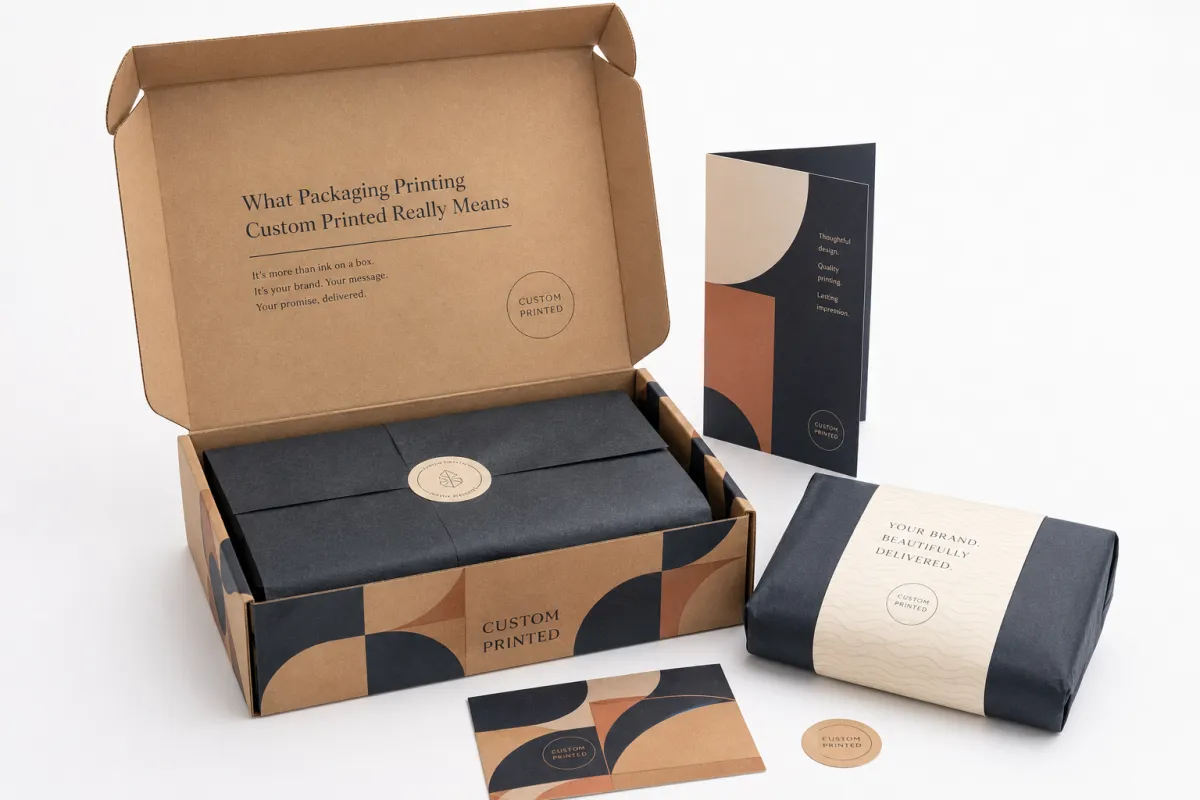
Packaging printing custom printed means packaging that is engineered around your artwork, dimensions, and real-world workflow, not a stock solution with cosmetic edits. It includes Custom Printed Boxes, retail packaging, sleeves, inserts, mailers, shipping cartons, and rigid presentation packs. Some jobs are primarily visual, while others exist first for dosing accuracy, storage control, impact resistance, and handling durability. One side fails first under pressure, and that is where teams quietly lose money.
In production, packaging printing custom printed sits at the overlap of design, engineering, and quality control. Creative teams push for brand language, spacing, hierarchy, and shelf impact. Manufacturing teams manage dielines, tolerances, glue flaps, press behavior, and fold mechanics. Sourcing and logistics teams then test freight performance, stacking behavior, and lead times. The project gets real when all three teams work from one set of truth, not three different interpretations.
Decoration and structure are separate systems. Decoration drives first impression. Structure decides survival. A glossy coating on weak board is just eye candy that collapses in transit. A stiff structure with weak graphics can pass handling and still underperform in brand communication. The strongest packages are born when both systems are planned together and verified before print.
Use cases are broad and often misunderstood. Ecommerce mailers, folding cartons, sleeves, inserts, shipping cartons, and premium rigid boxes all fall under the same umbrella, but they are not the same job. A light-weight mailer usually needs fast conversion and low unit mass, while a retail carton needs repeatable color and a shelf-ready appearance. A premium gift box might require higher compression strength and a tactile finish that signals value every time someone lifts it. Same phrase, very different engineering.
A mockup can help your sales team sell the concept. Production specs keep you out of the next quarter’s scrap pile.
That is why packaging printing custom printed should be treated like a product development decision, not a purely creative one. Start with the item it protects, then build aesthetics around that. I have seen teams start with a gorgeous Instagram mockup and expect manufacturing to “figure it out.” It does not work that way, especially under cost pressure. The package that performs in the real world builds trust faster than a polished render.
When deciding between Custom Packaging Products and a specialized build, ask the question that actually matters: what happens to this package after it leaves your dock? Freight, stacking, retail exposure, and opening sequence all affect board grade, coating choice, color control, and ultimately cost. If you skip those answers, your quote can look strong on paper and still fail in execution.
What Should You Check Before Ordering Packaging Printing Custom Printed?
Start with six checks, and make them boringly explicit: size, material, print method, finish, color target, logistics. If one is fuzzy, the job is not ready for production. That small habit is the difference between “looks good in the deck” and “works at the warehouse.” Packaging printing custom printed is still a manufacturing process; creativity can sit beside it, but it cannot replace it.
- Size: lock product dimensions, insert clearance, and closure mechanism.
- Material: select paperboard, corrugated board, kraft, or rigid board based on expected handling.
- Print method: choose digital printing, offset printing, or flexographic printing based on run volume and detail requirement.
- Finish: decide matte, gloss, soft-touch, foil, embossing, or uncoated stock before first proof.
- Color: define Pantone, CMYK profiles, and tolerances before art goes final.
- Logistics: include freight method, storage period, and assembly conditions in the planning sheet.
In my experience, projects with clean inputs are usually easier, even when they are complex. Vague specs trigger quote inflation, proof loops, and change orders. I see this weekly: the project team says “we can tweak later,” then spends double-budgeting on correction because nothing was locked. Clean inputs save everyone time.
If your team can answer all six with the same answer set, you are ahead. If not, pause and tighten the definition before you upload artwork. It is much cheaper to ask questions now than to spend your way out of missing assumptions later.
How Packaging Printing Custom Printed Production Works
Packaging printing custom printed production sounds procedural for a reason. A disciplined route avoids expensive ambiguity. It begins with a brief that includes dimensions, weight, shipping path, quantity, and finish expectation. A dieline follows. That flattened blueprint becomes the contract between design and production. From there, artwork is mapped to the dieline, proofing begins, and print method, substrate, and finishing are confirmed before production tooling starts.
Print method selection is where most teams make a hidden strategic bet.
Digital printing wins for speed, short runs, and frequent artwork updates. You get quick proof cycles, but per-unit pricing can rise as volume increases. Offset printing is often better when consistency and detailed color are core to the brand. Flexographic printing fits corrugated and high-volume shipping carton runs with repeatable output. Screen printing is less common, but still useful when you need dense ink coverage or tactile effects that other methods struggle to hold consistently.
| Print Method | Best For | Setup Cost | Typical Strength | Main Tradeoff |
|---|---|---|---|---|
| Digital printing | Short runs, rapid turn, variable artwork | Low to moderate | Fast proofs, flexible ordering | Higher unit cost at scale |
| Offset printing | Medium to large runs, precise branding | Moderate to high | Strong color consistency, sharp detail | More setup and longer prep |
| Flexographic printing | Corrugated mailers, shipping cartons | Moderate | Efficient for repeat production | Less ideal for very fine detail |
| Screen printing | Specialty graphics, heavy coverage, spot effects | Moderate | Bold ink deposit, tactile feel | Slower for complex multi-color work |
That matrix gets you a first decision, not a full technical answer. Print method changes line behavior, gradient handling, ink drying, and unit economics. Navy on smooth coated board will sit differently than the same value on kraft because absorbency changes the tone visually and in mass-production. Fine details can stay crisp in one setup and soften in another. Dense ink coverage can also trigger extra drying and finishing constraints you did not budget for. These are the kinds of details that quietly stack into visible defects.
Proofing is where most quality gaps appear. Digital mockups help layout planning, but they are not final proof for color, finish, and fold tolerance. Press-like proofs get closer, but production samples in real material are the real checkpoint. If fit and edge behavior matter, skipping samples is not a cost-saving move. It is a delay strategy with a known ending.
Finishing creates perception fast, and perception is part of business performance. Matte reduces glare for scan-heavy retail visuals. Gloss can improve contrast under point-of-sale lighting. Soft-touch creates hand-feel differentiation but adds handling friction in some climates. Foil gives premium depth, and yes, it needs precise registration. Embossing and debossing can support premium cues, and both have different tooling implications. Lamination improves durability and scuff resistance but can introduce sustainability tradeoffs. None of this is “better.” It is all “correct for this use case.”
Distribution conditions should influence process decisions up front. For freight-heavy packaging, handling performance matters more than “hero shots.” A package that looks perfect under showroom lights can fail ISTA-style handling standards quickly. You should review relevant test expectations early, especially for stack and vibration performance. If recycled content or sustainability claims are central, your spec must include chain-of-custody checks, not only marketing language. Using FSC claims without verifying sourcing creates trust risk. You can review the standards at ISTA and certification requirements at FSC.
When I compare suppliers under Manufacturing Capabilities, I watch repeatability more closely than peak capability. A supplier that can do it once but drifts by the tenth run is not a long-term partner for packaging printing custom printed. Reliable teams show stable control at your exact material, run size, and finish profile, repeatedly.
Key Factors That Shape Packaging Printing Custom Printed Results
Packaging printing custom printed results depend on some unglamorous variables: substrate, format, color strategy, print method, finish, and durability standard. The design can be excellent, but one weak variable turns a near-perfect package into a return problem. Sometimes it can be repaired. Often, once the order is in production, it cannot.
Substrate is not decoration. It is the operating surface for every other decision. Paperboard and corrugated board are not substitutes. Kraft has a natural warmth and a strong brand narrative, but its absorbency can shift color. Rigid board improves structural stiffness and shelf impact but adds cost and often slower handling throughput. Specialty stock can be gorgeous and still fail in moisture or folding behavior depending on grain, coating, and thickness. For most projects, substrate should be decided by function first, then by appearance.
Practical guide for common materials:
- Paperboard works for folding cartons, retail packaging, and lighter product formats.
- Corrugated is stronger for shipping protection, heavier footprints, and stacked storage environments.
- Kraft supports natural brand direction and can signal sustainability if finish and claims align.
- Rigid board is best for premium positioning, precise fit, and higher shelf expectations.
- Specialty stock adds visual distinction, but also increases print and finishing complexity.
Brand goals and handling goals often disagree at first pass. A metallic effect can look premium and still be a pain at the warehouse. Soft-touch can wow in launch videos, then wear quickly in high-touch environments. Matte uncoated can look clean in photos yet scuff badly in rough shipping. Packaging printing custom printed teams that test tradeoffs before launch avoid the painful gap between design and distribution.
Color strategy is another frequent source of drift. Retail products usually need tighter consistency because shelf recognition depends on repeated visual cues. Shipping packaging can accept small shifts if brand identity stays clear and durable. A tiny hue shift in premium segments can be expensive behaviorally. Customers do not always buy because the box is technically perfect, but they do notice inconsistency faster than you might think.
Durability has two components: material failure and use-pattern failure. Moisture, fold fatigue, and edge stress show up in real logistics, not in mockups. If a package gets opened repeatedly, rub-off and delamination matter more than whether the gradient is flawless. If units are stacked, stiffness and retention outweigh “cool” visuals. If the contents are fragile, inserts have to protect without adding assembly friction. A package becomes packaging printing custom printed success only when structure, material, and finish support real-world abuse.
One of the most useful buyer questions is still the same: what exactly must this package endure? Cosmetics cartons, candle mailers, and subscription fulfillment boxes can all look similar in style, yet each has different structural demands. This is where samples and references matter more than opinions from a review call.
Better-looking packaging can be worse packaging. If the substrate and structure are wrong, visual upgrades only hide weak engineering for a moment.
Consistency is not glamorous, but it is profitable. Choose a color standard and keep it for that product line. Maintain finish references in one repository. Track dielines and revision history with version tags. It sounds basic, and it is basic, but it reduces chaos when you reorder every quarter. That is how you stop color drift and avoid the “which version is current?” question that stalls production.
Packaging Printing Custom Printed Process and Timeline
Timelines for packaging printing custom printed vary with complexity and approvals, but disciplined execution still makes a huge difference. Teams that start with complete inputs usually move faster and make cleaner decisions. A weak brief cannot be fixed by machine speed. It can only be repaired with new deadlines and rework.
A typical route looks like this:
- Submit product specs and request a quote.
- Lock box style, material family, and print method.
- Approve dieline structure.
- Upload print-ready artwork and production files.
- Approve proof or production sample and verify fit.
- Start print, finishing, die-cutting, and assembly.
- Inspect finished units, then hand off to freight.
For simple digital runs with standard structures, a rough target is often 7-12 business days after proof acceptance, depending on capacity and finishing. Offset and rigid or specialty configurations can move into 12-25 business days. These ranges are not slow; they are normal when complexity and quality controls are present. Where delays actually happen is usually not the press.
Most timeline failures are internal. Artwork changes after proof, ambiguous specs, slow sign-offs, and unresolved logistics assumptions chew up capacity fast. If a logo shifts late, you lose speed. If material is undecided at kickoff, you lose predictability. If a “rush” request arrives without confirmed constraints, you are buying risk. Packaging printing custom printed does not reward casual changes during active production; it punishes them with variance and schedule drift.
Rush orders can work, but they compress decision space. Stock availability, finish options, and freight windows become harder to secure. If your timeline is tight and your design is complex, simplify first and add details later. A controlled first run is almost always better than a dramatic one-off that becomes a post-launch headache.
In practice, approval flow matters more than hardware. I have watched approval delays from “just one more reviewer” stretch schedules by days. Centralized final sign-off with clear responsibility usually beats committee cycles. Too many approvers turn a technical decision into preference politics.
My preferred sequence is consistent: define product, lock structure, choose material, confirm artwork, then prove and test. Reversing that order because “the artwork is done” is the common trap. At that point, your file is no longer the main asset. The package is. If the package does not perform, the art is just decoration.
Packaging Printing Custom Printed Cost and Pricing Factors
Packaging printing custom printed pricing is manageable once you split it into fixed and variable blocks. Quantity, material, format size, print method, color count, finishing, and structural complexity set baseline. Tooling, samples, freight, and storage are the line items that can quietly become the bigger expense. Buyers often fixate on unit cost and then get shocked by final invoice architecture.
Volume mechanics are predictable. Lower volumes usually increase per-unit price because setup is spread thinner. A run of 500 can look expensive per piece, while 10,000 brings unit cost down. But lower unit cost is not the same as lower total project cost. That misunderstanding persists in nearly every first packaging project, especially with startups scaling fast.
| Package Type | Typical Quantity | Approx. Unit Range | Why It Costs That Much |
|---|---|---|---|
| Simple digital mailer | 500-2,000 | $0.65-$1.40 | Short-run setup, quick production, limited optimization |
| Folding carton with standard finish | 2,500-10,000 | $0.18-$0.55 | Better scale, standard board, controlled print process |
| Rigid presentation box | 500-5,000 | $2.20-$6.50 | Heavier construction, manual assembly, premium finishing |
| Specialty box with foil and embossing | 1,000-5,000 | $0.85-$2.75 | Extra tooling, finishing steps, more quality checks |
These ranges are practical guides, not guaranteed numbers. Board quality, color load, dieline shape, and market conditions move them every month. One-side printing is usually cheaper than full bleed. Rigid structures with inserts can raise labor and assembly pressure significantly. Any custom tooling, unusual geometry, or structural change should be treated as a separate pricing lever.
Cheap is not always smart. Cheap packaging that fails in transit can damage stock, hurt reputation, and increase returns. I have worked on products where a small saving at print turned into a major reverse-logistics burden. Smart packaging can feel more expensive on day one and cheaper over the lifecycle.
Hidden costs are what kill margins most often. Tooling charges may be one-time and then quietly reappear in internal labor if not documented. Sampling may extend lead time and cost but saves a lot more in mass-stage corrections. Freight is often underestimated because people forget dimensional weight, loading density, and destination distance. Storage and staging costs can outpace production savings if demand forecasts are off by even a few weeks. Bad data is usually ten times the cost of better checks.
Ask for itemized quotes and keep them visible as decisions happen. See each item clearly: material, print, finish, assembly, freight, proofing. Once you see each cost bucket, your tradeoffs become tactical instead of emotional. Maybe a finish can scale back without losing core brand intent. Maybe a material grade shift keeps performance while controlling total spend. Maybe reorder quantity should be staged by quarter. That is how packaging printing custom printed becomes financially legible.
When your launch budget is tight, use a simple rule: compare feature additions against conversion, damage reduction, and margin contribution. A few cents for a better finish can be rational if shelf conversion improves, but a full-dollar premium can wipe out margin on a low-ticket item. Packaging printing custom printed is a commercial decision, not a style-only decision.
Common Mistakes in Packaging Printing Custom Printed Orders
Most costly errors are familiar, and that is the bad news. They happen because they feel urgent, not because they are clever. Unresolved artwork, ignored structural guides, wrong substrate, rushed color approvals, and “cheapest quote” thinking all appear in the same projects. It is process discipline, not sophistication, that protects teams from this pattern.
Artwork issues are still the biggest production source of delay. Files that look fine on screen can fail in press due to bleed setup, image resolution, transparency behavior, or font handling. Overprint modes can collapse across different print engines. Transparent elements can shift visually near fold lines. A logo can look stable at full-size, then drift near glue flaps after trimming. Treat files as production instructions, not conceptual art.
File checks that I use in every production intake:
- Lock dieline and do not move structural guides.
- Keep critical text away from folds, edges, and glue windows.
- Use print-size, high-resolution imagery only.
- Embed or outline fonts before submission.
- Verify CMYK versus spot-color workflow and who owns approvals.
Material choice driven only by visuals is risky. Thin board can pass early review and crack under handling stress. Kraft can support a natural story but reduce saturation in dark colors. Coated stock can improve visual accuracy while changing tactile expectations. If fulfillment conditions are rough, you cannot optimize this tension away at the end.
Fulfillment assumptions are a frequent blind spot. A package that passes an office bench test can fail after pallet stacking, taping, temperature swings, and humidity exposure. Complex weight distribution may need insert reinforcement. Moisture-sensitive SKUs often require finish controls that increase time and cost, but skipping that planning is costlier. Packaging printing custom printed is not a final design touch. It is part of fulfillment execution from day one.
Lowest headline price is not always lower total cost. Sometimes exclusions are where money hides: no tooling included, no physical sample set, lighter board than expected, downgraded finish, unclear freight assumptions. You get a low number for one line and a high-cost lifecycle. Compare quotes by like-for-like specs and reject estimates that hide assumptions.
If color standard and finish reference are absent at approval, inconsistency is not an exception. It is a process gap, and it is predictable.
Reorders can quietly erode brand consistency when standards drift. One batch gets a warmer white, another a different matte, a third goes through another supplier with a “close enough” finish. The same SKU no longer feels like one brand. The fix is simple: lock standards and archive approved references by version. Dull discipline beats creative improvisation every quarter.
Think of custom packaging as a reusable specification object, not a one-off art deliverable. That mindset saves teams from repeated debates and keeps quality stable across cycles. Reorder quality is where your operation either becomes scalable or starts collapsing into version noise.
Expert Tips and Next Steps for Packaging Printing Custom Printed Projects
Start with physical reality, then polish the visuals. If your product moves fast, gets touched a lot, or sits in a display cabinet, those details decide print method and structure. A candle in a rigid gift format has different fit and assembly demands than a snack mailer. A subscription carton and a retail display unit look similar in brand tone but behave differently in transit, merchandising, and unpacking.
Complex structures need prototype checks. A fold line that looked harmless in a mockup can create stress points once an insert is installed. If warehouse staff or fulfillment teams struggle with speed, your design is not production-ready. If possible, request a physical sample before the first full run. Software can help with layout, not with handfeel and assembly dynamics.
Standardization reduces errors and saves time. Keep a single source for color references, dieline versions, and naming conventions. Define approvers clearly: one accountable owner for artwork, one for sample approval, and one for final sign-off. Archive approved references with revision notes in one location. Then every reorder starts with proven data, not fresh panic.
Use this practical checklist:
- Specs: dimensions, quantity, product weight, and shipping route.
- Artwork: print-ready files with correct bleed and stable typography.
- Proof: select digital, press, or production sample based on material and risk.
- Sample: verify physical fit whenever fold tolerances are strict.
- Timing: lock approval deadlines, production windows, and freight milestones.
- Budget: break costs into unit, setup, tooling, and logistics before signing.
- Sign-off: assign one final approver to avoid committee loops.
When coordinating with Custom Logo Things, send one complete brief, not four incomplete versions. Include product size, quantity, finish expectations, and constraints in one packet. If this is a standard order under Custom Packaging Products or a custom build, say that directly. Clear structure and good files do not eliminate decisions. They just force decisions into a better sequence.
My rule of thumb on packaging printing custom printed is simple: first ensure function, then refine style. If the package cannot protect, stack, open, or travel, it is not ready for visual optimization. A product can carry a premium look only after it proves operationally dependable.
Practical next actions are simple and real. Measure the product. Set quantity. Choose substrate. Pick digital printing or offset printing based on run and detail needs. Finalize artwork. Request proof. Test fit with a physical sample if structure matters. Lock a repeatable spec, then run your first production batch. That is how packaging printing custom printed becomes an asset, not a recurring problem.
Packaging printing custom printed is not mysterious. It is exacting, and it rewards teams who track the right details. If you skip structure, material, and process discipline, delays and reprints follow. If you follow them, packaging becomes a reliable growth lever, not a recurring expense class.
What is packaging printing custom printed packaging, exactly?
Packaging printing custom printed means creating packaging to your specific size, artwork, and performance requirements instead of fitting a generic template. It includes dieline development, proofing, print production, finishing, and final assembly. Depending on the job, it can include boxes, sleeves, mailers, inserts, and rigid retail presentations with performance targets tied to shipping, retail display, and gift use.
How much does packaging printing custom printed work usually cost?
Cost depends on quantity, material selection, print method, size, and finish complexity. Small quantities usually drive up per-unit cost because setup is spread across fewer pieces. Rigid structures, custom tooling, and premium finishing usually add cost quickly. Compare line-item quotes on the same specification set, and you will get a much better decision than comparing only the headline price.
How long does packaging printing custom printed production take?
Simple digital jobs are typically faster when files are complete and approvals are organized. Offset, rigid, and specialty finishing can take longer due to prep and finishing complexity. In many cases, the biggest delays come from internal churn: last-minute file changes, unclear specs, or approval bottlenecks. A realistic schedule usually beats an aggressive one that causes rework.
What files do I need for packaging printing custom printed orders?
You need a clean dieline, print-ready artwork, and clear color references. Provide high-resolution images and make sure fonts are embedded or outlined before submission. If the design uses structural folds, advanced coatings, or special effects, confirm setup details before production starts. Clean files are the foundation of predictable output and fewer correction cycles.
What is the biggest mistake with packaging printing custom printed projects?
The biggest mistake is approving visual design without validating material, structure, and print method together. A strong look does not guarantee performance. Skipping proofing and sample checks compounds risk, especially when handling, shipping, and shelf display are part of the use case. Packaging printing custom printed performs when disciplined specification management and practical testing drive decisions, not last-minute assumptions.

