Buyer Fit Snapshot
| Best fit | packaging printing with logo branding sticks for packaging buyers comparing material specs, print proof, MOQ, unit cost, freight, and repeat-order risk where brand print, material, artwork control, and repeat-order consistency matter. |
|---|---|
| Quote inputs | Share finished size, material target, print colors, finish, packing count, annual reorder estimate, and delivery region. |
| Proofing check | Approve dieline scale, logo placement, barcode or warning zones, color tolerance, and any recyclable or compostable wording before bulk production. |
| Main risk | Vague material claims, crowded artwork, or missing packing details can create delays even when the unit price looks attractive. |
Fast answer: Packaging Printing with Logo Branding Sticks: Dieline, Finish, Proof, and Buyer Review should be specified like a repeatable production item. The safest quote includes material, print method, finish, artwork proof, carton packing, and reorder notes in one written spec.
What to confirm before approving the packaging proof
Check the product dimensions against the actual filled item, not only the sales mockup. Ask for tolerance on folds, seals, hang holes, label areas, and retail display edges. If the package carries a logo, QR code, warning copy, or legal claim, reserve that space before decorative graphics fill the panel.
How to compare quotes without losing quality
Compare board or film grade, print process, finish, sampling route, tooling charges, carton quantity, and freight assumptions side by side. A lower quote is only useful if the supplier can repeat the same color, closure quality, and packing count on the next order.
Packaging Printing With Logo: Branding That Sticks
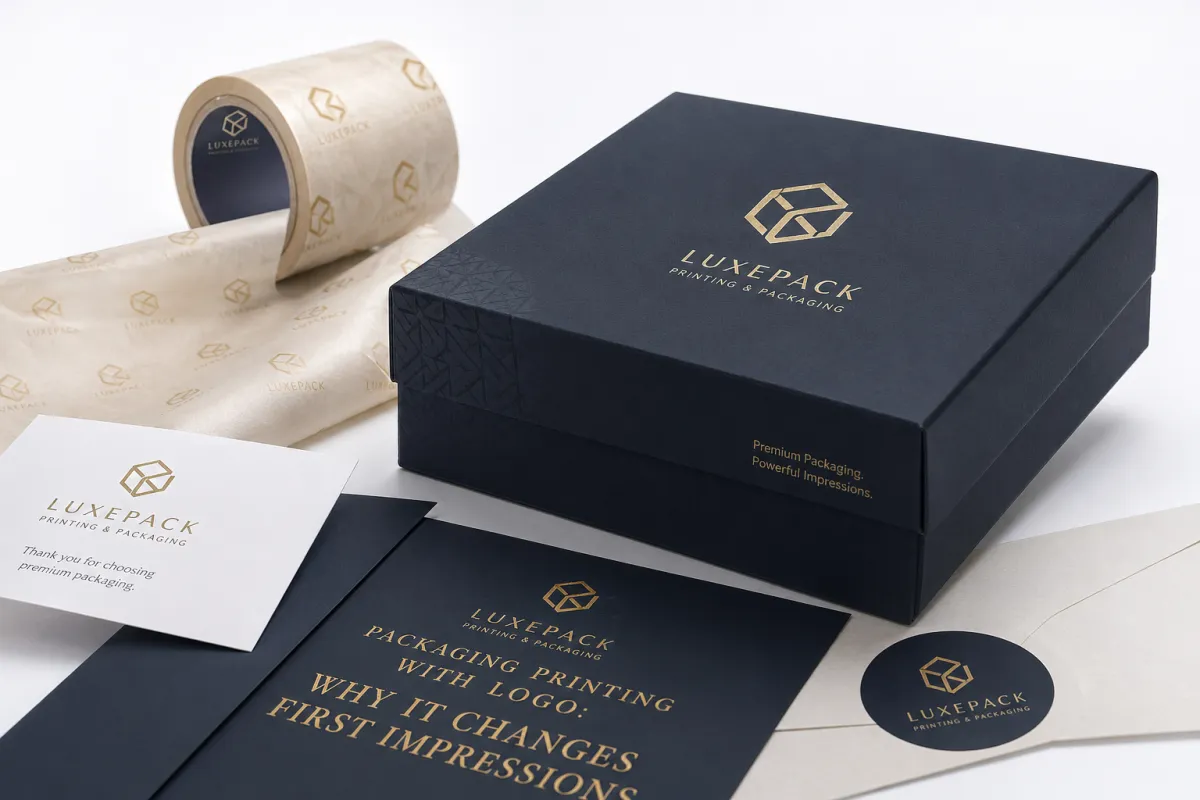
Two nearly identical products land on a shelf side by side. One sits in plain white corrugated shipping cartons. The other uses deliberate packaging printing with logo, a contrast-heavy palette, and a finish that catches the eye without screaming for attention. Guess which one gets picked up first, photographed more, and usually reordered by a returning customer?
That is not decorative fluff. In commercial terms, packaging printing with logo is a signal. It tells the customer, the retailer, and the warehouse team that the brand showed up on purpose. I keep seeing the same pattern: a clear logo mark and consistent color across the box, sleeve, and mailer cuts hesitation, especially for smaller brands trying to build trust in ecommerce and retail. Invoices may list cost of goods sold; packaging printing with logo affects perceived quality, return risk, and how much faith people put in the product before they touch it.
Think of it as a physical marketing channel that has to survive shipping, handling, and the occasional bad mood in receiving. The checkout creates the sale. The package arrives later and carries the last word. If your logo is fuzzy, badly sized, or different from one SKU to another, that promise gets weaker. If your packaging printing with logo looks precise, the brand feels planned instead of improvised. That difference is hard to capture in a spreadsheet, but it shows up in conversion confidence and repeat purchases.
I have sat through enough press checks to know this: a logo that looks fine in a PDF can turn into mush the second it hits the wrong stock. That is why this topic is not about decoration. It is about whether your packaging says “trusted brand” or “we winged it.”
"The first interaction with a customer is not just visual. It is logistical, tactile, and social at the same time."
Here is the practical version: how the print is made, what controls quality, where pricing moves, where timelines slip, and where teams usually trip over their own feet. You will also get a usable checklist for moving from idea to production-ready proof.
Packaging Printing With Logo: Why It Changes First Impressions
Packaging speaks before anyone opens it
Packaging printing with logo is often the first visible proof a buyer sees before they handle the contents. In warehouse sorting, a package moves through scan points, manual checks, and return loops; when the logo is clear and consistent, the box is easier to process. In retail, the printed mark becomes part of the shelf scan. Customers skim in under one second, often from several feet away. A readable emblem and a clean name create a memory hook before the hands ever touch the carton.
Three moments matter most: first pickup, first unboxing, and first social post. Good print decisions improve all three. Weak ones create doubt in all three. Brands rarely lose on one giant mistake. They lose on a stack of small ones that make the package feel forgettable.
Plain packaging is a shipping container with no personality. Packaging printing with logo adds context. It turns anonymous handling into recognizable brand experience. That matters for subscription programs, refill cycles, and seasonal launches where a customer may see the same box over and over again. It also helps custom packaging feel like a deliberate part of the product, not a box someone grabbed at the last second.
Brand consistency helps operations, not just design
Consistency across fulfillment, returns, and shelf replenishment is not vanity. It keeps the operation from tripping over itself. If cartons, inserts, and mailers disagree on logo position or color, people at receiving pause. They inspect. They scan twice. That slows put-away and adds labor cost in places teams rarely track until the numbers get ugly.
Most teams miss this. They approve artwork, then let packaging procurement run on its own. The result is variance in look and in material behavior. If you are using packaging printing with logo on rigid boxes for product packaging, sleeves for retail packaging, and labels for fulfillment, alignment matters in three places: dimension, contrast, and color.
If your brand has strict standards, loop in your Manufacturing Capabilities team early. Ask for production tolerance windows before artwork gets locked. Small errors pile up fast. A 0.5 mm misregistration on a tiny label can turn into inconsistent scanning or barcode collisions at distribution points. Nobody wants to explain that in a shipping meeting.
What teams get wrong at the budget stage
The common mistake is treating branded box printing as a line item instead of part of the acquisition funnel. Save a little on unit cost, and you can pay for it later in confusion, rework, and missed trust signals. The cheapest quote is often the one that creates the most expensive cleanup after launch.
Do not evaluate packaging printing with logo as extra decoration. Evaluate it as part of quality control, shelf behavior, and customer recognition. If the goal is less friction and more trust, this print layer deserves the same attention as product quality and fulfillment timing. That includes logo printing, not just structural packaging.
How Does Packaging Printing With Logo Work?
The messy part is the chain. Packaging printing with logo is not one action. It is a series of dependencies: file quality, prepress, print method, drying or curing, finishing, and inspection. One weak step and the next two make the problem louder.
Skip preflight checks and you may discover color shifts after press. Skip early proof reviews and you may notice a logo that sits too close to a fold after production has started. A controlled workflow avoids the reprint tax. That tax is expensive. It is also embarrassing, which somehow feels worse.
From artwork to press: the practical flow
- Artwork intake: vector logo files, master color references, and final dielines.
- File audit: resolution checks, bleed confirmation, font conversion, and color profile verification.
- Prepress setup: imposition, plate marking for offset or flexo work, or RIP setup for digital.
- Proofing: color proof and position proof before production gets the green light.
- Printing run: color, ink, pressure, and registration are set by method and substrate.
- Finishing: varnish, spot varnish, lamination, embossing, foil, die-cutting, and folding.
- Inspection: sample checks for registration, readability, edge integrity, and final pack behavior.
This flow stays the same whether the run is 300 pieces or 30,000 pieces. The tools change, not the logic. For smaller runs, digital printing with logo is often faster because setup is lighter. For large runs, plate-based methods can bring down unit cost and keep color behavior steadier.
Method by method: where each one earns its keep
Digital printing works well for short runs, frequent updates, and variable data. Think seasonal offers, personalized packs, or multiple SKU changes in one sprint. It handles moderate detail well and can produce solid quality on many coated and uncoated stocks without heavy tooling. It is the method you want when you are still testing the market and, frankly, do not want to gamble on a giant inventory pile.
Offset printing is still the workhorse for strong consistency and crisp tones at higher volume. If your budget handles larger runs and you need stable color across 5,000 or more units, this is often the baseline choice. Plate prep adds upfront setup, but the incremental cost per unit usually drops at scale.
Flexographic printing works best on flexible packaging films and longer runs on repeatable substrates such as pouches, mailer laminates, and some labels. It can struggle with very fine lines if it is not engineered carefully. In practice, thin strokes and tiny text need a lot more caution than people expect.
Screen printing is not trendy, but it is dependable for high ink opacity on rigid materials, especially textured stocks or special coatings where impact matters more than delicate gradients. It is often chosen for short to medium runs where tactile presence counts.
Foil stamping and embossing/debossing add texture and recognition, but they demand tight mechanical precision. These methods work best when the logo itself is part of the premium story, like gift packaging and high-end retail packaging.
Substrates and how they change output
Corrugated boxes absorb ink differently from art boards. Lower-GSM corrugated can dull color unless the ink load is adjusted. Folding cartons on coated stock show cleaner lines and more predictable gradients, but they can smudge if lamination does not match the print chemistry. Mailers made from film and paper laminates need adhesion planning, usually with corona treatment and special primers. Rigid boxes show detail well, but they ask for exact registration and tighter finishing control. Labels are less forgiving at the edges, so trim tolerance and placement become critical.
For every substrate, ask one blunt question: will the material hold line sharpness, or will it swallow detail? A 0.15 mm stroke on matte kraft may vanish while doing fine on coated stock. That is why packaging printing with logo begins with substrate selection, not just visual taste.
Proofs: cheap insurance before mass production
Proofing catches the avoidable mistakes. I would rather review six proofs than one full reprint. A proper workflow checks:
- Color mapping against approved brand specs.
- Logo alignment over seams, folds, and cut lines.
- Text legibility at realistic viewing distance.
- Coating changes after varnish and lamination.
This is also where CMYK versus spot color decides whether the logo feels official or half-baked. If your brand depends on a specific spot color, insist on an approved standard and make sure the printer can reproduce it on the chosen stock. Low-resolution artwork may look fine on screen and fall apart in proof with fuzzy edges and uneven registration.
What Affects Packaging Printing With Logo Quality?
Print quality is not magic. It is a chain of measurable variables. Packaging printing with logo looks premium when those variables are controlled. It looks cheap when they are guessed at.
Resolution, contrast, and color accuracy
Good files and stable color profiles are the foundation. As a rule of thumb, raster artwork below 300 DPI at final size is risky for logos with small text. Screens with too little line control can create moiré or grain. If brand colors need to stay steady, a managed ICC profile and strict proofs are not optional. In many packaging setups, teams work toward Delta E thresholds that are visually close enough to pass in real life. If that language feels vague, ask the printer for pre-production color tolerance in plain English.
Brand color fidelity is harder on coated paperboard than on uncoated kraft. Matte textures mute some pigments. Coated whites reflect differently, which can lift contrast but also make black look gray. That is why visual sign-off should happen on actual material samples, not only on swatches or screen views.
Material compatibility and surface behavior
Uncoated kraft creates a natural, premium feel at first glance, but ink can feather into the fiber and soften edge crispness. A heavier soft-touch surface can improve durability and tactility, but it changes gloss and readability under store lighting. Plastic films give a clean surface yet need precise adhesion chemistry for high-coverage logos. Textured paper can feel elevated and still hide tiny details in small marks.
That usually leaves a tradeoff: finish realism versus exact brand precision. If your logo has thin strokes, you may need to simplify the artwork or increase the print area. That is not a design failure. It is a packaging decision.
Finishes and perceived value
- Matte: cuts glare and can feel more refined; the downside is weaker visibility under yellow warehouse lighting.
- Gloss: adds visual pop and often improves color saturation; it shows fingerprints and scuffs faster.
- Soft-touch: creates a premium tactile impression, usually at a higher unit cost and longer lead time.
- Embossing/Debossing: adds depth and anti-counterfeit character, but die precision has to be exact.
- Metallics: strong shelf appeal for limited runs, less useful for very high-volume commodity SKUs unless the return is clear.
Finish choice is not a style pick. It affects handling, storage, and transport. Soft-touch and thick varnish layers can attract dust and transfer marks in tight fulfillment operations if drying or curing is rushed.
Durability and logistics reality
If packaging ships, durability is the first hidden test. Packaging printing with logo has to survive scuffs, compression, moisture, and temperature shifts. For heavy ecommerce cycles, ask whether the final pack holds up to repeated scan friction and pallet handling. If the route includes humid conditions, ask for moisture resistance specs and how the ink is protected against smudging.
One practical rule: if the package may sit in a truck for 72 hours and move in bulk, choose resistance and finish durability before micro-aesthetics. Customers still care about design. They care more that the box arrives intact and readable. ASTM and ISTA methods exist for a reason. Freight teams use them because guesswork gets expensive fast.
If your packaging design spans cartons, sleeves, and secondary packaging, enforce brand consistency through shared measurements and approved files. Otherwise your packaging printing with logo can look intentional in one format and weak in another. That is a quick way to erode trust.
Packaging Printing With Logo Costs, Pricing, and Tradeoffs
Here is the part where everyone wants a simple answer and gets a spreadsheet instead. Cost is driven less by the logo itself and more by volume, method, finish, and risk. A simple mark can cost more than expected because setup and inspection show up late if nobody asks early. That is usually where budgets go to die.
What moves price in real programs
The top five cost drivers for packaging printing with logo are usually:
- Order quantity and expected unit count.
- Print method such as digital, offset, flexo, screen, or foil.
- Number of colors and whether spot color control is required.
- Material and stock choice, including GSM, coating, recyclability, and barrier properties.
- Finishing and special treatments such as varnish, laminate, embossing, foil, or UV.
The economics are simple and brutal. Smaller runs reduce inventory risk but usually raise unit price. Larger runs lower per-unit cost but increase committed capital and storage exposure. There is no magic trick there. Just tradeoffs.
Method comparison: speed vs unit cost
| Method | Typical minimum quantity | Indicative per-unit cost range | Setup cost range | Best fit |
|---|---|---|---|---|
| Digital | 100-2,000 | $0.60-$2.20 | $120-$350 | Short runs, frequent design changes, variable offers |
| Offset | 1,000-5,000+ | $0.30-$1.40 | $250-$800 | Higher volume runs with stable artwork |
| Flexographic | 3,000-10,000+ | $0.20-$0.95 | $400-$1,000 | Packaging films, high-volume laminates, repeated runs |
| Screen + specialty | 500-5,000 | $0.70-$2.80 | $180-$600 | High-opacity logo marks, textured surfaces, premium accents |
These ranges are starting points, not promises. They vary by region, complexity, and the finishing stack. They also assume clean artwork and tidy prepress. If the file needs heavy correction, pricing climbs fast. So does the stress level.
Compare hidden categories too, not just the base price:
- Proofing and correction cycles, often $40-$250 per pass.
- Shipping and freight spikes for bulky cartons.
- Packaging samples, color adjustments, and possible reprints.
- Returns handling if quality disputes show up at fulfillment.
Digital vs plate-based for changing brands
If your catalog changes monthly or each line uses different artwork, digital is usually safer for margin predictability. You avoid plate amortization and can test options faster. If your design stays stable and the campaign lasts longer, offset printing or flexo can beat digital on per-unit economics once the volume is high enough.
The clean formula is this: treat the most expensive printing method as a hidden cost, not a premium option. If changing a product family color requires rework twice in one quarter, the savings disappear. For many growing brands, a mixed strategy works better: digital for test windows, offset for top sellers once the numbers point to a winner.
Value beyond the unit
Do not buy the lowest quote if it cuts into brand requirements. A cheap misprint run can cost several times the order in replacements, chargebacks, and brand repair. I have seen teams save 10% on the first invoice and spend 30% more fixing the campaign because the packaging felt cheap in the real world. That is not a cute savings story. It is a failure in disguise.
Judge packaging printing with logo against shelf confidence and customer understanding. If the product sells in a crowded channel, extra spend for visibility and durability can pay off quickly. That applies just as much to branded packaging as it does to the box itself.
Process and Timeline for Packaging Printing With Logo
Execution quality in packaging is mostly timeline management dressed up like administration. Good artwork can still fail launch if proofing windows and cutoffs are ignored.
From concept approval to delivery
A practical baseline timeline for standard packaging printing with logo projects often looks like this:
- Day 1-3: finalize dielines, materials, and quote brief.
- Day 4-6: prepress review and first proof.
- Day 7-9: first proof approval and correction cycle.
- Day 10-15: production setup and main print run for simple jobs.
- Day 16-20: finishing and final inspection.
- Day 21-25: packaging shipment staging and delivery window lock.
Simple digital runs can move in roughly 10-18 business days if proofing stays tight. Complex finishing, custom die-lines, foil work, and crowded production schedules can stretch that to 3-6 weeks.
Where delays usually happen
Most delays are not machine breakdowns. They are upstream communication misses:
- Incomplete specs: missing die-lines, unresolved text sizes, ambiguous colors.
- Late approvals: artwork stuck in multiple internal reviews.
- Material backorders: especially during peak season or for niche papers.
- Finishing complexity: emboss dies and coatings that need extra setup.
- Quantity changes: when teams revise targets after production already began.
A stable timeline needs strict gates. If you are running promotions, plan backward from the sell date. Inventory has to arrive before the product, not after. That matters even more when logo and product packaging need to match campaign imagery across channels.
Small change, big impact on lead time
Lead time matters more for branded printing than for plain packaging because visual alignment is part of the job. A plain box can often be replaced quickly if something slips. A branded package has to stay in sync with web, retail, and social assets. If the logo appears at one size online and the box is late, the campaign starts to feel disconnected.
In operations terms, it is a sequencing problem. Your packaging run should have at least one pre-booked proof deadline and one production booking date that only moves when the right people sign off. That one rule cuts missed windows more often than teams expect.
Common Mistakes Brands Make With Packaging Printing With Logo
Blunt truth: the mistakes are not random. They repeat. If you expect them, your project quality goes up and your budget pain goes down.
Raster files pretending to be scalable
Uploading a low-res logo and expecting press-grade output is still the classic expensive mistake. If the mark is a tiny PNG, any method, digital or offset, will show edges that look stitched or soft. On premium products, that can make a decent design team look careless.
Use vector files whenever possible: AI, EPS, or PDF/X with outlined fonts. If no vector exists, ask for an SVG, an AI master, or the original EPS file from the brand system. Packaging printing with logo is not the place to hope interpolation will save the day.
Overloading small packaging with too many elements
Cluttered front panels kill logo performance. On small cartons and curved bottles, too many decorative pieces reduce recognition by lowering contrast and shrinking distance readability. The fix is simple: cut secondary copy, protect space around the logo, and leave breathing room. A crowded front can look dramatic in mockups and perform badly in motion, on shelf, and in mobile thumbnails.
Choosing color only from a monitor
It is tempting to approve color on screen, but monitor calibration does not match print stock behavior. A blue that looked correct at full brightness may look flat on uncoated paper. I still see teams learn this on the production line and ask for corrections after only two pallets have been printed.
Never finalize a critical brand mark color without a physical proof or a contract-accurate proof on the exact material. For branded packaging, that is not optional. It is basic quality control.
Ignoring structural constraints
Glue flaps, fold lines, tabs, seams, and barcode zones are real estate with hard limits. If your logo sits too close to a die-cut fold line, it can warp or disappear after assembly. If the barcode shares visual space with the mark, fulfillment scanners may fail more often. Both problems are preventable with one technical drawing and one good proof cycle.
In one packaging design audit, the recurring issue was logo placement that looked centered on a flat proof, then landed under a seam once the box folded. That is not a creativity problem. It is a prepress coordination problem.
Ordering the wrong quantity or the wrong format
This one hurts operations. Teams often choose a run length they think is safe, then discover shelf constraints or shipping dimensions changed after design lock. The result is expensive overstock or short shipments. Packaging printing with logo choices should be checked against actual logistics dimensions, not only product dimensions.
Overbuying the wrong format is just as costly as underbuying the right one. Run a sizing check before you lock artwork and final quantity.
Expert Tips for Better Packaging Printing With Logo
Most improvements come from repeatable systems, not one perfect project. If your packaging workflow feels improvised, your output usually will too. Fix the system first.
Build a brand packaging spec sheet
Start with one controlled document for each logo family. Include:
- Approved vector logo files and variants.
- Exact color references, including CMYK values and brand spot references where needed.
- Minimum logo size on each packaging format.
- Substrate notes: board weight, finish, and adhesive compatibility.
- Finishing priorities and banned combinations.
That sounds administrative, and it is. It also cuts revision loops hard. If the specs are already defined, prepress can judge feasibility before anything gets printed. For teams running many SKUs, it also keeps package branding consistent across inserts, sleeves, and mailers.
Run focused mockup comparisons
Testing two or three mockups is smart, not fussy. Keep one version tuned for shelf readability, one for unboxing feel, and one for shipping durability. Compare them in real conditions:
- Photograph under white and mixed lighting.
- Open and reseal cycles for unboxing and handling.
- Scan and fold performance on a real pack line.
Most teams overestimate the difference a finish choice will make. In testing, matte versus gloss can shift perceived value by more than people expect, especially for high-contrast logos.
Design as a system, not isolated artwork
A good packaging program treats logo treatment as something that can move across channels. If your logo works on retail packaging, it should translate to Custom Printed Boxes, mailers, and inserts without turning into a different mark every quarter. That is where brand stability meets operations.
Use shared constraints: minimum target height, max contrast rules, and approved file templates. Then each format can adapt around those rules instead of reinventing the mark.
Prioritize legibility where speed matters
Ecommerce packaging gets seen fast, often under fluorescent or mixed overhead light. Contrast matters more than decorative detail. Ask whether the logo can be identified within 1.5 seconds from arm's length. If not, simplify.
That does not mean plain. It means readable. A well-spaced wordmark with clear letterforms often performs better in real channels than a stylized emblem packed with tiny detail.
"The fastest way to lose recognition is to add detail for style and remove clarity for speed."
Ask the right production questions before commit
Before locking a run, ask your print partner:
- What substrate tests do you run?
- Which proof type is used for final color sign-off?
- What are your production tolerances on registration and color variance?
- How do you handle first-pass failures?
If the answers stay vague, pause. A clear printer should explain the process without hiding behind jargon. If you want confidence in packaging printing with logo results, choose a partner with process clarity, especially when your packaging has to meet strict Custom Packaging Products standards.
What to Do Next With Packaging Printing With Logo
Now the important part: action. If you already have packaging in hand, skip the theory and start with an audit. Compare at least five SKUs and every external packaging touchpoint. If the logo looks different in size or tone across channels, the system is shaky.
Step 1: Run a packaging audit
Find the weak spots where logo communication breaks: low-contrast text, unreadable type sizes, inconsistent spacing, unstable color, and seams or folds that land on top of detail. Rate each SKU from 1 to 5 and map the results by channel: fulfillment, retail, and return handling.
Focus the next quarter on the highest-friction areas first. If you only have one hero SKU, start there. If you have several, pick the fastest sellers and the ones most sensitive to returns.
Step 2: Gather quote-ready information
Before you contact printers, prepare:
- Exact box dimensions and weight-bearing limits.
- Material preferences, including FSC claims if relevant, barrier needs, and stiffness target.
- Quantity range by variant and expected reorder cycle.
- Color requirements and approved logo files.
- Finish ideas and delivery deadline.
If your brand makes environmentally credible claims, verify material standards through recognized sources such as FSC instead of trusting supplier claims with no paper trail. For logistics-heavy programs, ask whether the spec aligns with tested freight handling expectations.
Step 3: Request samples and prove before mass order
Ask for prototypes or sample proofs before you commit, especially for metallics, soft-touch, or niche colors. A small sample set cuts ambiguity and often reduces rework. If one element matters most, test that element first. It is cheaper than full pilot production.
Step 4: Use a decision checklist
Build a matrix before final approval: price per piece, lead time, substrate durability, finish effect, and brand impact. Score each option. Teams often chase low unit cost and end up with a packaging program that needs reprints or redesign under live sales pressure.
Use one final check: does the option pass 3 filters? (1) visual consistency, (2) logistics compatibility, (3) budget and timeline fit. If any fail, return to proof and adjust before production.
Step 5: Move fast with controlled milestones
Schedule a packaging review with marketing, sourcing, and fulfillment owners. Compare methods and finalize once. Then lock proof and quantity together, not separately. That discipline keeps last-minute spec drift from sneaking into production.
The objective is simple. Consistent, durable, accurate packaging printing with logo creates fewer excuses at every stage from checkout to shelf. From a packaging buyer's perspective, that is where good branding turns into reliable operations.
When you treat packaging printing with logo as a controlled system instead of a design afterthought, every shipment gets clearer, every reorder looks stronger, and the brand stays coherent while it scales. The practical next move is simple: audit one SKU, fix the weakest print variable, then lock the spec before the next reorder so the same mistake does not get printed twice.
FAQ: Packaging Printing With Logo
What is packaging printing with logo, and how is it different from plain packaging?
Packaging printing with logo means adding your brand mark, typography, or branded message directly to the package instead of shipping unbranded or generic stock. The practical difference is recognition and message control. Plain packaging can protect a product, but branded packaging can also reinforce trust and consistency.
Which packaging printing with logo method is best for small orders?
For small or frequently changing runs, digital printing is usually the most practical choice because setup is lighter and revisions move faster. It works especially well when the design changes often or product lines are being tested. For color-sensitive or tightly controlled materials, the method can still shift depending on the finish goals.
How much does packaging printing with logo usually cost?
Cost depends on quantity, material, method, color count, and finishing. Small runs usually cost more per piece, while larger runs often bring the per-piece cost down. Budget for setup, proofing, freight, and possible rework too. The final amount should be measured against brand and operations value, not only unit price.
How long does packaging printing with logo take?
Timing depends on design approval cycles, proofing rounds, method choice, and material availability. A straightforward digital run can move in under three weeks; specialty-finish packaging with strict review cycles can take longer. The safest move is to plan backward from inventory and launch dates, with approval buffers built in.
What file format should I use for a logo on packaging?
Use vector files whenever possible: AI, EPS, or PDF workflows with outlines and proper color references. Raster files can work in some situations, but they often reduce precision, especially on small labels or textured substrates. Low-resolution files create fuzzy edges and unstable color in production.
Can I use the same logo artwork for every package type?
Usually yes, but not without adjustments. A mark that works on a rigid box may need resizing for a mailer, label, or sleeve. The safest approach is to build versioned artwork that respects each substrate's limits instead of forcing one file to behave perfectly everywhere. Packaging is physical. It does not care about wishful thinking.