A Glock 43X looks compact until the kit grows around it: two magazines, an optic, a light, a loader, a desiccant pack, and the small tool that always disappears at the worst possible moment. A pelican case 1170 glock 43x Custom Foam Insert turns that crowded setup into a controlled, repeatable package instead of a hard case full of parts knocking into each other.
The Pelican 1170 is a useful size for compact pistol transport, range-day organization, dealer samples, warranty kits, training sets, and premium firearm accessory bundles. It is also less forgiving than it looks. The outside dimensions suggest room. The usable foam area tells a different story.
Why a Pelican Case 1170 Glock 43X Custom Foam Insert Needs Real Planning
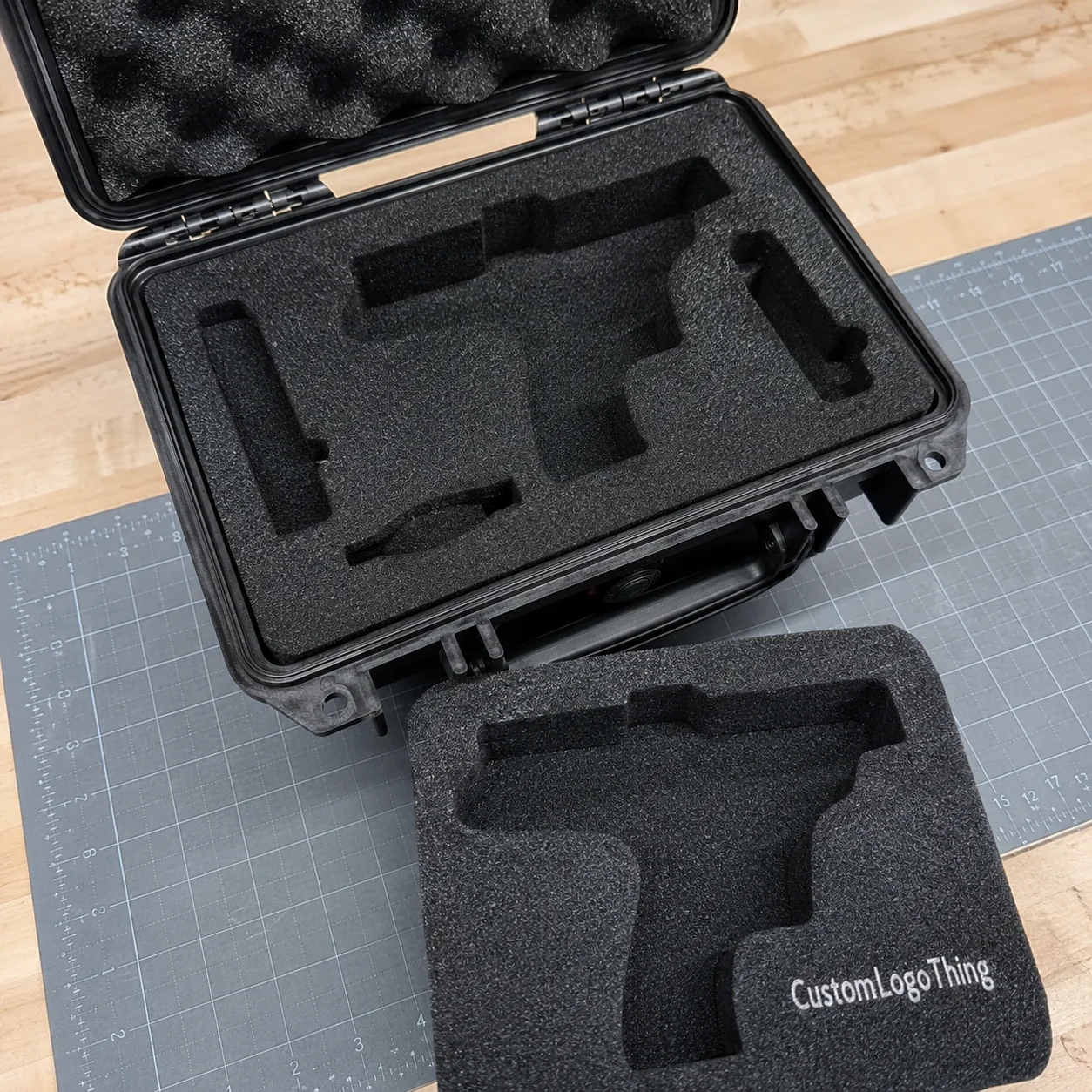
Custom foam is not just pick-and-pluck foam with better manners. Pick-and-pluck has a role: cheap, fast, good enough for temporary storage. But it is still perforated foam torn by hand, and torn foam rarely stays neat after repeated use.
A proper insert is a layout system. It controls protection, access, presentation, repeatability, and how the kit behaves after the tenth range trip, not just the first photo.
Most custom pistol inserts are CNC-cut, laser-cut, or waterjet-cut from a digital file. That file needs to match the actual firearm and accessories. A stock Glock 43X is not the same package as a 43X MOS with a mounted optic, extended base plates, aftermarket sights, and a rail-mounted light. Even small changes can shift the tallest point, widen the front end, or change how the pistol sits in the cavity.
Fit should feel secure without becoming irritating. The pistol should not float. It also should not require a two-handed wrestling match to remove, as if it owes you money. Good foam grips lightly, leaves finger access where the hand naturally reaches, and keeps magazines and tools from rubbing against the slide or optic.
Commercial use adds another layer. For companies selling premium firearm parts, dealer kits, or accessory bundles, the case and insert become part of the product packaging. Buyers read the foam before they read the instruction card. Crooked cavities, fuzzy edges, or a layout that traps the pistol below the surface make the whole kit feel improvised.
Compliance reminder: foam does not replace firearm safety rules. Follow local storage, transport, locking, and handling requirements. This article covers protective packaging design and fit, not legal advice.
How Custom Foam Holds a Glock 43X Inside a Pelican 1170
Foam has three jobs inside a compact pistol case: immobilize the firearm, absorb impact, and separate hard parts so they do not scratch, rattle, or grind against each other. If the pistol moves during handling, the insert failed. If the optic is crushed into the lid foam, the insert also failed. Protection is not the same as maximum tightness. It is controlled contact.
Most small pistol inserts use layered construction. A common stack includes a bottom support pad, a custom-cut cavity layer, and a top lid pad for light compression. In a Pelican 1170, the middle layer carries most of the design burden. It defines the pistol outline, magazine slots, accessory pockets, and finger reliefs while the bottom layer cushions from below.
Cavity depth deserves more attention than it usually gets. Too shallow, and the slide, optic, or magazine base plate sits proud. Too deep, and the user has to dig the pistol out every time. For many compact pistol layouts, partial-depth retention with finger pulls works better than a full-depth cavity that swallows the gun.
Cut style changes both function and feel:
- Outline cuts: follow the pistol profile for stable retention and cleaner presentation.
- Finger pulls: create access near the grip, slide, or magazine body without loosening the whole cavity.
- Magazine slots: can be vertical, angled, or flat depending on capacity, lid height, and retrieval.
- Accessory pockets: hold loaders, lights, tools, desiccant, paperwork, batteries, or spare parts.
- Relief channels: protect optics, sights, controls, and protruding hardware from pressure points.
Orientation is the next argument. A slide-up display layout looks good for dealer photos. A grip-forward layout often works better for fast access. A flat utility layout can fit more accessories, though it may look less polished. The prettiest symmetrical layout is not always the one people like after a few range sessions.
Real modifications must be designed into the file. A mounted optic changes height. A threaded barrel or compensator changes length. A weapon light changes width and front-end geometry. Extended magazines change height and can create lid pressure. Tall aftermarket sights may need a relief channel. Guessing from a stock outline is how a supplier produces a very nice insert for a pistol nobody actually carries.
The Pelican 1170 has a limited internal footprint, so the design needs priorities. Pistol plus two magazines is usually clean. Add four magazines, a loader, optic tool, light, desiccant, paperwork, and a morale patch, and the layout starts behaving like luggage for a weekend trip. Something has to give.
Key Specs to Confirm Before You Order the Insert
Start with the exact Glock 43X configuration. Not “a Glock.” Not “basically stock.” Specify standard 43X, 43X MOS, optic model, rail adapter, light model, compensator, threaded barrel, aftermarket sights, magwell, and base plate type. Foam suppliers are not mind readers. Shocking, I know.
Accessory creep ruins small-case layouts quickly. One extra magazine can force tighter spacing. A loader may need a blocky pocket that steals space from paperwork. A sight tool might fit only if it is angled. A desiccant pack may need a shallow rectangular cavity. Decide what must live in the case before design begins.
Material selection matters because pistol foam gets handled, flexed, and rubbed at the same points over and over. Polyethylene foam is a durable everyday option because it holds shape, resists tearing, and works well for frequent removal. Polyurethane foam feels softer and cushions nicely, but it can stretch or wear faster around tight handgun cavities. EVA foam gives firmer edges and a cleaner premium appearance, especially for dealer sets, retail bundles, and branded packaging programs.
| Foam Option | Best Use | Typical Feel | Buyer Tradeoff |
|---|---|---|---|
| Polyethylene foam | Range kits, frequent handling, practical storage | Firm, structured, durable | Less premium-looking than EVA unless finished carefully |
| Polyurethane foam | Light cushioning, low-contact applications | Soft, compressible | Can lose shape faster with repeated pistol removal |
| EVA foam | Dealer kits, retail presentation, premium bundles | Clean edges, firm support | Usually higher cost, especially with color layers |
Layer thickness depends on the case interior, pistol height, closure pressure, and tallest accessory. A typical build may use a thin lid pad, a thicker cavity layer, and a base pad. The exact stack depends on the 1170’s usable interior height and whether the optic, light, or magazine extension becomes the high point.
Density is another practical detail. Firmer foam improves edge stability and retention, but overly aggressive cavities can make removal awkward. Softer foam feels protective in the hand, then slowly relaxes around tight cuts. Thin walls between cavities are especially vulnerable. If two magazine slots are separated by a narrow strip of soft foam, expect that strip to look tired before the rest of the insert does.
Color and branding options belong in the planning stage, not after the proof is approved. Black foam is simple and tactical. Gray, red, blue, or layered EVA can create contrast. Logos can be engraved, printed on a card insert, marked on a top layer, or paired with Custom Packaging Products such as sleeves, mailers, instruction cards, or retail cartons. If the case is sold as a kit, the foam is part of the package branding, not background material.
Measurements should be boringly specific. Send photos with a ruler, model numbers for optics and lights, magazine type, base plate style, and side views of tall accessories. “Small red dot” is not a specification. It is a polite invitation to remake the insert.
Process and Timeline From Layout Approval to Finished Foam
The normal process starts with intake: case model, firearm configuration, accessory list, photos, measurements, quantity, foam color, branding needs, shipping destination, and target delivery date. For a pelican case 1170 glock 43x custom foam insert, the case model matters because the inside geometry controls every layout decision.
Next comes digital layout. The supplier creates a top-down drawing showing the Glock 43X, magazines, and accessories inside the Pelican 1170 footprint. This is the moment to check grip clearance, magazine orientation, optic relief, tool placement, desiccant space, and distance from the case wall.
Approval should not be treated like a formality. Review the proof like someone who has to use the case with cold hands on a crowded range bench. Can the pistol be lifted cleanly? Are the magazine slots deep enough without hiding the base plates? Does the lid foam touch lightly, or does it load pressure onto the optic? Are loaded magazines taller than the empty sample used for measurement?
For higher-quantity or branded programs, a sample insert is usually worth the extra time. One sample can confirm fit, edge quality, logo placement, lid pressure, and packing method before the full run. In packaging production, boring problems caught early are cheap. Surprises during full production are where money goes to die.
Simple one-off layouts may take about 1 to 2 weeks after proof approval if material is available and the accessory details are complete. Branded or larger production runs often take 2 to 5 weeks depending on foam type, color layers, logo work, sampling, queue, packing requirements, and freight. Rush orders may be possible, but they usually cost more because machine schedules and material lead times do not care about last-minute launches.
Jobs slow down for predictable reasons: missing accessory dimensions, late vector logo files, changing the pistol configuration after proof approval, or requesting several layout options without a clear decision-maker. If the program also needs retail packaging, printed boxes, paper inserts, serialized labels, or FSC-certified paper components, build that into the calendar. FSC sourcing details can be checked through the Forest Stewardship Council.
A realistic timeline includes design approval, material sourcing, cutting, quality check, packing, and transit. Cutting is only one step. Freight can add several business days, especially if cases and inserts ship together or if finished kits need protective outer cartons.
Cost, Pricing, and MOQ Factors for Custom Glock 43X Foam
Pricing depends on quantity, foam type, number of layers, cut complexity, branding, prototyping, freight, and whether the supplier already has a Pelican 1170 profile ready. A single custom insert costs more per unit because design and setup are spread over one piece. That is not a scam. That is math, the least charming part of buying custom anything.
For one-off inserts, expect the quote to sit noticeably above a replacement foam set. Small batches usually improve unit cost at quantities such as 10, 25, 50, or 100 units. Commercial buyers ordering dealer kits, training sets, warranty packages, or accessory bundles should ask for quantity breaks instead of treating the first-piece price as production pricing.
Typical price drivers include dense PE foam, EVA foam, multi-color layers, engraved logos, tight accessory cavities, adhesive lamination, prototype samples, specialty packaging, and rush production. A simple pistol-plus-two-magazine insert prices very differently from a presentation kit with layered color foam, logo engraving, printed insert card, and outer retail sleeve.
| Order Type | Typical Cost Behavior | Best For | Watch For |
|---|---|---|---|
| Single insert | Highest unit cost due to design and setup | Personal use, fit testing, one-off kit | Design fee may exceed material cost |
| 10 to 25 units | Better unit cost, still flexible | Small teams, trainers, dealer samples | Confirm whether sampling is included |
| 50 to 100 units | Stronger production pricing | Accessory bundles, sales kits, warranty kits | Lock the layout before cutting |
| Branded production run | Higher setup, stronger presentation value | Retail packaging, premium dealer programs | Logo files, color matching, packing specs |
Ask for a quote that separates design fee, sample cost, unit cost, case cost, branding, freight, and rush charge. Blended quotes can hide the expensive part. Clean line items make decisions easier, especially if you are comparing foam-only inserts against case-plus-insert programs.
Buyer-supplied cases can reduce case cost, but they can complicate receiving, inspection, and tolerance control. If cases arrive from different batches or in mixed condition, the supplier may need extra handling time. For business orders, having one supplier provide the Pelican case and insert together can reduce friction because the finished kit can be checked as a complete package.
Quality control should be part of the quote conversation. Ask how fit is checked, what happens if the sample needs revision, and whether the supplier verifies lid closure after the foam is installed. A visual inspection alone is not enough for a compact firearm case. The pistol should sit flat, accessories should remain separated, and the lid should close without forcing pressure onto optics, sights, or magazine extensions.
Value is practical. The right insert reduces damage, speeds packing, improves presentation, and makes the kit feel intentional instead of improvised. If you sell firearm accessories, training packages, or premium bundles, that first impression affects trust before the customer touches the product.
Common Layout Mistakes That Make Small Pistol Cases Frustrating
The biggest mistake is trying to fit too much inside the Pelican 1170 because the exterior looks larger than the usable foam area. Wall thickness, lid structure, foam margins, and finger access zones all eat space. By the time the items are properly protected, the fantasy four-magazine layout may become a much better two-magazine layout.
Poor grip access is another classic problem. If the user cannot lift the Glock 43X cleanly, the insert will be hated no matter how sharp it looks in photos. Add finger notches where hands actually go. Leave clearance around the grip. A case that photographs perfectly but fights the user is just expensive clutter.
Magazine slots cause their own trouble. Too tight, and magazines drag against the foam. Too deep, and they vanish below the surface. Too shallow, and they press into the lid. Loaded magazines may sit differently than empty ones, especially with extensions. Measure the real magazine setup before approving the cut file.
Accessory assumptions are dangerous. Optics, lights, base plates, compensators, and aftermarket sights need measurements. A stock Glock 43X outline will not protect a modified pistol correctly. A good custom insert is designed around the kit as used, not the catalog photo.
Foam softness is another trap. Very soft foam feels protective at first touch, but frequent handling can stretch edges, tear thin walls, and loosen retention. For range kits and dealer demo cases, firmer PE or EVA usually holds up better. For display-only kits, softer elements may be fine if removal is rare.
Lid foam can help or hurt. Light compression keeps parts from moving. Too much compression creates pressure points against optics, controls, and magazine extensions. If the lid takes effort to close, stop and check the stack height. For shipping programs, many packaging teams also reference testing concepts from organizations such as ISTA to think more clearly about drop, vibration, and distribution hazards.
Symmetry is overrated. A centered pistol with perfectly balanced accessory pockets may photograph beautifully and waste half the case. Usability should lead the design. Space is a budget. Spend it where the user’s hand, gear, and protection needs actually require it.
Next Steps Before You Request a Foam Insert Quote
Before requesting pricing, confirm the exact Pelican 1170 case, Glock 43X variant, optic or light setup, number of magazines, and every accessory that must fit. Make a must-have list and a nice-to-have list. Small cases punish indecision quickly and without mercy.
Photograph the full kit from above with a ruler in frame. Then take side photos of tall accessories such as optics, mag extensions, lights, compensators, and loaders. If the pistol has aftermarket sights, include a side profile. If magazines may be loaded during transport, say so, because height and weight can affect lid pressure and slot design.
Pick one priority before quoting: maximum protection, fastest access, lowest unit cost, best retail presentation, or branded dealer-kit polish. You can balance two priorities. You cannot maximize all five in a compact case without making compromises. Anyone promising otherwise is selling vibes.
For commercial programs, decide whether the case is part of a larger packaging design system. A dealer kit might need engraved foam, instruction cards, serialized labels, outer cartons, or inserts that match retail packaging. If you need examples of how presentation and protection work together, review relevant Case Studies before building the quote request.
Ask suppliers about foam density options, sample policy, expected lead time, artwork requirements, quantity price breaks, and whether they can supply the Pelican case plus insert together. If branding is involved, provide vector logo files such as AI, EPS, or clean PDF. Low-resolution PNG files are fine for email signatures. They are not great for production artwork.
Send these details for an accurate quote:
- Pelican case model and whether you are supplying the cases
- Exact Glock 43X configuration and modification list
- Accessory list, including magazine count and base plate type
- Preferred foam material, color, density, and layer style
- Branding files, retail packaging needs, or printed insert requirements
- Quantity, shipping location, target in-hand date, and rush requirements
A well-planned pelican case 1170 glock 43x custom foam insert should protect the pistol, fit the real kit, and make every inch of the case earn its rent. Not more foam. Smarter foam.
FAQ
Will a Pelican 1170 custom foam insert fit a Glock 43X with an optic?
Yes, if the optic is included in the layout measurements before cutting. The cavity may need extra depth, top relief, or adjusted lid clearance depending on optic height. Do not order from a stock Glock 43X outline if the pistol has an optic mounted.
How many magazines can fit with a Glock 43X foam insert in a Pelican 1170?
Most practical layouts fit the pistol plus 1 to 3 magazines, depending on magazine extensions and accessory choices. Adding a loader, light, tools, paperwork, or desiccant pack reduces capacity quickly. A clean two-magazine layout is often more usable than a crowded four-slot layout.
What foam is best for a Pelican 1170 Glock 43X insert?
Polyethylene foam is a strong everyday choice because it holds shape and resists tearing. EVA foam gives a cleaner premium look and firmer feel for presentation kits. Soft polyurethane foam cushions well, but it is usually less durable for frequent pistol removal.
How much does a custom foam insert for a Glock 43X Pelican case cost?
Cost depends on quantity, foam material, layer count, cut complexity, branding, sample requirements, case sourcing, freight, and rush timing. One-off inserts have a higher unit price because design and setup are not spread across a batch. Ask for separate pricing on design, sample, unit cost, case cost, branding, freight, and rush production.
What should I send to get a quote for a Glock 43X custom foam insert?
Send the Pelican case model, exact Glock 43X configuration, accessory list, quantity, foam color preference, shipping location, and target delivery date. Include photos with a ruler and note any optics, lights, threaded barrels, magazine extensions, or aftermarket parts. Provide logo files if the insert needs engraving, color layers, printed branding, or retail presentation details.