Plain cartons protect a product, but personalized christmas boxes do more than that: they establish a seasonal mood before the lid is opened, they make a gift feel deliberate, and they can lift the perceived value of something fairly simple. For packaging buyers, that extra moment matters because holiday shoppers remember the package almost as much as the item inside.
The real question is not just whether a box can be printed. It is whether the structure, material, and finish will survive shipping, fit the product properly, and still feel festive without pushing the budget past reason. That balance is what holiday packaging is really about.
Customization can be surprisingly restrained and still work well. A logo with a seasonal accent, a foil-stamped message, a sleeve, or a color shift from everyday packaging can be enough to make the box feel special without turning the design into clutter. Buyers who keep the product, shipping method, and display goal in view usually end up with better packaging than buyers who start with decoration and work backward.
Why personalized holiday packaging changes the unboxing moment
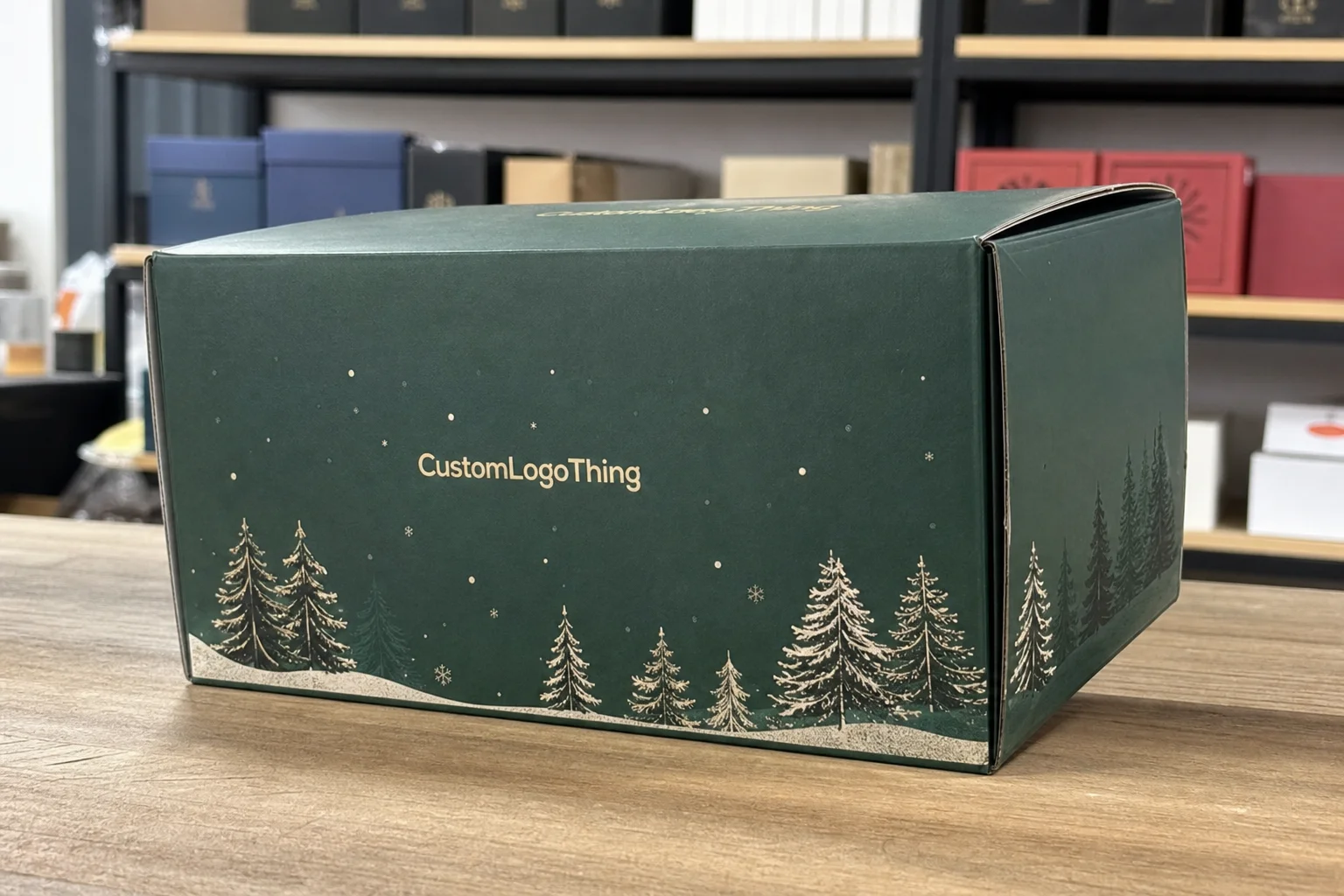
A plain kraft mailer can get a product from point A to point B. A well-designed holiday box can do that too, while also building anticipation, signaling care, and turning a routine delivery into something people want to photograph, gift, or remember. That is why personalized christmas boxes show up so often in boutique retail, subscription programs, corporate gifting, and direct-to-consumer holiday orders.
Personalization does not need to mean full-coverage artwork. It can be as simple as a printed logo with seasonal accents, a metallic stamp, a die-cut window, or a custom insert that holds the product in place. In practice, the strongest results usually come from matching the decoration level to the product value and the kind of experience you want the customer to have.
Common formats include:
- Printed folding cartons for lighter retail items, bakery packaging, and gift sets.
- Mailer boxes for e-commerce shipments that need strength and branding on the same structure.
- Rigid gift boxes for premium presentation, corporate gifting, and high-end cosmetics.
- Sleeve-and-tray styles when a clean reveal and a more gift-like feel matter.
These boxes are used for candles, skincare, specialty foods, apparel accessories, ornaments, and mixed holiday bundles. The right choice depends on product weight, shipping method, display needs, and whether the box should feel elegant, playful, rustic, or traditional.
For buyers comparing seasonal packaging formats, the practical distinction is usually between retail-ready packaging, shipping-grade mailers, and presentation boxes. Those categories look similar from a distance, but they behave differently in production, storage, and transit. A box built to sit on a shelf is not automatically the right box for parcel delivery.
“Holiday packaging works best when the box does three jobs at once: protect the product, support the brand, and make the customer feel the order was prepared with intention.”
How custom holiday box production actually works
Most orders begin with artwork and structural specs, not printing. A supplier needs the box dimensions, product weight, insert requirements, finish preferences, and quantity before a reliable quote can be prepared. Once the structure is confirmed, the process moves into prepress, proofing, and sample approval. That stage can feel routine, but it is where delays often begin if measurements are vague or files are not ready.
Print method matters as well. Offset printing is usually the better fit for higher quantities and tight color consistency. Digital printing is often faster for small runs or test programs because it avoids some of the setup associated with plates. Hot foil stamping adds metallic detail, embossing creates raised texture, UV coating adds shine and protection, and laminate finishes change both appearance and scuff resistance. None of these effects is universally better; each one solves a different packaging problem.
Box style also affects production complexity. Tuck-end cartons are efficient because they can be printed, cut, and shipped flat with relatively simple finishing. Mailer boxes need sturdier board and careful score lines because they are expected to handle parcel transit. Rigid boxes are a different category altogether: they often require wrapped chipboard, specialty equipment, and more hand assembly or semi-manual work.
Interior components matter too. Inserts, trays, dividers, and product locks are often added after the main structure is cut and printed. These details help prevent movement in transit and improve the unboxing sequence. If a product rattles around, the customer notices immediately, even when the exterior graphics look polished.
Before production starts, samples are worth the time. A screen mockup can hide a lot of problems: colors may print darker, folds may land differently, and the fit can feel too tight once the product is actually inside. For that reason, buyers often request a structural sample, a printed proof, or both. If you need to compare box formats, Custom Packaging Products is a useful place to review options and narrow down what makes sense for your item.
For a broader industry reference on packaging formats and material choices, the Packaging Machinery Manufacturers Institute provides useful background on packaging systems and terminology.
Cost and pricing factors buyers should compare
Pricing for personalized christmas boxes usually comes down to a handful of variables, and most of them are visible once you know what to ask for. The biggest drivers are box structure, board thickness, print coverage, finishing complexity, insert count, and quantity. A simple printed folding carton in a large run may be economical, while a rigid box with foil, embossing, and a custom insert can move into a different pricing bracket quickly.
Lower quantities almost always carry a higher unit cost because setup work, press calibration, cutting tools, and prepress time are spread across fewer boxes. Larger runs reduce the unit cost, but they also increase the capital tied up in inventory. That tradeoff is worth thinking through before approving a quantity that looks efficient on paper but sits in storage for months.
Special finishes can add noticeable cost, especially when they are stacked together. Foil stamping, spot UV, soft-touch lamination, and custom die-cuts all require extra processes, extra handling, or both. A buyer comparing two quotes should look past the headline price and compare exact specs line by line. A box quoted as “printed with finish” is not the same as one with a named board grade, a defined coating, and a specific insert style.
Shipping and fulfillment can shift the total project cost too. Flat-packed cartons ship and store more efficiently, while pre-assembled rigid boxes take up more space and often cost more to move. If a warehouse charges by pallet count or cubic storage volume, that difference can matter more than people expect.
For reference, a small run of simple printed cartons may land in a relatively accessible range, while Premium Rigid Boxes with specialty finishing and custom inserts can rise sharply. Exact pricing depends on quantity and spec, but in practice the gap between a basic holiday mailer and a luxury presentation box can be wide enough to change the whole packaging strategy.
| Box option | Typical use | Relative unit cost | Practical notes |
|---|---|---|---|
| Printed folding carton | Light retail items, bakery goods, gift sets | Lower | Efficient for larger quantities; flat-packed for storage |
| Mailer box | E-commerce gifting, subscription shipments | Moderate | Better for shipping durability; branding on exterior and interior |
| Rigid gift box | Premium products, corporate gifts | Higher | Stronger presentation value; more hand assembly and storage space |
| Sleeve-and-tray | Gift sets, specialty retail items | Moderate to higher | Clean reveal; exact sizing matters for fit and movement control |
As a practical buying habit, compare quotes only after verifying the same dimensions, same board spec, same print process, same finishing details, and the same artwork revision allowance. Otherwise, you are not comparing cost; you are comparing different boxes. For shipping durability and transit expectations, the testing guidance from ISTA is useful because it frames packaging around actual distribution conditions rather than appearance alone.
Lead time and production steps for seasonal orders
Holiday packaging is time-sensitive by nature, which means the order clock starts earlier than most buyers expect. A standard printed carton can move fairly quickly once artwork is approved, but once seasonal artwork, insert design, specialty finishes, or rigid construction are added, the schedule tightens. If the boxes need to arrive before peak shipping, planning ahead is the safest move.
A realistic production sequence usually looks like this: quote request, structure confirmation, artwork setup, proofing, sample approval, manufacturing, quality review, and freight booking. Depending on complexity, simple printed folding cartons may take roughly 10–15 business days after proof approval, while rigid Boxes with Custom inserts can take longer, especially if hand assembly is involved. Freight time is separate and should never be treated as an afterthought.
Several things can slow the schedule down. Artwork revisions are a common one. Missing dieline measurements are another. Color corrections can also add time, especially if brand colors have to be matched closely. Then there are material constraints: paperboard, specialty coatings, and foil stock can all affect availability during busy seasonal periods.
Buyers who keep the process moving usually do a few things early. They lock the box style and dimensions before artwork is finalized. They approve the dieline before design is locked. They review a sample or proof with the actual product if possible. And they release production only when quantity, finish, and delivery date are written down clearly.
- Lock the box style and dimensions first.
- Approve the artwork only after the dieline is confirmed.
- Review a sample or proof with the actual product if possible.
- Release production only when quantity, finish, and delivery date are all written down.
- Book shipping with enough buffer for transit delays and warehouse receiving time.
The biggest trap is treating holiday packaging as a last-minute add-on. If the boxes are late, inventory may be ready but not shippable, and that creates a bottleneck right when sales should be peaking. For packaging buyers, that is usually the part that hurts the most.
Choosing the right structure, material, and finish
The right material depends on both the product and the story the package needs to tell. SBS paperboard is common for crisp printed cartons and retail presentation. Corrugated board adds strength for shipping and heavier products. Kraft board gives a natural, earthy look that fits rustic or eco-minded branding. Rigid chipboard is the premium option when presentation matters as much as protection.
Product weight is the first filter. If the item is fragile, heavier, or being shipped through parcel networks, stronger board and a more protective structure make sense. If the item is light and meant for shelf display, print quality and finish usually become the priority. That is one reason personalized christmas boxes vary so much: a bakery box, a candle mailer, and a luxury gift box each solve a different packaging problem.
Finish choice changes the mood quickly. Gloss looks bright and lively, matte feels cleaner and more understated, soft-touch creates a velvety premium feel, and kraft reads warmer and more natural. Seasonal artwork also behaves differently on each surface. Bright reds and metallic accents pop on coated board, while minimalist designs often look better on matte or kraft substrates.
Brand goal should guide the decision. A retail brand may want bold shelf impact. A subscription company may care more about the unboxing reveal. A corporate gift program often wants a premium, restrained look that feels polished without being flashy. There is no universal best finish; there is only the finish that fits the message and the budget.
Closure style and insert design matter as much as the exterior. Magnetic closures, tuck flaps, sleeves, and lift-off lids all create different experiences. Inserts and partitions keep items stable, especially if the box contains multiple pieces. A good interior is not decorative fluff; it is what keeps the package looking intentional when the customer opens it.
There are also practical limits that buyers should keep in view. Deep embossing, heavy foil coverage, and multi-piece inserts can add cost and complicate assembly. Very dark inks on uncoated stock may show scuffing sooner. Soft-touch lamination feels premium, but it can mark more easily than some harder coatings. Those tradeoffs are manageable, yet they are real.
Step-by-step ordering process for personalized christmas boxes
The easiest way to order personalized christmas boxes is to start with the product, not the artwork. Measure the item accurately, decide how it will ship, and define the presentation style you want. That prevents the common mistake of designing a beautiful box that does not quite fit the product or the fulfillment flow.
Next, gather artwork assets early. A vector logo file is usually the best starting point because it scales cleanly and prints sharply. Then confirm the dieline, bleed, and safe area before proofing begins. If the seasonal graphics sit too close to a fold or trim line, production can expose the problem fast.
Once you have a proof or sample, review it in context. Put the actual product or insert inside. Check the colors under normal light, not just on a screen. Confirm that the typography is legible and the seasonal artwork still looks balanced after folding. Small errors can become expensive once the run starts.
Before approving production, make sure these points are written down:
- Exact box dimensions and board grade
- Print method and finish details
- Insert or divider requirements
- Quantity and over/under tolerance
- Carton pack configuration and shipping terms
- Required delivery date and receiving location
If you need a cleaner path through procurement, ask for a quote that separates structure, print, finishing, and freight. That makes it easier to compare options and spot hidden cost drivers. It also reduces the odds of signing off on a price that looks fine until the finishing details are added back in.
Practical quality-control checks should not be skipped. Buyers often ask for board samples to judge stiffness, request a printed proof to check color, and confirm that glue areas and folds do not interfere with branding or inserts. A one-piece mockup can reveal a fit issue that no screen rendering will show.
Common mistakes that raise costs or delay delivery
The first mistake is ordering too late. Holiday schedules compress quickly, and once proofing, sampling, production, and shipping are all stacked together, there is less margin than people think. A week lost in artwork approval can become two weeks lost at the end of the project.
The second mistake is choosing a box before confirming the product size. That usually leads to wasted board, awkward inserts, or a box that looks oversized on arrival. The third is overcomplicating the decoration. Too many finishes, too many revisions, or too many special elements can raise cost and slow the run without improving the package in any meaningful way.
Color expectations can also cause trouble. If the brand expects one shade of red and the press delivers another, somebody is unhappy. The fix is simple: establish the target carefully, ask how color will be controlled, and request a sample or proof before the full run. The same is true for retail display and shipping strength. A box designed for shelf presentation is not automatically strong enough for parcel transit, and a durable mailer may not feel premium enough for gifting.
Finally, do not forget the use case. A box meant for direct mail needs different performance than a box sitting on a shelf or handed across a counter. That distinction affects board choice, closure design, and even how much decoration is smart to include.
There is also a production-side issue that gets overlooked: design files that look clean on screen can still create trouble if the panels are mislabeled or the die line is not current. Every revision should be checked against the final template. That small habit prevents expensive rework.
Expert next steps for a smoother holiday packaging order
If you are getting Ready to Order personalized christmas boxes, the best next step is to tighten your brief before requesting a quote. Measure the product. Decide what kind of unboxing moment you want. Set a quantity range. Gather logo files, seasonal artwork, and any brand color references. Those moves save time later and make supplier conversations much clearer.
Then ask for a quote with exact dimensions, structure, material, finish, insert details, and delivery expectations. Vague pricing rarely helps anyone. Clear specs do. If the program is important, request a sample, proof, or mockup before production approval so you can review the box in context, not just on a screen.
It also helps to plan packaging inventory alongside holiday sales, rather than treating it as a last-minute accessory to the product. Boxes are part of the sellable experience. If they arrive late, the rest of the operation feels late too. If they arrive on time and fit well, they support the whole season quietly and effectively.
From a buyer’s point of view, the strongest results come when structure, print, and timing are handled together from the beginning. That is the practical path with personalized christmas boxes: Choose the Right build, confirm the details early, and give production enough runway to do the job properly.
A final check on expectations is useful before placing the order. Ask whether the run needs a small safety buffer for spoilage, damage, or packing mistakes. For seasonal packaging, that buffer is often cheaper than rushing a second order later.
How much do personalized christmas boxes usually cost per unit?
Unit cost depends on box style, size, quantity, print coverage, and finishing choices. Smaller runs usually cost more per box because setup costs are spread across fewer units. Specialty effects like foil, embossing, or custom inserts raise the price, but they can also improve the perceived value of the package.
What is the typical turnaround time for personalized christmas boxes?
Turnaround depends on proofing speed, quantity, material availability, and finishing complexity. Simple Printed Folding Cartons can move faster than rigid boxes or custom insert programs. For holiday orders, it is smarter to start early so there is enough time for artwork approval, production, and shipping.
Can I order personalized christmas boxes in a small quantity?
Yes, many box styles can be produced in short runs, especially with digital printing. Small quantities work well for test launches, boutique gift programs, or limited seasonal promotions. The tradeoff is usually a higher unit cost because setup is divided across fewer boxes.
What file or artwork setup do I need for custom holiday boxes?
You usually need a logo file, artwork for the panels, and a dieline or box template. Vector files are preferred when possible because they keep branding crisp at any size. It also helps to confirm bleed, safe area, and any special finish callouts before proofing begins.
Which box style is best for shipping holiday gifts?
Mailer boxes and corrugated styles are strong choices for direct shipping because they handle transit better. Rigid boxes work well for premium gifting, especially when presentation matters as much as protection. The best choice depends on product weight, fragility, and whether the box will travel through parcel networks.


