Buyer Fit Snapshot
| Best fit | Personalized Packaging for Retail projects where brand print, material claims, artwork control, MOQ, and repeat-order consistency need to be specified before quoting. |
|---|---|
| Quote inputs | Share finished size, material target, print colors, finish, packing count, annual reorder estimate, ship-to region, and any compliance wording. |
| Proofing check | Approve dieline scale, logo placement, barcode or warning zones, color tolerance, closure strength, and carton packing before bulk production. |
| Main risk | Vague material claims, crowded artwork, missing packing details, or unclear freight terms can make a low unit price expensive after revisions. |
Fast answer: Personalized Packaging for Retail: Quote Scope, Sample Proof, MOQ, and Lead Time should be specified like a repeatable production item. The safest quote records material, print method, finish, artwork proof, packing count, and reorder notes in one written spec.
Production checks before approval
Compare the actual filled-product size with the drawing, then confirm tolerance on folds, seals, hang holes, label areas, and retail display edges. Reserve space for logos, QR codes, warning copy, and material claims before decorative graphics fill the panel.
Quote comparison points
Review material grade, print process, finish, sampling route, tooling charges, carton quantity, and freight assumptions side by side. A quote is only useful when the supplier can repeat the same color, closure quality, and packing count on the next order.
Personalized Packaging for Retail: A Practical Guide
If you sell through stores instead of only through a checkout page, Personalized Packaging for Retail can move a product out of the crowded middle and into the small set buyers remember after one pass down the aisle. I once watched a buying team compare two nearly identical cartons at a table in Chicago; the difference was a $0.19 insert and a 6 mm shift in copy hierarchy. The plain version looked forgettable. The personalized version looked deliberate, and that changed the conversation in under 20 seconds.
What Personalized Packaging for Retail Actually Means
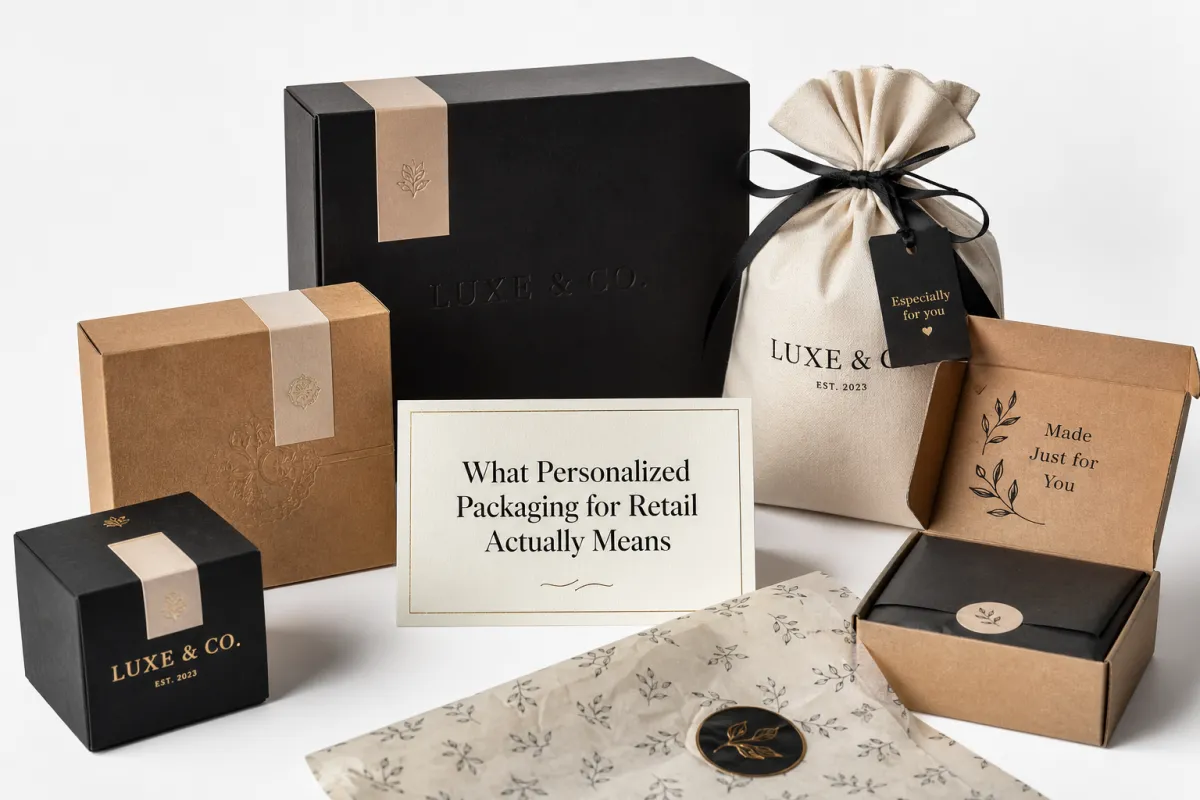
Personalized Packaging for Retail means the package is built for a specific store format, product line, audience, or seasonal campaign rather than pulled from a generic catalog and dressed up with a logo. I have watched a line of $14 skincare jars move from "fine" to "I can place this" just because the box size, copy order, and finish matched the shelf plan and the buyer's expectations in a store sample room in Dallas. That is personalized packaging for retail doing actual work, not just adding decoration to cardboard.
People often confuse personalization with surface-level branding, and that confusion makes sense because a logo and a smart palette are the easiest things to notice. But personalized packaging for retail is also about fit, messaging, unboxing flow, and merchandising logic. If a package must hang on a peg, fit a 38 mm bottle, and survive a 1.2 meter drop from a warehouse cart, the design has to solve those details first. A nice PDF is useful; a carton that survives a Tulsa stockroom is better.
Retail buyers judge packaging quickly, usually in 5 to 8 seconds, which is not much time if your panel is crowded with claims. That tiny window is why I keep telling teams that the package has to make the category obvious, create hierarchy on shelf, and avoid the generic look that disappears beside louder competitors. Personalized packaging for retail matters because it can signal premium, practical, playful, or eco-conscious before a shopper even touches the item. On a 1.2 meter shelf bay in Sydney, that first read can decide whether a product gets a second glance.
At a buyer meeting in Shenzhen, I once watched a merchant pick up a sample tray, flip it over, and say, "This looks like it was designed by somebody who has actually stood in a store aisle." That was not praise for luxury. It was praise for the details: a 24pt SBS folding carton, a barcode panel that stayed clean, and a tuck that opened without shredding the edge. Those ordinary choices are often where personalized packaging for retail is won or lost, especially when the line has to move through a 3,000-unit test run before a 30,000-unit order.
You can also scale it in different directions. Personalized packaging for retail might mean a printed sleeve over stock packaging, a custom insert for one hero SKU, a fully custom structural box, or a branded shipper that can go from warehouse to shelf without extra repacking. For many brands, the smartest move is a phased rollout: one SKU, one size family, one finish, then a second run after 12 to 15 business days of real sell-through data. That keeps waste down and gives you room to learn before you order 20,000 pieces and then regret the font size.
How Does Personalized Packaging for Retail Work?
How does personalized packaging for retail work in practice? It starts with a clean brief, then moves through structure, artwork, sampling, approval, production, and delivery. The process is more orderly than most teams expect, but only if the inputs are precise. If somebody skips the sample stage, they are betting that a computer screen understands gravity, and gravity does not care about optimism or a 4 p.m. deadline.
Before anyone opens Illustrator, the brand data matters. SKU count, retail format, hanging or shelf placement, carton master case size, and replenishment style all shape the structure. A 250 ml lotion bottle does not need the same packaging decisions as a 75 g soap bar, and a club store in Atlanta does not behave like a boutique in Milan. Personalized packaging for retail works best when the packaging design starts with operations, not only art direction. I have seen beautiful concepts collapse the second somebody asks, "How do we pack 4,800 units without creating overtime?"
There are more customization choices than most teams expect. You can change print finish, board grade, closures, labels, window cutouts, inserts, sleeves, tear strips, and localized messaging. In personalized packaging for retail, those choices are not random extras. A matte aqueous coating can reduce glare under store lighting, while a 350gsm C1S artboard may give enough stiffness for a premium folding carton without pushing the unit price out of range. That balance, not flash, is where a decent package becomes a smarter one.
I tell clients to think in two lanes at once. The first lane is branding: color, type, hierarchy, and package branding. The second lane is operations: stackability, case pack efficiency, barcode placement, and how fast a store associate can open and restock the item. Personalized packaging for retail fails when one lane wins and the other gets ignored. Pretty boxes that slow fulfillment are not a win; they are an invoice with good lighting, and the warehouse in Ningbo will still charge the labor hours.
Samples matter more than people want to admit. A mockup can look sharp on a laptop and still fail in a real aisle because the gloss is too reflective, the cutout is too small, or the insert is 2 mm off and rattles the product. In personalized packaging for retail, I have seen one bad tab design turn a 12-minute packing job into a 19-minute headache. That kind of drag shows up in labor cost fast, and it shows up in tempers even faster, especially on a Friday shift in Dongguan.
Key Factors That Shape Design, Materials, and Brand Fit
The first thing I ask about personalized packaging for retail is not the logo file. It is the product. How fragile is it? What is the shelf footprint? Does it need a hang hole, a tamper seal, or a barcode on the back panel? If a package has to survive ship-to-store handling, then a 32 E-flute corrugated build may make more sense than a soft folding carton, even if the folding carton looks prettier in the mockup. Pretty does not pay for broken inventory in a St. Louis replenishment cycle.
Materials send signals. SBS board says clean and commercial. Kraft says natural and a little less polished. Rigid board says higher value and more weight in the hand. Corrugate says protection and transport efficiency. Recycled paperboard can support sustainability claims, but only if the print and coating still hold up under retail lighting for a 90-day promo. Personalized packaging for retail needs the right material story, because buyers notice when the box language fights the product price. I have seen a $22 candle wrapped like a bargain cereal box, and the mismatch was almost painful.
Color and typography matter differently on shelf than they do in direct-to-consumer parcels. A mailer can spend 3 seconds on an unboxing reveal. Retail packaging has maybe 1 second from six feet away. That means contrast, hierarchy, and size matter more than decorative clutter. In personalized packaging for retail, I prefer a strong product name, a clean benefit line, and one finishing cue that does a job, such as a spot UV callout or a foil accent on a premium line. The package should speak plainly, not whisper vague brand poetry into the aisle in Kansas City or Kyoto.
Compliance sits in the background, which is exactly why it gets ignored until it causes trouble. Retail-ready packaging has to work with labeling rules, distribution testing, and store replenishment habits. If you need transit validation, I lean on standards from ISTA and ask for the actual test profile, not a vague "ship safe" promise. For sustainability claims and sourcing discipline, I also look at FSC chain-of-custody expectations instead of letting marketing invent a green halo out of thin air. Personalized packaging for retail gets easier when the rules are clear, and a lot less annoying too.
One thing most teams underestimate is brand fit across product categories. Premium beauty can tolerate a rigid box with 1.5 mm board and soft-touch lamination. Toys may need bright graphics, a window, and more hanger support. Apparel often needs a sleeve, hang tag, or rigid mailer depending on channel. Home goods may need more protection than polish. The same personalized packaging for retail approach will not work across all four, no matter how nice the render looks on the screen. The render is not the shelf, and the shelf in Toronto has less patience than the design review.
"It looks nice on a deck, but the aisle sees a cardboard afterthought." That was a retail buyer's line after rejecting six mockups in a Minneapolis review, and she was right. Personalized packaging for retail has to survive the store, not just the presentation board.
If you want a practical benchmark for carton language and packaging engineering terms, the resources at Packaging Machinery Manufacturers Institute are useful for teams that need to speak the same technical language before they send a PO. The cleaner the spec sheet, the fewer surprises in production. Personalized packaging for retail is easier when the buyer, brand, and supplier are all looking at the same 24pt, 350gsm, or 1.5 mm number instead of three different interpretations of "sturdy." A supplier in Guangzhou will quote faster when the spec is unambiguous.
Personalized Packaging for Retail Cost and Pricing
Money is the part people try to smooth over, which is usually a mistake. Personalized packaging for retail cost depends on size, substrate, print coverage, finish count, inserts, structural complexity, and order quantity. A simple printed sleeve might land at $0.12 to $0.28 per unit on a 5,000-piece run, while a rigid box with an insert can jump to $1.10 to $2.90 per unit depending on the board and finishing stack. That spread is why I ask for specs before I quote anything.
The pricing stack usually includes setup, tooling, sample rounds, unit production, freight, duties, and warehouse handling. A quote that looks low by $0.08 a unit can become the expensive one if it carries a $350 die charge, a $120 sampling fee, and a pallet freight bill that nobody mentioned in the first call. Personalized packaging for retail needs landed cost thinking, not just unit price thinking. Procurement people love to stare at the printed number and ignore the ship dock in Los Angeles or Rotterdam. Cute, but useless.
| Packaging Option | Typical Run | Illustrative Unit Cost | Best Use Case | Notes |
|---|---|---|---|---|
| Printed sleeve over stock pack | 3,000 to 10,000 units | $0.10 to $0.30 | Fast brand refresh or seasonal campaign | Low tooling, good for personalized packaging for retail with tight budgets |
| Custom folding carton | 5,000 to 20,000 units | $0.22 to $0.65 | Shelf-ready product packaging | Strong balance of print impact and line efficiency |
| Rigid box with insert | 1,000 to 5,000 units | $1.10 to $2.90 | Premium beauty, gifts, or high-value kits | Higher labor and board cost, but strong perceived value |
| Corrugated retail shipper | 2,500 to 10,000 units | $0.85 to $2.20 | Ship-to-store or display-ready packaging | Useful when transport protection matters as much as shelf appeal |
There is a trap here: low unit price can hide a high total cost. If the package causes 2% product damage, takes 18 extra seconds to assemble, or forces a second packing step, the savings evaporate fast. I have sat through a supplier negotiation where one plant tried to shave the carton price by $0.03, then added 7 business days because the lamination film had to come from a warehouse in Suzhou. That is not efficiency. That is a paper cut with a spreadsheet.
Real savings show up in the boring places. Fewer inks. Cleaner dielines. Standardized inserts. A finish that looks premium without requiring a metalized film plus a second pass. Even a decision like choosing a matte aqueous coating instead of soft-touch can save $0.04 to $0.09 per unit on larger runs. Personalized packaging for retail does not need every luxury option. It needs the right 2 or 3 choices that earn their keep. Spend where shoppers can see and feel the value, not where the sales deck gets a dramatic slide.
Step-by-Step Timeline: From Brief to Shelf
Personalized packaging for retail moves fastest when the brief is complete on day one. I want product dimensions, weight, fill material, SKU count, shelf life, target channel, budget, and launch date before anyone starts drawing. If I only get "we need boxes," the project is already late. A good brief cuts a week of back-and-forth and saves everybody from pretending certainty exists when it absolutely does not, especially when the factory in Xiamen is waiting on approvals.
The sample stage is where the truth shows up. First comes the dieline. Then artwork proofing. Then a structural prototype or digital mockup. Then a physical sample. For personalized packaging for retail, I usually expect 3 to 5 business days for a basic sample and 7 to 10 business days for a more complex structure, assuming the artwork is not changing every afternoon. The sample is not a formality. It is the first lie detector, and it does not care how nice the brand deck looked.
Production timing depends on complexity. A simple one-color sleeve can sometimes ship in 12 to 15 business days after proof approval. A Custom Folding Carton with foil, embossing, and multiple insert pieces may take 18 to 25 business days. Rigid boxes tend to take longer because of handwork and glue staging. Personalized packaging for retail is rarely delayed by printing alone. It is usually delayed by somebody deciding that the finish should change after the proof has already been signed. I have watched that movie in a plant near Foshan, and it is not a good one.
One afternoon in a Dongguan plant, I watched a line stop for 42 minutes because a client changed the insert pocket from 17 mm to 19 mm after samples were approved. That tiny adjustment meant the product sat too loosely and failed a drop check. Personalization is useful, but it still obeys physics. Personalized packaging for retail has to be designed with the actual product inside, not a fantasy version of it. The product is what pays the bills, not the sketch on the whiteboard.
Build buffer time into the calendar. If your launch date is fixed, give the project at least 10 extra days for revisions, freight delays, and one round of panic from somebody's boss. I have seen a 4-week plan become a 6-week rescue because approval was assumed instead of scheduled. Personalized packaging for retail is easier when everybody agrees that revisions are part of the process, not a personal attack. That agreement alone can save a surprising amount of emotional damage and at least one emergency call at 8:40 p.m.
Common Mistakes Retailers Make with Custom Packaging
The biggest mistake is overdesign. Too many finishes, too many messages, too many panel changes. Suddenly the package costs more, prints slower, and confuses shoppers. A beauty brand once tried to put 11 claims on one carton panel; the shopper needed a map. Personalized packaging for retail works better when each side has one job and does it well. That sounds simple, but simplicity becomes hard fast when six people have comments and all of them want one more badge.
Another mistake is ignoring the retail environment. Store lights flatten some colors and make others look dirty. Shelf height changes readability. Competitor packs crowd the view. If your item sits at ankle level, a 7 pt subtitle is useless. If it hangs on a pegboard, the top third of the box needs to do the selling. Personalized packaging for retail should be judged from 6 feet away, not from a PDF zoomed to 300%. I have a mild rage reaction to people approving color based on a laptop under office fluorescents, which is nearly the worst possible test.
Chasing the lowest quote is the classic budget sin. I have seen teams save $600 on tooling and then spend $2,400 on rush freight because the supplier was 11 days late. Another time, a company picked the cheapest carton but skipped the sample round, then lost 3% of units to crushed corners. Personalized packaging for retail is not cheap if it creates damage, labor waste, or a weak first impression. Cheap is sometimes just expensive with better marketing, usually after the pallet has already landed in Newark.
Internal alignment matters more than people admit. Marketing wants beauty. Operations wants speed. Procurement wants savings. Retail wants consistency. If those four groups never sit in the same room, the package gets sanded down into something nobody loves and nobody can defend. I have watched a 28pt SBS carton turn into a generic white box because everyone compromised too early. Personalized packaging for retail should not feel like a surrender document. It should feel like a decision, not a ceasefire signed under fluorescent lights.
Skipping a test run is asking for trouble. Test the closure. Test the insert. Test the box in a shipper. Test how the stock team opens 50 units in a row. If there is a window cutout or tear strip, test that too. I prefer a sample run of 100 to 200 units before a full launch, because that is enough to catch the stupid mistakes without burning the whole budget. Personalized packaging for retail becomes dependable only after it survives real handling. Real handling is messy, which is annoying, but it is also the truth.
Expert Tips and Next Steps for a Retail Rollout
Start with one hero SKU. That is my blunt advice. Do not try to customize 18 products at once unless you enjoy chaos and extra freight invoices. Pick the line that already sells, then use personalized packaging for retail to improve shelf lift, perceived value, or basket size. One focused rollout tells you more than a messy full-family launch ever will, and it gives you a cleaner story when you report back to the team in a 15-minute review.
Ask for a sample kit and compare it against competitors on an actual shelf, not on a conference table. Put your box next to two direct rivals and check read distance at 4 feet, 6 feet, and 8 feet. Then check how the package opens with gloves, because that happens in warehouses more than brand teams want to admit. Personalized packaging for retail should win in context, not in isolation. The store is the judge, not the deck, and the store in Phoenix will not care how elegant your slide looks.
Build a simple scorecard. I like landed cost, shelf impact, damage rate, and assembly time. Four numbers. No drama. A package that looks great but adds 12 seconds per unit may still be worth it for a premium line, but you should know exactly why. Personalized packaging for retail gets much easier to defend when you can show the math instead of waving at a mood board. Math is less romantic, sure, but it is also less likely to embarrass you in a review meeting.
Before anyone debates foil or spot UV, ask the supplier for three things: a dieline, a material spec, and a timeline. That is it. Guessing is not a strategy, and "we can probably do it" is not a production plan. If you need a starting point, browse Custom Packaging Products and narrow the options by board type, finish, and order size. Personalized packaging for retail works better when the first conversation is about fit, not fantasy. I would rather see a practical spec sheet than a heroic idea that collapses in manufacturing.
My honest take: the strongest projects keep the structure simple and spend the budget where shoppers can actually feel it. A clean 350gsm carton with one smart finish can outperform a bloated premium box that cost twice as much. If you are building personalized packaging for retail for Custom Logo Things, audit one product line, measure everything twice, request two sample options, and then pick the version that wins on numbers and shelf presence. That is personalized packaging for retail done like a grown-up, with enough restraint to keep the ops team from glaring at you across the table.
FAQs
How much does personalized packaging for retail usually cost per unit?
Cost depends on size, material, print coverage, finishes, and order volume, so there is no honest one-price answer. A simple printed sleeve might land near $0.10 to $0.30 at scale, while a rigid box with inserts can run from $1.10 to $2.90 depending on labor and board choice. Always compare landed cost, not just the factory number, because freight and setup fees change the real total for personalized packaging for retail. A 5,000-piece order in Guangdong can look cheap until the carton gets to the warehouse and the bill includes truck freight, pallet wrap, and a $75 receiving charge.
What is the difference between personalized packaging and standard retail packaging?
Standard retail packaging usually uses a common structure and a generic graphic layout, while personalized packaging for retail is built around one brand, one product line, or one campaign goal. Personalization can mean a custom size, localized messaging, a branded insert, or a finish that better matches the shelf environment. The point is not decoration for its own sake. It is to improve brand recognition, product packaging performance, and store-level clarity. In a chain with 300 locations, the right carton can make the same item feel like a $12 product instead of a $9 one.
How long does personalized packaging for retail take to produce?
Simple projects can move quickly if the artwork is ready and the structure is already approved. More complex work takes longer because sample rounds, special finishes, and distribution checks all need review before mass production starts. A practical timeline is 3 to 5 business days for a sample, 12 to 15 business days for a simple run after proof approval, and 18 to 25 business days for more complex Custom Printed Boxes. Add buffer time if your team likes to "just tweak one more thing" three days before sign-off.
What materials work best for personalized retail packaging?
Paperboard works well for lightweight retail items, corrugated board handles more protection and shipping stress, and rigid board creates a premium feel for higher-value products. The right choice depends on shelf presence, product fragility, sustainability targets, and budget. If the item needs a stronger hand feel and better structural support, I usually start with 24pt SBS, 32 E-flute, or 1.5 mm rigid board and refine from there. Material choice is one of those decisions that sounds technical because it is technical, especially when the line ships from a factory in Suzhou or Dongguan.
Can small retailers use personalized packaging without huge minimum orders?
Yes, but the tradeoff is usually a higher unit price because smaller runs do not get the same scale savings. A smart approach is to start with one SKU, one seasonal run, or one design family instead of customizing every product at once. Ask suppliers about short-run digital printing, modular structures, or hybrid solutions so you can test personalized packaging for retail without getting buried in inventory. That is the smartest way to start personalized packaging for retail, and it keeps the experiment manageable enough that you can actually learn from it.


